AI Research Intern: Your Guide to Landing a Top Role

You open an internship posting, see AI Research Intern, and immediately realize this isn't the same as a normal student engineering role. The description talks about experiments, papers, model behavior, and mentorship from senior researchers. If you want one of these jobs, especially in Web3, you can't rely on a generic ML resume and a few class projects.
Hiring teams treat this role as a pipeline. They're looking for people who can grow into research engineers, applied scientists, or full researchers. In the private market, the upside is obvious. Vatic Labs lists a weekly base salary of $3,000 to $4,500 for its AI Research Internship on a page referenced by Microsoft Research opportunities. That tells you two things. These roles are selective, and companies are willing to pay for rare talent.
In Web3, the bar is often even stranger than it looks from the outside. You need enough AI depth to reason about models and experiments, plus enough protocol intuition to understand on-chain behavior, adversarial incentives, and messy decentralized data. That combination gets noticed because it's still uncommon. If you want to scan live openings that sit near this crossover, the most relevant starting point is the AI and machine learning roles in Web3.
The Modern AI Research Intern Opportunity
The modern AI research intern role is closer to an apprenticeship than a student coding job. The best teams don't bring interns in to clean datasets for a quarter and disappear. They use internships to test whether someone can join a real research loop: read thoroughly, ask a precise question, build a method, run experiments, and explain what the results mean.
That matters in blockchain companies because the work is rarely “just AI.” A strong intern might analyze validator behavior, model fraud patterns in NFT markets, evaluate agent systems for governance tooling, or build language tools around smart contracts and protocol docs. The underlying expectation is the same. You're there to generate insight, not just output.
Why these roles matter for career progression
A research internship changes the shape of your next few years if you use it well. It can lead to a thesis topic, publication work, a return offer, or a shift into a more research-heavy full-time role. For candidates who want to stay technical but not get boxed into routine implementation work, this is often the cleanest way in.
In hiring, I look at these internships differently from general software internships. A software intern usually proves execution against known requirements. A research intern proves they can handle ambiguity without collapsing into random experimentation.
Practical rule: If your application reads like “I built features,” you'll blend in. If it reads like “I investigated a technical question and can defend my methodology,” you'll get more serious attention.
Why Web3 companies care
Web3 companies don't only need protocol engineers. They also need people who can work on ranking, anomaly detection, agent tooling, developer copilots, governance analytics, and data products built on noisy on-chain events. Those problems are hard to solve with off-the-shelf templates.
The candidates who stand out usually show one of two profiles:
- Research-first applicants who learned enough crypto infrastructure to apply their methods well.
- Crypto-native builders who learned enough ML to frame protocol or market problems in a researchable way.
Both can work. What doesn't work is being vague about both sides.
What an AI Research Intern Actually Does
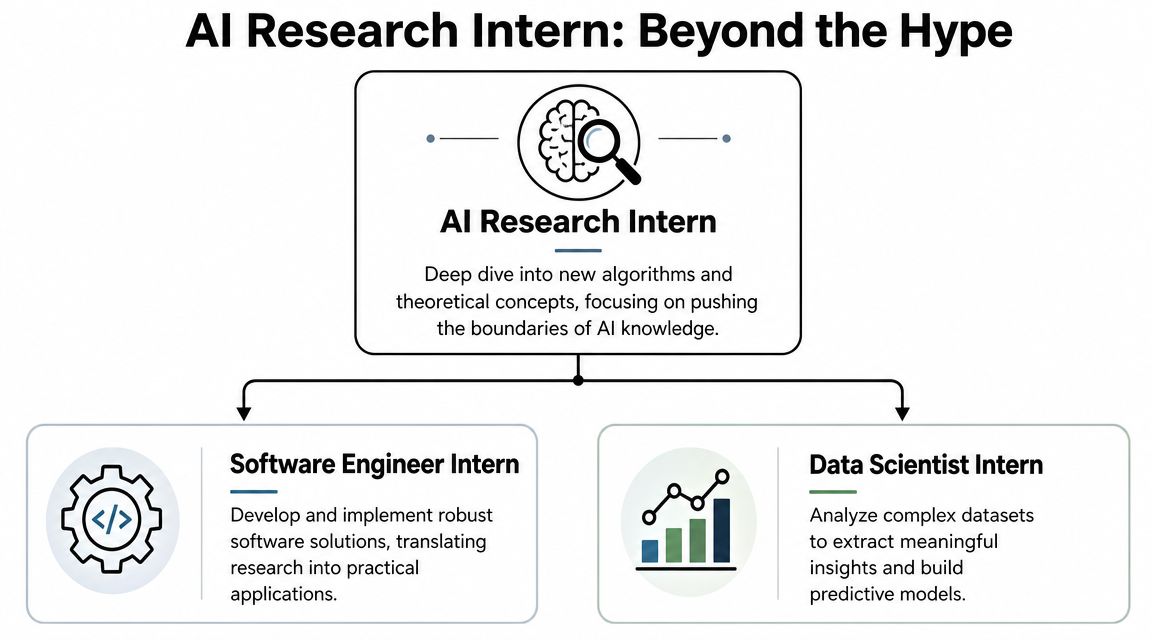
An AI research intern works like a junior investigator. The job is to help answer a technical question that doesn't already have a settled answer. That's the core difference.
A software engineering intern is usually the builder. A data scientist intern is often the analyst. The research intern is closer to the architect who tests whether a new blueprint is even worth building.
The day-to-day work
On strong teams, the work usually includes some mix of these tasks:
- Reading papers closely so you understand prior methods, baselines, assumptions, and open gaps.
- Forming hypotheses such as whether a modeling choice, training setup, or data representation should improve a specific result.
- Designing experiments with controls, evaluation criteria, and enough rigor that someone else can reproduce what you did.
- Building prototypes in Python, usually with research tooling rather than polished production systems.
- Writing clearly so your mentor or team can inspect not just the result, but the reasoning behind it.
That last part matters more than most applicants realize. Research teams don't trust unexplained wins. If you can't explain why a result happened, they assume you got lucky or measured the wrong thing.
What success looks like
The strongest employers signal that these internships are research-facing. Ai2 says interns are paired with a mentor, work directly on its research, and there are no publication restrictions, while Vector emphasizes research internships that bridge academic theory and real-world application on Vector Institute's AI research internship page. That's a useful benchmark for understanding the role. Good internships often aim toward outputs such as papers, benchmarks, or reproducibility artifacts.
In practice, I'd separate outputs into two buckets:
| Output Type | What it shows | Why hiring teams care |
|---|---|---|
| Research artifact | Experiment logs, benchmark reports, ablation notes, technical writeups | You can reason and document rigorously |
| Engineering artifact | Code, pipelines, evaluation scripts, demos | You can turn ideas into usable systems |
Candidates often overweight the second bucket. For research hiring, the first bucket is usually the differentiator.
Most rejected applicants can code. Fewer can explain a failed experiment without hand-waving.
How this differs from applied ML
Applied ML internships usually ask, “Can you improve a product metric with models?” Research internships ask, “Can you investigate whether this approach is valid, novel, or useful?” There's overlap, but the mindset is different.
In Web3, that gap is even sharper. Applied work might ship a classifier into a wallet risk engine. Research work might ask whether graph structure, transaction sequencing, and entity clustering produce a better representation for fraud detection in the first place.
Essential Skills That Get You Hired
Most applicants list too many tools and not enough evidence of depth. For an AI research intern role, breadth is fine, but foundations win interviews. If you don't have strong mathematical intuition, experimental discipline, and clean implementation habits, the rest won't rescue you.
Many roles now require advanced quantitative training. Workonward's AI intern description lists core requirements in Python, AI/ML libraries, and strong math in statistics, linear algebra, and calculus. At a higher level, CHAI at UC Berkeley requires candidates to have, or be about to obtain, a PhD in a relevant technical discipline for its research fellowships, as described in Workonward's AI intern overview. You shouldn't read that as “undergrads can't compete.” You should read it as a warning that serious research roles often benchmark you against people with deep training.
Core competencies for AI research interns
| Skill Category | Essential Skills | Why It's Critical |
|---|---|---|
| Programming | Python, experiment scripting, debugging, version control | Research speed depends on your ability to test ideas without breaking your pipeline |
| ML frameworks | PyTorch, TensorFlow, model training workflows | You need to implement baselines, modify architectures, and run controlled experiments |
| Mathematics | Statistics, linear algebra, calculus | These are the tools behind optimization, model behavior, uncertainty, and evaluation |
| Research process | Literature review, hypothesis design, ablations, reproducibility | This is what separates research from random tinkering |
| Communication | Technical writing, presenting results, documenting failures | Teams hire people who can explain what happened and what should happen next |
| Autonomy | Scoping work, asking sharp questions, handling ambiguity | Mentors want interns who can move independently without drifting |
What hiring managers actually notice
I care less about whether you know ten libraries and more about whether you've used one stack well. A candidate who can defend a PyTorch experiment, explain gradient behavior, and show a careful evaluation setup is stronger than someone who throws every buzzword onto the page.
For Web3-focused roles, I also watch for domain fluency in the way people talk about problems. If you've worked with wallet labels, smart contract events, subgraphs, mempool data, governance proposals, or token flow analysis, say that plainly. Don't hide it under generic “alternative datasets.”
A useful way to sharpen your workflow is to study how other researchers structure searches, notes, and synthesis. If you want a practical roundup, top AI solutions for researchers is a decent resource for thinking about tools that support literature review and research organization.
Skills that matter more in Web3 than applicants expect
- Adversarial thinking: Many on-chain systems are noisy because participants are strategic, not because your data is bad.
- Data skepticism: Labels are often weak proxies. Wallet ownership, entity resolution, and sybil behavior create ambiguity.
- Systems awareness: If your model depends on unrealistic assumptions about block timing, contract upgrades, or protocol mechanics, it won't survive review.
- Clear writing for mixed audiences: You may need to explain a model result to researchers, protocol engineers, and product leads in the same meeting.
Building a Portfolio for a Research Role
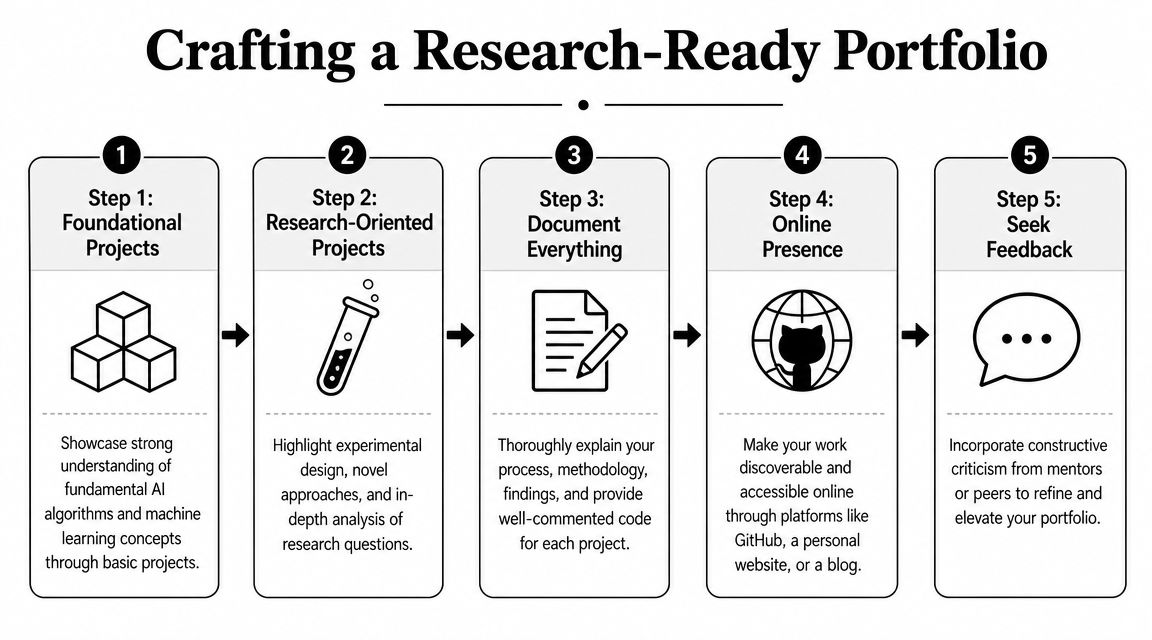
A research portfolio shouldn't look like a trophy shelf. It should look like evidence. I want to see how you choose a question, how you test it, and how you communicate the result.
Generic Kaggle-style projects can still teach useful habits, but they rarely tell me whether you can do research in a Web3 environment. Strong portfolios narrow in on a question that matters to a real system and then document the investigation well.
Projects that signal research potential
These are the kinds of portfolio projects that get my attention:
- NFT wash trading detection: Build a graph-based or sequence-aware model for suspicious trading patterns. The key isn't only classification. The key is whether you define labels carefully and explain false positives.
- DeFi protocol risk analysis: Model liquidation patterns, liquidity stress, or borrower behavior from on-chain events. Strong work shows feature reasoning, not just a dashboard.
- LLM for smart contract explanation: Build a system that summarizes contract behavior, identifies function intent, or maps risks from source code and ABI data. You'll stand out if you evaluate factuality instead of only demo quality.
- Governance proposal clustering: Use NLP to group proposals, surface themes, or detect shifts in governance language across DAOs.
- Wallet entity research: Investigate whether graph embeddings or transaction motifs help infer wallet roles such as market makers, treasury activity, or airdrop farming patterns.
What separates a good project from a weak one
A weak project says, “I trained model X on dataset Y.” A strong project says, “I tested whether representation A or B better captures behavior C under these constraints, and here's what failed.”
Use this checklist when you publish your work:
- State the question clearly. One sentence is enough if it's precise.
- Describe the dataset thoroughly. Explain collection, labeling assumptions, and missing context.
- Use baselines. If you skip comparisons, nobody knows whether your result matters.
- Show error analysis. Research teams trust candidates who inspect failure cases.
- Write a short report. Even a concise technical memo beats a bare notebook.
If your GitHub repo needs your voiceover to make sense, it's not ready.
Presentation matters more than students think
Your portfolio needs a public home. GitHub is the minimum. A lightweight personal site is better because it lets you frame projects by question, method, and result instead of forcing everything into repository form. If you need a practical guide to that setup, you can explore Uplyrn's portfolio website resources and adapt the structure for research work rather than freelance design.
For Web3 hiring, include a short “why this problem matters” note on every project. That tells me you're not only chasing fashionable models. You understand the system around the model.
Crafting Your Resume and Nailing the Web3 Interview
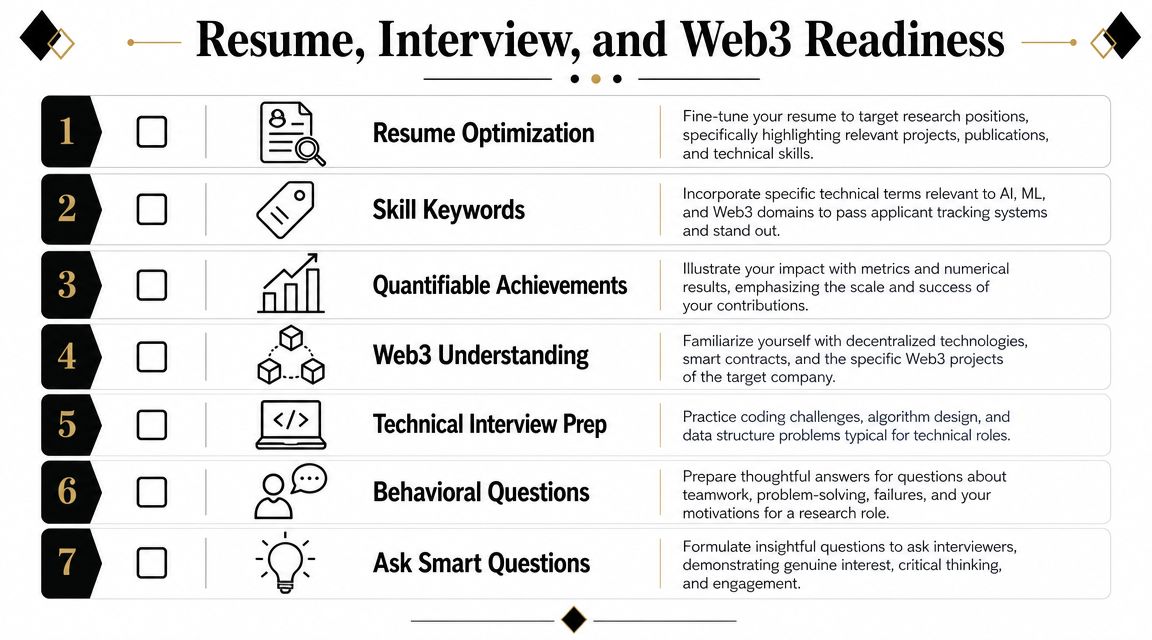
Most resumes for research internships fail before the interview because they sound interchangeable. They mention Python, machine learning, NLP, and teamwork. That's not enough. A Web3 company wants to know whether your research instincts apply to decentralized systems, weird datasets, and incentive-heavy environments.
Recent internship postings also show that specialization is getting more important. UNDP's internship explicitly centers on Generative AI for global development challenges and asks interns to draft analytical briefs, which you can see on the UNDP Generative AI research intern posting. The lesson for Web3 applicants is straightforward. Domain context now matters alongside coding.
Early in your search, it also helps to watch highly focused role formats such as this GitHub LinkedIn CV quick drop listing, because they reveal how some crypto teams evaluate candidate signal quickly.
Resume bullets that actually work
Here's the shift I want to see.
Weak bullet
- Built a machine learning model in Python to analyze blockchain transactions.
Better bullet
- Designed and evaluated a transaction-classification pipeline on on-chain event data, compared multiple feature representations, and documented failure cases for wallets with sparse history.
The second version tells me you understand process, evaluation, and real data pain.
A few more rewrites:
| Before | After |
|---|---|
| Researched NLP models for crypto | Evaluated LLM prompting and retrieval strategies for explaining smart contract functions, with notes on hallucination risks and unsupported claims |
| Worked on anomaly detection | Investigated graph-based anomaly detection for wallet behavior and analyzed where entity ambiguity weakened labels |
| Built dashboard for DeFi data | Combined protocol event parsing with predictive modeling to study risk patterns in lending activity |
Interview questions you should expect
A research interview usually checks three things at once: depth, judgment, and communication.
Expect standard questions such as:
- Why did you choose that baseline?
- What would you ablate first?
- How would you evaluate model reliability?
- What broke in your pipeline, and how did you find it?
For Web3 roles, expect domain-specific follow-ups:
- How would you model wallet behavior when labels are noisy?
- What signals would you use to detect manipulative trading?
- How would you apply an LLM safely to smart contract explanation?
- Where can AI systems fail in decentralized identity or governance workflows?
This interview walk-through is useful if you want a quick refresher before practice sessions:
What impresses interviewers
Ask specific questions back. Don't ask, “What does the team do?” Ask about evaluation, data quality, and research taste.
A strong final-round question is simple: “How do you distinguish publishable insight from an interesting internal experiment on this team?”
That question tells me you understand the role.
Where to Find Internships and Network Effectively
A lot of applicants look in the wrong places, then conclude there aren't many AI research internships in Web3. The problem usually isn't supply alone. It's search strategy.
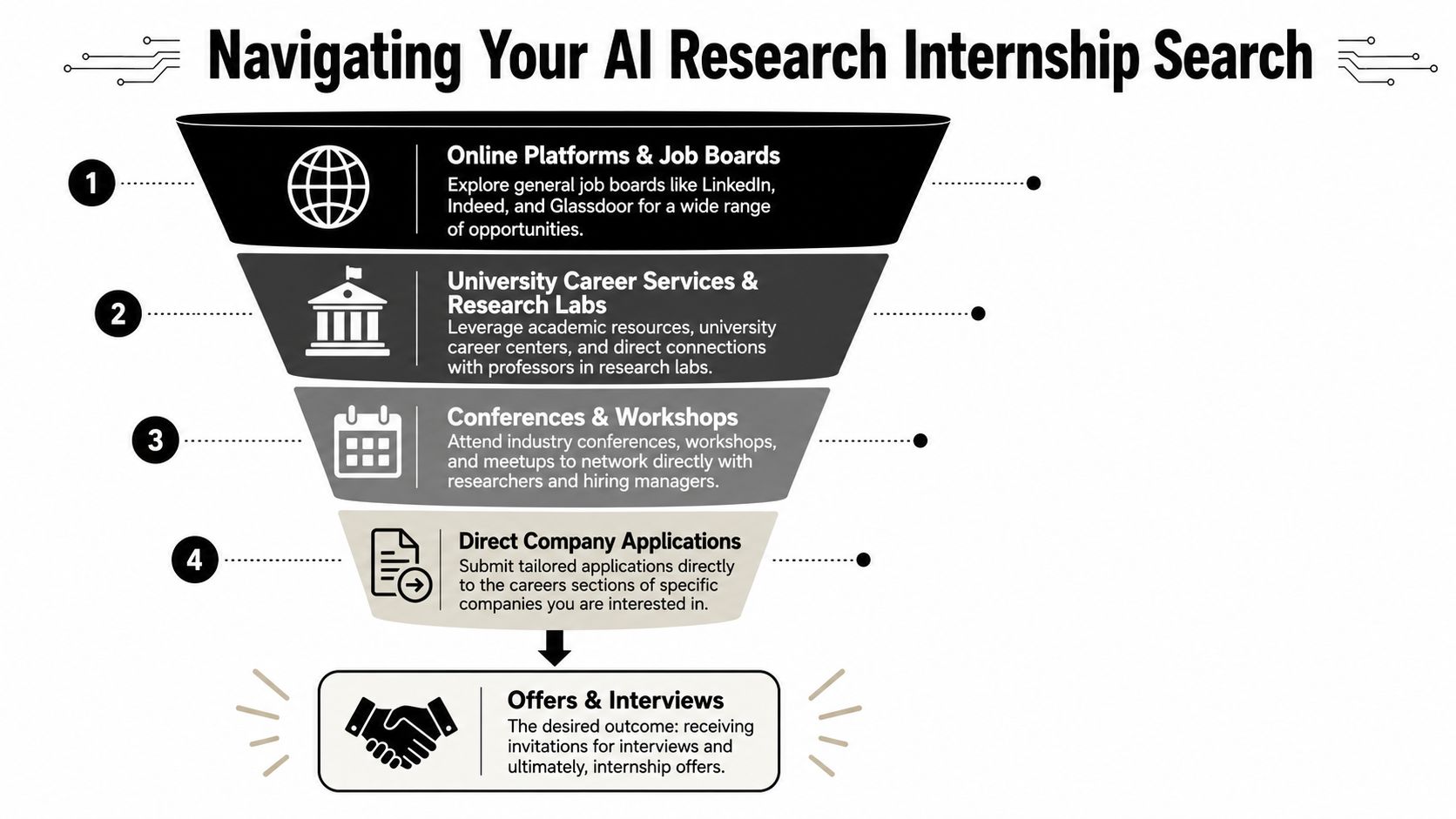
The search starts broad, but serious candidates narrow fast. They track labs, company research pages, open-source repos, conference communities, and founder or researcher posts that never make it onto giant job boards. If you want an example of a targeted crypto internship listing, look at this machine learning engineer intern role at Coinbase. Even when the title isn't “research intern,” the underlying signals can overlap.
Where strong candidates actually look
- Research labs and institute pages: These are often the clearest source of serious research-oriented openings.
- Company career pages: Especially for infrastructure firms, analytics platforms, and AI-first crypto startups.
- Open-source ecosystems: If a team maintains public tooling, contribution history can become your introduction.
- Technical communities: Research workshops, protocol forums, GitHub discussions, and specialized Discord or Telegram groups often surface opportunities before formal recruiting starts.
How to network without sounding transactional
Most cold outreach fails because it asks for too much and proves too little. Don't write to a researcher saying you're passionate and want to pick their brain. Send something concrete.
A useful cold message does three things:
- Names a specific piece of their work
- Adds a short observation or question
- Links a relevant artifact of your own
Example:
I read your recent work on on-chain behavior modeling and liked the way you handled sparse wallet history. I built a small experiment on transaction motif clustering and found label ambiguity was the hardest part. I wrote up the failure cases here. If your team considers interns, I'd value any feedback on whether this direction is worth pushing further.
That works because it respects their time and shows overlap.
What gets remembered
People remember applicants who show up twice. First through useful public work, then through concise outreach tied to that work. Contributing a clean issue, benchmark note, or reproducibility improvement to an open repo often does more than a generic networking chat.
The best networking strategy for aspiring researchers is simple. Build something adjacent to the team's interests, publish it, then start a conversation around the work rather than around your need for a job.
Your Path from Applicant to AI Researcher
The candidates who land a strong AI research intern role usually do a few things differently. They learn the fundamentals thoroughly. They build projects that ask real questions. They document their thinking. And they tailor their story to the domain they want to work in.
For Web3, that domain fit matters. A candidate who understands on-chain data, adversarial behavior, smart contract context, and decentralized product constraints has a real advantage over someone presenting generic ML work. You don't need to be a protocol expert on day one. You do need to show that you can translate research skill into protocol reality.
Career progression gets easier once you prove that once. After a good internship, your next applications change. You're no longer saying you want to do research. You're showing that you already have.
If you want another perspective on how internship paths can translate into stronger ML careers, especially in company settings, insights for enterprise ML internships are worth reading alongside your research prep.
Start with one tight project, not five scattered ones. Write one sharp resume, not a keyword dump. Reach out to a small number of relevant people with evidence, not enthusiasm alone. That's the path that consistently gets attention.
If you're ready to turn your portfolio into applications, Blockchain Jobs is a strong place to find Web3 roles across AI, machine learning, engineering, data, and adjacent crypto teams. Use it to spot how companies describe problems, what skills they repeat, and where your research background fits best.