AML Jobs NY: Find Your Compliance Career 2026
If you're searching for aml jobs ny, start with one reality: New York isn't a niche compliance market. It's one of the few places where traditional bank AML hiring and crypto-adjacent compliance work can sit in the same career path.
Indeed lists 587 AML Analyst roles in New York City, which is higher than the 235 AML Transaction Monitoring openings listed there as well, a useful signal that firms need both broad AML talent and specialists who can work alert queues and investigations (Indeed AML Analyst jobs in New York). For candidates, that changes the strategy. You don't need to guess whether demand exists. You need to position yourself for the slice of demand you're equipped to win.
The mistake I see most often is simple. Candidates treat AML as a single job family. It isn't. New York employers hire for onboarding, KYC, EDD, sanctions, transaction monitoring, investigations, quality control, model governance, and increasingly, roles that touch digital assets. If you come from Web3, product, engineering, or operations, your edge isn't pretending you've worked at a bank for years. Your edge is showing that you understand risk flows, wallet behavior, tracing logic, and how crypto activity creates compliance problems that many traditional teams still struggle to interpret.
Why New York Is a Global Hub for AML Careers
New York sits at the center of AML hiring for a simple reason. The city concentrates high-risk customer activity, cross-border payments, institutional capital, and some of the toughest regulatory expectations in the country.
As noted earlier, New York has a large volume of AML analyst and transaction monitoring openings. That matters less as a headline and more as a signal of market depth. Firms here keep hiring because compliance work does not disappear when markets slow down. Backlogs build, onboarding standards tighten, and investigations still need to be written clearly enough to survive internal review, audit, and regulator scrutiny.

Why the market stays strong
New York is where large banks, broker-dealers, asset managers, payment companies, fintechs, and digital asset firms all touch the same financial system. That creates steady demand for people who can handle KYC reviews, EDD cases, sanctions questions, transaction alerts, SAR support, and exam prep.
The pressure is operational.
A bank with a large correspondent network has one set of risks. A fintech scaling onboarding has another. A crypto company serving U.S. customers has to explain wallet activity, source of funds, and exposure to mixers, sanctions, or high-risk counterparties in a way traditional risk teams can understand. In New York, those worlds often meet inside the same hiring market.
This is especially relevant for crypto and blockchain companies trying to maintain banking access, support institutional clients, or build products for U.S. users. Once a business touches regulated money movement, compliance stops being a side function and becomes part of whether the company can keep operating.
Practical rule: New York AML hiring follows workload, documentation standards, and regulator expectations. Teams pay for people who can reduce case risk and write defensible decisions.
Why this matters for Web3 candidates
Candidates with only traditional banking experience are common in New York. Candidates who can work in bank-grade controls and also explain on-chain behavior are still harder to find.
That gap creates an opening.
A strong Web3 candidate does not need to pretend crypto is separate from AML. The better approach is to show how blockchain knowledge improves standard compliance work. Wallet clustering helps with investigations. Token flow analysis helps with source-of-funds reviews. Familiarity with chain analytics tools helps teams move faster on escalations that confuse people who have only worked in fiat environments.
Keep your search wider than standard bank titles, especially if you want firms hiring across compliance, risk, operations, and crypto in multiple U.S. markets. A useful starting point is this list of USA blockchain and crypto job openings.
In New York, the candidates who stand out usually bring two things at once. They understand the discipline of regulated compliance work, and they can explain digital asset risk without jargon. That combination travels well across banks, fintechs, and crypto firms.
Decoding the New York AML Job Market
A lot of candidates search for aml jobs ny as if every posting leads to the same desk. It doesn't. New York's market has distinct lanes, and your search gets sharper once you know which lane you're targeting.
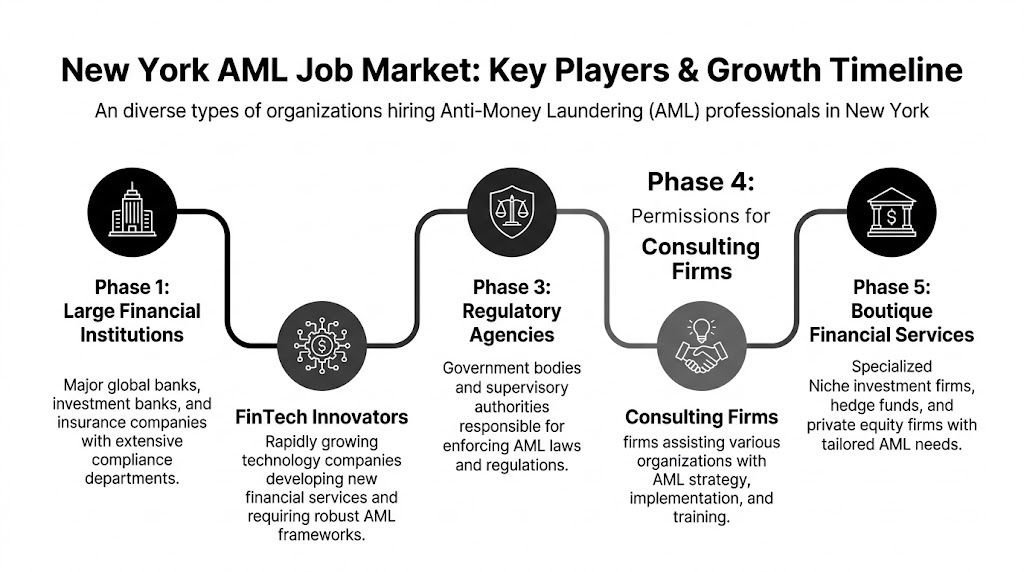
Who hires in New York
The hiring base is broad, but the work changes depending on the institution.
- Large banks: These teams usually hire for KYC refresh, onboarding, transaction monitoring, investigations, QC, and sanctions screening. Work is structured, documented, and process heavy.
- Fintech firms: These roles often combine onboarding, fraud, payments monitoring, escalations, and vendor tooling. Teams want people who can adapt quickly.
- Consulting and staffing firms: Contract hiring is common in AML. New York has over 235 AML Transaction Monitoring positions on Indeed, and recruiters like Michael Page advertise contract roles in the $32 to $39 per hour range, often asking for familiarity with Verafin or Actimize (Indeed AML Transaction Monitoring jobs in New York).
- Crypto-adjacent firms: These are harder to find on general boards. Job titles vary, and the work may sit under compliance, legal, risk, operations, or investigations.
What the main AML roles actually do
Most entry and mid-level candidates are choosing among a few core role types.
KYC and onboarding
This work focuses on customer intake, CIP, document review, beneficial ownership, source-of-funds questions, and escalation of higher-risk cases. It's a strong entry point if you're detail-oriented and can write clearly.
Good candidates in this lane show judgment. They don't just collect documents. They identify what is missing, what is inconsistent, and what needs escalation.
Transaction monitoring
This is the role many people underestimate. You're reviewing alerts, checking customer profiles, comparing behavior against expected activity, and deciding whether an alert closes or becomes an investigation.
If you have crypto experience, this lane is often the easiest bridge. Wallet activity, mixer exposure, rapid fund movement, and cross-platform transfers all map naturally to monitoring logic.
Sanctions and adverse media
These roles require patience and precision. Name screening, PEP review, sanctions hits, and media review sound repetitive, but firms care because a sloppy escalation or a bad clearance decision creates avoidable risk.
The firms that hire well don't just test whether you know the acronym. They test whether you can defend your decision after scrutiny.
Tools that keep showing up
Two names matter in New York hiring because they show up in job descriptions repeatedly: Actimize and Verafin. You don't need expert-level mastery to get interviews, but you do need to know what these systems do.
A practical baseline:
| Tool or area | What hiring managers care about |
|---|---|
| Actimize | Alert handling, case workflow, documentation quality |
| Verafin | Monitoring logic, suspicious activity review, escalation discipline |
| Excel | Sorting, filtering, QA checks, review support |
| Case management systems | Notes quality, consistency, audit trail |
| Screening platforms | Sanctions, PEP, adverse media research |
If you're early in your career, don't claim tool expertise you don't have. Say you've studied the workflow, understand the purpose, and can learn fast. That reads better than inflated software claims.
Building Your AML Skillset for the NYC Market
The New York market doesn't reward vague interest in compliance. It rewards a stack of practical skills that let you produce clean work under pressure.

Start with the non-negotiables
You can't skip the basics. Even firms with advanced tooling still expect analysts to understand the core discipline behind the workflow.
Build fluency in:
- BSA and AML fundamentals: Know why customer due diligence exists, what suspicious activity looks like, and how firms document decision-making.
- KYC, CIP, and EDD: These aren't interchangeable. Learn where each one starts and where escalation happens.
- SAR logic: Even if you haven't filed or drafted one, understand what kind of fact pattern would justify deeper investigation.
- Sanctions and PEP awareness: You don't need to be a sanctions lawyer. You do need to know that name screening and customer risk aren't box-ticking exercises.
Candidates from operations, fraud, trust and safety, or payments often already have pieces of this. The hiring challenge is translation. Rename your experience in compliance language without overstating it.
Then build technical depth
The market gets harder at the senior end. New York employers hire analysts, but they also hire people who can work with data instead of waiting for someone else to explain it.
According to Michael Page's New York AML market overview, senior AML roles require technical ability including mining complex transactional data with Python and SQL, and strong performers operate in environments where 90-95% of alerts are false positives (Michael Page AML jobs in New York). That means the primary skill isn't only spotting risk. It's filtering noise without getting sloppy.
Here's the difference between weak and strong preparation:
| Weak prep | Strong prep |
|---|---|
| "I know Excel" | Can explain how you used Excel to review, reconcile, or quality-check cases |
| "I've seen SQL" | Can describe querying transaction data or tracing patterns logically |
| "I'm analytical" | Can walk through how you'd isolate relevant facts from noisy alerts |
| "I worked in crypto" | Can explain wallet flow analysis and risk indicators in compliance terms |
Add the crypto layer carefully
Web3 candidates can gain ground, but only if they stay disciplined.
Crypto knowledge helps when you can tie it to control questions like these:
- What does normal activity look like for this user or entity?
- What explains the source and destination of funds?
- Is this movement consistent with stated business purpose?
- Do wallet interactions increase risk or just complexity?
A hiring manager won't be impressed because you've used DeFi protocols. They will be impressed if you can explain how on-chain behavior creates monitoring challenges, false positives, or escalation triggers.
After you've got the basics down, this video is a useful supplement for understanding how AML skills are discussed in practice:
What to study if you're pivoting from Web3
A strong pivot plan usually looks like this:
- Learn traditional AML vocabulary first. If you can't speak the language of KYC, EDD, alert review, and escalation, your blockchain background won't land properly.
- Study transaction monitoring workflows. Understand what analysts do all day, not just what regulations require.
- Practice writing short investigative summaries. Clear writing gets people hired.
- Map blockchain analytics to existing AML tasks. Wallet tracing, entity clustering, and flow analysis belong in the same conversation as suspicious activity review.
- Develop basic data comfort. SQL and Python matter because they help you inspect patterns instead of relying only on dashboards.
The best hybrid candidates don't market themselves as "crypto people." They market themselves as compliance professionals who can handle digital asset complexity.
Crafting Your Resume and Acing the AML Interview
Most AML resumes fail for one of two reasons. They're either too generic, or they're stuffed with buzzwords copied from job descriptions.
If you're trying to break into aml jobs ny, your resume has one job. It must show that you can help a team review risk, document decisions, and work inside a controlled process. Everything else is secondary.
What your resume needs to prove
Hiring managers scan for evidence, not enthusiasm. They want to see whether you've done work that resembles AML operations, even if your prior title wasn't AML Analyst.
That means your bullets should show things like:
- Investigative judgment: reviewing activity, identifying exceptions, escalating unusual patterns
- Documentation discipline: writing case notes, summarizing findings, maintaining accurate records
- Operational reliability: handling queues, meeting deadlines, following procedures, supporting audits
- Cross-functional communication: working with legal, fraud, operations, support, product, or engineering
If your current resume reads like a biography, fix that first. A practical tool that helps many candidates structure cleaner, keyword-aligned applications is this ATS-friendly CV builder. Use it for formatting discipline, not as a substitute for real content.
How Web3 experience should appear on the page
At this point, many candidates either undersell themselves or become unreadable.
Job boards show a real disconnect here. Entry-level AML roles often ask for traditional financial services experience, while giving almost no guidance on how technical Web3 backgrounds translate. That makes blockchain knowledge a differentiator only if you frame it as relevant compliance value, not as a separate identity (Indeed AML jobs in New York).
Bad framing:
- "Deep passion for decentralization"
- "Extensive knowledge of tokenomics"
- "Native understanding of Web3 culture"
Better framing:
- Reviewed transaction flows across wallets and counterparties
- Investigated anomalous movement patterns and documented findings
- Worked with product or engineering teams on controls, monitoring logic, or account restrictions
- Assessed user behavior in high-risk operational environments
Interview note: If your blockchain background is technical, translate it into risk language. If it's community or operations based, translate it into monitoring and escalation language.
You can also study live role wording to calibrate your language. Reviewing a posting like this AML Officer role helps you see how employers combine regulatory expectations with practical task lists.
How to answer AML interview questions well
AML interviews are rarely won by the most impressive speaker. They're usually won by the clearest thinker.
Use this structure for scenario questions:
| Part of answer | What to include |
|---|---|
| Situation | Brief context only |
| Risk question | What looked unusual or incomplete |
| Actions | What you reviewed, compared, escalated, or documented |
| Outcome | What decision was reached and why |
For technical questions, resist the urge to perform expertise. If asked how you'd investigate suspicious activity, walk through a disciplined process:
- Review the alert or case trigger.
- Check the customer profile and expected activity.
- Compare transaction behavior against that profile.
- Look for related parties, counterparties, and movement patterns.
- Document facts separately from assumptions.
- Escalate if the rationale for closure isn't strong enough.
If they ask about crypto, keep your answer grounded. Explain how you'd trace fund movement logically, identify the entities or wallets involved, and note where the risk comes from. Don't disappear into protocol jargon unless the interviewer takes you there.
Where to Find AML Jobs in NY Including Crypto Roles
Many job seekers approach platforms inefficiently. They search one exact title, apply to everything, and then conclude the market is impossible.
A better search strategy starts by separating traditional AML roles from crypto-adjacent compliance roles, then using different keywords for each.
Search strategy that actually works
For mainstream boards, use combinations like:
- AML analyst
- transaction monitoring analyst
- KYC analyst
- EDD analyst
- financial crimes analyst
- sanctions analyst
- risk and compliance analyst
Then add New York filters and contract filters. Contract work is often the fastest way in, especially if you need recognizable AML experience.
For crypto-adjacent work, broaden the terms:
- crypto compliance
- digital asset compliance
- blockchain investigations
- financial crime risk
- legal and compliance
Specialized pages are often better for the second category than large boards. If you want a tighter view of crypto-native and adjacent hiring, review current legal and compliance jobs in Web3.
It's also worth understanding how firms describe themselves when they hire. Teams in the financial services industry can vary widely in pace, formality, and control structure. That matters because the same AML title at a bank, fintech, or digital asset company can feel like three different careers.
Typical AML salary ranges in New York 2026
Use salary data as a benchmark, not as a promise. Pay depends on employer type, experience, and whether the role is permanent or contract.
| Role Level | Experience | Typical Salary Range |
|---|---|---|
| AML Analyst | Entry to mid-level | $70,000 to $80,000 |
| AML Data Analyst | Varies by experience and firm size | $50,000 to $80,000 |
| AML contract consultant | Experience in AML, KYC, EDD, or monitoring | $32 to $39 per hour |
Those ranges reflect verified New York market references from Indeed, ZipRecruiter, and Michael Page as summarized in the source material already discussed earlier in this article.
Where candidates miss opportunities
They ignore recruiters. They apply with one resume to every role. They don't search adjacent titles. And they treat crypto compliance as if it only exists at exchanges.
It doesn't. Payment firms, fintechs, infrastructure companies, analytics vendors, and legal-compliance teams all hire people who can bridge AML and digital asset risk.
Your Career Path After Landing the First AML Job
The first AML role matters, but it isn't the finish line. It's your proof-of-execution period.
Once you've shown that you can review cases, document decisions, survive audit scrutiny, and manage repetitive workflows without losing judgment, your options widen fast. New York rewards people who become useful in a narrow area and then expand from there.
The most common progression paths
Some analysts become stronger investigators. Others move toward oversight, quality control, or technical work.
A practical progression often looks like this:
- KYC or onboarding to EDD: Good for people who like customer risk assessment and file-based analysis.
- Transaction monitoring to investigations: Strong path for candidates who can synthesize behavior, narratives, and escalation decisions.
- Analyst to QC or QA: A fit if you're good at spotting weak rationale, inconsistent notes, and process errors.
- Operations to sanctions or screening: Better for candidates with precision and patience.
- AML to crypto investigations or digital asset compliance: Best for people who can bridge traditional controls with blockchain-specific behavior.
The higher-value specializations
The market becomes more interesting when you stop being interchangeable.
Senior AML roles in New York can involve forensic analytics, model tuning, workflow design, regulatory response, and data-heavy investigation work. That means there is room to grow into more technical paths if you build the right foundation early.
Three strong long-term bets:
| Path | What makes it valuable |
|---|---|
| Investigations leadership | You learn to make and defend hard risk decisions |
| AML analytics | You connect alert quality, data patterns, and operational efficiency |
| Crypto compliance specialization | You become useful to firms dealing with wallet tracing, digital asset exposure, and hybrid control environments |
The best careers in AML don't come from chasing titles. They come from becoming the person who can handle messier, higher-risk problems without creating confusion for everyone else.
What helps you move up
Promotion usually follows trust. Managers promote analysts whose work doesn't need repairing.
That means your daily habits matter more than people think:
- Write clearly.
- Escalate only when your reasoning is solid.
- Don't close alerts just to clear volume.
- Learn the business line, not just the checklist.
- Keep building technical fluency if you want senior opportunities.
For Web3 candidates, the long game is especially strong. Once you've added traditional AML credibility to blockchain knowledge, you're no longer competing only for entry roles. You're building toward a hybrid niche that many firms still struggle to hire for.
If you want to find compliance roles that reflect where the market is going, not just where it has been, browse opportunities on Blockchain Jobs. It's a practical place to track Web3, legal, compliance, finance, and adjacent roles where AML experience and blockchain knowledge can meet.