Best Podcasts About Cryptocurrency for Your Web3 Career

What if your podcast queue could do more for your Web3 career than your social feed?
Treating crypto podcasts as background noise is a mistake. If you want to break into Web3, switch from one protocol category to another, or hire people who understand the stack, the best podcasts about cryptocurrency function as recurring briefings on incentives, architecture, regulation, and operator judgment.
The audience is large enough now that passive listening is not enough. A 2024 report from Triple-A on global crypto ownership estimates hundreds of millions of people worldwide own digital assets. Access to information is no longer scarce. Good filtering is.
That filtering pays off in concrete ways. Engineers can listen for how protocol teams defend design decisions under technical pressure. Product managers can sharpen questions about token incentives, wallet UX, and governance mechanics. Legal and compliance candidates can hear how serious operators discuss enforcement risk, disclosures, and jurisdictional trade-offs. Recruiters and hiring managers can also use these shows to spot which founders communicate clearly, which teams understand their own business model, and which narratives fall apart under basic scrutiny.
I use podcasts this way because they compress time. A strong interview can give you the backstory on a protocol, the decision logic behind a product launch, and the cultural signals around a team in under an hour. That is useful before interviews, during market mapping, and while screening roles on Web3 job boards for blockchain roles.
The list below focuses on career advantage. Each show earns its place by helping you prepare for interviews, build sharper domain judgment, and understand how different parts of crypto hiring work.
If you also want broader professional listening outside crypto, this roundup of career development podcasts pairs well with the shows below.
1. Unchained
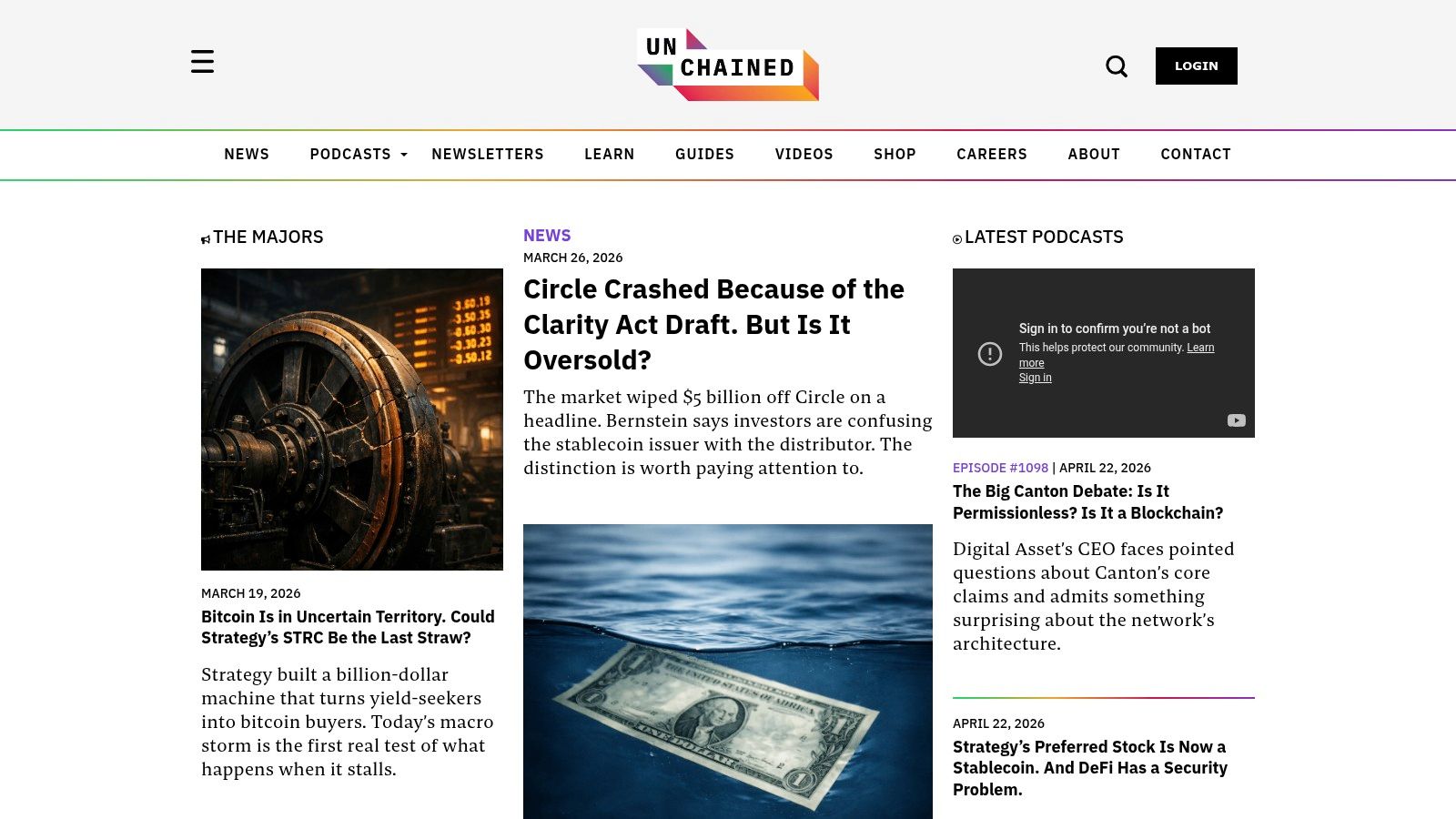
Unchained is the podcast I’d give to someone who wants signal without joining a cult around one chain, one founder, or one investing style. Laura Shin approaches crypto as a reporter first, and that changes the usefulness of the show. You hear harder questions, cleaner timelines, and better accountability than you get from founder-friendly interview circuits.
For hiring and career growth, that journalism-first approach matters. Engineers don’t just need to know what a protocol claims. They need to know what broke, who made the call, and how teams defended their choices after the fact. Product leaders and legal teams need the same discipline when they evaluate partners, token structures, or governance processes.
Where it helps most
Unchained is especially strong when you’re preparing for roles that sit between technical and strategic work. If you’re interviewing with an exchange, L2, wallet company, analytics platform, or policy-sensitive startup, this show helps you build language around trade-offs instead of slogans.
A few reasons it earns a permanent slot:
- Editorial discipline: Episodes usually force guests to explain mechanisms, not just outcomes.
- Useful breadth: It covers Bitcoin, Ethereum, DeFi, NFTs, market structure, and enforcement issues without getting trapped in one niche.
- Interview prep value: You can borrow the host’s question style to stress-test your own understanding before interviews.
Practical rule: If a guest can’t explain token design, governance, or revenue logic clearly on a serious podcast, don’t assume the company will explain it clearly in an interview either.
This is also one of the better podcasts for people who need a chain-agnostic map of the industry. A lot of candidates overfit their knowledge to the ecosystem they already know. Unchained helps correct that.
Trade-offs to know
The downside is straightforward. It isn’t the deepest technical listen on pure protocol engineering, and some episodes lean more toward policy, market structure, or founder accountability than implementation detail. That’s a feature if you work across functions. It’s a limitation if you want proving-system internals or smart contract architecture walkthroughs.
Still, I’d rank it highly for candidates who need to sound credible in interviews with cross-functional panels. Recruiters, PMs, counsel, and engineering managers rarely care whether you memorized jargon. They care whether you understand why decisions happened and what second-order effects followed.
If you’re actively tracking employers while you listen, keep a browser tab open to Blockchain Jobs. Unchained is one of the easiest shows to convert into a target-company list because guests often reveal how teams think under scrutiny.
2. Bankless
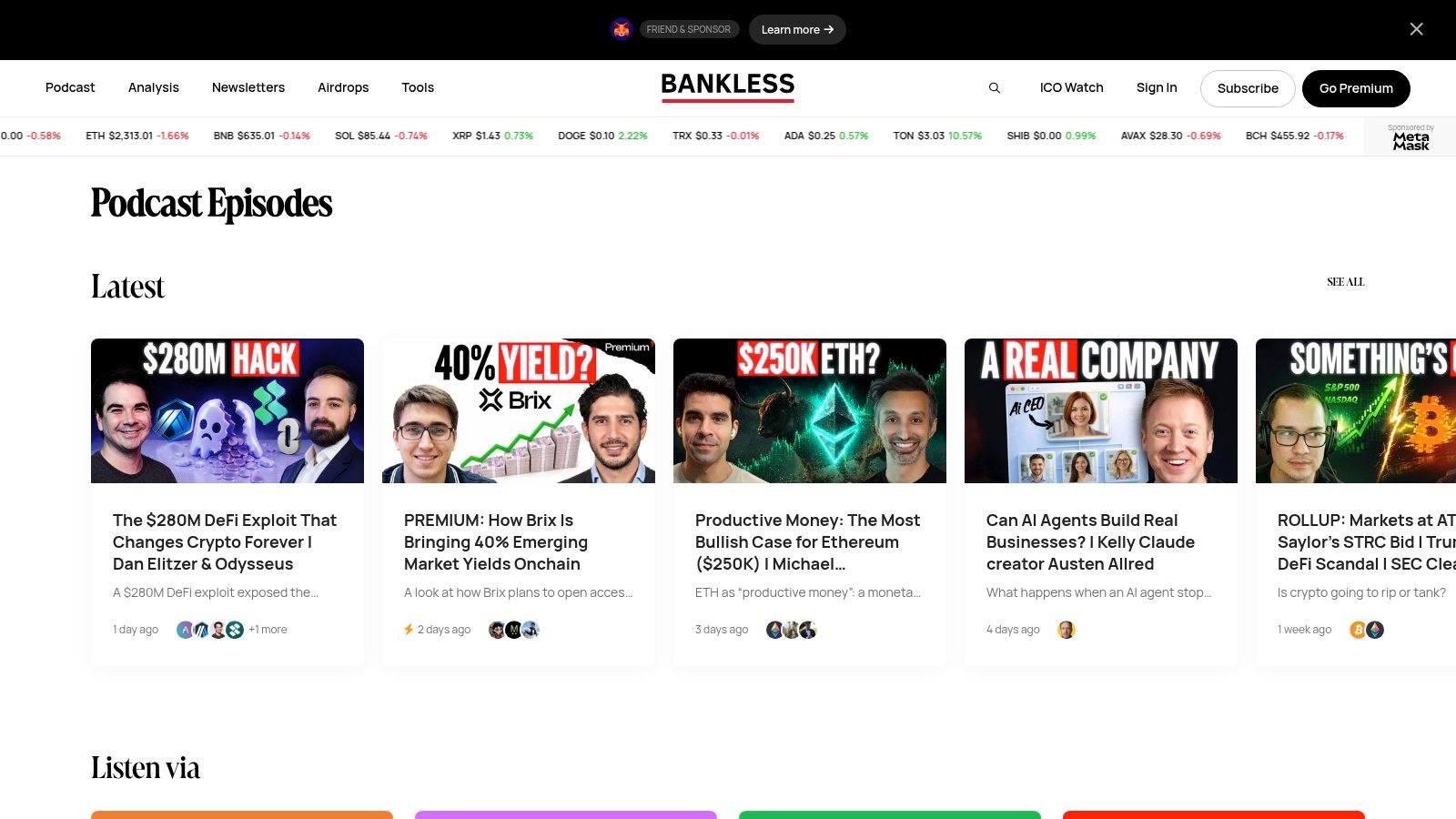
What should you listen to if you want to sound current in a crypto interview without spending every waking hour on Crypto Twitter? Bankless is one of the better answers.
Bankless is especially useful for candidates targeting Ethereum-focused companies, DeFi teams, wallet products, L2 infrastructure, and consumer crypto apps. The show moves with the market, which matters because hiring managers can tell when your examples are six months old. If you work in product, growth, ecosystem, or engineering, this podcast helps you track where user behavior, product design, and founder attention are shifting.
I use Bankless less as a news source and more as a signal source. It helps answer practical questions: Which product categories are gaining real traction? Which design choices are becoming standard? Which narratives are turning into hiring plans?
How to use it for career growth
The mistake is treating every episode like required listening. Bankless is more useful when you sort episodes by job relevance.
- Product roles: Prioritize discussions on wallets, onboarding flows, app distribution, stablecoin usage, and consumer retention.
- Growth and community roles: Listen for how teams talk about incentives, activation, network effects, and what keeps users around after the token campaign ends.
- Engineering roles: Pick founder or protocol interviews focused on rollups, infrastructure, interoperability, and performance constraints. Then turn those into follow-up reading before interviews.
- Research or strategy roles: Focus on episodes where the hosts pressure-test category theses, token models, or go-to-market assumptions.
That role filtering matters more than broad popularity metrics. During the 2021 market cycle, crypto interest surged well beyond trading circles, and Google Trends shows a sharp rise in search interest for terms like "crypto" during that period through Google Trends. Shows that could translate fast-moving ideas into plain English gained outsized influence. Bankless benefited from that shift because it consistently explained why a theme mattered, who it served, and where it could break.
Good Bankless listening gives you current language and sharper questions for interviews. Bad Bankless listening produces recycled opinions with no operating judgment behind them.
Where it helps most, and where it does not
Bankless is strong on app-layer strategy and Ethereum-native market context. That makes it a strong fit for PMs, ecosystem hires, growth operators, developer relations candidates, and engineers who need commercial awareness alongside technical fluency.
It is less effective as a standalone source for legal, compliance, or highly specialized cryptography preparation. It also assumes some baseline context. New entrants may find parts of the conversation too compressed, especially in episodes that jump straight into rollup design trade-offs or token incentive mechanics.
Use it with intent. If an episode highlights a category that keeps coming up, compare that theme against active teams on the crypto companies hiring right now and see whether the market attention is translating into actual headcount. That is where Bankless becomes more than a podcast. It becomes a filter for where to spend your job search time.
3. Empire
Empire helps listeners answer a hiring question that comes up in nearly every serious crypto interview: why does this category deserve capital, talent, and product attention right now?
That focus makes it unusually useful for product managers, ecosystem leads, founders, BD teams, and engineers who need commercial judgment alongside technical credibility. I recommend it to candidates who can already explain how a protocol works but struggle to explain why a team’s wedge matters, why distribution might fail, or why one market narrative keeps attracting operators while another fades.
Why it works as a career tool
Empire is strongest when the hosts push guests past surface-level optimism and into incentives, market structure, and execution risk. Those conversations give you material you can use immediately in interviews. You hear how investors assess timing, how founders defend token design, and how experienced operators talk about competition without resorting to slogans.
Listen for three things in particular:
- Category conviction: Which segments still attract serious builders after the hype cools.
- Business model pressure: Where revenue, distribution, or retention assumptions start to break.
- Talent signals: Which functions founders keep mentioning when discussing bottlenecks, including product, growth, partnerships, legal, and technical hiring.
Empire also earns its place because it covers consumer, media, and NFT cycles with more seriousness than many infrastructure-first shows. That matters for candidates targeting wallets, social products, creator tooling, marketplaces, and community-heavy apps. Those roles often live or die on user behavior, not protocol elegance alone.
Where it helps most, and where it does not
This is a strong podcast for people preparing for roles that sit near strategy, capital, or go-to-market. It is less useful if your immediate goal is to sharpen low-level protocol knowledge or cryptography depth. Zero Knowledge Podcast and Epicenter will usually do more for that.
The trade-off is straightforward. Empire gives better context for market timing and company direction. It gives less step-by-step help for shipping technical systems.
Hiring lens: Track what founders and investors repeat without prompting. Repeated concerns often show up later in job descriptions, interview loops, and team priorities.
Use those patterns to build a target list. If several episodes keep surfacing the same category, compare that thesis against the crypto companies hiring across wallets, infrastructure, DeFi, and consumer apps. That turns passive listening into market mapping.
4. Zero Knowledge Podcast
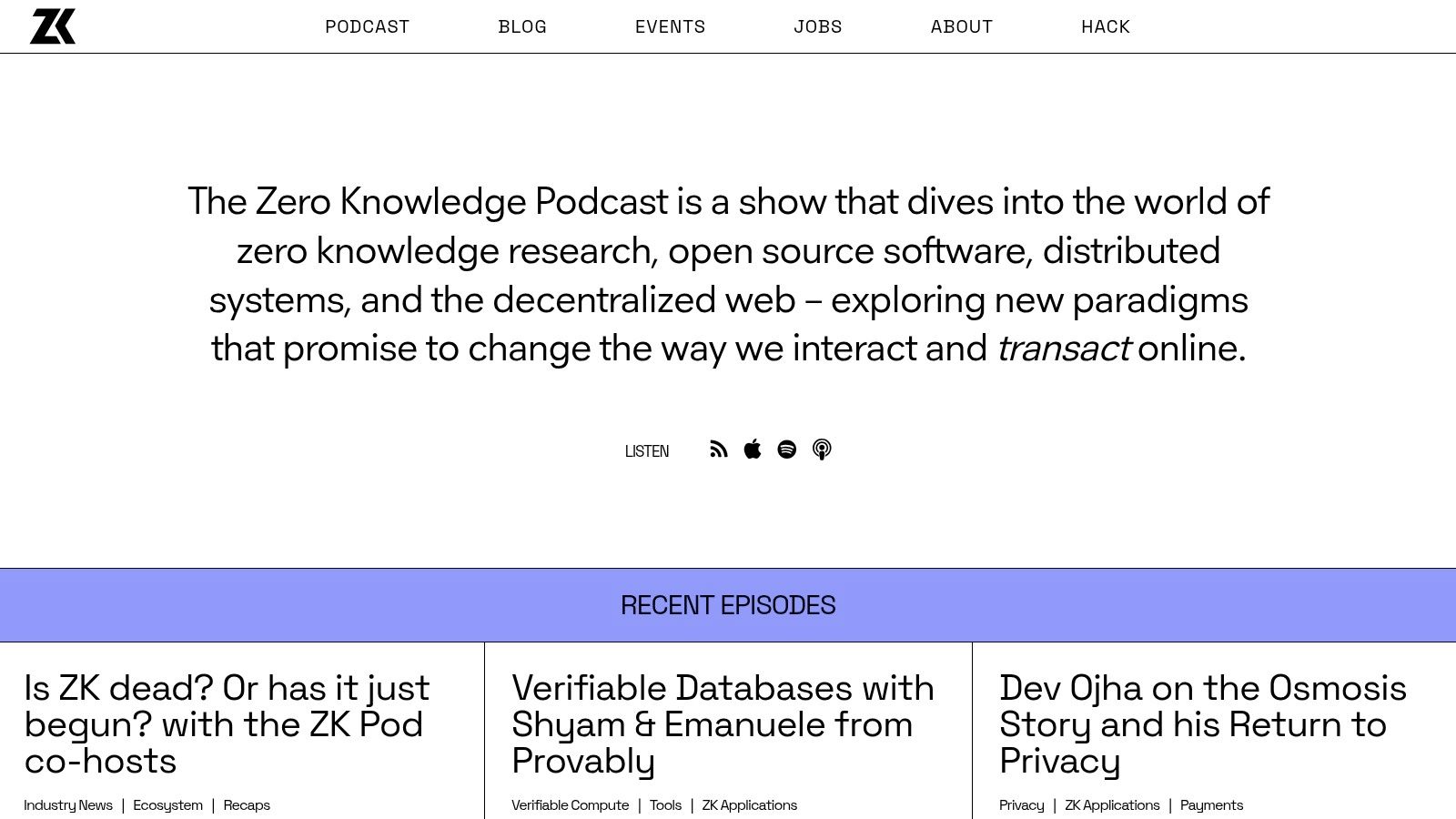
Want a podcast that makes you better at technical crypto interviews?
Zero Knowledge Podcast is one of the few shows I’d recommend without qualification to protocol engineers, cryptography researchers, privacy builders, rollup teams, and security specialists. It treats technical subjects with the level of precision they require. That matters if your job depends on understanding proving systems, verifier costs, trusted setup assumptions, or the operational limits of privacy tooling.
Its career value is straightforward. The show helps listeners hear how serious builders reason through constraints before those ideas get simplified into conference slogans. That is useful in hiring loops. Strong candidates are rarely rejected because they lack buzzwords. They get rejected because they cannot explain trade-offs under pressure.
The audience here is narrower than for Bankless or Empire, but the payoff is higher for the right roles:
- Protocol developers who need sharper intuition for proving systems, verification, and scaling design choices.
- Security engineers who want a better grasp of privacy models, assumptions, and failure points.
- Technical PMs and research-adjacent operators who need enough depth to scope products, question feasibility, and communicate candidly with cryptographers.
That role alignment is not theoretical. DeFiLlama’s chain and protocol data shows Ethereum remains the central execution environment for a large share of DeFi activity, which keeps scaling, privacy, and proving discussions commercially relevant, not just academically interesting. Teams building on that stack need people who can discuss implementation cost, latency, tooling maturity, and user experience in the same conversation.
This podcast is particularly good for separating surface familiarity from working knowledge. A candidate can say "ZK is important for scaling and privacy" and still fail an interview. A stronger answer explains why a specific proving approach creates different constraints for developer experience, hardware requirements, auditability, or time to production.
Use it like study material, not background audio.
A simple method works well. Listen once to map the problem. Revisit the episode and write down the primitive being discussed, the trade-off under debate, and the product or protocol decision it affects. That gives you language you can use in interviews, design reviews, and hiring conversations with technical founders.
Don’t measure success by whether you caught every detail on the first pass. Measure it by whether your questions became more precise.
There is a real trade-off. This is a demanding listen, especially if your current knowledge comes from X threads, conference clips, or high-level explainers. For legal, policy, BD, or generalist product roles, the return on time may be lower unless you work close to infrastructure. For engineering, research, and technical product roles, though, few podcasts do a better job of sharpening the kind of judgment teams pay for.
5. Epicenter
Epicenter is one of the few crypto podcasts that can make you better in interviews six months from now, not just better informed this week.
Its archive is the advantage. If you work in protocol engineering, product, research, legal, or ecosystem strategy, old episodes help you trace how ideas around governance, interoperability, validator design, token incentives, and privacy evolved. That matters in hiring. Strong teams rarely care whether you memorized the latest narrative. They care whether you can explain why a design choice keeps reappearing, what failed before, and which trade-offs still have no clean answer.
Epicenter is especially useful for candidates who need historical judgment. A lot of interview panels test for this indirectly. They ask about decentralization, cross-chain design, or governance capture, then listen for whether your answer comes from one market cycle or from a broader base of knowledge.
Why the archive matters
Crypto products keep changing. Core constraints usually do not.
Epicenter gives listeners access to earlier discussions before categories were polished for marketing. That makes it easier to compare first-generation and current approaches to the same problem, whether the topic is DeFi architecture, validator incentives, protocol coordination, or treasury governance. For hiring managers, that kind of context signals maturity. For candidates, it gives you cleaner language and better pattern recognition.
That is particularly helpful if you want to work in wallets, lending, analytics, risk, or infrastructure. DeFi may look different now than it did at its 2021 peak, but the assumptions that broke under stress still show up in product decisions, risk models, and compliance reviews today.
Best way to use it
Use Epicenter like a research backlog.
Start with one hiring-relevant theme, then build a short listening sequence across time. For example, a protocol PM could group episodes on governance design and compare how guests discuss voter participation, delegation, treasury control, and implementation overhead in different eras. A legal or policy candidate could do the same with episodes touching decentralization claims, validator concentration, or governance accountability.
A practical workflow:
- Choose one theme tied to your target role: L1 design, governance, interoperability, privacy, or validator economics
- Listen across cycles: pick one older episode, one mid-cycle episode, and one recent one
- Write role-specific notes: engineers should capture system constraints and failure modes. Product candidates should capture trade-offs, user impact, and rollout risk. Legal and policy candidates should capture control points, governance structure, and where claims may exceed reality
This turns passive listening into interview material. It also helps with hiring intelligence because you start hearing which topics serious operators return to repeatedly.
Where it loses to newer shows
Epicenter is not the fastest source for weekly market context, fundraising chatter, or narrative shifts. It is also a demanding listen if you prefer short summaries or mostly follow crypto through social posts and clips.
The payoff is different. This show helps you build durable judgment. For candidates who want to sound credible with founders, research leads, and senior product teams, that is often more valuable than being first to repeat the latest storyline.
6. a16z crypto show
How do strong crypto candidates separate themselves once everyone in the room already knows the protocol basics? The a16z crypto show helps answer that question. It trains you to hear how serious operators talk about adoption constraints, distribution strategy, standards, payments, identity, and market structure.
That makes it especially useful for product managers, ecosystem leads, partnerships hires, strategy candidates, and founders preparing to hire across functions. Engineers can still get value from it, but the primary payoff is learning how technical progress connects to business timing, user behavior, and institutional demand.
Best fit for people who need commercial judgment
A lot of interview loops test more than technical fluency. Hiring teams want to know whether a candidate can explain why a product should exist now, which dependency is still missing, and what would have to change for a market to open up. This show is strong on those questions because guests often discuss category formation, not just feature releases.
That matters in a market where crypto increasingly intersects with large financial and software companies. If your target role touches payments, tokenization, compliance, treasury operations, or go-to-market work, you need a better lens on how crypto products get adopted inside real organizations.
For legal, finance, and operations candidates, some of the best episodes are the ones that explain stablecoins, payment rails, and regulatory design in plain business terms. A good example is the firm’s discussion of stablecoins and payments on the a16z crypto site, which gets into settlement, global money movement, and why these systems matter to companies that move funds. Pair that with targeted outside listening, including Bitcoin quantum threat podcasts, and you start building a sharper view of infrastructure risk, policy exposure, and how technical topics get translated for broader stakeholders.
Use it to prepare for cross-functional interviews
This show is one of the better tools for candidates who need to sound credible outside their home discipline.
- Product candidates should track adoption blockers, sequencing decisions, and user distribution assumptions
- Partnerships and BD candidates should note where standards, wallets, custodians, or payment providers create bottlenecks
- Legal and compliance candidates should listen for control points, jurisdictional friction, and how guests frame acceptable risk
- Founder associates and strategy hires should capture where the speaker’s thesis depends on regulation, capital availability, or incumbents participating
One warning matters here. The show reflects a VC-informed worldview. That is useful, because venture firms often see category trends early, but it also means topic selection and framing can tilt toward investable narratives.
The right way to use the show is with a filter. Ask what assumptions each guest is making about distribution, capital, regulation, and customer behavior. If you do that consistently, a16z crypto show becomes more than background listening. It becomes interview prep for roles where commercial judgment matters as much as crypto literacy.
7. What Bitcoin Did
Need to sound credible in a Bitcoin interview, not just crypto-adjacent? What Bitcoin Did is one of the faster ways to build that fluency.
Peter McCormack’s show has been running since 2017, and the archive itself is part of the value. The official episode library shows how consistently the show has tracked Bitcoin through multiple market cycles, policy fights, custody debates, mining narratives, and infrastructure shifts. That kind of continuity matters if you are interviewing for roles where hiring managers expect more than a surface-level take on Bitcoin.
This is a career tool for candidates targeting Bitcoin-native work. It helps you hear how serious operators frame trade-offs around self-custody, treasury strategy, mining economics, regulation, and Lightning adoption. Those are the kinds of details that separate someone who follows headlines from someone who can contribute on day one.
Best fit by role
This show is especially useful for:
- Bitcoin infrastructure and mining roles
- Policy, research, and education positions
- Finance and treasury professionals with Bitcoin exposure
- Generalist candidates who need a solid Bitcoin foundation before specializing
The practical strength of the show is range without losing the thread. Some episodes stay high level and macro. Others get into operational questions that matter in hiring conversations, such as how custody changes user trust, why miners respond differently to energy and regulatory pressure, or where Bitcoin companies face distribution constraints.
For hiring intelligence, this matters more than raw audience numbers. A broad Bitcoin podcast reaches founders, researchers, investors, and operators at the same time. Triton Digital’s U.S. Podcast Ranker is a better source for understanding how podcast reach is measured across the industry, even though it does not rank every niche crypto show directly. The takeaway is simple. Podcasts with durable distribution shape the talking points candidates will hear repeated by interviewers, founders, and internal teams.
There is a real trade-off. A Bitcoin-only lens gives depth, but it can leave gaps if you are pursuing roles in DeFi, gaming, NFTs, or cross-chain infrastructure. Bitcoin fluency is valuable. It is not the same thing as broad Web3 fluency.
Use the show with intent. Engineering candidates should track infrastructure and security assumptions. Policy and legal candidates should note where guests draw lines around sovereignty, compliance, and state pressure. Treasury, finance, and strategy hires should pay attention to how guests justify holding periods, risk management, and capital allocation under volatility.
For a narrower companion on long-term technical risk, this set of Bitcoin quantum threat podcasts adds useful context.
Candidates who can explain Bitcoin’s technical, economic, and policy trade-offs clearly tend to interview well for Bitcoin-native roles. Candidates who treat Bitcoin knowledge as a substitute for broader crypto literacy usually hit a ceiling.
Top 7 Crypto Podcasts Comparison
| Podcast | Technical complexity 🔄 | Resource requirements ⚡ | Expected outcomes 📊 | Ideal use cases 💡 | Key advantages ⭐ |
|---|---|---|---|---|---|
| Unchained (Laura Shin) | Moderate, deep interviews, not always technical | Medium, long-form episodes, no heavy prerequisites | Strong policy, legal, and industry awareness | Legal/compliance, product leaders, engineers needing regulatory context | High editorial standards and timely guests |
| Bankless | Intermediate, assumes some Ethereum/DeFi familiarity | High cadence, weekly rollups; some paid tiers | Actionable DeFi/product insights and trend awareness | Product, growth, and engineering teams building app-layer products | Frequent updates and practical guidance |
| Empire (Blockworks) | Moderate–Advanced, finance and market-focused | Medium, timely episodes backed by research | Market narratives, token launch and investor signals | PMs, protocol engineers, venture-minded listeners | Good signal on emerging categories and debate-driven format |
| Zero Knowledge Podcast | High, deep technical cryptography and ZKPs | High, requires strong cryptography/protocol background | Cutting‑edge ZK technical knowledge and implementation trade-offs | Protocol developers, cryptographers, security engineers | Exceptional technical rigor and research depth |
| Epicenter | High, long-form technical and historical discussions | Medium, extensive archive for on-demand study | Historical context and protocol design trade-offs | Engineers, protocol/product leaders seeking deep context | Consistent depth and a rich archive |
| a16z crypto show | Moderate, strategic/VC-centric framing | Medium, integrates with broader a16z research | Strategic frameworks for product-market fit and distribution | Founders, executives, strategy and GTM roles | High-quality guests and a strategic market perspective |
| What Bitcoin Did | Moderate, Bitcoin-focused technical and policy mix | Medium, frequent topical series and back catalog | Deep Bitcoin technical, mining, policy, and cultural understanding | Roles at Bitcoin-focused companies or researchers | Clear, accessible interviews and comprehensive Bitcoin coverage |
From Listening to Leading Turn Insights into Opportunities
Podcasts only become career assets when you listen with intent. Passive listening gives you familiarity. Strategic listening gives you usable judgment. That’s the difference between sounding informed and being useful in an interview, in a hiring meeting, or inside a fast-moving team.
The best podcasts about cryptocurrency each serve a different professional purpose. Unchained sharpens your ability to reason about accountability, regulation, and industry narratives without swallowing PR. Bankless keeps you close to app-layer and DeFi motion. Empire helps you read capital, positioning, and founder conviction. ZK Podcast and Epicenter deepen technical judgment. The a16z crypto show improves strategic framing. What Bitcoin Did gives Bitcoin-native professionals a serious operating context.
Use them like tools, not like trophies.
A simple system works better than a giant queue. Pick two primary podcasts and one specialist show. Make one of them broad and current. Make one role-specific. Make the third stretch your weak spot. If you’re a protocol engineer, that may mean ZK Podcast plus Epicenter, with Unchained as your industry context layer. If you’re a PM, Bankless plus Empire is a strong core, with Unchained or a16z crypto added depending on whether your gap is policy or strategy. If you work in legal, compliance, or finance, combine Unchained with a strategy-heavy show and then selectively pull episodes on market structure, payments, stablecoins, and enforcement.
Then do the part most listeners skip. Convert listening into artifacts.
Take notes in hiring language. Don’t just write “interesting L2 episode.” Write “candidate takeaway: team prioritized lower user friction over maximal decentralization in early rollout.” Don’t just note “founder discussed token incentives.” Write “use in interview: ask how protocol measures productive participation versus mercenary liquidity.” These distinctions matter because employers don’t hire podcast listeners. They hire people who can apply ideas under constraints.
You should also build a company map as you listen. Every time a founder, operator, or researcher makes you think, add the company, category, and role type to a running list. Over time, patterns emerge. You’ll see which sectors align with your skills, which teams communicate clearly, and which narratives are producing actual hiring demand versus noise.
That’s where action starts to compound. Once you know the categories, teams, and role types you want, move from listening mode to search mode. Browse openings, study team pages, compare role requirements, and test whether your current skill stack matches where the market is heading. The podcasts give you context. A dedicated jobs platform gives you the surface area to act on it.
Done right, this turns your commute, workout, or walk into a professional edge. You start hearing the same issues hiring managers care about. You recognize technologies before they become default interview topics. You stop learning crypto as spectacle and start learning it as a working system with real jobs, real constraints, and real opportunities.
That’s the point. Listening is not the finish line. It’s how you show up better prepared for the work.
If you’re ready to turn podcast insight into an actual next move, browse roles on Blockchain Jobs. It’s one of the most direct ways to connect what you’re learning about DeFi, infrastructure, product, compliance, marketing, and crypto-native operations to live opportunities across the Web3 market.