Top Blockchain Developer Remote Jobs: 2026 Career Guide
Remote blockchain work stopped being a niche perk. It became a structural advantage.
In 2025, Web3 added 26,925 new remote jobs, up 40% year over year, even as much of the broader tech market leaned harder into office returns, according to Coincub's Web3 jobs report. If you're targeting blockchain developer remote jobs in 2026, that number matters for one reason: companies in this market still hire where the talent is, not where the office sits.
That changes how you should approach your career. A weak generic resume won't cut it, but neither will a strong one that can't be verified. In Web3, hiring managers can inspect your GitHub, your deployed contracts, your protocol contributions, your audit trail, your forum posts, and sometimes even your wallet activity. Your resume is no longer just a summary. It's a claim set that can be checked.
The State of Remote Blockchain Development in 2026
Remote Web3 hiring stayed active into 2026 because the work leaves receipts.
A hiring manager can review merged PRs, deployed contracts, audit notes, governance posts, test coverage, and wallet-linked activity without booking a call. That changes the hiring bar. In many software roles, a resume is still mostly narrative. In blockchain, a good chunk of it is auditable.
Remote teams are built around that reality. Protocol releases happen across time zones. Security reviews happen asynchronously. Specs live in docs, issues, and code comments. Engineers who get traction in this market usually make their work easy to inspect, easy to reproduce, and easy to trust.
The role mix has widened too. Teams still hire Solidity, Rust, and protocol engineers, but they also want people who can ship safely in production, explain trade-offs, and work across indexing, frontend, DevOps, and security review. A junior developer trying to break in should read that as a signal. Pure syntax knowledge is not enough. Teams want proof that you can finish work and leave behind artifacts another engineer can verify.
Why remote still favors candidates with visible proof
Remote access widened the candidate pool. It also made filtering harsher.
Recruiters and engineering leads can reject applicants fast by checking a few concrete signals: whether the repo is maintained, whether tests cover failure paths, whether the README explains setup clearly, whether deployment addresses are real, whether a block explorer shows meaningful usage, and whether past contributions survived review. The on-chain resume matters more than the PDF for these reasons.
A weak claim sounds like this: “Built DeFi apps.”
A strong claim sounds like this: “Shipped a lending market update, reduced gas on borrower actions, added invariant tests for liquidation paths, and deployed the upgrade to mainnet at this address.” One statement creates work for the reviewer. The other saves them time.
I have seen solid junior engineers get interviews with less pedigree because they showed verifiable output. I have also seen candidates with polished resumes get ignored because nothing they claimed could be checked.
Good writing helps here. Async teams depend on engineers who can explain decisions in PRs, specs, and incident notes without a meeting. Teams that work this way often use AI documentation tools to keep specs and code explanations from falling apart, but the tool is secondary. Clear thinking is what gets noticed.
If you are still building your foundation, this guide on how to become a blockchain developer is a useful starting point. Then turn that study time into public, reviewable work.
What this changes in your search
Treat your profile like a system another engineer has to audit quickly.
- Quantified impact beats broad labels. Show gas reductions, test coverage gains, incident fixes, TVL-related features shipped, indexing performance improvements, or user-facing outcomes tied to code you wrote.
- On-chain evidence beats polished wording. Contract addresses, governance posts, audit contest findings, hackathon repos, and merged commits carry more weight than generic project summaries.
- Security judgment is part of your reputation. Hiring teams look for access control discipline, edge-case testing, upgrade safety, and signs that you understand how expensive small mistakes become on-chain.
- Communication shows up in your artifacts. A clean PR description, setup guide, and architecture note often tell a remote team more than a rehearsed interview answer.
The practical takeaway is simple. In 2026, strong candidates are not just applying for blockchain developer remote jobs. They are giving teams a fast way to verify what they can already do.
Groundwork Your Target Role and Skills Checklist
Most applicants waste time by applying under the label “blockchain developer” without deciding what kind of developer they are. That creates weak resumes, scattered portfolios, and forgettable interviews.

The market doesn't hire abstractions. It hires for specific gaps. One team needs someone who can harden lending contracts. Another needs a Rust engineer for Solana programs. Another needs an application engineer who can connect contracts, indexers, and a React front end without turning the codebase into a mess.
Pick a lane that maps to actual hiring
A practical shortlist looks like this:
| Role focus | What teams usually expect |
|---|---|
| EVM smart contract engineer | Solidity, Foundry, testing, upgrade patterns, event design, gas awareness |
| DeFi protocol engineer | Lending, AMMs, liquidation logic, oracle risk, invariant thinking |
| Security-focused engineer | Vulnerability patterns, audit mindset, fuzzing, access control review |
| Rust or Solana engineer | Rust fluency, account models, Anchor, performance discipline |
| Cross-chain or infra engineer | Messaging assumptions, bridge risk, relayers, off-chain services |
| Full-stack Web3 engineer | Contracts plus frontend integration, wallet flows, indexing, production UX |
If you're early-career, this choice matters even more because the market is tilted upward. CryptoJobsList's remote developer listings show a clear skew toward experienced candidates. High-end roles can pay $200k to $300k, while beginner roles are rarer and often sit in the $40k to $100k range.
Your checklist should match the lane
Don't build a random stack. Build a stack that makes a hiring manager think, “This person can step into our repo.”
For EVM-heavy roles, your baseline checklist should include:
- Solidity and Foundry for tests, fuzzing, and local development
- OpenZeppelin patterns so you understand established implementations
- Security basics like reentrancy, access control, oracle assumptions, and upgrade safety
- Deployment literacy so you can show contracts in a block explorer and explain what changed
For Rust and Solana paths:
- Rust fluency first. Ownership, lifetimes, and data modeling matter
- Anchor familiarity if the team uses it
- Account-model reasoning instead of EVM assumptions copied over blindly
For broader application roles:
- TypeScript and React
- ethers.js or comparable tooling
- Indexing and event handling
- Wallet UX awareness, because users don't care that your backend is elegant if signing flows confuse them
Beginners usually lose by trying to look senior in five categories instead of competent in one.
How juniors close the experience gap
The right project does more than prove you can code. It proves you can finish.
That means one polished project is worth more than a dozen half-built repos. A small but complete lending toy, governance module, NFT mint flow, or staking system with tests, docs, and deployment proof does more for you than another forked tutorial.
If you need a roadmap for building that foundation, the guide on how to become a blockchain developer is a useful companion. Use it to structure your learning, then narrow quickly into one marketable specialty.
Craft Your On-Chain and Off-Chain Resume
Recruiters spend seconds on a first pass. Engineers spend a few minutes verifying whether your claims survive inspection. Your resume needs to work for both.
A common approach is to submit one resume. A stronger strategy is to maintain two. The first is your off-chain resume, a clean PDF or doc that makes your fit obvious. The second is your on-chain resume, a set of public artifacts that prove you shipped code, fixed issues, and understand production trade-offs.
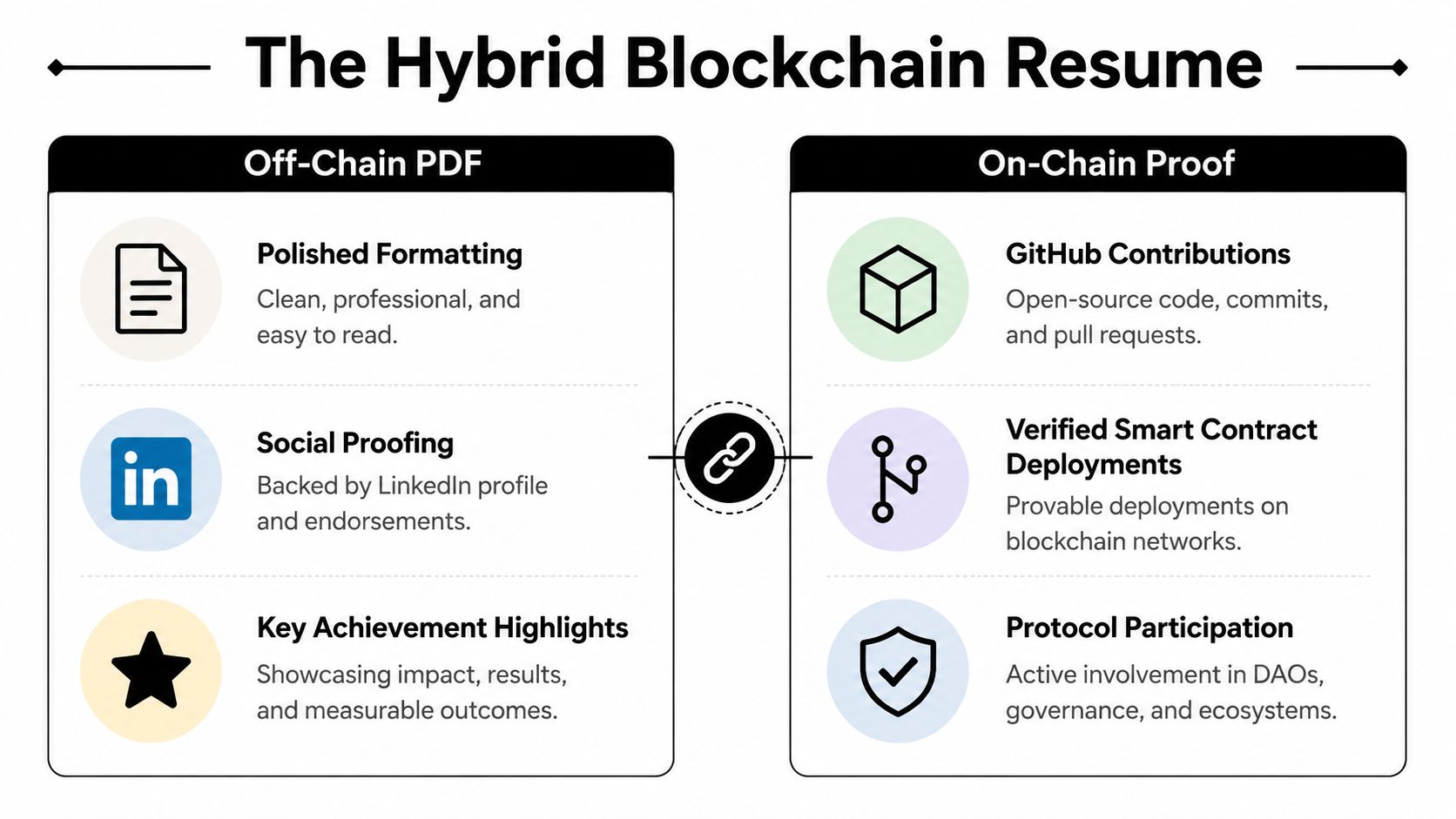
What belongs on the off-chain resume
Your PDF has one job. Get a technical interview.
That means clear positioning, selective project history, and bullets built around outcomes. “Built smart contracts” is weak because it says nothing about risk, scope, or result. “Implemented role-based access control for a staking contract, added test coverage for pause paths, and reduced critical audit findings before deployment” gives a reviewer something concrete to assess.
Good bullets usually include three parts: the system, your contribution, and the measurable effect. The hiring advice in craft a tailored resume still applies here, but in Web3 the bar is higher because much of your work can be checked publicly. Keywords may get you through a filter. Evidence gets you through an engineer.
Use numbers only when they mean something and you can defend them. Gas reduction, test coverage growth, issues remediated, time to finality improved, failed transaction rate reduced, indexer latency cut. Those metrics map to how teams judge engineering work.
What belongs on the on-chain resume
This is the part that changes the conversation.
A strong on-chain resume gives a hiring manager links they can inspect without asking for access. If I open your application, I want to see proof in a few clicks, not a promise that proof exists somewhere.
Useful evidence includes:
- Verified contract deployments on explorers with readable source
- Merged pull requests in active repos, especially if they include tests and review discussion
- Public repos with setup instructions, architecture notes, and realistic test cases
- Audit work, including findings fixed, mitigations added, or threat models written
- Governance and technical forum posts that show protocol reasoning
- Dashboards, indexers, or analytics queries that expose live usage or contract behavior
For role discovery, remote blockchain engineering job listings also help you reverse-engineer what proof to highlight. Read five postings for the same kind of role and you will see the same patterns. Teams ask for Solidity, Foundry, upgradeability, and security review experience because those items affect delivery speed and incident risk.
What actually gets attention
Signal strength is not equal.
From what I have seen in hiring loops, reviewers respond fastest to work that is public, recent, and close to production conditions. A merged PR in a known codebase usually beats a polished portfolio page. A deployed side project with tests, docs, and verified contracts usually beats screenshots. A postmortem or design note that explains trade-offs can beat a long skills section.
The common thread is auditability. If a skeptical engineer can verify your best claim in five minutes, that claim has real hiring value.
A practical structure for the hybrid resume
Keep the off-chain version tight, then point outward to proof.
- Headline: one line that states your niche clearly, such as Solidity smart contract engineer, Solana Rust developer, or full-stack Web3 engineer
- Core stack: languages and tools you can discuss under pressure
- Selected work: two to four projects with scope, outcome, and links to evidence
- Proof links: GitHub, explorer pages, audits, dashboards, technical writeups
- Context: what problem you solved, what constraints mattered, and what changed after your work shipped
If you do not have paid production experience yet, create public work that looks reviewable. Deploy to a testnet or public chain, verify contracts, write a README another engineer could use, and show failure handling, not just happy-path demos.
That is the genuine advantage of an on-chain resume. It turns “junior but promising” into “worth interviewing because the work is visible.”
Strategic Hunting Where to Find Legitimate Remote Roles
The worst way to search for blockchain developer remote jobs is to scatter applications across generic boards and hope volume wins. It usually doesn't. You spend hours filling forms and get filtered out by people who can't evaluate your actual skill.
A better approach is to hunt in channels where crypto-native teams already expect to find crypto-native candidates.
Compare the main channels before you spend time
| Channel | Good for | Weakness |
|---|---|---|
| Specialized Web3 job boards | Fresh role discovery, category filtering, remote-specific searches | Public roles attract a lot of competition |
| Protocol Discords | Unlisted openings, contributor visibility, technical context | Easy to lurk without becoming visible |
| DAO and ecosystem communities | Relationship building, early trust, contributor paths | Less structured than standard recruiting |
| X and Farcaster | Public technical presence, warm introductions, role signals | Noise is high if you don't curate well |
| Generic job sites | Broad visibility | Lower signal, more irrelevant listings |
Niche boards are useful because they keep you close to actual market demand. If you want a direct engineering feed, use remote-friendly blockchain engineering listings as one source alongside other crypto-native boards. The point isn't loyalty to one channel. The point is reducing junk.
Community participation beats passive applying
Some of the strongest opportunities never become formal listings for long. A team notices someone answering technical questions in their Discord, reviewing an improvement proposal, shipping a small contribution, or posting a clean breakdown of a protocol design choice. That person is no longer just an applicant. They're already adjacent to the work.
A few examples of useful behavior:
- Join protocol communities you use. You'll sound sharper because you understand the product.
- Comment on technical issues carefully. Don't posture. Add signal.
- Contribute docs, tests, or small fixes. Lightweight contributions still build trust.
- Ask better questions. Good questions reveal system understanding.
The fastest way to stop looking like an outsider is to start acting like a contributor.
What not to do
Don't spray the same resume everywhere. Don't cold-message founders with “GM ser, hiring?” Don't claim expertise in every chain, every VM, and every tooling stack. And don't hide in private repos if you're trying to break in.
Public relevance wins. Quiet competence wins. Repetition without evidence doesn't.
The Remote Interview Playbook From Code Challenge to Offer
Remote interviews in Web3 usually expose the same thing: whether you can think clearly in a distributed environment while handling code that can't afford sloppy mistakes.

The format varies, but the pattern is familiar. Recruiter screen. Technical screen. Take-home or live coding. Architecture or system design. Team fit. Offer discussion.
The technical screen is filtering for sharpness, not theater
The strongest candidates narrate trade-offs. They don't just dump an answer.
If you're solving a Solidity exercise, explain why you chose a storage layout, why you emitted a certain event, what assumptions you're making about external calls, and where you'd harden the code before production. If you're interviewing for an application role, talk about wallet handling, indexing delays, front-end state consistency, and failure states.
23stud's hiring strategy writeup says that 65% of candidates fail live coding challenges because of problems like unoptimized reentrancy guards or improper event emissions. The same source says candidates with audited protocol contributions deliver MVPs 2.5x faster after hire. That tracks with how interviewers think. Public evidence of careful work lowers perceived hiring risk.
What the stages usually test
- Recruiter or hiring screen: Can you explain your background crisply, especially your niche?
- Live coding: Can you write safe code while talking through it?
- Take-home: Can you structure work cleanly without hand-holding?
- System design: Can you reason about contracts, indexing, backend services, and user flows together?
- Team interview: Can you operate asynchronously and communicate without drama?
A lot of candidates prepare only for syntax. That's a mistake.
How to prepare for the part most people botch
Use realistic practice. Debug a vulnerable contract. Write tests before patching. Explain your event schema out loud. Build a small flow end to end, then review your own work like an auditor.
If you want extra reps on communication under pressure, some candidates use resources focused on Coding interview assistance to sharpen explanation, structure, and mock responses. That can help, but only if the underlying code quality is real.
Here's a useful benchmark for yourself:
If an interviewer asks “why did you do it this way?” and your answer is “that's how the tutorial did it,” you're not ready.
A strong answer sounds more like this: “I used pull over push for payouts because I don't want one failing external call to block the whole flow. If this were production, I'd also add more invariant tests around withdrawal behavior.”
The video below is worth watching with that lens. Don't watch for magic questions. Watch for how strong candidates communicate decisions.
Remote-specific signals hiring managers notice
A distributed team also notices non-code details:
- Written follow-up quality
- How clearly you explain blockers
- Whether your take-home is documented
- How responsibly you discuss security uncertainty
Being fast helps. Being legible helps more.
Negotiating Your Offer Beyond Just the Salary
A remote Web3 offer almost never comes down to base salary alone. If you negotiate like it's a standard software package, you'll miss the parts that shape long-term upside and day-to-day working conditions.

According to Algorand's 2025 blockchain developer salary and job outlook, typical remote blockchain developer salaries benchmark between $130,000 and $270,000, often with token equity on top. The same source notes that specialized roles like security auditors can reach $600,000.
Read the package like an engineer
Break the offer into components:
| Offer component | What to check |
|---|---|
| Base salary | Is it aligned with your niche and seniority? |
| Token package | What's the vesting schedule, and what triggers vesting? |
| Bonus structure | Is it discretionary or tied to specific deliverables? |
| Remote setup support | Equipment budget, home office support, coworking support |
| Work expectations | Time-zone overlap, travel, on-call expectations, offsites |
Compensation becomes a practical matter here. A lower base with a vague token story can be worse than a cleaner cash-heavy offer. A high headline number can also hide painful expectations around hours, travel, or overlap.
Questions worth asking directly
Ask these before you sign:
- How do you value the token component internally?
- What happens to vesting if the role changes or the team restructures?
- How much overlap is expected each week?
- How often do engineers travel for offsites or incidents?
- What does success in the first months look like?
These aren't awkward questions. They're the questions of someone who has worked in remote teams before.
For salary context beyond the broad benchmark above, it helps to review a dedicated blockchain developer salary guide and compare it against the role's exact scope. Security-heavy work, protocol ownership, and hard-to-find language expertise usually justify a stronger ask than a generic application role.
The cleanest negotiation posture is simple: tie your ask to the role's risk, ownership, and scarcity.
What works in negotiation
Don't negotiate by bluffing. Negotiate by framing.
Explain the evidence: your audited work, your public proof, your niche fit, and the kind of responsibilities you'll own. If the team wants someone who can safely ship production smart contracts with minimal supervision, that's not entry-level labor. Price accordingly.
Thriving in Your First 90 Days and Beyond
Getting hired proves potential. The first three months prove reliability.
In remote blockchain teams, people trust what they can see. Clear updates, thoughtful PRs, accurate estimates, and steady delivery matter more than sounding impressive in meetings.
The first month is about map-making
Start by understanding the system before trying to redesign it.
Read old PRs. Read incident notes if they exist. Trace how contracts, indexers, APIs, and frontend components connect. Learn where the team stores decisions and how they discuss changes. If the codebase uses Notion, GitHub issues, Discord threads, and internal docs in parallel, figure out what belongs where.
Your first win should be small enough to ship safely but real enough to matter. Fixing a flaky test suite, cleaning deployment scripts, tightening event consistency, or improving internal tooling often earns more trust than chasing a flashy feature.
The next month is about becoming predictable
Once you know the terrain, optimize for consistency:
- Write updates that remove ambiguity. Say what you did, what's blocked, and what's next.
- Leave clean pull requests. Good summaries save reviewer time.
- Surface risks early. Security concerns and product edge cases shouldn't appear at the last minute.
The third month is where leverage starts
By this point, you should be shipping without constant guidance. You should also be building visibility the right way, not by self-promotion, but by making collaboration easier.
That usually means better docs, sharper reviews, cleaner interface boundaries, and clearer handoffs between contracts and application layers.
Remote engineers grow faster when they become easy to trust, easy to review, and hard to misinterpret.
Long term, your career compounds around visible proof. Keep a record of shipped work, public contributions you can discuss, and internal projects that show ownership. In this market, the next role often comes from the reputation trail you leave in the current one.
If you're actively looking for blockchain developer remote jobs, use Blockchain Jobs to scan current Web3 openings across engineering and related functions, then apply with a profile that pairs a sharp resume with auditable proof. That combination is what consistently gets attention.