
Chief Marketing Officer Average Salary: 2026 Outlook

The hardest part of discussing the chief marketing officer average salary is that the headline number often misleads people.
In the United States, average CMO base pay in 2026 spans a striking range, from $168,474 on Indeed to a $373,650 median on Salary.com, with top earners above $510,790, according to Indeed’s CMO salary overview. That spread is too wide to treat as a single market price. It tells you one thing clearly: title alone doesn’t determine compensation.
For Web3 operators, that matters even more. A protocol hiring its first real executive marketer isn’t buying brand stewardship in the old corporate sense. It’s buying community trust, launch execution, token narrative discipline, analytics fluency, partner positioning, and often crisis management across Telegram, X, Discord, governance forums, and investor calls. That bundle prices differently from a classic enterprise CMO role.
Decoding the Chief Marketing Officer Average Salary in 2026
CMO pay in 2026 still spans a very wide band, and that gap matters more in Web3 than in almost any other hiring category.
Averages hide the variables that move offers. Company stage, ownership of revenue versus brand, hiring geography, team size, board exposure, and the mix of cash, equity, and tokens all change the number. A generic benchmark may help set expectations, but it does not price a role accurately.
In Web3, the spread gets wider because the brief is wider. Boards are often hiring one executive to cover brand strategy, product marketing, ecosystem growth, community trust, launch coordination, partner positioning, and reputation management during volatile market cycles. That is a different job from a traditional enterprise CMO role with a large in-house team and stable channels.
I tell candidates and founders to treat salary data as a reference band, then pressure-test the role against the actual work. If the company expects one person to build demand, shape token narrative, manage exchange-facing messaging, and steady the community during drawdowns, the title alone is not enough to benchmark compensation.
That framing improves both negotiation and hiring plans. Candidates present a stronger case when they tie prior wins to scope and business risk. Hiring teams avoid weak offers when they compare against active Web3 marketing roles instead of broad marketing averages that ignore token exposure and remote-first competition.
Comp strategy also borrows from adjacent marketing salary playbooks. Practical tips to boost marketing earnings can sharpen how senior marketers position outcomes, especially when their remit cuts across growth, brand, partnerships, and revenue.
Practical rule: use the average as orientation, then price the role based on scope, volatility, and the cost of getting the hire wrong.
Beyond the Base Salary A CMOs Total Compensation Package
A CMO offer is a portfolio, not a paycheck.
Candidates who focus only on base salary usually miss where real upside or real risk sits. Founders make the opposite mistake. They assume an impressive token or equity story can compensate for a weak base. Sometimes it can’t. A senior executive still has bills, opportunity cost, and reputation risk.
The three layers of compensation
Think of compensation like building a house.
The base salary is the foundation. It’s the stable cash component that pays for predictability. This matters more than people admit, especially in volatile sectors where the company may still be proving product-market fit, token utility, or compliance durability.
The bonus or short-term incentive is the operating system. It should connect directly to measurable executive outcomes. In mature companies, that may tie to pipeline quality, customer acquisition efficiency, retention, or launch performance. In Web3, it often needs a more customized scorecard.
The equity or token component is the roof. It’s where long-term upside sits, but it’s also where misunderstanding causes expensive mistakes. Equity and tokens aren’t interchangeable. Equity usually tracks company value over time. Tokens may carry liquidity potential, but they also bring volatility, vesting schedules, governance questions, and market-structure risk.
What candidates should actually evaluate
A good CMO doesn’t just ask, “What’s the number?” A good CMO asks how the package behaves under pressure.
Use this checklist in interviews:
- Base stability: Is the base high enough that you’re not forced to overvalue speculative upside?
- Bonus design: Are performance targets within your control, or are they dependent on engineering delivery, treasury decisions, or broad market conditions?
- Long-term incentive quality: If the company offers equity or tokens, what creates value and what destroys it?
- Vesting mechanics: How long before meaningful ownership accrues, and what happens if strategy changes?
- Exit pathways: Is there a realistic path to realizing value, or is the upside mostly narrative?
Here’s a simple comparison framework.
| Component | Growth Tech CMO (Series C) | Established CPG CMO |
|---|---|---|
| Base salary | Usually designed to attract a builder with some cash certainty | Usually designed around a more stable executive pay structure |
| Annual bonus | Often tied to growth, launch, pipeline, market expansion, or category creation | Often tied to revenue, brand health, market share, and team performance |
| Equity or token upside | More central to the package, but requires careful diligence | Often more standardized and easier to benchmark |
| Risk profile | Higher operational and compensation volatility | Lower volatility, but sometimes less asymmetric upside |
| Negotiation leverage | Scope, stage fit, and growth narrative matter heavily | Prior title, company scale, and category track record often matter more |
What works and what fails
What works is alignment. The company defines a clear remit, funds the role properly, and ties upside to outcomes the CMO can influence.
What fails is symbolic compensation. That’s when a startup offers a broad title, an under-market base, and a vague token promise with little clarity on issuance, vesting, or liquidity. Experienced candidates see through that fast.
A strong package is coherent. Every piece should tell the same story about scope, trust, and expected impact.
What Drives CMO Salary The Four Core Influencers
At the executive level, small differences in role design can create six-figure differences in pay. The title stays the same. The mandate does not.
A board hiring a CMO to rebuild growth, fix positioning, and recruit a leadership bench is buying a different operator from a board hiring someone to manage a mature team and protect an existing revenue engine. That is why average salary figures are only useful if they are tied to scope.
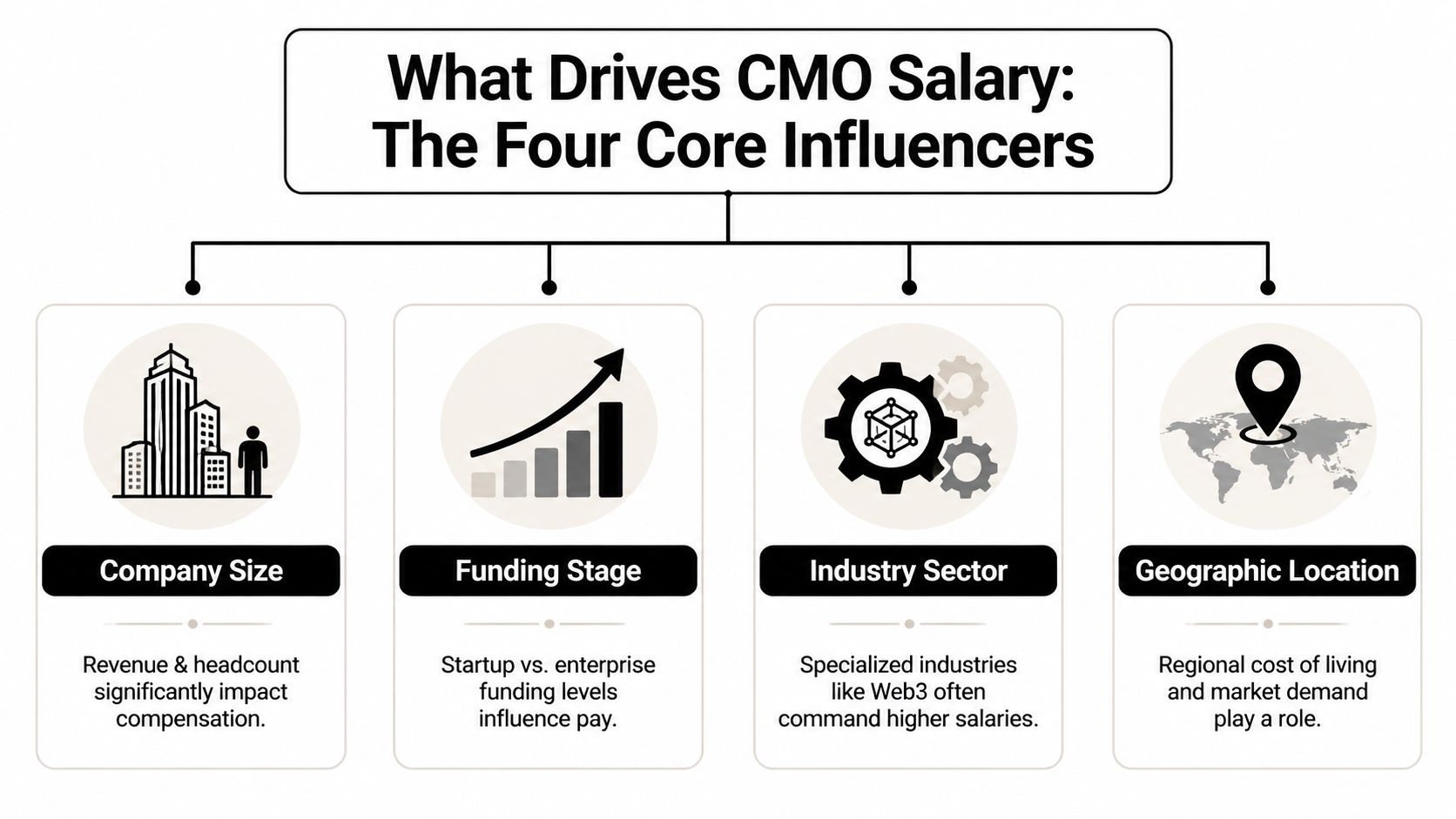
Company size
Scale changes the job faster than any title rubric does.
BrainWorks reports that CMO compensation ranges from $210,000 to $313,000 at companies with $20M to $50M in revenue and rises to over $720,000 at companies above $1B in revenue, according to its CMO salary analysis by company revenue. That gap reflects more than prestige. Larger companies usually expect tighter forecasting, more board exposure, more risk management, and leadership across a wider set of functions.
Revenue is only part of it. Team complexity matters too. A CMO who directly oversees product marketing, brand, lifecycle, paid media, analytics, communications, and regional leads is doing more managerial and political work than a hands-on executive at a smaller company.
In hiring, I look past headcount and ask one question first. How many business problems sit inside this role?
Funding stage
Stage affects both compensation mix and the company’s tolerance for imperfection.
Earlier-stage businesses often want a builder. They need someone who can sharpen messaging, pressure-test acquisition channels, hire carefully, and work closely with founders before the function is fully built. Base salary can be tighter, but the role often carries more strategic influence and more upside if the company grows.
Later-stage companies buy consistency. They expect operating cadence, cleaner attribution, disciplined budget allocation, and fewer surprises in front of investors or the board. That usually supports a stronger cash package because the company is paying for proven pattern recognition at scale.
Candidates lose money. They describe achievements without translating them into stage fit. If a company needs a CMO who can steady post-Series B growth after a costly launch, broad brand wins at an enterprise software company will not close the gap on their own.
Industry sector
Industry specialization affects pay because replacement risk is different.
A consumer brand CMO may be strong in retail, media buying, and brand architecture. A SaaS CMO may be stronger in pipeline, product marketing, and sales alignment. A Web3 CMO usually needs some combination of community leadership, ecosystem partnerships, founder communications, launch timing, and trust management during volatile market cycles.
That mix is rare. It raises compensation when the business has a genuine need for it.
For blockchain companies, I advise founders to separate real category needs from wish lists. If the role is mainly growth marketing with some community exposure, pay for that profile. If the executive must handle token narrative, exchange relationships, governance communication, and ecosystem expansion, the budget should reflect a narrower talent pool. Roles like Celestia Labs Head of Marketing openings in the blockchain market show how often Web3 companies blend classic marketing leadership with ecosystem and category-building demands.
I use four filters when assessing whether an industry premium is justified:
- Category fluency: Can the candidate explain the adoption motion clearly, including who joins, buys, stakes, trades, or builds?
- Channel credibility: Have they led the channels that matter in this market?
- Cross-functional trust: Can they work with product, founders, BD, legal, and community leads without constant friction?
- Operating tempo: Have they handled a market where narrative and sentiment can shift in days, not quarters?
Geographic location
Location still matters, but the logic has changed.
Large metro benchmarks continue to shape executive expectations. Remote-first hiring has not erased that. It has made compensation policy more exposed. If a company says it hires globally but subtly anchors offers to one low-cost region, senior candidates notice fast.
Web3 teams have an added complication. They often recruit across multiple countries, pay in a mix of fiat and token incentives, and compete for a small pool of executives who can lead remote organizations without heavy in-office infrastructure. In practice, many of these companies are not paying for zip code alone. They are paying for scarcity, timezone coverage, and the ability to manage a distributed market presence.
The cleanest approach is to choose one compensation philosophy early. Geography-based, national remote, or premium-for-scarce-experience can all work. Problems start when companies switch models midway through the process or try to justify a discounted base with vague upside. Senior marketers read that as uncertainty, and uncertainty slows hiring.
The Web3 Premium How Blockchain CMO Salaries Are Different
Generic CMO salary guides help, but they don’t capture the full economics of a serious Web3 marketing role.
The reason is simple. Web3 marketing isn’t just marketing. In many companies, it’s part market education, part community governance, part ecosystem activation, and part reputation defense. The executive leading that function often operates closer to a general manager than a classic brand chief.

Why the premium exists
Traditional salary data often misses blockchain-specific upside. In the Web3 market, niche expertise in DeFi and NFTs can command a 20 percent to 50 percent premium, and smaller firms often include meaningful token incentives that generic salary guides don’t model, according to PayScale background referenced for CMO compensation context/Salary).
That premium doesn’t appear because companies are being generous. It appears because qualified talent is scarce.
A strong Web3 CMO usually brings several of these capabilities at once:
- Token literacy: They can explain token utility, emissions, incentive design, and market perception without turning every message into jargon.
- Community judgment: They know when to involve Discord mods, ecosystem contributors, governance participants, and founders, and when to protect message discipline.
- Launch mechanics: They can coordinate product marketing, partnerships, social narrative, and community timing around launches that can’t afford sloppy execution.
- Reputation management: They’re comfortable communicating through volatility, security concerns, liquidity questions, and governance tension.
That mix is hard to hire for. It’s even harder to verify in interviews.
Tokens change the compensation conversation
In Web2, executives usually understand how to think about salary, bonus, and equity. In Web3, the package often includes tokens, and that changes risk.
A token grant can be attractive, but only if the candidate understands what they’re being offered. The right questions are operational, not just financial:
- What triggers vesting and when does it start?
- What happens if token issuance timing changes?
- Is the allocation fixed or subject to board or governance revision?
- How should the executive think about liquidity risk versus paper value?
- Does the token have a clear role in the product or ecosystem narrative?
Candidates should also separate emotional excitement from compensation quality. A famous protocol name doesn’t automatically create a strong offer.
If you want a real-world feel for how specialized these roles can look in market, review a live Head of Marketing opening at Celestia Labs. Roles like that often blend category building, technical translation, ecosystem storytelling, and leadership across distributed teams.
What Web3 companies get wrong
The biggest hiring error is replacing cash with hope.
Founders sometimes assume a mission-driven candidate will accept a compressed base because the token package could be valuable later. Senior operators rarely make that trade without clear logic. They know token upside may be real, but they also know treasury policy, vesting schedules, exchange conditions, and broader sentiment can all change.
A better approach is to build compensation around credibility. The company pays enough cash to respect executive seniority, then uses tokens to align long-term upside.
This video is useful context for anyone evaluating executive compensation and role scope in modern marketing leadership.
How candidates should frame Web3 experience
Many candidates undersell themselves by describing Web3 work as “community-led marketing” and stopping there.
That leaves money on the table. The stronger framing is business-facing. Talk about market education, category creation, partner activation, launch sequencing, user trust, narrative control, and measurable adoption signals. The board doesn’t pay premium executive compensation for vibes. It pays for strategic clarity and execution in a difficult market.
If your Web3 experience reduced confusion, improved market understanding, strengthened launch discipline, or built durable user trust, that’s executive-grade value. Say it that way.
Calculate Your CMO Salary A Practical Benchmarking Guide
Most senior candidates don’t need more salary data. They need a process.
The practical way to benchmark your compensation is to build your own range from the role outward. Start with market anchors, then adjust for stage, scope, scarcity, and risk. This works better than pulling one average from a search result and treating it as definitive.

Step one, define the actual job
Start by ignoring the title.
A “CMO” role can mean executive strategist, first marketing leader, player-coach, or scaled functional manager. Read the brief and classify the work:
- Builder role: You’re creating positioning, team structure, reporting, and early process.
- Scaler role: You’re inheriting a team and expected to install sharper systems and accountability.
- Transformation role: You’re fixing a stalled narrative, weak funnel, or fragmented org.
This one step changes your benchmark more than most candidates realize.
Step two, adjust for the hidden premium
Some compensation lifts don’t show up cleanly in standard salary pages.
Glassdoor-linked guidance in the verified data notes a 15 percent to 25 percent compensation boost for CMOs skilled in AI and ML-driven marketing analytics, and says over 70 percent of Web3 marketing executive roles are remote, which makes remote benchmarking a critical 2026 skill, as captured in the Glassdoor CMO salary context referenced here. If you lead with strong analytics credibility, attribution discipline, or AI-assisted marketing operations, you should price that into your range.
In practice, I’d ask:
- Do you know the tools? Think HubSpot, Google Analytics 360, product analytics platforms, CRM reporting, and AI-supported campaign workflows.
- Can you lead with evidence? It’s not enough to say you’re data-driven. Show how you manage decision quality.
- Are you built for distributed leadership? Remote executive work requires clearer writing, tighter operating cadence, and stronger stakeholder management.
Step three, build a negotiation band
Don’t walk into an interview with one number. Walk in with a range and a rationale.
A useful structure looks like this:
- Floor: The lowest package you’d accept if the role is unusually strong in learning, scope, or upside.
- Target: The package that reflects your actual market value.
- Reach: The package you pursue when the company is clearly buying scarce expertise.
The best candidates defend that band with logic, not emotion. They talk about business stage, functional breadth, market complexity, and the quality of the long-term incentive.
Step four, script the conversation
Most executives don’t lose advantage because they ask for too much. They lose advantage because they explain poorly.
Use language like this:
“Given the scope across brand, growth, product marketing, and executive leadership, I’m benchmarking this as a top-of-function role rather than a conventional department head.”
Or this:
“I’m open on mix, but I’d want the cash component to reflect the operating complexity of the role. Then we can structure upside around the long-term value I’d help create.”
If you want another negotiation lens outside pure marketing, StoryCV has a practical article on how to negotiate project manager salary. Different function, same core lesson: negotiations improve when you tie pay to scope, accountability, and measurable value.
Step five, pressure-test remote offers
Remote executive packages can look attractive until you test the assumptions.
Check whether the company benchmarks globally, nationally, or by location tier. Ask how often leadership meets in person, who owns cross-time-zone decisions, and whether the compensation philosophy changes after relocation or expansion. Remote can widen your opportunity set, but it can also hide pay inconsistency.
Negotiating Your Next Role Tips for Web3 CMO Candidates and Hirers
The final stage of compensation work isn’t analysis. It’s execution.
Candidates either translate their story into executive value or default to broad claims about “growth” and “brand.” Similarly, hiring teams either design an offer that closes or spend weeks losing strong finalists to better-structured packages.

For candidates
In Web3 startups, compensation should include meaningful variable pay. Apex CMO Search notes that 40 percent variable pay tied to on-chain metrics like wallet growth or TVL uplift can make sense, while smaller firms with 10 to 49 staff average $103,458 base plus $14,885 bonus, a level that usually must be increased and structured more creatively to attract strong crypto-native leadership, according to Apex CMO compensation data by organizational size.
That has two implications for your interview strategy.
First, don’t negotiate only the base. If the company wants executive-grade output, ask how incentive pay connects to actual business results and whether those results are within your span of control.
Second, force clarity around the scoreboard. In Web3, a vague variable plan is often worse than a smaller but cleaner one.
Ask questions like these:
- What exact metrics determine variable pay?
- Which metrics are marketing-owned versus cross-functional?
- How often are targets reviewed?
- Who can change the targets?
- How does token or equity value interact with bonus expectations?
For candidates moving from Web2, the key is translation. Don’t say you “managed community.” Say you led user trust, launch communication, ecosystem engagement, and market education across distributed channels. Don’t say you “worked with product.” Say you shaped adoption narratives with product and founder stakeholders.
If you want to understand how adjacent strategic marketing leadership roles are being framed in crypto hiring, review a current Product Marketing Director role at Fireblocks. You’ll see how often business positioning, technical fluency, and executive communication overlap.
For hiring teams
Most hiring teams lose strong CMO candidates for predictable reasons.
One is under-scoped budgeting. The company wants a category-defining operator but budgets for a senior director. Another is poor incentive design. The package includes bonus or tokens, but the value logic is murky and the candidate can’t tell what they’re really being asked to bet on.
A better hiring process does three things well:
- Set the mandate early: Is this person building the function, scaling it, or repairing it?
- Define the scorecard: Tie incentives to a limited number of outcomes that leadership agrees matter.
- Balance cash and upside: A serious CMO offer usually needs both, especially in volatile sectors.
What closes executive candidates
Senior marketers don’t accept offers just because the package is large. They accept when the company looks credible.
Credibility comes from alignment between role, expectations, budget, and authority. If the CMO owns growth, let them influence product launches, external narrative, and team design. If they’re being paid on on-chain adoption goals, make sure analytics, community, and product teams are structurally able to support those goals.
Operator’s note: The fastest way to lose a senior finalist is to present compensation as flexible while leaving scope, reporting lines, and success metrics unresolved.
Frequently Asked Questions About CMO Compensation
Is there a single reliable chief marketing officer average salary?
No. The title spans very different jobs. A first marketing executive at a startup, a scaled SaaS leader, and a public-company CMO may all share the same title but carry very different scope, risk, and compensation structure. Use averages as orientation, not as a final benchmark.
Do Web3 CMOs need a technical background?
Not always. They do need enough technical fluency to work credibly with product, founders, ecosystem teams, and advanced users. The strongest non-technical candidates usually win by translating complexity clearly, not by pretending to be engineers.
Should I value tokens the same way I value equity?
No. Tokens and equity behave differently. Candidates should ask how value accrues, what vesting looks like, what can change, and what practical path exists to realizing upside. If the company can’t explain that clearly, the package needs closer scrutiny.
Can a Head of Marketing step into a CMO salary band?
Yes, if the scope is already executive in practice. That usually means ownership across strategy, team leadership, cross-functional influence, budget decisions, and measurable business outcomes. The title matters less than the operating reality.
What’s the best interview move when salary comes up early?
Anchor to scope first. A strong response is to say you’d like to understand mandate, reporting line, team maturity, and incentive design before locking into a number. That keeps the conversation strategic and safeguards your advantage.
Are remote Web3 roles easier or harder to benchmark?
Harder, because location, scarcity, and company philosophy all affect the offer. Candidates should ask whether the company pays by geography, by role level, or by strategic importance. That answer often reveals whether the offer will be coherent.
If you’re exploring your next move in crypto marketing leadership, Blockchain Jobs is one of the better places to track roles across Web3, from community and product marketing to senior executive mandates. For candidates, it’s a clean way to monitor how teams describe scope, seniority, and remote expectations. For hiring companies, it puts openings in front of a crypto-native audience that already understands the difference between generic marketing and true ecosystem growth.