
Crypto Product Manager Jobs: A Practical Hiring Roadmap
You're a mid-career product manager at a fintech company, scrolling through crypto vacancies and finding that the title tells you almost nothing. One posting expects order-book microstructure, another wants smart-contract fluency, and a third is really an institutional custody role disguised as a general product position. You've shipped products before, but you're not sure which experience will transfer or how to prepare without spending months learning the wrong domain.
That confusion is reasonable. Crypto product manager jobs are a search term, not a single job. The market includes DeFi protocols, exchanges, custody platforms, tokenized assets, and developer infrastructure, each with different users, risks, metrics, and interview expectations. The practical move is to choose a sub-track first, then build your skills, portfolio, résumé, and interview stories around that lane. Current listings reflect this fragmentation, with roles across ecosystem, asset management, DeFi, API, trading, and developer-platform products at companies including Morpho, MoonPay, Bitpanda, Binance, Coinbase, and OKX (current crypto product management listings).
Why Crypto Product Manager Jobs Are a Sub-Specialty Play
A fintech PM moving into crypto often starts with the wrong question: “How do I become a crypto product manager?” The better question is, “Which crypto product problem am I prepared to own?”
A trading PM manages execution, liquidity, market structure, and the consequences of latency or poor order handling. A DeFi PM works with protocol parameters, smart-contract risk, governance, and incentives that can change user behavior. A custody PM may spend more time on permissions, key management, institutional controls, and operational resilience than on consumer growth. An ecosystem PM might build tools for developers, partners, and communities rather than a conventional end-user application.
Those roles share product fundamentals, but the day-to-day work differs sharply. The user research methods, technical conversations, success metrics, and failure modes all change with the product surface. A candidate who sounds compelling for a brokerage product can still appear unprepared for a lending protocol if they can't explain liquidation risk or governance dependencies.
Practical rule: Choose the product surface before choosing the job title.
That decision should shape every career asset. Your résumé should foreground the experience that transfers to the chosen lane. Your case study should demonstrate the relevant trade-offs. Your interview preparation should focus on the mechanisms that can break that product, not on crypto vocabulary collected from whitepapers.
A useful starting point is to review specialist blockchain product opportunities and career context, then compare active roles by their actual responsibilities rather than their titles. The sections that follow use the same filter: identify the lane, understand its hiring bar, create evidence of fit, and target employers where your existing experience has the clearest bridge.
The Five Sub-Tracks Hiring Managers Actually Hire For
The fastest way to waste time applying for crypto product manager jobs is to treat every opening as interchangeable. Use the table below to identify where your experience has the strongest transfer.
Crypto Product Manager Sub-Tracks at a Glance
| Sub-Track | Product Surface | Key Metrics | Best Background Transfer | Typical Hiring Bar |
|---|---|---|---|---|
| DeFi protocol PM | Lending, swaps, staking, liquidity, governance | Liquidity quality, utilization, protocol revenue, risk events, user activity | Fintech infrastructure, risk products, marketplaces, quantitative products | Protocol mechanics, smart-contract trade-offs, incentive design, governance judgment |
| Exchange and trading PM | Spot and derivatives trading, order books, onboarding, execution | Volume quality, spread, execution quality, deposits, retention, incident rates | Brokerage, exchange, payments, high-volume transactional systems | Market structure, APIs, reliability, compliance, data-driven prioritization |
| Custody and infrastructure PM | Wallets, custody controls, settlement, APIs, institutional workflows | Transaction reliability, authorization quality, integration success, operational risk | Banking platforms, payments, security, enterprise infrastructure | Architecture fluency, security thinking, institutional requirements, stakeholder management |
| Tokenized-asset and on-chain asset management PM | Tokenized funds, credit, real-world assets, issuance, reporting | Investor activity, liquidity, fee revenue, asset servicing quality, compliance readiness | Treasury, asset management, banking, payments, capital-markets products | Financial-market knowledge, regulatory awareness, lifecycle design, distribution |
| Ecosystem and developer-platform PM | APIs, SDKs, data tools, developer experience, partner programs | Developer activation, integration quality, API reliability, usage depth, partner success | Platform SaaS, cloud tools, developer products, technical partnerships | API and architecture understanding, developer research, documentation, ecosystem strategy |
A traditional exchange or brokerage PM often converts most directly into a trading role because the core questions already feel familiar: order handling, market participants, transaction flows, and operational controls. A banking treasury or payments PM may have a cleaner path into tokenized assets because they understand settlement, liquidity, financial controls, and institutional decision-making.
DeFi usually requires a deeper domain reset. A strong consumer PM can bring excellent experimentation and user research, but that experience won't compensate for an inability to reason about oracle dependencies, liquidity incentives, or protocol failure modes. Developer-platform roles reward a different transfer pattern. A platform PM who has shipped APIs and understands developers may be more credible than a consumer crypto enthusiast with no technical product history.
The hiring bar also varies by company maturity and scope. A role tied to credit, liquidity, developer platforms, or institutional trading will usually demand evidence beyond enthusiasm. A Coinbase role, for example, requires at least 5 years of product management experience and at least 2 years of crypto-industry experience, alongside deep knowledge of at least one segment such as DeFi, NFTs, or RWAs (Coinbase product manager role requirements).
Self-select before you rewrite your résumé. Pick one primary lane and, at most, a closely related secondary lane. Your interview preparation will become more precise immediately.
Core Skills Hiring Managers Screen For
Crypto PM interviews test whether you can make decisions where product behavior, financial incentives, technical constraints, and regulation interact. Score yourself against the six skills below, then identify the two that gate your chosen sub-track.
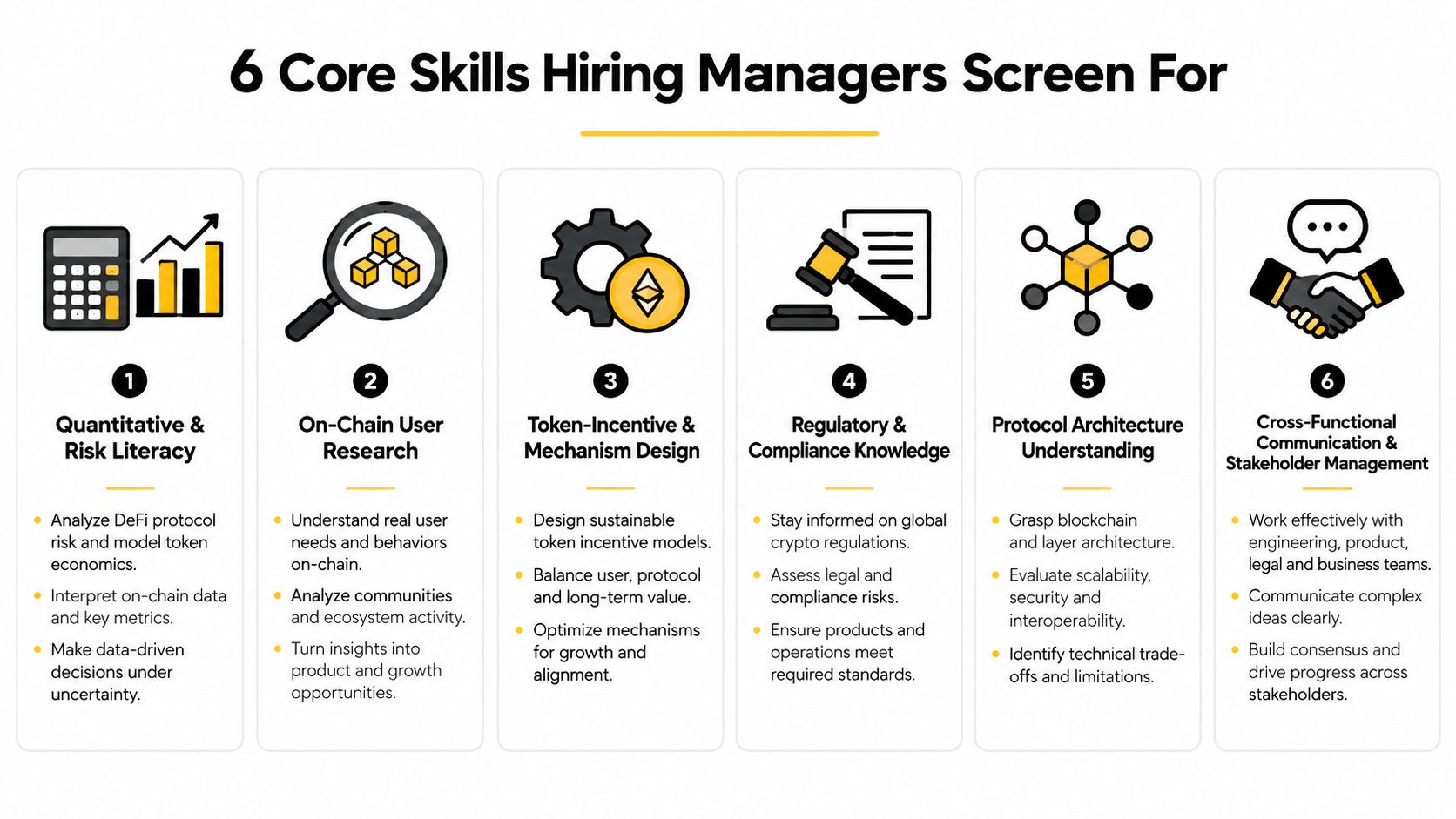
Quantitative and risk literacy
Strong candidates can reason through a liquidation cascade on a lending protocol, explain which assumptions drive the risk, and identify what data they'd monitor before changing a parameter. Weak candidates repeat total value locked or token-price narratives without connecting them to user exposure or protocol solvency. This skill is essential for DeFi, trading, and tokenized-asset roles.
On-chain user research
Good research goes beyond asking users what they want. It combines interviews with wallet behavior, transaction paths, failed actions, gas sensitivity, and the difference between a stated preference and an observed decision. A weak answer says “the community wants better UX” without naming the user segment, the friction, or the evidence. This matters across all five lanes, especially ecosystem and consumer-facing exchange products.
Token-incentive and mechanism design
A capable PM can explain who receives an incentive, what behavior it creates, how that behavior might be gamed, and what happens when the reward disappears. Hand-waving about “building community” won't pass for mechanism design. DeFi and ecosystem candidates need this most, while tokenized-asset PMs must connect incentives to liquidity and investor suitability.
Regulatory and compliance awareness
You don't need to act as legal counsel, but you must surface regulatory questions early and know when a product decision requires specialist review. Strong answers identify affected users, jurisdictions, disclosures, controls, and launch constraints. Evasive answers treat compliance as an obstacle to solve after launch. Coinbase's hiring guidance emphasizes communication, adaptability, resilience, and comfort with cryptocurrency's technical side, alongside strategic and analytical judgment (Coinbase PM interview guidance).
Protocol architecture understanding
For smart-contract teams, explain the relationship between contracts, oracles, upgrade mechanisms, interfaces, and external dependencies. For exchange or custody roles, demonstrate comfort with APIs, system architecture, transaction states, and operational failure. Candidates don't need to pretend to be engineers. They do need to ask precise questions and understand the consequences of technical choices.
Written decision-making under ambiguity
A strong written answer states the decision, alternatives, assumptions, risks, owner, and reversal conditions. A weak answer restates the whitepaper or lists features without prioritization. Technical crypto hiring often values structured thinking, data-driven prioritization, API knowledge, system architecture, SQL, compliance, and stakeholder management across global teams (Kraken product manager hiring guide).
For a broader hiring lens, this is also where skills-first hiring for HR leaders is useful. It encourages hiring teams to assess demonstrated capabilities rather than rely on title matching, which suits a market where adjacent experience often transfers unevenly.
Roadmapping Tokenized Products the Right Way
A SaaS roadmap can often treat incentives, governance, and operational risk as supporting work. A tokenized product can't. These elements influence adoption, liquidity, control, and the product's ability to respond when assumptions fail.
Start with three connected layers.
The user-facing layer
Map the wallet flow, fiat or crypto funding path, transaction confirmation, balances, permissions, and support experience. Write down where users can misunderstand settlement, fees, custody, or irreversible actions. For an institutional product, include reporting, approvals, account structures, and reconciliation rather than copying a consumer onboarding pattern.
The protocol layer
Document fee switches, emission curves, oracle dependencies, upgrade paths, contract permissions, and external integrations. Each feature needs a risk classification:
- Market risk: liquidity gaps, price movements, concentration, or incentive-driven behavior.
- Smart-contract risk: bugs, dependency failure, oracle manipulation, upgrade mistakes, or permission abuse.
- Regulatory risk: distribution, disclosures, suitability, custody, reporting, and jurisdictional restrictions.
The governance layer
Define who can propose, review, approve, delay, pause, or reverse a change. Timelocks, vote framing, emergency shutdown procedures, and delegated authority belong in the roadmap before launch. A governance process that exists only in documentation isn't a control. Test the operating path.
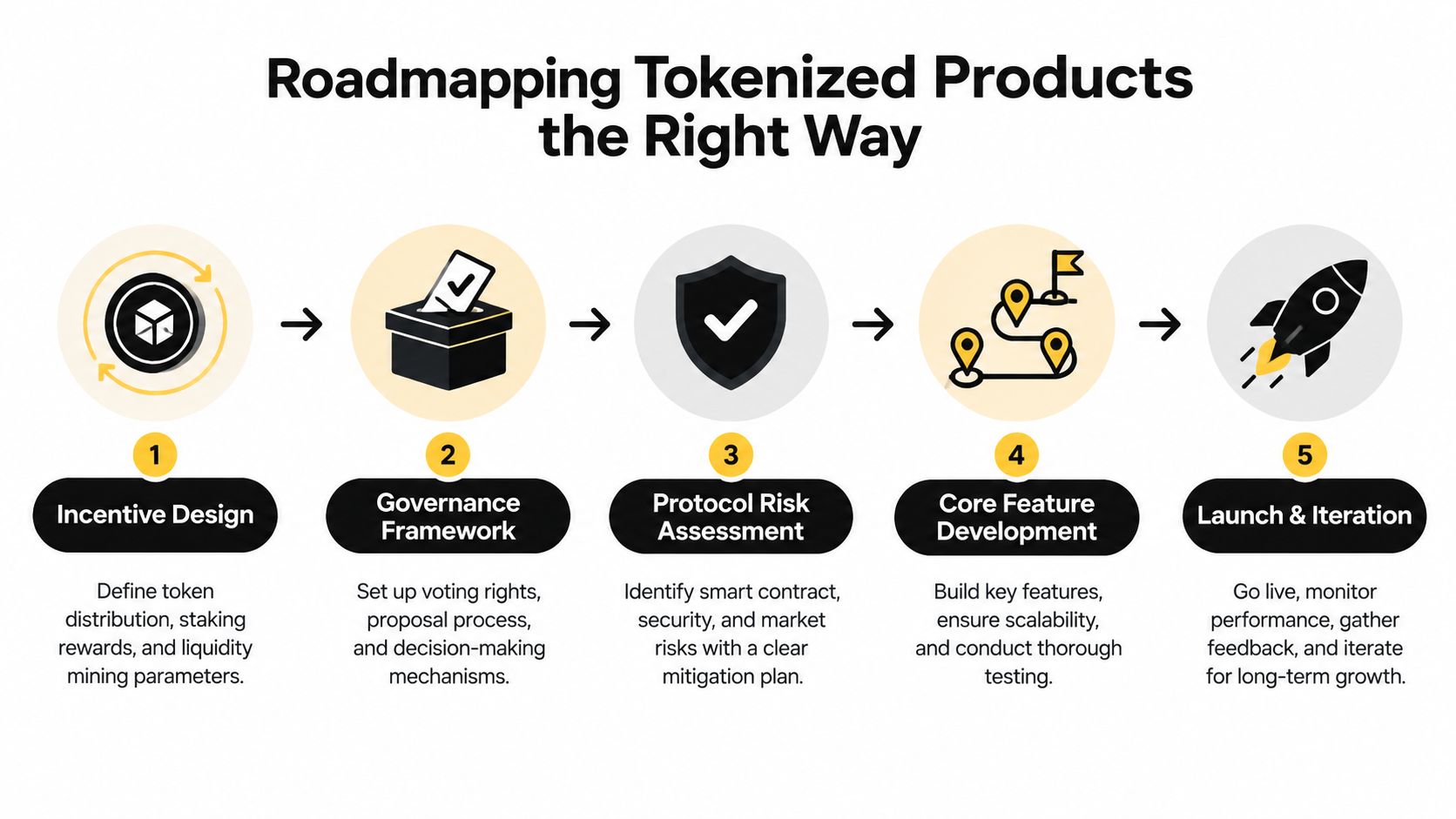
A closed beta with caps gives the team more control over exposure and parameter changes, but it may produce weak evidence about behavior at scale. An open mainnet with guarded parameters creates more realistic usage, while increasing the cost of an incorrect assumption. Neither option is universally correct. The choice should follow dependency maturity, audit progress, liquidity depth, and the team's ability to monitor and pause the system.
Hiring managers want artifacts that reveal how you think, not a polished feature list. Include a written incentive model, a governance vote summary, and a post-mortem of a parameter change. Before putting a feature into the current quarter, ask:
- Is the token supply or reward logic understood?
- Is there enough liquidity for the intended user behavior?
- Are critical dependencies mature and monitored?
- Are audit and pause-test exit criteria met?
- Can governance approve and reverse the change safely?
- Has compliance reviewed the affected user and distribution model?
For an example of a role focused on this domain, review the lead product manager position in tokenization. It illustrates why tokenized-product roadmaps require more than conventional feature sequencing.
Building Real Experience Without the Title
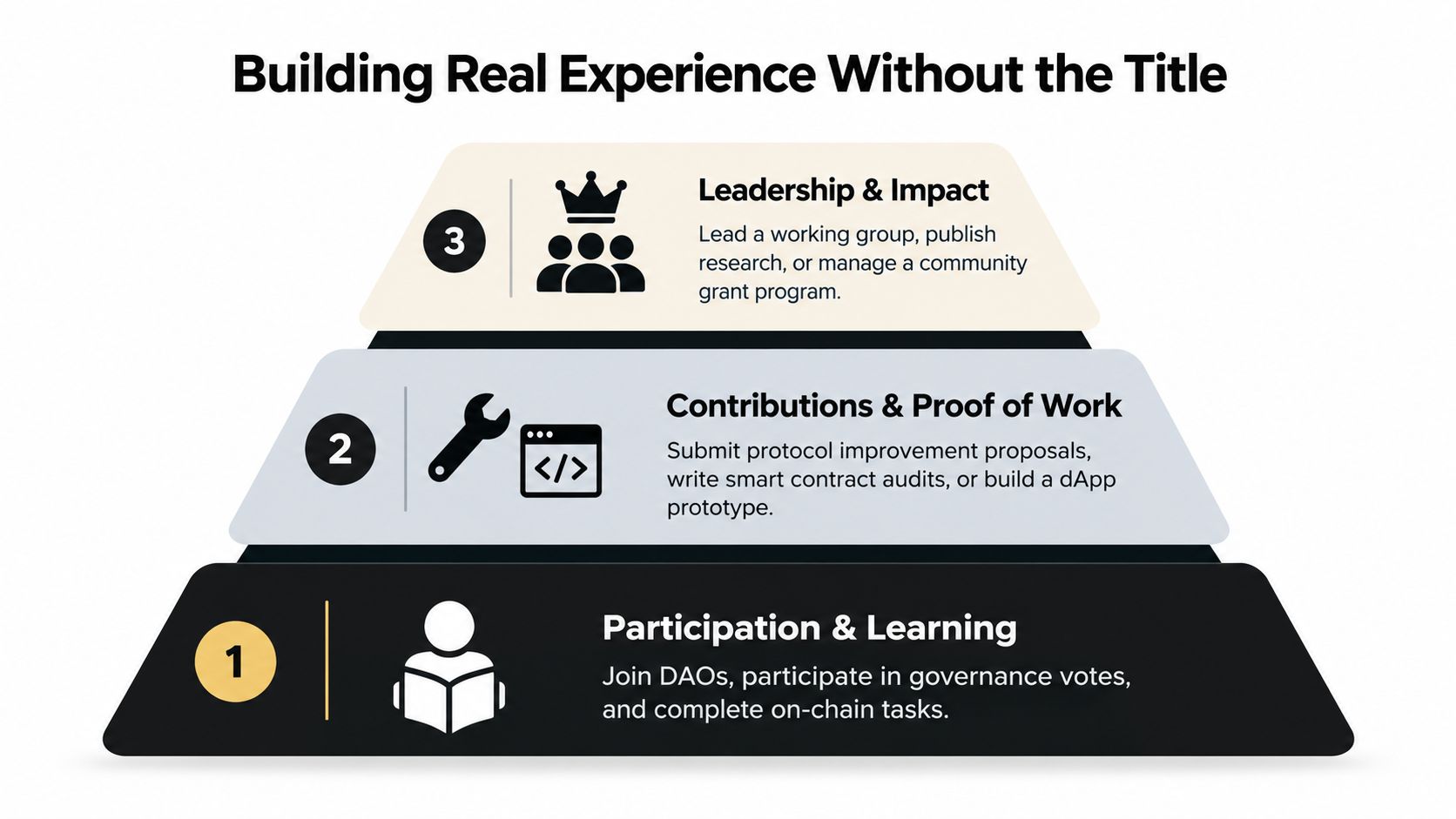
A candidate without a crypto title can still become credible, but passive learning won't do it. Hiring panels respond to shipped work, documented decisions, and evidence that other people engaged with your contribution.
Start with participation. Vote on DAO proposals, write useful forum comments, join testnets, study bug-bounty reports, and attend working-group calls. Capture the proposal link, your comment, the decision context, and what you learned. Participation alone won't qualify you for a senior role, but it gives you the vocabulary and observation base for better work.
The next level is contribution. Draft a governance proposal that receives substantive feedback, ship a small open-source tool, or build a dashboard tracking protocol KPIs. A DeFi candidate might create a dashboard showing utilization, liquidity composition, and parameter changes. An ecosystem candidate might improve an SDK example or document a confusing API flow. Preserve GitHub commits, dashboard links, forum threads, and review comments.
Ownership is the strongest signal. Lead a working group, own a feature shipped to a DAO treasury, or co-author a tokenomics review adopted by a team. Be precise about your role. If you contributed research but didn't make the final decision, say so. Inflated claims fail quickly when an interviewer asks who approved the change, what alternatives were considered, or which dependency caused the delay.
Turn proof into interview stories
Use STAR, but adapt it to protocol work:
- Situation: Identify the user, protocol, risk, and decision context.
- Task: State the outcome you owned, not the entire team's mission.
- Action: Explain your analysis, collaborators, trade-offs, and controls.
- Result: Show what changed, including limitations and follow-up work.
A practical four-week start looks like this:
- Week one: Choose a lane and study one protocol or product surface.
- Week two: Participate in governance, test a product, and document the user journey.
- Week three: Build a small artifact, such as a teardown, dashboard, or documentation improvement.
- Week four: Publish your reasoning, request feedback, and turn the work into a STAR story.
That sequence creates a footprint you can discuss, even before your résumé contains a crypto employer.
Resume, Case Studies, and Target Employers
A traditional SaaS résumé often hides the signals crypto hiring managers need. Replace broad claims about growth or engagement with evidence of how you handled financial flows, risk, permissions, incentives, data, or technical dependencies.
A payments PM should explain settlement, fraud controls, transaction reliability, and partner integrations. A marketplace PM can emphasize liquidity, matching, trust, and supply-demand dynamics. A platform PM should foreground APIs, developer workflows, documentation, and system constraints. Translate the experience, but don't relabel old work as protocol work you never did.
Case studies that survive scrutiny
The strongest portfolio usually includes two formats. First, write a one-page protocol decision memo covering an incentive change, parameter adjustment, or feature cut. State the problem, options, metric, reasoning, risks, approval path, and result or planned validation.
Second, produce a competitor teardown with a clear point of view. Compare user flows, custody assumptions, liquidity or integration dependencies, governance controls, and the product decision you'd make next. Avoid a feature-by-feature inventory. The panel wants prioritization.
| Employer Bucket | Example Companies | Typical PM Role | Hiring Velocity | Primary Screening Signal |
|---|---|---|---|---|
| Centralized exchanges | Coinbase, Kraken, OKX | Trading, onboarding, custody, payments | Structured and role-specific | Market structure, reliability, compliance, transactional scale |
| DeFi protocols | Uniswap, Aave, MakerDAO | Protocol mechanics, governance, incentives, risk | Community and domain dependent | Smart-contract reasoning, mechanism design, governance judgment |
| Infrastructure platforms | Alchemy, Chainalysis, Fireblocks | APIs, data, custody, developer and institutional tools | Technical and partnership-led | Architecture fluency, developer empathy, security awareness |
| Tokenized-asset firms | Securitize, Ondo, Maple | Issuance, asset servicing, credit, distribution | Finance and regulatory dependent | Capital-markets knowledge, lifecycle ownership, compliance judgment |
Hiring velocity and interview difficulty differ across these buckets. A centralized exchange may run a more formal loop, while a DeFi team may inspect your public work and governance reasoning closely. Infrastructure teams often probe technical fluency, and tokenized-asset firms may focus on regulated workflows and institutional stakeholders.
Remove generic “Web3 passion” statements unless they support a specific body of work. Never fabricate protocol experience, token launches, partnerships, or ownership. One accurate governance contribution is more persuasive than an inflated claim that collapses under basic follow-up questions.
Your 90-Day Job Search and Interview Plan
Run the search like a product operating rhythm, not a stream of disconnected applications. Choose the sub-track first, then make every research block, referral conversation, case study, and mock interview serve that choice.
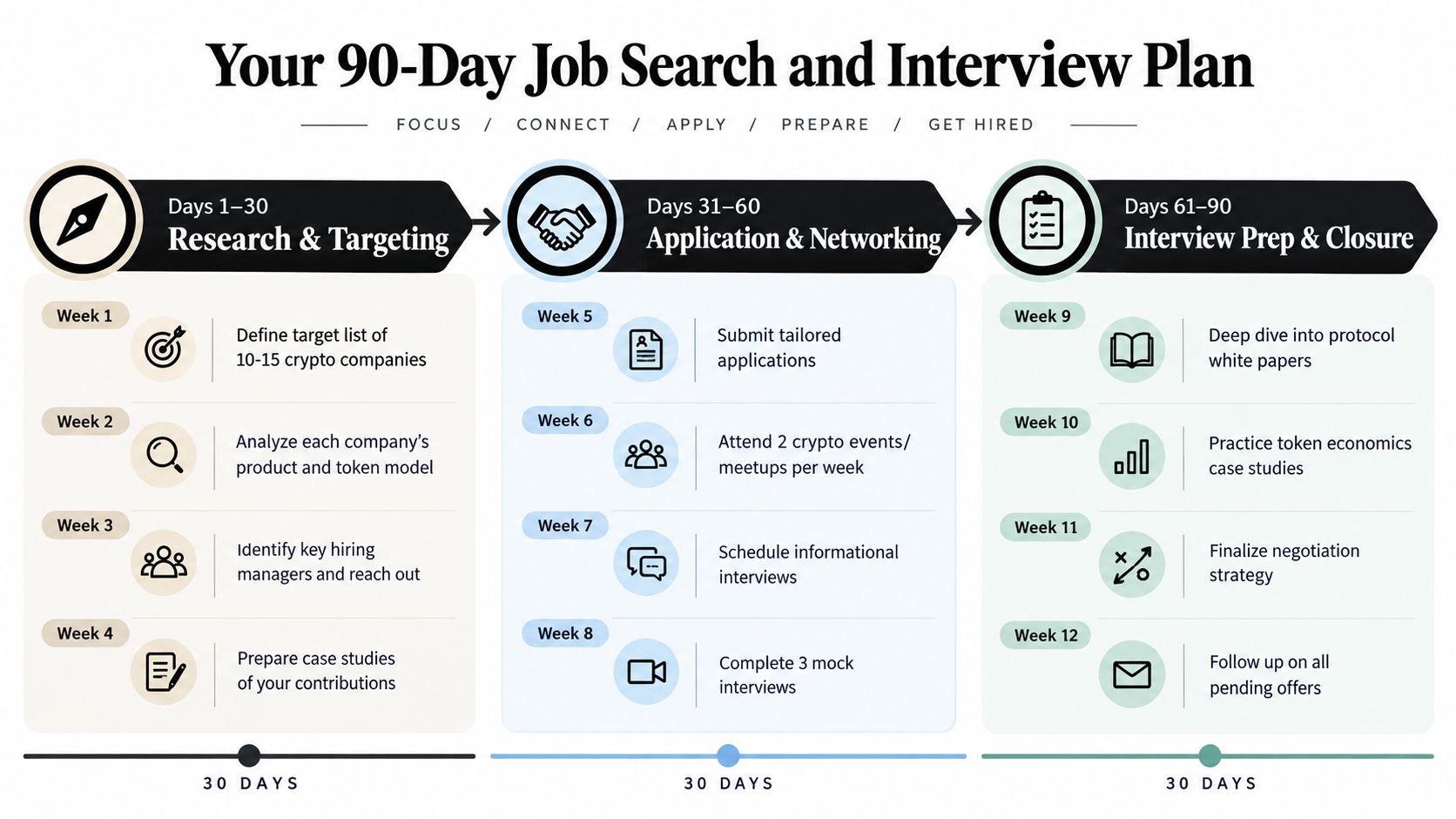
Days one through thirty
Build a focused target list rather than collecting every crypto vacancy. Study each company's product, user segment, token model if relevant, dependencies, and likely risk surface. Identify hiring managers and adjacent product leaders, then send outreach that references a real product observation.
Use the rest of this stage to polish two case studies. A trading candidate should prepare an onboarding or execution critique. A DeFi candidate should prepare a parameter or incentive decision. A developer-platform candidate should bring an API or integration teardown. A tokenized-asset candidate should demonstrate lifecycle and compliance thinking.
Days thirty-one through sixty
Submit applications with a résumé headline and evidence matched to the lane. Schedule informational conversations with people doing comparable work, not only recruiters. Use those conversations to test your assumptions about the role's actual scope.
Practice the prompts most likely to expose shallow preparation:
- Design an incentive for a lending or staking product.
- Critique an exchange onboarding flow.
- Prioritize an API feature for developers.
- Explain how you'd launch a tokenized asset under regulatory constraints.
- Respond to a liquidity, oracle, custody, or transaction incident.
Days sixty-one through ninety
Deepen the technical primer for your lane. That may mean AMMs and liquidation mechanics for DeFi, order books and wallet flows for trading, permissions and settlement for custody, or issuance and reporting for tokenized assets. Practice explaining regulatory risk directly. Name the question, identify the specialist, propose a controlled path, and explain what you won't launch until the issue is resolved.
Avoid the common traps. Don't over-index on protocol lore while neglecting user decisions. Don't ignore compliance red flags because a community wants speed. Don't send the same application to a DeFi startup, an exchange, and an infrastructure platform.
Use this same-day checklist:
- Select a lane: Name your primary sub-track and one backup.
- Rewrite evidence: Match résumé bullets to that product surface.
- Create proof: Publish or package one relevant artifact.
- Research employers: Record product, users, risks, and hiring signals.
- Practice decisions: Complete a case study with explicit trade-offs.
- Request feedback: Ask a practitioner to challenge your assumptions.
You can also monitor product management roles across the blockchain market while keeping your applications focused on genuine fit.
Blockchain Jobs offers a curated search across product, engineering, DeFi, infrastructure, legal, finance, and other Web3 functions, including remote-friendly opportunities and recently added roles. Visit Blockchain Jobs to find crypto product manager jobs matched to your chosen sub-track, or to reach a specialized audience if you're hiring.