How to Land DeFi Jobs in 2026: A Complete Career Guide

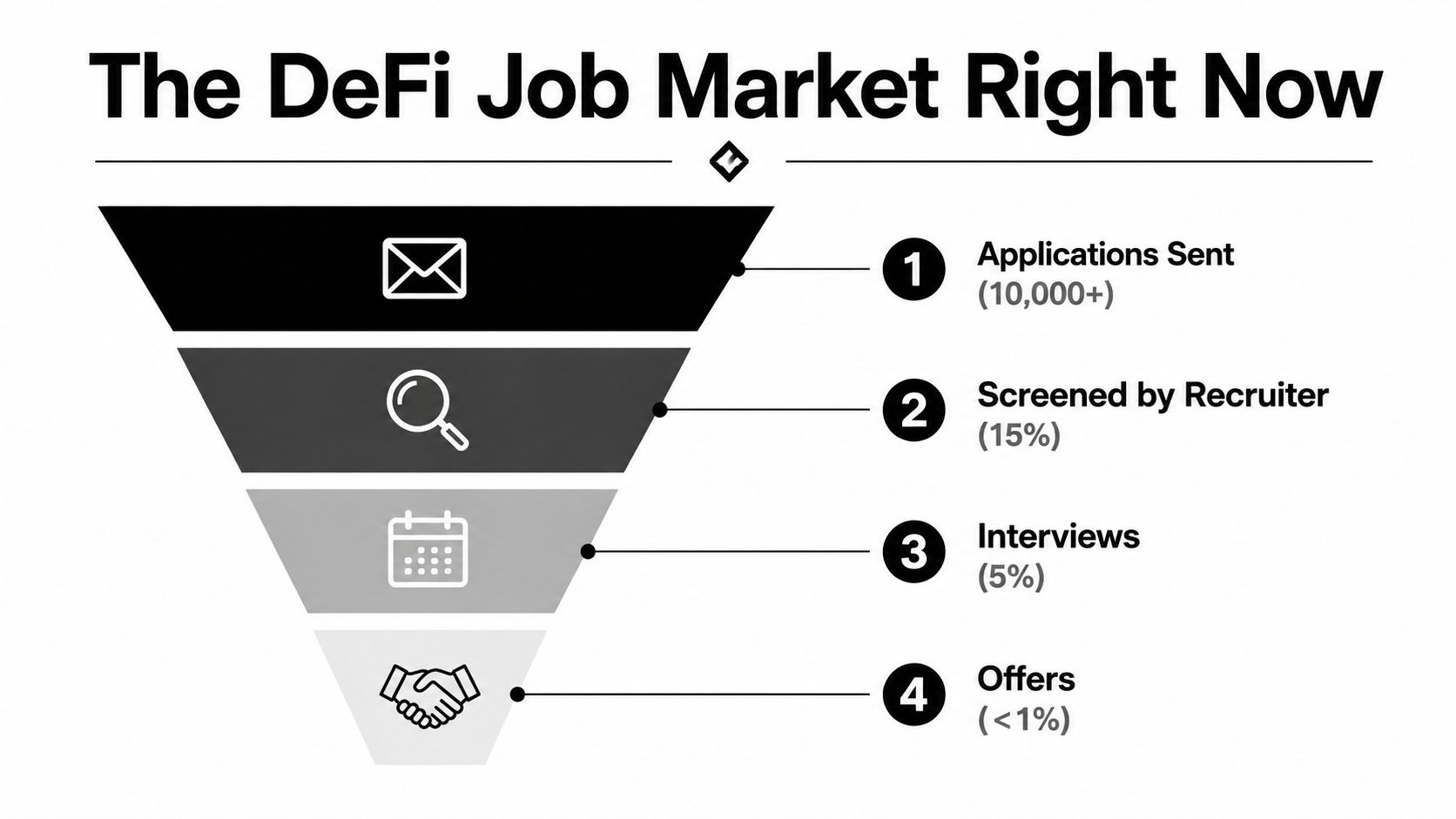
You've shipped two Solidity side projects, deployed contracts to a testnet, and spent three months sending applications without getting a serious response. The problem probably isn't effort. It's that you're treating DeFi hiring like a Web2 search, where a polished résumé and a high application count can carry you through the funnel.
DeFi teams screen for evidence of protocol judgment, security awareness, and live delivery long before they care about broad blockchain enthusiasm. The candidates who progress make their work easy to verify, target a narrow role family, and build enough protocol-specific context that a referral feels obvious rather than charitable.
The DeFi Job Market Right Now
The DeFi market is small at the UK hiring level and substantial at the global level. Those facts aren't contradictory. They describe a labor market where a limited number of teams hire highly specialized people for roles with unusually high consequences and compensation.
In the UK, ITJobsWatch's DeFi employment data recorded 5 permanent jobs citing DeFi in the six months to 11 October 2025. That represented 0.010% of all permanent UK jobs, while the median annual salary quoted for those roles reached £230,000, up 132.91% year over year. The signal is clear: broad-volume recruitment hasn't arrived. A handful of employers are looking for people who can own protocol risk, smart-contract delivery, or specialized market infrastructure.
Globally, the addressable sector is much larger. Gate Research's 2025 crypto employment market report reported that DeFi total value locked exceeded USD 210 billion by Q2 2025, up 24% year over year, with demand concentrated in smart-contract development, economic model design, protocol security, and market operations. The same report cites StartUs Insights' estimate of more than 208,900 DeFi professionals, with 43,800 workers added in the prior year.
Why qualified candidates have leverage
A Q1 2026 labor-market analysis found that engineering postings grew 62% year over year, while the pool of developers with production DeFi experience grew only 8%, with average time-to-hire reaching 71 days. The DeFi talent shortage analysis supports a practical conclusion: qualified candidates have an advantage, but generic candidates don't.
Teams are still selective across L1 and L2 infrastructure, DEXs, lending markets, restaking, intent-based infrastructure, real-world asset protocols, and onchain perpetual DEXs. Hiring conditions differ by treasury strength, product-market fit, token exposure, and recent layoffs. Don't assume every protocol with a visible community is hiring, and don't assume a quiet protocol lacks serious openings.
Remote-first DAO culture expands the geographic pool, but payment still depends on entity structure, payroll compliance, contractor rules, and jurisdiction. Ask early whether the engagement is employment, contracting, grants, or contributor compensation. Legal payment eligibility can eliminate a role before technical interviews begin.
For current listings and category signals, monitor DeFi and blockchain job opportunities, but use the board as one input in a targeted funnel, not as your entire search strategy.
DeFi Job Categories and What They Actually Do
“DeFi developer” is an inadequate job-search keyword. Protocols use titles inconsistently, and the same title can describe very different responsibilities across a lending market, an infrastructure provider, and a DAO foundation. Read the output expected from the role, then map your background to it.
Six role families worth separating
Smart contract engineering centers on Solidity or Vyper, contract architecture, upgrade patterns, testing, deployment, and gas behavior. A typical day might involve implementing a vault change, writing invariant tests, reviewing a liquidation edge case, and preparing a deployment plan.
Protocol and infrastructure engineering supports the systems around contracts, including indexers, oracle integrations, sequencers, cross-chain messaging, and MEV infrastructure. The daily output could be a resilient event-indexing pipeline or an integration that handles delayed, malformed, or conflicting data.
Security and auditing involves static analysis, exploit modeling, formal verification, fuzzing, and bug-bounty triage. Security specialists don't merely identify syntax problems. They reason about how an attacker can combine permissions, market conditions, oracle behavior, and transaction ordering.
Frontend and full-stack onchain work connects wallet flows to usable products. Engineers may build transaction simulation, wallet connection, account-abstraction flows, or error handling with wagmi, viem, and RainbowKit. The strongest candidates understand that failed transactions and unclear signing prompts are protocol risks, not just interface defects.
Quantitative and DeFi-specific roles cover AMM design, liquidation engines, risk parameters, yield decomposition, and MEV search strategies. A quant might simulate how a lending market behaves under changing collateral prices rather than just producing a dashboard.
Business-side roles include BD, ecosystem growth, DAO operations, treasury management, token engineering, and governance leadership. Their work may involve structuring an integration, preparing a governance proposal, monitoring treasury exposure, or building contributor processes.
| Role Family | Day-to-Day Output | Typical Background |
|---|---|---|
| Smart contract engineering | Tested Solidity or Vyper changes, deployment plans, protocol fixes | Backend, EVM, or production smart-contract engineering |
| Protocol and infrastructure | Indexers, oracle systems, messaging, MEV or node infrastructure | Distributed systems, Rust, Go, data engineering |
| Security and auditing | Findings, exploit reproductions, fuzzing campaigns, remediation reviews | Application security, audit, formal methods |
| Frontend and full-stack onchain | Wallet flows, transaction UX, integrations, user-facing protocol features | TypeScript, React, product engineering |
| Quantitative and DeFi research | Simulations, risk models, parameter recommendations | Quant finance, mathematics, Python research |
| Business and DAO operations | Partnerships, governance, treasury, community, ecosystem programs | Finance, operations, BD, community, governance |
If your background is conventional software engineering, don't force yourself into a smart-contract title. Review engineering roles in blockchain by responsibilities, then choose the family where your existing evidence is strongest.
Skills and Learning Paths Employers Screen For
“Learn Solidity” is not a career plan. Hiring managers want a stack-specific competency map that shows you can write code, test hostile conditions, and understand the economic system around the code.
Build the competency map
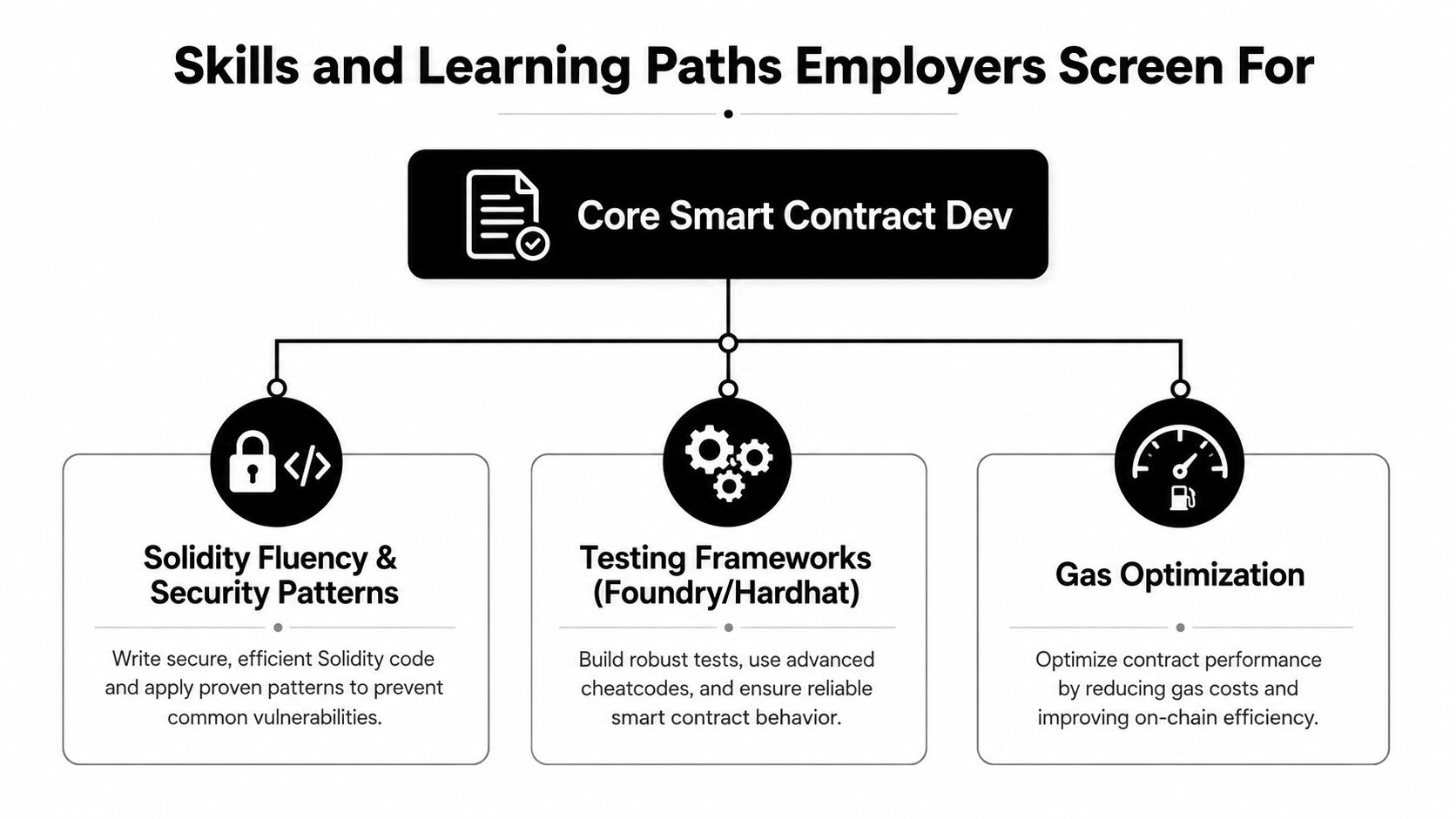
For EVM smart-contract roles, employers screen for Solidity fluency, Foundry or Hardhat test suites, gas profiling, and EVM fundamentals such as storage layout, memory versus calldata, proxy patterns, and ERC-4337. You should also be able to reason about reentrancy, oracle manipulation, sandwich attacks, access control, and upgrade risk. A concise audit-style write-up is stronger evidence than another tutorial repository.
Protocol engineers may need Rust for Solana or Stylus, Go for Cosmos SDK work or offchain infrastructure, and an indexer stack such as Ponder, Subsquid, or The Graph. They should understand MEV, cross-chain messaging, and oracle design well enough to discuss failure modes, not merely name the technologies.
Quant and risk candidates need Python, pandas, NumPy, and simulation experience. They must connect AMM curves, liquidation math, and LST or LRT yield decomposition to actual protocol decisions. Business candidates need a different proof set: hands-on DAO participation, governance forum fluency, treasury dashboards, and a verifiable onchain record.
An independent analysis of 340 DeFi protocol job postings from Q4 2025 through Q1 2026 found that 87% requested Solidity, 82% smart-contract testing, 89% security best practices, 92% DeFi protocol usage, and 58% multi-chain deployment experience. The analysis also found ERC-4337 in 34% of engineering roles and formal verification in 27% of senior security roles. Review the DeFi protocol role breakdown for the source details.
Sequence your learning instead of collecting tools
Use this order:
- Pick one chain and one protocol pattern. Learn the execution model and build around a vault, AMM, lending market, or account-abstraction flow.
- Ship one contract with complete tests. Include unit, fuzz, invariant, fork, and integration tests where they fit. Testing is part of the artifact, not a later polish step.
- Write an adversarial review. Explain assumptions, trust boundaries, oracle dependencies, privileged roles, and attack surfaces.
- Replicate the design on a second chain. Document what changed in deployment, messaging, gas, tooling, and security assumptions.
- Apply only after the evidence is public. Your portfolio should let a reviewer inspect the implementation and your reasoning without scheduling a call.
For interview mechanics such as unit testing, fuzz testing, invariant testing, fork testing, Git, and CI/CD, use this DeFi jobs technical guide as a checklist. Web3.js or Ethers.js familiarity alone won't distinguish you. Hiring teams increasingly test gas optimization, MEV knowledge, multi-chain delivery, and account-abstraction judgment.
Building a Portfolio That Gets You Interviews
Your portfolio is a credibility test. A reviewer should understand what you built, what could fail, and how you tested it before deciding whether to continue.
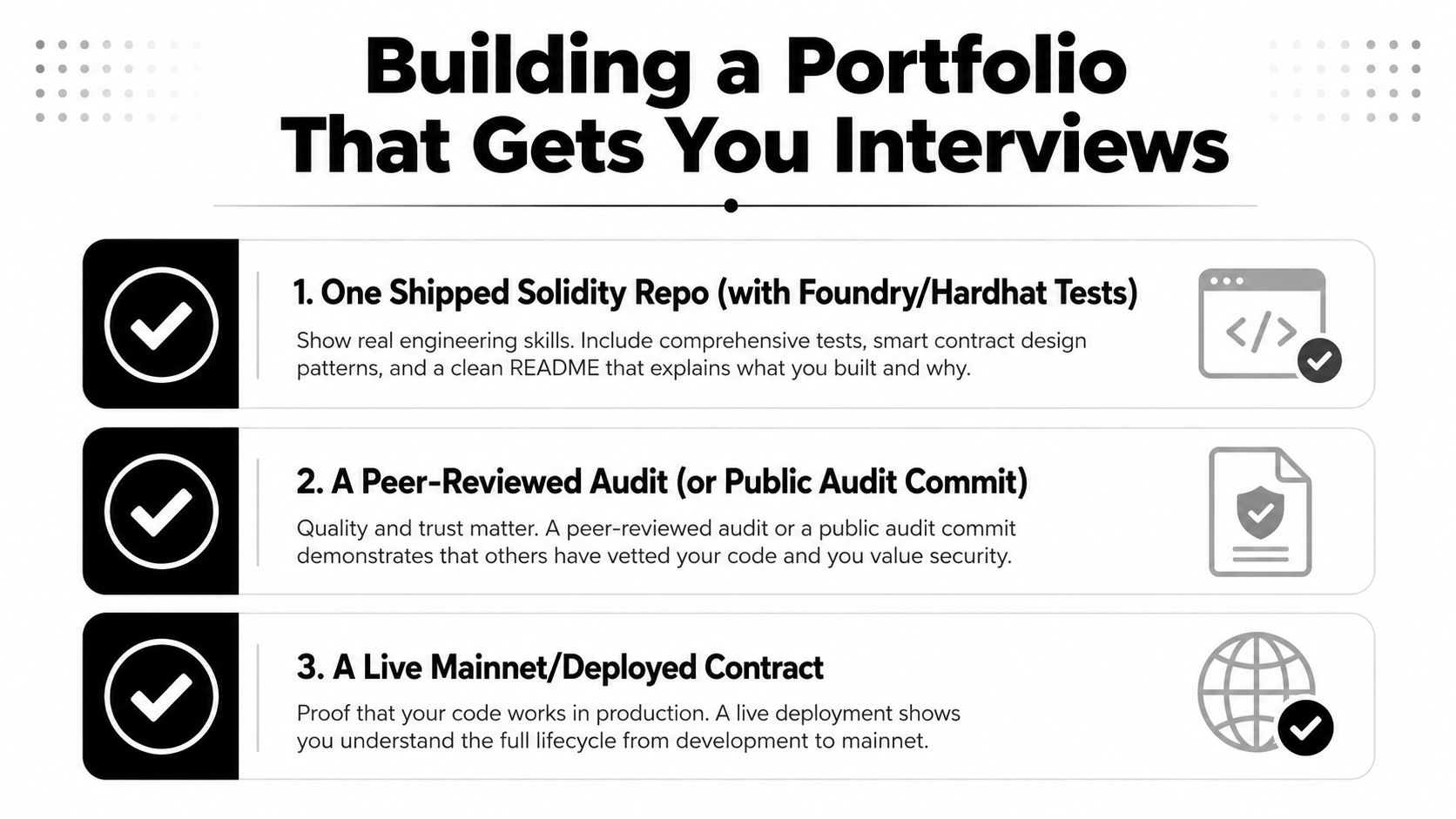
Pin one shipped Solidity repository on GitHub. The repository needs a readable README, deterministic setup instructions, Foundry or Hardhat tests, deployment history, and a short threat model. A contract that merely compiles isn't proof of production readiness. Show the decisions that would matter during a code review.
Add security evidence next. That can be a peer-reviewed audit report, a documented public audit contribution, or a bug-bounty record on Code4rena or Immunefi. Don't hide the uncomfortable findings. Explain the original assumption, the exploit path, the fix, and the regression test.
Show contribution, not just personal experimentation
DAO participation should leave a trail. Contribute to open-source repositories, publish rationale threads, participate in governance discussions, and record merged pull requests. For a business-side candidate, replace code with governance proposals, treasury dashboards, community playbooks, or growth experiments. State the decision, the action, and the observable result without inflating the outcome.
Hiring managers often click these artifacts first:
- Pinned GitHub repositories: Make the first screen show the deployed project, tests, and security notes.
- Technical writing: Use Mirror or another durable publishing platform to explain a protocol mechanism, not just its token.
- Governance activity: Link Snapshot votes and comments that demonstrate informed participation.
- Audit evidence: Connect findings to reproducible tests and remediation commits.
Portfolio rule: Every claim should lead to an artifact someone else can inspect.
Avoid tutorial-grade repositories, undated activity, screenshots without reproducible steps, copied code with no design explanation, and a long list of abandoned experiments. A smaller portfolio with a clear scope and honest limitations beats a crowded profile that signals shallow execution. For a practical framework on how helps you prove impact, focus each project description on the problem, your contribution, and the evidence.
A short walkthrough can help reviewers understand the product context, but it can't replace the repository. Use video to explain the user flow and the technical trade-offs, then point back to tests and code.
Where to Find DeFi Jobs and Build a Referral Pipeline
The best channel is the one with the highest signal density, not the one with the easiest application button. Start with niche boards such as CryptoJobsList, Web3 Career, and the bankr job feed. Then inspect protocol-native Discord servers, token-holder Discord job channels, Telegram groups, and targeted Twitter lists that include founders, engineering leads, security researchers, and ecosystem managers.
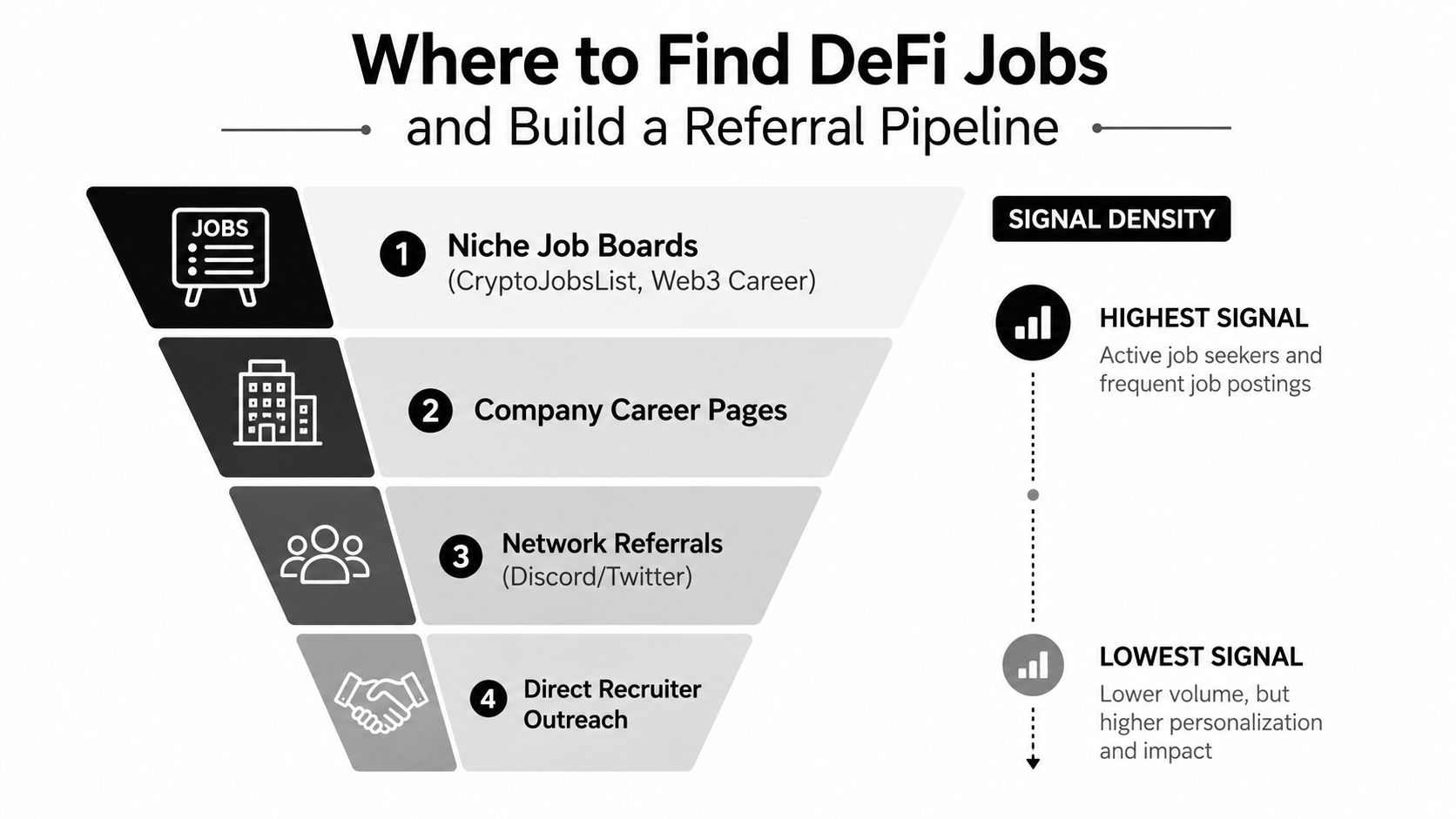
Company career pages still matter, but they shouldn't be your only route. A cold application gives a recruiter little context about your protocol fit. Public contributor work, a thoughtful issue comment, a hackathon project, or a useful technical analysis gives someone a reason to remember your name.
Turn attention into a referral
Build a list of 20 target protocols, chosen by role fit rather than brand recognition. Follow their repositories, documentation, governance, product releases, and hiring leads. Spend two to three weeks contributing useful observations before asking for an introduction. Don't send “Are you hiring?” Send a specific role, a relevant artifact, and a concise reason your experience matches the team's current problem.
Hackathons can accelerate this process. ETHGlobal, Chainlink, and Solana Foundation events create concentrated opportunities to build with engineers and ecosystem teams. Choose a project that demonstrates the role you want, keep the repository clean, and follow up with a short message that includes the shipped work and the specific contribution you can make next.
Referral message: “I built this integration after studying your protocol's documentation. I'm targeting the protocol engineering role because my work covers the same failure modes. Would you be comfortable referring me if the implementation looks relevant?”
Use remote DeFi jobs to identify geographically flexible roles, but verify timezone expectations, contractor status, payment currency, and entity requirements before investing in a process. Follow up after a hackathon once you have a concrete artifact. One useful message is better than repeated reminders.
Interview Strategies for DeFi Roles
Standard software engineering preparation is necessary, but it's insufficient for DeFi. A protocol team needs to know whether you can anticipate economic attacks, reason about irreversible state changes, and communicate risk under pressure.
The three-stage interview funnel
The first stage tests protocol literacy. Smart-contract candidates may be asked how reentrancy differs from an oracle manipulation attack, or how they'd secure an upgradeable contract. Protocol engineers may need to explain cross-chain message failure or MEV exposure. Security candidates should discuss exploitability and remediation, while quant candidates should connect liquidation parameters to market behavior.
Strong answers name assumptions, attack paths, mitigations, and residual risk. Weak answers repeat “use a reentrancy guard” without explaining whether the issue is external calls, stale prices, privilege escalation, or economic insolvency.
The second stage is a take-home or pair-programming exercise. You may build a small contract, an indexer, a subgraph, or an integration test against a testnet. Scope the work so a reviewer can evaluate it quickly:
- Define assumptions: State supported chains, actors, permissions, and known limitations.
- Show the test strategy: Separate normal behavior from adversarial cases.
- Document trade-offs: Explain why you selected the architecture and what you'd change with more time.
- Make execution simple: Include commands, expected results, and a short review guide.
The final stage tests adversarial judgment. Interviewers may ask you to break your own implementation, defend an architecture, or respond to a governance crisis involving a compromised key, bad oracle data, or an unsafe parameter change.
| Stage | Duration | What Is Tested | Candidate Deliverable |
|---|---|---|---|
| Protocol screen | Short technical discussion | DeFi concepts, threat modeling, system understanding | Structured verbal reasoning |
| Take-home or pairing | Practical build session | Coding, testing, scope control, communication | Repository, tests, README |
| Adversarial scenario | Deep technical discussion | Failure response, architecture defense, risk judgment | Attack analysis and mitigation plan |
Prepare a protocol deep-dive template covering users, assets, trust assumptions, privileged roles, price sources, liquidation paths, upgrade mechanisms, and governance. Read the protocol documentation, audits, governance proposals, and recent code changes before the interview. Your aim isn't to memorize every function. It's to form a defensible view of where the system can fail.
Salary, Contracts, and Your 90-Day Action Plan
Compensation in DeFi depends heavily on specialization, geography, protocol maturity, and contract structure. A 2026 salary benchmark reports average US base pay of $190,000 for DeFi developers, compared with $155,000 for blockchain developers, with blockchain developer pay up 14% from $136,000 in 2024. Live job-board data places US blockchain developer compensation around $75K to $150K for junior-to-mid roles and roughly $90K to $280K for senior, staff, and principal engineers, according to Web3 Career's 2026 crypto jobs guide.
Those ranges are directional, not promises. Compare offers by guaranteed cash, token terms, vesting, unlock risk, contract classification, benefits, jurisdiction, and the team's ability to fund the role.
| Role | Base USD | Token/Equity Component | Typical Contract Type |
|---|---|---|---|
| DeFi developer | $190,000 average US base | May be included, ask for terms | Full-time or specialized contract |
| Blockchain developer | $155,000 average US base | May be included, ask for terms | Full-time or contract |
| Junior-to-mid blockchain developer | $75K to $150K US band | Role-dependent | Full-time or contract |
| Senior, staff, or principal engineer | $90K to $280K US band | Role-dependent | Full-time, contract, or protocol engagement |
Negotiate the complete package
Ask whether tokens are guaranteed, discretionary, or contingent on continued service. Clarify vesting, cliffs, release dates, tax treatment, termination rights, and what happens if the protocol changes the token structure. Remote flexibility, signing compensation, accelerated vesting, conference budgets, review timing, and title scope can matter as much as base salary.
Use public compensation benchmarks, treasury disclosures, and comparable role levels to form a range, but don't treat a token allocation as cash. A high nominal package with uncertain liquidity can be weaker than a smaller guaranteed amount.
Your 90-day funnel
Weeks 1 to 2: Choose one role family, audit your skill gaps, and select target protocols. Rewrite your résumé around shipped outcomes and security judgment.
Weeks 3 to 6: Ship one verifiable proof-of-work artifact. Publish the repository, tests, deployment details, threat model, and technical explanation.
Weeks 7 to 10: Build the referral pipeline. Engage with target protocols through GitHub, Discord, governance, and Twitter. Request introductions only for roles that match your evidence.
Weeks 11 to 12: Run protocol deep dives, practice take-home exercises, prepare adversarial scenarios, and define negotiation terms before interviews begin.
Maintain a weekly cadence of thoughtful Discord participation, visible GitHub work, and targeted Twitter engagement. Hiring leads notice useful contributions, clear technical writing, and consistent follow-through. They don't need another account that posts broad optimism about Web3.
Career principle: Move from implementation, to protocol ownership, to security-sensitive judgment. Each step makes your work harder to replace and easier to price.
If you're serious about changing your search this week, stop sending generic applications. Choose a role family, publish one inspectable artifact, and use targeted DeFi listings to identify teams where your evidence matches an actual hiring need.
Blockchain Jobs curates roles across DeFi, engineering, security, operations, product, and other Web3 functions, including remote-friendly opportunities. Visit Blockchain Jobs to find relevant openings, filter by category, and turn your portfolio into a focused application pipeline.