Mastering Front End Developer Salaries in 2026
The headline number should reset your expectations. In the United States, average front end developer pay sits in a strong band, but the ceiling is what matters: top earners at companies like ExxonMobil, Coursera, and Bloomberg can clear well over $273,000 according to Indeed’s front end developer salary data. That tells you something important. Front end isn’t the “less technical” side of engineering. It’s a revenue-facing, product-defining discipline, and the best companies pay for it.
Most salary guides stop there. That’s lazy.
What determines front end developer salaries is a mix of strategic advantages, not just years worked. Your stack matters. Your interview positioning matters. Your location strategy matters. And if you’re willing to move into blockchain product teams, wallet UX, DeFi dashboards, and dApp interfaces, your compensation options change fast. For contractors weighing permanent versus flexible structures, it’s also worth reviewing Umbrella company options for Front End Developers so you understand how pay, compliance, and take-home can differ by engagement model.
I’m going to give you the version hiring managers and recruiters use privately. Which candidates get screened into higher bands. Which skills trigger stronger offers. Which salary arguments work in interviews. And why Web3 is one of the few front end niches where design-heavy engineers can still create a major compensation jump.
Understanding the 2026 Front End Salary Landscape
The gap between average front end pay and top-end pay is large. The developers who reach the upper tier are usually attached to revenue, retention, or transaction-heavy product work. In Web3, that premium often gets even bigger because strong front end engineers are still scarce relative to demand.
That changes how you should read salary numbers.
A generic market average blends together very different jobs. One role is maintaining marketing pages and design system tickets. Another is shipping wallet flows, trading interfaces, account security UX, and high-performance product surfaces where every delay affects conversion or trust. Employers do not price those jobs the same way.
Why salary data looks inconsistent
The first problem is title inflation. Front End Developer, Frontend Engineer, UI Engineer, Product Engineer, and Web Engineer often describe overlapping work, but companies attach different salary bands to each title.
The second problem is compensation structure. Large employers may put more weight on base pay. Startups often shift more value into equity. Crypto-native teams may add token grants or project-based upside, which makes direct comparisons harder if you only look at salary tables.
For contractors, structure matters too. If you are weighing freelance, contract, or permanent roles, review Umbrella company options for Front End Developers so you understand how engagement model affects compliance, pay setup, and take-home income.
What actually pushes pay higher
Stop asking what front end developers earn in general. Ask what business problem you can own.
Higher bands usually go to engineers who can ship on product surfaces tied to money or trust, such as onboarding, checkout, subscriptions, analytics dashboards, identity flows, admin systems, and customer retention features. In Web3, that extends to wallet connection UX, dApp interfaces, portfolio views, staking flows, NFT marketplaces, and DeFi dashboards.
The hiring logic is simple. If your work affects conversion, reduces churn, improves performance, or lowers user error on high-stakes screens, your salary case gets stronger.
The strongest candidates also present themselves differently. They show React or TypeScript skill, but they also prove judgment: performance tuning, accessibility, state management, testing discipline, API integration, product tradeoffs, and clean collaboration with design and backend teams.
That is where salary separation happens. Not at the title level. At the level of risk you remove and value you create.
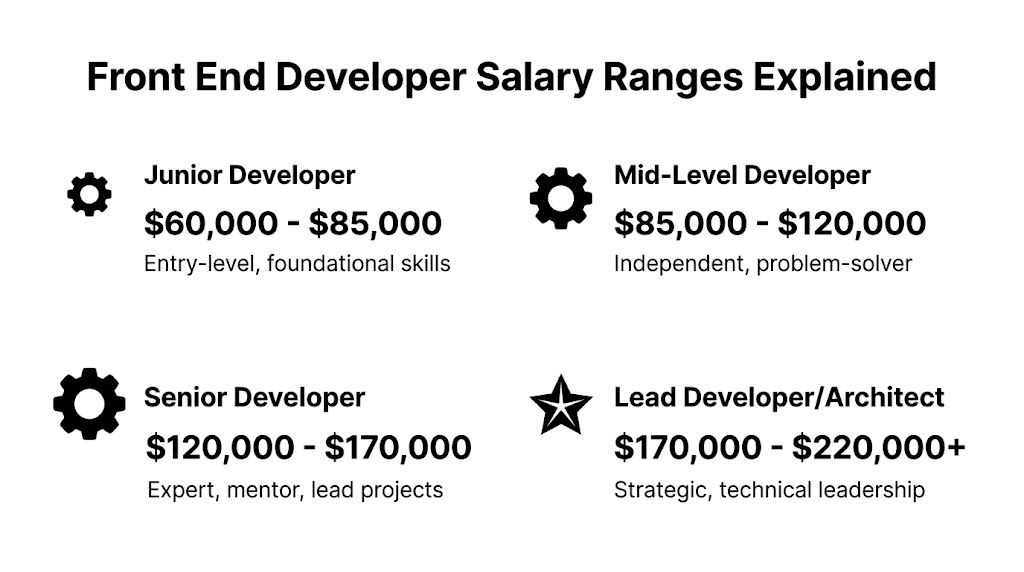
Front End Developer Salary Ranges Explained
Salary progression in front end is real, and it’s steep if you keep increasing the level of responsibility you can carry. According to Clarusway’s front end developer salary guide, entry-level roles average $70,000 to $90,000, mid-level roles command $95,000 to $115,000, and senior developers earn $120,000 to $150,000+. The same source notes that Web3 roles can add a 10-20% premium at each level.
That premium matters because it changes how you should plan your career. Don’t treat front end as a flat ladder. It’s a branching path.
Salary bands by level
Here’s the clean version recruiters use when they assess market fit:
| Level | Typical range | What employers expect |
|---|---|---|
| Junior | $70,000 to $90,000 | Solid HTML, CSS, JavaScript, basic framework use, close guidance |
| Mid-level | $95,000 to $115,000 | Independent delivery, debugging, feature ownership, reliable collaboration |
| Senior | $120,000 to $150,000+ | Architecture decisions, mentoring, cross-team execution, stronger system thinking |
The difference between these bands isn’t just coding speed. It’s risk reduction.
A junior developer often needs structure. A mid-level developer can take a ticket and finish it without drama. A senior developer makes the whole team faster by preventing bad architecture, simplifying delivery, and protecting user experience under pressure.
What moves you from one band to the next
If you’re stuck in a lower bracket, the issue usually isn’t effort. It’s packaging and scope.
A junior becomes mid-level when they can:
- Ship independently: not perfect code, but production-ready work with minimal hand-holding.
- Debug across the stack: enough API fluency to isolate issues instead of blaming the backend by default.
- Communicate tradeoffs: explain why a feature should be built one way, not just ask what to do next.
A mid-level becomes senior when they can:
- Own systems, not just tickets: design component patterns, improve maintainability, and reduce regressions.
- Lead through ambiguity: take a vague product requirement and turn it into a workable implementation plan.
- Raise the bar for others: code reviews, mentoring, standards, and technical judgment.
Hiring signal: Senior candidates don't just say they know React. They explain where React complexity hurts a team and how they'd simplify it.
Startup versus enterprise pay logic
Company type affects how bands get applied.
Startups often hire “up” for flexibility. They want someone who can code, design solutions, talk to product, and survive changing priorities. That can help a capable mid-level developer reach a stronger package faster.
Enterprises tend to formalize leveling. The upside is clearer process and usually stronger salary predictability. The downside is slower title progression if your manager doesn’t advocate for scope expansion.
A practical rule: if you’re underpaid, don’t just ask for a raise. Ask whether your current company can support the next scope level. If not, your fastest compensation jump may come from changing employers, not waiting for internal recognition.
The Web3 multiplier changes the map
The standard path still works. But if you can apply front end fundamentals to decentralized products, the pay curve steepens.
That doesn’t mean every crypto job is automatically better. It means the market pays more when your interface work touches wallet connection flows, token interactions, transaction signing, or high-trust financial UX. Those problems are harder than standard SaaS CRUD, and companies know it.
How Location and Remote Work Impact Your Salary
A bigger salary number doesn’t always mean a better deal.
The cleanest example comes from CareerCheck’s frontend engineer salary comparison. It shows that a senior developer in New York has about 27% more purchasing power than one in San Francisco, despite earning a lower median salary of $127,046 versus $147,625. If you only compare headline pay, you miss the point.

Nominal salary versus usable salary
Front end developers still chase famous markets because they assume top-city pay equals top outcome. Sometimes it does. Often it doesn’t.
A high-cost hub can help if:
- You need brand-name experience: a marquee employer can reset your future compensation.
- You’re early in your career: dense markets can create more interviews, mentorship, and role mobility.
- You want elite peers nearby: that network effect can matter.
But a lower-cost market or remote role can be stronger if:
- You’re already proven: you don’t need the city to validate you.
- You can negotiate based on output: strong portfolio, strong interview loop, strong references.
- You care about retained income: what stays in your bank account matters more than a bragging-rights number.
Remote work gives experienced developers leverage
Remote work changed salary strategy. Not evenly, but enough.
Companies now split into a few buckets. Some still peg offers tightly to location. Others use broader national bands. The best remote setups for front end developers are usually the ones where the company hires for capability first and geography second.
That matters even more in blockchain hiring, where distributed teams are standard. If you want to compare active remote opportunities in the space, review remote blockchain roles and study how often frontend work appears alongside product, protocol, and design functions.
Remote pay is strongest when you can prove low-management execution. Employers pay more when they believe you won't disappear into Slack.
How to use location strategically
Don’t relocate blindly for salary.
Use this decision filter instead:
| Scenario | Better move |
|---|---|
| You need résumé credibility fast | Take the strongest branded role you can win |
| You already have strong product experience | Prioritize remote roles with broad salary bands |
| Your offer looks high but local costs are punishing | Recalculate based on actual spending power |
| You're targeting Web3 | Favor distributed teams that hire nationally or globally |
One more blunt point. Candidates often under-negotiate remote offers because they assume they’re already lucky to get flexibility. That’s a mistake. If the company is trusting you with core product surfaces, remote isn’t a favor. It’s just the working model.
The Skills That Command Higher Front End Salaries
Higher pay goes to front end developers who solve product risk, not developers who collect framework logos.
That gap matters even more if you plan to move into Web3 later. Blockchain teams pay a premium for frontend engineers who already know how to build reliable, fast, user-facing systems under pressure. The path starts with strong fundamentals, then moves into architecture, performance, and trust-sensitive UI work.
According to Away Digital Teams’ front end salary guide, JavaScript developers earn an average salary that is 8.4% higher than general web developers, and the same source notes that framework mastery such as React can push senior salaries well above the $120,000 base. Recruiters use that distinction every day. General web work gets average offers. Product-grade frontend engineering gets better ones.

Foundational skills you can't skip
These skills will not make you highly paid on their own. They do determine whether serious teams view you as dependable.
- HTML and semantic structure: Strong markup improves accessibility, maintainability, and search visibility from the start.
- CSS and responsive design: Product teams notice quickly when layouts collapse under real content, odd screen sizes, or design changes.
- JavaScript fluency: Strong candidates understand state, async behavior, data transformation, event flow, and browser quirks without guessing.
Senior-title candidates often underperform here. They can ship a tutorial app, but they struggle to explain rendering behavior, event timing, or why a UI breaks in production.
Frameworks that move you into better salary bands
React remains the safest path to a higher salary because it appears across modern product teams and dominates hiring in both SaaS and Web3. Vue and Angular still have value, but React gives you the widest market and the clearest route into better-paid roles.
The framework itself is not the differentiator. Execution is.
Show evidence that you can handle:
- Component system design: reusable, readable, scalable UI patterns.
- State management under pressure: especially when data is delayed, inconsistent, or driven by user actions.
- Performance judgment: controlling bundle size, avoiding unnecessary renders, and choosing the right rendering pattern for the product.
If you’re aiming for senior compensation, review a real senior frontend web engineer opening and work backward from the requirements. Hiring managers care less about “knows React” and more about “can own production complexity.”
Practical rule: Learn the framework well enough to explain when extra abstraction makes the code worse.
Skills that separate high earners from average earners
A salary jump usually comes from reducing team risk and increasing product quality.
TypeScript
TypeScript helps teams move faster with fewer misunderstandings. In larger codebases, that translates directly into fewer regressions, safer refactors, and easier collaboration across frontend, backend, and design.
Next.js and modern app architecture
You do not need blind loyalty to a framework. You do need clear judgment around routing, server versus client rendering, caching, data fetching, and deployment tradeoffs.
Accessibility
Accessibility is still underpriced in hiring, which makes it a smart advantage. Candidates who can build keyboard-friendly, screen-reader-aware interfaces stand out because they lower legal, UX, and brand risk.
Performance optimization
Fast interfaces convert better and retain users longer. Employers pay more for engineers who can improve interaction speed, reduce page weight, and keep products usable on real devices, not just powerful laptops.
API and data integration
Salary climbs when you stop acting like a UI decorator. Higher-paid front end developers handle messy API responses, empty states, errors, loading behavior, and trust issues without making the product feel broken.
What to learn if you want more money fast
Pick a stack and get sharp. Do not spread your effort across five frameworks and a pile of surface-level tools.
A high-value path looks like this:
- Deep JavaScript knowledge
- React built for production
- TypeScript
- Testing and debugging discipline
- Performance and accessibility
- Architecture decisions tied to product outcomes
That mix earns stronger offers because it maps to real business pain. In Web3, it also sets you up for the next salary tier, where the frontend is responsible for trust, transaction clarity, wallet state, and error prevention. That is where front end work stops being presentation and starts becoming revenue protection.
Unlocking Top Tier Pay in Web3 and Blockchain
Generic front end salary advice usually falls apart because it treats Web3 as a sideshow. That’s wrong.
For ambitious front end engineers, Web3 is one of the few niches where interface work can command a sharp premium. According to ZipRecruiter salary context cited for Web3 front end roles, front-end developers specializing in decentralized UIs can command a 25-50% salary premium, with total compensation often reaching $130,000 to $200,000+ because demand is high and token incentives can be part of the package.

Why Web3 front end pays more
Blockchain products put more pressure on the interface than most traditional apps do.
A normal SaaS dashboard can often tolerate mediocre UX for a while. A crypto product can’t. If users don’t trust the transaction flow, don’t understand wallet prompts, or can’t interpret balances, slippage, gas, approvals, and signatures, they leave. Worse, they make expensive mistakes and blame the product.
That means front end work in Web3 isn’t cosmetic. It sits directly on top of trust, conversion, and risk.
Here’s what makes these roles harder:
- Wallet connection flows: users bring their own identity layer.
- Onchain transaction UX: the interface must explain actions clearly before users sign.
- Asynchronous state: pending, confirmed, failed, reverted, disconnected. The UI has to handle all of it.
- Financial clarity: poor design creates real user loss, not minor frustration.
The skills that create the Web3 premium
If you want the premium, earn it. Don’t just append “Web3” to a React résumé.
You need to show that you can build interfaces for:
- DeFi products: dashboards, swaps, staking, portfolio views.
- Wallet-aware apps: login, signing, chain switching, account states.
- Data-heavy token interfaces: balances, positions, fees, approvals, and historical activity.
- Trust-sensitive flows: confirmations, warnings, and clear fallback states.
A strong way to benchmark yourself is to review a live frontend engineer role asking for a React and Web3 background. The job title matters less than the recurring pattern. Teams want front end engineers who can make decentralized systems understandable.
The best Web3 frontend engineers think like product designers, systems engineers, and risk managers at the same time.
Token compensation is real, but don't get blinded by it
At this stage, candidates get sloppy. They hear “token package” and stop asking hard questions.
Token compensation can create upside, but it can also distract you from a weak base, fuzzy vesting, or a product with no traction. Treat token allocation as part of total compensation, not a substitute for disciplined evaluation.
Ask about:
- Vesting mechanics: when it starts, how it vests, and what happens if you leave.
- Liquidity realities: whether the token is practically usable or just theoretical.
- Base salary strength: your cash compensation still matters.
- Role scope: if the company wants senior-level execution, the base should reflect that.
For a useful overview of how Web3 development careers are evolving, this short video is worth a watch before you start targeting crypto-native roles.
My advice if you're choosing between SaaS and Web3
If you’re early-career and still shaky on fundamentals, get stronger first. Web3 won’t rescue weak engineering.
If you already have solid React, API integration, debugging, and product sense, then Web3 is a serious salary growth path. The premium exists because the work is harder, the UX stakes are higher, and good candidates are still relatively scarce.
How to Negotiate Your Front End Developer Salary
Most front end developers lose money before negotiation even starts. They answer too quickly, anchor too low, and talk about what they want instead of the value they create.
Don’t do that.
Salary negotiation starts with positioning. If the company sees you as a generalist pair of hands, you’ll get a modest offer. If they see you as someone who can own a revenue-facing product surface, reduce delivery risk, and mentor others, your ceiling moves up.
Before the interview loop
You need a compensation thesis before anyone asks for your number.
Build it around three inputs:
- Your market level: junior, mid, senior, or lead based on actual scope, not ego.
- Your stack's value: React, TypeScript, architecture, performance, accessibility, Web3 UI complexity.
- Your business relevance: what your work changes for users and for the team.
Write down a few concrete stories. Not “built components.” Better examples are “owned checkout redesign,” “stabilized complex state handling,” “reduced frontend regressions through testing discipline,” or “improved transaction flow clarity in a wallet-connected product.”
Don't negotiate from effort. Negotiate from outcomes, ownership, and risk reduction.
How to answer salary expectation questions
Don’t blurt out a narrow number early. You need room.
Better approaches:
- If you're still learning scope: say you want to understand the full role, team expectations, and total compensation before landing on a range.
- If you're clearly qualified: state that you're targeting senior-level compensation aligned with the complexity of the role and your background.
- If Web3 or equity is involved: separate base salary from token or equity discussion so the company can’t blur them together.
Good phrasing sounds like this:
“I’m targeting a package that reflects senior-level frontend ownership, especially where the role includes architecture, product collaboration, and complex UI flows. I’m open to discussing the full structure once I understand scope and expectations.”
That answer works because it doesn’t trap you early, and it reinforces your value.
What to negotiate beyond base salary
Too many candidates only negotiate salary. That’s incomplete.
You should also discuss:
- Bonus structure: especially if the company uses performance incentives.
- Equity or tokens: ask how grants work, not just what the headline sounds like.
- Signing support: if you’re walking away from other compensation or taking on risk.
- Title and level: these affect your next negotiation, not just this one.
- Review timing: if the company won’t move enough now, ask for a defined compensation review after proven impact.
How to negotiate inside your current job
Internal negotiation needs a different tone. Don’t walk in with market frustration. Walk in with evidence.
Frame the conversation around expanded scope:
- You now own more than your title reflects
- Your work affects more critical product areas
- You’re operating at the next level already
Then ask directly for one of two things:
- salary adjustment now, or
- a documented path with timeline, expectations, and review criteria
If your manager can’t define either, that’s useful information. It often means the company isn’t set up to pay you at the level you’re working.
Mistakes that cost developers money
Avoid these immediately:
- Giving the first precise number too early
- Talking only about coding skill and not product impact
- Accepting token-heavy offers without interrogating the cash side
- Treating remote flexibility as a reason to ask for less
- Negotiating emotionally after a long job search
Strong negotiators stay calm, specific, and commercially aware. That’s what companies trust.
Your Career Outlook and Next Steps
Front end pay has room to grow. The biggest jumps rarely come from staying in generic UI work. They come from becoming the developer companies trust with revenue-critical product surfaces, complex state, performance, and user confidence. In Web3, that premium gets even larger because poor front end execution breaks onboarding, transactions, and trust fast.
That is the career bet I’d make.
Broad front end hiring should remain healthy over the next several years, and the long-term demand case is still solid based on U.S. Bureau of Labor Statistics projections cited earlier in this article. The better takeaway is practical. Good front end developers will keep finding work. Specialized front end developers, especially those who can ship polished product experiences in high-stakes environments, will keep getting paid more.
Web3 deserves more attention than it gets in general salary guides. If you can build interfaces around wallets, signing flows, transaction feedback, security cues, and failure states, you move into a smaller talent pool with stronger compensation upside. That is where many front end developers can outrun standard market salary bands.
What I’d recommend right now
- If you're junior: get strong in JavaScript, one major framework, debugging, accessibility, and shipping production UI that holds up under review.
- If you're mid-level: take ownership of performance, testing, design system quality, and cross-functional product decisions. That is where salary growth starts to separate.
- If you're senior: position yourself as the person who owns critical user-facing systems, not just screens and components.
- If you're targeting Web3: learn wallet connection patterns, transaction lifecycle UX, on-chain data handling, and trust-focused interface design before you interview.
Be deliberate about your market.
If your current role is teaching you the same things each quarter, your compensation ceiling is probably getting closer. If your next role adds harder product problems, stronger commercial exposure, or Web3-specific complexity, your ceiling rises. Salary follows scope, scarcity, and business impact. Build your career around those three factors.
Frequently Asked Questions About Front End Salaries
Do you need a computer science degree to earn a high front end salary
No. Companies hire for capability, not just credentials. A degree can help early on, but a strong portfolio, clear technical reasoning, and real product examples matter more once you’re in the market. If you can explain architecture choices, debug effectively, and ship reliable UI, you can compete.
Do freelance front end developers make more than full-time employees
Sometimes, but it’s less predictable. Freelancers may command strong project rates when they have a niche, reputation, and steady pipeline. Full-time roles usually offer more consistency and can be stronger overall once you include bonus, equity, or token incentives. Pick based on your risk tolerance and your ability to sell and deliver independently.
Is front end paid less than backend or full-stack
Often, but not always. Some sources place backend and full-stack averages above frontend in broad market comparisons. In practice, top front end developers can still earn exceptional compensation, especially in product-heavy companies and Web3 teams where interface quality directly affects trust, activation, and revenue.
If you’re ready to turn these salary insights into a better role, start with Blockchain Jobs. It’s one of the simplest ways to find Web3 opportunities where strong front end engineers, product-minded developers, and crypto-native builders can compete for higher-value roles.