Mastering Hiring Unity Developer for Web3 in 2026
You’re probably in one of two situations right now. You’re either trying to ship a blockchain game or interactive Web3 product and keep meeting Unity candidates who are good at game mechanics but weak on wallets, contracts, and on-chain constraints. Or you’ve posted a role for a “Unity developer” and attracted a pile of applicants who don’t fit what the product needs.
That happens because most hiring advice treats Unity as a generic game engine hiring problem. Web3 changes the profile. A developer building a mobile puzzle game, a multiplayer metaverse client, and a Unity front end that connects to smart contracts might all share C# and editor experience, but they are not interchangeable hires.
When hiring unity developer talent for Web3, the mistake isn’t usually lack of volume. It’s lack of precision. Teams write broad job descriptions, overvalue flashy portfolios, under-test integration skill, and realize too late that the candidate can build scenes but can’t safely connect game logic to decentralized systems. The fix is a tighter role definition, a better sourcing process, a harder interview loop, and an offer that reflects how scarce this hybrid profile really is.
Decoding the Web3 Unity Developer Skillset
Most guides still frame Unity hiring around generic game development portfolios and broad requirements like Unity/C#, 3D graphics, and cloud familiarity. That leaves a gap for blockchain and Web3 employers hiring for simulations, metaverse experiences, decentralized asset flows, or blockchain-integrated products, as noted by Alcor’s write-up on Unity hiring gaps in Web3 and enterprise use cases.
That gap matters because a Web3 Unity role is not one skill. It’s a stack of skills. If you don’t separate them, you’ll hire someone excellent in one layer and weak in the one that breaks your release.
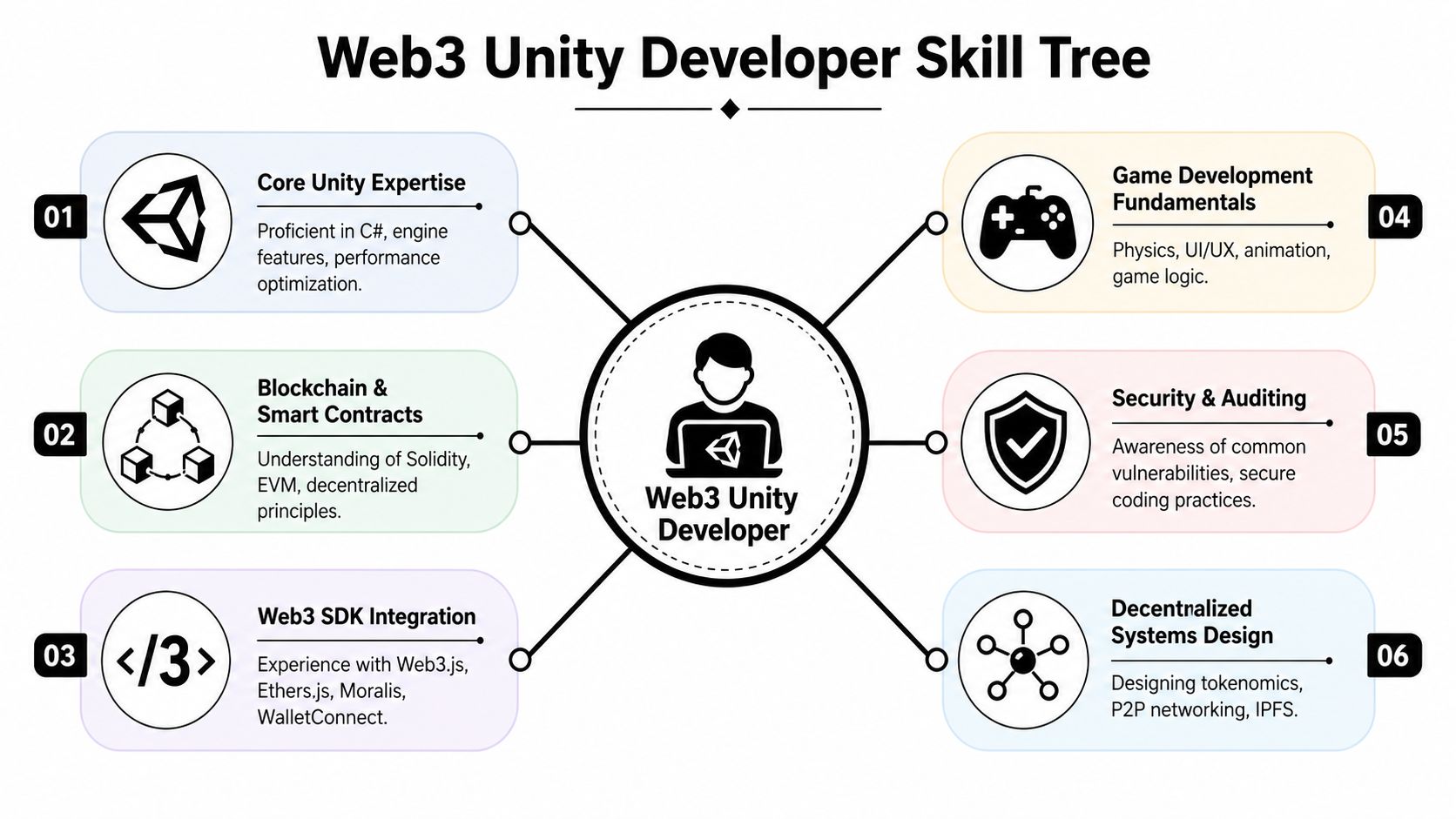
Foundational Unity capability
Start with the part that should be non-negotiable. A Web3 angle doesn’t excuse weak Unity fundamentals.
Look for:
- Strong C# fluency. They should explain architecture decisions, not just paste MonoBehaviour scripts together.
- Engine literacy. Scene management, prefabs, ScriptableObjects, input systems, animation states, and debugging inside the Unity editor should feel routine.
- Rendering and optimization awareness. They don’t need to be a graphics specialist for every role, but they should understand draw calls, memory pressure, profiling, and platform-specific constraints.
- Build discipline. They should know how Unity projects behave across desktop, mobile, and WebGL, because blockchain projects often need broad distribution.
A weak candidate talks about “making games in Unity.” A strong one talks about why a feature should live in a service layer, how they’d avoid garbage collection spikes, and what they’d test before shipping a WebGL build.
Advanced game development depth
Many hires fail. Teams assume a candidate with nice visuals can handle production game logic. Often they can’t.
Useful signals include:
- Multiplayer and state synchronization experience. Even if your game isn’t fully on-chain, many Web3 products involve shared environments, server-authoritative logic, or event-driven economies.
- UI systems under load. Wallet prompts, inventory states, marketplace flows, and transaction feedback all put pressure on UI architecture.
- Performance triage. If your game has token-gated assets, avatar systems, or heavy metadata-driven inventory, the candidate needs to know where bottlenecks usually appear.
- Platform realism. Mobile and WebGL constraints punish candidates who’ve only worked on ideal desktop environments.
Practical rule: If the candidate can’t clearly explain the worst production issue they fixed in Unity, keep looking.
The Web3 integration layer
This is the layer most generic hiring guides barely touch, and it’s the layer that separates a game developer from a Web3-ready one.
For blockchain-integrated projects, assess whether the candidate can work with:
- Wallet connectivity. They should understand session management, signing flows, and what should never be trusted from the client.
- Smart contract interaction. They don’t need to be your lead Solidity engineer in every case, but they should know how a Unity client reads contract state, submits transactions, and handles failure states.
- NFT and asset metadata handling. Rendering token-linked assets sounds simple until metadata is incomplete, delayed, malformed, or chain-dependent.
- Backend and indexing dependencies. Good candidates know that many smooth Web3 experiences rely on indexers, APIs, caching layers, and off-chain services.
- Security boundaries. The right answer is almost never “we’ll just store it in the client.”
A practical way to map the role is to rank needs into three buckets:
| Layer | What to test for | What goes wrong if you skip it |
|---|---|---|
| Foundation | C#, architecture, profiling, builds | Messy codebase, slow iteration, unstable releases |
| Game depth | Networking, UI systems, optimization | Feature stalls, poor user experience, weak scalability |
| Web3 layer | Wallets, contracts, metadata, security | Unsafe integrations, broken transactions, trust issues |
Most bad hires happen because teams only validate the first bucket. They hire a good Unity developer, not the right Unity developer.
Crafting a Job Description That Attracts Top Talent
A job description is a filter, but it’s also a pitch. Strong candidates decide fast whether your team understands the work. If the posting reads like a recycled game studio template with “blockchain” added at the bottom, serious applicants will assume the role is poorly scoped.
What a weak JD looks like
A bad post usually has these traits:
- Vague title. “Unity Developer” says almost nothing.
- Task list instead of mission. Candidates see chores, not product impact.
- Bloated requirements. Every tool gets dumped in, whether it matters or not.
- No architecture context. There’s no mention of wallet flows, backend services, or contract interaction.
- Generic benefits language. “Fast-paced environment” and “competitive package” don’t help anyone decide.
Here’s the hidden problem. Generic language attracts generic applicants.
What a strong JD needs
The better version is specific enough to repel the wrong people.
Use a structure like this:
Title that reflects the actual hybrid role
Examples: “Unity Developer for Web3 Game Client” or “Senior Unity Engineer for Blockchain Game Systems”Short project summary
Explain what you’re building in plain language. Mention whether the product is a multiplayer game, metaverse client, NFT-driven economy, simulation layer, or cross-platform experience.Impact-based responsibilities
Don’t write “develop gameplay systems.” Write what they’ll own, such as wallet connection flow, inventory rendering tied to token metadata, or optimization of transaction-linked UI states.Tech stack with key integration points Name Unity, C#, your networking layer, APIs, wallet tooling, and how the client talks to blockchain infrastructure.
Must-have versus nice-to-have qualifications
Separate production-critical requirements from stretch skills. If everything is “required,” candidates stop trusting the post.
The best Web3 candidates usually want to know what they’re building, what constraints they’ll inherit, and how much technical ownership they’ll actually have.
A practical rewrite
Compare these two approaches:
| Weak wording | Strong wording |
|---|---|
| Build gameplay features | Own client systems that connect gameplay, wallet state, and backend data |
| Experience with blockchain preferred | Hands-on experience integrating wallet flows, contract reads/writes, or token-driven asset logic |
| Work with team members cross-functionally | Collaborate with backend, smart contract, product, and design to ship stable player-facing features |
What to include that candidates actually care about
Good hires don’t just evaluate compensation. They evaluate clarity.
Add:
- Your product stage. Prototype, live ops, or scaling post-launch.
- Your shipping expectations. Are they inheriting a codebase or building core systems from scratch?
- Your collaboration model. Async-heavy, overlapping hours, or tightly scheduled team work.
- Your decision model. Founder-led, engineering-led, or DAO-like stakeholder involvement.
- Your upside structure. Equity, token participation, or other long-term incentives, if applicable.
A well-written JD won’t solve hiring by itself. But it tells strong candidates that your team understands the difference between game development and blockchain-integrated game development. That alone improves the quality of the pipeline.
Sourcing Candidates Beyond Traditional Job Boards
The best Web3 Unity candidates often aren’t actively applying. They’re shipping side projects, contributing to SDKs, hanging out in niche Discords, or doing contract work for teams that found them through their public output.
If your sourcing strategy is limited to LinkedIn and broad job boards, you’ll meet people who are available. That’s not the same as finding people who fit.
Start with obvious channels, then go narrower
Mainstream platforms still have value, especially when the role is scoped well. But for a hybrid profile, I treat them as a baseline, not the core of the search.
A better approach is layered:
- General applications for volume and employer brand
- Crypto-native engineering boards for role relevance
- Game developer communities for hands-on Unity depth
- Public work review for proof of execution
When I need a candidate who can bridge game client logic and Web3 systems, I care less about polished self-description and more about what they’ve actually built.
One reliable starting point is browsing active blockchain engineering roles on Blockchain Jobs. Not because every Unity hire will come directly from a listing, but because the role patterns tell you how adjacent teams position engineering work in Web3.
Where strong candidates leave evidence
GitHub won’t always show a full commercial history, but it does reveal habits. I look for repositories that suggest the developer can work beyond tutorials. Useful signs include wallet integration experiments, Unity tooling, C# architecture patterns, API wrappers, or game jam code with disciplined structure.
Itch.io is underrated. A small game jam project can show more about shipping behavior than a polished portfolio page. If a candidate has a rough but playable prototype with clean menus, clear controls, and a thoughtful postmortem, that’s often more meaningful than a cinematic trailer.
Reddit and Discord communities can be even better, especially where Unity, multiplayer systems, or blockchain game development overlap. You’re not looking for someone who posts hot takes all day. You’re looking for developers who answer specific questions well, share technical breakdowns, or show works in progress with substance.
Good sourcing in this niche feels less like database mining and more like pattern recognition.
Mini-scenarios that actually work
Here are three examples of how strong candidates often surface.
The GitHub contributor
You find a developer who has touched Web3-related C# or integration code. Their repos aren’t huge, but commits are thoughtful, issue comments are clear, and they document trade-offs. That’s usually worth a direct outreach.The game jam builder
Someone ships a Unity prototype on Itch.io that isn’t visually perfect but handles input, menus, feedback loops, and deployment cleanly. If they also describe what broke and how they fixed it, they’re probably interview-worthy.The Discord problem-solver
In a technical server, a developer explains how they approached client-side transaction UX or why a sync issue belongs in backend state management instead of the Unity layer. That kind of reasoning is hard to fake.
What not to overvalue
Some of the worst sourcing decisions come from chasing the wrong signals.
Avoid over-indexing on:
- Pure crypto enthusiasm without shipping evidence
- Beautiful portfolios with no technical depth
- Resume keyword density around NFT, metaverse, or tokenomics
- Freelance availability alone for long-term core roles
A Web3 Unity hire should be comfortable in public technical spaces, but they don’t need to be loud. Quiet builders often outperform charismatic applicants, especially in teams that need reliability over hype.
The strongest sourcing pipeline mixes visible output, targeted outreach, and communities where developers show how they think. That’s where the real shortlist starts.
The Ultimate Interview and Assessment Workflow
Resumes don’t protect you from a bad hire. Portfolios don’t either. The candidate may have touched a shipped game and still be the wrong person for your codebase, your production constraints, or your blockchain integration needs.
That’s why I like a hard funnel. A structured process matters because poor technical vetting is tied to hiring mistakes that hurt budgets and timelines. A step-by-step methodology with deep portfolio review, a multi-stage interview, a technical assessment, a live coding challenge, and a paid team trial is outlined in Juego Studio’s guide to avoiding Unity hiring pitfalls.

Stage one with portfolio audit and screen call
I don’t start with theory questions. I start with evidence.
Ask the candidate to walk through specific shipped work or prototypes. Not just what they built, but what they personally owned. Good follow-ups include:
- Which systems did you write yourself?
- What was the hardest bug in production?
- What did you optimize, and how did you know it worked?
- Where did blockchain or backend complexity show up in the client?
Then use a short screen call to check alignment. I want to know if they understand the product category, if they’ve worked in remote teams, and whether they can speak clearly about trade-offs.
Watch for red flags:
- Credit inflation. They imply ownership of whole systems but get vague on implementation.
- No failure stories. Anyone who’s shipped enough Unity work has broken things.
- Surface-level Web3 talk. They know terms, but can’t explain a wallet flow or transaction failure state.
Stage two with a focused technical interview
This round should test judgment, not trivia.
Split the interview into two parts. One interviewer goes deep on Unity architecture and performance. Another probes integration thinking across backend and blockchain boundaries.
Sample Unity-side questions:
- How would you structure a feature that depends on asynchronous wallet status, backend inventory data, and local client state?
- What usually causes UI-related performance problems in Unity, and how do you isolate them?
- How would you prepare a project for WebGL deployment if it already works on desktop?
Sample Web3-side questions:
- How would you handle a failed transaction from the player’s perspective?
- What data can the Unity client trust, and what must be validated elsewhere?
- If token metadata is slow or incomplete, how would you design the asset-loading experience?
The strongest candidates think in systems. They don’t answer with slogans like “put it on-chain” or “cache everything.” They talk about ownership boundaries, player experience, and fallback behavior.
A strong Unity engineer for Web3 usually sounds conservative in the right places. They don’t trust the client too much, and they don’t overpromise smoothness where blockchain latency exists.
Stage three with a practical assignment
Take-home work should resemble real production problems, not abstract puzzle tasks.
Good assignment themes include:
- Refactor a messy Unity feature that mixes UI logic, state changes, and network calls
- Diagnose a performance issue in a scene with clear bottlenecks
- Build a small wallet-connected flow with mocked blockchain responses
- Handle a token-driven inventory display with incomplete metadata and error states
Keep the task bounded. The point is to see code organization, naming, error handling, and assumptions.
Score against criteria like:
| Area | What good looks like | Warning sign |
|---|---|---|
| Architecture | Clear separation between UI, services, and data models | Everything sits in one script |
| Reliability | Handles nulls, timeouts, and failure cases | Only works in ideal conditions |
| Performance awareness | Avoids obvious waste and explains trade-offs | No profiling mindset at all |
| Communication | Documents assumptions and decisions | Silent code dump with no context |
For Web3 roles, I care a lot about how the candidate handles uncertainty. Blockchain-connected UX often breaks at boundaries, not in the happy path.
Stage four with live coding or pair programming
This round reveals habits under pressure. It also shows whether the candidate can collaborate, receive feedback, and reason out loud.
A useful live session is not “build a game from scratch.” It’s closer to production triage.
Try prompts like:
- Debug a Unity scene with stutter and poor state management
- Clean up a small feature that mixes wallet state directly into UI logic
- Add a fallback path for delayed metadata
- Review a snippet that improperly trusts client-provided values
The point isn’t speed alone. A slower candidate who identifies the right risks is often safer than a fast candidate who rewrites everything impulsively.
What I want to hear:
- “I’d separate this service from presentation.”
- “This should probably be validated server-side.”
- “I’d check profiler output before changing the rendering path.”
- “We need to define what happens when the transaction is pending for too long.”
What worries me:
- “I’d just store that locally.”
- “The client can decide that.”
- “We can optimize later.”
- “It works on my machine.”
Stage five with team fit and paid trial
Culture fit is too vague on its own. Team fit is better. Can this person work with design, backend, smart contract engineers, and producers without creating drag?
Use the final round to test collaboration style:
- How do they handle incomplete specs?
- How do they raise risk early?
- How do they document decisions?
- How do they respond when product wants something technically unsafe?
For senior hires, I like a short paid trial on a contained problem. A real feature slice, code review loop, or debugging task reveals more than another interview ever will.
A paid trial also tests your team. If your internal documentation is weak, your repo is chaotic, or your reviewers can’t articulate standards, strong candidates will notice that immediately.
A workflow that filters for the right failures
Not every rejection is the same. A good hiring process tells you why the candidate is wrong.
- Great at Unity, weak at Web3 integration. Good future hire for a different team shape.
- Great at Web3 concepts, weak production coding. Maybe useful in product-adjacent roles, not core client engineering.
- Good technically, poor collaboration. Risky in async remote teams.
- Good on interviews, weak in assignment. Usually means they present better than they ship.
That clarity matters. Hiring unity developer talent for Web3 is expensive, and the replacement cost of a wrong fit is usually higher than the cost of running one more rigorous assessment round.
Understanding Salary Benchmarks and Making the Offer
Compensation for this niche isn’t just a budget line. It’s a market signal. If your offer tells candidates you don’t understand the scarcity of hybrid Unity and blockchain skill, they’ll either decline or treat the role as a temporary stop.
The baseline data already shows wide variance. According to Wellfound’s Unity3D salary data for blockchain and cryptocurrency startups, the average salary for Unity3D developers in blockchain and cryptocurrency startups is $89,455 annually, with a range from $21,000 to $290,000. The same data shows New York at $187,000 on average, while remote positions average $40,000, and senior remote Unity engineers earn $90,000 to $120,000.
Why the spread is so wide
This market doesn’t price “Unity developer” as one thing. It prices combinations.
A candidate’s compensation usually moves based on:
- Geography. New York pays differently than lower-cost markets.
- Seniority. A developer who has shipped and debugged complex client systems commands more.
- Web3 depth. Wallet and smart contract interaction experience isn’t interchangeable with generic gameplay work.
- Product complexity. Marketplace-heavy UX, multiplayer economies, and asset pipelines change the job.
The remote figure often confuses founders. It doesn’t mean all remote Unity talent is cheap. It often reflects location differences and role mix. If you want a senior person who can own client architecture and Web3 integration, you should think closer to the upper end of the relevant senior band, not the remote average.
The broader market pressure behind the offer
This isn’t happening in a calm hiring market. The blockchain talent shortage affects every specialized technical role around it.
The wider blockchain developer market has approximately 440,000 job openings globally versus only 26,000 qualified professionals available, which works out to 14 vacant positions for every available blockchain developer, according to OneHour’s blockchain developer market statistics. The same source says general blockchain developers average $108,000 annually in the US, while smart contract developers average $147,000, and experienced blockchain developers in the US command $150,000 to $200,000 annually.
When you’re hiring someone who blends game engineering with blockchain literacy, you’re competing against more than game studios. You’re competing against protocol teams, infrastructure companies, exchanges, and startups that can absorb a specialist quickly.
If a candidate can credibly work across Unity, backend coordination, and blockchain integration, your offer is being compared against several labor markets at once.
How to build an offer that closes
Base salary matters, but structure matters too.
A good package usually addresses these points:
- Role scope clarity. If you want architecture ownership, say so and pay for it.
- Upside alignment. Equity or token exposure can help, but only if the base is already credible.
- Work model honesty. Remote-first flexibility matters, especially in crypto-native teams.
- Decision speed. Strong candidates disappear during slow approvals.
For broader context across engineering roles, I sometimes check developer compensation data from Resumatic as a comparison reference. It’s useful for calibrating internal expectations when founders are anchored to generic software bands rather than niche market realities.
If you’re hiring distributed talent, it also helps to compare role positioning against remote blockchain job listings to see how remote-first employers frame seniority, ownership, and flexibility.
A simple offer framework
Use this internal checklist before sending anything:
| Offer element | What to confirm |
|---|---|
| Base salary | Does it reflect true role complexity, not a generic Unity band? |
| Equity or token component | Is it upside, not a substitute for salary? |
| Scope | Does the written offer match what interviewers described? |
| Remote setup | Are hours, overlap, and async expectations explicit? |
| Growth path | Can the candidate see how the role expands over time? |
Weak offers usually fail because the company underprices the role, overstates upside, or introduces ambiguity late. Strong candidates notice all three immediately.
Onboarding for Success in a Decentralized World
A signed offer doesn’t create productivity. It creates expectations. In Web3 teams, onboarding breaks down when new hires get repo access but no architecture map, no security rules, and no clear owner for questions.
A better first month is structured, documented, and narrow enough to produce an early win. For teams tightening their process, it helps to review guidance on documenting successful employee onboarding so key setup steps don’t stay trapped in someone’s head.
The first thirty days that actually work
Use a staged approach.
First week
Give access to repos, environments, issue tracking, design files, and communication channels. Pair that with a security briefing that covers wallet interaction rules, credential handling, and what the client must never own or expose.Second week
Walk through the product architecture. Show how the Unity client talks to backend services, where blockchain interaction happens, and which parts are mocked, indexed, or chain-dependent. A new hire should know where state is authoritative before they touch production code.Third week
Assign one contained task with real value. Good examples include improving transaction status feedback, cleaning up an inventory display flow, or hardening error handling around asset metadata.Fourth week
Move into code review rhythm, planning cadence, and ownership expectations. By then, the developer should know how decisions get made and who signs off on client, backend, and contract changes.
What Web3 teams need to spell out
These details matter more than many organizations realize:
- Security boundaries between client, backend, and contract layers
- Communication norms for async work, especially across time zones
- Definition of done for blockchain-connected features
- Escalation path when product asks for something unsafe or technically misleading
New hires ramp faster when they know where trust ends, where authority sits, and who can unblock them.
If your company has a distributed structure, browsing Web3 companies that are actively building teams can be useful shorthand for how different organizations frame roles, remote work, and operating models. It won’t replace your onboarding plan, but it can sharpen how you present your own.
The goal of onboarding is simple. Get the developer secure, oriented, and useful without forcing them to reverse-engineer the company.
If you’re hiring for Web3 and need a better place to reach crypto-native candidates, Blockchain Jobs is a practical starting point. Employers can post roles for engineering, product, design, marketing, legal, and more, while candidates can search a focused marketplace built around blockchain, DeFi, NFTs, and remote-friendly Web3 work.