How to get a job as a programmer: Proven steps to land your first tech role
To land a programming job, you need more than just coding knowledge; you need a strategic plan. It's not about learning every language, but about mastering the right skills that hiring managers are looking for and proving you can build solutions to real-world problems. This guide provides actionable steps focused on interviews, career progression, and what it takes to get hired.
Building Your Technical Foundation for the Job Market
Before applying, you must build a strong technical base aligned with what hiring managers need. This isn't about getting lost in tutorials; it's about making strategic decisions to become a valuable candidate.
The most critical first step? Pick a niche.
Instead of being a jack-of-all-trades, focus your energy. If you're drawn to building interactive websites, dive into web development. This means mastering JavaScript, HTML/CSS, and a popular framework like React or Vue. If you're more interested in extracting insights from data, then data science with Python and its libraries (like Pandas and Scikit-learn) is a direct path to a high-demand career.
Choosing a specialty gives your skillset a clear narrative, making it easy for a recruiter to understand your value proposition. It turns the overwhelming world of programming into a clear, manageable career path.
Master the Core Concepts First
No matter your niche, some fundamentals are non-negotiable. Every programmer needs a rock-solid grasp of core concepts because this is how you prove you can think like an engineer. Technical interviews are designed to test your problem-solving abilities, not just your memorization skills.
Your learning plan must prioritize two key areas to pass these interviews:
- Data Structures: Get comfortable with arrays, linked lists, stacks, queues, trees, and hash maps. You will be asked about these.
- Algorithms: Understand sorting, searching, recursion, and dynamic programming. These are standard interview topics.
Mastering these concepts is the difference between writing code that just works and writing code that is efficient and scalable—a distinction that separates a promising junior candidate from a must-hire.
Specializing in High-Growth Areas Like Web3
For a competitive edge, specialize in a fast-growing field like blockchain. The market for Web3 and blockchain developers is expanding rapidly. The Bureau of Labor Statistics projects 356,700 new computer and IT jobs annually through 2033, with blockchain roles being a significant driver.
To enter this space, master core languages like Python, C++, or Go, then dive into specifics: Solidity or Rust for smart contracts, cryptography, and consensus algorithms. These skills are essential for building the next generation of DeFi apps and NFTs, and they make you a highly sought-after candidate.
From a hiring perspective, the goal isn’t to be a walking encyclopedia. It’s to become a specialist who can solve a specific set of problems exceptionally well. This focus makes you a much more attractive and valuable candidate.
Think of it as a three-part process for your career launch: pick your niche, learn the interview-critical essentials, and practice relentlessly.
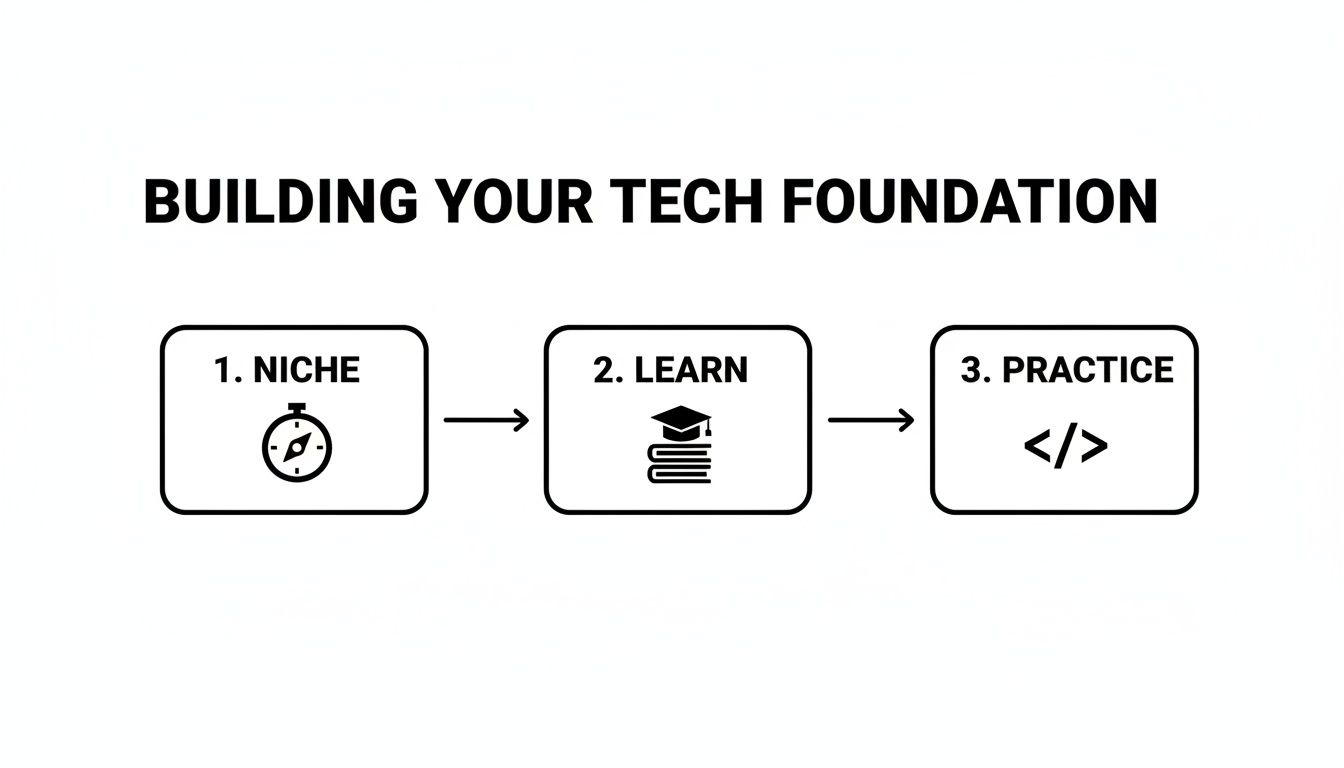
This structured approach is far more effective for job hunting than bouncing between random technologies. Even for entry-level positions like a Software Engineer Intern, this focused foundation will make you stand out from the competition.
Creating a Portfolio That Opens Doors

Your portfolio is the single most important asset in your job search. Knowing how to code is one thing; proving it is what gets you an interview. Your portfolio is the tangible evidence that transforms you from just an applicant into a serious candidate. It shows hiring managers you don't just write code—you build functional products.
A portfolio tells a story about your readiness for a professional role. A page of tutorial clones says you can follow instructions. A collection of unique projects, however, shows you can think critically, solve problems, and are prepared to contribute from day one.
This isn't just about listing skills; it's about showcasing them in a way that proves your value.
Your GitHub Is Your New Resume
Recruiters and engineering managers will review your GitHub profile. They often trust it more than a resume because it's a direct view of your work. A messy or empty profile is a major red flag, suggesting a lack of experience or passion.
To make your GitHub a hiring tool, pin your top 2-3 projects. For each, write a detailed README.md file. Explain what the project is, the problem it solves, the tech stack, and—most importantly—how to run it. Good documentation signals professionalism and strong communication skills.
From a hiring perspective, a well-documented GitHub project is more than just code. It’s evidence of your communication skills, attention to detail, and ability to think like a user—qualities that are essential for any successful programming job.
A strong portfolio is your ticket to getting noticed. The table below breaks down what a job-ready portfolio should contain to catch the eye of recruiters and hiring managers.
| Portfolio Component | What to Include | Why It Matters to Recruiters |
|---|---|---|
| The "Crown Jewel" Project | One substantial, complex application that showcases a wide range of your skills. Think full-stack app with a database, authentication, and a clean UI. | This shows you can handle a project from start to finish and integrate different technologies. It's your proof of concept for the job. |
| A Collaborative Project | A project where you contributed to an open-source library or worked with at least one other developer. | Demonstrates your ability to work in a team, read someone else's code, and use version control (like Git) collaboratively. |
| A Problem-Solving Project | A smaller, unique app that solves a specific, real-world problem—even if it's just for you or a small community. | This highlights your creativity, initiative, and ability to apply technical skills to practical challenges, a key trait for any new hire. |
| Clear Project READMEs | Every project needs a README.md with a project overview, setup instructions, tech stack, and maybe a GIF of it in action. |
Good documentation is a sign of a professional. It shows you care about others being able to understand and use your work. |
| A Polished GitHub Profile | A clean profile with a professional picture, a short bio, and your best projects pinned to the top. | Your GitHub is often the first impression a technical manager has of you. A well-organized profile is a huge plus. |
Ultimately, these elements come together to tell a compelling story about who you are as a developer and what you're capable of building for a potential employer.
Choosing Projects That Solve Problems
The biggest mistake aspiring developers make is filling their portfolios with generic tutorial projects. A simple to-do list app, a basic calculator, or another weather app clone won't impress a hiring manager. You'll be one of thousands of applicants with the exact same projects.
Instead, build something that solves a real problem, no matter how small.
- Solve a personal inconvenience: Build a script or a small app to automate a tedious task. Maybe it’s a tool to track your workout progress or manage your budget.
- Improve an existing tool: Find a simple open-source project and contribute. Fix a bug, add a small feature, or improve the documentation. This is a golden ticket for showing you can work with an existing codebase.
- Build for a community: Offer to build a simple site or a management tool for a local club or non-profit.
Projects like these demonstrate initiative and creativity. For instance, building a Discord bot that pulls event data from a local community calendar is far more impressive than another weather app. It proves you can identify a need, work with APIs, and deliver a useful product—showing you're ready for a real programming job.
4. Crafting Applications That Actually Get Noticed
Hundreds of developers are likely applying for the same role you are. A generic resume will get lost. To get a job as a programmer, your application must pass two filters: the automated Applicant Tracking System (ATS) and the six-second scan from a busy recruiter.
First, dissect the job description like you would a complex function. Extract all the core technical skills they mention—like "Solidity," "React," or "Next.js"—and soft skills like "collaborative environment." These are the keywords the ATS is scanning for. If they aren't on your resume, a human will likely never see it.
Fine-Tuning Your Resume for Every Single Application
Create a "master resume"—a comprehensive document with every skill, project, and achievement you've ever had. This is your personal library, not what you send out.
For each job application, copy the master resume and customize it heavily. If the job ad emphasizes "API integration," your resume must highlight the project where you did exactly that. Mirror their language and prioritize their needs.
The key is to frame your experience in terms of achievements, not just duties. Show the impact you made.
- What most people write: "Responsible for building UI components."
- What you should write: "Developed and implemented a new component library in React, cutting page load time by 15% and streamlining the developer workflow."
That small change proves you don't just write code; you create business value. That’s what gets a hiring manager to stop scrolling and consider you for an interview.
A resume packed with quantifiable results tells a recruiter you’re more than just a coder—you're a problem-solver who understands the bigger picture. It directly answers their main question: "Will this person make our product better?"
A Cover Letter That Someone Will Actually Read
Many developers skip the cover letter, which is a massive mistake. It’s your only chance to tell a story and show the hiring manager you're genuinely interested in their company.
A good cover letter doesn't repeat your resume; it connects the dots.
Start by addressing a pain point you noticed in the job description. For instance, if they're hiring someone to help scale their platform, open with: "As a developer obsessed with building scalable systems, I was immediately drawn to [Company Name]'s need to enhance platform performance for its growing user base."
Then, tie one of your portfolio projects directly to their needs. Show them you’ve already solved a similar challenge. This demonstrates that you’ve done your homework and are a proactive candidate they need to interview.
Nailing the Technical and Behavioral Interviews

The interview is where your preparation pays off. It's your chance to prove you're more than a resume—you're a problem-solver who can think on their feet, communicate clearly, and add value to the team. The interview tests both your technical skills and your cultural fit.
In a technical interview, especially a live coding challenge, the hiring manager wants to see how you think. They are evaluating your ability to dissect a problem, ask clarifying questions, and articulate your logic.
If you get stuck, do not go silent. Verbalize your thought process. Explain what you're trying, why it isn't working, and what you'll try next. A candidate who communicates their way through a tough problem, even with a slightly imperfect solution, is far more impressive than one who silently fails.
Answering Behavioral Questions That Actually Matter
You will face behavioral questions designed to assess your soft skills and real-world problem-solving abilities. Companies hire team players who can take feedback, collaborate, and navigate challenges.
The STAR method is your best tool for structuring impactful answers:
- Situation: Briefly describe the context. What was the project or challenge?
- Task: What was your specific responsibility?
- Action: What exact steps did you personally take to address the task?
- Result: What was the quantifiable outcome? Use numbers and data.
Don't just say, "I worked on a team project."
Instead, try this: "Our team was tasked with improving app performance (Situation). My responsibility was to identify and resolve frontend bottlenecks (Task). I used a profiler to analyze the code, identified slow-loading image components, and implemented lazy loading (Action). This resulted in a 20% reduction in initial page load time (Result)."
This structured answer provides concrete proof of your impact and problem-solving skills, making you a much stronger candidate.
From Asking Questions to Negotiating the Offer
An interview is a two-way street. When the interviewer asks, "Do you have any questions for us?" your answer must be "Yes." Asking insightful questions shows genuine interest and helps you determine if the company is the right fit for your career progression.
Once you receive an offer, the final step is negotiation. This is where specializing in a high-demand niche pays off. For example, if you specialized in blockchain, you have significant leverage. By 2026, senior blockchain developers are projected to command base salaries between $200,000 and $300,000. Knowing your market value is crucial for negotiating with confidence. You can learn more about Web3 careers and salary expectations to arm yourself with data.
Keep the conversation professional. Express gratitude for the offer, reiterate your excitement, and then present your case based on your skills, market data, and the value you bring to the company. A well-negotiated offer is the best start to your new programming career.
Networking and Navigating the Job Market

A killer portfolio and resume are essential, but applying cold to job postings is a slow strategy. To accelerate your job search, you must be proactive, build connections, and engage with the community where recruiters and engineers are active.
The ultimate goal is to get a referral. A referral from a current employee is the single most effective way to get your resume noticed. It bypasses the initial screening process and puts your application directly in front of a hiring manager, dramatically increasing your chances of an interview.
Building Connections on LinkedIn
Treat LinkedIn as a dynamic networking tool, not just an online resume. Create a target list of companies, then find engineers or recruiters on their teams.
When you send a connection request, always personalize it.
- "Hi [Name], I saw your recent post on [Topic] and found your insights on [Specific Point] really interesting. I'm an aspiring developer passionate about this space and would love to connect."
- "Hello [Name], I'm genuinely impressed by the work [Company Name] is doing with [Project/Technology]. As I'm building my skills in this area, I'd appreciate the chance to connect and follow your work."
This is about starting a professional relationship, not asking for a job immediately. Once connected, engage with their content through thoughtful comments.
Go Where the Developers Are
Immerse yourself in the online communities where developers collaborate. This is where you'll learn from professionals, demonstrate your knowledge, and build authentic connections.
Engaging in these communities isn’t just about being seen—it's about contributing. Answering a question on Stack Overflow or participating in a technical discussion on a Discord server demonstrates your skills and collaborative spirit far more effectively than a line on your resume.
Find the platforms relevant to your niche. If you're targeting Web3, for example, being active in the right Discord and Telegram channels is essential. This is where you’ll hear about job opportunities before they're widely advertised.
Find Your Niche and Your Job Board
While large job boards are useful, specialized platforms are often more effective. They cut through the noise, especially in high-growth fields like blockchain.
The demand in this space is significant. Over 95% of blockchain roles are remote-friendly, and experts project 45% job posting growth in 2025 for this sector. This talent shortage means a shorter path to a great role for skilled candidates.
Instead of getting lost on a massive site, use a focused platform. A site like Blockchain Jobs lists openings exclusively for the Web3 ecosystem. It connects you directly with companies that need your specific skills, getting your application in front of the right hiring managers.
Frequently Asked Questions About Getting Hired
Landing your first programming job can feel overwhelming. Here are answers to common questions from a hiring and career progression perspective.
Do I Really Need a Computer Science Degree?
No, not necessarily. While a CS degree provides a strong theoretical foundation, what hiring managers value most today are provable skills and a portfolio of completed projects.
Many successful engineers are self-taught or bootcamp graduates. They secured top jobs by building impressive personal projects, contributing to open source, and excelling in technical interviews. In specialized fields like Web3, hands-on experience with Solidity can be more valuable than a traditional degree.
How Many Projects Should I Have in My Portfolio?
Focus on quality over quantity. A portfolio with 2-3 substantial, well-documented projects is far more effective than a dozen small tutorial apps. You need to demonstrate that you can see a complex project through from concept to completion.
An interview-ready portfolio should include:
- A full-stack application with a database and user authentication.
- A unique project that solves a real-world problem.
- A contribution to an open-source project, proving you can work in a collaborative codebase.
These projects show you can build functional software—which is precisely what hiring managers are looking for.
What's the Biggest Mistake Junior Developers Make?
The most common mistake is sending out generic, copy-paste applications. Recruiters can easily spot a templated resume and cover letter, which signals a lack of genuine interest in the role and company.
The other major error is neglecting networking. Relying solely on job boards means you miss out on the power of referrals. A referral from a current employee can get your resume directly to the hiring manager, bypassing the ATS and HR filters where most applications get lost.
Your technical skills might get you the interview, but your soft skills—like communication, collaboration, and problem-solving—will get you the job and help you succeed long-term. Modern software development is a team sport, and companies hire engineers who can work well with others.
These are just a few of the common hurdles. For a deeper dive into navigating the job search, check out more career advice on the Blockchain Jobs blog.
Ready to find your place in the future of tech? On Blockchain Jobs, you can discover thousands of opportunities in Web3, DeFi, and beyond. Find your next role and start building the decentralized future today.