How to Get a Job in Web3: A 2026 Career Roadmap

You've probably reached the frustrating point where you understand the basics of wallets, tokens, and smart contracts, but every Web3 vacancy seems to demand prior Web3 experience. Or perhaps you're a developer being told to learn Solidity, despite having stronger product, legal, marketing, or operations experience that could transfer immediately.
The practical answer to how to get a job in Web3 isn't to collect every blockchain credential or send the same application to every protocol. It's to choose a realistic role, build public evidence that you can perform it, and target employers with a focused search system. In 2026, hiring managers are looking for people who can connect blockchain knowledge with useful execution.
Where Web3 Hiring Actually Stands in 2026
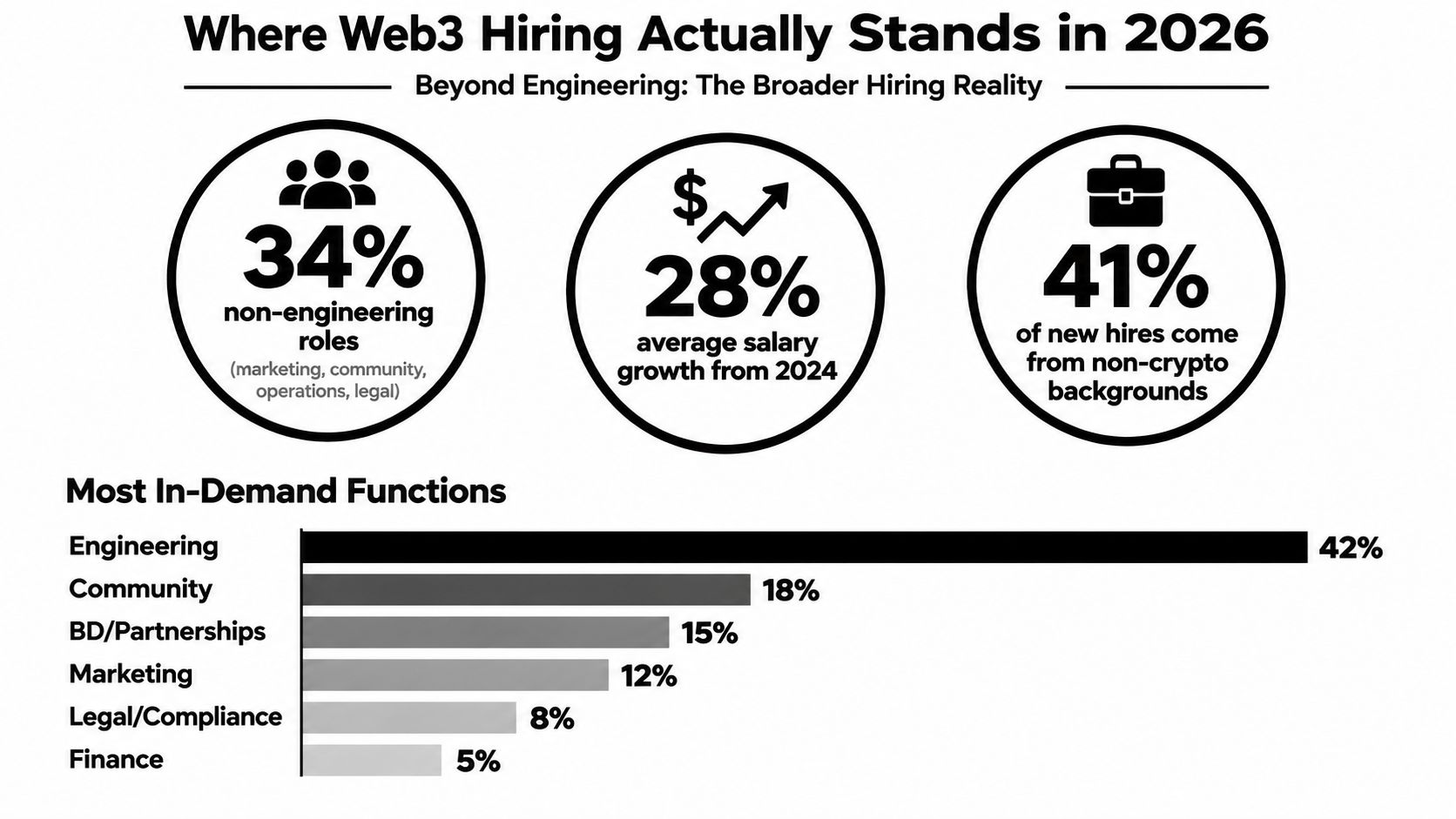
Web3 hiring has moved beyond its earlier engineering-heavy identity. A 2025 industry report found that project and programme management represented over 27% of postings, while a separate analysis of 12,347 open positions across 45 countries reported that compliance, legal, and institutional roles rose 340% year over year, even as pure engineering roles declined 18%. The Web3 intelligence report shows why the old advice, “learn Solidity and build a dApp,” now misses a large part of the market.
A 2026 hiring analysis of 2,932 active postings found engineering accounted for 34.1% of roles, while compliance and legal represented 10.4%. That distribution doesn't mean engineering has stopped mattering. It means employers also need product managers, programme leads, risk specialists, legal professionals, operations contributors, institutional salespeople, and people who can make distributed teams function.
What the compensation signals mean
Compensation varies sharply by function, seniority, location, and whether a package includes tokens or equity. A 2026 benchmark placed the average US blockchain developer base salary at about $155,000, compared with $136,000 in 2024, a 14% increase. The same Web3 salary benchmark listed mid-level blockchain developer compensation between $130,000 and $175,000, and senior Solidity or Rust engineers between $165,000 and $220,000, before token or equity upside.
Entry routes exist below senior protocol engineering. The benchmark placed junior Web3 frontend developers around $75,000 to $110,000, and junior smart-contract developers around $85,000 to $120,000. Those figures shouldn't become entitlement anchors, but they can help you understand why employers scrutinize proof of competence rather than enthusiasm alone.
A separate report covering 618 open roles put the median annual salary at $189.5k, with product roles around $207.5k and legal or compliance roles around $208k. The range was extremely wide, so treat published compensation as a negotiation reference, not a promise.
Where candidates should focus
The same 2025 intelligence analysis found that the US, UK, and UAE accounted for 58% of Web3 postings. Remote work broadens access, but hiring still clusters around regulatory, financial, and technical hubs. A candidate outside those markets should make timezone compatibility, written communication, and remote execution visible rather than assuming location won't matter.
If you want a broader view of why companies struggle to recruit and retain people with both domain knowledge and execution ability, read this practical resource on overcoming Web3 talent shortage. The key career implication is simple: choose a lane where your existing strengths give you an advantage, then add enough blockchain fluency to become useful quickly.
Choosing a Role That Matches Your Background
Start with your existing professional evidence, not with the most fashionable blockchain tutorial. Hiring managers can teach a strong operator token mechanics more easily than they can turn an untested beginner into someone who manages stakeholders, handles regulatory ambiguity, or ships reliable software.
Use this decision rule: keep your strongest transferable skill, add Web3 context, and create one public artifact that proves the combination. A frontend engineer might build a wallet-connected interface. A compliance professional might write a risk assessment for a token-related product. A project manager might publish a delivery plan showing how protocol, legal, product, and community dependencies fit together.
| Role Family | Common Entry Path | Signal That Gets Interviews |
|---|---|---|
| Engineering | Software development, frontend, backend, smart contracts | A deployed application, readable repository, tests, and a clear technical explanation |
| Product | Product management, research, fintech, platform operations | A protocol teardown, product brief, governance analysis, or prioritised roadmap |
| Legal and Compliance | Law, AML/KYC, financial services, risk | A practical regulatory memo connecting obligations to a blockchain product |
| Operations and Programme Management | Delivery, business operations, project coordination | Evidence of launching work across distributed teams with clear ownership |
| Marketing and Community | Content, growth, communications, community support | A campaign, editorial portfolio, community playbook, or useful public analysis |
| Design and Research | UX, product design, user research | Wallet or dApp flows that reduce confusion, supported by research reasoning |
Match the problem to your background
Engineers should decide whether they want application development, protocol work, infrastructure, data, or security. Those paths overlap, but their interview expectations don't. A strong React and API background may create a faster route into a Web3 frontend role than attempting to compete immediately for protocol engineering.
For non-technical candidates, avoid hiding behind a generic “passionate about crypto” summary. Translate prior work into the employer's operating reality. A compliance manager can discuss transaction monitoring and KYC controls in a blockchain setting. A product manager can explain governance, incentives, and wallet friction. An operations lead can show how they coordinate contributors across time zones.
Look through Web3 companies and hiring categories to compare the kinds of organisations hiring before you commit to a learning path. Study recurring responsibilities, not just job titles. If postings repeatedly ask for institutional onboarding, governance operations, or regulatory analysis, those signals may offer a more realistic opening than a crowded junior developer track.
Choose one primary lane
Don't apply equally to engineering, marketing, legal, and operations roles. That creates a résumé with no coherent story. Pick one primary lane and one adjacent lane, then make your portfolio support both.
For example, a technical writer could target developer relations as the primary lane and documentation operations as the adjacent lane. A financial analyst could target protocol operations while building enough on-chain data literacy to support product or risk work. This approach preserves flexibility without making your candidacy look unfocused.
Building the Skills and Stack Employers Screen For
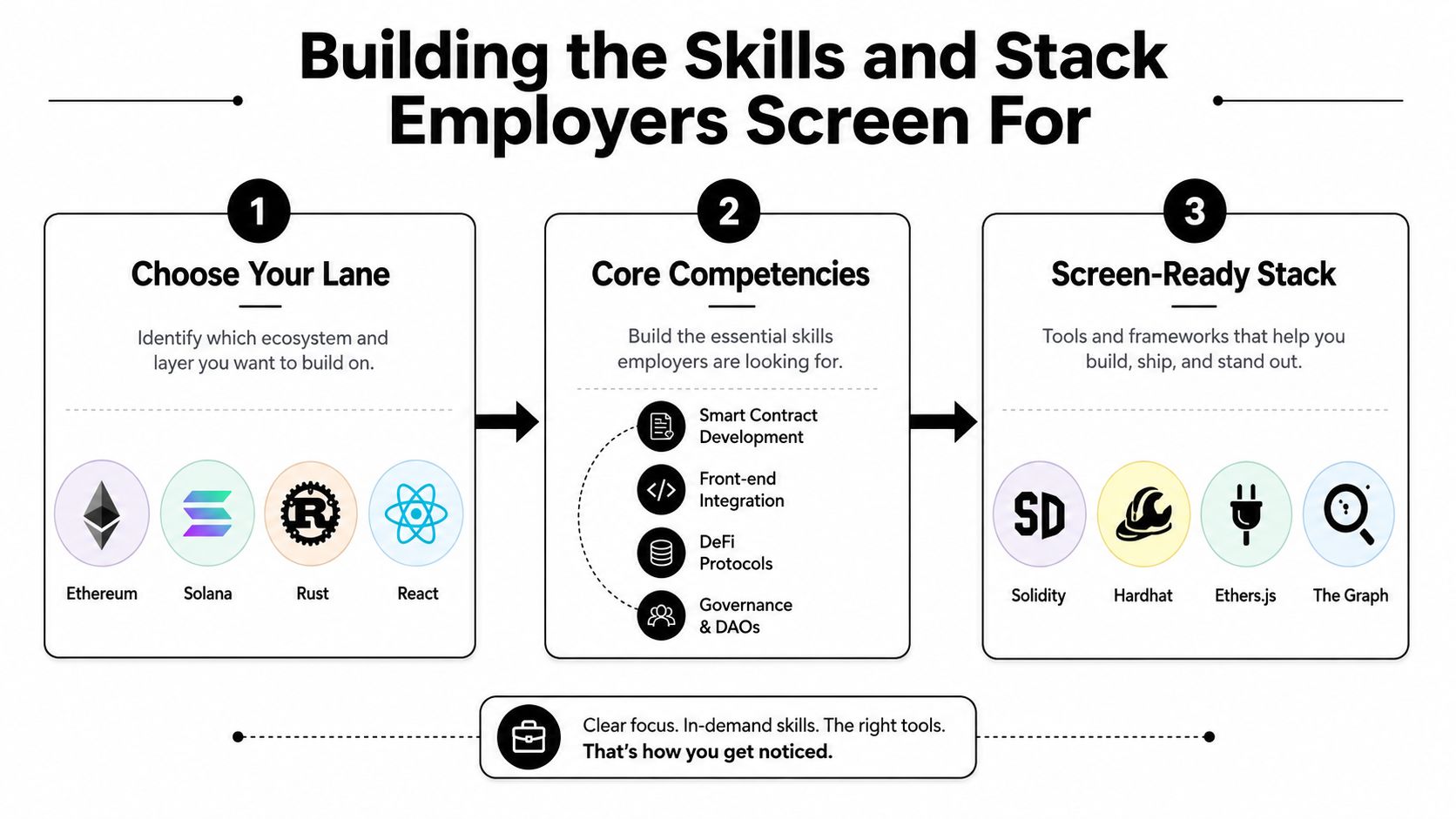
Hiring managers rarely evaluate one isolated skill. They look for combinations that reduce handoffs. A blockchain job-market study recorded repeated employer screening for Ethereum, with 371 occurrences; React, with 213; NFT, with 213; Java, with 205; and Rust, with 102. The blockchain job-market study supports a practical conclusion: build for an ecosystem and a working layer, not for a language badge.
Technical combinations that compound
For an EVM engineering path, learn Solidity alongside contract testing, wallet interaction, frontend integration, and security-aware development. A candidate who can write a contract but can't connect it to a usable interface still leaves a major part of the product unfinished. Pairing Solidity with React and an integration library creates a clearer hiring signal.
Rust makes sense if you're specifically targeting ecosystems and infrastructure where it appears in the role requirements. Don't choose it because it sounds more advanced. Choose it because you can explain which systems you want to build and demonstrate a working component.
Non-engineering candidates need a similarly concrete stack. Product candidates should understand wallets, transactions, tokens, governance, and protocol incentives. Legal and compliance candidates should connect AML/KYC practice with the operational realities of pseudonymous users, smart-contract systems, and cross-border products. Community and operations candidates should be comfortable with Discord, Telegram, governance forums, documentation, and async decision-making.
The engineering roles section on Blockchain Jobs can help you compare current requirements and identify the recurring tools worth prioritising.
A focused 90-day plan
An engineering-track candidate can structure the first phase around ecosystem fundamentals and a small contract. The next phase should add tests, frontend integration, documentation, and a security review. The final phase should turn the project into a public case study with a deployed address, repository, design decisions, and known limitations.
A non-engineering candidate can spend the first phase learning how a protocol works from its documentation and user perspective. The second phase can produce a useful artifact, such as a governance proposal, compliance memo, community operating guide, or product teardown. The final phase should publish it, request informed feedback, and revise it based on what the project needs.
Hiring rule: Learn only what you can connect to a role, a deliverable, and a public explanation.
A three-to-six-month runway can be productive when every learning task feeds the same portfolio story. It becomes wasteful when you collect unrelated certificates, switch chains weekly, or consume tutorials without producing something another person can inspect.
Shipping Portfolio Projects That Actually Get You Hired
A résumé tells me what you claim to have done. A portfolio lets me inspect how you think, what you finish, and whether you can explain trade-offs. In Web3, that distinction matters because public work is often easier to verify than a conventional achievement statement.
What technical reviewers open first
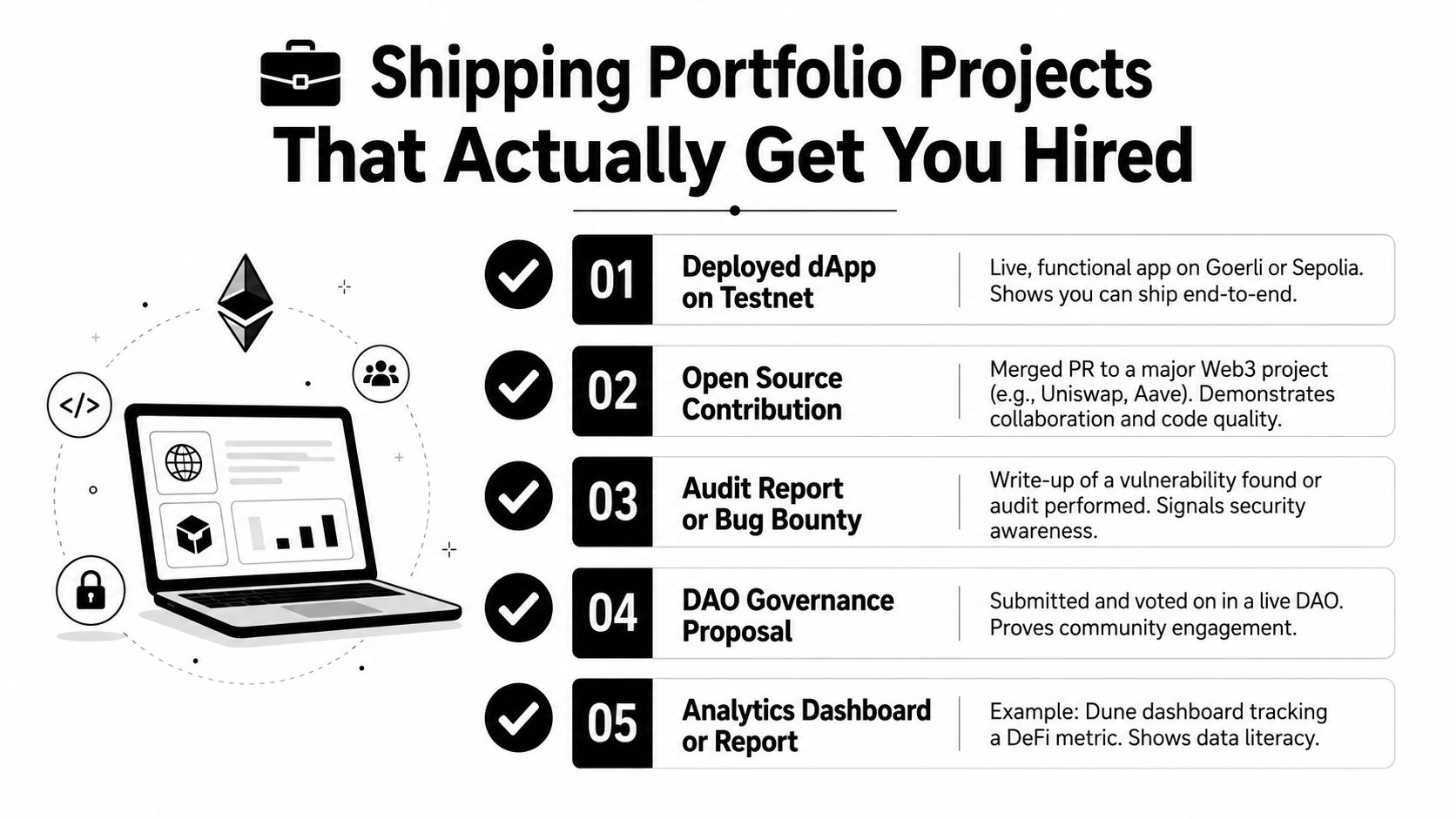
A credible engineering project has a live component, a repository, and an explanation of the decisions behind it. Include the contract address, network, frontend link, setup instructions, tests, threat assumptions, and a short note explaining what you'd change before production use.
A tutorial clone rarely helps because it proves that you can follow someone else's path. A better project introduces a constraint. Build a small governance tool, analytics interface, or wallet-connected workflow, then document how you handled failed transactions, permissions, gas considerations, and user confusion.
Open-source contributions can carry similar weight. Documentation fixes, test improvements, issue reports, and focused pull requests show that you can work within an existing codebase. Reviewers care less about theatrical complexity than about clean changes, useful context, and evidence that someone else could maintain your work.
What non-technical reviewers need to see
Non-engineering portfolios should be equally concrete. A product candidate could publish a protocol teardown that identifies a user problem, compares alternatives, and proposes a prioritised solution. A compliance candidate could write a structured memo that identifies risks, assumptions, controls, and questions requiring legal review.
Community and operations candidates can show a moderation playbook, contributor onboarding flow, governance summary, or postmortem. If you worked on a campaign or community initiative, describe the objective, the action you owned, the evidence you reviewed, and what you changed afterward. Don't fabricate performance figures. A transparent account of the measurement method is stronger than an impressive unsupported result.
Audit your public work before applying
Use this checklist:
- Can a reviewer verify it? Link directly to repositories, documents, dashboards, proposals, or published analysis.
- Does it show your target role? A general crypto thread won't replace a product brief when you're applying for product work.
- Does it explain trade-offs? Include constraints, rejected options, risks, and what remains unfinished.
- Does it look maintained? Fix broken links, clarify setup steps, and remove abandoned drafts from the first view.
- Can you discuss it live? Interviewers will probe decisions, not just admire screenshots.
The most common mistake is presenting activity instead of contribution. Joining a DAO, opening a wallet, or completing a course may begin your story, but the portfolio must show what you produced for other people.
Sourcing Roles and Running Your Job Search
Treat the search as a small sales pipeline. Your résumé is the positioning document, your portfolio is the evidence, and each application is a targeted proposal to solve a specific problem.
Start by rewriting the top third of your résumé for the lane you selected. Put relevant blockchain work near the top, including open-source contributions, governance participation, protocol analysis, or wallet and dApp projects. Pseudonymous work can be included with a stable public identity and links, but be ready to explain what you personally owned without exposing private keys or sensitive information.
Make each channel do a different job
LinkedIn should make your professional background legible to recruiters who may understand enterprise technology better than crypto-native communities. Your headline should state the function you perform and the Web3 context you understand. X, Discord, Telegram, and governance forums can demonstrate ongoing participation, but don't turn every interaction into a job request.
Use job boards to identify patterns, then build a target list of companies whose products and requirements fit your evidence. Blockchain Jobs remote listings can be useful when location flexibility is part of your plan, while direct company career pages and protocol communities may reveal roles that require more research.
Check fresh postings regularly and record the role, company, contact, closing information, required evidence, and next action in a simple tracker. A smaller set of carefully crafted applications is easier to improve than an undifferentiated stream of submissions.
Outreach should offer relevance
A strong message names the product, identifies a specific need, and links one relevant artifact. Don't send a life story. Tell the hiring manager what you noticed, what you've already done, and what conversation would make sense next.
For technical teams, resources on how to find skilled engineers with Talantrix illustrate why specialised sourcing depends on matching evidence to the actual role. Candidates should apply the same principle in reverse. Find the person closest to the problem, then make their evaluation easy.
Avoid scams throughout the process. Never share seed phrases or private keys, never pay to receive an offer, and verify that a role appears through an official company channel. A rushed interview conducted only through an unverified account deserves caution.
Networking, Interview Prep, and Closing the Offer
A representative candidate, Maya, moved from fintech operations into a protocol operations role without pretending to be an engineer. She spent time in the project's public community, wrote a concise analysis of a contributor workflow, and used that document in outreach. The conversation started because she had already demonstrated that she understood the team's operating problem.
Her interview loop tested that evidence. The recruiter asked about her transition, a functional interviewer asked her to improve the contributor process, and a founder asked how she would make decisions in an async environment. She prepared by reading documentation, reviewing governance discussions, and writing down assumptions before proposing solutions.
Prepare for the work, not the label
Technical interviews may include protocol design, contract security, debugging, or a take-home exercise. Product and operations interviews can involve governance scenarios, prioritisation, incident communication, or a written operating plan. Legal and compliance interviews may test whether you can identify uncertainty without overstating a conclusion.
Your preparation should include:
- A project walkthrough: Explain the user, constraint, decision, result, and unresolved risk.
- A Web3 point of view: Discuss the company's product, users, governance model, or business tension specifically.
- Async examples: Show how you documented decisions, managed handoffs, and progressed without constant supervision.
- Questions for the team: Ask how success is measured, who owns decisions, how compensation works, and what the first deliverable should be.
The signal that turns an interview into an offer is credible ownership. Show what you noticed, what you did without being asked, and how you learned from the result.
“No direct Web3 experience” is an objection only when your previous experience isn't translated. Explain the equivalent problem you solved, then demonstrate that you understand the blockchain-specific constraints. Don't claim to be crypto-native if you aren't. Curiosity backed by useful work is more convincing than borrowed jargon.
Networking also needs boundaries. Contribute before asking, respect community norms, and avoid spamming founders. A practical networking guide from Access Courses Online can help structure relationship building, but the quality of your contribution still determines whether people remember you positively.
Your First 90 Days and Long-Term Career Path
Landing the role changes the evaluation. During the first two weeks, secure access to repositories, documentation, communication channels, dashboards, and decision records. Learn which decisions belong to the core team, which go through governance, and how the organisation handles disagreement across a distributed workforce.
Your first useful contribution shouldn't be a grand redesign. Fix a contained issue, improve documentation, close a small operational gap, or complete a low-risk feature. Then write down what you learned and make the work visible to the people who depend on it.
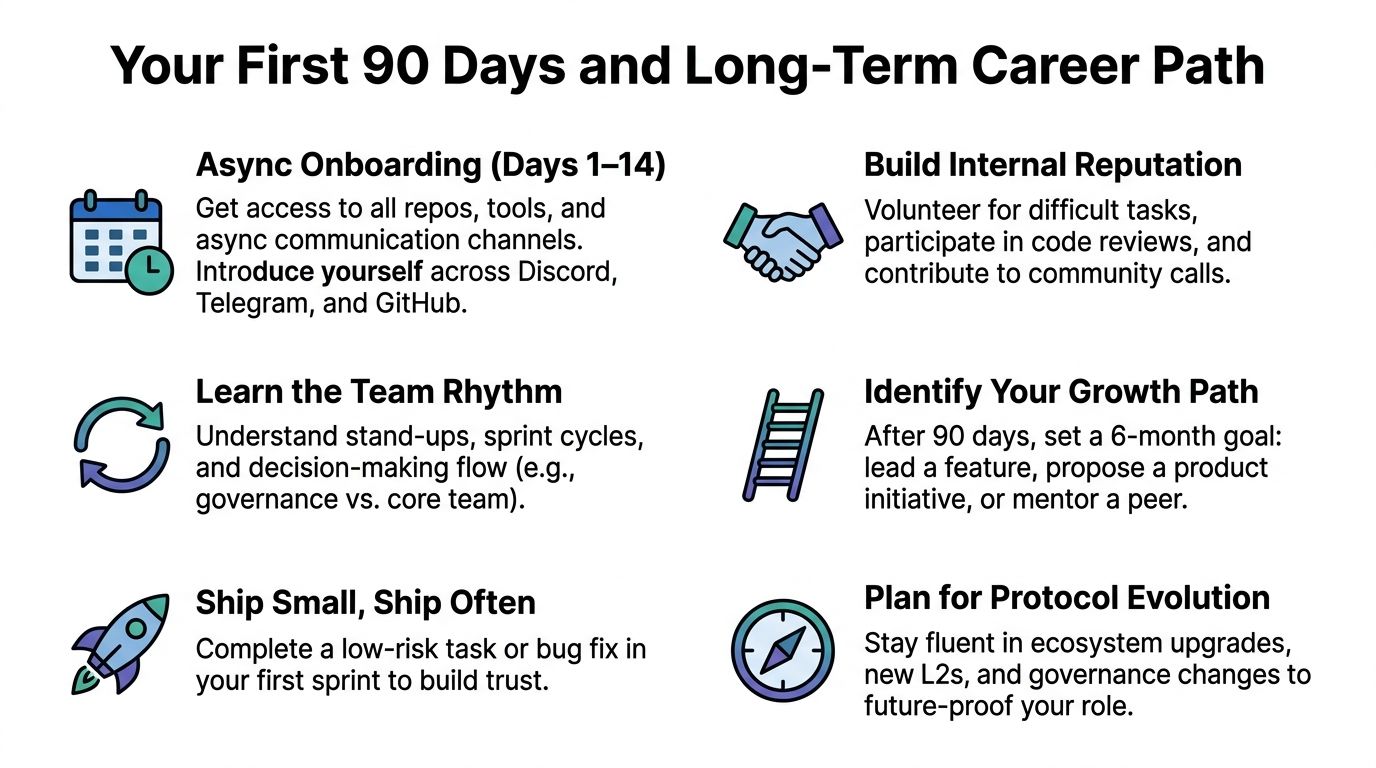
Use the first 90 days deliberately
At 30 days, you should understand the product, team rhythm, decision paths, and immediate risks. At 60 days, aim to own a meaningful piece of delivery and become dependable in one recurring workflow. At 90 days, agree on a longer-term goal, such as leading a feature, improving an operational system, proposing a product initiative, or mentoring a contributor.
The long-term choice is usually between deeper specialisation and broader responsibility. Engineers may deepen into security, infrastructure, or protocol design. Product and operations professionals may become domain specialists in governance, institutional workflows, or compliance. Management can increase scope, but senior individual contributor work may offer greater technical or functional depth.
Compensation should be evaluated as a package. Compare base salary, token or equity terms, vesting, liquidity assumptions, jurisdiction, and the stability of the company's funding. The 2026 AI, Crypto, and Web3 labor-market study reported 15,247 active jobs, an average annual salary of $127,400, and median salaries of $155,000 for Solidity smart-contract developers and $148,000 for blockchain backend engineers. Use role-specific benchmarks to plan your next move, but let demonstrated scope and execution determine your value.
Your action plan is straightforward: choose a lane, build one relevant artifact, publish your reasoning, contact aligned teams, prepare for the actual interview format, and review progress at 30, 60, and 90 days. The developer research from SlashData's 2025 blockchain study draws on more than 1,400 developers engaged with blockchain or cryptocurrency, reinforcing the value of studying how practitioners work rather than relying only on beginner content.
Blockchain Jobs helps candidates search curated Web3 roles across engineering, product, operations, legal and compliance, marketing, data, security, and other specialist categories, including remote-friendly openings. Visit Blockchain Jobs, filter for the lane you've chosen, and turn your portfolio evidence into targeted applications.