
Jobs on Go Language: Roles, Skills, and Salaries in 2026

Go engineers with production experience average 9.2 interview requests per candidate, making Go the most recruited-for language in a recent IEEE Spectrum study. In 2026, the market is smaller than it was, but experienced engineers with cloud and infrastructure depth can still command premium compensation.
That combination defines the current reality of jobs on Go language. The easy growth phase has cooled. Employers aren't collecting candidates who merely completed a Go course or built a basic REST API. They're hiring engineers who can keep distributed services reliable, reason about concurrency, reduce latency, and work comfortably inside production systems.
I've placed Go candidates for six years, and the pattern is consistent: a concise Go resume with credible operational evidence beats a longer résumé full of language keywords. The strongest candidates usually come from backend engineering, platform engineering, cloud infrastructure, or blockchain protocol work. The sections below are designed for three groups, active Go job seekers, backend engineers considering a switch, and blockchain developers who want to turn practical Go knowledge into a formal career path.
Why Go Still Pays a Premium in 2026
Salary resilience is the clearest reason to take Go seriously. Go engineers with production experience averaged 9.2 interview requests per candidate in the IEEE Spectrum study cited by Riem AI's 2026 Go salary analysis, the highest figure for any language in that study. Recruiter attention has held up better for engineers who can prove operational results than for candidates who only list Go on a résumé.

The premium goes to a specific profile. Employers want engineers who have shipped concurrent services, operated containers, diagnosed production failures, and made sound trade-offs in distributed systems. Go is easy to read, but production Go requires judgment about concurrency, reliability, performance, and service ownership.
A correction with salary resilience
UK hiring data shows a smaller, more selective market. In the six months ending 15 August 2026, employers posted 468 permanent jobs citing Go, representing 0.44% of all permanent jobs and 2.52% of the Programming Languages category. The same period in 2025 recorded 1,005 roles. Candidates should expect fewer openings and more demanding interview processes.
Pay has not fallen in step with listing volume. The current median annual salary is £82,000, compared with £90,000 a year earlier, according to HiringTrends' State of Go report. That change still leaves experienced Go engineers well positioned when they bring infrastructure depth, because employers are paying for dependable systems work rather than syntax familiarity.
The post-hype correction has changed the hiring standard. Demand remains concentrated in infrastructure, cloud platforms, financial services, observability, and protocol systems, where outages and poor performance carry real costs. Production evidence is the dividing line between a premium candidate and a beginner competing for general backend roles.
Hiring rule: Treat Go as a specialization layered on top of backend or infrastructure competence, not as a substitute for it.
Tailor every résumé to operational outcomes. Backend engineers switching to Go should lead with systems experience, then demonstrate idiomatic Go through a real service. Blockchain developers should document networking, node operation, testing, and protocol behavior instead of presenting Go as a standalone checkbox.
Reading the Go Hiring Market Right Now
Go's professional base remains stronger than its listing volume. The official 2025 Go Developer Survey results found that 87% of respondents identified as professional developers and 82% used Go for their primary job. The survey ran from 9 to 30 September 2025, with results published on 21 January 2026.
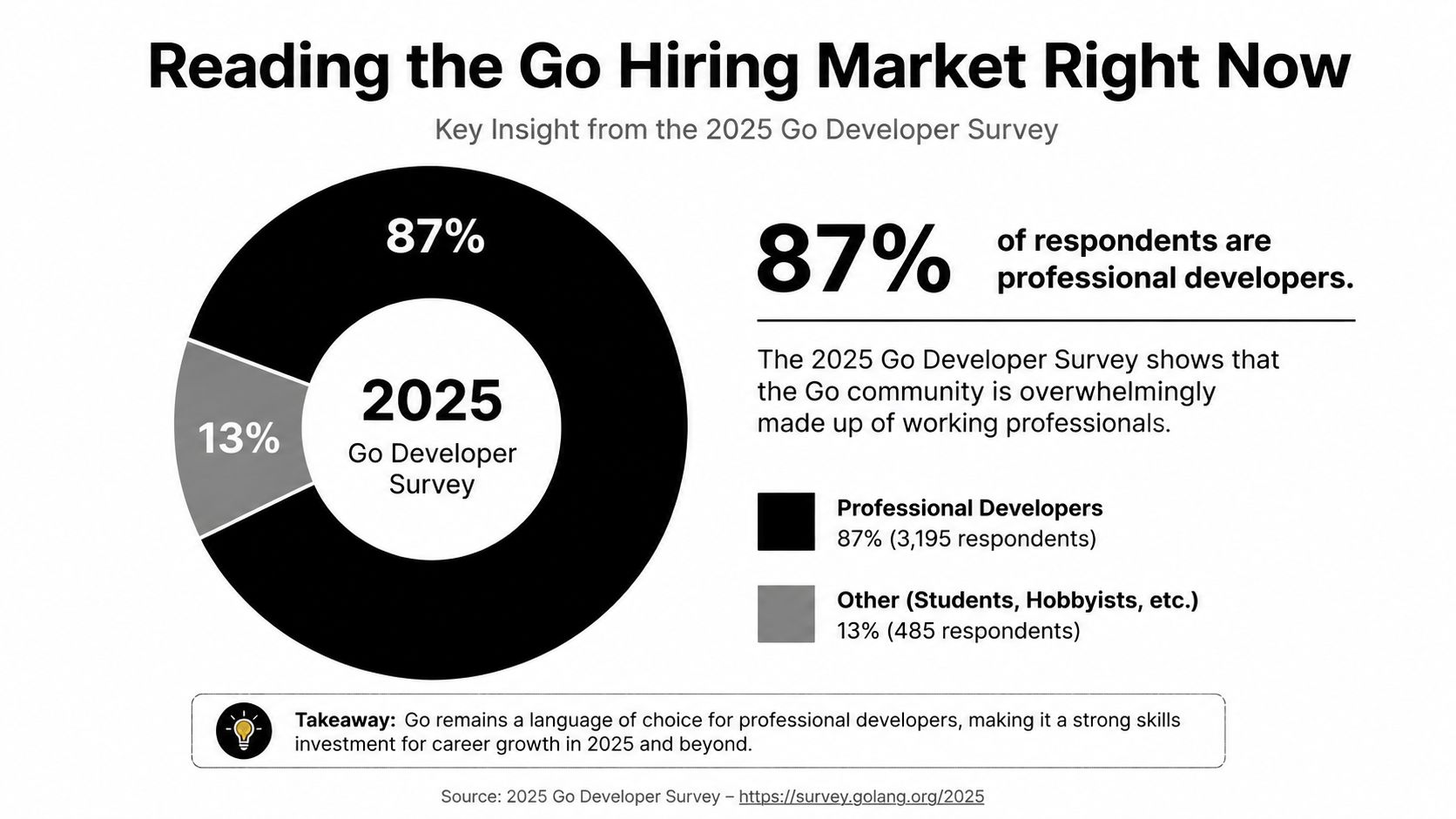
The survey also found that 72% use Go for personal or open-source projects and 46% work at technology companies. The hiring signal is clear: Go is established inside working engineering teams, especially those building services, infrastructure tooling, and systems that require predictable performance.
Volume and quality are different measurements
The UK figures require a focused application strategy. The latest six-month window contained 468 permanent Go roles, equal to 0.44% of all permanent jobs, while the comparable 2025 window contained 1,005. Target those 468 roles instead of treating the market as empty. The decline confirms a post-hype correction, not the disappearance of Go work.
A smaller market rewards specialists. Hiring managers want evidence of service ownership, failure handling, and deployment responsibility. A polished portfolio tied to production outcomes can therefore outperform a high-volume application strategy.
Use a focused workflow:
- Filter by system type: Separate backend services, platform engineering, and protocol roles before applying.
- Read operational requirements: Prioritize postings that mention reliability, Kubernetes, networking, storage, or observability.
- Adapt the application: Use ResumeToJobs job application help to improve the structure, then rewrite each section around your actual Go evidence.
- Inspect adjacent roles: A backend Golang software engineer role shows how employers combine Go with distributed systems and product context.
The market is smaller, so generic applications lose value. Go engineers with production experience and infrastructure depth still command stronger recruiter interest than language specialists whose experience stops at syntax. Present Go as proof of production judgment, not as the entire qualification.
Skills That Show Up in Every Go Job Description
Hiring managers rarely reject a candidate because they haven't memorized enough syntax. They reject candidates who can't explain how their service behaves under load, how cancellation propagates, or what happens when a dependency fails.
The technical baseline
You should be able to discuss goroutines and channels without treating them as magic concurrency keywords. Explain ownership, cancellation, synchronization, backpressure, race detection, and the risks of leaking work after a request ends. A strong candidate can describe when a worker pool is appropriate and when a simple synchronous flow is safer.
The rest of the recurring stack usually sits around the service:
- Service communication: Build and debug HTTP and gRPC APIs, including deadlines, retries, status handling, and backward compatibility.
- Deployment: Package services with Docker and explain how Kubernetes handles health checks, configuration, rollout behavior, resource limits, and failure recovery.
- Observability: Instrument meaningful signals with Prometheus and OpenTelemetry, then connect traces, metrics, and logs to an incident diagnosis.
- Data systems: Work confidently with SQL transactions, indexes, migrations, connection pools, and at least one NoSQL model when the design requires it.
- Delivery discipline: Use CI/CD pipelines for testing, static analysis, reproducible builds, security checks, and controlled deployment.
A Go role may not list every tool, but the underlying expectations recur. You can learn a product-specific platform after joining. You can't fake an understanding of cancellation, service boundaries, or operational risk during a system design interview.
The signals behind the keywords
Your application needs more than a technology inventory. Hiring teams look for evidence that you have owned a service after deployment, participated in incident response, worked through an unfamiliar codebase, and accepted the constraints of on-call work.
Show those signals through a production story. Explain the failure, the diagnosis, the change you made, and the verification that followed. If you have open-source work, point to a meaningful issue, review, bug fix, or documentation improvement. A candidate who contributes carefully to an existing Go project demonstrates more than someone who publishes another isolated tutorial repository.
For a useful benchmark, compare your experience against a role such as this Golang engineering position at Bitpanda. Then ask yourself three questions: Can I explain my concurrency decisions? Can I operate the service I built? Can I review someone else's Go code and defend a change?
If any answer is no, don't apply broadly yet. Build the missing evidence first.
The Three Go Career Lanes You Can Apply For Today
Go hiring becomes easier to understand when you stop treating “Go developer” as one job. Three lanes absorb most credible candidates, and each lane evaluates a different kind of depth.
| Lane | Typical Seniority | Core Stack | Sample Responsibilities |
|---|---|---|---|
| Backend services | Junior to senior | Go, HTTP, gRPC, SQL, queues, Docker | Build APIs, maintain microservices, improve request handling, support payment or data workflows |
| Infrastructure and platform | Mid-level to senior | Go, Kubernetes, Linux, cloud tooling, Prometheus, OpenTelemetry | Develop operators, improve deployment systems, maintain internal platforms, diagnose reliability issues |
| Blockchain and protocol development | Mid-level to senior | Go, networking, cryptography concepts, databases, testing, node tooling | Build clients, maintain indexers, implement protocol behavior, improve validator or node operations |
Backend services
A representative description might read: “Build and maintain Go microservices, design gRPC and HTTP APIs, improve data access patterns, and participate in production support.” This lane suits a backend engineer who already understands APIs, databases, testing, and service ownership.
Your competitive edge comes from showing judgment around boundaries. Explain why you chose synchronous calls or asynchronous messaging, how you handle retries, and how you prevent duplicate work. If your background is in Java, TypeScript, Python, or another backend ecosystem, don't hide it. Frame Go as the implementation language and your systems experience as the transferable asset.
For a broader comparison of Go and Java for startups, focus on the trade-offs that affect hiring, team familiarity, runtime behavior, and operational simplicity rather than language preference.
Infrastructure and platform
Platform roles want engineers who can build tools other engineers depend on. A sample responsibility set would include writing Kubernetes controllers, improving deployment workflows, building observability integrations, and reducing operational toil.
This lane is usually harder to enter directly because interviewers expect Linux knowledge, networking fundamentals, cloud architecture, and incident experience. A strong portfolio project might be a Go operator with clear reconciliation logic, structured logs, tests, and documentation explaining failure handling. A toy command-line tool won't establish the same credibility.
Blockchain and protocol development
Protocol roles may ask you to maintain a node client, build an indexer, work on peer-to-peer networking, or improve transaction and state-processing logic. These jobs reward careful reasoning because correctness, determinism, and compatibility matter as much as throughput.
Candidates from ordinary backend work should learn the domain before applying. Candidates from blockchain development should replace vague claims about “Web3” with concrete evidence, such as node behavior, indexing pipelines, chain data, testing strategy, and recovery procedures. Choose the lane where your existing experience reduces the reskilling burden. Apply across all three only when your résumé clearly separates the relevant evidence for each.
What Go Engineers Earn in 2026
Go compensation varies sharply because the title covers very different levels of responsibility. A junior service developer and a senior engineer designing cloud infrastructure are not competing for the same scope, even when both write Go every day.
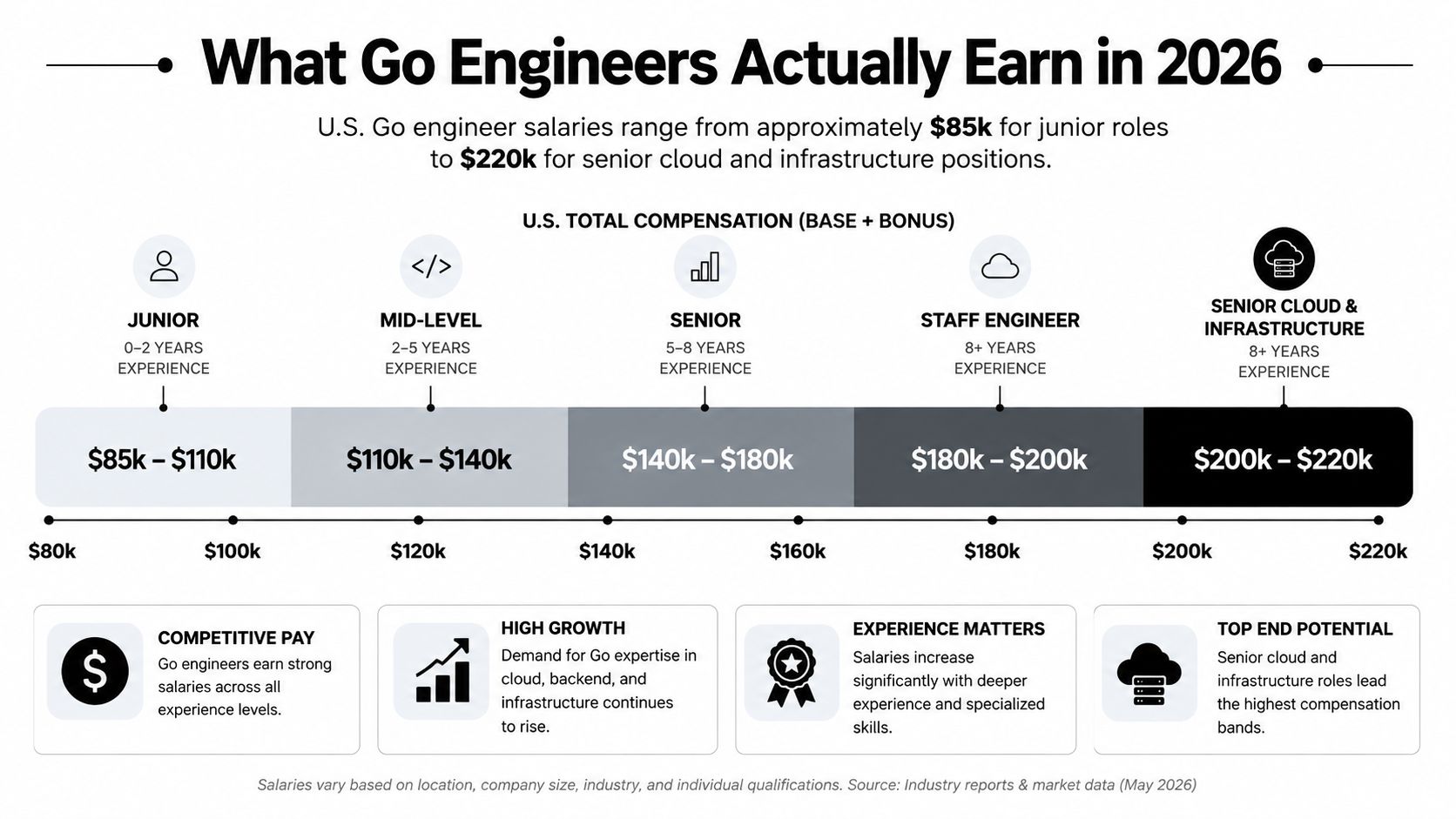
A 2026 salary guide places U.S. Go engineer compensation at roughly $85,000 to $220,000 across junior-to-senior bands. Another benchmark reports a U.S. average of approximately $120,086, with the middle market between $98,500 and $142,000 and the 90th percentile at $162,000. These figures come from NexaTalent's 2026 Go developer salary guide.
UK compensation remains substantial even as hiring volume has cooled. Go roles had a median annual salary of £82,000 in the latest six-month window, while the UK excluding London recorded a median of £70,000. The market is correcting after its hype cycle, but production experience and infrastructure depth still command a premium.
Why infrastructure raises the ceiling
The premium comes from scope, not from the language name. Employers pay more for engineers who can design concurrent systems, reduce latency, operate distributed services, and make sound decisions during incidents. Those responsibilities usually sit in senior backend, platform, cloud, and protocol roles.
Use that scope as your negotiation anchor. Years of Go experience alone provide weak bargaining power. A candidate who has built small services should target the appropriate level. A candidate who has led architecture decisions, handled production incidents, and operated infrastructure should make that ownership visible before discussing compensation.
Salary ranges set expectations, but they cannot calibrate a role by themselves. Ask about ownership, on-call responsibility, service criticality, and the technical decisions attached to the position. Those answers show whether an offer belongs near the bottom, middle, or top of the band.
Where to Find Go Jobs That Are Worth Applying To
Generic job boards are useful, but they shouldn't be your entire search. Go roles often appear under titles such as backend engineer, platform engineer, site reliability engineer, infrastructure engineer, or protocol engineer. Searching only for “Go developer” hides relevant openings.
Start with specialized sources. Golang.cafe is useful for Go-focused roles and salary context, while Remote OK can help when you filter deliberately for Go rather than browsing broad remote listings. LinkedIn, Wellfound, and Hired remain valuable when you search by stack and responsibility, not just title.
Prioritize channels by signal
Use a weekly routine that favors evidence and direct contact:
- Check specialist listings: Review Go-focused boards and targeted filters for newly posted roles.
- Search company career pages: Look at cloud platforms, observability vendors, fintech companies, infrastructure providers, and protocol teams where Go is central to the product.
- Use Web3-specific boards selectively: Protocol and infrastructure openings often require Go alongside networking, storage, or node operations. A targeted remote Go developer role can show how employers describe that combination.
- Contribute in public: Fix a small bug, improve tests, or document a confusing path in an established Go project. Maintainers notice useful contributions more readily than empty “Go developer” branding.
- Build relationships before asking for referrals: Join Go, cloud-native, and protocol communities. Discuss technical problems, share a finished project, and ask focused questions about the work.
Your portfolio should contain three kinds of proof: an open-source contribution, a deployed Go service, and a concise production story. The service doesn't need to be elaborate. It needs tests, documentation, observability, a clear deployment path, and a README that explains design trade-offs.
Recruiters should understand your fit within seconds. Put Go beside the relevant domain, such as “Go backend engineer, gRPC, Kubernetes, PostgreSQL,” rather than listing it among unrelated tools. Every application should answer one question quickly: why is this person ready for this specific class of Go work?
Building a Go Resume and Portfolio That Get Replies
A Go résumé should lead with systems you have operated, not courses you have completed. Put production services, deployment ownership, concurrency work, latency improvements, incident response, and architectural decisions near the top.
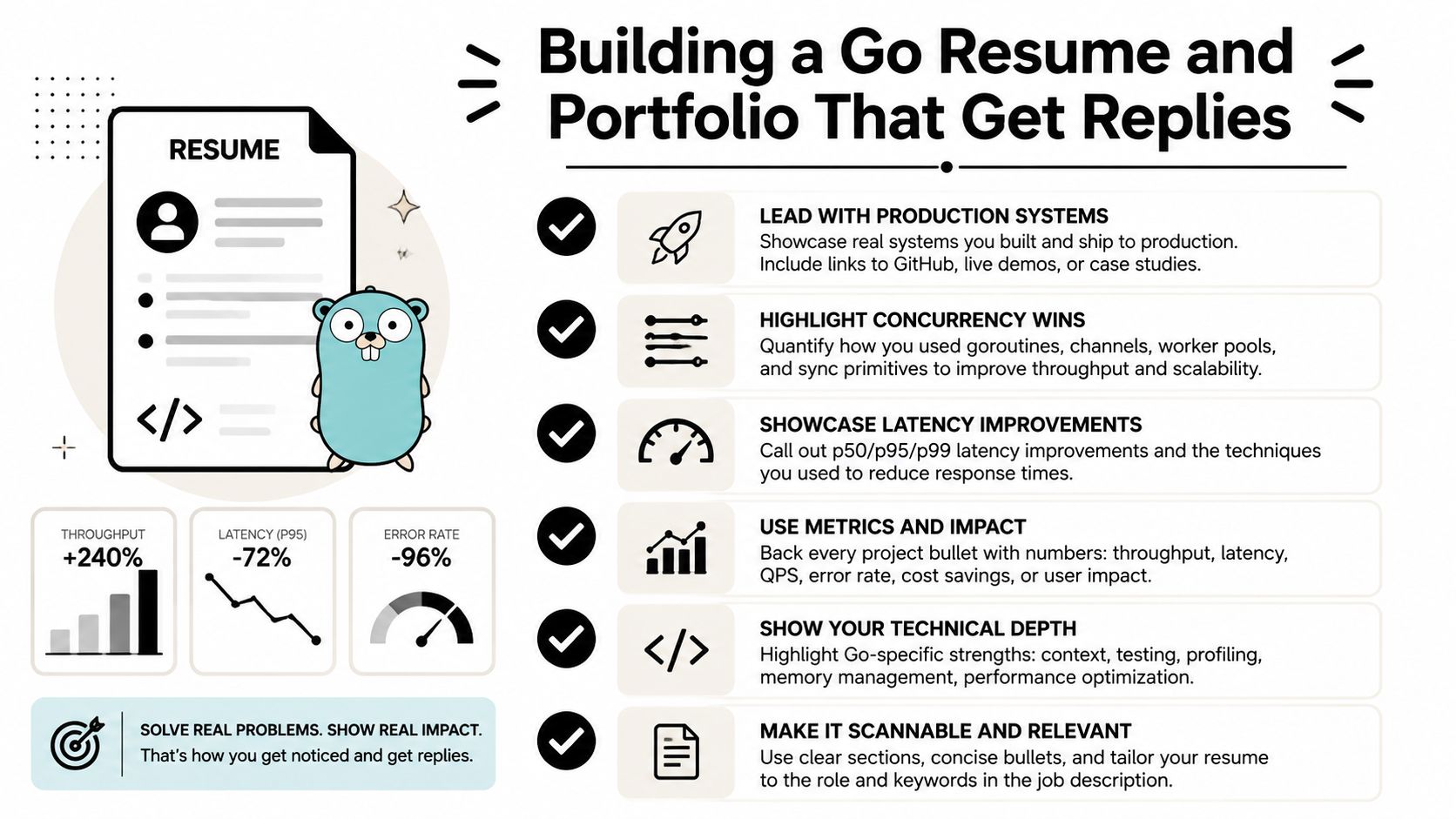
A weak bullet says, “Developed Go APIs.” A stronger bullet explains the system, your responsibility, and the engineering consequence: “Owned Go services for a customer workflow, introduced request cancellation and structured tracing, and supported the deployment and incident process.” Don't claim a performance result unless you can document it.
Build proof at the right level
Junior candidates need visible evidence because they may not have production history. Build a Go service deployed on Kubernetes, expose a gRPC endpoint, add Prometheus metrics and OpenTelemetry tracing, write integration tests, and document how the service behaves when dependencies fail. That project gives an interviewer material for questions about design, testing, deployment, and operations.
Mid-level candidates should show ownership. Include a service migration, a queue or worker design, a difficult debugging story, or an incident where you improved the system afterward. Senior candidates must add leadership signals, such as architecture decisions, mentoring, cross-team coordination, technical standards, and the ability to explain why a simpler solution was rejected.
Keep the résumé selective:
- Lead with production systems: Name the service type, domain, and ownership scope.
- Explain concurrency decisions: Describe worker coordination, cancellation, synchronization, or throughput constraints.
- Show latency work carefully: State what you measured and changed, but don't invent an improvement figure.
- Name operational tools: Include Docker, Kubernetes, CI/CD, Prometheus, OpenTelemetry, databases, and cloud systems you used.
- Remove tutorial clutter: Delete generic CRUD projects that don't demonstrate judgment.
- Add readable links: Point to code, design notes, pull requests, or a project README that an engineer can inspect.
The interview loop will test whether the résumé is accurate. Prepare each project so you can explain its architecture, failure modes, testing strategy, and the trade-offs you made.
Acing the Go Interview from Screen to Offer
Tailor your application to the Go niche because generic backend preparation leaves predictable gaps. Recruiters first verify role fit and production context. Coding interviews then test practical Go, often through a worker pool with context cancellation, a rate limiter, API behavior, data handling, or concurrent processing.
The language-internals round may cover goroutine scheduling, the garbage collector, memory behavior, interfaces, error handling, race conditions, and the standard library. System design usually shifts toward distributed services, service boundaries, storage, retries, observability, and operational recovery. Behavioral interviews test whether you can own incidents, explain trade-offs, and collaborate when the codebase is larger than your personal project.
Use the score-Go-developer-responses resource to practice question patterns, but don't memorize scripts. Write solutions, test them, explain complexity, and narrate why your design handles cancellation and failure.
For the next 30 days, follow a focused plan:
- Week one: Rewrite your résumé around one target lane and identify missing technical evidence.
- Week two: Finish or improve one deployed Go project with tests and observability.
- Week three: Run timed coding and system design practice, then review every weak explanation.
- Week four: Apply selectively, contact relevant engineers, and prepare compensation questions around scope and ownership.
Negotiate from evidence. Use the published U.S. bands and UK medians as context, then anchor to the responsibility of the role, your production depth, and competing offers. Don't bluff about alternatives. Ask for the full package, clarify expectations, and make the employer price the capability they need.
Blockchain Jobs connects engineers with specialized opportunities across blockchain, DeFi, infrastructure, protocol development, and other Web3 disciplines. Visit Blockchain Jobs to search curated roles, find remote-friendly openings, and put your Go experience in front of teams building decentralized systems.