NFT Marketplace Developer Skills and Hiring Guide
The most popular advice about becoming an NFT marketplace developer is wrong. It tells candidates to learn Solidity, connect a wallet, build a gallery, and call the product finished. It tells hiring managers to search for one full-stack engineer who can handle contracts, indexing, user experience, payments, and production operations.
That approach creates impressive demos and fragile marketplaces. A real platform behaves more like a small exchange than a CRUD application. It must validate ownership, discover assets, process bids, reconcile settlement, preserve metadata, support multiple chains, and survive adversarial transaction paths. Hiring should reflect that reality.
Rethinking the Role of an NFT Marketplace Developer
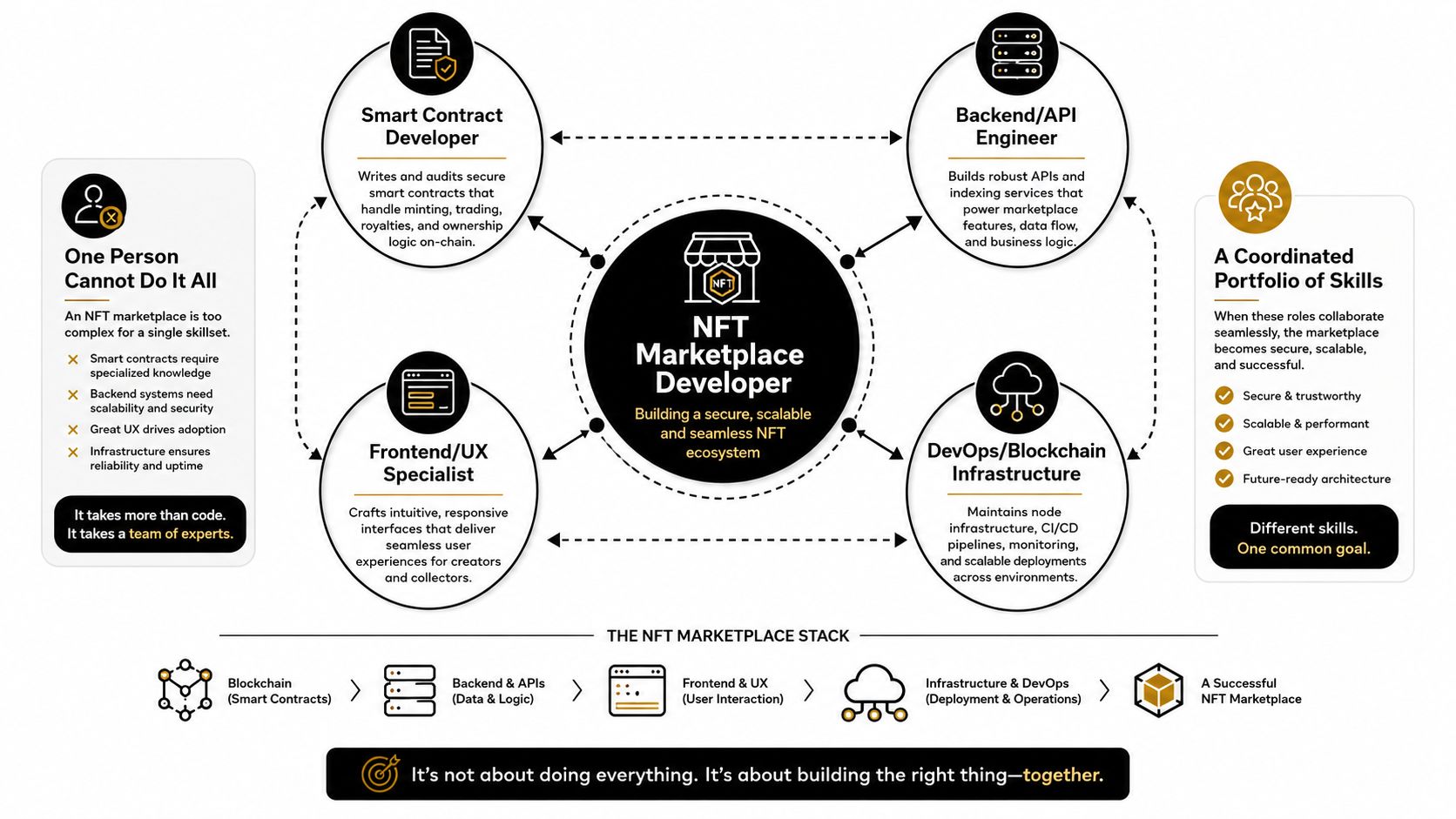
An NFT marketplace developer isn't automatically one person who can ship every layer by Friday. The strongest hiring model treats the role as a coordinated portfolio of specialties: smart contract engineering, indexing and data engineering, frontend and product engineering, and payments or facilitator engineering.
A recent marketplace and commerce hiring package made that division explicit by recruiting four developers across smart contracts, blockchain indexing and backend APIs, Web3 frontend, and payments backend. That structure is a better description of the work than the generic title “NFT engineer,” because each discipline carries different failure modes and interview signals. The role breakdown in that hiring package shows why teams should scope positions around ownership rather than ask one candidate to master every tool in the stack.
The four specialties hiring teams should separate
The smart contract engineer owns settlement rules, token standards, auctions, royalties, access control, and upgrade decisions. This person must reason about adversarial behavior, not just write a successful mint transaction.
The indexing and data engineer turns chain events into usable marketplace data. Transfers, listings, offers, cancellations, ownership changes, price history, and collection activity must become searchable records without drifting from chain state.
The frontend and product engineer makes those records understandable. Wallet connection, signing prompts, filters, bidding flows, responsive galleries, error recovery, and transaction status all sit here. A polished interface can't compensate for stale ownership data, but poor interface design can still destroy user confidence.
The payments or facilitator engineer handles the parts that make commerce practical. That includes fiat on-ramps, gasless flows, settlement reconciliation, routing, fees, and cross-chain transaction coordination.
Hiring rule: Treat “NFT marketplace developer” as a team shape first, and a job title second.
The market's own history supports this infrastructure-first view. Academic analysis of 6.1 million trades covering 4.7 million NFTs from June 23, 2017, through April 27, 2021 found activity remained near $60,000 traded daily until mid-2020, then rose above $10 million per day by March 2021, roughly 150 times higher in eight months. The same analysis found Art NFTs represented approximately 71% of transaction volume since July 2020, while collectible assets contributed about 12%, and Games plus Collectibles represented 44% and 38% of transactions respectively. The market-tracker reference explains why early mint-and-list flows evolved toward indexing, discovery, and analytics.
A hiring process that still evaluates only minting and gallery UI is screening for the prototype, not the marketplace.
Core Responsibilities Across the Marketplace Stack
Start with the asset and settlement rules, then work outward. Each responsibility belongs to a different architectural layer, and assigning all of them to one person is how teams create bottlenecks.
Smart contracts define what settlement means
The contract layer covers ERC-721 and ERC-1155, minting, transfers, auctions, offers, royalties, permissions, and upgradeability. A developer must understand how token callbacks interact with marketplace logic, how administrative roles are protected, and where royalty expectations can fail during settlement.
Off-chain order books are common. Listings and offers can be signed with EIP-712 typed structured data and validated on-chain only when a trade executes, reducing storage and listing gas. That design also introduces replay risks across chains, criteria-proof bugs for trait offers, royalty bypass through alternate settlement paths, and reentrancy through ERC-721 or ERC-1155 transfer callbacks. This smart contract security guide is useful preparation for interviews because it focuses on the failure modes candidates must explain, not only the happy path.
Off-chain infrastructure makes assets discoverable
The indexing layer listens for events, handles reorgs, backfills history, and exposes data through GraphQL or REST. It also manages metadata stored through IPFS or Arweave, database updates after sales, cache invalidation, collection search, and activity feeds.
A marketplace can have correct contracts and still feel broken if the indexer shows the wrong owner or fails to reflect a cancellation. Candidates should be able to describe how they detect drift between indexed data and chain state, how they retry failed events, and how they preserve historical pricing.
APIs and SDKs connect commerce flows
The service layer turns marketplace actions into reliable application operations. Listing, bidding, trade execution, transaction simulation, wallet state, fee calculation, and notification systems need consistent interfaces.
Teams should track engineering delivery without reducing the work to superficial activity counts. PullNotifier's 2025 developer productivity tracking guide provides useful context for choosing measures that support quality and delivery rather than rewarding noisy output.
Frontend and payments remove friction
The frontend handles wallet connection, EIP-1193 providers, WalletConnect sessions, trait filters, responsive galleries, pending transactions, and failed signatures. Payments engineering extends the experience to on-ramps, gasless transactions, bridging, aggregator routing, and settlement reconciliation.
The same person rarely owns all four layers well. Write the job description around the layer the hire will own, then define the collaboration contract with the other specialists.
Essential and Nice-to-Have Technical Skills
Candidates should audit themselves by depth in one marketplace layer and working fluency across adjacent layers. Hiring managers should stop copying every popular Web3 keyword into one posting. A long tool list isn't a hiring plan.
| Skill Area | Required | Nice-to-Have |
|---|---|---|
| Smart contracts | Solidity or Move, ERC-721, ERC-1155, OpenZeppelin, Hardhat or Foundry | ZK concepts, advanced upgrade patterns |
| Blockchain integration | Ethers, wallet flows, EIP-1193, WalletConnect | Account abstraction and paymasters |
| Indexing and data | The Graph or Ponder, event processing, API design | Elixir or Go for high-throughput indexers |
| Storage and metadata | IPFS, content addressing, token metadata resolution | Arweave strategy and advanced CDN caching |
| Frontend | React or Next.js, transaction states, responsive marketplace UX | Design systems and accessibility ownership |
| Cross-chain systems | Chain-aware transaction handling and replay protection | LayerZero, Wormhole, and bridging design |
| Security | Reentrancy checks, access control, testing, audit remediation | Formal verification and security research |
| Product intelligence | Search, ownership history, listings, bids, and basic analytics | Advanced marketplace analytics and experimentation |
The required column describes the minimum credible profile for a focused marketplace role. It doesn't mean every candidate must be an expert in every row. A Solidity specialist can be a strong hire without designing the React system, provided the team has that coverage elsewhere.
The nice-to-have column becomes valuable when the product has a clear reason to need it. Account abstraction matters when the product wants smoother onboarding. Cross-chain messaging matters when settlement spans networks. ZK knowledge matters when privacy or proof-heavy workflows justify the complexity. Don't turn speculative architecture into a mandatory interview filter.
Candidates should also distinguish familiarity from evidence. Saying “I know IPFS” is weaker than explaining content addressing, pinning strategy, metadata refresh, and what the application does when a gateway fails. Saying “I use Foundry” is weaker than showing tests for failed signatures, replay attempts, unauthorized upgrades, and callback behavior.
For a useful benchmark, compare your expectations with a senior full-stack engineer role combining React, NestJS, and Solidity, then remove skills your actual team doesn't need. The right job description is narrow enough to attract specialists and broad enough to test collaboration.
Modern Marketplace Architecture and the Multichain Reality
A modern marketplace has four interlocking planes. Settlement executes ownership and payment. Asset storage preserves files and serves them efficiently. Metadata resolution turns token references into structured information. Discovery and routing makes activity searchable and coordinates users, aggregators, relayers, and chains.
Settlement may involve EVM networks, Solana, or Sui, each with different transaction models, finality assumptions, tooling, and failure handling. Storage often combines IPFS or Arweave with CDN edge caching. Metadata resolution can involve tokenURI, shared schemas, on-chain JSON, or off-chain JSON. Discovery depends on subgraphs, marketplace SDKs, search services, and activity pipelines.
That architecture changes what I prioritize in interviews. I care less about whether a candidate can make a gallery look elegant in isolation, and more about whether they can explain what happens when a chain reorganizes, a metadata endpoint fails, an order is replayed on another chain, or an aggregator routes around expected royalty logic.
By 2026, one major tracker covered sales volumes, price histories, and buyer activity for 44 NFT projects across art, collectibles, gaming, metaverse, and DeFi, with data spanning June 2017 through March 2025. A multichain API provider also described real-time and historical floor price, market cap, and 24-hour trading-volume data across collections on each marketplace. Those requirements make cross-chain metadata, historical pricing, and liquidity analytics core product functions, not optional dashboards.
Public market data placed global NFT market capitalization at about $1.94 billion on September 5, 2026, with daily sales volume near $2.96 million. That live activity doesn't justify careless spending, but it does justify hiring engineers who can keep infrastructure reliable after the speculative peak. A Solana program engineering role illustrates the kind of chain-specific depth that a multichain team may need.
The practical consequence is straightforward: replay protection, metadata uptime, indexer correctness, and settlement reconciliation now outweigh minting-page polish. Candidates who can operate those systems have stronger influence than candidates who only know how to launch a collection.
Interview Questions That Reveal Real Marketplace Ability
Avoid trivia questions that reward memorization. Give candidates a failure scenario, ask them to identify the boundary between components, and score the quality of their trade-offs.
| Question | Sub-role | Strong answer signals |
|---|---|---|
| Walk through a reentrancy bug in an English auction contract and your fix. | Smart contract | Identifies callback risk, follows checks-effects-interactions, uses guards where appropriate, tests malicious receivers, and explains settlement ordering. |
| How do you keep royalty enforcement honest when marketplaces bypass EIP-2981? | Smart contract | Separates royalty signaling from enforcement, identifies settlement paths, explains business and protocol trade-offs, and avoids claiming the standard guarantees payment. |
| How would you backfill 50M transfers missing from your subgraph, and how would you detect drift? | Indexing | Describes chunked historical reads, idempotent writes, checkpoints, reconciliation jobs, reorg handling, and metrics for missing or conflicting state. |
| Design a collection page that stays responsive with 10k lazy-loaded items. | Frontend | Uses pagination or virtualization, server-side filtering, progressive media loading, stable caching, and clear pending and error states. |
| Which wallets and gasless flows would you support? | Frontend and payments | Discusses EIP-1193, WalletConnect, signing responsibility, relayers, sponsorship limits, chain switching, and recovery when a sponsor rejects a transaction. |
| How would you route a buyer through an aggregator when one venue has better depth but worse royalty splits? | Payments | Compares execution price, fees, slippage, royalty policy, trust assumptions, and user disclosure instead of optimizing one number blindly. |
How to score the discussion
For smart contracts, score threat modeling and invariant thinking above syntax. For indexing, look for operational maturity, especially replayable jobs and reconciliation rather than a happy-path event listener.
For frontend candidates, assess whether they understand chain latency and partial failure. For payments candidates, test whether they can balance conversion, cost, compliance, settlement accuracy, and user consent.
Strong interview signal: The candidate names what can go wrong, how the system detects it, and who owns recovery.
A junior candidate may solve one bounded problem with guidance. A senior candidate should define interfaces between the four tracks and defend an architecture under pressure.
Salary Ranges and What Actually Drives Pay
U.S. compensation data places NFT-marketplace-related work firmly in specialist software territory. ZipRecruiter's salary index reports an average hourly rate of $56.85, with most workers between $45.19 and $67.31 per hour as of May 21, 2026. Its separate developer salary page reports average yearly pay of $129,348, with a typical range from $106,000 to $157,000 as of August 29, 2026. The NFT marketplace salary index provides the baseline, but it shouldn't be treated as a universal offer calculator.
Those figures collapse several labor markets into one label. A pure frontend engineer moving into Web3, a Web2 full-stack engineer learning wallet flows, and a protocol-level Solidity or Rust engineer don't bring the same scarcity or risk profile.
The requested junior-to-staff bands below are useful as internal planning targets, but they aren't verified market statistics, so treat them as editorial hiring ranges rather than published benchmarks.
| Level | U.S. Base Range | Primary Pay Lever |
|---|---|---|
| Junior Web3 frontend | $80,000 to $110,000 | Reliable wallet, transaction, and responsive UI execution |
| Mid-level marketplace engineer | $110,000 to $150,000 | Ownership of indexing, metadata, payments, or contract features |
| Senior protocol or marketplace engineer | $150,000 to $200,000 | Architecture, security judgment, and cross-chain depth |
| Staff marketplace architect | $180,000 to $260,000+ | System ownership, technical leadership, and token-heavy compensation |
Four levers that move pay
Chain specialization matters. Ethereum, L2 ecosystems, Solana, and Sui require different debugging habits and runtime knowledge.
Marketplace depth beats generic Web3 polish. A candidate who has handled auctions, order validity, royalties, indexing, and reconciliation is more valuable than one who has only built a token dashboard.
Security evidence commands trust. Audit remediation, public findings, threat models, and deployed fixes carry more weight than a list of certifications.
On-chain proof closes the gap between claims and ability. Deployed contracts, indexed datasets, open-source contributions, and reproducible demos make negotiation concrete.
Remote work, grants, equity, and token packages can make headline compensation difficult to compare. Ask for the base, vesting, liquidity assumptions, grant conditions, and responsibilities separately.
Career Progression From Junior to Team Lead
Titles inflate easily in Web3. Evidence doesn't. Candidates should target the next level by demonstrating scope, reliability, and public proof rather than repeating a senior title across several short engagements.
A hiring guide defines the progression as Junior at 0–2 years, Middle at 2–5 years, Senior at 5–8 years, and Expert or Team Lead at 8+ years. That seniority ladder is a useful frame, but interviews should still test what the candidate shipped and owned.
Junior
Junior engineers should show dependable execution. A credible portfolio might include a tested ERC-721 or ERC-1155 project and meaningful frontend work that reads on-chain data. They should explain transaction states, failed calls, basic reentrancy defenses, and how they used OpenZeppelin rather than treating libraries as magic.
Mid-level
Mid-level engineers own a slice of the stack, often indexing, metadata, API services, or marketplace UI. They can debug gas issues, trace failed transactions, review code, and complete audit remediation without constant hand-holding.
Senior
Senior engineers architect across at least two specialties. They make decisions about data consistency, contract boundaries, chain integrations, operational monitoring, and user-facing failure recovery. They also mentor juniors and communicate trade-offs to product and compliance stakeholders.
Expert and Team Lead
Experts and leads define technical roadmaps, choose protocol integrations, set quality controls, and make hiring decisions. They represent the marketplace in partnerships and can explain why the team should adopt, reject, or delay a new chain or payment rail.
Career advice: Build a public trail of contributions. GitHub pull requests, audit reports, mainnet deployments, Etherscan records, and Snapshot participation are stronger signals than résumé adjectives.
The market penalizes padding because blockchain work is unusually verifiable. If a candidate claims ownership, interviewers can ask for the transaction, repository, audit response, or design decision. Prepare those artifacts before applying.
Where to Find Candidates and How to Hire
The best candidates rarely present themselves through a generic keyword search. Look where engineers already publish technical work and debate protocol behavior.
Start with specialized channels such as CryptoJobsList, Web3 Career, smart contract engineering feeds, and talent communities on Mirror and Lens. Search GitHub for contributors to OpenSea repositories, Reservoir, Alchemy SDKs, and major marketplace indexers. Commit history isn't a perfect hiring filter, but it gives you something better than a keyword match, namely evidence of how someone works.
Protocol Discord servers can expose candidates who answer difficult questions in public. Look for relevant jobs channels around ERC-721x, Lens, and Farcaster, then review the technical context behind a candidate's posts. Twitter or X remains useful as a screening surface when engineers publish debugging threads, gas-optimization breakdowns, incident write-ups, and architectural notes.
Candidates should prepare a compact proof portfolio:
- Deployments: Show contracts, networks, verified source, and the decisions you owned.
- Audits: Explain findings, remediation, tests, and what changed after review.
- Data systems: Demonstrate an indexer, API, dataset, or reconciliation process.
- Product flows: Record wallet connection, listing, bidding, failure recovery, and responsive behavior.
- Public profiles: Keep GitHub, technical writing, and governance contributions consistent with your résumé.
Hiring managers need an equally strict checklist:
- Scope the role: Hire for smart contracts, indexing, frontend, or payments instead of advertising an impossible unicorn.
- Design the interview: Use failure scenarios and a scorecard tied to the sub-role.
- Review evidence: Ask for repositories, deployments, audits, and architecture decisions.
- Price the specialty: Compensation should reflect security ownership, chain depth, and production responsibility.
- Test collaboration: Require candidates to explain the interfaces between their layer and the other three.
Candidates changing direction may also benefit from a tailored ATS resume for Revolut, especially when translating Web3 infrastructure work into clear product and engineering outcomes. Employers can compare their scope against specialized engineering opportunities without turning every opening into a generic full-stack search.
Blockchain Jobs offers a focused place to find NFT, protocol, engineering, infrastructure, and other Web3 roles without forcing marketplace specialists into generic job searches. Visit Blockchain Jobs to compare current openings, identify the sub-role that matches your strongest evidence, and find companies hiring for the infrastructure that real marketplaces need.