How to Land High-Paying Online Community Management Jobs in Web3
Looking to break into Web3 as a community manager? The good news is, projects are desperate for top talent. The bad news? Hiring managers can spot an outsider from a mile away. Landing one of the best online community management jobs isn't just about knowing how to use Discord; it’s about proving you have the strategic mind and on-chain credibility to build a thriving ecosystem.
This guide is built on real-world hiring experience, showing you exactly what hiring managers for leading projects expect to see on your resume, in your portfolio, and during your interview.
Your Career Path in Web3 Community Management

In Web3, a strong, engaged community isn’t just a marketing asset—it’s a fundamental part of the product. Projects live or die by the strength of their community, which is why skilled community managers are in such high demand. This creates a massive career opportunity for anyone who can act as the crucial link between a project's core team and its passionate user base.
But what does it really take to get hired? It's a world away from just moderating chats. Hiring managers are on the hunt for a specific combination of strategic skills, crisis management prowess, and authentic Web3 knowledge.
What Hiring Managers Truly Want
When I'm screening candidates, I'm not just looking at a resume. I'm looking for a community leader, a strategist, a crisis manager, and a brand champion rolled into one. The job title might say "manager," but the role is about leadership. To get an offer, you need to prove you can deliver on three key fronts:
- Build Genuine Belonging: Show you can create a space where people feel connected and heard, not just managed. In an interview, talk about how you've turned a quiet server into an active hub.
- Merge Social Skills with Tech Knowledge: You have to speak the language. This means a solid grasp of blockchain basics, tokenomics, and the project's tech stack. Be ready to explain a complex topic simply.
- Navigate High-Stakes Drama: Can you handle pressure? You'll need to confidently manage community sentiment during brutal market swings, FUD attacks, or major protocol changes. This is a common interview topic.
From a hiring perspective, the best candidates are already respected members of other Web3 communities. Their reputation becomes a powerful reference, turning a cold application into a warm introduction and a much easier path to an interview.
This guide is your roadmap to becoming that candidate. We'll walk through building the right skills, crafting a portfolio that gets you noticed, and acing the interview. Whether you’re aiming for a role like a Web3 Social Media Manager or a director-level position, the principles for career advancement are the same: you prove your value with your actions.
What a Web3 Community Manager Actually Does

If you've scrolled through listings for online community management jobs in Web3, you've probably noticed how vague the descriptions can be. Let's cut through the jargon. This role is a high-energy mix of digital strategist, crisis manager, event planner, and data analyst. You are the living, breathing connection between a project's core team and the community that gives it life.
A typical day might have you analyzing sentiment in Discord after a bumpy feature release, then immediately jumping into a live "Ask Me Anything" (AMA) on X (formerly Twitter) with the founder. Before you can even catch your breath, you might find yourself dismantling a coordinated FUD (Fear, Uncertainty, and Doubt) attack aimed at tanking the project's reputation.
This is not a background support role—it's front and center. The broader job market reflects this, with projections estimating around 14,100 new openings for community professionals annually in the U.S. through 2034. This growth is largely because sectors like blockchain can't survive without genuine digital engagement. You can dig into more community manager career statistics to understand the long-term career stability.
The Daily Grind: Responsibilities That Shape Your Career
At its core, a Web3 community manager's job is to create and guide conversations that build real loyalty and trust. To progress in this career, you must demonstrate mastery in these areas:
- Platform Leadership: You're the heart of the community on platforms like Discord and Telegram. This means you’re not just a moderator but a host—setting the tone, enforcing rules fairly, and sparking conversations that keep members engaged. This is a foundational skill for any junior role.
- Content and Event Execution: You'll be the one planning and running community events. Think AMAs, educational workshops, or game nights. Success here involves everything from lining up speakers to creating promo materials and getting people to show up. This demonstrates project management ability.
- Crisis Management: When things go wrong—a bug, a market crash, or bad press—you are the first responder. Your ability to communicate with transparency and stay calm under pressure is a critical skill that hiring managers look for when filling senior roles.
Interview Tip: Be ready for scenario-based questions. A hiring manager will almost certainly ask, "Tell me about a time you handled a community crisis." They aren't looking for a perfect story but for your thought process in managing panic, getting accurate information out, and protecting the community.
A Real-World Scenario: The Protocol Upgrade
Let's walk through an example that showcases the strategic depth of the role—a massive protocol upgrade. This is a make-or-break moment where a community manager proves their value.
As the community manager, you’re quarterbacking the entire public-facing strategy. First is the pre-announcement prep. You'll work with the dev team to understand the technical details. Your job is to translate complex "dev-speak" into clear, exciting messaging that the community can rally behind.
Next, you plan the staged rollout. You create a content calendar to build momentum. This might include teaser posts, a detailed blog article explaining the why behind the upgrade, and a scheduled AMA with the lead developers to answer questions directly. This shows strategic planning.
During the live AMA, you're the active facilitator—fielding questions, keeping the conversation productive, and shutting down misinformation. The goal is to make sure everyone feels heard. This showcases your public communication and moderation skills.
Finally, the post-launch monitoring phase begins. You’ll be glued to all channels, watching for feedback, bug reports, and sentiment shifts. You'll compile this into actionable reports for the product and dev teams. This demonstrates your ability to provide value back to the core team.
This entire process is a perfect case study for your portfolio or an interview, showing that online community management jobs are deeply strategic. You're not just relaying messages; you’re shaping the project’s narrative and using community feedback to guide its future.
Proving Your Impact with Data
The community managers who get the best jobs and advance their careers are the ones who speak the language of data. Hiring managers want to see concrete proof of your impact, not just fuzzy anecdotes about "good vibes."
To set yourself apart in a job interview, get comfortable tracking metrics that tie directly to business goals:
- Engagement Rate: Are people actually participating, or is your Discord a ghost town?
- Sentiment Analysis: Is the overall mood in the community positive, negative, or neutral?
- Retention: Are new members sticking around and becoming active participants?
- Conversion: Did your community campaign lead to a desired action, like more governance votes or product sign-ups?
When you can walk into an interview with this kind of data, you're no longer just a community manager. You're a strategic partner who delivers measurable results—and that’s who gets hired.
Building the Skills That Get You Hired
To land a top-tier Web3 community manager job, you need to prove you’re more than just a fan of the project. Hiring managers are searching for a specific combination of skills that shows you can not only rally a community but also connect its growth to the project's bottom line.
Think of it less as a checklist and more as three interconnected skill sets: genuine people skills, hard technical abilities, and deep, authentic Web3 knowledge. Nailing all three is what gets you from the application pile to the offer letter.
The Human Skills of Community Leadership
Let's start with the stuff you just can't fake. Without real people skills, all the technical know-how in the world won't make you a successful community manager. This is what hiring managers are probing for in every interview, especially with scenario-based questions.
You absolutely have to master these human-centric abilities:
- Genuine Empathy: This isn't just about being nice. It's about truly understanding what makes your community tick—their hopes, their frustrations, and their passions. It means listening more than you speak and ensuring every member feels seen and heard.
- Crisis Communication: Volatility is a feature, not a bug, in Web3. You have to be the steady hand and calm voice during a market dip, a protocol exploit, or a sudden FUD attack. Get good at drafting clear, honest, and reassuring announcements when things get chaotic.
- Conflict Resolution: Arguments will happen. Your job is to de-escalate fights between members, mediate disagreements fairly, and uphold the rules without coming off as a power-tripping mod. Your ability to keep the vibe positive and productive is a superpower.
When a hiring manager asks, "How would you handle a coordinated FUD campaign?" they’re testing your crisis management instincts. A strong answer shows a clear process: first, get the facts straight with the core team; second, draft a transparent and honest response; and third, get into the channels and actively counter the bad info with facts.
The Technical Skills for Proving Your Impact
Human skills are what build your community, but technical skills are what prove its value to the organization. To really stand out, you need to operate like a data-informed strategist, not just a friendly moderator.
Focus on getting comfortable in these key areas:
- Data Analysis and Reporting: Never just say you "grew the community." Prove it. Use tools like Discord's server insights, X Analytics, or dedicated platforms like Common Room to track your KPIs. A hiring manager is infinitely more impressed by "I launched a new ambassador program that boosted active monthly members by 30%" than a fuzzy claim.
- Content Creation and Curation: You are the voice of the project. That means you need to be able to write sharp, engaging announcements, create compelling X threads, and find and share valuable information with your members. Your portfolio should showcase this with real examples—great writing is a non-negotiable skill for many roles, like this Content Marketing Manager opening.
- Tool Proficiency: Get fluent in the standard Web3 community stack. This means going beyond basic use and mastering Discord (bots, roles, permissions), Telegram, and social scheduling tools like Buffer or Sprout Social.
The good news is that the industry is putting its money where its mouth is. A striking 65% of organizations plan to increase their community budgets. This isn't a fleeting trend; it's the foundation for stable, long-term careers. For a deeper dive, you can explore more online community growth statistics that highlight this opportunity.
Essential Toolkit for Web3 Community Managers
Being a great community manager means being a master of your tools. The platforms below aren't just "nice to have"—they are the core of your daily workflow for managing, analyzing, and growing a thriving Web3 community.
| Tool Category | Essential Platforms/Tools | Why It's Critical for Web3 Jobs |
|---|---|---|
| Communication Hubs | Discord, Telegram | These are the de facto town squares for Web3. Mastery of roles, bots, channels, and security is non-negotiable. |
| Social Media | X (formerly Twitter), Farcaster | X is the global broadcast channel. Farcaster is the emerging hub for the crypto-native. You need to be fluent in both. |
| Analytics & Insights | Discord Server Insights, X Analytics, Dune Analytics | Data proves your impact. These tools help you track engagement, growth, and sentiment to make strategic decisions. |
| Collaboration | Notion, Miro | For planning campaigns, tracking content calendars, and collaborating with the wider team on community initiatives. |
| Community Operations | Collab.Land, Guild.xyz | Essential for token-gating channels and managing roles based on on-chain activity (e.g., holding an NFT or token). |
Familiarity with these tools shows you can step into a role and start adding value from day one, which is exactly what hiring managers want to see.
Essential Web3 Native Knowledge
This is what truly separates a Web3 community manager from their Web2 counterpart. You have to speak the language fluently and live in the ecosystem. If you can't confidently discuss the project's technology, you'll never earn the trust of your community or a hiring manager.
Make it a priority to deeply understand these concepts before an interview:
- Tokenomics: You must be able to explain how the project's token works. What is its purpose? How is it distributed? What incentives does it create? Be ready to break this down for everyone, from total beginners to seasoned degens.
- Governance: For DAOs and decentralized protocols, you are often the primary facilitator of the governance process. This means knowing the ins and outs of how proposals are created, discussed, and voted on.
- NFTs and DeFi: Even if your project isn't an NFT collection or a DeFi protocol, you need a solid working knowledge of them. They are cornerstones of the Web3 world, and your members will expect you to be well-versed.
Let's be blunt: in Web3, a slick resume might get you a first glance, but a killer portfolio is what lands you the job. This isn't your typical corporate world. Hiring managers for online community management jobs in this space are looking for proof-of-work, not just a list of credentials. They need to see that you can actually build, engage, and grow a vibrant community from the ground up.
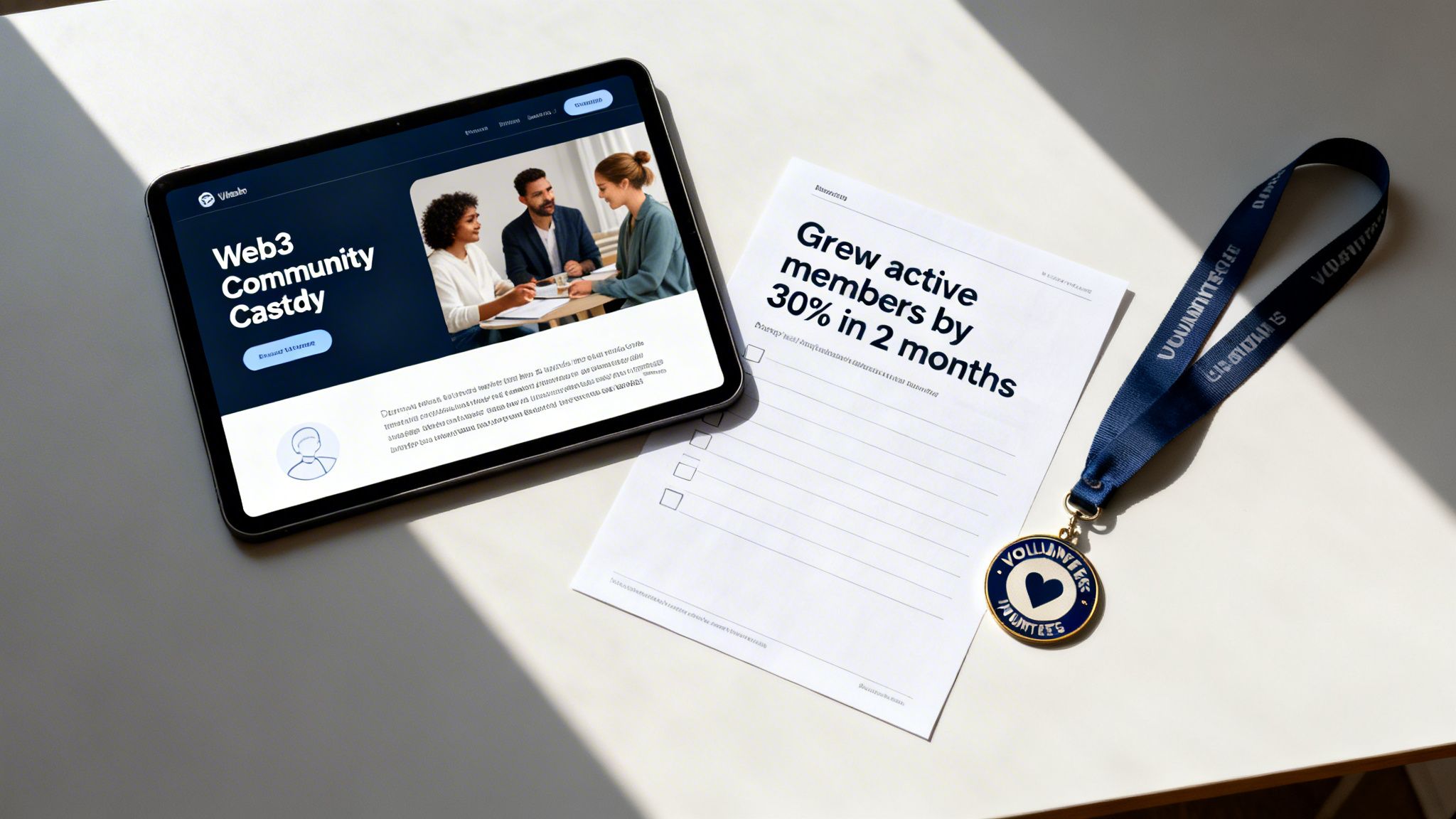
Think of your portfolio as the ultimate answer to the hiring manager's biggest question: "Can this person deliver results?" It’s your chance to show, not just tell.
And here's the best part—you don’t need a single day of paid experience to build a portfolio that blows them away.
Get Your Foot in the Door by Contributing
The quickest way to build that proof-of-work is to just start doing the work. Find a small, up-and-coming crypto project that catches your eye. Most of these projects are running on fumes and passion, with a tiny team trying to do everything. They are almost always looking for dedicated people to help out.
This is your opening. Jump into their Discord or Telegram. Offer to help moderate, answer questions from new users, or even organize a small online event. You’re creating a win-win here. The project gets much-needed help, and you get a real-world sandbox to hone your skills and, more importantly, document your impact.
From a hiring manager's perspective, a candidate who took the initiative to volunteer for a project is often more compelling than one with a generic corporate background. It screams passion, commitment, and a focus on getting things done.
Once you're contributing, your mission is to make a tangible difference. This volunteer gig is the raw material for your first killer case study.
Turn Your Work into a Compelling Case Study
A case study is the heart of your portfolio. It’s what turns "I volunteered for a project" into a powerful story about your abilities. It lets you walk a potential employer through a specific problem, how you tackled it, and the concrete results you achieved.
Don’t just make a list of your tasks. That’s boring. Frame it as a narrative. Explain the why behind your actions and connect them directly to the outcome.
A strong case study needs these core components:
- The Challenge: Start with a snapshot of the problem. For instance, "When I joined, the project's Discord was stagnant, with key channels getting fewer than five messages a day."
- Your Strategy: Detail the plan you put into action. For example, "I pitched and launched a 'Weekly Builder's Corner' to feature community-made tools, creating a space for peer recognition and collaboration."
- The Results: This is where you seal the deal. Use hard numbers. Instead of a vague "I grew the community," hit them with "I grew the number of active members by 30% in two months."
Use screenshots of lively chat channels, simple charts showing member growth, or positive feedback from community members to back up your claims. Visuals make your impact undeniable.
Become a Community Analyst
Don't have the time to commit to volunteering? No problem. You can still create an incredibly impressive portfolio piece by putting on your analyst hat.
Pick a well-known project—maybe a major Layer-1 or a blue-chip NFT collection—and do a deep-dive analysis of their community strategy. Approach it as if you were a consultant hired to tell them what they're doing right and where they could improve. This shows a hiring manager that you can think strategically.
Your breakdown should cover:
- Onboarding: How do they bring new people in? Is it a smooth, welcoming experience, or is it a confusing mess?
- Engagement: What are their go-to tactics for keeping the community alive? Look for their rituals, like AMAs, contests, or governance calls.
- Strengths & Weaknesses: What are they absolutely nailing? Where are the glaring holes or missed opportunities?
- Actionable Advice: If you were in charge, what three things would you change immediately? Get specific.
For example, you might notice a project has a massive number of members but very little real conversation. Your recommendation could be: "Implement a token-gated ambassador program to empower and reward the top 5% of contributors, effectively turning lurkers into evangelists." This shows you don't just spot problems—you come with solutions.
Publish your analysis on a platform like Medium or even as a detailed X thread. When you apply to online community management jobs, you can link directly to this public work. It’s definitive proof that you have the strategic mind they’re desperate to find.
Finding Open Roles and Crafting Your Application
Alright, you’ve honed your skills and built a portfolio that proves your worth. Now for the fun part: actually landing the job. Let me tell you, the best online community management jobs in Web3 rarely show up on the massive, generic job boards. The real gems are found deep within the ecosystem itself.
To find these roles, you have to be where the action is. Forget the traditional spray-and-pray approach. In Web3, hiring managers are looking for people who are already part of the conversation, not just another resume in a digital stack.
This is what I mean—the most effective channels for finding a community role are all about being an insider.
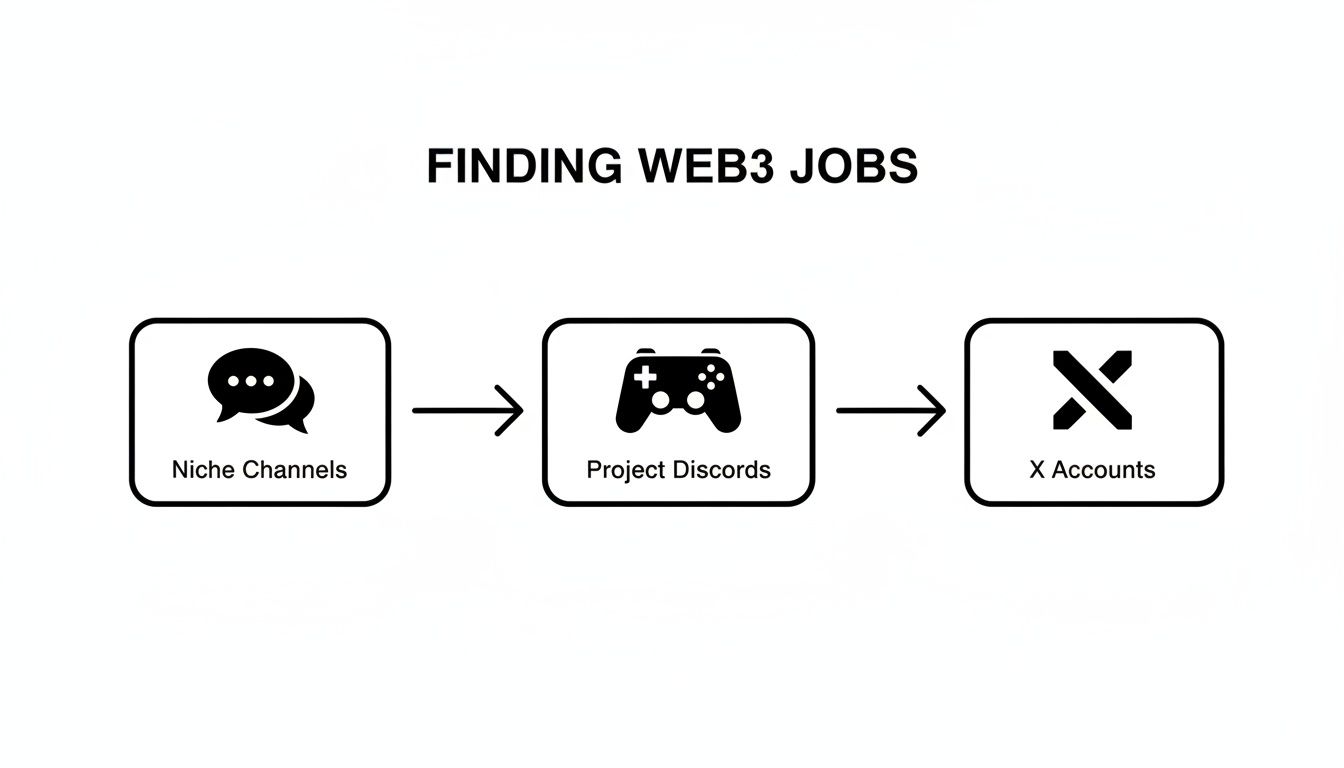
Job searching in this space isn’t a passive activity. It's an active hunt that rewards those who are genuinely immersed and engaged.
Where to Uncover Hidden Job Openings
So, where do you look? The most promising opportunities are often found through direct engagement and networking, long before they're ever made public.
Here’s where you should be spending your time:
- Project Discords and Telegrams: This is your home base. Join the communities of projects you genuinely admire. Look for channels like
#hiring,#jobs, or#contribute. Many teams post openings here first as a way to reward their most dedicated community members. - Niche X (Twitter) Accounts: Curate your feed. Follow the founders, VCs, and established community managers who are shaping the space. They constantly share or amplify job postings. Get creative with your search terms, like combining
"community manager" (hiring OR job)with specific keywords likeDeFi,NFT, orDAO. - Specialized Job Boards: While the big platforms can be a waste of time, crypto-native job boards are gold. Sites that focus exclusively on the industry are a fantastic source for high-quality, relevant roles. You can find a well-curated list of remote online community management jobs on these dedicated platforms, which cuts through all the noise.
As a hiring manager, if a candidate reaches out through our Discord or comes from a trusted referral, they immediately jump to the top of the pile. It shows they're already bought in and get our culture, which saves everyone a ton of time.
Reframe Your Resume for Web3
Your standard corporate resume won't cut it here. You need to translate your experience into the language of Web3, focusing on the metrics and outcomes that a project founder actually cares about. The goal is to demonstrate tangible impact, not just list your daily tasks.
Let's look at a quick before-and-after to see what I mean.
Before: The Vague, Traditional Resume
- Responsible for managing social media accounts.
- Answered customer questions in online forums.
- Organized weekly online meetings for community members.
This is passive and shows nothing about the results you achieved. Now, let’s give it a Web3 spin.
After: The Impact-Driven, Web3 Resume
- Grew X account engagement by 40% in Q3 by launching a content series on protocol updates, leading to a 15% boost in organic followers.
- Achieved a 95% resolution rate for community support tickets in Discord within 24 hours, measurably improving community sentiment.
- Hosted weekly AMAs with the core team, driving a 25% increase in active participation in governance proposals.
See the difference? The "after" version is packed with hard numbers. It proves you understand that community work is directly tied to a project’s growth and success.
Networking with Authentic Outreach
Cold applying is a low-percentage game. A far better strategy is to build real relationships before you ever ask for a job. The secret is simple: provide value first.
Find a project you're passionate about and start contributing. Be helpful in the Discord, share thoughtful analysis on X, or create content about the project. Once you're a familiar face, your outreach will be warm, not cold.
Here’s an example of an outreach message you could send after you've already been an active community member:
"Hi [Hiring Manager Name],
My name is [Your Name], and I’ve been an active member of the [Project Name] community for a few months now (my handle is [Your Discord/X Handle]). I was really impressed with how you handled the communication around the recent V2 launch—super transparent.
I was recently looking at how [A Competing Project] is using an ambassador program and saw a few things that could work really well for [Project Name]. I put together a quick analysis with some ideas here: [Link to your analysis on Medium/X].
I also saw you're looking for someone for an online community management job. With my experience in [mention a key skill, e.g., 'growing active users by 30% for a previous DAO'], I’m confident I could help you guys hit your Q4 goals.
Would you be open to a quick chat next week to discuss it?
Best, [Your Name]"
This approach is incredibly effective because you're not just a random person asking for a job. You're a passionate community member who has already demonstrated expertise and a genuine desire to help the project succeed. This is how you turn a long shot into a serious conversation.
Acing the Interview and Negotiating Your Offer
You’ve built your portfolio, sent out applications, and now the interviews are rolling in. This is where you seal the deal. Landing an online community management job in Web3 isn't about passing a stuffy corporate screening; it's about showing you have the right strategic mindset and genuinely fit the culture.
The whole process is designed to test you on multiple levels, from your personality and passion to your on-the-ground practical skills. Knowing what's coming is your biggest advantage.
Navigating the Web3 Interview Gauntlet
Most Web3 interview processes follow a similar path. It almost always starts with a "vibe check," usually a casual chat with a founder or the hiring manager. They’re trying to gauge your real passion for Web3 and see if you actually get their project's mission. Get ready to talk about your favorite dApps or NFT projects and explain what draws you to this corner of the internet.
After that, expect a practical test. This is where the work you put into your portfolio really shines, because now they want to see you in action.
You might be asked to handle tasks like these:
- Draft a Community Announcement: They could give you a scenario—maybe a planned protocol upgrade or an unexpected network outage—and ask you to write the copy for Discord and X (formerly Twitter).
- Handle a Community Crisis: You might be faced with a hypothetical FUD (Fear, Uncertainty, and Doubt) attack or a tricky user complaint, and they'll want to see your step-by-step crisis management plan.
- Outline a Mini-Strategy: A common task is to create a 30-day plan to boost engagement in a quiet community channel or launch a new initiative.
The point of the practical challenge isn't just about good writing. They're testing your strategic thinking, your communication style under pressure, and your ability to be a calming, authoritative voice for the community. This is where you prove you’re the steady hand they need.
Finally, you’ll likely meet with other people on the team, from developers to marketers. They need to know you can collaborate across departments. Be prepared to explain how you’ll translate community feedback into actionable insights that can actually improve the product.
Talking Money and Getting Paid What You're Worth
Once you've made it through the gauntlet and the team is sold on you, the conversation will shift to compensation. This is not the time to be shy; it's the time to be prepared with data.
As of early 2025, the average salary for an Online Community Manager in the US is $116,923 annually. Most roles fall within the $100,022 to $136,901 range. Of course, this can swing quite a bit based on your experience, the project's funding, and whether you're joining as a junior manager or a Head of Community. Do your own homework on sites that provide salary data for online community managers so you know your market value.
The salary landscape in Web3 is unique, so it's useful to see how experience level and responsibilities map to compensation.
Web3 Community Manager Salary Expectations 2026
Here’s a snapshot of what you can expect as you grow in your Web3 community career. These ranges often include a mix of base salary and potential token incentives.
| Experience Level | Average Annual Salary Range (USD) | Common Role Titles |
|---|---|---|
| Entry-Level (0-2 Years) | $65,000 – $90,000 | Community Moderator, Community Manager, Discord Manager |
| Mid-Level (2-5 Years) | $90,000 – $140,000 | Community Manager, Senior Community Manager, Community Growth Lead |
| Senior-Level (5+ Years) | $140,000 – $200,000+ | Head of Community, Director of Community, Ecosystem Manager |
Remember that these are just general guidelines. A well-funded project might offer more, while an early-stage startup might offer a lower base but a more significant token package.
When an offer finally lands in your inbox, don’t get tunnel vision on the base salary. A Web3 compensation package is often a mix of components. Pay close attention to any token allocations, as these can have enormous upside. Also, weigh the value of benefits like fully remote work, which can dramatically improve your quality of life and reduce personal expenses.
Use your research, the value you've demonstrated, and the results from your practical challenge to negotiate with confidence. When you make a counteroffer, tie it directly to the value you've already proven you can deliver. By being prepared, you can turn a good offer into a great one and ensure you're fairly compensated for the vital role you'll play.
Common Questions on the Path to Becoming a Community Manager
If you're mapping out your path to an online community management job in Web3, you’ve probably got a lot of questions. It's a role that looks different from its Web2 counterpart, and the expectations can feel a bit murky. Let's clear up some of the most common things people ask.
So, Do I Actually Need a College Degree?
Honestly? Not really. In the Web3 world, what you can do almost always trumps a piece of paper. Hiring managers are far more interested in seeing your on-chain activity, your portfolio of work, and your genuine understanding of the culture.
Your proof-of-work is your resume here. A degree in communications or marketing won't hurt, but it’s no substitute for real, demonstrated experience within the ecosystem.
How Can I Get Experience if I'm Starting From Scratch?
This is the classic chicken-and-egg problem, but the solution is simple: just start doing the work. Find a small, up-and-coming project you believe in and offer to help moderate their Discord or Telegram. This is your sandbox for learning the ropes without the pressure of a full-time gig.
When I see a candidate who has been actively volunteering for a small project, they immediately go to the top of my list. It shows incredible initiative and the exact kind of proactive attitude every startup needs.
Don’t just moderate, though. Create content. Start a blog, a newsletter, or even just a thread on X where you analyze the community-building tactics of major projects. Document every little thing you do. That volunteer gig and those analytical threads? They become the first case studies in your portfolio.
What's the Single Most Important Skill for This Job?
If I had to pick just one, it’s crisis management. Hands down.
Anyone can post memes and host game nights when things are going well. But your real value is proven when the market tanks, FUD is spreading like wildfire, or there’s a technical issue. The ability to stay calm, communicate with absolute clarity, and hold the community together during chaos is what separates the good from the great. Expect to be tested on this with "what would you do if..." questions in every interview.
Should I Specialize in a Niche like DeFi or NFTs?
Absolutely. Specializing can be a massive advantage. Becoming the go-to person for communities in a specific area—whether it's DeFi, GameFi, or something more technical like ZK-tech—makes you a much more attractive hire for projects in that space.
It shows you have a deep, genuine interest, not just a surface-level one. This allows you to build a stronger personal brand, create more relevant content, and ultimately, it helps you command a higher salary as you advance in your career.
Ready to find the Web3 community that's waiting for you? Blockchain Jobs is the leading board connecting talented people with incredible opportunities. You can browse hundreds of open roles from top-tier projects and take the next step in your career today. Find your next job on Blockchain Jobs.