
Part Time Crypto Jobs: A Practical Guide to Getting Hired

Most advice about part time crypto jobs starts in the wrong place. It tells you to filter a job board, join a Discord, and wait for a flexible role to appear. That approach misses how Web3 hiring works. Many opportunities described as part-time are really contract assignments, milestone-based freelance work, contributor bounties, or short-term engagements. The best candidates don't search for a label. They identify a business problem, show proof they can solve it, and negotiate a scope that fits their available hours.
The market is still large enough to reward a focused search. Web3 employers added 66,494 roles worldwide in 2025, a 47% rebound from 2024, while remote listings reached 26,925 and grew 40% year over year, according to the 2025 Web3 Jobs Report. A separate workforce survey found that 77% of Web3 professionals worked remotely, with software development representing 26% of respondents and sales and marketing 15%, as documented in the 2024 Web3 Workforce Survey.
Your advantage won't come from applying to everything. It will come from choosing the right work structure, presenting credible proof, protecting your payment terms, and screening out teams that want full-time commitment for part-time money.
Why Part Time Crypto Jobs Look Different in 2026
The idea that part-time crypto work is mostly junior moderation, airdrop farming, or low-level social posting is outdated. Those roles exist, but they aren't the only path, and they aren't where experienced candidates should focus. Senior protocol reviewers, smart contract specialists, growth marketers, finance professionals, and compliance contributors can all fit into limited weekly capacity when the employer buys a defined outcome instead of open-ended availability.
The hiring market has also become more selective. Generic community work is easier for teams to combine, automate, or distribute among existing contributors. Specialized work remains harder to replace because it requires judgment, accountability, and technical context. That distinction matters in interviews. A founder isn't asking whether you can stay online all day. They're asking whether you can reduce a specific risk, ship a defined deliverable, or move a measurable business process forward without constant supervision.
The market favors specialists with boundaries
The broader Web3 labor market provides useful context. In 2025, the United States accounted for 21,612 roles, showing that demand remained concentrated in major markets even as global and remote hiring continued, according to Coincub's Web3 jobs analysis. Remote work isn't a temporary feature of the sector either. The workforce survey cited above found that remote employment was already the norm for many Web3 professionals.
That creates two hiring signals. First, employers are comfortable evaluating work through repositories, dashboards, writing samples, and async updates. Second, candidates must demonstrate that they can operate without continuous supervision. A profile that says “available for anything” sounds less attractive than one that says “available for protocol documentation, Dune analysis, or compliance research within an agreed weekly scope.”
What part-time candidates should expect
Remote availability still comes with constraints. A 2026 market analysis found that remote roles represented 40.2% of active crypto postings, or 1,180 listings, while industry summaries placed remote share around 41% and hybrid share around 35%, as reported in the Tiger Research crypto hiring analysis. Those figures don't mean every role is asynchronous. They mean you should ask about overlap, response expectations, jurisdiction, and meeting load before accepting an interview process.
The practical shift is simple: treat “part-time” as a question, not a guarantee. Ask whether the role has a weekly cap, a fixed deliverable list, an engagement end date, and an hourly or milestone payment structure. If the hiring manager can't answer those questions, you're probably looking at a full-time job with a softer title.
Where to Actually Find Part Time Crypto Jobs
The highest-volume channel isn't always the best channel. Public job boards help you map demand, but warm introductions and narrowly scoped freelance work often produce stronger conversations because the buyer already understands the problem.
Start with specialized boards such as CryptoJobsList, Web3 Career, Remote3, and Crypto Recruit. Search for contract, fractional, freelance, contributor, and project-based alongside part-time. A search for “part-time” alone will miss roles that have flexible capacity but use different employment language. You can also monitor remote blockchain job listings to identify companies that already support distributed work.
Freelance platforms add volume, but they require sharper positioning. Upwork and Toptal can be useful for research, writing, design, operations, and development assignments. Web3-native venues such as LaborX, CryptoTask, and Dework are more likely to surface paid bounties, milestone work, and contributor opportunities. The trade-off is that you must inspect payment terms and project credibility more carefully.
Rank channels by signal, not excitement
Community channels often reveal opportunities before public listings appear. Watch project Discords, token-gated Telegram groups, Farcaster feeds, governance forums, and contributor discussions. Don't enter a community and immediately pitch yourself. Read the technical roadmap, identify recurring requests, and respond with a useful observation or small proof of work.
Warm introductions are usually the strongest route. Developer DAOs, writing collectives such as BanklessDAO, and talent groups including Raid Guild and Stochastic Labs can connect specialists to teams that already trust the network. LinkedIn still matters for identity verification and recruiter discovery, so use this practical guide to LinkedIn job hunting to improve your search and outreach workflow.
| Channel | Type | Typical Roles | Conversion Signal | Time Investment |
|---|---|---|---|---|
| Warm introductions | Network-led | Engineering, product, growth, operations | Highest trust and clearer context | Relationship building |
| Web3 communities | Early-stage discovery | Contributors, moderators, researchers, writers | Strong when you add value before pitching | Regular participation |
| Freelance marketplaces | Project-based | Content, design, analysis, development | Strong for narrow deliverables | Proposal and portfolio work |
| Specialized job boards | Public listings | Technical, marketing, finance, compliance | Useful, but filters can be misleading | Application and follow-up |
| Broad remote boards | General discovery | Mixed functions | Lower signal for crypto-specific fit | High browsing time |
Use a simple allocation rule: spend most of your search effort where someone can validate your work, a smaller portion on specialist marketplaces, and the remainder on public applications. Don't confuse visible listing volume with hiring probability. The question isn't “where are there many jobs?” It's “where can this employer quickly believe I can deliver?”
Comparing True Part Time, Contract, and Freelance Crypto Roles
The label matters less than the operating terms. A genuine part-time employee has one employer, an agreed schedule, payroll, and whatever benefits the employer provides on a prorated basis. A contractor works under a master services agreement and statement of work, while a freelancer usually sells a defined project or milestone with less ongoing commitment.
Before you compare pay, compare risk. The Umbrella Company comparison of contracting and employment is useful for understanding the broader distinction between employee and contractor arrangements. In crypto, the difference becomes sharper when payment arrives in stablecoins or native tokens and the employer operates across borders.
| Dimension | True Part-Time W-2 | Contract (MSA+SOW) | Freelance / Bounty |
|---|---|---|---|
| Work pattern | Fixed weekly hours and employer direction | Agreed capacity and deliverables | Project or milestone scope |
| Payment | Fiat or stablecoin through compliant payroll | Hourly, weekly, or milestone payment | Per milestone, task, or bounty |
| Benefits | May include prorated access | Usually none | None |
| Tax responsibility | Employer generally handles payroll withholding | Worker manages taxes | Worker manages taxes |
| IP ownership | Usually assigned through employment terms | Must be written into the agreement | Must be clarified per project |
| Termination risk | Tied to employment policy and local law | Depends on notice and SOW terms | Can end after a milestone |
| Best fit | Income stability and predictable hours | Experienced specialists with defined capacity | Flexible contributors building a client base |
Contract work can produce a higher effective hourly rate because the buyer isn't carrying the same benefits and payroll overhead. That higher rate compensates you for administration, unpaid gaps, tax complexity, payment delays, and weaker employment protection. Don't accept the rate without pricing those risks.
A current remote cryptocurrency listing described a part-time arrangement requiring 10 to 30 hours per week, while another role used a contract remote structure, according to Indeed's remote cryptocurrency listings. Ask about weekly capacity and contract scope during the first serious conversation. For a current example of senior contract hiring, review this senior business recruiter contract opportunity.
Building a Web3 Profile That Gets Shortlisted
Your resume, LinkedIn profile, GitHub account, and crypto-native identity should tell one consistent story. Hiring managers don't need a long biography. They need to see what you shipped, which stack you used, what you owned, and how much supervision you required.
Engineers should lead with proof of work. Put deployed contracts, testnet demonstrations, audit notes, issue threads, and readable repositories near the top of your profile. Link Etherscan, Sourcify, or Scaffold evidence when relevant. A conventional resume can summarize your experience, but a reviewer should be able to inspect the actual work without asking for permission.
Show the evidence your role requires
Marketers need more than “growth hacker” on a resume. Show campaign briefs, wallet acquisition work, conversion tracking, community experiments, and screenshots that establish what you personally managed. Writers and community managers should link published long-form work on Mirror, Paragraph, or respected Web3 outlets, then explain whether they moderated a DAO, hosted X Spaces, maintained documentation, or managed contributor communication.
A single Notion or Carrd portfolio is enough if it is organized. Each project should identify the scope, tools, deliverables, and outcome. Replace broad corporate language with stack-specific terms such as Solidity, Cairo, Foundry, Axelar, Dune queries, Lens, and Farcaster. Use the same handle across GitHub, Lens, Farcaster, and X so a recruiter can cross-reference your history.
| Role | Must-Have Proof | Nice-to-Have Proof | Profile Boosters |
|---|---|---|---|
| Engineer | Repository, deployed contract, test or audit notes | Open-source issues and pull requests | Solidity, Cairo, Foundry, Etherscan |
| Marketer | Campaign case study and acquisition evidence | Dashboard or experiment archive | Dune, analytics, community tooling |
| Writer | Published technical or editorial samples | Documentation system or editorial calendar | Mirror, Paragraph, protocol expertise |
| Community lead | Moderation history and operating playbook | Event or governance coordination | Discord, Farcaster, DAO participation |
| Operations or compliance | Process documentation and risk work | Templates, controls, or reporting samples | Notion, finance tools, regulatory fluency |
State open to part-time Web3 work clearly in your bio and pinned posts. Specificity helps the right recruiter self-select, while vague availability attracts employers who want unlimited access. If you also use Upwork, this resource on how to craft a winning Upwork portfolio can help you present project evidence without turning your profile into a generic service menu. You can also monitor general Web3 openings for companies that may be open to a role shaped around a clearly defined capability.
Outreach, Interviews, and Common Red Flags
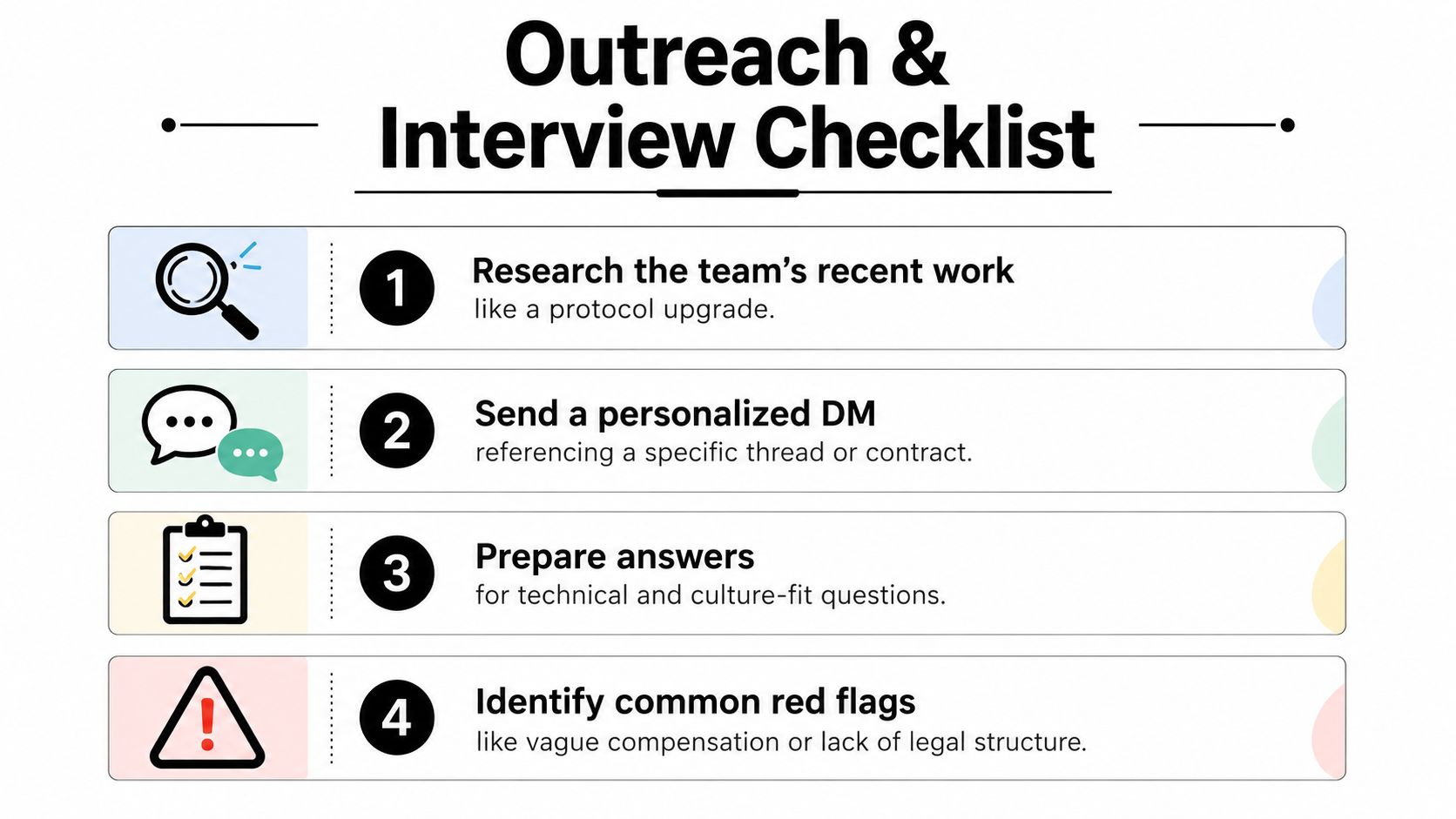
Most successful part-time placements begin with a specific message, not a mass application. Reference a protocol upgrade, a recent team thread, a documentation gap, or a contract address you reviewed. Then state the problem you can solve, attach two relevant samples, and give your available capacity.
A useful first message is short enough to scan quickly:
Sample outreach: I saw your recent protocol update and noticed the documentation still leaves the integration path unclear. I write developer-facing docs and can deliver an integration guide plus review notes within an agreed weekly scope. Here are two relevant samples, and I'm available for part-time contract work.
The screening call usually tests three things: whether you've shipped similar work, whether you communicate well asynchronously, and whether your working hours overlap with the team. Prepare two concise STAR stories about Web3 projects you completed independently. Explain the situation, your responsibility, the action you took, and the result. Don't spend the call reciting every tool you've ever used.
Protect your time and your wallet
Take-home exercises should be tightly bounded. If an unpaid assignment demands several hours of strategic work, ask whether the exercise can be shortened or paid. A serious employer can evaluate your thinking without extracting a deliverable they could use in production.
Walk away from these signals:
- Upfront payments: Never buy tokens, equipment, training, or access to receive work.
- Wallet requests: No legitimate recruiter needs your private key or seed phrase.
- Illiquid compensation: Be cautious when the entire offer depends on a token with unclear liquidity or release terms.
- Missing legal structure: Ask who signs the agreement, who pays invoices, and which entity owns the work.
- Treasury evasiveness: Founders should answer reasonable questions about payment capacity and operating runway.
- Identity gaps: Verify team members, company domains, wallet history, and mutual LinkedIn connections before signing.
A polished Discord server doesn't prove a company is legitimate. Review the team's public work, inspect relevant on-chain activity, and ask direct questions about scope and payment before you invest more interview time.
Negotiating Pay, Payment, and Contract Terms
Don't negotiate from a single number. Bring three figures to the conversation: your target fiat rate, its stablecoin equivalent, and a conservative valuation for any token component. Treat the token as speculative compensation unless the agreement defines liquidity, vesting, and payment timing clearly.
The available 2026 freelance benchmark is role-sensitive. Junior blockchain developers are listed at roughly $75 to $125 per hour, mid-level developers at $125 to $200, senior developers at $200 to $350, and specialists at $350 to $500 or more, according to Crypto Recruit's 2026 remote crypto jobs guide. Smart contract audits are typically priced at $25,000 to $75,000 over two to four weeks in the same guide, which reinforces the value of selling a narrow review or integration package rather than pretending to offer unlimited full-time availability.
| Role | Junior (USD/hr) | Mid (USD/hr) | Senior / Specialist (USD/hr) |
|---|---|---|---|
| Blockchain developer | $75 to $125 | $125 to $200 | $200 to $350, specialists $350 to $500+ |
| Smart contract audit work | Project-based | Project-based | $25,000 to $75,000 per audit project |
State your preferred payment currency before the final offer. USDC may be operationally simpler than a volatile native token, but you still need to understand local tax treatment and the chain used for settlement. Ask for a written rule covering invoice dates, network fees, failed transfers, exchange-rate calculation, and what happens if payment is late.
Negotiate scope before you negotiate discounts
Your agreement should define deliverables, revision limits, response expectations, IP ownership, termination notice, and a kill fee for canceled work. For a longer engagement, ask for a retainer or scheduled invoice cycle. Never accept “we'll sort the paperwork later.” A DAO, foundation, or offshore company still needs a clear contracting entity and payment process.
Use this counter:
Candidate: My rate for this scope is based on the technical complexity and the two comparable projects in my portfolio. I can reduce the first milestone or extend the delivery window, but I won't reduce the rate while keeping the same deliverables.
That response protects your price without making the negotiation adversarial. In part-time work, scope creep is more dangerous than a slightly low rate. Put every “quick extra” request in writing and explain what it displaces.
Compliance, Taxes, and Your First 90 Days
An offer letter starts the operating work. Your obligations depend on where you live, where the client is established, how you are classified, and whether payment arrives in fiat, stablecoins, or tokens. Speak with a qualified tax professional before choosing an entity or accepting cross-border compensation.
KYC and AML checks can apply to part-time contributors, especially when the client handles customer funds, runs a regulated product, or hires through a US-based entity. Ask what information the company collects, which entity signs the agreement, how identity documents are stored, and whether compliance training is required.
Choose a Delaware LLC, Estonian OÜ, Dubai structure, or Singapore company only after professional advice. Entity formation, VAT or GST registration, payroll, reporting, and personal tax treatment vary by residence and activity. A local accountant can identify the thresholds and filings that apply to your work.
Keep an audit-ready payment trail
Retain the signed agreement, invoices, wallet transaction history, payment confirmations, and the fair-market value used when a digital asset arrives. Separate client funds from personal trading activity. Record the date, asset, network, transaction identifier, invoice reference, and conversion method in your bookkeeping system.
Stablecoin invoices still require documentation. A token payment is not automatically tax-free, and contractor classification does not remove reporting duties. Set aside money for estimated payments according to local rules. Reconcile wallets monthly instead of reconstructing transactions at year-end.
Operational rule: If you cannot explain who owes you money, under which agreement, and how you recorded the payment, the engagement is not ready to scale.
Use this 30-60-90 day plan:
- Days 1 to 30: Set up the appropriate entity or sole-trader process, banking, invoicing, wallet records, bookkeeping, and compliance documents.
- Days 31 to 60: Ship the first deliverable, confirm acceptance in writing, document the working rhythm, and remove tasks that were outside the agreed scope.
- Days 61 to 90: Review the economics, renegotiate recurring terms if the work is valuable, or add a second client without exceeding your capacity.
The strongest part-time career is not a pile of random gigs. Build one well-scoped engagement into recurring work, backed by clean records, credible proof, and a reputation for delivering without drama.
If you are ready to replace misleading “part-time” filters with targeted Web3 roles, use Blockchain Jobs to search remote opportunities across engineering, marketing, operations, finance, compliance, and content. Review listings with a contractor mindset, then apply with a focused profile, clear availability, and proof of work that makes hiring you easy.