Explore QA Engineer Salaries: Your Guide to Nailing the Interview and Maximizing Your Offer
When you hear "QA Engineer," what salary comes to mind? While there's a solid average for Quality Assurance Engineers in the United States, that number is just the beginning of the story. The real earning potential—the kind that truly changes your career trajectory—is unlocked when you factor in specialization, location, and the high-stakes world of blockchain. This guide provides the actionable insights you need to navigate the job market, ace your interviews, and negotiate a top-tier salary.
Decoding The Modern QA Engineer Salary
Think of a QA engineer as the digital world's structural integrity expert. From a simple mobile app to a complex financial platform, their job is to find every crack, weakness, and potential failure before a user ever sees it. This role is absolutely critical for protecting a company's revenue and reputation, which is why skilled QA pros are so valuable on the job market.
To truly understand what a QA engineer can earn, you have to look past a single national average. The salary landscape is shaped by powerful forces: the industry's demand, the technical complexity of the product, and where the major talent hubs are located. For anyone looking for a job or trying to hire, getting a grip on these details is the first step to a successful outcome.
Setting The Baseline For Your Career
Let's start with a broad market overview to anchor your expectations. The data shows a strong foundation for QA roles across the board, but it also reveals clear paths to making significantly more money. This is the data you'll use to benchmark your career and prepare for salary negotiations.
For example, the average Quality Assurance Engineer in the US earns around $95,168 per year. But that's just a benchmark. This number shifts dramatically based on location and specific skills. In a tech hub like Cupertino, CA, the average jumps to $117,412. Get into a more specialized role like a Service Assurance Engineer, and you could be looking at salaries as high as $134,144, proving just how much niche expertise pays off. You can explore more detailed salary data insights to see how these factors play out.
Knowing this information is a game-changer during the hiring process. As a candidate, it helps you:
- Set realistic expectations: You'll know what a competitive offer actually looks like for your skill set in your city.
- Justify your ask: You can walk into negotiations armed with data to back up your requested salary.
- Spot growth opportunities: You can pinpoint the specializations that will give you the biggest financial boost down the road.
A Tale Of Two Industries: Web2 vs. Web3
The salary conversation gets really interesting when you compare traditional tech (Web2) with the booming blockchain space (Web3). Both value quality, of course, but Web3 puts an enormous premium on it. A bug in a standard e-commerce app might be an inconvenience. A flaw in a decentralized finance (DeFi) protocol could mean the irreversible loss of millions of dollars.
This high-stakes environment means Web3 companies are willing to pay top dollar for elite QA talent. They aren’t just looking for people to find bugs; they’re looking for guardians who can secure immutable smart contracts and protect digital assets. For career-minded QA professionals, this is where the biggest opportunities are.
This table gives a quick snapshot of how compensation differs, helping you decide which career path to target.
QA Engineer Salary At A Glance: Web2 vs. Web3
| Metric | Traditional Tech (Web2) | Blockchain (Web3) |
|---|---|---|
| Average Base Salary | $95,000 - $130,000 | $130,000 - $180,000+ |
| Key Responsibilities | Functional, UI/UX, performance, and regression testing for web/mobile apps. | Smart contract audits, protocol security, network integrity, and dApp testing. |
| Compensation Extras | Stock options (RSUs), annual cash bonuses. | Token grants/allocations, higher cash bonuses, often remote-first packages. |
| Required Skills | Test automation (Selenium, Cypress), API testing, CI/CD familiarity. | Deep blockchain knowledge, smart contract languages (Solidity), security testing tools. |
As you can see, the distinction creates a clear split in compensation. This sets the stage for a deeper look into why blockchain expertise can so dramatically elevate a QA engineer's salary and which skills are most in-demand for these highly paid roles.
The Web3 Premium: Why Blockchain Expertise Commands Higher Pay
Pivoting into the world of blockchain often comes with a nice salary bump for QA engineers, and it’s not just hype. This "Web3 premium" is a direct result of the incredibly high stakes baked into decentralized technology. In a typical Web2 app, a bug might crash a feature or cause some frustrating downtime. Annoying, for sure, but usually fixable with a quick patch.
Things are different in Web3, where the consequences can be catastrophic. Smart contracts, once deployed on a blockchain, are usually immutable—meaning the code is set in stone. A single flaw in a DeFi protocol isn't just an inconvenience; it can lead to the permanent loss of millions of dollars in user funds. There are no do-overs.
The High Cost of a Single Mistake
The history of crypto is littered with cautionary tales that underscore just how critical meticulous QA is. These aren't just theoretical what-ifs; they are real-world exploits that have drained protocols and shattered user trust. Understanding these risks is crucial for any job seeker wanting to stand out in an interview.
- Smart Contract Flaws: A simple coding error, like a reentrancy bug, can create a loophole for attackers to drain a contract's funds by making repeated withdrawals before the balance can update.
- Cross-Chain Bridge Vulnerabilities: Bridges linking different blockchains are incredibly complex and juicy targets for hackers. A tiny weakness in their validation logic can result in a nine-figure theft.
- Oracle Manipulation: DeFi apps often rely on "oracles" for external data like asset prices. If QA doesn't test how the system handles bad or manipulated data, it can be tricked into thinking an asset is worth more or less than it is, leading to massive financial losses.
Because the risks are so immense, Web3 companies simply can't afford to treat QA as an afterthought. They need engineers who can think like an adversary, who deeply understand the unique failure points of decentralized systems, and who can ensure the code is airtight before it's deployed and locked in forever.
How the Market Responds to High Stakes
This intense demand for a specialized skill set is what’s driving compensation through the roof. In the fast-moving Web3 ecosystem, QA engineers are pulling in impressive salaries that leave many traditional tech roles in the dust. The average yearly compensation hit $120,000 as of January 2026, with a baseline of $70,000 and top-tier roles reaching up to $200,000. You can find more data on Web3 QA engineer salaries that really brings this premium to light.
Hiring managers in this space aren't just looking for a tester. They're searching for a defender—someone who can safeguard the protocol's treasury and protect user assets from sophisticated threats. That level of responsibility justifies a premium salary.
This security-first mindset completely changes the hiring game. Candidates are often grilled on their knowledge of common smart contract vulnerabilities, their ability to design test cases for decentralized apps (dApps), and their experience with blockchain-specific testing tools like Foundry or Hardhat. Showing you have a handle on these areas is crucial for landing a top-tier Web3 QA role, like this Senior QA Engineer position available for those with deep protocol knowledge.
At the end of the day, the higher salaries for QA engineers in Web3 boil down to a simple economic truth: where the risk is greatest, the rewards for those who can manage it are also highest. For any QA professional willing to dive deep into blockchain, the career and financial upside is undeniable.
Mapping Your QA Career And Salary Progression
A career in Quality Assurance isn't a straight line—it's a journey of expanding influence. Your compensation should reflect that growth. Think of it like this: an architect starts by checking blueprints but eventually designs entire skyscrapers. A QA professional follows a similar path, evolving from running predefined tests to architecting an organization's entire quality strategy.
Understanding this progression is vital. For job seekers, it’s a roadmap for your next move. For hiring managers, it’s the key to knowing what top-tier talent looks like at every level. Let's break down the typical career path, the skills you'll need, and what you can expect to earn along the way.
Below is a quick overview of how salaries typically stack up as you gain experience in both traditional tech (Web2) and the emerging blockchain space (Web3).
QA Engineer Salary By Experience Level
| Experience Level | Typical Years of Experience | Average Web2 Salary Range | Average Web3 Salary Range |
|---|---|---|---|
| Junior | 0-2 years | $65,000 – $85,000 | $80,000 – $100,000 |
| Mid-Level | 2-5 years | $85,000 – $115,000 | $100,000 – $140,000 |
| Senior | 5-8 years | $115,000 – $140,000 | $120,000 – $200,000+ |
| Lead/Architect | 8+ years | $140,000 – $180,000+ | $160,000 – $220,000+ |
As you can see, the Web3 space consistently offers a premium, reflecting the high stakes and specialized knowledge required. Now, let’s dig into what each of these roles really entails from a hiring and career perspective.
The Junior QA Engineer: Launching Your Career
This is where everyone starts—learning the fundamentals and executing with precision. As a Junior QA Engineer, your world revolves around manual testing, running existing test scripts, and becoming a master of documenting bugs.
Your main job is to follow test plans to the letter, write clear and concise defect reports in tools like Jira, and work closely with developers to make sure fixes actually work. Hiring managers aren't expecting you to know everything; they're looking for a sharp eye for detail, great communication skills, and a genuine hunger to learn. This is your chance to absorb everything and build the foundation for your future growth.
The Mid-Level QA Engineer: Expanding Your Impact
After a couple of years, you've moved beyond just following instructions. As a Mid-Level QA Engineer, you start contributing to the test plan itself. You're tackling more complex testing scenarios, getting your hands dirty with test automation, and taking full ownership of quality for specific features.
This is the point where you stop just thinking about how to test and start asking why. You're expected to be more proactive, spotting gaps in test coverage and suggesting better ways to do things. For hiring managers, this is where they look for signs of independent problem-solving. Success at this level is about demonstrating that you can think strategically about quality, not just execute tasks.
This is especially critical in Web3, where the consequences of a missed bug can be catastrophic. The entire system is built on a hierarchy of value where quality assurance is the last line of defense.
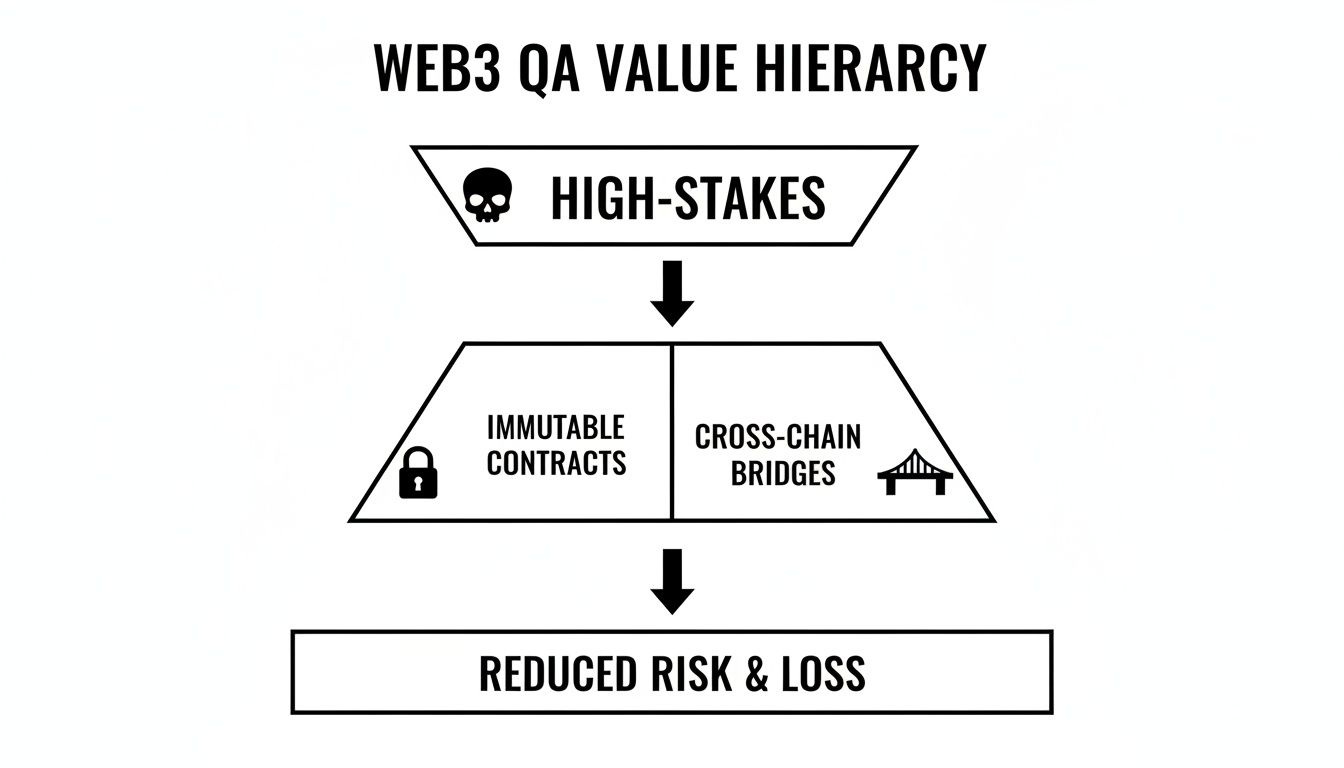
As the diagram shows, a single bug in an immutable smart contract or a cross-chain bridge can't just be "patched"—it can lead to irreversible financial loss. This is why experienced QA professionals are so highly valued in the space.
The Senior QA Engineer: Mastering The Craft
As a Senior QA Engineer, you’re no longer just testing features; you’re a guardian of entire systems. You’ve become a domain expert and a technical leader on the team. Your focus shifts to designing broad test strategies, mentoring junior engineers, and leading the charge on building and maintaining sophisticated test automation frameworks.
At the senior level, your value isn’t measured by the bugs you find, but by the bugs you prevent. You’re influencing the development process from day one, embedding quality into the foundation of the product.
This strategic shift is where QA engineer salaries really take off. In the US market, median salaries for seniors climbed from $102,459 in 2023 to an average of $106,323 by early 2025, with top earners pushing past $112k. In Web3, where the stakes are even higher, the average senior salary hits $120k and can soar to $200k. You can dive deeper into these figures by checking out senior QA engineer salary trends on Salary.com.
The Lead QA Engineer or Architect: Strategizing For Scale
At the top of the technical track, you'll find roles like Lead QA or QA Architect. Here, you're responsible for the quality of an entire product line or even the company as a whole. Your job is to set the technical vision for QA, evaluate new tools and technologies, and ensure quality processes can scale as the business grows.
- You'll be: Defining the QA roadmap, establishing the key metrics (KPIs) that matter, and cultivating a culture of quality across the entire engineering department.
- Hiring managers want: Proven leadership, a deep understanding of system architecture, and the ability to connect quality initiatives directly to business goals.
Salaries for these roles in Web2 typically range from $140,000 to $180,000+. In Web3, where you're safeguarding against massive financial and security risks, a QA Architect can easily command over $200,000, often supplemented with a hefty chunk of token incentives. A look at a QA engineer role at a company like Tanium offers a great window into the kind of responsibilities you can expect at this elite level.
The High-Value Skills That Boost Your QA Salary

In the world of QA, not all skills are created equal. If you really want to bump up your salary, you have to move past the basics of manual testing and dive into the specializations that companies are willing to pay a premium for. Think of it like a doctor: a general practitioner is essential, but a heart surgeon’s specialized expertise commands a much higher price tag. The same principle applies here.
Your ability to master the right tools and frameworks is what gives you real leverage in a salary negotiation. It's not enough to just list them on your resume. You need to connect those skills to real business results. For example, instead of just saying you know automation, explain how you built a script that cut regression testing time from three days down to just four hours. That’s a clear return on investment (ROI) that justifies a bigger paycheck.
The Power Of Test Automation
The single biggest lever you can pull to increase your earning potential is test automation. When a QA engineer can write code to test software, they often take on the title of Software Development Engineer in Test (SDET). This is a hybrid role, blending the worlds of quality assurance and software development, and it’s one of the most sought-after positions in tech.
Why are SDETs so valuable? Because they make the entire quality process more efficient and scalable. Automation speeds up development cycles, expands test coverage, and frees up manual testers to focus on the tricky, exploratory work that computers can't do. For any company trying to ship products faster without breaking things, that’s a massive win. Being able to code makes you a force multiplier for the whole engineering team.
A few key tools will immediately signal your value to hiring managers:
- Selenium: The old guard of web browser automation, still widely used and respected.
- Cypress and Playwright: These are the modern, developer-friendly frameworks that are becoming the new standard. They're fast, reliable, and a joy to debug with.
- Web3 Specific Tools: If you're in the blockchain space, knowing frameworks like Foundry or Hardhat is non-negotiable for testing smart contracts. This is often where you'll find the highest QA engineer salaries.
During an interview, don’t just say, "I know Cypress." Tell a story. Describe a project where you built an end-to-end testing suite that caught a critical bug before it hit production, saving the company from a potential PR nightmare and lost revenue.
Performance Testing For Scalability
Another high-impact specialization is performance testing. While functional testing asks, “Does it work?” performance testing asks, “Does it work under pressure?” It’s all about simulating heavy user loads to find bottlenecks, measure response times, and make sure the application doesn't crumble when it matters most.
Companies building products for thousands or even millions of users will pay top dollar for this skill. They need engineers who can prevent the site from crashing during a Black Friday sale or a big product launch. Expertise here shows you have a deep understanding of system architecture and what makes for a good user experience. This is a skill you should highlight prominently in your resume and interview conversations.
Security Testing: The Ultimate Value-Add
In an age of constant data breaches, security testing (often called penetration testing) has become one of the most critical—and highly paid—QA specializations. A single security flaw can lead to devastating financial and reputational damage. This makes a sharp security QA engineer an incredibly valuable asset, especially in Web3, where a single exploit can drain millions from a protocol in minutes.
If you can walk into an interview and talk confidently about identifying vulnerabilities like SQL injection, cross-site scripting (XSS), or flaws in smart contracts, you will immediately stand out. This skill proves you can protect a company’s most important assets: its data and its customers’ trust. When you frame your experience in terms of mitigating risk, you're making a powerful case for a top-tier salary.
How To Ace The Interview And Negotiate Your Worth
Getting your resume noticed is one thing, but the interview and negotiation are where you truly secure a top-tier salary. This is the moment you translate all that technical skill on paper into a rock-solid financial case for yourself. Nailing this final step is what separates a good offer from a great one.
Think of the interview less as a test and more as a live-action demo of your brain at work. They don't just want you to recite definitions from a textbook; they want to see how you think. Hiring managers are looking for your thought process, especially when you're staring down a complex technical problem.
Navigating The Technical Interview
The technical interview for any serious QA role, especially for an SDET, is all about your practical, hands-on abilities. You should be ready for a mix of coding challenges, system design hypotheticals, and real-world-style problems.
- Automation Challenges: You might get asked to write a test script from scratch for a sample webpage using a tool like Cypress or Playwright. The real test isn't just whether the code runs. They're watching to see how you structure it, how you handle edge cases like a slow-loading element, and if you write code that someone else can actually maintain.
- System Design: A classic question is, "How would you approach testing a system like Twitter's feed?" This is where they check if you can think big. A great answer would touch on everything: functional testing (posting, retweeting), performance testing (how does it hold up with millions of users?), security testing (what about spam bots?), and, of course, how you'd automate it all.
- Web3 Specifics: If you're going for a blockchain job, expect questions about testing smart contracts. They’ll want to know how you’d check for common vulnerabilities like reentrancy or what tools you’d use (like Foundry or Hardhat) to mimic different network conditions.
The absolute key here is to talk through your entire process out loud. Explain the assumptions you're making, discuss the trade-offs of one approach versus another, and spell out why you're making the choices you are. This shows the interviewer you’re a strategic thinker, not just someone who follows a script. A strong performance here gives you a ton of leverage when it's time to talk numbers.
The Art Of Salary Negotiation
Negotiation doesn’t start when you get the offer letter. It starts way before that, with you knowing your market value inside and out and being ready to advocate for it. Simply taking the first number a company throws at you can mean leaving thousands of dollars on the table.
The most powerful tool in any negotiation is information. Walking in armed with current, relevant salary data for your specific role, experience level, and industry (Web2 vs. Web3) changes the conversation from what the company wants to pay to what the market demands.
Sooner or later, you'll get the dreaded question: "What are your salary expectations?" If you answer with a single number, you've just boxed yourself in. The better move is to provide a well-researched range that reflects the market data you’ve gathered.
For example, you could say: "Based on my research for senior SDET roles with blockchain experience, similar positions are compensating in the $150,000 to $175,000 range. Given my specific expertise in performance testing for DeFi protocols, I'm targeting the upper end of that scale."
This kind of response does a few things perfectly:
- It anchors the discussion high: You’ve set a strong, data-backed starting point for the conversation.
- It shows you've done your homework: This immediately signals that you're a serious professional who knows their worth.
- It connects your skills to value: You're not just asking for more money; you're explaining why your specific skills justify it.
Negotiating The Total Compensation Package
Finally, always remember that base salary is just one piece of the puzzle. This is especially true in the Web3 space, where token grants can make up a huge chunk of your total earnings. Don't be shy about negotiating the entire package.
Here are a few of the elements you should be thinking about:
- Base Salary: The foundation. This is your guaranteed income.
- Signing Bonus: A one-time payment, often used to make up for a bonus you're leaving behind at your current job.
- Performance Bonus: An annual bonus that’s usually tied to how well you and the company perform.
- Equity/Tokens: For startups and Web3 companies, this has the biggest potential upside. Be sure to ask about the vesting schedule and the total allocation.
For instance, if a company is firm on a base salary that’s a little lower than you want, you can counter by asking for a larger signing bonus or an increased token allocation to bridge the gap. When you approach the negotiation with this kind of flexibility and focus on the total value, you show them you’re a strategic partner, not just another candidate.
Taking a look at real-world job descriptions for high-level positions, like this Sr. QA Automation Engineer role at a major exchange, is a great way to see what skills command the top-tier packages.
Got Questions About QA Engineer Pay? We've Got Answers.
When you're trying to figure out QA salaries, a lot of questions pop up. Am I getting paid fairly? How do I get to that next salary bracket? This section cuts through the noise and gives you straight answers to the most common things people wonder about.
We'll cover everything from how much more an SDET really makes to whether working remotely will help or hurt your paycheck.
How Much More Can I Earn As an SDET Compared To a Manual QA Tester?
Making the jump from manual QA to an SDET (Software Development Engineer in Test) role is one of the surest ways to see a serious pay bump, often in the 20-40% range. The reason is pretty straightforward: you stop being a proxy for the user who just finds bugs and become a developer who builds systems to prevent them in the first place.
An SDET who can code fluently in Python or JavaScript and is comfortable with automation frameworks like Selenium or Cypress is valued much like a software developer. Why? Because the work you do—automating tests—delivers a massive and easily measurable return on investment for the company.
Think about it in the high-stakes world of Web3. The ability to automate tests for a smart contract isn't just a nice-to-have; it's a critical defense against catastrophic financial loss. This elevates the SDET role from important to essential, and the pay reflects that. Your coding skills directly translate into risk mitigation.
Are QA Engineer Salaries in Web3 More Volatile Than in Traditional Tech?
Yes, they can be, but that volatility comes with a much, much higher potential upside. Most of the volatility comes from the token or equity part of your compensation package. Since its value is tied to the crypto market, it's naturally going to have its ups and downs.
To counteract this risk and still attract top-tier talent, Web3 companies usually offer a higher base salary in a stable currency (like USD) than you'd find at a typical Web2 company. This approach gives you a solid financial foundation while leaving the door open for a potentially life-changing payout. A traditional stock option might double or triple in value over a few years, but a successful token launch can create incredible wealth in a fraction of that time. That's an opportunity you just don't see in established tech.
Does Being Remote Affect My QA Engineer Salary?
The whole remote work and pay situation is definitely evolving, especially in the Web3 space. While plenty of traditional tech companies still hang on to the old model of adjusting your salary based on the cost of living in your city, that's quickly becoming outdated.
The more forward-thinking, remote-first companies—particularly in blockchain—are shifting to location-agnostic pay. Their philosophy is simple: hire the best person for the job, no matter where they are in the world. They set a single, competitive salary band for a role and stick to it globally.
When you're heading into an interview or negotiation, keep this in mind:
- Benchmark Nationally, Not Locally: Do your salary research based on national or even international averages for your role and experience. Don't limit yourself to what people are paid in your hometown.
- Ask Upfront: Get clarity on the company's pay philosophy in your very first screening call. A simple question like, "Do you adjust salaries based on location?" can save everyone a lot of time.
- Focus on Your Value: Always frame your salary expectations around the skills and value you bring to the table, not the location of your desk.
This shift is a game-changer. It gives you the power to negotiate based on your actual worth, opening up doors to higher-paying jobs that used to be exclusive to major tech hubs.
What's the Best Way to Break Into Web3 QA Without Direct Experience?
If you want to land a Web3 QA job without having one on your resume already, you have to get your hands dirty. You can't just say you're interested—you have to prove it. The single most effective way to get a hiring manager's attention is by building a portfolio of real, relevant projects.
First, just dive into the ecosystem. Get a solid grasp of blockchain fundamentals and how smart contracts work, especially with the most common language, Solidity.
Next, start playing with the tools of the trade. Download and experiment with Web3-native testing frameworks like Foundry or Hardhat. Use them to write and run tests on sample smart contracts. You can write your own or find plenty of open-source ones to work with.
Finally, become part of the community. Find open-source blockchain projects on platforms like GitHub and start contributing. You could identify bugs, write test cases for existing code, or help improve their documentation. Every contribution is public, tangible proof of your skills and initiative, making you a far more compelling candidate than someone who just says they're passionate about the space.
Ready to find your next high-paying role in the blockchain space? Blockchain Jobs is the leading job board connecting top talent with the most exciting opportunities in Web3. Explore curated roles in QA, engineering, security, and more. Find your Web3 job on Blockchain Jobs.