
Top 10 Sites for Remote Jobs Machine Learning in 2026
You're probably in one of two situations right now. You already work in machine learning and want out of geography-bound hiring, or you're trying to break into ML and keep finding that “remote” listings are vague, overloaded, or not really remote once you read the fine print.
That frustration is normal. Remote jobs in machine learning exist, but the search got more selective. One 2025 market scan found that companies explicitly listing remote ML engineer roles dropped from 12% to 2% in a year, while remote options still showed up in about 12% of all AI and ML postings by mid-2025, which means many real opportunities now sit inside broader AI hiring pipelines rather than obvious remote-only buckets (Underdog's remote ML hiring analysis).
That's why a good search strategy matters more than a bigger application count. You need the right boards, but you also need a portfolio that proves production thinking, a resume that reads like an operator wrote it, and interview habits that work over video. Most remote ML teams don't hire for model experimentation alone. They hire for shipping, documenting, debugging, and collaborating across time zones.
If your long-term target includes agentic systems, data tooling, or product-facing ML work, this guide for builders on AI agents is a useful companion read.
1. ai-jobs.net
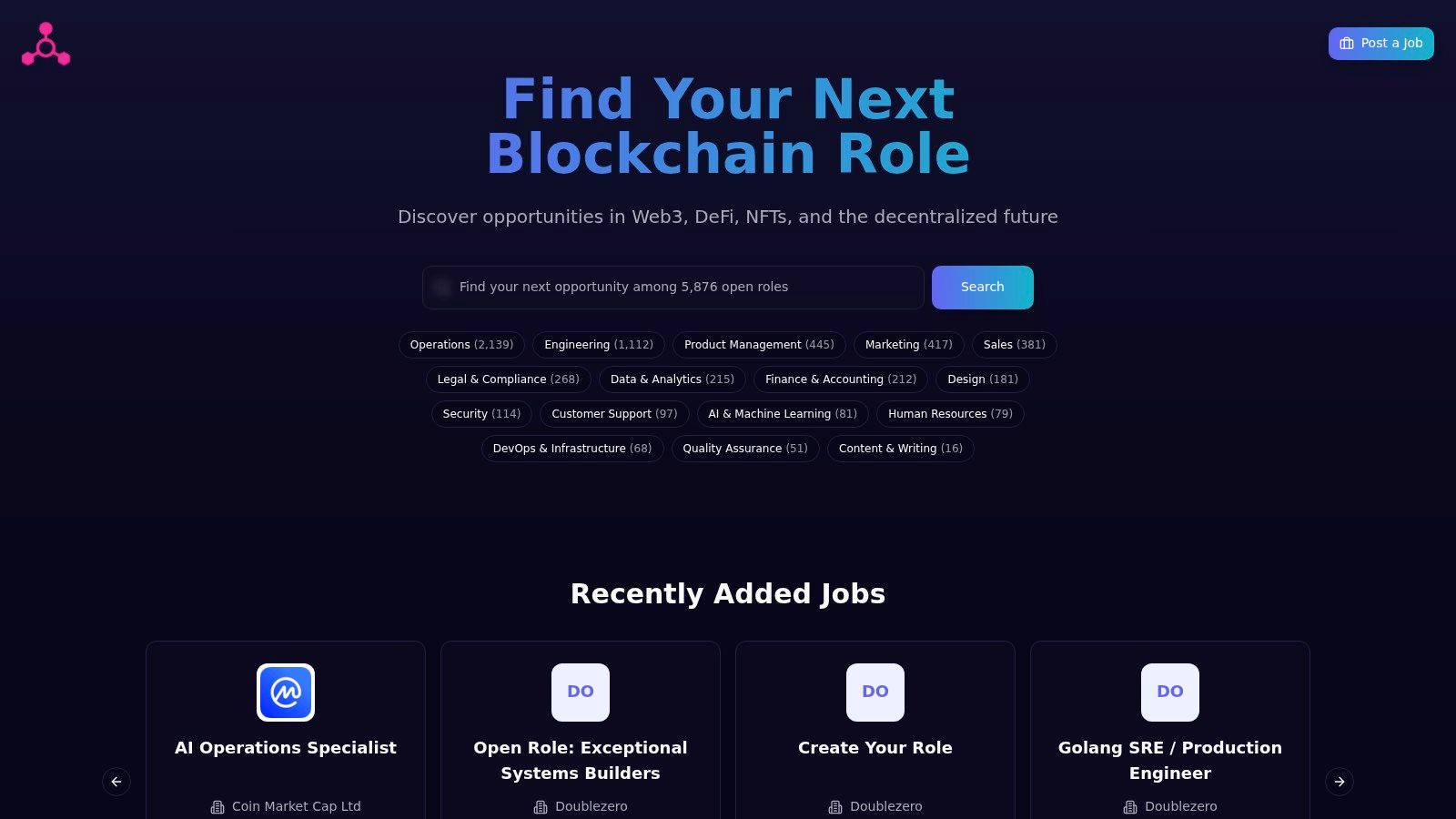
ai-jobs.net is where I'd start if you want less noise and more relevance. General boards can bury machine learning roles under data analyst, software engineer, and recruiter spam. ai-jobs.net avoids most of that because the board is built around AI, ML, data science, and MLOps from the start.
The biggest practical advantage is filtering. You can narrow by role family, experience level, salary, and remote option quickly, which matters when you're trying to separate true ML engineering jobs from research-heavy or analytics-heavy postings. A lot of listings also show compensation bands and posting freshness, which helps you prioritize newer openings before the ATS gets crowded.
Best use case
This board works best when you already know your lane. If you're targeting MLOps, applied ML, LLM engineering, or data-platform-adjacent roles, it gives you a cleaner feed than broader sites. It's less useful if you want sheer volume.
A smart move is to pair it with a niche adjacent market. If your ML background touches crypto, on-chain analytics, or agent infrastructure, browse these AI and machine learning blockchain roles alongside ai-jobs.net. The overlap is stronger than many candidates expect.
- Use freshness as a ranking signal: Apply to newly posted jobs first. On specialist boards, early applications usually get more human attention.
- Filter by production keywords: Search for terms like MLOps, inference, feature store, pipeline, deployment, and observability.
- Read for hidden constraints: Some remote roles still require specific regions or overlap hours.
The downside is simple. Volume is smaller than LinkedIn or Dice, so you won't run your whole search from this site alone. But for high-fit discovery, it's one of the best starting points.
2. We Work Remotely
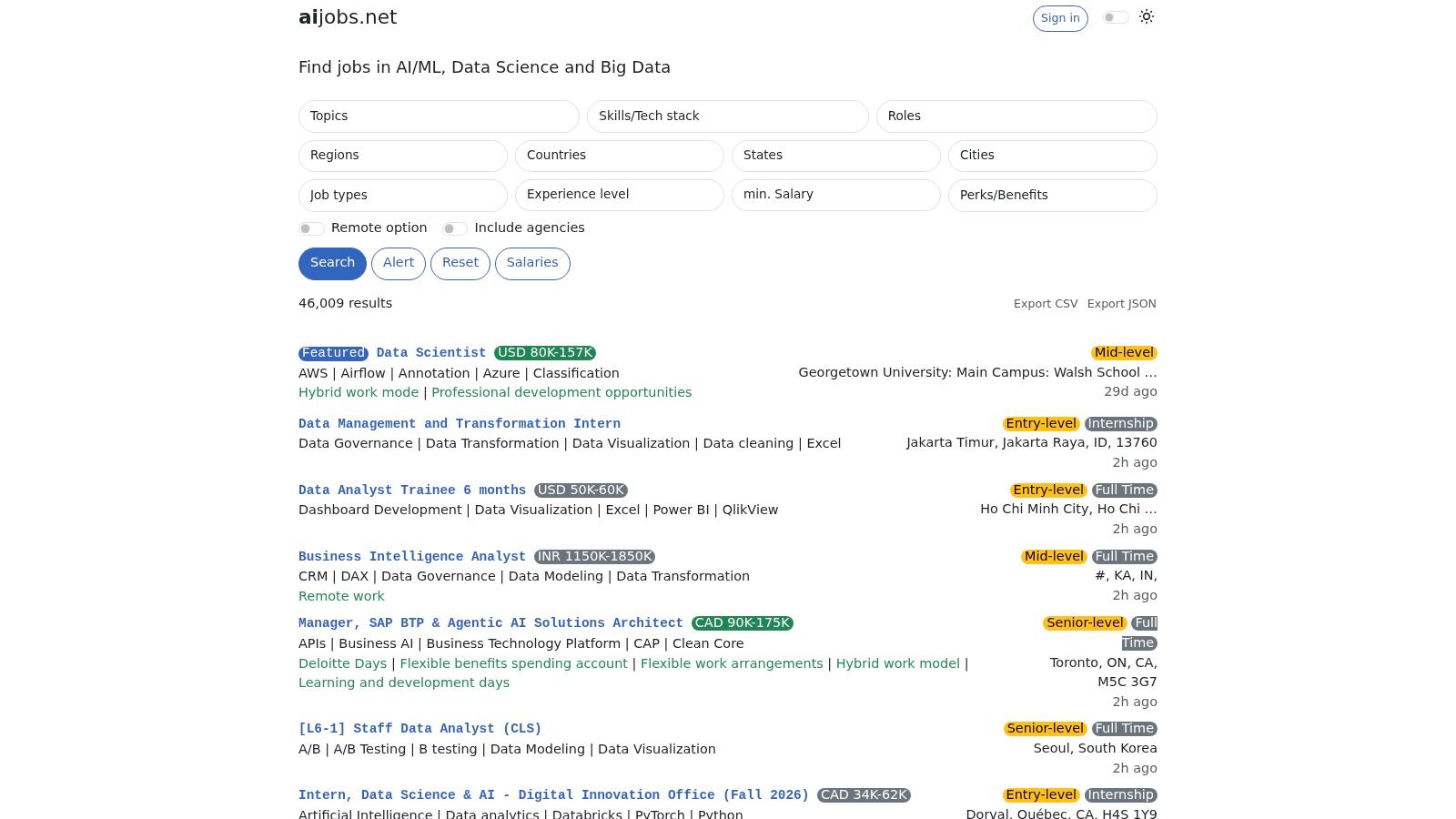
We Work Remotely's machine learning jobs page is useful for one reason above all. Everything starts remote-first. That sounds obvious, but it changes your review process because you're not constantly filtering out office-based roles dressed up with flexible language.
The listings tend to be easy to skim, and that matters when you're doing this every day before work or between interviews. I like this board for building a habit: open it, scan newest roles, shortlist fast, then move to deeper employer research only on the promising ones.
Where it helps most
It's especially good for candidates who want distributed startups, SaaS companies, or smaller engineering teams. If ai-jobs.net is better for precision inside ML, We Work Remotely is better for remote-first company discovery.
You can also use it as a signal board. If a company posts here, there's a decent chance the rest of its hiring process, communication style, and onboarding are designed for distributed work. That's not guaranteed, but it's a better starting assumption than on hybrid-heavy platforms. For broader distributed hiring beyond ML, this remote jobs collection is worth tracking in parallel.
Practical rule: Don't judge a remote ML role by the board alone. Click through to the employer site and confirm timezone overlap, legal hiring regions, and whether the job is actually machine learning or mostly backend engineering with an ML label.
A trade-off: some posts don't give enough technical depth. You'll often need the employer's own careers page to answer the key questions. Is this a data pipeline job? A model serving role? An experimentation platform role? You won't always know from the listing summary.
Still, as part of a multi-board routine, We Work Remotely earns its spot.
3. Remote OK
Remote OK's machine learning work-from-home listings are built for speed. If your search style is “show me what's new, what pays well, and what's getting attention,” this board fits that workflow better than most.
The sorting options are the main draw. You can scan by latest, highest paid, or most applied, which makes it easier to choose your application strategy. When I'm helping candidates with remote jobs machine learning searches, I usually suggest using “latest” for action and “highest paid” for calibration. The first finds openings. The second shows what skill combinations employers value most.
What to watch for
Remote OK often feels more salary-forward than traditional boards, and that's helpful. Compensation transparency changes how you position yourself. You can tell quickly whether a posting is likely looking for junior implementation support, mid-level product ML, or senior platform ownership.
There's a catch. Boards like this can include reposts, cross-posts, or listings that need verification. Before spending time on a specific application, check that the job still exists on the company site and that the remote policy matches what the board shows.
- Compare before applying: If a role looks strong, validate it on the employer page.
- Use alerts carefully: Set them narrow enough that you don't train yourself to ignore them.
- Prioritize salary-plus-scope: Higher pay often correlates with broader ownership, not just better modeling skill.
This is not the place to rely on one-click habits alone. It's a strong scanning tool, but you still need manual judgment. Used that way, it saves time.
4. Wellfound
Wellfound remote jobs is the best board on this list if you want startup impact. Not safety. Impact. That means more scope, more ownership, often more equity, and a better chance of landing a role where you touch product, infrastructure, and customer-facing outcomes instead of just one narrow subsystem.
For machine learning candidates, that can be a real advantage. Early and growth-stage teams often need someone who can move between experimentation, data plumbing, deployment, and stakeholder communication without getting territorial. If that sounds like your profile, Wellfound can surface better-fit roles than enterprise-heavy platforms.
Why startup signals matter
The useful part isn't just the remote filter. It's the hiring context. Many listings show compensation and equity bands, plus signals like active hiring or employer responsiveness. Those details help you avoid dead-end applications.
That transparency also helps with career decisions. If you're choosing between an established company and a startup, the trade-off isn't just cash versus equity. It's also mentorship versus autonomy, specialization versus breadth, and process versus speed.
Remote startup ML work often looks less like “train model, hand off” and more like “own the path from messy data to production behavior.”
The downside is obvious. Startup risk is real. Some roles are remote in name but constrained by US states, tax jurisdictions, or timezone windows. Others expect broad ownership without much support.
If you apply here, make your resume read like a builder's document. Highlight shipped systems, ambiguous problem-solving, and evidence that you can work across engineering and product without waiting for a perfect spec.
5. FlexJobs
FlexJobs machine learning openings appeals to a different kind of candidate. If you're tired of scammy listings, vague agencies, and junk aggregations, the value here is curation. That alone can justify the subscription for some people, especially if your time is more constrained than your budget.
I don't usually recommend paid job boards first. But FlexJobs is one of the few cases where paying for cleaner search results can make sense. It removes some of the screening work from your side, which is useful if you're balancing a current job, freelance projects, or interview prep.
Who should use it
This works best for candidates who want a lower-noise environment and are willing to trade some volume for trust. It's also a good fit if you're re-entering the market after a break and want a more controlled search experience.
The job volume in machine learning won't match LinkedIn. That's the trade-off. But the quality bar is often steadier, and the platform includes tracking and application tools that help if you're running a disciplined pipeline.
- Pay for signal, not hope: Subscribe only if you'll use it actively over a concentrated period.
- Treat curation as a filter, not a guarantee: You still need to assess team quality, technical scope, and interview maturity.
- Use it to protect focus: Fewer listings can be a benefit when you're tailoring applications carefully.
FlexJobs is not the best discovery engine for frontier ML work. It is a good anti-chaos tool. For some job seekers, that's exactly what improves outcomes.
6. LinkedIn Jobs
LinkedIn Jobs for remote machine learning roles is still unavoidable. Even if you dislike the feed, the messaging noise, or the premium upsells, the platform sits too close to recruiter workflows to ignore.
The reason to use LinkedIn isn't elegance. It's market coverage. One 2025 remote-job index analyzed 2,187 machine learning engineer listings and found a structured global market rather than a fringe niche, with employers taking about 53 days on average to close a role and compensation rising from $115,771 for entry-level remote ML engineers to $224,591 for lead-level roles across the dataset (Remote Rocketship's remote ML salary index). That kind of range is exactly why LinkedIn matters. You need exposure to the full stack of seniority, employer type, and region.
How to make LinkedIn work
The worst way to use LinkedIn is broad search plus Easy Apply on everything. The better approach is narrow filters, saved searches, and profile alignment. Your headline, About section, and featured projects should match the kind of ML work you want recruiters to associate with you.
If you need ideas for sharpening your public-facing professional narrative, the career content on the Blockchain Jobs blog can help with positioning and job-search discipline.
- Tighten filters hard: Remote, recent postings, exact job titles, and relevant seniority.
- Use your profile as a landing page: Recruiters often read it before the resume.
- Favor direct applications for top targets: Easy Apply is fine for lower-priority roles, but your best opportunities deserve a custom application.
LinkedIn is noisy, but it's where many hiring conversations start. Ignore it and you'll miss too much of the market.
7. Dice
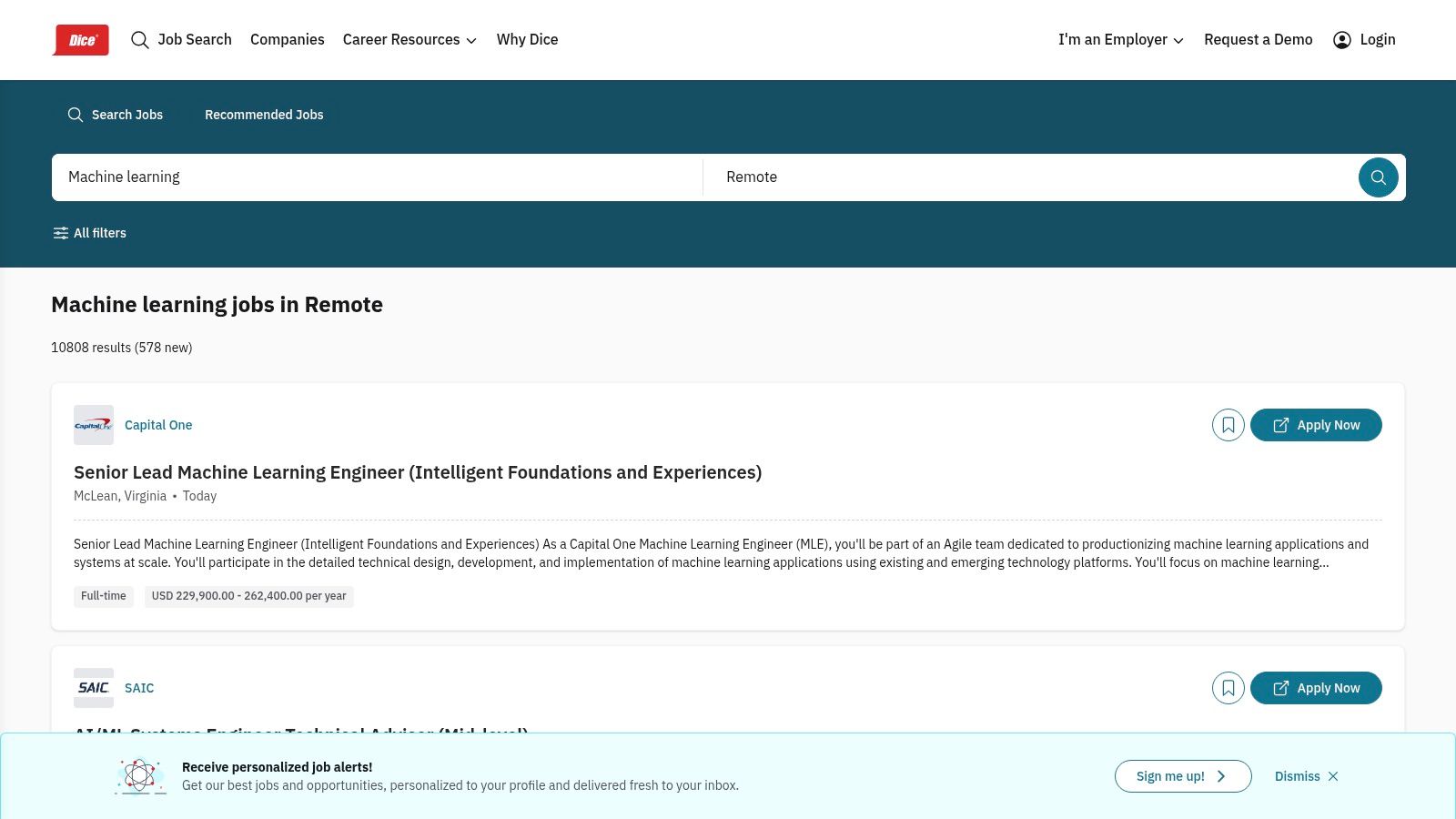
Dice remote machine learning jobs is a better board than many ML candidates assume. It's strongest when your background leans toward enterprise systems, consulting, regulated industries, government-adjacent work, or applied engineering inside large organizations.
That matters because not every remote ML career should be startup-centric. Plenty of strong roles sit inside established companies that care less about flashy research and more about deployment, integration, security review, and long-lived systems. Dice surfaces more of that world.
Enterprise-heavy roles change the interview
If you apply through Dice, expect more recruiter involvement and more variance in listing quality. Some postings are sharp. Some are thin. Some are clearly driven by staffing pipelines rather than direct team hiring.
Still, the board has value because enterprise ML hiring often looks for candidates who can manage requirements, legacy systems, and stakeholder management. Those skills are underrated by candidates who only optimize for startup-style postings.
If your strongest work involved production APIs, governance, model monitoring, or integrating ML into existing business systems, Dice may fit your profile better than boards dominated by early-stage startups.
The trade-off is that you'll need stronger screening discipline. Verify whether a recruiter is exclusive, whether the role is direct hire, and whether “remote” means remote after onboarding. Use it selectively, not passively.
8. Built In
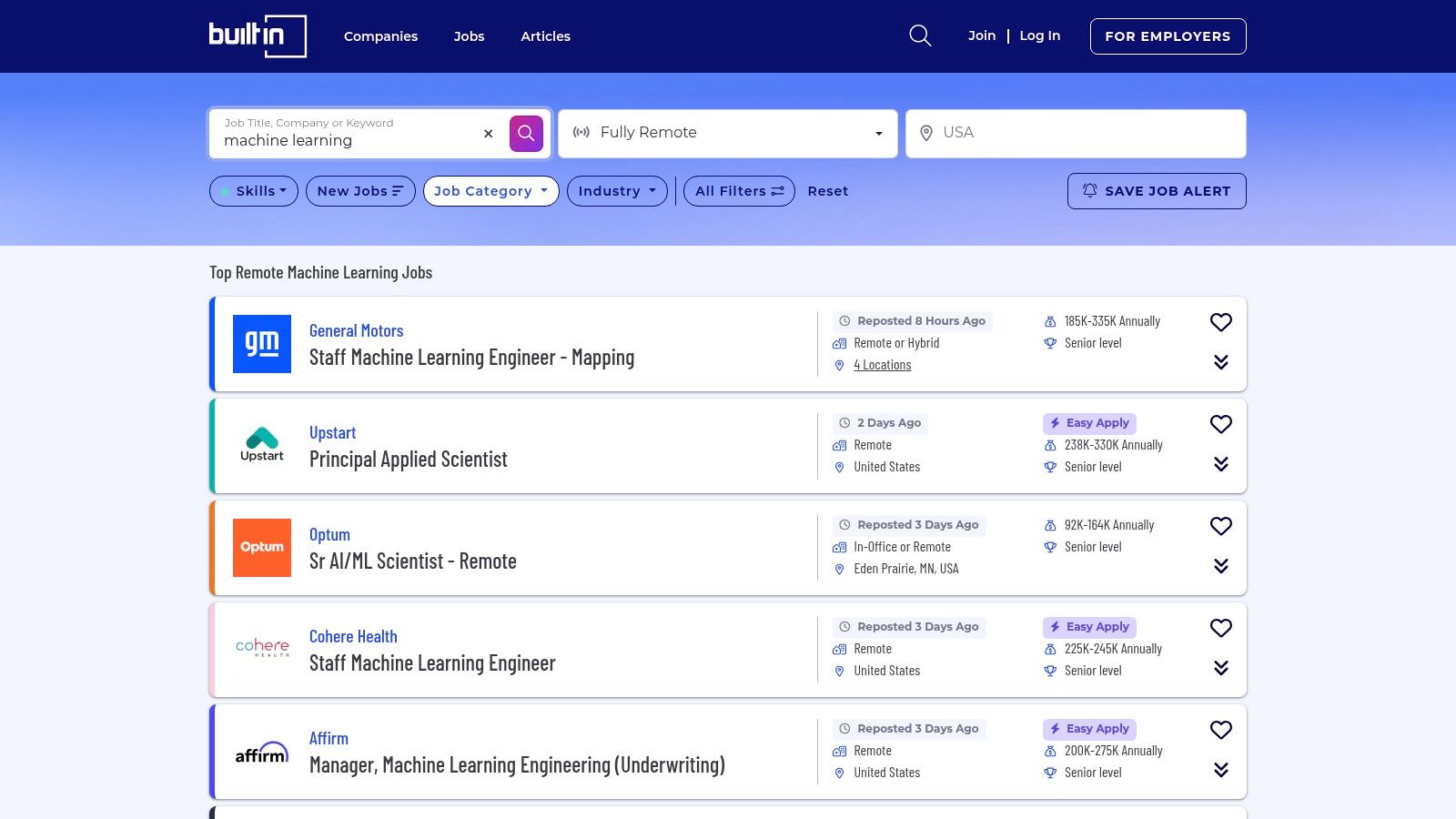
Built In remote machine learning jobs is one of the better boards for context. Some platforms help you find openings. Built In often helps you understand the company behind the opening.
That difference matters in remote jobs machine learning because remote fit isn't just a policy issue. It's an operating model issue. You want to know how the company talks about engineering, product, data, and hiring maturity before you invest in a take-home assignment or a multi-round interview loop.
Company context is part of job quality
Built In's company pages and role pages are often richer than the standard aggregator format. You can usually get a better read on business model, team type, and company narrative, which helps you tailor your application more precisely.
The platform is especially useful for candidates who care about US tech companies and scaleups. That's where it's strongest. It's less helpful if your search is highly international or heavily tilted toward freelancing.
A practical approach:
- Read the company page before the role page: It tells you whether the job is worth your time.
- Look for operational clues: Engineering blog, product maturity, hiring language, and technical stack mentions.
- Tailor your resume to their stage: Scaleups want proof you can bring order. Earlier teams want proof you can handle ambiguity.
Built In won't replace a specialist ML board. It does something different. It improves decision quality before you apply.
9. Y Combinator Work at a Startup
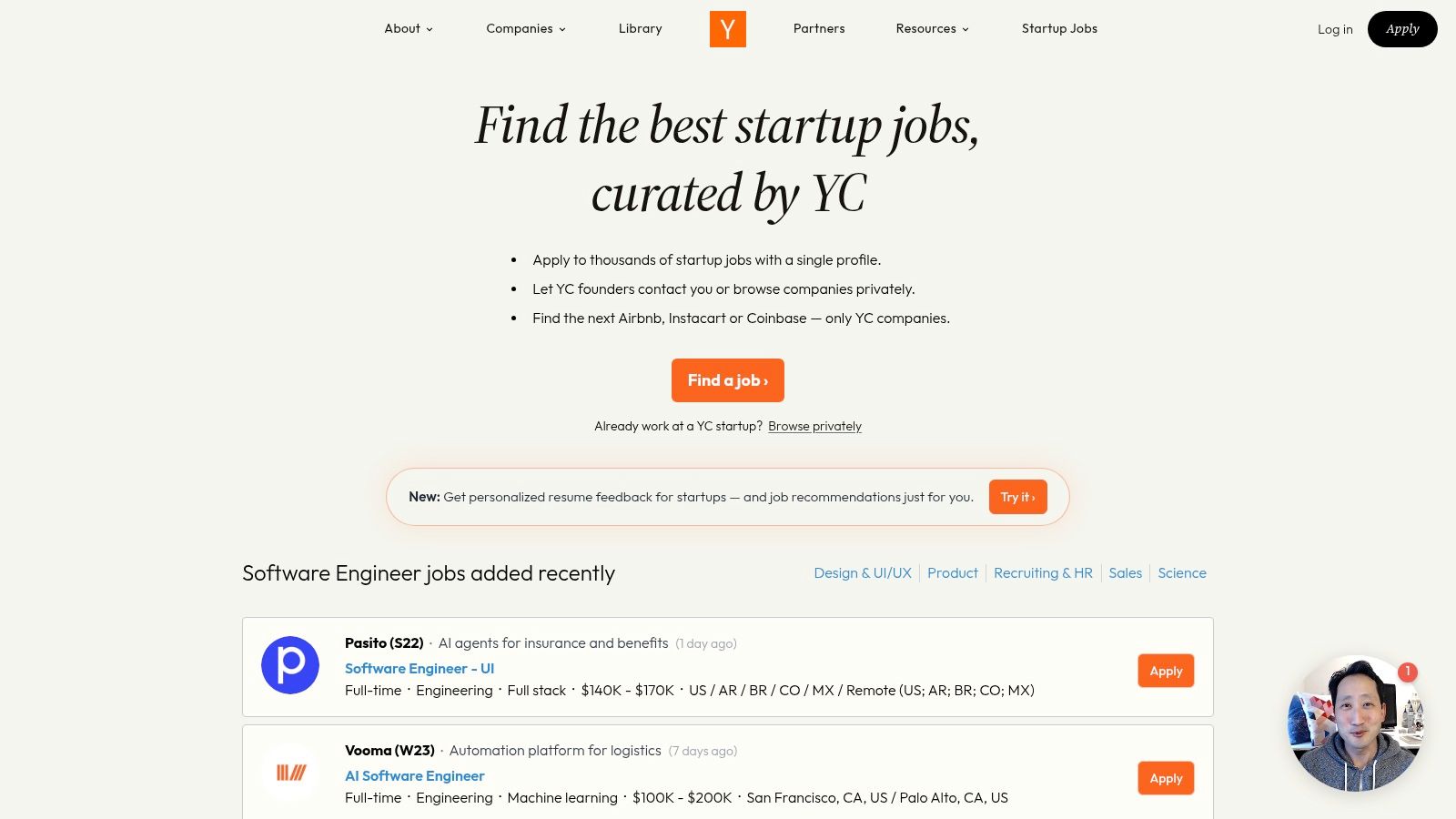
Y Combinator's remote startup jobs portal is a concentrated bet on startup density. If you want remote roles at AI-first companies where the product and the model are tightly coupled, this board is one of the fastest ways to find them.
The single-profile application flow is part of the appeal. It reduces friction when you want to test several adjacent roles across different YC companies without rebuilding your story every time. That's helpful when you're exploring where your background fits best, such as applied ML engineer versus ML infrastructure engineer versus research engineer.
Why this board is different
YC companies often hire for slope, not just polish. They want people who can learn fast, own outcomes, and operate with incomplete information. That can work well for strong practitioners whose resumes don't map neatly onto big-company ladders.
But the hiring bar is still practical. One of the most useful realities to keep in mind is that many remote ML roles now emphasize pipeline ownership, cloud platforms, governance, SQL, Spark or Kafka, and cross-functional collaboration rather than pure model building. Some listings also require fixed core hours tied to a timezone, which narrows what “remote” really means (Indeed remote ML job listings overview).
If you search YC effectively, optimize your materials for that reality. Show shipped systems. Show data reliability thinking. Show product judgment. Not just notebooks.
10. Blockchain Jobs
Blockchain Jobs earns extra attention because it solves a problem general boards don't solve well. It narrows the market to teams building in Web3, crypto infrastructure, DeFi, NFTs, security, data, and related product areas where remote hiring has been part of the culture for a long time.
If your machine learning experience overlaps with fraud detection, risk, recommendation systems, agent workflows, analytics, market data, security tooling, or autonomous operations, this niche matters. Crypto-native companies often need ML talent, but those openings can disappear inside broader engineering feeds on mainstream boards. A specialized board surfaces them faster.
Why niche focus helps serious candidates
The strongest feature here isn't just remote-friendliness. It's relevance density. You're browsing a market where employers already expect distributed teams and where category filtering makes it easier to identify companies that are aligned with your background.
The board also spans far beyond engineering. That matters if your ML work sits close to product, data, operations, security, or growth. A candidate who has built scoring systems, analytics pipelines, or LLM-enabled workflows may fit multiple paths in a Web3 company, not just a single “machine learning engineer” title.
There's also useful social proof on the platform itself. Public listings and filled-role visibility help signal that real teams are hiring and closing roles, not just posting aspirational jobs.
How to use it strategically
This is the board I'd use when I want less competition from generic applicants and more overlap with remote-native employers. It's especially strong if you can tell a coherent story about why your ML background belongs in decentralized tech.
A few ways to make that story stronger:
- Lead with adjacent business problems: Talk about prediction, anomaly detection, ranking, personalization, or agent automation in business terms.
- Translate your stack clearly: If you've done Python, data engineering, APIs, distributed systems, or cloud ML, make those links explicit.
- Show comfort with emerging domains: You don't need deep protocol experience for every role, but you do need curiosity and fast ramp-up ability.
Another advantage is search efficiency. You're not competing with every software applicant browsing a mega-board. You're moving inside a smaller, more relevant labor market.
That fits a broader hiring reality. On a major freelance marketplace, there were 1,257 open machine learning jobs and a sample of 2,080 posted ML engineer jobs, with median hourly rates of $25 to $50 per hour, showing remote ML demand extends beyond full-time employment and often rewards candidates with software engineering, data processing, and deployment strength (Upwork machine learning job marketplace). Blockchain Jobs captures a similar practical truth from the full-time and niche-employer side. Teams don't just want theoreticians. They want people who can build.
The trade-offs are straightforward. Employer pricing and some candidate-service details aren't as visible on job-listing pages as they are on large horizontal platforms. But for job seekers, that matters less than role quality and market fit. If you want remote machine learning work in crypto-native companies, this is one of the few boards that makes that search efficient instead of accidental.
Top 10 Remote Machine Learning Job Boards Comparison
| Platform | Core focus & filters | UX & quality (★) | Value & pricing (💰) | Target audience (👥) | Unique selling points (✨) |
|---|---|---|---|---|---|
| ai-jobs.net | Niche AI/ML, MLOps filters + remote toggle | ★★★★ | 💰 Free for seekers; employer-paid posts | 👥 ML/AI specialists (remote-friendly) | ✨ Salary bands, time-stamped freshness |
| We Work Remotely | Remote-only with Machine Learning category | ★★★★ | 💰 Free to apply; employer promos | 👥 Remote professionals & ML job hunters | ✨ Career services & AI Job Search tool |
| Remote OK | Remote + Machine Learning filter; sortable views | ★★★★ | 💰 Free browse; premium for early access | 👥 Remote ML seekers & power users | ✨ Sort by highest-paid / alerts |
| Wellfound (AngelList) | Startup-centric; remote + equity/comp bands | ★★★★ | 💰 Free for seekers; employer-paid listings | 👥 Startup/early-stage candidates | ✨ Equity info + “Actively Hiring” signals |
| FlexJobs | Curated, human-vetted remote & flexible roles | ★★★★ | 💰 Subscription-based (refundable trial) | 👥 Candidates seeking vetted opportunities | ✨ Scam-free vetting + Expert Apply tools |
| LinkedIn Jobs | Largest inventory; robust search & Easy Apply | ★★★★★ | 💰 Free basic; Premium upsell available | 👥 Broad professionals & recruiter-driven hires | ✨ Network effects & recruiter outreach |
| Dice | Tech-focused US board; ML/enterprise roles | ★★★½ | 💰 Free for candidates; employer tools | 👥 Enterprise tech, contractors, gov't roles | ✨ Strong employer sourcing & mobile app |
| Built In | US tech market, company profiles + comp info | ★★★★ | 💰 Free to browse/apply | 👥 US-scaleups & tech candidates | ✨ Rich company context & editorial curation |
| Y Combinator – Work at a Startup | YC portfolio jobs; filters by batch/stage/remote | ★★★★ | 💰 Free for job seekers | 👥 ML/AI candidates targeting funded startups | ✨ Single profile applies across YC companies |
| 🏆 Blockchain Jobs | Web3/DeFi/NFT niche; category-tagged + remote-friendly | ★★★★½ | 💰 Job seekers free; employer pricing via contact | 👥 Crypto-native talent & Web3 recruiters | ✨ Niche Web3 focus, “Recently Added” + “Recently Filled” feeds, targeted audience |
Your Remote ML Career Strategy Starts Now
A good remote ML search isn't about finding one perfect website. It's about building a system that matches how hiring works now.
The market is real and durable. In the UK, one 2025 industry source reports an average machine learning engineer salary of £65,000 versus £53,000 for the average UK salary in 2024, with AI engineers also averaging £65,000 and research scientist roles exceeding £85,000 in some cases. The same source says demand for machine learning professionals is expected to grow by 40% by 2027 (Firebrand's machine learning career outlook). That doesn't mean every remote role is easy to land. It means the field is established enough that strong candidates can still gain a significant advantage.
What changes outcomes is execution. Use ai-jobs.net when you want focused discovery. Use LinkedIn for coverage and recruiter visibility. Use We Work Remotely and Remote OK to stay close to distributed-first employers. Use Wellfound and YC when you want startup upside. Use Dice and Built In when your experience maps better to enterprise or scaleup environments. Use Blockchain Jobs when you want a cleaner route into Web3 and crypto-native teams.
Then do the work most candidates skip.
Your portfolio should prove production thinking. Show data ingestion, model decisions, deployment trade-offs, monitoring ideas, and business framing. A notebook with a benchmark score is rarely enough. Remote teams want evidence that you can work without constant supervision and still make good technical decisions.
Your resume should read like someone who ships. Put outcomes, system ownership, tools, and collaboration signals above generic responsibility bullets. If a role emphasizes SQL, Spark, Kafka, cloud platforms, or governance, reflect that directly. If a company is remote but timezone-bound, say so in your own planning and don't waste interview energy on roles that won't fit your life.
Your interviews need to sound operational. Talk through trade-offs. Clarify assumptions. Explain how you document work and unblock teammates asynchronously. For remote jobs machine learning, communication is part of the technical bar, not a soft extra.
One more practical point. Don't run an application marathon across ten boards every day. Pick two or three primary channels. Set alerts. Review them at the same time each day. Tailor thoroughly for the best roles. That usually beats high-volume, low-context applying.
If you also want a business-side lens on where ML skills create value, this piece on leveraging machine learning for business is a useful complement.
The next step is simple. Choose the boards that match your target market, tighten your materials around shipped work, and start applying like a specialist instead of a browser.
If you want a faster route into remote roles across crypto, DeFi, infrastructure, security, data, and AI, explore Blockchain Jobs. It's one of the most efficient ways to find remote-friendly teams that already understand distributed hiring and need candidates who can build in emerging technical markets.