
How to Land Remote Trader Jobs in 2026
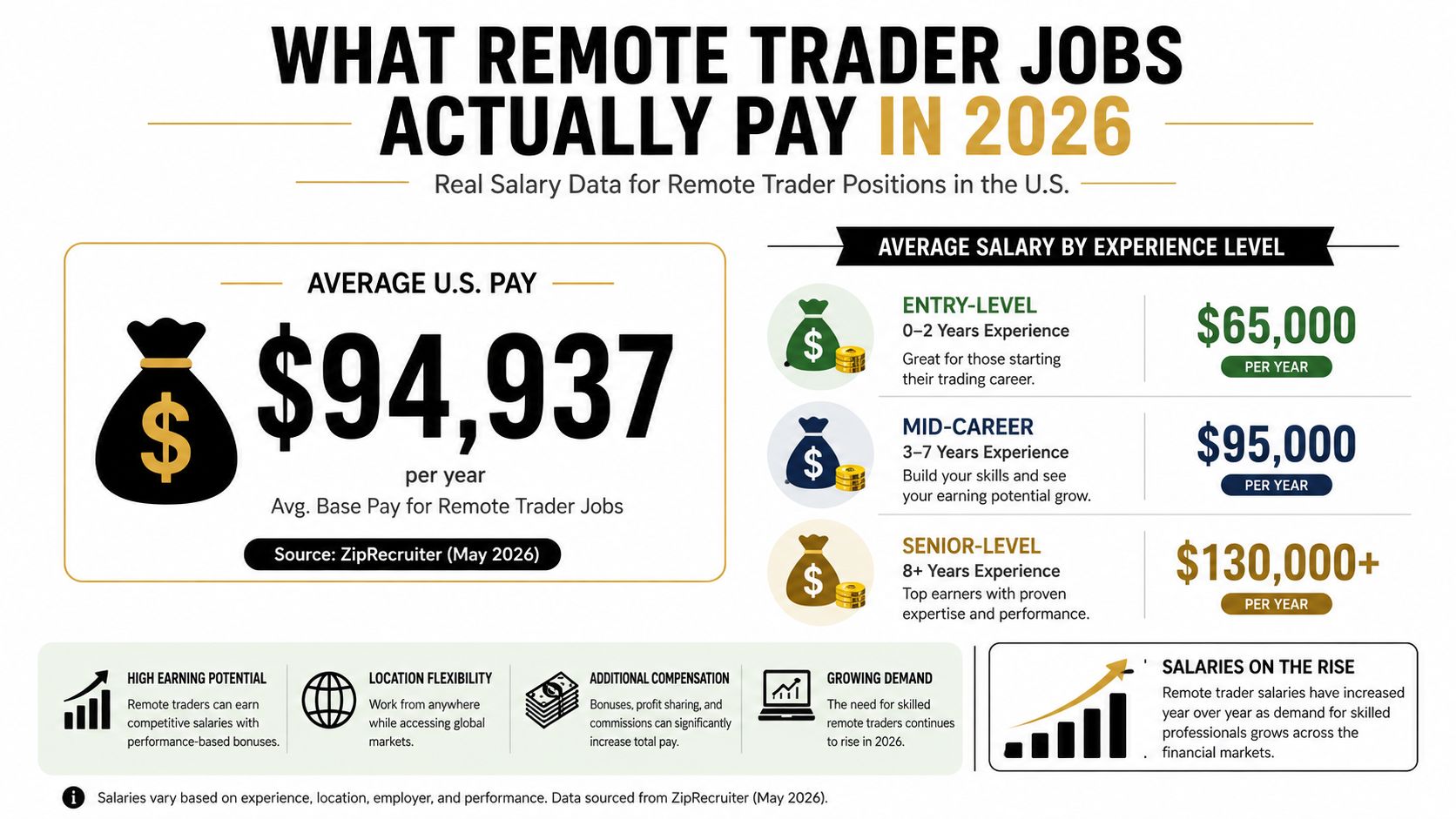
Remote trader jobs are not a casual side hustle, and the pay tells you why. ZipRecruiter shows $96,774 as the average annual pay for remote traders in the United States, with most workers landing between $56,500 and $105,500, and the wage curve skewing up to a $100.2K 75th percentile and a $76.3K median ZipRecruiter remote trader pay snapshot. That's a real hiring market, not a novelty search result.
LinkedIn's job data backs that up with 474 remote trader jobs in the United States and 2,000+ remote trading jobs in broader search results, including 1,140 remote postings ZipRecruiter remote trader pay snapshot. If you want one blunt takeaway, it's this, firms pay well because they want people who can already handle risk, execution, and judgment. Beginners who apply like this is generic remote work get ignored.
What Remote Trader Jobs Pay in 2026
The money is good because the work is unforgiving. ZipRecruiter's remote trader snapshot puts average U.S. pay at $96,774, with a range from $56,500 to $105,500, plus a $76.3K median and a $100.2K 75th percentile ZipRecruiter remote trader pay snapshot. That spread tells you exactly what hiring managers already know, remote trader jobs reward people who can produce, not people who just want flexibility.
Why the compensation is skewed upward
This isn't an entry-level market dressed up as one. The wage distribution points to experienced candidates and performance-sensitive seats, which is why strong applicants come in with domain depth, not just enthusiasm. Firms want people who understand market-making, risk, or execution well enough to work without hand-holding.
LinkedIn's listing volume also matters. Seeing 474 remote trader jobs in the U.S. and 1,140 remote postings in broader remote trading search results means this niche has enough depth to build a real pipeline, but it's still specialized enough that sloppy applications stand out fast [see source above]. Don't confuse “available” with “easy.”
Practical rule: If your background can't justify a seat at a trading desk, the market will tell you quickly. Remote trader jobs are paid like specialist roles because they are specialist roles.
How to read the market like a recruiter
Look at pay as a filter, not a promise. If a role sits well above the usual remote-job median, the employer is buying experience, speed, and judgment, not training time. That is why candidates with real trading or quantitative evidence get interviews, and generic remote-work applicants do not.
The right mindset is simple. Treat the pay band as a signal that the bar is high, then build your candidacy to match it. If you cannot explain where your edge comes from, someone else will get the call.
The Four Flavors of Remote Trading Roles
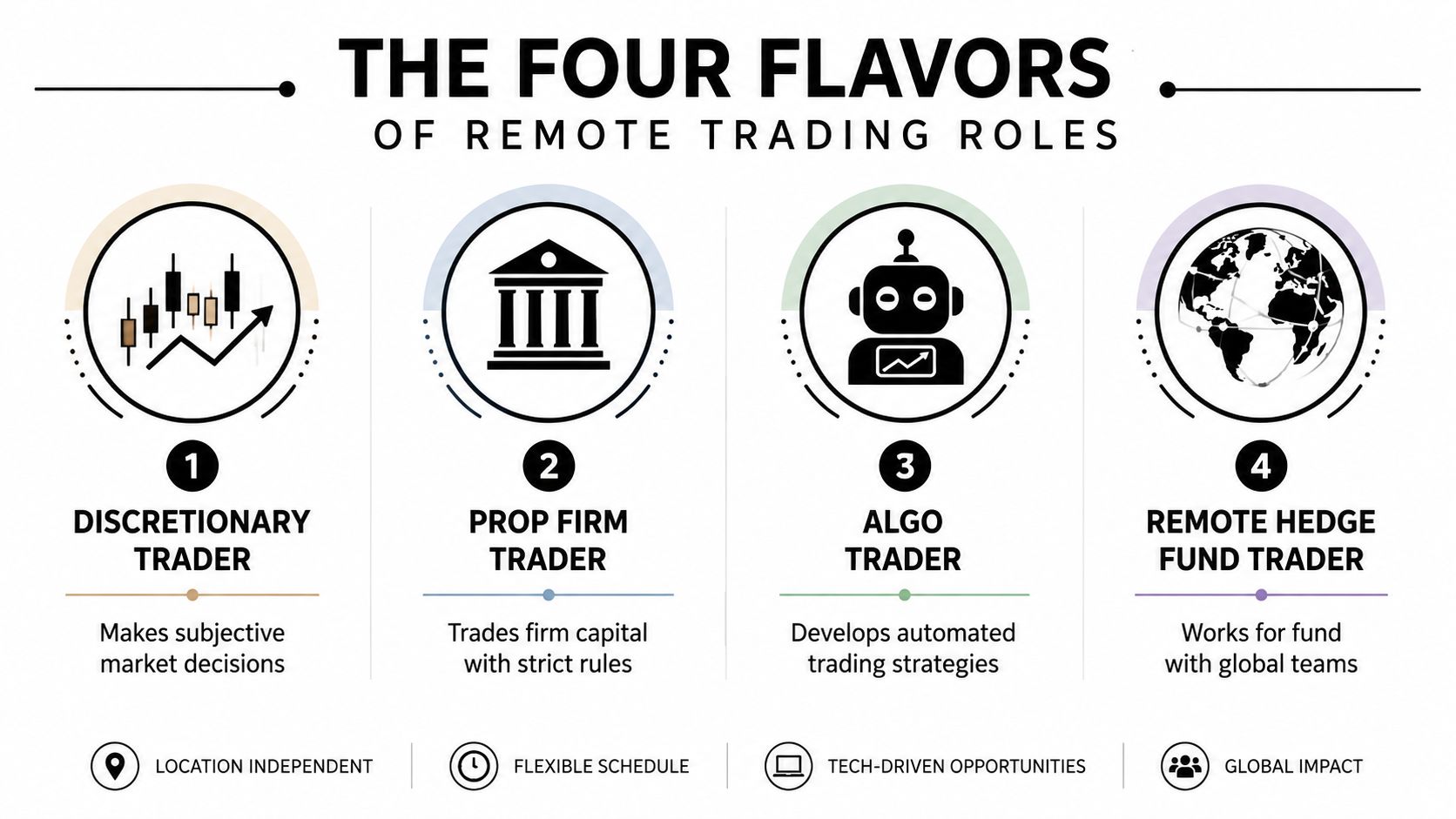
Remote trader jobs are not one thing. A discretionary trader, a prop trader, a quant, and a crypto-native trader can all be called “remote traders,” but they get hired for very different reasons and judged by different standards. If you apply to the wrong lane, your resume looks off before anyone finishes reading it.
Match the lane to the candidate
A discretionary trader usually makes subjective market decisions and may lean on pattern recognition, tape reading, or event-driven judgment. A candidate with strong instincts and a clean trade journal fits here better than someone trying to lead with code. A prop firm trader trades firm capital under strict rules, so employers care about risk control, consistency, and whether you can follow process without freelancing.
A quantitative or algorithmic trader develops automated strategies and gets screened on coding, back-testing, and reproducibility. A crypto-native Web3 trader works closer to DeFi flows, on-chain execution, or digital-asset strategy, so technical fluency matters as much as market intuition. For a current example of a digital-assets role, see this digital assets trader flow-traders listing.
| Archetype | Pay Model | Typical Employer | Best Fit For |
|---|---|---|---|
| Discretionary Trader | Base plus performance-linked comp | Small firms, boutiques, or independent setups | Traders with sharp judgment and a documented record |
| Prop Firm Trader | Firm capital, payout split, or contractor structure | Proprietary trading firms | People who can live inside rules and manage downside |
| Quant Trader | Salary plus bonus or project-based comp | Hedge funds, trading shops, systematic desks | Coders who can build and test strategies |
| Crypto-Native Trader | Salary, token-linked comp, or trading incentives | Web3 firms, crypto funds, or protocol-adjacent teams | Operators fluent in digital assets and on-chain tooling |
The fastest way to waste time is applying with the wrong self-story. If your strength is execution logic, don't pitch yourself like a discretionary chart reader. If your edge is market judgment, don't bury it under jargon you can't defend in an interview.
The job search gets easier when you choose a lane first. Then you can build the right proof for that lane instead of trying to be everything at once.
The Skill Stack Employers Screen For
Remote trader hiring is filter-heavy. Employers look for quantitative rigor first, then coding ability, then enough market judgment to handle execution and risk without hand-holding. If one layer is thin, the application usually stops there.
Start with rigor, then add code
For quantitative or algorithmic seats, the baseline is a STEM or similarly rigorous degree, such as computer science, mathematics, physics, engineering, or quantitative finance Indeed remote day trader jobs. Python is the floor. Lower-level languages like C++, Rust, or Julia show up in harder low-latency roles, and postings often ask for back-testing, large-dataset processing, and market microstructure work. That tells you the workflow is a research-to-execution pipeline, not a chart-watching hobby.
If your day is split across analysis, strategy iteration, and market monitoring, protect it like a trading book. Remote traders who need real focus should use routines that improve deep work for remote employees, because distraction cuts straight into judgment and execution quality.
Know the experience thresholds before you apply
A lot of candidates apply too early. Current listings show employers asking for 5+ years in high-volume trading, 3+ years in financial-services or wealth-management operations, or at least 2 years in options or currency trading. Some quantitative roles also want 20–30 hours weekly of synchronous collaboration, which means “remote” does not always mean fully asynchronous.
The failure modes are obvious once you've read enough postings. Weak programming fluency gets rejected. Poor data-validation discipline gets rejected. Thin risk intuition gets rejected. If you cannot explain your process to both technical and non-technical people, a stronger candidate will beat you.
A strong remote trader candidate does not just say “I trade.” They show they can code, validate, explain, and stand up to a real review of their decisions.
Building a Verifiable Trading Portfolio
Resumes don't close remote trader jobs. Proof does. Hiring managers want something they can inspect, compare, and trust, which means your portfolio has to survive skepticism from the first five minutes of review.
Build evidence, not just claims
Start with a public PnL trail where possible. Broker exports, exchange records, or screenshots can work if they're organized and consistent. If you're a discretionary trader, keep a trade journal that captures entry, exit, thesis, size, and what changed your mind. If you're systematic, use version-controlled code and make your back-tests reproducible.
A short research notebook helps a lot. Put the hypothesis, the data source, the test window, and the result in plain English. Then add a one-page summary that a recruiter can skim without opening ten files. The summary should show what you trade, how you make decisions, and what kind of risk profile you've handled.
Show honesty around drawdowns
Don't hide the ugly periods. Hiring teams know every real trader has them, and a polished portfolio with no losses looks fake. A clean explanation of a drawdown, followed by what you changed, looks much better than a suspiciously perfect curve.
Keep the archive tight. A few strong artifacts beat a bloated folder full of noise. If your portfolio can't be read in a minute, it won't be read at all.
Practical rule: Make the portfolio auditable first and impressive second. Remote desks trust evidence they can verify, not stories they have to decode.
Where Remote Trader Jobs Get Posted
Remote trader roles are not hidden, they are scattered. Hiring flow comes through a mix of dedicated job searches, niche finance boards, prop firm career pages, and Web3-native listings. If you want interviews, you need a sourcing system, not a single tab you refresh once a day.
Use channels that surface openings
LinkedIn still matters because it surfaces remote trader listings and broader remote trading searches fast. Specialized finance boards and prop firm career pages often post harder-to-find roles before the aggregators catch up. For Web3-facing seats, Blockchain Jobs is one practical source because it pulls together crypto and blockchain roles across finance, data, and trading-adjacent categories, including remote jobs.
For a broader search routine, remote job search channels to try is a useful reference if you want to compare boards, alerts, and community sourcing without wasting time on dead feeds.
A concrete crypto trading posting also helps calibrate what serious desks publish. this crypto trader role at Jump Trading is the kind of listing that rewards precision, not broad claims.
Build a weekly sourcing routine
Use three saved searches, two community check-ins, and one direct outreach action each week. Cover broad remote trading terms, niche asset-class terms, and crypto or quant variants in those saved searches. Community check-ins can be Discords or Telegram groups tied to desks, funds, or research communities. The direct outreach should go to a hiring manager, trader, or recruiter with a short note and a proof point, not a generic “open to work” message.
Keep your materials aligned with how desks review candidates. A strong headline names your strategy focus and asset class. The experience block should foreground metrics like Sharpe, drawdown, AUM, or execution quality when you can substantiate them. Your skills section should name real tools and methods, not soft phrases.
Treat applications like screening documents
Cover letters should be three sentences, not three paragraphs. State fit, state proof, state why this desk. If you can add a short Loom walking through a back-test or a one-page teardown of the firm's public trade style, that helps more than another generic paragraph.
Operational readiness gets checked more often than applicants expect. Stable internet, time-zone overlap, and basic setup discipline matter because remote desks do not want avoidable friction. A lot of good traders lose out because their application looks careless before the trading discussion even starts.
Acing the Remote Trader Interview Loop
Remote trader interviews usually follow a familiar pattern, and the candidates who get offers prepare for each round differently. A recruiter screens for availability, work authorization, and risk tolerance. A hiring manager probes strategy and process. A technical round tests your thinking with a case or back-test. A behavioral round checks whether you can handle drawdowns, communication, and pressure without spiraling.
Prepare for the rounds like a desk would
In the recruiter screen, be direct about your trading lane, your availability, and your tech setup. If a role needs regulatory steps, say whether you already have them or how fast you can get them. If you're applying for a discretionary seat, you need a crisp explanation of what you trade and why you think you have an edge.
The technical round is where a lot of people get exposed. Reproducibility matters more than flashy returns. Risk-adjusted thinking matters more than lucky upside. Code quality and a clear write-up usually separate the serious candidates from the people who can only talk.
Bring the numbers you can defend, then explain the process behind them. That's what most interviewers actually want.
Know the legal and regulatory gate
Some roles don't let you start until licensing and paperwork are complete. A remote trader role at T3 Trading Group says securities traders must pass the Securities Industry Essentials (SIE) and Series 57 exams to obtain Securities Trader Representative registration, and candidates also complete FINRA paperwork and background checks T3 Trading Group remote trader role. That means the hire can depend on regulatory qualification as much as trading skill.
For prop-style roles, contract structure also matters. One remote trader listing in Australia uses Independent Contractor (1099) status and requires 2+ years of trading or investment-management experience, plus a stable computer setup and reliable high-speed internet Australian remote trader listing. If you miss the operational details, you'll look careless.
Crypto-native roles add another layer. KYC and AML paperwork are common, and some desks will want to understand your source of funds, device hygiene, or wallet workflow before you start. If you're outside the firm's home jurisdiction, expect tax and compliance questions too.
Rehearse the way you'll perform
Don't memorize canned answers. Rehearse a short explanation of your trading process, one example of a bad drawdown, and one example of a change you made after a loss. If they ask for a case study, walk through your assumptions calmly and show how you'd validate them, not just what you think the market will do.
The best candidates sound prepared without sounding scripted. They know their process, they know their limits, and they don't pretend every trade was a masterpiece.
Your 90-Day Plan to Land a Remote Trader Job
The next 90 days should be run like a project, not a wish list. Candidates who land remote trader jobs usually move in phases, close gaps fast, and stop pretending they need another month of “research.” The ones who keep browsing listings usually never convert.
Weeks 1 to 2
Audit your target lane and your gaps. Decide whether you're aiming at discretionary, prop, quant, or crypto-native roles. Then clean up the evidence you already have, choose the strongest trading artifacts, and identify the one skill that would most improve your interview odds.
If your prep path needs structured learning, learn how to trade only helps if you use it to sharpen a specific gap, not to wander through generic content. Pick one market, one toolkit, one proof point.
Weeks 3 to 4
Build the portfolio packet. Make the one-page summary, add supporting notes, and prepare a short version for recruiters and a deeper version for hiring managers. Ask two people who know your work to be references, and make sure they're ready to speak to process, not just personality.
Weeks 5 to 8
Start active sourcing and applications. Run the saved searches, reach out directly, and tailor every submission to the desk. If a role needs code, send code. If it needs regulatory readiness, say where you are in that process. If it needs evidence of discipline, include it.
Weeks 9 to 12
Interview hard. Practice the case studies, rehearse the behavioral stories, and prepare your negotiation notes in advance. Have your operational setup ready too, meaning reliable internet, backup power, and the compliance documents a desk might ask for on day one.
The shift is simple. Stop asking whether remote trader jobs are real, and start proving you're already operating at the level they need.
Blockchain Jobs connects candidates with remote-friendly roles across Web3, finance, data, and compliance, which makes it a practical place to watch if you're targeting trading-adjacent seats in crypto and blockchain. If you're serious about landing a remote trading role, start by comparing live listings and then apply with a tighter story at Blockchain Jobs.