
Salary of Content Writer: 2026 Web3 Earnings & Outlook

U.S. content writer pay spans from modest generalist salaries to six-figure specialist roles. That spread matters more than any single average because employers pay for business impact, not for filling a content calendar.
From the hiring side, the clearest salary multiplier is technical fluency. A writer who can interview a founder, polish a blog post, and hit deadlines is useful. A writer who can explain staking mechanics, wallet security, governance changes, or protocol design to users, investors, and internal teams commands a different budget because the candidate pool is much smaller.
Web3 makes that gap wider. Teams regularly pay more for writers who can read docs, ask sharp product questions, catch vague claims before legal does, and turn complex systems into clear language without flattening the nuance. That combination raises pay because it lowers risk, shortens review cycles, and improves conversion across education, onboarding, and trust-building content.
That is also why salary alone is an incomplete way to judge an offer. Benely's guide on compensation is a useful reference for evaluating the full package, including equity, bonus structure, benefits, and remote terms. Writers aiming for the top tier should assess all of it, especially in startup and Web3 roles where base salary is only part of the value.
Understanding the Content Writer Salary Spectrum
The salary of content writer roles spans a wide range because employers aren't buying word count. They're buying judgment, domain fluency, and execution under business constraints. The writer who summarizes a product launch for a lifestyle brand is in a different market from the writer who explains validator incentives or drafts investor-facing protocol education.
That difference shows up fast in hiring conversations. Early-career writers usually compete on effort and versatility. Senior writers compete on clarity, speed, subject expertise, and whether they can work with product, legal, growth, and founder teams without constant hand-holding.
Why one average salary is misleading
Averages help with orientation, but they don't help much with career decisions. A junior writer asking, "What does a content writer make?" usually wants a benchmark. A hiring manager asks a more useful question: "What kind of content writer are we trying to hire?"
Those are not the same thing.
If your work sits in broad editorial or low-complexity SEO content, pay usually tracks generalist market rates. If your work sits closer to revenue, product education, onboarding, developer documentation, regulated topics, or technical storytelling, pay moves higher because fewer candidates can do it well.
Practical rule: The closer your writing is to product comprehension, trust, and conversion, the stronger your salary leverage becomes.
What hiring managers actually screen for
In interviews, I don't look first at how polished a headline sounds. I look for signs that the writer can operate inside a complex business.
That usually means:
- Technical comprehension: Can you understand enough of the product to explain it accurately?
- Editorial judgment: Can you decide what matters, what confuses users, and what should be cut?
- Stakeholder management: Can you handle revisions from founders, PMs, marketers, and legal reviewers?
- Proof of execution: Can you show published work that solved a real communication problem?
Writers who improve those four areas stop being interchangeable. That's the first step toward the upper tier of the market.
Content Writer Salary Benchmarks in 2026
The gap between an average content writer and a top-paid specialist is wide. In hiring, I see the same title cover blog production, product marketing, documentation, founder ghostwriting, and technical education. Those jobs do not pay on the same curve.
For a grounded baseline, use broad U.S. market benchmarks as a starting point, not a target. As noted earlier, average pay for content writers sits around the high five figures, with entry-level writers usually landing lower and experienced writers with stronger ownership earning much more. The significant split happens when a writer adds technical range, industry context, and the ability to publish without constant correction.
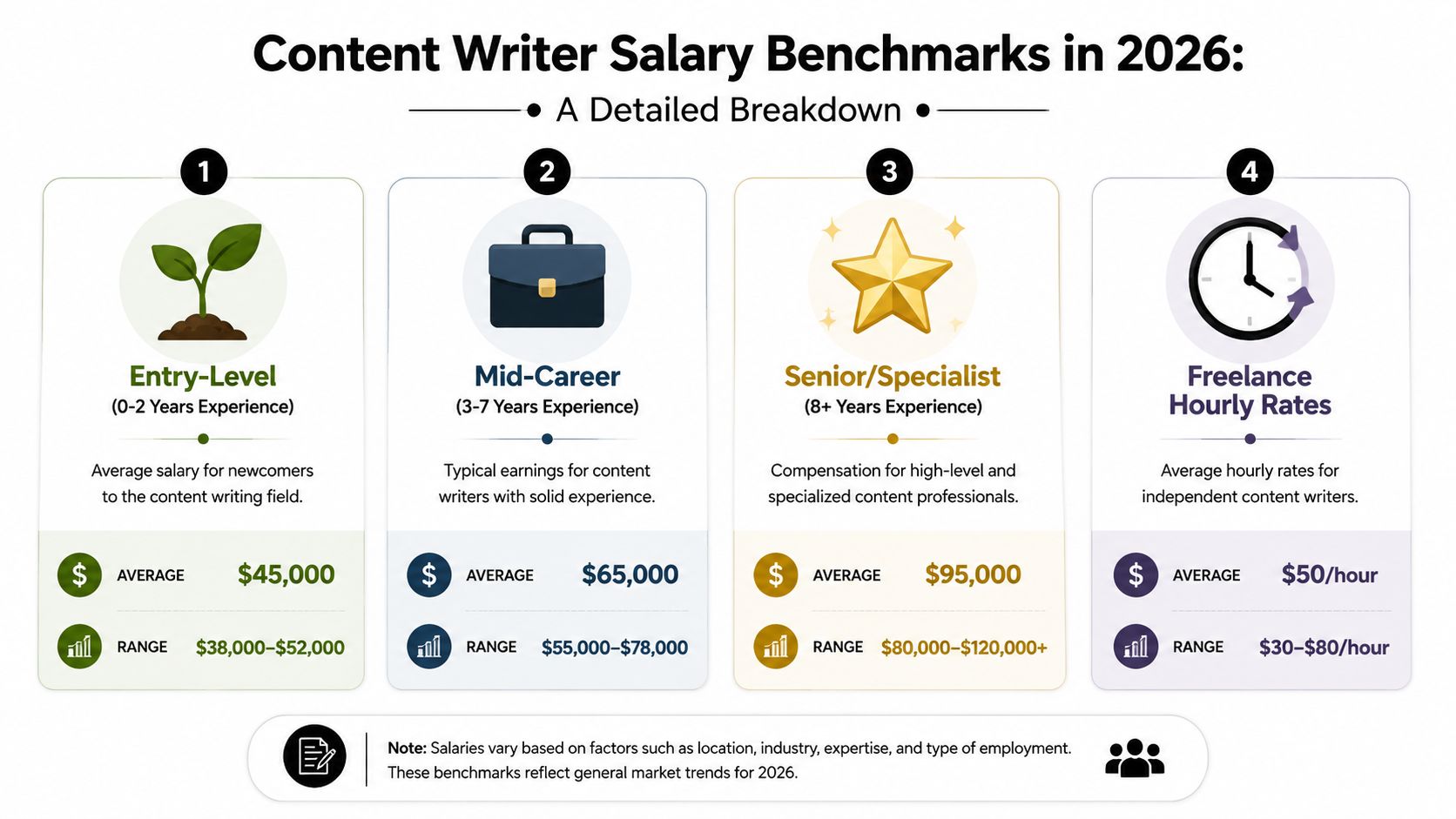
Salary bands by experience
Experience still matters. Salary follows capability more than tenure.
| Experience level | Typical benchmark |
|---|---|
| Less than 1 year | Early-career band, usually lowest salary range |
| 1 to 4 years | Mid-level band, higher pay if portfolio shows ownership |
| 5 to 10 years | Senior band, often much higher for specialist work |
| U.S. average across content writers | Broad baseline, useful for orientation only |
That table is useful for one reason. It stops writers from treating "content writer" as a single market.
A generalist with three years of SEO blog experience may sit in the middle band. A Web3 writer with the same tenure, but with published protocol explainers, tokenomics content, product onboarding flows, and founder-facing thought leadership, can price far above it. That is the technical multiplier. The writing skill matters, but technical fluency changes what companies trust you to handle.
What these numbers mean in interviews
Candidates lose money in predictable ways.
Some anchor on the national average and underprice themselves, even though their portfolio shows specialist value. Others ask for senior compensation with samples that still read like supervised content. Hiring teams notice the difference quickly.
In interviews, strong salary cases come from proof. Show that you can explain a wallet flow correctly, turn product complexity into clear user education, interview technical stakeholders without getting lost, and write copy that supports adoption or trust. In Web3, that standard gets stricter because weak content creates confusion fast. If a writer cannot explain staking, bridging, governance, custody, or onchain product flows accurately, the company usually needs another review layer. That lowers what the role is worth.
Writers in the top tier reduce review time. They do not just produce drafts.
Where the market gets more specific
Salary surveys flatten the category. Live job posts show how employers scope the role.
Reviewing content writing roles in blockchain makes the differences obvious. Some companies want article volume. Others want someone who can write token launch education, ecosystem pages, exchange listings content, knowledge base articles, email sequences, and founder ghostwriting, all with technical accuracy. The second group usually pays for judgment, not just output.
Freelancers should benchmark this another way. Convert project fees into an hourly floor before accepting work, especially if research and stakeholder review are heavy. TimeTackle's hourly rate guide is a useful way to sanity-check whether a flat content rate still makes sense after revisions, interviews, and admin time.
The practical takeaway is simple. If you want to move toward the top 10% of content writer earnings, stop benchmarking yourself only against other writers. Benchmark against the business problems you can solve without hand-holding.
Key Factors That Influence Your Pay
The salary of content writer roles changes most when one of four levers shifts: location, work model, industry, and skill depth. Writers who understand those levers make better career decisions. Hiring managers who understand them avoid under-scoping the role and losing strong candidates.

Location still matters
Global comparisons make this obvious. The U.S. average is around $58,858, Canada's average is CAD $45,692, and India's early-career average is around INR 2.9 LPA. Remote writers in the U.S. average $65,000, according to Simplilearn's cross-market content writer salary overview.
A lot of candidates assume remote work erases geography. It doesn't. It changes the equation, but companies still benchmark pay in different ways. Some pay by headquarters market. Some pay by role value. Others use hybrid geographic bands.
If you're evaluating a remote offer, ask how the company calibrates compensation. Don't assume a remote title means top-market pay.
Employment model changes the math
Full-time salary and freelance rate aren't interchangeable. A contractor has to cover unpaid admin time, pipeline risk, taxes, and gaps between projects. That's why rate setting needs discipline, not guesswork.
If you're moving from full-time work into contract roles, TimeTackle's hourly rate guide is a useful resource for translating annual income goals into a working rate that reflects real workload and overhead.
For hiring teams, the trade-off is simple:
- Full-time hires work best when you need ongoing product knowledge, faster iteration, and close collaboration.
- Freelancers work best for campaigns, launch support, editorial overflow, or specialist assignments.
- Contract-to-hire roles help when a company needs output now but hasn't finalized long-term headcount.
A live example of that hybrid model is a content designer contract role at Binance, where the title itself signals that the company values structured content work but may not need a permanent hire yet.
Industry and specialization drive the biggest jumps
Many writers undersell themselves because, while "content writer" sounds broad, the market doesn't pay every vertical equally. Finance, developer tools, crypto, AI, and regulated industries often pay more because accuracy matters and candidate supply is thinner.
If a company needs a writer who can publish without creating legal risk, confusing users, or misrepresenting the product, it will pay more for that reliability.
The practical takeaway is simple. If you want to raise your ceiling, don't just improve your writing. Improve the business context in which you write.
The Web3 Premium Unlocking Higher Earnings
Web3 content salaries separate faster than many writers expect. General content roles cluster around broad marketing execution. In blockchain, pay rises when a writer can explain technical systems clearly enough for users, developers, compliance reviewers, and internal teams to trust the copy.
I see this in hiring loops constantly. Strong candidates do not just write clean sentences. They reduce product risk. A writer who understands wallet flows, token utility, governance mechanics, validator behavior, bridge risks, or smart contract constraints can save hours of review time and prevent expensive messaging mistakes. That is the technical multiplier. Better technical judgment improves the content itself and raises its value across product, support, growth, and community.
Why Web3 companies pay more
The premium comes from scarcity and consequence.
A generalist can draft a blog post about industry news. A strong Web3 specialist can read product docs, question vague claims, catch inconsistent terminology, and publish copy that does not confuse users or create trust issues. That difference matters more in crypto than in many other sectors because the products are harder to explain and the cost of imprecise language is higher.
Hiring teams usually pay more for writers who can handle work such as:
- Protocol and product interpretation: reading technical source material and turning it into accurate education, release notes, onboarding copy, or feature explainers
- Risk-aware messaging: writing clearly about rewards, fees, security, and limitations without drifting into hype
- Audience switching: adjusting the same product story for retail users, developers, ecosystem partners, and token holders
- Cross-functional execution: working with product, legal, design, support, and growth teams without needing every sentence rewritten
This is why broad "crypto content" samples often underperform in interviews. Market commentary is easy to produce. Clear product communication is harder, and companies pay for the harder skill.
Where the premium actually comes from
The highest-paid writers in Web3 usually sit closer to technical complexity, not farther from it.
That does not mean every writer needs to become an engineer. It means the market rewards writers who can absorb technical context fast enough to produce useful assets without introducing confusion. In practice, the jump in earning power often happens when a writer moves from general blog production into one or more of these lanes:
| Higher-value Web3 lane | What companies expect |
|---|---|
| Product education | Feature explainers, onboarding flows, help content, release notes |
| Technical content | Docs support, architecture explainers, API or infrastructure messaging |
| Content design | UX copy for wallets, dashboards, staking flows, permissions, errors |
| Editorial strategy | Messaging systems, governance content, launch planning, review workflows |
The trade-off is straightforward. Specialization narrows the number of roles you fit on paper, but it raises your value in the roles that do fit. That is how writers move toward the top 10% of earners instead of competing in the crowded middle.
You can see that progression in senior openings such as this copywriting lead role at Bybit, where the scope goes beyond writing into strategic messaging, team coordination, and crypto-native judgment.
How a generalist writer becomes a high-earning Web3 specialist
Writers usually make this transition in the wrong order. They chase the niche label first and the technical depth second. Hiring managers can spot that quickly.
A better path looks like this:
- Pick one product category. Wallets, DeFi, infrastructure, exchanges, analytics, gaming, or payments. Depth beats surface-level familiarity with every sub-sector.
- Study the underlying mechanics. Read docs, product pages, support centers, governance forums, changelogs, and user complaints. Learn how the product works.
- Build conversion samples, not opinion pieces. Rewrite a confusing onboarding flow. Draft a help article. Create a plain-English feature explainer from technical notes.
- Show precision. Define terms consistently. Distinguish custody from non-custody, APR from APY, bridging from swapping, governance from utility.
- Work faster without lowering accuracy. Tools like HyperWhisper and other dictation options can help experienced writers increase output during research-heavy drafting, but speed only helps if the underlying thinking is solid.
One strong portfolio piece in a hard category often beats five generic crypto blogs.
What gets candidates into the top salary band
The top tier usually combines writing skill with technical confidence and business judgment. In hiring, the strongest candidates tend to show four things at once:
- They can read a product spec and ask smart follow-up questions.
- They can simplify complex mechanics without introducing errors.
- They understand where compliance, trust, and user confusion affect conversion.
- They can connect content output to product adoption, retention, or support volume.
That combination is rare. It is also paid accordingly.
If your goal is to raise the salary of content writer roles available to you, Web3 is not attractive because it is trendy. It pays more when you become the writer who can handle technical complexity without losing clarity. That is the premium.
Your Roadmap to a Six-Figure Content Career
The market has become less forgiving for generalists and more rewarding for specialists. While the median content marketing income fell almost 5% to $100,000 in 2025, the average full-time content marketer still earned $113,276. At the top end, Senior Content Designers at firms like Google see compensation packages from $260,000 to $310,000, according to Superpath's content marketing salary report.
That split matters. It tells you that career growth in content isn't passive anymore. Writers who stay broad compete in crowded pools. Writers who build rare skills move into roles with stronger pay and better negotiating power.

Step one through three
The path usually starts with a correction in focus.
- Master fundamentals first. Clean writing, strong structure, and reliable research still matter. If your copy needs heavy editing, specialization won't save you.
- Pick a market with complexity. Web3, UX, developer tools, AI, fintech, and regulated products are stronger bets than broad lifestyle content.
- Build a portfolio around business problems. Show onboarding content, product explainers, docs rewrites, email sequences for launches, and thought leadership tied to a real audience.
A portfolio should answer a hiring manager's silent question: can this person handle the kind of confusion our users have?
Step four and five
The middle stage is where many good writers stall. They keep producing content, but they don't improve their operating range.
Strong portfolios don't just show polish. They show that you can think like product, support, marketing, and user education at the same time.
To move up:
- Develop technical literacy. Learn Markdown, GitHub workflows, basic analytics reading, and how product teams document features.
- Get comfortable with tools that increase throughput. Writers who can research well, edit quickly, and document consistently are easier to justify at higher salary bands.
If dictation helps you draft faster or reduce friction in long-form work, HyperWhisper and other dictation options are worth evaluating alongside your usual stack of Google Docs, Notion, Grammarly, and CMS workflows.
A practical overview of the progression looks like this:
Step six and the interview piece
Salary growth often gets won in interviews, not just portfolios. Candidates who command more pay usually speak clearly about scope. They know whether they're applying as a production writer, content strategist, technical writer, or content designer. They don't blur all those roles together.
When you negotiate, focus on business value instead of personal need. Explain how your background reduces ramp time, improves product understanding, or raises the quality of technically sensitive content. That's a stronger argument than saying you want more because you've been writing for years.
What doesn't work is trying to leap to six figures with a generic portfolio and vague positioning. What does work is narrowing your niche, deepening technical literacy, and proving you can solve expensive communication problems.
Frequently Asked Questions About Content Writer Salaries
Does a portfolio matter more than a degree
Yes, in most cases.
A degree can help with HR screening, especially at larger companies. The portfolio is what gets a writer hired. I look for proof that a candidate can explain a product clearly, handle technical nuance, and match the level of sophistication the audience expects. In Web3, one strong sample on wallets, staking, token mechanics, or protocol risk usually carries more weight than a generic marketing portfolio with no subject depth.
What tools or software skills increase pay
The highest-paid writers are rarely just good on the page. They work faster, make fewer factual mistakes, and need less hand-holding because they understand the systems around the writing.
In Web3, that usually means comfort with Markdown, GitHub, CMS publishing, analytics dashboards, documentation workflows, and collaboration tools such as Notion and Google Docs. SQL, product analytics, on-chain research habits, and the ability to read basic protocol docs can push pay higher because those skills multiply output. That technical multiplier is what separates a general content writer from a specialist a team can trust with expensive, high-context work.
How much can crypto writers earn per hour
For Crypto Writers in the United States, average hourly pay is $38.94 as of mid-2026, with most earning between $28.85 and $47.12, based on ZipRecruiter's crypto writer pay data.
That range is useful, but it hides the split in the market. Writers at the low end usually handle general blog production. Writers at the high end bring subject knowledge, can interview founders or engineers, and can turn technical input into content that is accurate enough to publish without heavy rewrites.
Is remote work better for salary growth
Sometimes. Remote work gives writers access to better-paying companies, especially in crypto, but remote by itself does not raise compensation.
Higher remote salaries usually go to writers who are easy to manage across time zones, can work from messy product inputs, and can publish without constant editorial rescue. The market pays for independence. It also pays for specialization.
Is AI lowering content writer salaries
AI is putting pressure on low-trust, low-context writing. That part of the market was already crowded.
The safer end of the salary spectrum is work where mistakes are expensive. Web3 teams still need writers who can verify claims, interview subject-matter experts, spot contradictions in source material, and explain technical products without sounding inaccurate or promotional. AI can speed up drafts. It does not replace judgment.
What's the fastest way to level up
Generalist writing is the slow route to top-tier pay. Specialization gets you there faster.
For Web3 writers, the practical path is clear. Learn the basics of wallets, exchanges, smart contracts, governance, tokenomics, and on-chain user behavior. Build three to five samples that show technical clarity, not just style. Then position yourself for roles tied to product education, documentation support, founder ghostwriting, research-led content, or onboarding flows. Those are the assignments that tend to move a writer from average market rates into the top earning tier.
If you're hiring or looking for your next role in crypto, Blockchain Jobs is one of the best places to find focused Web3 content opportunities without sorting through generic listings. It's especially useful for writers who want roles closer to product, protocol education, and high-context technical storytelling.