Understanding Virtual Machines: A 2026 Guide for Blockchain
You're in a system-design interview, and the question lands cleanly: design infrastructure for a validator fleet, explain how you'd isolate workloads, and justify why you'd choose one virtualization approach over another. A lot of candidates can define a VM. Fewer can explain what that choice means for uptime, kernel control, migration, or the way a hiring manager evaluates trade-offs on a real production team.
That's why understanding virtual machines still matters in Web3. VM knowledge shows up in DevOps, infrastructure, protocol engineering, SRE, and security work because these teams live inside the decisions that determine whether a node boots cleanly, survives upgrades, and stays manageable under load. The market has also made the point for us. One estimate puts the global virtual machine market at USD 11.86 billion in 2024, up from USD 7.2 billion in 2018, with a projection of USD 35.52 billion by 2032 at a 14.8% CAGR Credence Research. Another estimate places it at USD 9.71 billion in 2022, growing to USD 30.12 billion by 2030 at 15.1% CAGR Credence Research. Those numbers don't describe a niche skill. They describe a core layer of enterprise infrastructure.
Why Virtual Machines Matter to Your Web3 Career
A candidate once tried to answer a validator-fleet design question by talking only about Docker, CI, and autoscaling groups. The interviewer kept pushing on the harder part. What happens when a client needs a different kernel, when you need stronger isolation for an untrusted testnet, or when a hot migration is safer than a rebuild? The room went quiet because the candidate knew the tooling names but not the operating model.
That gap is exactly why VMs keep showing up in hiring loops. A DevOps engineer gets asked how to provision and migrate nodes. A protocol engineer gets asked how to reproduce a client bug without polluting a laptop. An SRE gets asked how to balance isolation, cost, and recovery. A security engineer gets asked where VM isolation helps and where it doesn't. Those aren't trivia questions. They're signals that the interviewer wants someone who can keep production stable while the stack shifts under them.
Practical rule: if you can't explain why the host, hypervisor, guest OS, and workload boundaries matter, you'll struggle in any interview that includes cloud or infra design.
Career progression follows the same pattern. Early-stage roles often test whether you know what a VM is. Mid-level roles test whether you can run one safely. Senior roles test whether you can choose between VMs, containers, and bare metal without hand-waving. That's especially true in Web3, where the difference between a clean rollback and a messy recovery can decide whether a team ships an upgrade on time.
If you're scanning roles and trying to map your current skill level to what teams hire for, start with the job descriptions and the language they use on Blockchain Jobs. The technical terms are usually the tell. Once you can read those terms confidently, you can answer interview questions with the kind of precision that hiring managers notice.
The Core Concepts Behind Understanding Virtual Machines
Think of one physical server as an apartment building. The hypervisor is the landlord. Each virtual machine is an apartment with its own walls, plumbing, and meter, even though all of them sit inside the same structure. That's the mental model that keeps the rest of the topic straight.
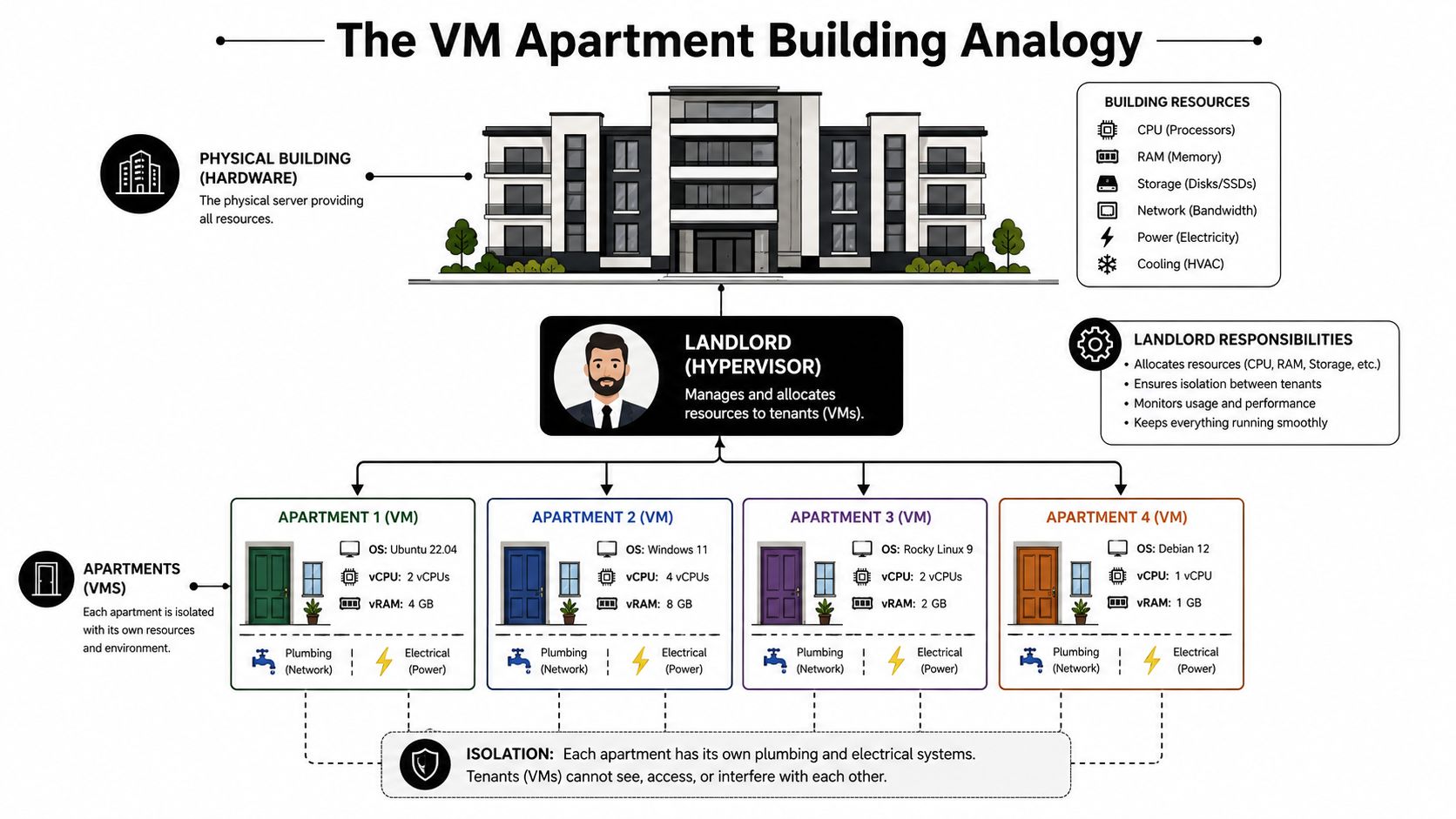
A VM is an isolated computing environment with its own virtual CPU, virtual memory, virtual disk, and virtual NIC. That means it can run a separate guest OS and behave like a software-defined machine, not just a process inside another OS AWS. IBM's virtualization model describes the same idea at the hardware level, one system's processors, memory, networks, and storage are divided into multiple VMs that behave like separate computers IBM. Cisco also frames the value plainly, VMs raise server utilization by letting more applications run per server Cisco.
What that means in practice
A guest OS matters because many workloads need their own kernel behavior, patch cadence, or library stack. If you're running multiple blockchain clients on one host, you need to know whether they're sharing the same OS boundary or each living inside its own one. That's a real DevOps and protocol-development question, not an abstract architecture quiz.
A virtual CPU and virtual memory are the pieces interviewers expect you to connect to scheduling and capacity. A virtual disk is what makes snapshots, rollback, and image-based provisioning possible. A virtual NIC is why network segmentation and service isolation can be handled at the machine boundary instead of only inside the application.
For a business-facing explanation of why this matters, the article on virtualization benefits for businesses is a useful companion read because it ties the technical model to consolidation and operational control. That's the same language teams use when they justify infrastructure spend.
A VM is useful because it gives you a machine-shaped boundary you can automate, move, snapshot, and retire without treating every workload like a snowflake.
If you can say that clearly in an interview, you're already ahead of most candidates who only know the term from cloud dashboards.
Type 1 and Type 2 Hypervisors and Why Interviewers Ask About Them
The easiest way to separate the two is by placement. A Type 1 hypervisor runs directly on bare metal. A Type 2 hypervisor runs on top of a host operating system. That architectural split affects density, latency, isolation, and the kinds of machines teams are comfortable using in production IBM.
A bare-metal hypervisor is what cloud and infrastructure people usually care about. It's the design behind production servers, clustered hosts, and environments where you want the hypervisor to schedule CPU time and allocate memory, storage, and network resources with as little extra stack as possible IBM. The hosted model is more common on a laptop or test machine, where the goal is convenience rather than maximum consolidation.
| Characteristic | Type 1 (Bare-Metal) | Type 2 (Hosted) |
|---|---|---|
| Placement | Runs directly on hardware | Runs on top of a host OS |
| Typical use | Production servers, cloud hosts | Developer laptops, local labs |
| Operational focus | Density, isolation, latency | Convenience, portability |
| Interview signal | Cloud and infra fluency | Local testing familiarity |
Tools and where they fit
VMware ESXi, Microsoft Hyper-V, and KVM fit the bare-metal world. VirtualBox and VMware Workstation fit the hosted world. In a Web3 stack, that usually means Type 1 when you're talking about validator hosts, indexer infrastructure, or managed cloud nodes, and Type 2 when you're talking about local client testing or reproducing a bug on your own machine.
Interviewers ask about this because they want to hear judgment, not brand names. Saying “KVM is open source” won't get you far. Saying “I'd use a Type 1 hypervisor for production validator nodes because I care about isolation and scheduling control, then use a Type 2 setup for local client reproduction” sounds like someone who has operated systems.
The best answer is short. Name the architecture. Name the workload. Name the reason. Skip the product tour unless they ask for it.
How a Virtual Machine Lives, Boots, and Gets Managed
A VM starts as an image, template, or cloned machine, and that choice affects how quickly a team can reproduce a known-good setup. In production, a golden image is the baseline you trust, a template is a reusable pattern for creating new instances, and a snapshot is a point-in-time capture used for rollback or testing. They're not interchangeable, and interviewers like to see whether a candidate understands that difference.
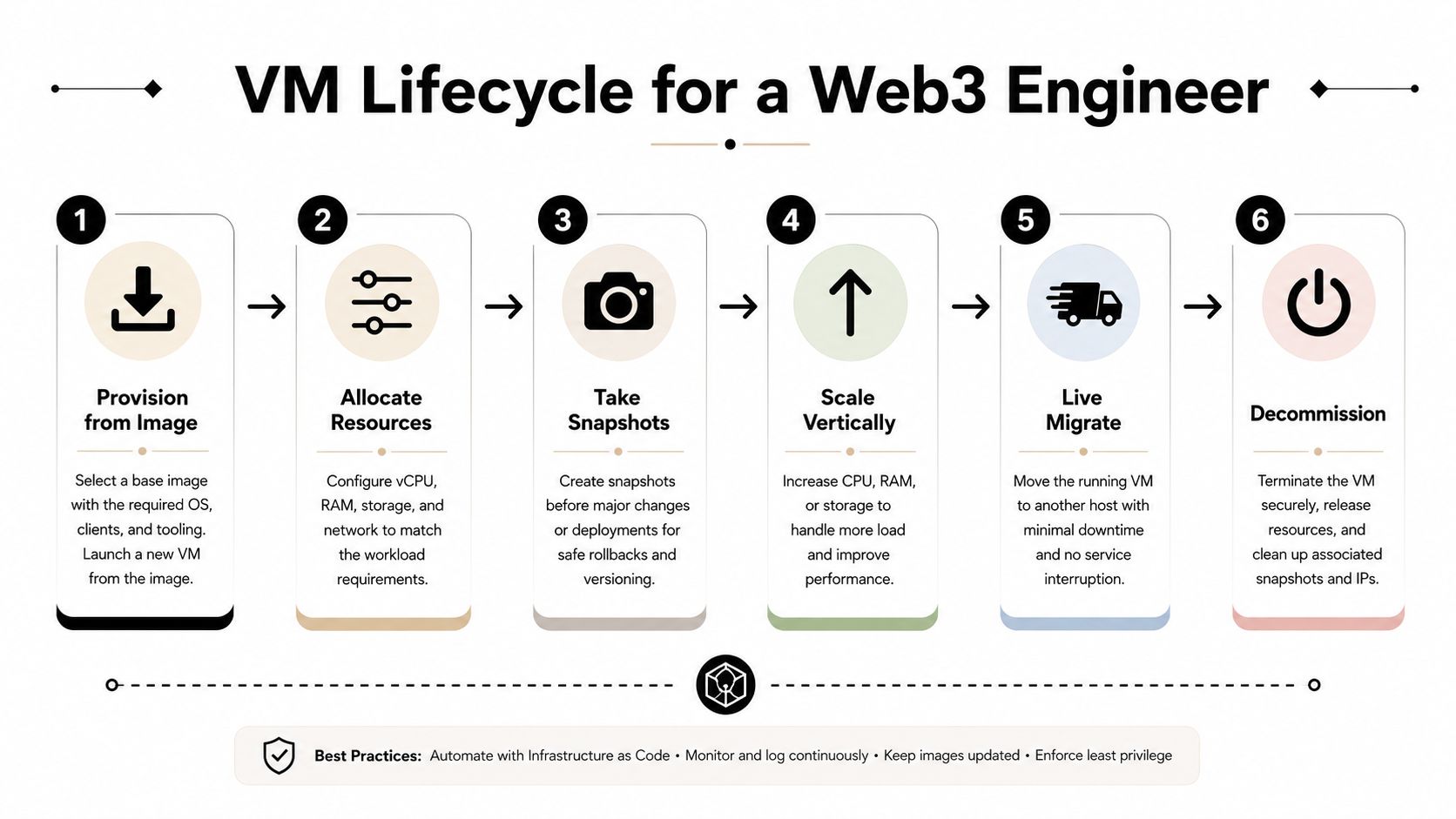
Provisioning matters because it's where reproducibility begins. If you're standing up a node for a client upgrade, you want the build to come from an image that already matches your expected packages and hardening choices. If you're testing a release candidate, you want the environment to be boring in exactly the right ways.
Where the lifecycle gets messy
Snapshots are useful, but they're also where production teams create avoidable risk. Broadcom's VMware documentation notes that snapshots should not be treated as backups, and that running a VM on a snapshot for extended periods can cause instability and data loss Broadcom. It also describes how child disks grow as writes accumulate, which is why snapshot sprawl becomes an operational problem instead of a harmless convenience Broadcom. That's the kind of detail a senior candidate should know without needing a prompt.
Migration and decommissioning are just as important. Quick migration lets you move a node to a better host when a workload spikes or a server needs maintenance. Clean decommissioning matters because stale images and forgotten snapshots are how teams lose track of what's running.
A useful operational guide for managing the moving parts is the modern virtual server management guide, especially if you're trying to connect lifecycle discipline to real fleet hygiene. That's the same discipline interviewers expect when they ask how you'd avoid drift across dozens of nodes.
For a role that asks for this kind of work, a posting like this cloud infrastructure engineer opening is a good proxy for the skill set teams want: build repeatable images, manage resources cleanly, and know what to do before and after a client upgrade.
Questions you should be ready for
- How do you create a repeatable VM image?
- When do you use a snapshot versus a backup?
- How do you spot snapshot sprawl before it hurts storage?
- What do you monitor before migrating a validator?
- How do you decommission a node without leaving stale state behind?
If you can answer those without drifting into theory, you're speaking the language of operators, not just learners.
Virtual Machines vs Containers in Blockchain Workloads
The common interview mistake is to say containers have replaced VMs. They haven't. They solve different problems, and blockchain teams still use both because the workload mix is messy.
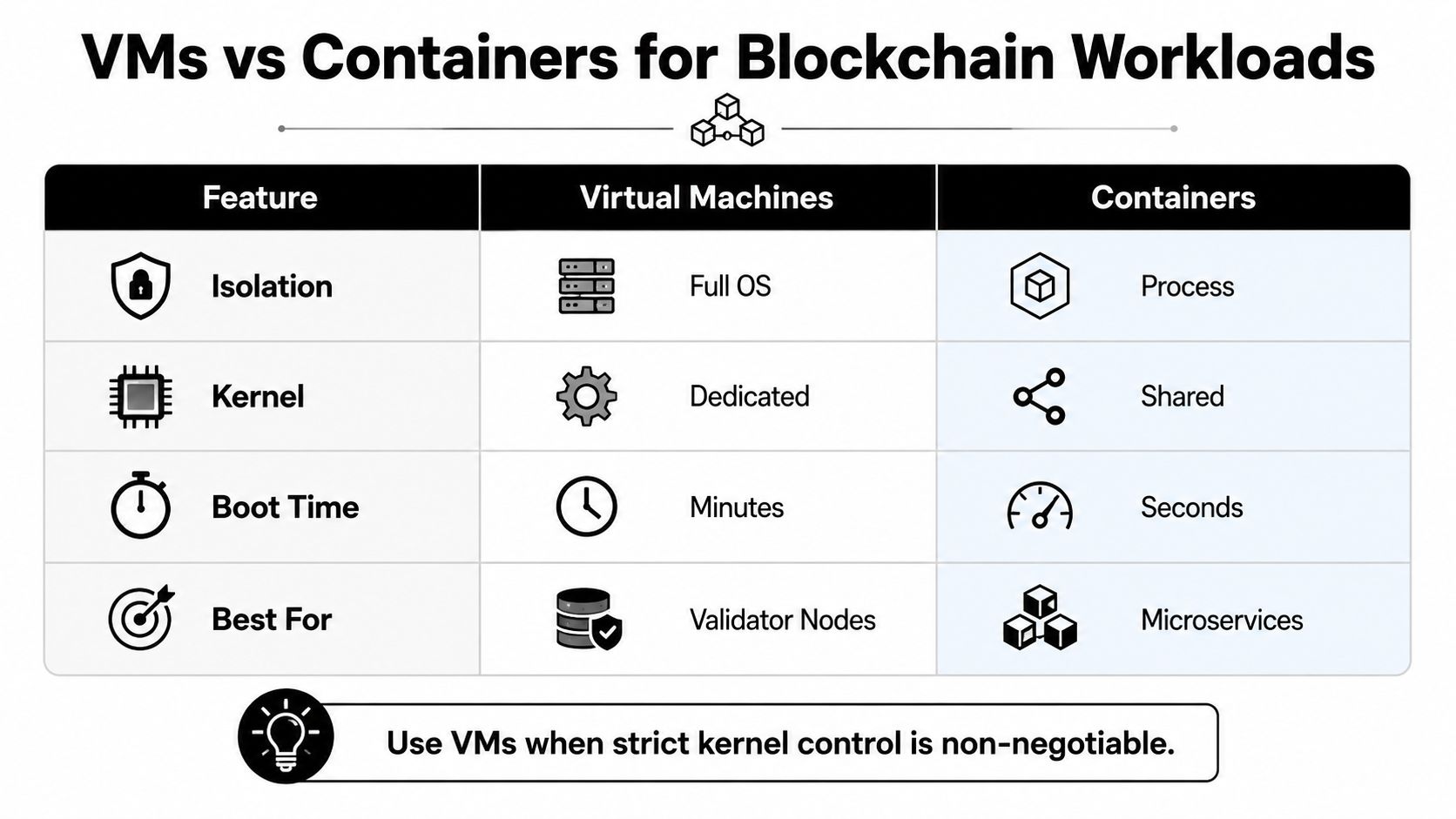
The clean line is this. VMs give you full OS isolation, dedicated kernel behavior, and a machine boundary that's strong enough for validator clients, sandboxed testnets, and workloads that need stricter control. Containers are better for fast-starting services, CI pipelines, and microservices that can share a kernel safely. Red Hat, AWS, and MongoDB all describe VMs as independent virtual machines sharing the same hardware while staying operationally separate AWS.
How real teams combine them
A common production pattern is container-in-VM. The VM gives you the isolation boundary, and the container layer gives you packaging and deployment convenience. Another pattern is VM-as-node, where the node itself lives on a dedicated VM because the team wants predictable kernel behavior and easier lifecycle control. A third pattern is container orchestration on VM workers, which is common when teams want the cluster primitives of Kubernetes without giving up machine-level isolation underneath.
Use VMs when strict kernel control is non-negotiable.
That's the line to remember in an interview. If the workload depends on kernel modules, host-level hardening, or a clear boundary around untrusted software, the VM answer is usually stronger. If the workload is a lightweight stateless service in a CI path, a container may be the better operational choice.
I've seen candidates oversell container skills by talking as if Docker solved every infrastructure problem. Hiring managers usually see through that fast. They want to know whether you can place the workload in the right isolation model and explain why.
A video walkthrough can help reinforce the mental model, especially if you're comparing deployment speed and runtime boundaries in a cloud context.
Real Blockchain Use Cases Where VMs Earn Their Keep
Full nodes are the obvious example. If an indexer team is running an Ethereum or Solana node, a VM gives them a clean boundary for client binaries, disk state, and upgrade testing. That's the kind of setup where you care about reproducible images and being able to roll back if a release behaves badly.
Validator operations make the case even more clearly. A staking provider may want each validator client on a separate VM so a bug or misconfiguration doesn't bleed across the fleet. That aligns with the DevOps & Infrastructure roles that show up in blockchain hiring because the work is less about coding a single feature and more about keeping a production service alive.
Where VM skills show up in job categories
- Engineering: node operations, client testing, release validation.
- DevOps & Infrastructure: provisioning, migration, patching, fleet automation.
- Quality Assurance: ephemeral testnets, regression environments, rollback validation.
Ephemeral testnets are another good use case. Protocol researchers often need isolated environments that can be torn down cleanly after a fork test or upgrade rehearsal. A VM makes that easy because the whole machine state is disposable in a way that a shared physical host isn't.
CI runners also benefit. Smart-contract test suites and integration jobs often need isolation from the rest of the build farm. A VM keeps the runner environment predictable, which matters when you're trying to reproduce failures instead of chasing them.
The sizing decision should be workload first, not vanity first. If a validator needs a larger instance because the node's disk I/O or memory pressure changed after an upgrade, the job is to move it safely, not to argue about hardware elegance. That's the same reasoning interviewers want to hear when they ask how you'd handle a production spike.
If you're looking at roles that sit near this work, the DevOps and infrastructure listings are the clearest place to see how teams describe it. The recurring theme is operational ownership, not just tool familiarity.
Performance, Security, and Cost Trade-offs That Get Tested in Interviews
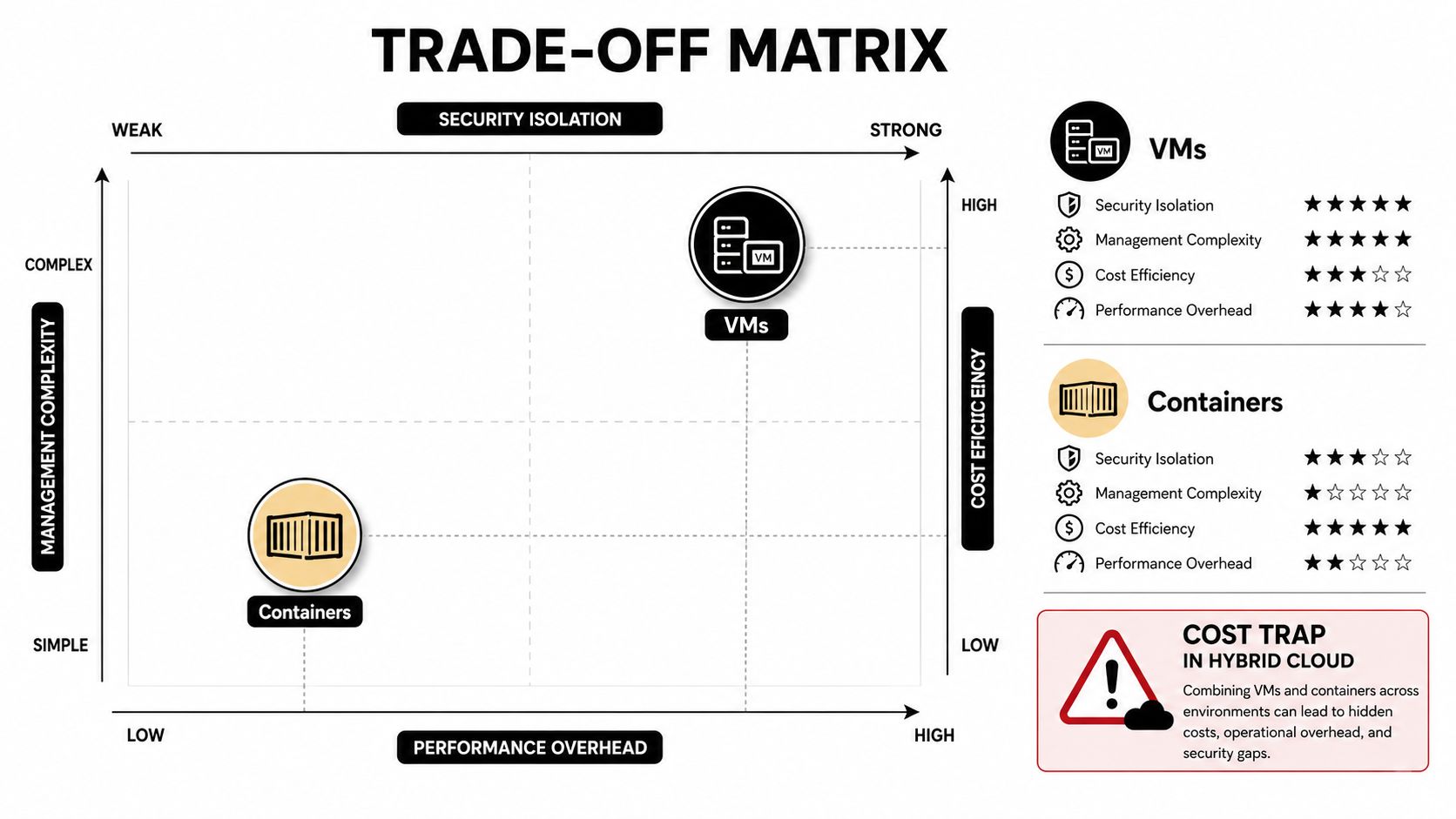
The strongest interview answers don't list generic pros and cons. They pick a workload and explain the trade-off. Virtualization can add overhead, and the sources don't pretend otherwise. The question is whether the isolation and manageability are worth it for the task at hand.
The datacenter data is useful here because it grounds the discussion in actual operational behavior. In one virtualization study, 94% of respondents reported operational savings from virtual infrastructure, and for one-time server-management tasks, half said VMs reduced time by 50% to 90% compared with traditional physical servers Insight. The same study found that provisioning, decommissioning, and server migration each took at least 75% less time for nearly two-thirds of respondents Insight. It also found that about 6 to 7 virtual machines ran on each host on average in a European enterprise survey, which is the consolidation effect teams are chasing Insight.
What senior interviewers listen for
Security comes up through lifecycle discipline. Snapshot sprawl, stale images, patch drift, and weak network segmentation are all signs that the team has let the fleet get ahead of its controls. Huntress points out that VMs are used for secure testing and that users should keep VM OSes updated, use snapshots carefully, and isolate critical workloads Huntress. The missing part in many public writeups is how often those controls get neglected once a fleet starts growing.
Networking also matters. If you're handling firewalling or segmentation, the AWS firewall rules overview is a useful reference point because it lines up with the practical question interviewers ask, how do you keep the VM boundary useful after the machine has booted? That's the test, not whether you can recite a product feature list.
Cost traps usually appear in hybrid cloud. Teams spin up too many medium-sized VMs, spread state across environments, and then pay for complexity they never planned to manage. The right answer isn't “VMs are expensive.” The right answer is, “VMs are worth it when the isolation boundary reduces risk or makes operations simpler, but I'd avoid them for workloads that don't need that level of control.”
If you can frame the decision that way, you'll sound like someone who has carried pager duty.
Turning VM Knowledge Into Web3 Career Progress
If you want to turn this into a career advantage, learn the stack in layers. KVM teaches you what a bare-metal Linux path looks like. Hyper-V matters if you work in Microsoft-heavy environments. AWS EC2 and GCP Compute Engine teach you how cloud VMs are consumed. Terraform and Ansible turn VM knowledge into repeatable operations.
That stack maps directly to job categories. DevOps and infrastructure teams want automation. Security teams want isolation and patch discipline. Engineering teams want reliable test environments and clean rollback paths. The more clearly you can tie the tool to the outcome, the better your interview answers will sound.
A good resume line doesn't say “worked with VMs.” It says you provisioned, migrated, and maintained isolated node environments with automation and clear recovery procedures. That sounds like ownership. It also fits the kind of roles you'll see on Blockchain Jobs, especially when a team needs someone who can keep a fleet consistent while the rest of the stack changes.
VMs aren't going away in Web3. They sit underneath modular execution layers, node services, and the parts of infrastructure where predictable isolation still wins. If you can explain that plainly, you're not just interview-ready, you're ready for the kind of on-call and design decisions that shape a real infrastructure career.
If you're serious about turning VM knowledge into a Web3 role, visit Blockchain Jobs and scan the current infrastructure, security, and engineering openings. Pick at least three roles that match the skills you've just sharpened, then tailor your resume and interview stories to the exact VM trade-offs those teams care about.