
7 Best Sites for Web Developer Jobs in Chicago

Looking for web developer jobs in Chicago, or looking for the jobs that lead to interviews? That difference matters. Chicago has real demand, but the better roles are often buried in hybrid listings, recruiter pipelines, and niche startup boards, so the smartest search is less about scrolling and more about choosing the right tools for each stage of the hunt. If you're also exploring local startup roles, this startup jobs near me angle is worth keeping in mind when you want to compare fast-moving teams with more traditional employers. For those specifically targeting the fast-growing Web3 space, also consider niche boards like Blockchain Jobs to find specialized roles in crypto and decentralized tech.
1. Built In Chicago
Built In Chicago works best when you want local context, not just a pile of postings. The Chicago hub is tightly aligned with product and engineering hiring, and its company pages help you judge culture, benefits, and compensation before you spend time applying. That matters in a market where the strongest roles are often hidden inside employers' broader tech teams rather than posted as generic developer openings.
The practical advantage is signal. You can narrow your search to Web Developer, Front End, or Full Stack, which cuts down the noise you get on broader boards. If you're aiming at startups or product-heavy companies, this is one of the fastest ways to build a target list and learn which employers are active in Chicago.
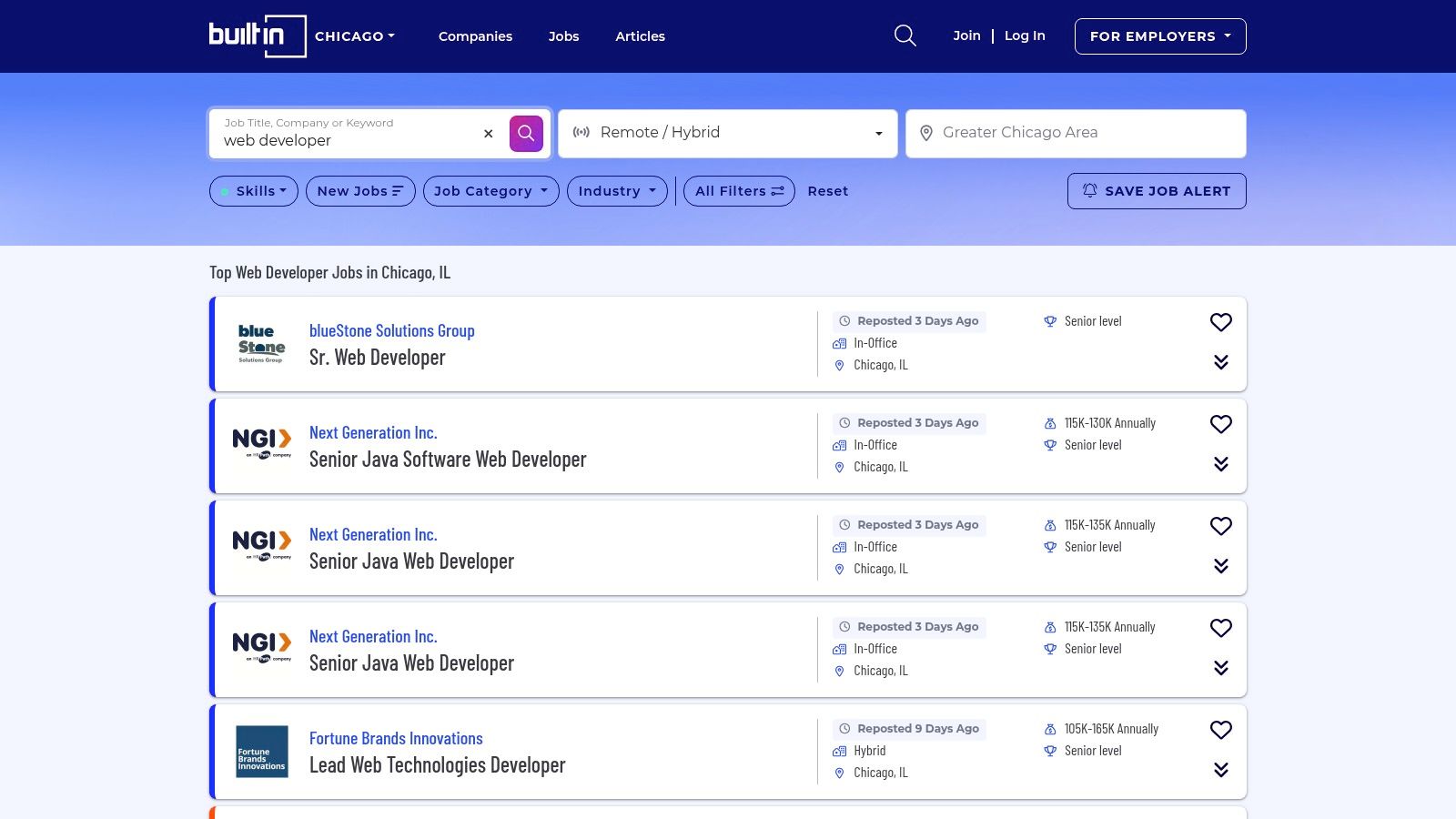
A few habits make this board more useful:
- Use company pages before you apply. The culture and salary context can help you tailor your pitch to the team's stack and working style.
- Watch for duplicates. Some openings are cross-listed from employer ATS systems, so don't waste time applying twice.
- Treat it as a research tool. It's especially strong for understanding the Chicago tech scene and spotting which employers are building right now.
Practical rule: If a posting on Built In has a clear tech stack and a real company profile, it's usually worth a tailored application. If it's vague and cross-listed, keep moving.
The direct link is Built In Chicago's web developer search, and it's one of the best first stops when you want a local shortlist instead of a national firehose. For a different specialized angle, this Chicago blockchain and crypto corporate communications role shows how niche boards can surface adjacent opportunities that never appear on generic tech sites.
2. LinkedIn Jobs Chicago
LinkedIn is where scale meets networking, and that combination is hard to beat in Chicago. You're not just looking at listings, you're also seeing mutual connections, alumni, and recruiter activity, which means the same role can be approached cold or through a warmer path depending on who you know.
That matters because the Chicago market is crowded enough that plain applications often get buried. LinkedIn's current Chicago web developer search shows a meaningful number of live roles, and the platform's saved searches and alerts let you react quickly when a new opening hits. If you're applying to mid-level or senior roles, being fast and visible on LinkedIn is often more useful than sending out another batch of generic resumes.
The downside is straightforward. Competition is high, and the platform's personalization can hide relevant jobs if your filters are sloppy. The people who get traction here tend to do three things well.
- Tune the search tightly. Separate Web Developer, Front End, and Full Stack searches so you don't miss role-specific openings.
- Use mutuals immediately. A connection at the company is often more valuable than another round of résumé edits.
- Reply to recruiter outreach fast. The good roles move, and recruiter attention drops quickly when candidates wait.
A smart way to use LinkedIn is to pair it with profile discipline. Your headline, featured work, and recent activity should make it obvious that you can ship real product work, not just write code in isolation. That's especially true in a market where local employers tend to favor people who can contribute to UI, application logic, and cross-team ownership.
For an adjacent remote-first example, see this software engineer role remote or Chicago in blockchain and DeFi, which is a good reminder that location filters are getting more fluid across the tech market.
3. Indeed Chicago
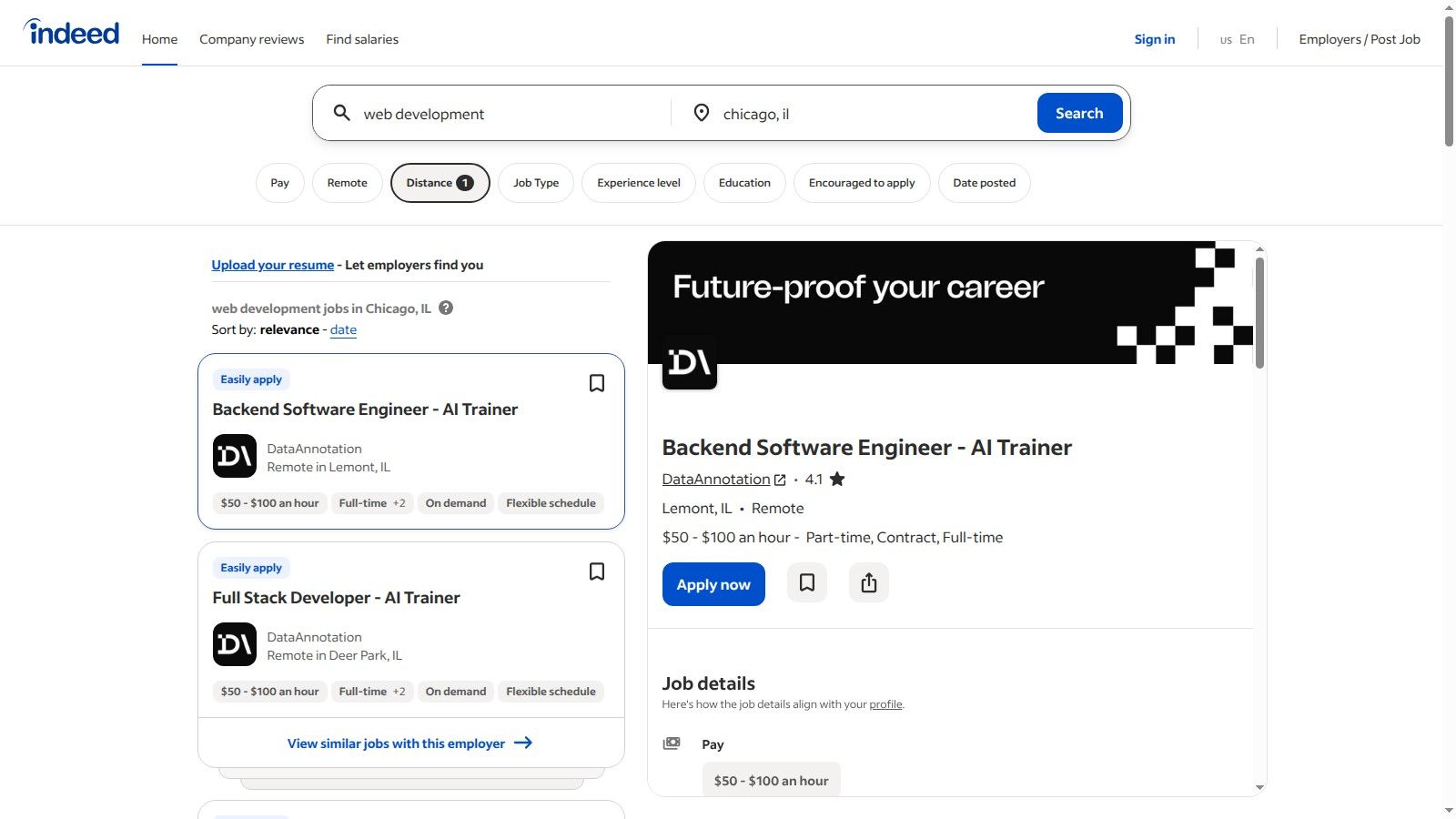
Indeed is the right move when your goal is volume with filters. It pulls in openings from companies, agencies, universities, and government, which makes it especially useful in Chicago, where not every legitimate developer role lives on a polished tech board. If you want to catch fresh postings quickly, this is one of the fastest places to scan.
The trade-off is noise. You'll see a lot of variation in quality, and some listings redirect through staffing vendors with limited detail, so filtering matters more here than anywhere else. Use salary, experience level, and remote or hybrid filters aggressively, because “web development” on Indeed can mean anything from a junior support role to a serious full-stack position.
Indeed is strongest when you're trying to answer practical questions fast.
What to look for
- Newly posted roles. Fresh listings tend to respond better than stale ones.
- Employer reviews. Use them as a quick read on management and process, not as gospel.
- Hybrid and remote labels. Chicago searches often mix local and flexible roles, which changes how you commute and negotiate.
This platform is also helpful for newcomers because it surfaces a wide range of entry-level openings, though the pay can vary dramatically. One visible example on the entry-level side shows how broad the range can be, so don't assume “entry-level” means a clean path into real web development work.
The best use of Indeed is not to apply to everything. It's to find the handful of roles where the stack, location, and hiring setup match your actual experience.
The direct search page is Indeed's Chicago web development jobs, and it's worth checking daily if you want to catch roles before they get flooded. If you're comparing adjacent talent channels, this technical lead analytics engineer opening at Rush Street Interactive is a useful example of how niche boards can intersect with Chicago tech hiring in unexpected ways.
4. Dice
If you already know the stack you want, Dice saves time. It is built for tech-only inventory and a recruiter-heavy flow, so you can filter for React, Node.js, and .NET roles without sorting through broad generalist listings.
That focus fits Chicago well. A lot of the better openings here sit inside enterprise teams or staffing pipelines, and Dice reflects that mix clearly. It also surfaces contract and contract-to-hire roles more often than many broader boards, which can be a practical path into companies that are hesitant to hire directly at first.
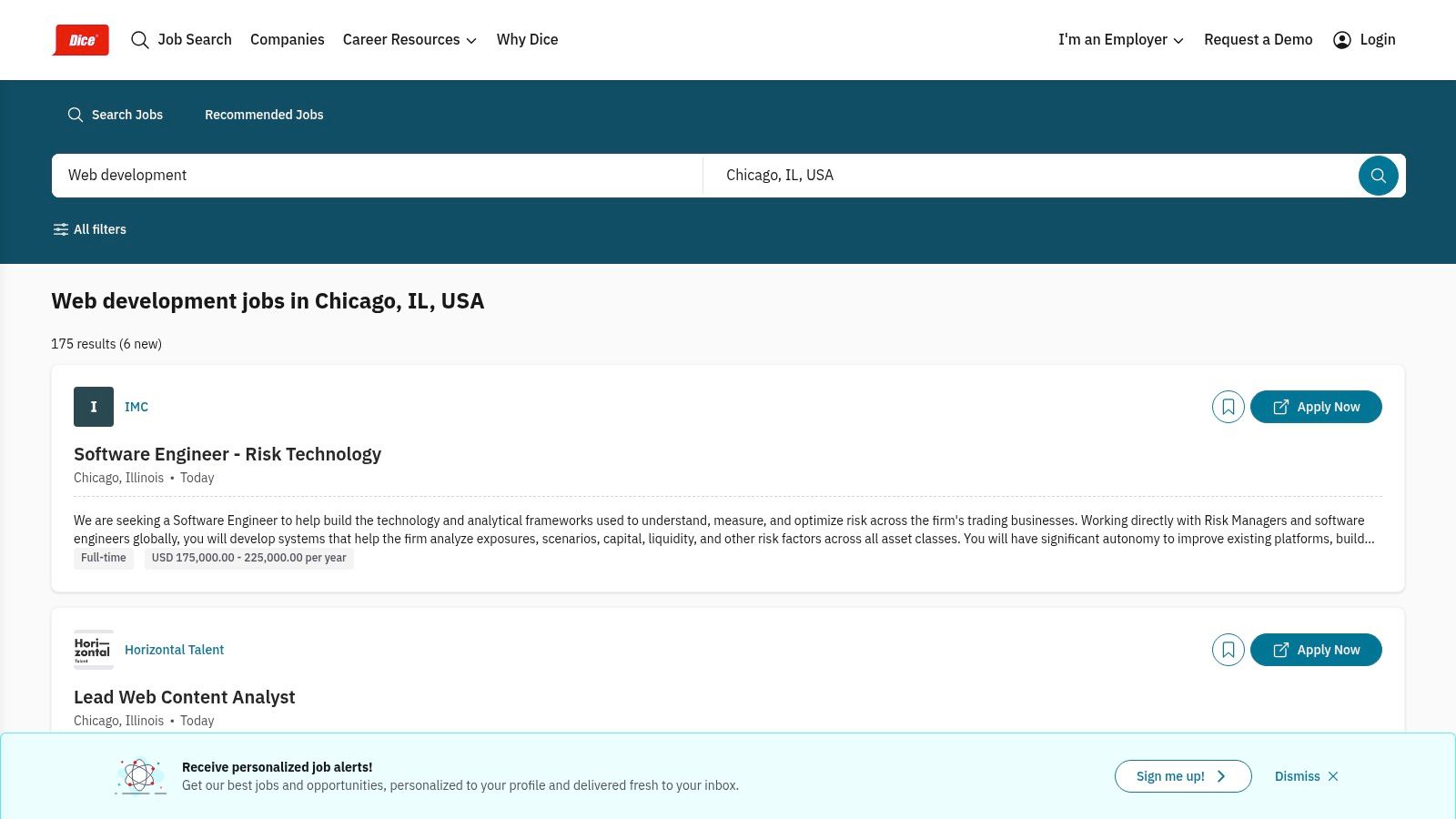
How to use Dice effectively
A weak Dice profile disappears quickly. A strong one gets pushed toward recruiters who are filling very specific technical gaps.
- List your stack clearly. Put frameworks, cloud tools, and databases near the top of your profile.
- Turn on alerts. Contract roles can move fast, and the better ones often disappear before a casual browser notices them.
- Expect mid-senior bias. Dice is usually better for developers with production ownership than for people looking for a first break.
If you are comfortable working through staffing relationships, Dice can shorten the path to interviews. Recruiters on the platform often care more about whether you can meet the spec than whether your personal brand is polished, which helps if you have the skills but have not built a big public presence yet.
The direct link is Dice web development jobs in Chicago. If you want context for how recruiter-led searches work, this best IT staffing firms for 2025 resource is useful for understanding how staffing firms shape the Chicago hiring pipeline.
5. Wellfound Chicago Startups
If your goal is to get in front of startups quickly, Wellfound is the stronger fit. Chicago startups and remote-friendly teams use it for roles that often show compensation, equity, and team-stage details up front, which makes it easier to tell whether a posting is a real hiring effort or just a loose request for “a developer.”
That kind of visibility saves time in screening. When salary and equity are listed, you can spend your energy on product fit, stack fit, and the kind of ownership the team expects, instead of chasing a role that was never in your range. For developers who want early-stage responsibility, Wellfound usually gives a clearer picture than broad job boards.
Your profile matters more here than on a generic board. Startup founders and hiring managers tend to respond better to candidates who show curiosity, shipping history, and a specific reason for wanting startup work, rather than a long list of languages with no context.
Where it helps most
- Early-stage visibility. It works well for teams hiring generalist developers who can move across the stack.
- Compensation clarity. Salary and equity ranges are often visible, which makes screening faster.
- Location flexibility. Chicago, hybrid, and remote filters help you separate true local roles from broader U.S. openings.
Startups hire the person who looks ready to own ambiguous work. Your profile should show that before the first message ever goes out.
The other reason to keep Wellfound in rotation is timing. Startup hiring in Chicago moves with funding cycles, so the volume changes, but the conversations can be strong when the right company is active. That makes the board less about constant volume and more about catching a good match at the right moment.
The direct link is Wellfound Chicago startup jobs. For a more specialized example of how targeted searches can surface sharper roles, the Rush Street Interactive technical lead role shows the kind of focused opportunity that can sit alongside startup-focused browsing.
6. Hired
Hired flips the usual job-search model. Instead of sending cold applications into a black box, you build a profile, set preferences, and let employers send interview requests back to you. That model works especially well for mid-level to senior web developers who already have a track record and want fewer, better conversations.
The main upside is signal. If a company reaches out through Hired, there's already some level of alignment around location, skills, and availability, which cuts down on wasted time. For Chicago candidates, that can be a strong way to test the market discreetly while staying selective about the kinds of interviews you accept.
The catch is selectivity. Early-career developers often get fewer inbound requests, and niche stacks can be thinner in some markets. So Hired is less useful if you're still trying to prove you can ship production code, and more useful if you've already done that and want employers to come to you.

How to make it work
Your profile has to do the heavy lifting here.
- Be precise about availability. Companies want to know whether you can start quickly and whether you're open to hybrid work.
- Lead with recent impact. Hired works better when your profile reflects what you've shipped, not just what you've studied.
- Be realistic about seniority. If your background is still early-career, treat this as a supplemental channel rather than the main engine.
In an inbound marketplace, vague profiles disappear. Specific profiles get interviews.
Use Hired when you want a more curated experience and you're ready for employers to evaluate you on demonstrated outcomes. It's a good fit for developers who already know their worth and want to avoid the spray-and-pray rhythm of traditional job boards.
The website is Hired, and it's one of the cleanest ways to test how the Chicago market values your current level without submitting dozens of applications.
7. Motion Recruitment Chicago IT Staffing
Need a recruiter who can do more than forward résumés? Motion Recruitment is the option I'd use when I want human help and a faster route into hiring conversations. A good recruiter can get you in front of decision-makers sooner than a cold application, especially in Chicago, where some roles move through agency relationships before they ever show up on public boards.
That matters for Chicago web developer jobs because a lot of the better openings are screened before they become widely visible. Recruiters also help with the parts candidates often underplay, including résumé framing, salary expectations, and interview prep. If you can build and ship code but struggle to tell that story cleanly, a strong staffing partner can make your search sharper.
The trade-off is real. You give up some control over the funnel, and plenty of the roles will be contract or contract-to-hire instead of direct hire. That can still be the right move if your goal is to get into a solid company quickly, add recent experience to your résumé, and position yourself for a stronger permanent role later.
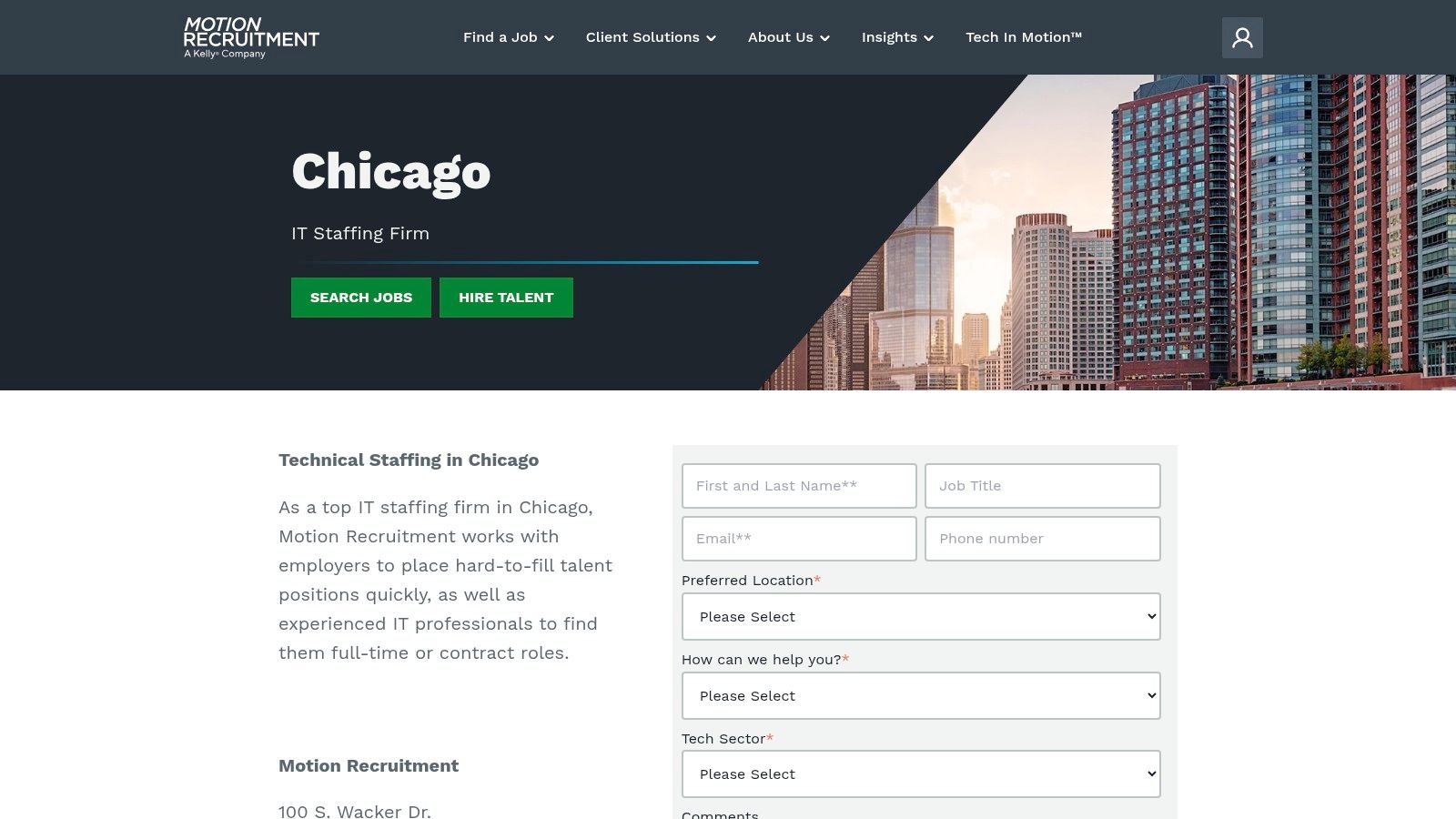
Where recruiters help most
- Market translation. They know what Chicago employers are screening for and how to position your experience so it fits the role.
- Faster access. Agency partners can shorten the path to interviews when the client already trusts them.
- Role matching. They can surface openings that never reach the big public boards.
- Offer pressure testing. A recruiter can tell you whether a title, stack, or rate is competitive for the market you're targeting.
The best recruiter relationships are two-way. Be clear about your stack, commute limits, remote flexibility, and salary expectations. That keeps you from getting pushed into roles that look fine on paper but fail the first five minutes of the conversation.
The direct link is Motion Recruitment Chicago IT staffing, and it belongs in any serious Chicago search. If you want a broader hiring-market lens while you compare agencies, best IT staffing firms for 2025 is a useful companion read. For résumé presentation that supports recruiter outreach, Glassmorphism resume design can help if you want a cleaner visual first impression.
Top 7 Chicago Web Dev Job Boards, Comparison
| Platform | 🔄 Implementation complexity | ⚡ Resource requirements | ⭐ Expected outcomes | 📊 Ideal use cases | 💡 Key advantages |
|---|---|---|---|---|---|
| Built In Chicago | Low, straightforward local search and AI assist | Low, quick targeted applications and company research | High relevance to Chicago tech roles; fewer irrelevant hits | Local web/product/engineering searches and company research | Local hub, company culture/salary pages, lower noise |
| LinkedIn Jobs (Chicago) | Medium, profile/network tuning and algorithm management | Medium–High, networking, messages, and application volume | High scale and reach but high competition; strong recruiter access | Broad searches where warm introductions and scale matter | Largest network, mutual connections, recruiter outreach |
| Indeed (Chicago) | Low, simple search engine interface with filters | Medium, sift many listings; requires careful filtering | Very broad coverage including non‑tech; higher noise | Finding volume listings across agencies, government, universities | Massive aggregation, salary estimates, employer reviews |
| Dice | Low–Medium, tech‑focused filters and profile setup | Medium, profile optimization to attract recruiters | Good for IT staffing, contract and mid‑senior roles in tech | Contract/perm developer roles and enterprise IT hiring | Tech‑only focus, skills filters, market trend resources |
| Wellfound (AngelList) | Low, candidate profile and saved searches | Low–Medium, apply to startups; monitor equity details | Good visibility into startups; often transparent comp | Early‑stage and growth startup roles; equity‑inclined offers | Startup‑centric listings, comp transparency, signal profiles |
| Hired | Medium, vetting and preference setup required | Medium, maintain profile; interviews come inbound | High signal for vetted candidates; efficient inbound requests | Mid‑senior developers seeking curated employer outreach | Curated marketplace, salary transparency, inbound matching |
| Motion Recruitment (Chicago) | Medium–High, recruiter coordination and agency process | Medium, recruiter calls, resume prep, interviews | Access to unposted/agency‑preferred roles; variable by demand | Candidates wanting human guidance and hidden opportunities | Local recruiters, market intel, interview/resume coaching |
Your Strategic Job Search Action Plan
Finding your next web developer job in Chicago isn't just about browsing listings, it's about using the right platform for the right stage of the search. Built In Chicago gives you local tech context, LinkedIn gives you networking reach, and a recruiter like Motion Recruitment can open doors that never show up in a plain search. The people who get the best interviews usually don't rely on one board, they build a search system.
Chicago's market also rewards clarity about level and fit. As noted earlier, national web developer employment is projected to grow 7% from 2024 to 2034, with about 14,500 openings per year on average, and Chicago's pay sits near the national benchmark, so it's a credible place to build a stable career (BLS web developers outlook). That means your next move should be deliberate, not scattershot.
Here's the practical approach. Use Built In to identify local employers worth knowing, LinkedIn to activate warm introductions, Indeed to catch fresh postings, Dice for tech-heavy and contract opportunities, Wellfound for startup roles, Hired for inbound interest, and Motion Recruitment when you want a human advocate in the process. Tailor each application to the stack, the seniority level, and the kind of ownership the employer wants.
Keep your portfolio and résumé aligned with the roles you want, not the ones you can barely qualify for. If you're aiming at stronger Chicago opportunities, the candidates who win are usually the ones who show production experience, clear communication, and a reason for wanting that specific team. The search gets easier once your materials tell the same story your applications do.
If you're also exploring Web3-adjacent work, Blockchain Jobs gives you a focused way to find engineering, product, operations, and adjacent roles across the decentralized ecosystem. It's a strong next stop if you want your search to stay specialized while still keeping an eye on remote-friendly opportunities and fresh listings.