
What Is a Liquidity Pool and How It Can Launch Your Web3 Career

Think back to the early days of crypto trading. If you wanted to trade one token for another, you had to find someone else willing to take the other side of your trade. This relied on a traditional order book, just like the stock market. But what if no one wanted to buy what you were selling at your price? You were stuck.
This is the problem liquidity pools were built to solve.
The Engine of DeFi: What Is a Liquidity Pool?
At its core, a liquidity pool is simply a big pot of two or more different crypto tokens locked in a smart contract. These pools are the backbone of almost every decentralized exchange (DEX), allowing for instant trades without ever needing to wait for a buyer or seller.
Think of it like a community-owned currency exchange booth. Instead of a single company stocking all the cash, anyone can contribute to the inventory and, in return, earn a small cut of every transaction that happens. This "inventory" is the pool's liquidity, and it powers billions of dollars in daily trading volume across the Web3 ecosystem.
For anyone serious about a career in this space—whether you're an aspiring protocol engineer, a DeFi product manager, or a financial analyst—mastering this concept is non-negotiable. It’s not just tech; it's a fundamental economic primitive. Hiring managers at top DeFi protocols like Uniswap will expect you to discuss it with fluency in a job interview.
Who Supplies the Tokens? The Role of Liquidity Providers
So, where do all these tokens come from? They're supplied by users known as Liquidity Providers (LPs). An LP is anyone who deposits a pair of assets into the pool. For instance, to help create a market for trading Ether (ETH) and the stablecoin USDC, an LP would deposit an equal value of both tokens into the smart contract.
By contributing their assets, LPs effectively become decentralized market makers. This role was once the exclusive domain of large financial institutions. Demonstrating that you understand how liquidity pools have democratized market-making is a powerful way to show a hiring manager you grasp the "why" behind DeFi, not just the "what."
This democratization has created entirely new career paths and requires skills in tokenomics, risk analysis, and smart contract engineering that have no direct parallel in traditional finance.
From Order Books to Automated Pools
This model is a world away from the old order book system. Where traditional markets rely on matching individual buy and sell orders, liquidity pools use an algorithm to handle everything automatically.
To stand out in a job interview, it helps to articulate not just the differences, but the implications of those differences.
Liquidity Pools vs Traditional Order Books
This table highlights how DeFi's approach creates new professional specializations and demands a different set of skills.
| Feature | Liquidity Pool (DeFi) | Traditional Order Book (TradFi) |
|---|---|---|
| Market Making | Open and permissionless; anyone can provide liquidity. | Restricted to specialized firms and institutions. |
| Price Discovery | Determined automatically by an algorithm based on asset ratios. | Set by matching buy and sell orders at specific prices. |
| Trading | Instant swaps against the pool's assets. | Requires a buyer and seller to agree on a price. |
| Required Skillset | Demands knowledge of smart contracts, AMMs, and tokenomics. | Focuses on market microstructure and high-frequency trading. |
Understanding not just what a liquidity pool is, but why it's a superior solution for certain use cases, is what separates a strong candidate from an average one. It shows you're thinking about the market problems the technology solves, which is crucial for roles in product, strategy, and engineering. This is your first step toward building a meaningful career in the decentralized economy.
Understanding the Mechanics of Automated Market Makers
So, what's the engine driving these liquidity pools? It's a clever piece of code called an Automated Market Maker (AMM). An AMM isn't a person or a company pulling strings; it's a smart contract that automatically sets asset prices based on a mathematical formula. For any aspiring technical professional in Web3, a deep understanding of AMM logic is a prerequisite for interviews and on-the-job success. It’s the foundational knowledge that top candidates are expected to have mastered.
Unlike traditional stock exchanges that use an order book to match individual buyers and sellers, an AMM lets you trade directly against the pool's assets. This core mechanism ensures there’s always liquidity to trade against, and a price is always available, whether you're swapping $10 or $10,000.
The whole system is a self-sustaining cycle fueled by different participants, with the liquidity pool acting as the automated core.
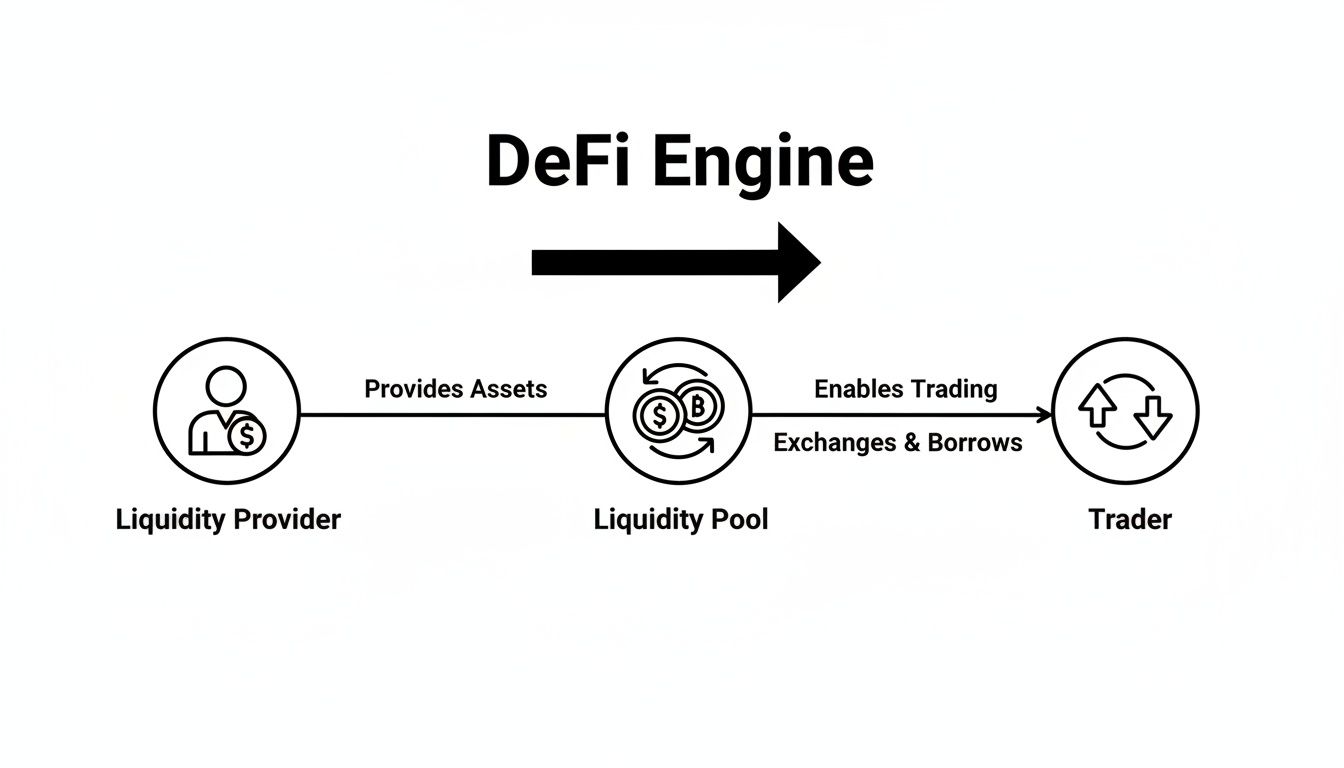
Identifying where you can add the most value in this flow—as a provider, builder, or trader—is a key step in charting a successful Web3 career path.
The Constant Product Formula Explained
The most foundational algorithm for AMMs is the constant product formula, made famous by Uniswap. It’s beautiful in its simplicity: x * y = k.
This isn't just an abstract equation. For a developer, this is the logic you'll code and optimize. For a data analyst, it's the model you’ll use to analyze pool performance. And for a product strategist, it’s the user behavior you’ll build tokenomic incentives around.
Here’s what the variables represent:
- x: The total amount of Token A in the pool (e.g., ETH).
- y: The total amount of Token B in the pool (e.g., USDC).
- k: A constant value, which is simply the product of x and y.
The rule is that k must always remain the same before and after a trade (not counting fees). When a trader swaps one token for another, the AMM adjusts the balances of x and y to maintain this constant, which is what causes the price to change.
Being able to walk a hiring manager through the x * y = k formula with a real-world example is a common litmus test in DeFi technical interviews. It proves you understand the mechanics that actually make decentralized trading work, moving you beyond just reciting buzzwords.
A Practical Example: ETH and USDC
Let's see this in action from the perspective of an engineer building the system. Imagine a liquidity pool contains 10 ETH (x) and 20,000 USDC (y).
First, your code calculates and stores the pool's constant, k:
10 ETH * 20,000 USDC = 200,000
This product, 200,000, is the magic number the smart contract must preserve. Now, a trader comes along wanting to buy 1 ETH from the pool.
- Before the trade: The pool holds 10 ETH and 20,000 USDC.
- The trade: The trader removes 1 ETH, so the pool now has only 9 ETH left.
To keep k at 200,000, the smart contract needs to calculate how much USDC must be in the pool:
9 ETH * y = 200,000
y = 200,000 / 9
y ≈ 22,222.22 USDC
The pool started with 20,000 USDC, and now it needs to have 22,222.22 USDC. The difference—2,222.22 USDC—is what the trader had to pay into the pool to get that 1 ETH. So, the effective price for their trade was 2,222.22 USDC per ETH.
This single swap has now changed the asset ratio in the pool, which in turn sets a new price for the very next trade. Grasping how every swap impacts asset balances, price discovery, and potential slippage is an essential skill for anyone looking to build, analyze, or secure these powerful financial systems. In an interview, explaining this process shows you can think through the entire lifecycle of a trade.
The Rewards and Realities of Providing Liquidity

Knowing how a liquidity pool works is one thing. But for anyone building a serious career in DeFi, understanding the economic trade-offs is where the real expertise lies. Becoming a liquidity provider (LP) isn't a "set it and forget it" investment—it's an active balancing act between tantalizing rewards and very real risks.
This balance is the core challenge that defines many Web3 jobs. Product managers wrestle with it to design UIs with clear risk warnings. Security auditors view the "realities" as a primary focus for their audits. And for DeFi strategists, mastering this dynamic is the key to building protocols that attract and retain capital.
The Allure of LP Rewards
So, why would anyone put their crypto on the line like this? The allure is simple: the chance to earn passive income. This income generally comes from two places, and it's the toolbox that tokenomics teams use to attract and lock in capital.
- Trading Fees: Every time a trader swaps assets using the pool, they pay a small fee. That fee gets split among all the liquidity providers, proportional to their share. A pool with high trading volume can turn into a serious fee-generating machine.
- Yield Farming Incentives: To get a new pool off the ground, many DeFi protocols sweeten the deal with extra rewards. This is what's known as yield farming (or liquidity mining). LPs are rewarded with the protocol's native governance tokens, giving them a slice of ownership and an extra income stream.
For a DeFi analyst or strategist role, looking at a pool's APY (Annual Percentage Yield) is just scratching the surface. The real job is to deconstruct where that yield comes from. Is it driven by sustainable trading fees, or is it propped up by temporary token emissions? This is the kind of critical thinking that hiring managers look for in interviews for DeFi finance and accounting roles.
The Hard Reality of Impermanent Loss
Now for the catch, and it’s a big one: impermanent loss. The name is a bit of a misnomer—the loss can become very permanent if you pull your funds out at the wrong moment. At its core, it's the opportunity cost of being an LP versus just holding the assets.
Think of it this way. You’re a grocer with a stall stocked with an equal value of apples and oranges. Suddenly, a new health trend makes oranges twice as valuable overnight. Your customers will rush to your stall to swap their now less-valuable apples for your "cheap" oranges.
Before you know it, you're left with a mountain of apples and almost no oranges. While the total dollar value of your stall might have risen, you would have made a lot more money if you had just held onto your original stock of super-valuable oranges instead of letting them get swapped away. That difference—between the value of your assets in the pool and what they would have been worth if you’d just held them—is impermanent loss.
Modeling and hedging against impermanent loss is a full-time job for quantitative analysts. For product managers, building a calculator to help users visualize this risk before they deposit is a must-have feature for earning user trust and a great example to bring up in an interview.
Smart Contract Risk and MEV
Beyond impermanent loss, LPs face technical risks that keep security and infrastructure teams up at night. These risks are not just theoretical; they are the focus of entire careers in Web3.
- Smart Contract Vulnerabilities: Liquidity pools are just code, and code can have bugs. A clever exploit in the protocol's smart contracts could let an attacker drain the entire pool, resulting in a 100% loss for providers. This is exactly why top-tier security auditors are paid to scrutinize every single line of code.
- Maximal Extractable Value (MEV): This is an advanced risk where validators or specialized bots reorder or inject transactions to profit from on-chain activity. A common example is a "sandwich attack," where a bot sees a large trade, front-runs it to push the price up, lets the victim's trade execute at a worse price, and then sells, pocketing the difference.
These risks are what product and security teams in DeFi work around the clock to mitigate. For instance, a trader once lost nearly an entire $50.4 million swap due to an illiquid pool—a disaster that highlights the importance of robust risk management features.
If you're building a career in this space, this risk-reward equation is your bread and butter. Whether you’re coding the protocol, designing the product, or analyzing its financial health, your job is to navigate these currents to build safer and more efficient markets. You can find many DeFi finance and accounting jobs where this expertise is in high demand.
A Developer's Guide to Different Liquidity Pool Models

So, you've wrapped your head around the brilliant simplicity of the constant product formula (x * y = k). That's a huge first step, but in DeFi, it's just the baseline. The real magic—and where high-value career opportunities are found—is in understanding the specialized pool models that evolved from that foundation.
Not all liquidity pools are built the same. For a developer, strategist, or quant, knowing which tool to use for which job is what separates a generalist from an in-demand specialist. This knowledge isn't just academic; it's a direct line to more senior roles. A protocol developer building a new feature isn't just copying old code; they are making critical design decisions based on these models.
Let’s dive into the main designs you’ll need to master for your career.
Constant Product Pools: The Workhorse Model
This is the classic design that got the ball rolling, pioneered by protocols like Uniswap V2. It’s built on a simple premise: maintain a 50/50 value balance between two assets. It’s the foundational engine that still powers a massive slice of the DEX market, and its simplicity is its greatest strength.
From a career perspective, understanding the constant product model is the baseline requirement for almost any technical DeFi role. To stand out, discuss its limitations. In an interview, explaining the capital inefficiency of this model—and how it led to newer innovations—shows you're thinking like a senior engineer who solves problems, not just a junior who implements formulas.
While it's perfect for creating a basic market for any token pair, its "one-size-fits-all" nature has some serious drawbacks, which paved the way for the next wave of innovation.
Weighted Pools: For Multi-Asset Exposure
Enter weighted pools, a concept brought to the forefront by Balancer. These pools shatter the rigid 50/50 rule. Imagine a pool that isn't just two assets, but up to eight, each with a custom weight—like 80% WETH and 20% BAL, or four assets split 25% each. Suddenly, the liquidity pool becomes something far more sophisticated: a self-rebalancing, decentralized index fund.
- Engineering Challenge: The math gets significantly more complex. As a developer, you're moving from a simple product to a value function that must be maintained across multiple assets, requiring a solid grasp of portfolio management mathematics.
- Career Specialization: This is where you find roles focused on building decentralized ETFs, treasury management tools, and other complex financial products. Smart contract developers who also understand finance are highly sought after for these positions.
Stable Pools: Optimized for Low Slippage
What happens when you're trading assets that should be worth the same, like USDC for USDT? Using the constant product formula is a terrible fit; it causes way more slippage than necessary. This is precisely the problem stable pools (often called Curve-style pools) were designed to solve. They use a completely different mathematical curve—one that's nearly flat—to allow for massive swaps between similarly-priced assets with almost no price impact.
The demand for this efficiency is astronomical. By early 2026, stablecoin liquidity pools were clocking a daily transaction volume of $298.3 billion, a 78.2% jump in a single month driven by institutional adoption. To put it in perspective, a single protocol like Curve Finance holds a USDC liquidity pool TVL of $2.73 billion. These are not niche products; they are titans of DeFi, and the engineers who build and maintain them are in high demand.
Concentrated Liquidity: For Capital Efficiency
The most recent major evolution is concentrated liquidity, famously introduced with Uniswap V3. This model tackles a core weakness of the constant product formula: most of the money just sits there, waiting for wild price swings that rarely happen. Concentrated liquidity lets providers put their capital to work within a specific price range where they predict most of the trading action will be.
This creates a whole new world of opportunities and challenges. For LPs, it means their capital can be thousands of times more efficient. For developers, the infrastructure needed to support these advanced protocols is a major engineering effort. You can browse DevOps and infrastructure positions to see how critical this expertise has become.
Of course, this efficiency comes with a trade-off. It introduces new complexities, like actively managing your price range and facing a higher risk of impermanent loss. For quantitative analysts and DeFi strategists, mastering the art of modeling these positions has quickly become one of the most sought-after and lucrative skills in the entire industry.
Turning Pool Knowledge Into a High-Value Web3 Career
Understanding the theory behind a liquidity pool is just the price of admission for a serious career in Web3. The real differentiator—what gets you hired and helps you advance—is turning that theory into specialized, practical skills relevant to a specific role.
When you sit down for an interview, a deep grasp of liquidity mechanics, risk, and user incentives is your single most valuable asset. Hiring managers aren't looking for someone who can recite a definition; they need specialists who can build, manage, and secure these complex financial systems. Let's break down what that means for different career paths.
The Protocol Engineer
For the builders, liquidity pools are the ultimate playground. A Protocol Engineer isn't just using a framework; they are the ones writing the core logic that powers an entire decentralized exchange. Their code directly handles the money of thousands of users.
- Day-to-day work: They implement and fine-tune AMM formulas, write the smart contracts that manage token deposits, and focus relentlessly on security and gas optimization.
- What you need: Mastery of Solidity is a given. But beyond that, you need a serious obsession with gas optimization and the ability to translate financial math into secure, bug-free code.
In an interview, a candidate who can fluently debate the trade-offs between a Uniswap V3 concentrated liquidity model and a Curve-style stable pool—from a gas-cost and security perspective—is demonstrating senior-level thinking. This is how you prove you're ready to build.
The DeFi Strategist
While engineers build the engine, the DeFi Strategist designs the economic incentives around it. This role is a fascinating mix of finance, behavioral economics, and data analysis, all focused on one question: how do we attract and sustainably retain liquidity?
A great DeFi Strategist knows that liquidity is a commodity. Their job is to architect incentive programs, like yield farming rewards, that offer a compelling return for LPs without causing hyperinflation of the protocol's native token.
They spend their time analyzing competitor protocols, modeling the potential returns for LPs under different market conditions, and designing tokenomics that create a self-sustaining ecosystem. It’s a role that demands a sharp analytical mind and a gut-level feel for what motivates market participants.
The Product Manager
The Web3 Product Manager serves as the user's advocate. They are obsessed with making complex DeFi interactions feel simple, intuitive, and safe. They are the crucial link between the highly technical backend and an experience that doesn't scare away mainstream users.
Their work involves:
- Designing user flows: They map out the step-by-step process for depositing into a pool, ensuring risks like impermanent loss are communicated clearly without overwhelming the user.
- Prioritizing what to build: They make the tough calls. Should the engineering team build a new slippage tolerance feature or an integrated analytics dashboard for LPs first?
- Gathering user feedback: They are constantly talking to users, digging into the pain points people have when using the protocol to inform the product roadmap.
If you're an aspiring PM, walking into an interview with a feature proposal—like a simple, visual impermanent loss calculator—shows you’re already thinking about solving real problems for real users.
The Security Auditor
Last but certainly not least, the Security Auditor is the guardian. Their entire job is to think like a malicious attacker and find vulnerabilities before millions of dollars are stolen. They are paid to be paranoid.
Auditors meticulously stress-test every single line of a pool’s smart contract code, hunting for subtle logic flaws, reentrancy bugs, or oracle manipulation vectors. Their expertise is what allows liquidity providers to sleep at night. If you’re drawn to the high-stakes world of blockchain security, check out the latest Web3 engineering jobs to see just how critical—and in-demand—these skills are.
Frequently Asked Questions About Liquidity Pools
Once you get the hang of the basics, you'll find a few questions that pop up over and over. Getting clear, straightforward answers is the best way to build real confidence, whether you're aiming for a job in DeFi or just want to understand the tech you're using.
Let's tackle some of the most common ones.
What Happens to My Assets When I Add Them to a Pool?
When you deposit crypto into a liquidity pool, you're handing it over to be managed by a smart contract. You don't just send it into the void, though. In return, the pool mints and sends you LP (Liquidity Provider) tokens.
Think of these LP tokens as your claim ticket or a receipt for your share of the pool. They're what you'll use to collect your portion of the trading fees, and they represent your ownership stake.
When you're ready to exit, you trade your LP tokens back to the pool to withdraw your assets. Just remember, the amount of each token you get back might not be the same as what you put in. Price movements can change the ratio of assets in the pool, a phenomenon known as impermanent loss.
How Do I Evaluate a Good Liquidity Pool Opportunity?
This is where an analyst's mindset really kicks in. Finding a good pool isn't just about chasing the highest APY—that can be a trap. It's about weighing the potential rewards against the very real risks.
Here’s a checklist that a professional DeFi analyst would use:
- Total Value Locked (TVL): High TVL often means the pool is deep, reducing price impact (slippage) for traders, which attracts more volume and generates more fees.
- Trading Volume: This is your primary source of real yield. High trading volume directly translates into more fee revenue for liquidity providers.
- Source of APY: Always ask where the yield is coming from. Is it driven by sustainable trading fees, or is it propped up by temporary token incentives that could disappear?
- Asset Volatility: This is a key risk factor. Pairs with highly volatile assets have the highest risk of impermanent loss. Stablecoin pairs are at the low end of this risk spectrum.
- Smart Contract Audits: Has the protocol been audited by reputable security firms? Never provide liquidity to an unaudited protocol.
Knowing how to balance these factors is a core skill for anyone working seriously in the DeFi space.
Is Providing Liquidity the Same as Staking?
No, and it's a critical distinction to make in a professional context. People often confuse them, but they serve entirely different functions and have different risk profiles.
Providing liquidity means depositing a pair of assets into a DEX to facilitate trading. Your reward comes from trading fees and incentives. Staking, on the other hand, typically involves locking up a single asset (like ETH) to help secure a Proof-of-Stake network. Your reward comes from the network itself for helping validate transactions.
While both are popular ways to earn yield, an employer will expect you to understand the fundamental difference. In fact, many advanced strategies, often called yield farming, involve both: you provide liquidity to get LP tokens, and then you stake those LP tokens to earn even more rewards.
Ready to turn your knowledge into a career? Blockchain Jobs is the leading platform connecting talented professionals like you with top opportunities in DeFi, protocol engineering, security, and more. Find your next role and help build the future of finance.