Whats FOMO Stand for in Your Web3 Career?

FOMO stands for fear of missing out. The term was reported as being popularized as a widely known term in 2004, and in Web3 it's not just about social media envy. It drives bad trades, rushed interviews, weak career moves, and a lot of regret.
If you're in crypto long enough, you've felt it. You open X, LinkedIn, Discord, or Telegram and see someone announcing a new role at a hot protocol, a token package, a fast promotion, or a lucky trade that makes your own timeline feel slow. That tight feeling in your chest is not ambition. It's pressure.
I've seen smart candidates throw away good roles because they wanted the trendy one. I've seen engineers accept offers before they understood the runway, vesting terms, reporting line, or actual product direction. I've seen marketers chase hype cycles instead of building a career they could still respect when the noise died down.
If you're searching “What's FOMO stand for,” the acronym matters less than what it does to your judgment. In Web3, unmanaged FOMO makes people act fast when they should think clearly.
The FOMO Moment in Every Web3 Career
A product manager sees a former coworker post: “Excited to join a fast-growing DeFi team.” An engineer watches a friend announce a token-heavy comp package. A community lead notices three people from the same Telegram circle all landing jobs at one new protocol in the same week.
Then the spiral starts.
You wonder if you're behind. You start refreshing feeds, scanning job boards, and second-guessing the role you already have. You tell yourself you're being proactive, but most of the time you're reacting to other people's highlight reel.
That's the career version of FOMO. In Web3, it hits harder because the whole ecosystem runs on speed, visibility, and public momentum. Jobs look urgent. Teams sound early. Everyone claims they're building the future. If you don't have a filter, every announcement feels like your missed chance.
You don't need every opportunity. You need the right one before your attention gets hijacked by the wrong one.
I tell candidates to stop confusing motion with progress. Refreshing listings ten times a day won't make you more strategic. Comparing your path to public announcements won't make your next interview stronger. It usually makes you sloppy.
If you need a cleaner pulse on the hiring market without living inside social feeds, use focused resources like the Blockchain Jobs blog. It keeps your attention on hiring realities instead of the usual crypto theater.
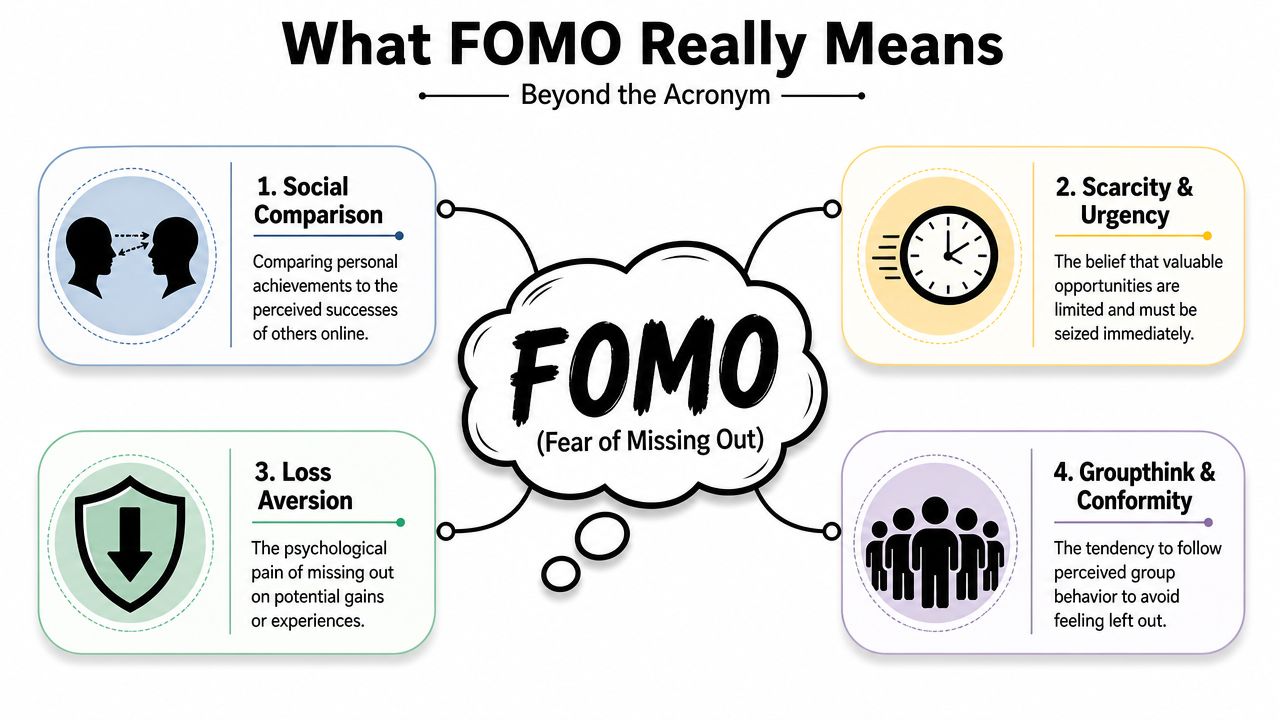
What FOMO Really Means Beyond the Acronym
FOMO is not just internet slang. It's now a standard dictionary entry, and Merriam-Webster notes the term was reported as being popularized as a widely known term in 2004 in its FOMO definition entry. That matters because it shows this isn't some throwaway meme word. It stuck because people recognized the pattern immediately.
In plain English, FOMO means anxiety that other people are getting experiences, wins, or access that you aren't. In career terms, it's the feeling that another candidate is joining a better team, getting a bigger upside package, or moving faster than you are.
Why Web3 magnifies it
Web3 is a perfect environment for comparison. Wins are public. Compensation is often discussed in fragments. Team moves spread fast through tight networks. People talk about token upside before they talk about management quality, shipping discipline, or whether the company knows how to execute.
That creates a distorted view of reality.
You don't see the missed payroll. You don't see the weak onboarding. You don't see the founder who changes direction every week. You see the announcement graphic and the line about being “early.”
The four forces behind FOMO
- Social comparison. You measure your private reality against someone else's public update.
- Scarcity and urgency. You assume the opportunity won't come again.
- Loss aversion. Missing the upside feels worse than the downside feels risky.
- Conformity pressure. If everyone smart seems to be moving in one direction, you want to follow.
Career truth: FOMO feels like clarity when you're in it. It usually isn't.
This is why the question “What's FOMO stand for?” matters in a professional context. It's not just a definition quiz. It's shorthand for a mental state that can wreck your decision quality if you don't catch it early.
How FOMO Fuels Risky Crypto Trading Decisions
FOMO is often first associated with trading, and that's fair. Crypto makes it obvious. A token starts running, your feed fills with screenshots, and suddenly your original plan disappears.
You tell yourself you're spotting momentum. Often, you're just late and emotional.

The mechanism behind the obsession
In technical psychology terms, FOMO is defined as a “pervasive apprehension” that others may be having rewarding experiences from which one is absent, and it has been linked to a desire to stay continuously connected. That's why it's tied to repeated checking behavior and works like an attention-loop trigger, as described in this explanation of FOMO and repeated checking behavior.
In crypto, that loop looks like this:
| Trigger | What you do | Why it goes wrong |
|---|---|---|
| Green candles everywhere | You open charts again | You're chasing movement, not a thesis |
| Other traders post wins | You feel late | You inherit their timing, not your plan |
| Price dips after entry | You panic-check every minute | You make reactive decisions under stress |
The problem isn't only financial. It spills into your career. If you're overtrading, under stress, and mentally glued to the market, your interview prep gets worse. Your work quality drops. You show up scattered.
What disciplined people do instead
They reduce unnecessary checking. They set conditions before acting. They separate signal from noise.
If you rely on event-driven updates rather than staring at a screen all day, this guide to instant signals for traders is useful because it supports a calmer workflow. Fewer compulsive checks usually means fewer impulse moves.
Try these rules:
- Write the reason before the trade. If you can't explain the setup in one or two sentences, skip it.
- Protect your attention during work hours. Don't let market noise sabotage your actual income.
- Treat trading stress as a career issue. If your portfolio volatility is dictating your job decisions, you're not making career choices. You're seeking emotional relief.
That last one matters. I've seen candidates accept shaky jobs because they felt financial pressure after bad trading decisions. FOMO in the market often becomes FOMO in the job search.
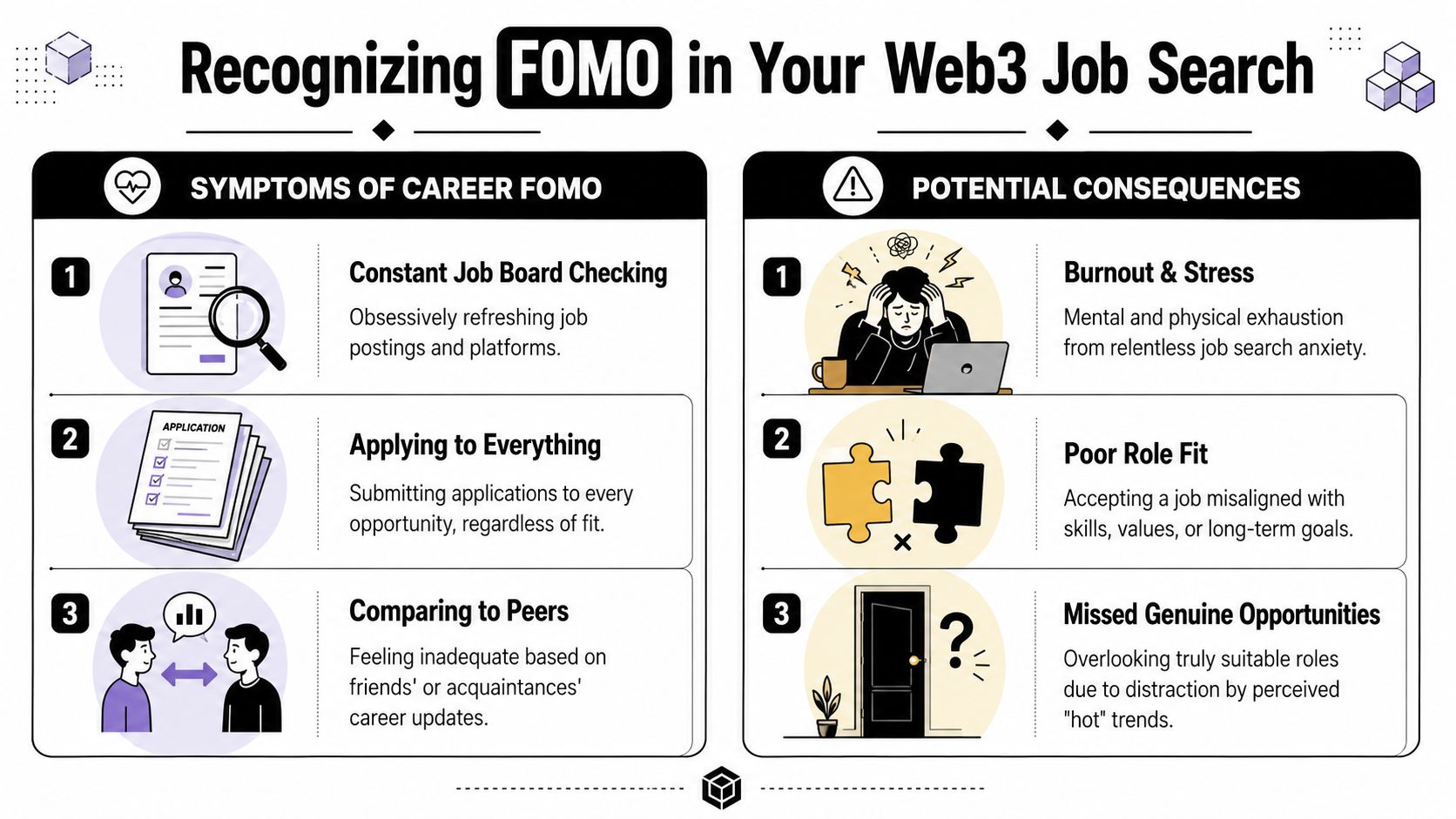
Recognizing FOMO in Your Web3 Job Search
Career FOMO in Web3 is rarely dramatic at first. It looks productive. You apply to more roles. You answer recruiters faster. You tell yourself you're staying open. Then the quality drops.
You start chasing category labels instead of role fit. “AI x crypto.” “DePIN.” “Restaking.” “Infra.” “Consumer SocialFi.” It changes every cycle, but the candidate mistake stays the same. People assume the hottest sector must be the smartest move.
What it looks like in real hiring situations
Here are the signs I watch for when a candidate is making fear-based decisions:
- They rush toward “urgent” roles. If a posting sounds like a countdown timer, they treat speed as proof of quality.
- They overvalue token talk. They focus on upside stories before they understand cash comp, vesting mechanics, team stability, and scope.
- They ignore manager quality. They'll spend an hour on narrative and five minutes on who they'll report to.
- They apply too broadly. They stop asking whether the role strengthens their long-term profile.
From a behavioral-design perspective, FOMO is often amplified by scarcity framing. Messages like “only X items are left” or time-bound offers trigger loss aversion, and the same principle can raise response rates in Web3 hiring when a role signals limited slots or high demand, as explained in this behavioral-design view of FOMO and scarcity framing.
That doesn't mean every urgent role is bad. It means urgency is a cue to slow your brain down.
A simple reality check for candidates
Ask these questions before you move forward:
- Would I want this role if nobody posted about it publicly?
- Does this company have a product and team I respect, or am I reacting to hype?
- If the token disappeared from the package, would the job still make sense?
- Am I choosing this because it fits my next chapter, or because I'm scared of being left behind?
A rushed offer can still be a bad offer. Fast process does not equal strong company.
For remote candidates, broad visibility helps, but filtering matters more. If you're scanning opportunities, use focused sources like remote Web3 jobs to compare roles calmly instead of letting social chatter pick for you.
The hiring language that should make you pause
Some phrases aren't red flags by themselves, but they should trigger deeper questions:
- “We need to move fast”. Why? Growth, chaos, or poor planning?
- “Everyone wants in”. Says who, and what does that mean?
- “This is a once-in-a-cycle opportunity”. Maybe. It's still your job to verify fundamentals.
- “We're looking for all-rounders who can wear many hats”. Fine in some startups. Also a common way to hide messy scope.
The strongest candidates I know don't get seduced by tempo. They get specific. They ask about runway, reporting lines, hiring plans, product roadmap, team culture, and what success in the role looks like after you join.
Practical Strategies to Tame Career FOMO
A candidate gets a hot offer on Tuesday, signs by Wednesday, and realizes by week three that the role is vague, the manager is absent, and the token upside was doing all the selling. I have seen that story too many times in Web3. FOMO is expensive when it shows up in your career.
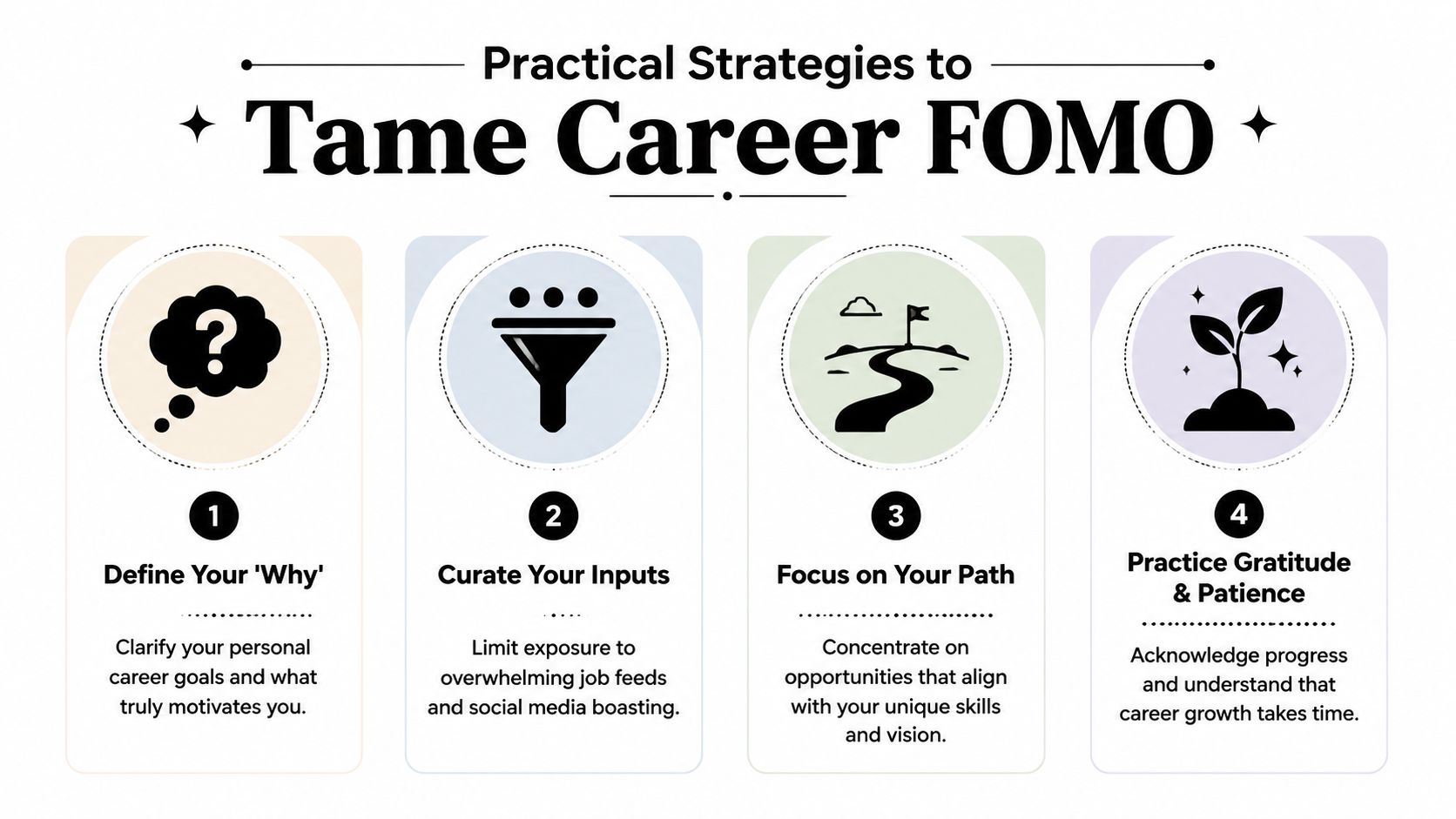
You do not fix career FOMO with more confidence. You fix it with a system that slows bad decisions down and makes good decisions easier to spot.
Five rules I give candidates
Set your decision criteria before interviews speed up
Write your baseline on paper. What stage do you want. What kind of manager do you work well with. How much cash versus token exposure makes sense for your risk tolerance. What skills are you trying to build over the next two years.
If a role misses on the points you already said matter, stop trying to talk yourself into it.
Create a 24-hour pause for offers
Excitement distorts judgment. So does scarcity. Once an offer arrives, wait a day, read the contract carefully, and compare the written terms to what you heard in calls. If a company pressures you to decide before you can think clearly, treat that as useful information.
Limit the inputs that trigger irrational moves
A lot of career FOMO starts with exposure. Funding announcements, title upgrades, token screenshots, and public victory laps can make mediocre opportunities look urgent. Clean up your feeds and stop treating public momentum like private proof.
If you want a better framework for staying steady under pressure, these trading psychology strategies apply to job decisions too. The same emotional mistakes show up in both arenas.
Score the role after every serious interview
Do not trust your memory. Use a simple scorecard and force yourself to rate the job on substance.
Criteria Your notes Manager quality Product clarity Team credibility Compensation structure Learning value Reputation risk This keeps one charismatic founder or one flashy brand from hijacking your judgment.
Use one grounded checkpoint before you commit
Talk to someone who is not impressed by hype. A good recruiter, operator, or mentor should ask plain questions about runway, scope, reporting line, and what success looks like after six months. That conversation will usually tell you more than another founder pitch.
Critical rule: Never accept a Web3 role because you're afraid there won't be another one.
One practical way to lower pressure is to stay visible without forcing a rushed choice. Joining a curated option like the Bitso talent network for future Web3 openings lets you stay in the market while keeping your standards intact.
Play the Long Game for a Sustainable Web3 Career
A founder pings you on Friday night. The title sounds bigger than your current role. The token package looks exciting. By Monday, half the team could be gone, the funding story could change, and your name would still be attached to the decision.
That is why the people who last in Web3 build judgment before they chase opportunity. They do not treat every hiring spike, token run, or loud announcement as a signal to move. They protect their reputation, their energy, and their ability to choose well again.
If you are already running on fumes, FOMO gets louder and your standards get weaker. That is usually the point where good people accept vague roles, unstable compensation, or messy reporting lines just to feel momentum. If that sounds familiar, read this practical guide on support for expat burnout. The recovery advice applies to high-pressure remote Web3 work too.
Strategic patience is selective action. It means staying active in the market, keeping conversations warm, and rejecting roles that do not hold up under scrutiny.
If you are looking for your next move in crypto, use Blockchain Jobs to find Web3 roles across engineering, product, design, marketing, compliance, operations, and more. Keep your search tight, ask harder questions, and pick the role that still makes sense after the hype wears off.