Async Remote Jobs: A Guide to Getting Hired in 2026
You’re probably here because you’ve seen “remote” on a job listing, taken the interview, then discovered the role still expects you online for half your day, in meetings spread across New York, London, and Singapore. That setup wears people down fast, especially in Web3, where engineering, product, security, and compliance work already carry a high cognitive load.
I’ve hired for distributed teams long enough to know that most candidates don’t fail async remote jobs because they lack technical skill. They fail because they misunderstand the operating model. In async environments, writing replaces a lot of talking, documentation replaces memory, and visible ownership replaces performative busyness. If you want to get hired into that kind of role, you need to show you can work that way before anyone gives you an offer.
What Asynchronous Remote Really Means
A lot of people use “remote” and “async” as if they mean the same thing. They don’t.
A remote team can still run like an office with webcams. You sit at home, but your day is controlled by live standups, fast replies, and constant availability. An asynchronous team works differently. It pushes decisions, updates, and context into written systems so people can contribute across time zones without waiting for everyone to be online at once.

That distinction matters because demand is still intense. Despite a multi-year decline, remote jobs stabilized at around 6% of all new postings by early 2025 while drawing 60% of all job applications, and the technology sector accounted for 18.3% of remote roles according to Aura’s remote and hybrid work report. In practice, that means good async remote jobs attract strong applicants who know how distributed teams function.
What real async looks like
On a real async team, people don’t treat Slack like a chat room that demands instant replies. They use it more like a documented workspace. Proposals go into channels, not side DMs. Product decisions live in docs. Pull requests contain context, trade-offs, and open questions. If someone wakes up six hours later in another region, they can still understand the state of the work.
That’s why candidates benefit from mastering synchronous vs asynchronous communication before they start applying. Hiring managers can usually tell within a few interactions whether someone knows when to write, when to escalate, and when a live discussion is justified.
Hiring signal: If you need constant verbal clarification to move work forward, you’re not showing async readiness. If you can create clarity for others in writing, you are.
What async is not
Async does not mean “nobody talks.” It also doesn’t mean total schedule freedom with no accountability.
Good async teams still use live communication for incidents, conflict resolution, hiring debriefs, and complex calls that would otherwise create long written loops. The difference is that synchronous time is used deliberately. It isn’t the default setting for every question.
For Web3 teams, that matters even more. Protocol work, wallet flows, token launches, governance mechanics, and compliance reviews all generate ambiguity. The strongest teams reduce that ambiguity with process, not with more meetings.
The Async Trade-Offs You Must Understand
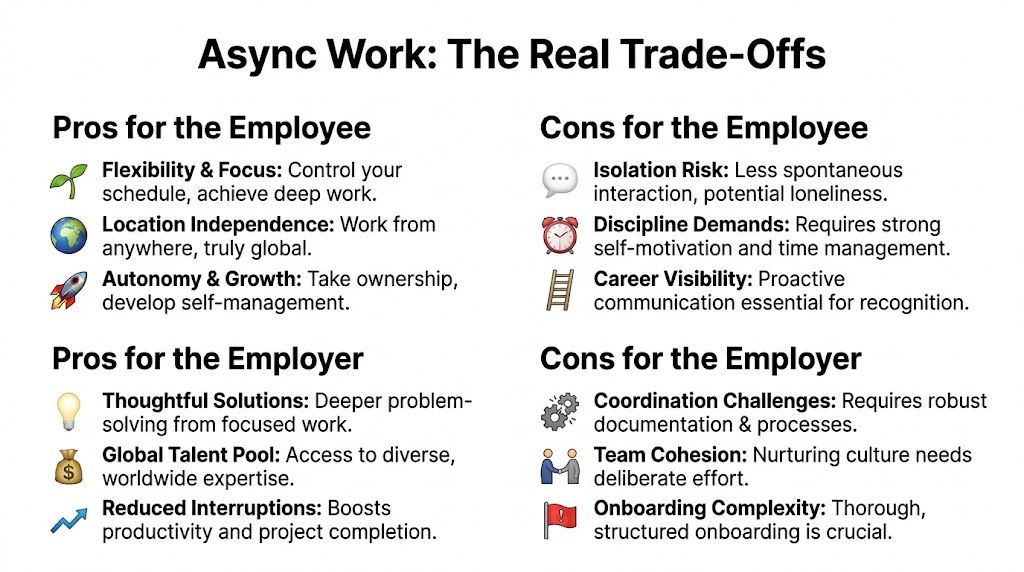
It's often said that async work means freedom. That’s incomplete. Async work is freedom paired with exposure. You get more autonomy, but your habits become visible very quickly.
If you’re organized, clear, and reliable, async remote jobs can be excellent. If you rely on managers to prompt you, teammates to rescue unclear work, or meetings to think out loud, async will feel harsh.
The upside people get right
The obvious upside is focus. For engineers, designers, and product managers, uninterrupted time matters. In crypto teams, one well-scoped block of deep work is often more useful than a day of fragmented status chatter.
Async also widens the talent map. Teams can hire strong people across regions without forcing everyone into a narrow overlap window. That’s especially useful in Web3, where niche skills in smart contracts, security, token design, and regulatory work aren’t evenly distributed in one city.
The downside people ignore
The hidden cost is that async punishes vague communication. Teams that use open channels and lightweight RFC-style documents can improve alignment by 40% to 60%, but lack of updates can also create 25% to 35% project delays when protocols are weak, according to Respawn’s analysis of remote and async work.
That’s the trade-off in one sentence. Async can make teams sharper, but only if they document decisions and progress well.
Async doesn’t remove coordination work. It turns coordination into written work.
What hiring managers are actually testing
When I assess candidates for async roles, I’m not just looking at their resume. I’m looking for operating habits.
Here’s what usually matters:
- Ownership under ambiguity. Can you move a task forward when instructions are incomplete, or do you stall?
- Writing quality. Can you explain a recommendation, risk, or blocker in a way that saves others time?
- Update discipline. Do you surface progress before someone has to chase you?
- Decision hygiene. Do you keep key context in shared spaces, or do you create confusion in private threads?
- Emotional steadiness. Can you handle delayed replies without assuming the project is off track?
The social side is real
Async can also make people professionally invisible if they don’t build trust on purpose. In office-heavy cultures, charisma can carry someone. In async environments, your reputation often comes from artifacts: docs, comments, issue quality, follow-through, and judgment.
That’s hard for candidates who expect “good work speaks for itself.” It doesn’t. Not in distributed teams. Good work has to be legible.
Reality check: If you want recognition in async work, don’t just finish tasks. Leave a clean trail of context, decisions, and outcomes.
Some people thrive in that model. Others feel isolated or under-seen. Neither reaction is wrong. But if you’re chasing async remote jobs because they sound easier, you’re optimizing for the wrong thing.
How to Find Genuine Async Remote Jobs
The fastest way to waste time is to search for “remote” and assume the role is async. Most aren’t. Many are just office jobs with a home internet connection.
In Web3, that gap is even wider. Plenty of companies market themselves as distributed while still relying on constant Slack responsiveness, founder-driven calls, and timezone-heavy rituals. Generic boards also blur the difference between remote-friendly and async-first jobs. That matters because a 2025 GitLab report noted 68% of distributed dev teams struggle with async adoption, a problem highlighted in the context around asynchronous remote job listings on Indeed.
Search for signals, not labels
“Async” rarely appears cleanly in the title. You need to search for cultural terms that reveal how the team operates.
Here’s a practical table I recommend candidates use.
| Search Query | Best For Finding | Example Platform |
|---|---|---|
| "documentation-first" | Teams that expect written thinking and decision trails | Niche Web3 job boards |
| "timezone agnostic" | Roles designed for low-overlap collaboration | Company career pages |
| "distributed team" | Globally spread organizations with async habits | Remote-first startup sites |
| "async communication" | Explicitly process-oriented teams | Founder or engineering blogs |
| "written communication" | Roles where writing is part of execution, not just reporting | Product, ops, and compliance listings |
| "low meeting culture" | Companies trying to protect maker time | Engineering and product roles |
| "RFC" | Technical teams with structured decision-making | Engineering career pages |
| "overlap hours" | Roles that are remote but not fully async, useful for comparison | Large job boards |
For crypto-specific roles, a dedicated remote board is often more useful than a giant horizontal platform. If you want a cleaner view of current opportunities, start with remote blockchain roles.
Read the job description like an investigator
A real async listing usually tells on itself. You just need to know what to look for.
Green flags:
- Written deliverables are named. The post mentions specs, memos, PRDs, runbooks, governance proposals, or audit coordination docs.
- Communication norms are explicit. It states how the team uses Slack, Notion, GitHub, Linear, Jira, or comments on pull requests.
- Time zone expectations are honest. The company says whether there’s limited overlap, core hours, or emergency coverage.
- Process appears before perks. The listing explains how work gets done before talking about retreats, stipends, or culture slogans.
Red flags:
- “Remote” paired with “must be available all day.”
- Heavy emphasis on fast replies without mention of documentation.
- No indication of how decisions are recorded.
- Vague culture language like “great communicator” with no specifics about channels, tools, or artifacts.
Vet the company outside the listing
The strongest candidates don’t stop at the post.
Check whether the company has public engineering notes, a team handbook, product updates, GitHub contribution patterns, or long-form writing from founders and leads. You’re looking for evidence that the company already thinks in writing. A team that publishes clear updates externally often does the same internally.
For engineering roles, review how they discuss pull requests, incidents, and roadmap trade-offs. For product roles, see whether they publish thoughtful release notes or governance context. For legal or compliance roles, look for signs that written review and escalation are formalized.
Use interviews to test the culture back
Most candidates use interviews to prove fit. Strong candidates also use them to verify the operating model.
Ask questions that force specifics:
- How are non-urgent decisions made when stakeholders are asleep in different regions?
- Where does final context live after a discussion ends?
- What kind of work gets a live meeting versus a written memo?
- How do new hires learn communication norms?
- What makes someone successful in the first ninety days?
A weak async team will answer with generalities. A mature one will describe channels, docs, review habits, and escalation paths.
Crafting Your Application to Win an Async Role
Your application is your first async test. Many candidates still treat it like a static package. In reality, hiring teams read it as evidence of how you think when nobody is there to clarify the brief.
That matters because research on remote work found 30% to 40% of subjects ignore instructions without real-time nudges, which leads to invalid data or failed tasks, as discussed in this Sage Journals paper on remote asynchronous testing. Hiring managers know this. When a role includes a written exercise, take-home task, or document-based interview, they’re often checking whether you can execute carefully from written prompts alone.

Rewrite your resume for async evidence
A generic resume tells me what you touched. An async-ready resume tells me how you operated.
Weak bullet:
- Managed cross-functional product launch for DeFi feature
Stronger bullet:
- Coordinated a distributed launch for a DeFi feature across product, engineering, and compliance using written briefs, milestone updates, and decision logs
Weak bullet:
- Led community growth initiatives
Stronger bullet:
- Built an async content and reporting cadence for community campaigns, documented experiments, and shared weekly insight memos with stakeholders across regions
Weak bullet:
- Supported legal reviews for token-related initiatives
Stronger bullet:
- Organized written review workflows for token and vendor matters, tracked open questions, and maintained decision records to reduce approval ambiguity
The point isn’t to stuff in buzzwords. The point is to show repeatable async behaviors: documentation, clarity, initiative, structured updates, and cross-time-zone coordination.
Show proof, not claims
If you say you’re strong in async work, back it up with artifacts.
Useful proof includes:
- A GitHub profile with readable pull request descriptions
- A portfolio that explains process, not just outcomes
- A Notion or document sample with clear thinking
- A writing sample for governance, product rationale, research, or operations
- A concise project postmortem
If you need examples of what strong written materials look like in the industry, browsing commentary and career resources on the Blockchain Jobs blog can help you benchmark tone, structure, and clarity.
Application rule: Don’t say “excellent communicator” unless your application already proves it.
Treat the take-home like a work artifact
Most candidates still submit assignments as if they’re turning in homework. In async hiring, the submission itself is part of the evaluation.
A strong submission usually includes:
A short summary up top
State what you understood, what you prioritized, and any constraints you assumed.Your reasoning, not just your answer
Show trade-offs. Explain what you chose not to do.Clean structure
Use headings, bullets, links, and labels so someone can review it quickly.Explicit open questions
Good async workers don’t hide uncertainty. They name it clearly.A note on next steps
Tell the reviewer how you’d validate, hand off, or extend the work.
This is especially important in Web3. Smart contract engineering, product design for wallet flows, security coordination, and compliance reviews all involve incomplete information. A candidate who shows structured judgment under those conditions stands out.
Written interviews are where many good candidates lose
A lot of sharp people underperform in written Q&A because they write like they’re texting. Short, reactive answers don’t build confidence.
Use a simple pattern:
- answer the question directly
- give brief context
- show how you’d execute
- mention one trade-off or risk
That pattern works for engineers, PMs, marketers, community leads, and legal candidates alike. It signals maturity. It shows you won’t create more work for the people who hire you.
Thriving in Your Async Career Beyond the Offer
Getting the offer is one challenge. Building a career in async remote jobs is another.
The biggest adjustment is visibility. In office settings, people often get credit for being present. In async environments, they get credit for making progress understandable. If you don’t document your impact, someone else’s more visible work may get rewarded first.
That concern is especially sharp outside engineering. Q1 2026 data cited in the context around facetime bias in asynchronous roles shows 55% of async marketers report stalled promotion due to facetime bias, and some studies referenced there find async legal teams can be 30% slower on ambiguous tasks without the right tools. For Web3 marketers, legal teams, and compliance professionals, that means performance has to be translated into documented outcomes.
Make your work easy to evaluate
If you want promotion momentum in async environments, create a system that surfaces impact without sounding self-congratulatory.
Use simple habits:
- Keep a weekly wins log with decisions made, blockers removed, and outcomes influenced.
- Write end-of-project summaries that capture what changed, what shipped, and what you learned.
- Use threads well so important reasoning stays attached to the original work.
- Document ambiguous issues early instead of waiting for confusion to harden.
A marketer can document campaign hypotheses, messaging tests, partner coordination, and community insights. A legal or compliance professional can document review paths, unresolved questions, and risk decisions. A product manager can keep specs, trade-offs, and post-launch learnings accessible.
Learn the tools that carry influence
In async teams, influence often travels through tools before it travels through meetings.
Get good at using Notion, Slack threads, GitHub, Linear, Jira, and RFC-style docs in a way that helps others move. Don’t write for the sake of writing. Write so someone in another time zone can take action without chasing you.
If you want a practical companion resource, this guide to best practices for remote teams is useful because it reinforces the habits that keep distributed work from turning into scattered work.
The people who grow fastest in async teams usually aren’t the loudest. They’re the clearest.
Manage up without creating noise
A lot of professionals overcorrect in async settings. They either disappear or over-update.
The middle path works best. Send thoughtful progress updates tied to business outcomes. Flag risk early. Ask narrower questions. Bring recommendations, not just problems. That makes managers trust your judgment, which is what usually drives stretch assignments and promotion paths.
For non-dev roles in Web3, this is critical. Community, partnerships, operations, legal, and finance work often produces less obvious visibility than code. Documentation closes that gap.
A Word for Employers Writing Async Job Listings
Most async job listings are too vague. They ask for “strong communication” and “self-starters,” then say nothing about how the company works. That weakens hiring on both sides.
If you want to attract strong async talent, write the listing like an operating document, not a recruiting poster.
What to include
- Define the communication model. Say whether the team is async-first, has core overlap hours, or uses a hybrid cadence.
- Name the tools and artifacts. Mention Slack, Notion, GitHub, Linear, Jira, RFCs, memos, or whatever runs the work.
- Describe decision flow. Tell candidates where proposals happen, who reviews them, and how final decisions are recorded.
- Be honest about urgency. If the role includes incident response, launch windows, or audit coordination, say so plainly.
- Explain the interview format. If there’s a written exercise, take-home, or async Q&A, tell candidates up front.
- State how success is measured. Good candidates want outcomes, not slogans.
What candidates should look for
A strong async listing reads with operational clarity. It tells you how the team communicates, what written work matters, and what kind of autonomy the role carries. A weak one hides behind culture language and never explains the mechanics.
Employers that want to attract crypto-native talent can post roles directly to a specialized audience through Blockchain Jobs hiring tools.
If you’re serious about landing async remote jobs in Web3, start where the roles are already filtered for the industry you care about. Blockchain Jobs makes it easier to find remote opportunities across engineering, product, marketing, legal, compliance, operations, and more, without digging through generic listings that don’t understand how decentralized teams hire.