Blockchain and Accounting: Guide for Finance Careers
You're halfway through month-end close, comparing wallet activity with the general ledger, chasing missing transaction details, and waiting for another team to confirm whether a payment belongs in accounts payable or an intercompany balance. The work feels familiar, but the records no longer live only in spreadsheets and ERP systems. In Web3 finance, accountants may need to interpret wallet addresses, trace smart-contract activity, and explain how on-chain events become financial statement entries.
That's where blockchain and accounting meet. The opportunity isn't limited to faster bookkeeping. Distributed ledgers can change reconciliation, audit evidence, internal controls, reporting, and the skills employers expect from finance professionals. If you understand both accounting judgment and transaction technology, you can become the person who translates raw blockchain activity into reliable financial information.
Introduction to Blockchain and Accounting Careers
Blockchain's accounting relevance traces back to the 2008 Bitcoin whitepaper, which introduced a decentralized, trustless, immutable ledger. That idea later shaped distributed-ledger applications in accounting and auditing. By the 2020s, accounting research had developed far beyond cryptocurrency infrastructure. A bibliometric study covering 2019 to 2021 found that blockchain represented 10.47% of the analyzed double-entry bookkeeping and ledger research stream, while a 2017 paper, “Can Blockchains Serve an Accounting Purpose?”, ranked as the most cited work in that set with 16,142 citations (accounting and blockchain research study).
Those figures matter for your career because they show how quickly the subject moved from a technical curiosity into a serious accounting research area. Employers aren't hiring accountants merely to repeat definitions of blocks and wallets. They need professionals who can reconcile on-chain activity, assess evidence, understand automated controls, and apply reporting standards when the underlying asset or transaction doesn't fit a familiar template.
What changes in daily work
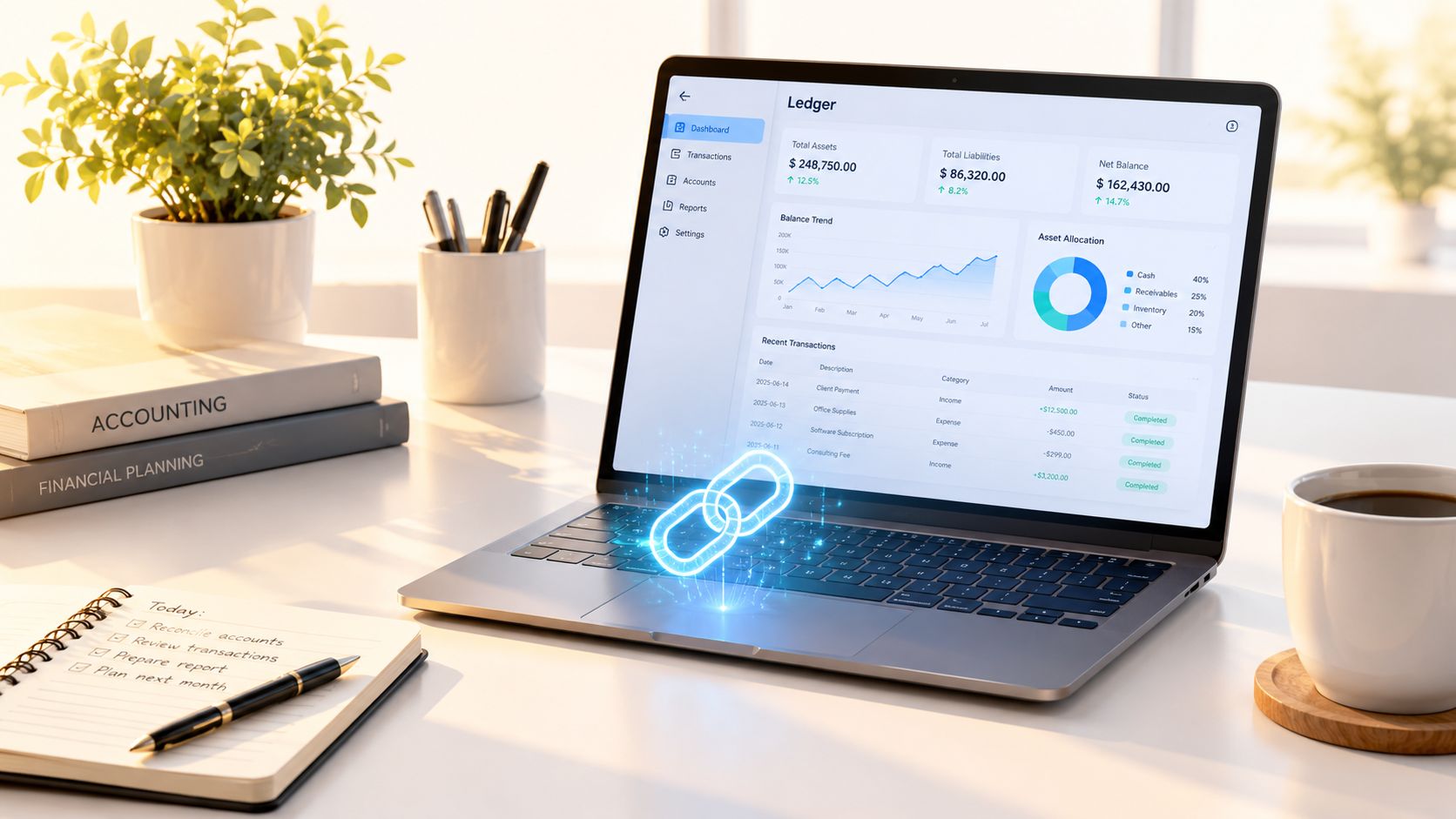
A traditional accountant may compare two company records and investigate differences. A blockchain accountant may start with a block explorer, identify the wallet involved, trace a smart-contract interaction, classify the economic event, and then map it into the ERP. The accounting judgment remains familiar, but the evidence trail becomes more technical.
That shift creates a hybrid career path. Entry-level candidates can stand out by learning how transaction data is structured and how to document a reconciliation. Mid-level professionals can progress by designing controls, reviewing custody processes, and explaining digital-asset reporting decisions to auditors and executives.
Career perspective: The valuable skill isn't knowing blockchain vocabulary. It's connecting a blockchain event to a defensible journal entry, control conclusion, or financial statement disclosure.
Understanding Blockchain Ledger Concepts
Start with the accounting problem, not the technology. In a conventional system, each organization may maintain its own database and later compare its records with another party's records. A distributed ledger lets authorized participants share a synchronized transaction history, so the question shifts from “Which spreadsheet is correct?” to “What transaction did the network validate, and how should we account for it?”
Four ideas provide the foundation:
- Decentralization: Records are shared across participating nodes rather than controlled by one database owner. In a permissioned business network, access can still be restricted, so decentralization doesn't necessarily mean public access.
- Immutability: Once a transaction is confirmed, changing the historical record is extremely difficult without the required network agreement. The ledger preserves the sequence of events, but it doesn't guarantee that the original input was correct.
- Consensus: Network participants validate transactions according to the system's rules. For an accountant, consensus is relevant because it supports the existence and timing of a recorded event, although it doesn't replace management approval or accounting analysis.
- Timestamping: Each record is dated and ordered, which helps teams establish when an asset moved, a payment occurred, or a contract condition was met.
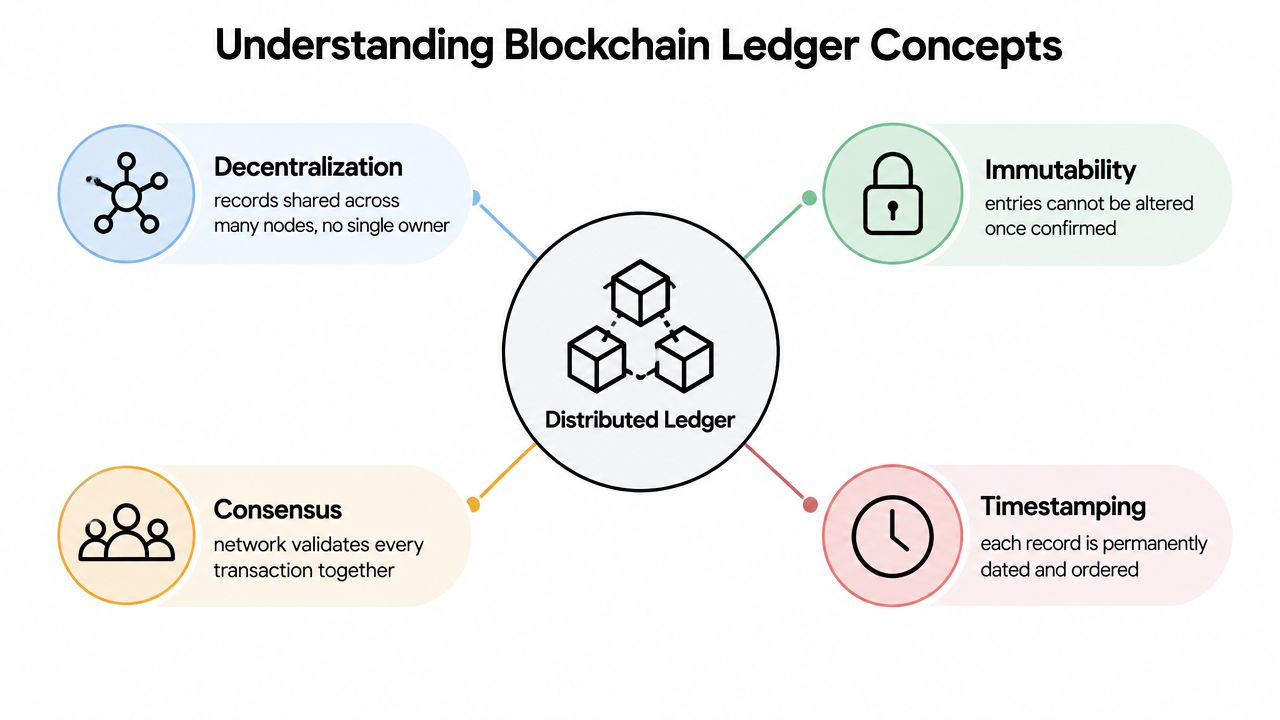
A useful analogy is a shared subledger that participants validate together. Traditional double-entry bookkeeping still matters because the company must record debits, credits, balances, and disclosures. Blockchain changes how supporting transaction evidence is created and shared. It can make the historical trail easier to verify, but the accountant still decides the economic substance and appropriate accounting treatment.
Why data capture becomes a control issue
An immutable ledger can preserve an error just as reliably as it preserves a valid entry. If a wallet is misidentified, a token is sent to the wrong address, or an oracle supplies incorrect information, later users may have difficulty correcting the historical record. Strong identity checks, approval workflows, and input validation therefore belong at the point of entry.
For junior accountants, the practical lesson is to learn both sides of the process: how a transaction is validated and how the organization confirms that the transaction reflects an authorized business event. For mid-level candidates, interviewers may expect you to explain how ledger design, custody, approvals, and journal-entry automation fit together. A useful companion resource is this guide to audit-ready journal entry automation, especially when you're considering how operational data can flow into controlled accounting processes.
Here's a short visual explanation of the ledger mechanics:
Efficiency Gains in Reconciliation and Reporting
A controller reviews an intercompany settlement and finds three versions of the same transaction: one in the company ledger, one in a supplier file, and one in a payment platform. The work is not difficult because the accounting rule is unclear. It is difficult because the records do not agree. Blockchain can reduce that repeated comparison when several parties use a synchronized transaction history.
Intercompany accounting, supply-chain settlements, and shared accounts-payable or accounts-receivable processes are strong candidates. Instead of matching separate records line by line, accountants can verify whether participants reference the same transaction state. A 2025 Frontiers literature review reports empirical evidence of a 90% temporal reduction in reconciliation protocols in a PwC example, alongside automated transaction authentication, machine-learning anomaly detection, and continuous monitoring (Frontiers review of blockchain applications).
The career lesson is specific. Employers hiring for Web3 finance roles need accountants who can supervise automation, define exception rules, validate inputs, investigate unusual activity, and document acceptance decisions. Faster processing has value only when the resulting records remain usable for reporting.
A 2024 PLOS ONE study reported a 25.7% increase in information-sharing efficiency, a 19.8% improvement in data accuracy, and a 13.6% reduction in financial information-sharing costs compared with a control group (PLOS ONE study on blockchain accounting). The practical application is clearest where multiple organizations need one dependable transaction history.
| Metric | Improvement |
|---|---|
| Reconciliation protocol time | 90% temporal reduction in a PwC example, Frontiers review |
| Information-sharing efficiency | 25.7% increase |
| Data accuracy | 19.8% improvement |
| Financial information-sharing costs | 13.6% reduction |
Turn efficiency into an interview answer
Avoid the vague claim that blockchain makes reconciliation faster. Explain the workflow. Separate teams maintain records for one settlement, discrepancies trigger manual matching, and a shared ledger lets participants verify a common transaction state. Accountants then focus on authorization, classification, valuation, and exceptions.
A clear interview response follows four steps:
- Identify the process: Separate teams record the same settlement.
- Explain the failure point: Differences create follow-up and manual matching.
- Describe the improvement: Participants verify a synchronized transaction state.
- Name the remaining judgment: Accountants assess authorization, classification, valuation, and exceptions.
That answer connects technical knowledge to accounting results: fewer repetitive reconciliations, cleaner evidence, and more time for judgment-heavy work. It also shows hiring managers that you understand where automation stops and professional responsibility begins.
Shifting Internal Controls and Audit Workflows
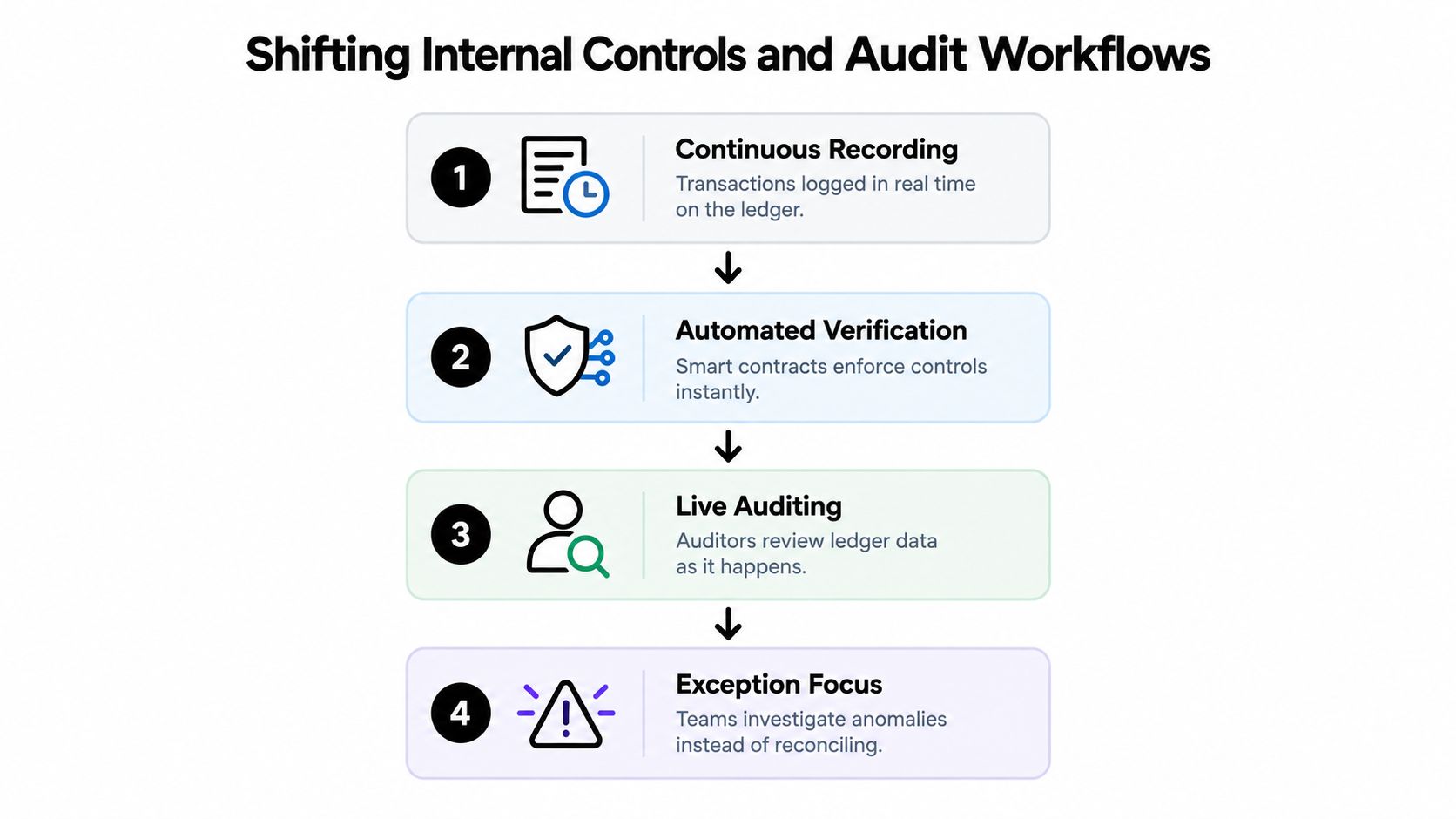
A month-end close reveals the difference between old and blockchain-oriented controls. Under a traditional process, accountants reconcile ledgers, collect invoices and emails, test samples, and investigate unusual balances after activity has accumulated. A blockchain workflow can place more checks near the transaction itself, recording activity continuously and applying predefined rules before or during posting.
The ledger works like a shared logbook. Its time-stamped entries can make sequence, ownership, and timing easier to verify. They do not show whether the transaction was authorized or whether the accounting conclusion is correct. A smart contract can enforce a rule, while finance professionals still assess whether that rule matches the business agreement and reporting requirements.
Compare the control models
| Traditional workflow | Blockchain-oriented workflow |
|---|---|
| Teams reconcile separate records after activity occurs. | Participants reference a synchronized transaction history. |
| Auditors test selected historical transactions. | Monitoring can run continuously against ledger activity. |
| Evidence is gathered from invoices, emails, and system logs. | Time-stamped ledger records supplement supporting evidence. |
| Exceptions may appear during month-end close. | Rules can flag or prevent exceptions closer to the transaction point. |
The 2024 Management Science paper on distributed ledgers presents financial reporting and auditing as a redesigned process, including misreporting incentives, auditor monitoring, and regulatory policy (Management Science discussion of distributed ledgers). That perspective gives candidates a stronger interview answer than “blockchain stores records.” Employers hiring for Web3 finance roles want people who can connect ledger design with monitoring, management reporting choices, and assurance.
For a practical explanation of evidence trails, accountants can review the Jumpstart Partners audit trail guide. The guide connects traceability with the questions auditors ask: what happened, when it happened, who approved it, and whether the record changed.
The input problem
Blockchain protects the integrity of recorded data only when information enters the system accurately. Interviewers may ask about oracle governance, identity management, wallet permissions, and approval workflows. A strong answer separates two responsibilities: protecting a confirmed record and validating the actual event that produced it.
Interview rule: State what the ledger proves, then state what it does not prove. That distinction shows control judgment.
Crypto Asset Valuation and Reporting Standards
Crypto-asset accounting becomes difficult when the technology is familiar but the reporting conclusion isn't. A finance team may hold tokens, issue digital assets, receive crypto consideration, operate a custody arrangement, or use decentralized-finance protocols. Each fact pattern can raise separate questions about classification, measurement, presentation, tax reporting, and disclosure.
Under U.S. GAAP, FASB ASU 2023-08 requires fair-value measurement for certain crypto assets. The same evidence base notes that the IRS Form 1099-DA starts broker reporting for 2025 transactions, while IFRS-related materials state that FASB added a digital-assets research project in August 2025 (IFRS material on cryptocurrencies and digital assets). These developments make it risky to give a single answer to “How do you account for crypto?” The correct response depends on the asset, the holder's purpose, the jurisdiction, and the applicable reporting framework.
Build a classification analysis
IFRS doesn't provide a dedicated cryptoasset standard. KPMG explains that companies must apply relevant existing IFRS requirements, and it notes that the 2019 IFRS IC agenda decision supports applying IAS 2 to cryptocurrencies held for sale in the ordinary course of business (KPMG guidance on cryptoassets under IFRS).
In an interview, work through the facts in sequence:
- Purpose: Is the asset held for investment, resale, operational use, or another business purpose?
- Rights: Does the token create an enforceable claim against an issuer or another party?
- Market evidence: Can the organization support valuation and explain volatility?
- Control: Who controls the wallet, private keys, or custody arrangement?
- Presentation: Which line items, disclosures, and policy explanations will help users understand the position?
Don't label every token an intangible asset, inventory item, or financial instrument by default. Explain which facts drive the conclusion and which standards you would research. That approach signals technical maturity.
Candidates should also monitor specialist roles such as this senior manager financial reporting and technical accounting position, because the responsibilities illustrate how digital-asset work connects standards research with close, disclosure, and audit support.
Building Hire-Ready Skills for Blockchain Accounting
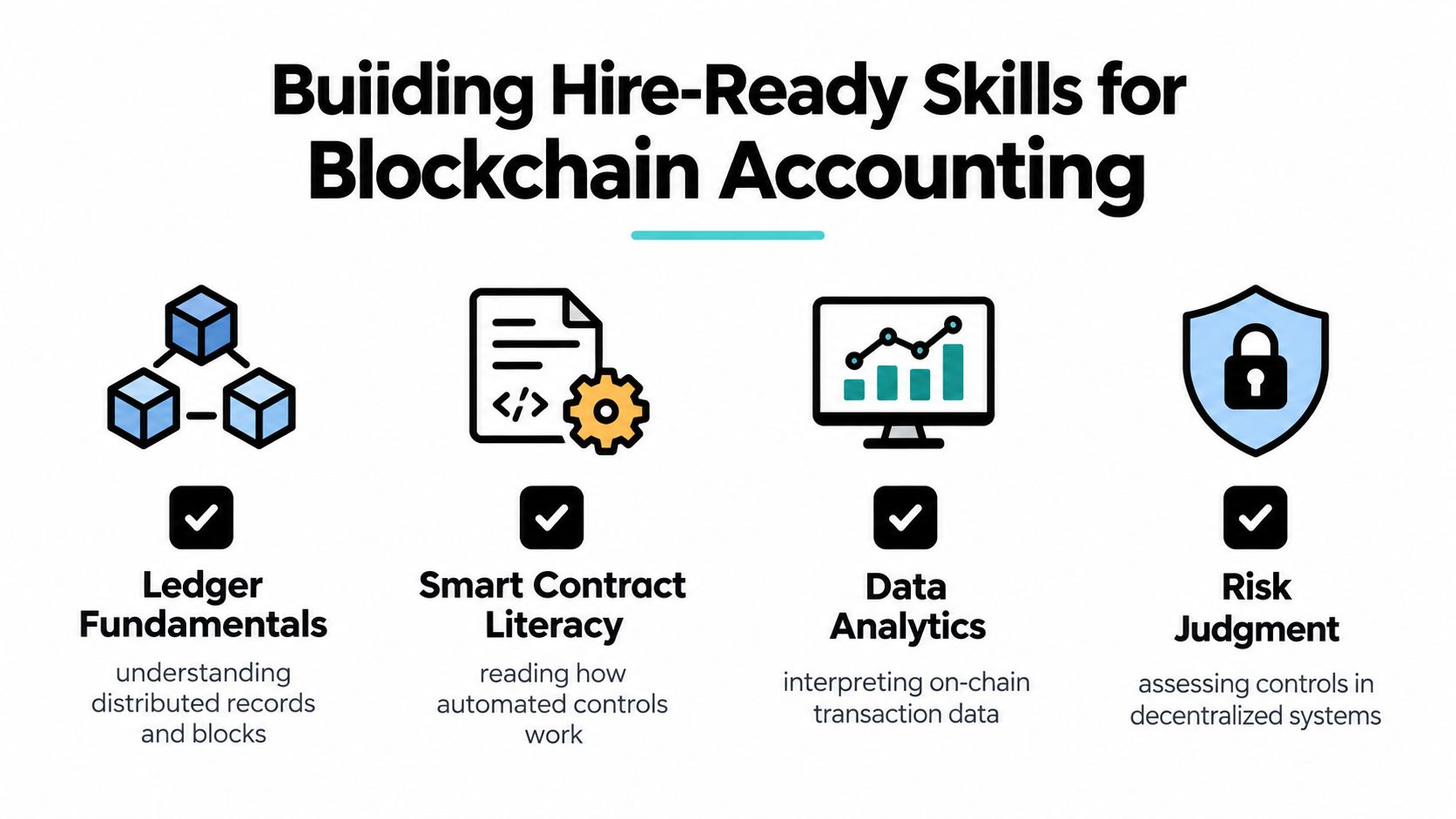
A strong blockchain accounting profile combines conventional credentials with evidence that you can interpret on-chain activity. Ernst & Young's External Audit, FSO Blockchain Senior posting asks for a bachelor's degree in accounting, finance, information systems, computer science, or a related field, two or more years in external audit or assurance, and CPA certification or CPA eligibility with progress toward passing the exam (EY blockchain audit role). The posting also values knowledge of wallets and addresses, transaction mechanics, smart contracts, DeFi, and custody or private-key management.
Develop the hybrid profile
Ledger fundamentals come first. Learn how to follow a transaction from wallet activity to a business event, then explain what evidence supports the accounting entry.
Data analysis turns that knowledge into workplace value. Job listings emphasize advanced Excel, ERP exposure, and analytics tools. Some mention SQL or Python as a bonus, while others seek NetSuite or similar ERP experience and comfort handling high volumes of on-chain transactions (digital-assets accounting role).
Technical accounting judgment separates a curious candidate from a dependable one. Practice analyzing token issuances, exchange and custodial accounting, DeFi, staking, lending, derivatives, and crypto basis tracking. You don't need to present yourself as a protocol engineer. You do need to explain the economic substance clearly.
Control awareness is equally important. Be ready to discuss wallet access, private keys, approvals, reconciliations, smart-contract dependencies, and exceptions. Employers want someone who can ask, “What could go wrong, and what evidence would prove the control worked?”
Position your experience clearly
Translate familiar work into blockchain-relevant language. A bank reconciliation becomes transaction-source validation. An audit schedule becomes an evidence trail. An ERP implementation becomes systems integration. A variance analysis becomes exception investigation.
If you're weighing accounting against planning work, read about FP&A on AmbitionCFO to clarify which path fits your strengths. Blockchain companies need both controllership discipline and forward-looking analysis, but the hiring signals differ.
For a role-specific benchmark, review this accounting manager opportunity at Coinbase. Compare the requirements with your own experience, then close the gaps through a small portfolio project, such as documenting a wallet reconciliation, building an exception report, or writing a technical accounting memo.
Next Steps for Your Blockchain Finance Career
Your career plan should combine accounting depth with practical blockchain fluency. Start by mastering the ledger concepts that affect evidence, then apply them to reconciliation and controls. After that, practice reporting questions involving classification, fair value, custody, and disclosure. This sequence helps you speak like an accountant who understands the system rather than a technologist repeating industry terms.
Use a focused progression
- Strengthen the accounting base. Be comfortable with journal entries, reconciliations, financial statement presentation, audit evidence, internal controls, and technical research. Blockchain work still depends on these fundamentals.
- Trace real transaction patterns. Use a public block explorer to follow wallet activity, identify transfers and contract interactions, and document what you can and can't conclude from the data.
- Create interview-ready work samples. Prepare a reconciliation walkthrough, a control matrix for wallet approvals, and a short memo analyzing a digital-asset classification question. Remove confidential information from any previous employer material.
- Practice the judgment questions. Explain how you would investigate an unexplained wallet balance, validate a private-key control, evaluate an oracle dependency, or reconcile on-chain activity to an ERP.
- Track reporting changes. Standards and regulatory expectations continue to evolve, so show interviewers how you find authoritative guidance and update a documented accounting policy.
The most durable advantage is translation. Hiring teams need professionals who can move between a block explorer, an ERP, an audit request list, and a management discussion without losing the accounting thread. That capability supports progression from reconciliations into senior accounting, controllership, technical accounting, assurance, finance systems, or risk roles.
Explore current finance and accounting jobs in blockchain and compare each listing with your skills inventory. Choose one target role, mark every requirement as demonstrated, developing, or missing, and spend your next study session closing the most important gap. Then rehearse a concise explanation of how your accounting experience improves the company's control, reporting, or reconciliation process.
Blockchain Jobs brings together Web3 finance and accounting opportunities alongside roles across the broader blockchain ecosystem, helping you search for positions that match your technical and professional goals. Visit Blockchain Jobs to review focused listings, identify your next target role, and put your blockchain accounting skills into action.