
Web3 Marketing Strategy Playbook for Careers and Growth

Web3 marketing strategy now lives and dies on wallet behavior, not top-of-funnel attention. Teams are judged on activated wallets, weekly active wallets, and cohort retention, while many still spend 20% to 40% of treasury resources on growth with less than 20% attribution capability, which is why weak marketing operators get exposed quickly and strong ones build careers fast.
That's the counterintuitive part. In most markets, marketers can hide behind reach, brand lift, and traffic charts for a while. In web3, that doesn't last. If a user connects a wallet and never does anything on-chain, the campaign didn't work in any meaningful sense.
That shift changed more than reporting. It changed hiring. The people who keep advancing are the ones who can translate narrative into activation, activation into retention, and retention into a credible hiring story. If you want better roles, stronger interview performance, or a higher offer, you need to understand how a real web3 marketing strategy gets evaluated in practice.
The Shift from Awareness to Activation in Web3 Marketing
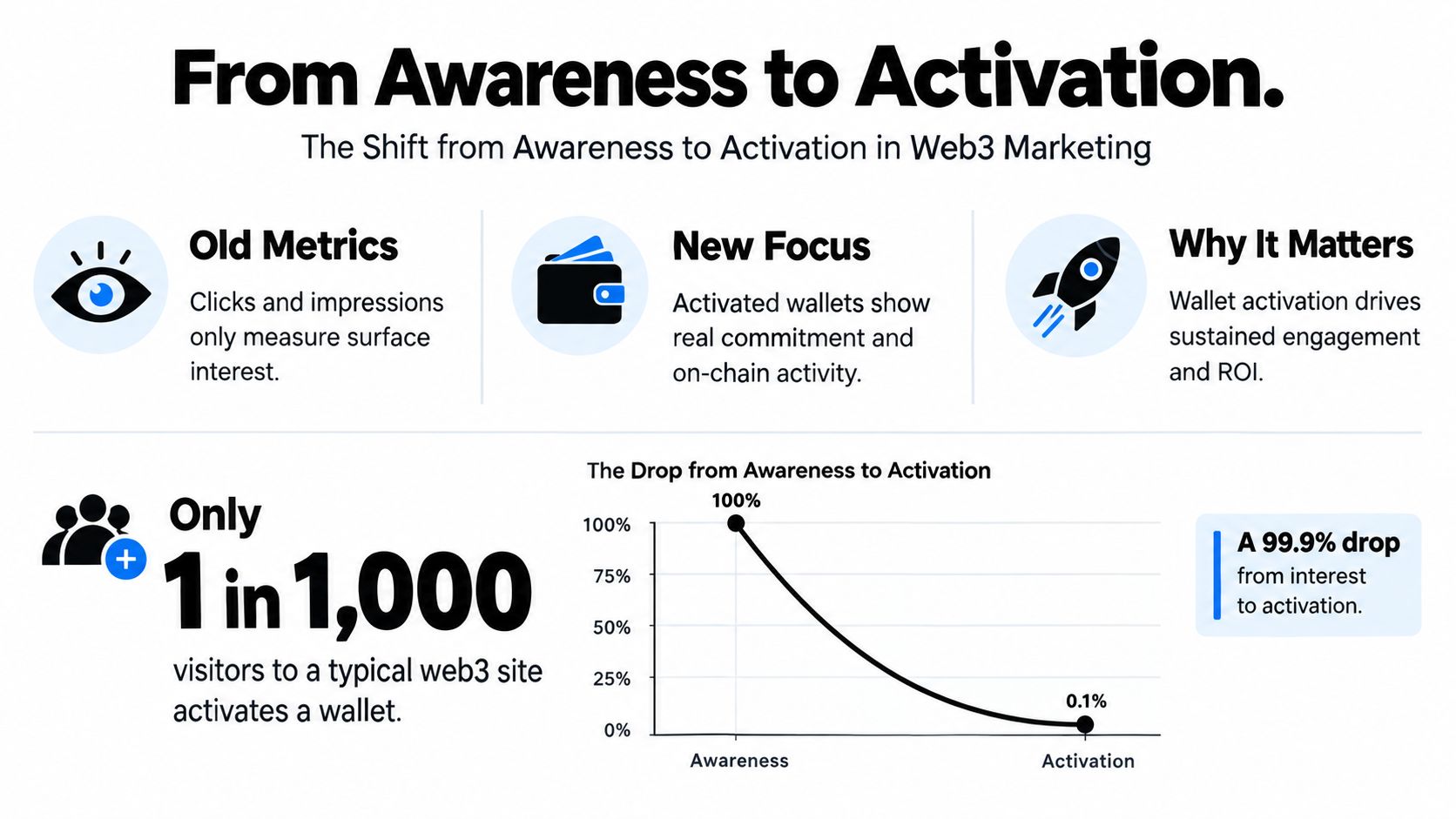
The old web2 instinct is to optimize for visibility first and trust conversion later. In web3, that order often fails. The useful unit isn't the click. It's the activated wallet.
A strong team tracks cost per wallet, activated wallet rate, weekly active wallets, and cohort retention, because those metrics reveal whether acquisition turned into actual product use, not just curiosity (Coinbound on web3 marketing metrics). That sounds obvious, but many teams still hire for posting volume, surface engagement, or event coordination without asking whether the marketer can trace user behavior after the first touch.
What changes when the wallet becomes the metric
Once you measure activation properly, marketing starts looking a lot more like product and analytics work.
Instead of asking whether a campaign got attention, you ask:
- Did the user fund a wallet: A connected wallet with no downstream action is often weak intent.
- Did they complete a meaningful action: Mint, swap, stake, vote, bridge, or whatever your product defines as real usage.
- Did they come back: Retention tells you whether the original message matched the product experience.
That shift matters because web3 teams often direct 20% to 40% of treasury resources to growth while still operating with less than 20% attribution capability (Coinbound on web3 marketing metrics). If you've hired for crypto before, you've seen the result. Lots of busy activity. Very little clarity.
Practical rule: If a marketer can't explain what happens between wallet connect and second on-chain action, they're not ready for ownership.
The market got large enough that this discipline stopped being optional. One market summary reported the global web3 user base grew 43% year-over-year to 302 million in 2022 (Coinbound on web3 marketing metrics). When the audience scales that quickly, retention stops being a nice dashboard and becomes the only way to distinguish real growth from noisy acquisition.
Why this changes hiring and promotion
Junior marketers can still win by executing community ops, content distribution, and launch support. But promotion starts when they can connect work to behavior.
A hiring manager looking at a resume for an activation-focused role wants evidence like:
| What you did | What it signals in interviews |
|---|---|
| Built onboarding flows tied to wallet actions | You think past traffic |
| Reported by cohort instead of by post | You understand user quality |
| Partnered with product on activation events | You can work cross-functionally |
That's why roles built around habit loops and activation are gaining weight. If you want to understand what employers mean by this in practice, look at an engagement marketing manager focused on activation and habituation. Those job descriptions usually reveal expectation better than public marketing advice does.
One practical support layer here is distribution infrastructure. Teams that publish repeated, structured mentions across relevant outlets often use tactics like programmatic branded clipping to reinforce discoverability around launches, partnerships, and ecosystem milestones. It won't fix a weak product funnel, but it can strengthen narrative recall when the activation system behind it is solid.
Defining Your Web3 Audience Beyond Follower Count
Most bad web3 marketing strategy starts with one flawed assumption. Bigger community equals better growth.
That's not how strong teams think anymore. The more useful question is whether your audience has the right kind of intent. Recent industry coverage pushes past generic community-first advice and puts more emphasis on developer audiences, technical credibility, and real-world activations before mainstream reach (Blokhaus on the state of crypto marketing 2026). That has direct career implications because mid-level and senior interviews now test audience judgment, not just execution speed.

Four audience buckets that actually matter
I've found that web3 teams get sharper when they stop talking about “the community” as one blob and split the market into behavior groups.
Developers
These users care about documentation quality, technical credibility, ecosystem support, and whether the protocol is worth building on. If you market infra, L2s, tooling, or anything composable, this group often matters more than retail attention.Holders and active users
They want utility, clarity, and signs that the team ships. They're sensitive to product friction and messaging inconsistency.Partners and institutions
This group evaluates professionalism. Messaging that works on Crypto Twitter often fails here. Team transparency, roadmap discipline, and operational maturity matter more.Skeptics and adjacent newcomers
They're not persuaded by slogans. They need lower perceived risk and clearer explanations of what the product does.
How to define the audience in practice
A practical audience review usually starts with three checks.
- Look at who performs the second meaningful action: The best audience isn't the one that arrives first. It's the one that returns.
- Audit where questions come from: Developer-heavy communities ask implementation and integration questions. Mercenary communities ask about rewards first.
- Compare messaging response by segment: The same announcement can attract builders in one channel and bounty hunters in another.
The audience quality test is simple. Would you still want this segment if all incentives disappeared next month?
That's the kind of question senior interviewers ask indirectly. They may phrase it as “How would you segment our community?” or “How would you launch to both builders and users?” What they want to hear is that you understand audience depth.
What this means for career progression
Audience sophistication is one of the clearest markers between levels.
- Early-career marketers usually get asked to grow channels, moderate, and publish.
- Mid-level marketers need to show they can segment and tailor campaigns.
- Senior marketers need to know which audience matters first, and which can wait.
A candidate who says “I grew Discord” sounds tactical. A candidate who says “we prioritized developers first because ecosystem adoption depended on integration trust” sounds promotable.
Here's the practical difference:
| Candidate framing | Hiring read |
|---|---|
| “I increased community engagement” | Execution support |
| “I built separate journeys for builders, holders, and skeptics” | Strategic thinking |
| “I changed messaging after seeing low-quality wallet activity from one segment” | Operator with judgment |
Follower count still has some signaling value. It just shouldn't drive your strategy, or your career story.
Community Tactics Versus Token-Native Growth Models
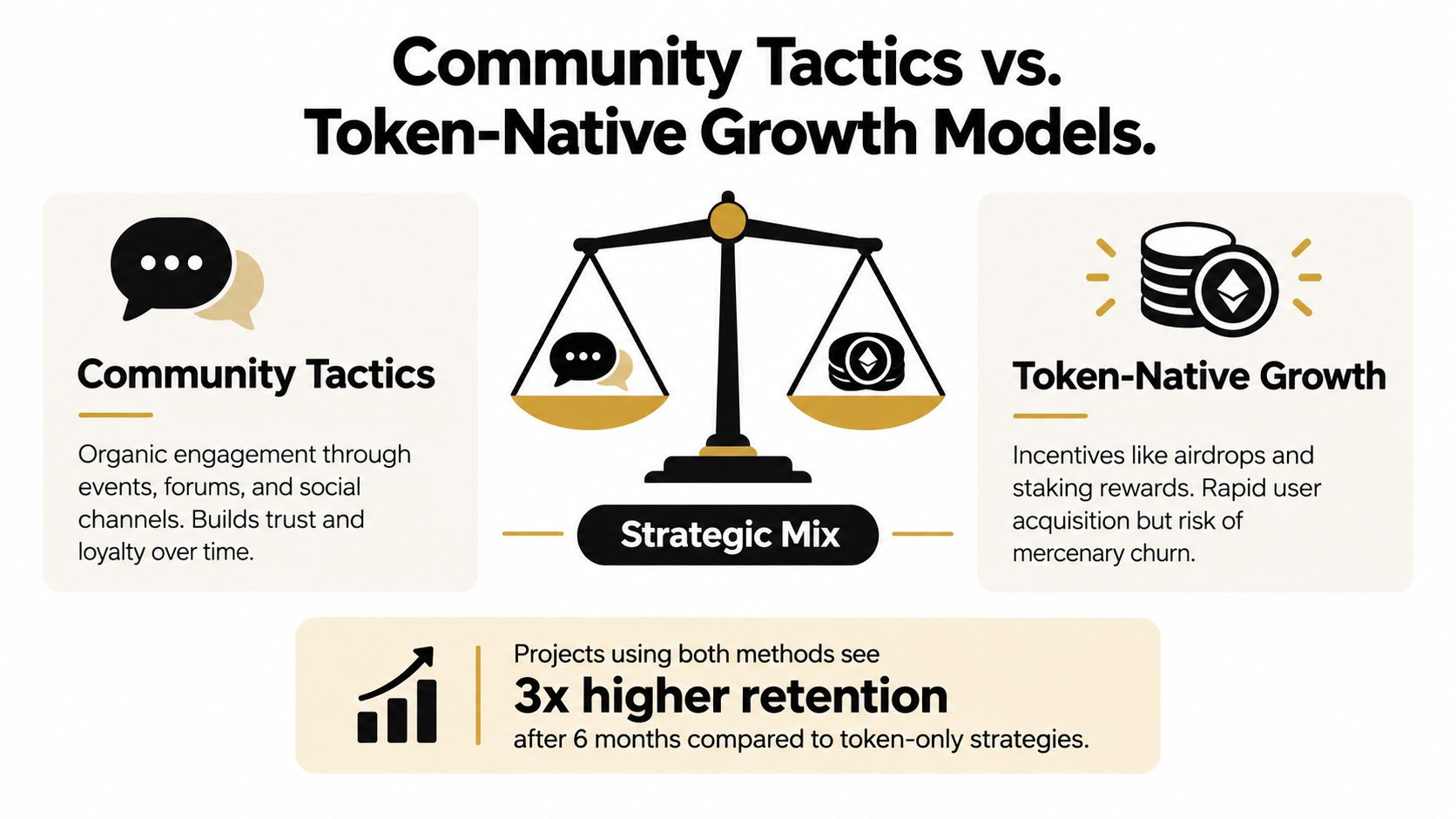
Web3 teams love false binaries. Community or incentives. Brand or token. Organic or paid. In reality, most strong programs use a mix. The hard part is knowing which lever should lead.
For NFT and tokenized brand marketing, the discovery layer concentrated early around public social platforms, with Twitter accounting for roughly 75% of social-media traffic share and YouTube coming in at under 25% in one market snapshot (Webacy NFT market snapshot). That history still shapes execution. Social conversation, creator-led storytelling, and visible participation mechanics remain central to how people find web3 projects.
When community tactics win
Community-led growth works best when the product needs trust before scale.
That usually includes developer platforms, infrastructure, governance products, and anything where users are making a longer-term commitment. In those cases, the marketing job is to create repeated proof. Founder visibility, contributor participation, technical explainers, ecosystem support, and consistent social presence all matter more than short-term volume.
Use community-first tactics when:
- The product has a learning curve: Users need education and reassurance.
- Technical credibility is part of the brand: Empty reach can actively hurt you.
- You need durable advocates: Developers, contributors, and power users compound distribution over time.
When token-native growth wins
Token mechanics can accelerate discovery fast. Airdrops, points, staking rewards, quests, referral loops, and access tiers can all create movement. But they often attract users who optimize for extraction rather than adoption.
That doesn't mean they're bad. It means they need guardrails. If incentives aren't tied to meaningful product behavior, the team buys activity it can't retain.
A simple decision matrix helps.
| Situation | Community-heavy approach | Token-native approach |
|---|---|---|
| Early infra or protocol credibility | Strong fit | Risky if used too early |
| Consumer launch with low friction onboarding | Helpful but slower | Useful for fast attention |
| Thin treasury and small team | Better if message is strong | Can create support burden |
| Weak analytics discipline | Safer | Dangerous because noise looks like growth |
The broader market moved quickly in this direction. One summary reported 47% of marketers globally had incorporated web3 elements into their strategies by 2023, and another cited 35% growth in decentralized-platform usage by marketers between 2021 and 2023, both captured in the same market snapshot context (Webacy NFT market snapshot). That fast maturation is why teams now expect marketers to make trade-off calls, not just run campaigns.
A good visual reminder helps when teams get overly ideological about this choice.
What hiring managers look for here
Seniority starts to show.
A junior marketer asks how to promote the campaign. A senior marketer asks what behavior the campaign is buying, and what kind of user it will attract.
If you're interviewing for a growth, ecosystem, or head-of-marketing role, expect some version of this prompt: “Would you use an airdrop here?” The strongest answer isn't yes or no. It's a stage-aware trade-off tied to product maturity, audience quality, and retention risk.
Attribution, Analytics, and the Multi-Touch Reality
The fastest way to spot an inexperienced web3 marketer is to ask how they attribute conversion. If the answer is basically “last click,” you already know the ceiling.
Web3 user journeys are messy. A user might see a founder thread on X, join Telegram, watch a YouTube explainer, read docs, connect a wallet from a different device, and transact days later. Single-touch reporting flattens that into fiction.
Why multi-touch matters
One 2025 analysis reported a 14–36% CPA efficiency lift when teams used multi-touch attribution models instead of single-touch models, while roughly 70% of crypto projects reportedly failed to demonstrate marketing ROI (state of web3 marketing 2026 Q2). That gap tells you two things at once. Better measurement improves efficiency, and a lot of teams still don't have it.
If you need a clean non-crypto explanation of one common blind spot in paid measurement, this guide to view through attribution defined is useful because it clarifies why an impression can influence a later action even without a direct click.
The activation gap most teams ignore
Wallet connection is not success. It's the start of qualification.
The stronger benchmark is whether users complete at least one or two on-chain actions within 30 days and then retain over 90 days, which is exactly why source-level cohort tracking and reward-hunter detection matter in web3 measurement (state of web3 marketing 2026 Q2). Without that, teams congratulate themselves for attracting wallets that never become users.
A practical reporting stack should answer four questions:
- Which source introduced the user first
- Which touchpoints appeared before the first transaction
- Whether the wallet performed a second meaningful action
- Whether that wallet stayed active beyond the initial incentive window
Don't report connected wallets without reporting post-connect behavior. That's how weak campaigns survive longer than they should.
What this looks like in interviews and on the job
Attribution literacy is a career accelerator because it maps directly to ownership.
For junior candidates, it's enough to show comfort with campaign tagging, dashboards, and clean reporting habits. Mid-level candidates should be able to explain cohort logic and identify where vanity metrics distort decision-making. Senior candidates need to set the measurement model, align with product and data teams, and challenge bad conclusions.
Here's a useful framing:
| Level | What interviewers want on analytics |
|---|---|
| Junior | Can you track and report accurately |
| Mid-level | Can you interpret source quality and cohort behavior |
| Senior | Can you design the measurement system and defend budget allocation |
The marketers who get hired into stronger roles aren't always the most creative people in the room. They're often the ones who can say, with discipline, which channels assisted activation, which wallets were low quality, and which campaign looked good only because the model was wrong.
Career Paths and Hiring Expectations in Web3 Marketing
Talk about web3 marketing strategy as if it's one job. It isn't. It's a ladder of very different jobs, and companies hire differently at each rung.
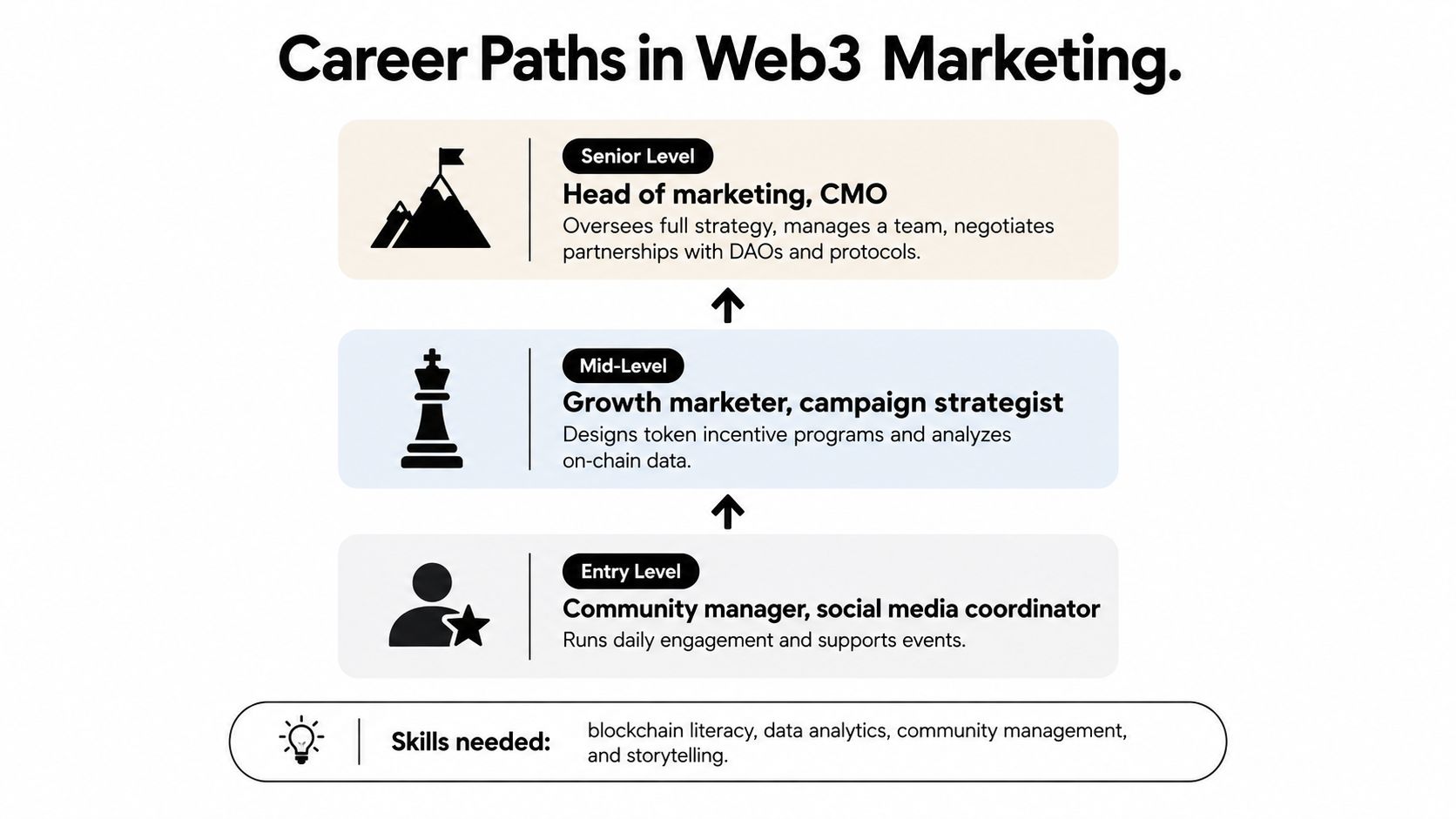
A practical career map from a 2026 web3 marketer guide breaks the path into four stages: entry level at 0–18 months, mid-level at 18 months–4 years, senior level at 4–7 years, and executive level at 7+ years (Flexe web3 marketer guide). The responsibilities shift from community and social execution to campaign ownership, then to strategy, tokenomics input, institutional marketing, and organizational leadership.
What each stage actually looks like
The title matters less than the scope. The scope tells you whether you're under-leveled, over-leveled, or priced correctly.
Entry and mid-level roles
Entry-level work usually means community management, content, and social operations. Mid-level shifts into campaign ownership and KOL coordination (Flexe web3 marketer guide).
A separate salary breakdown gives this useful role-level view (CoinTerminal web3 marketing jobs):
- Community Manager: $45,000–$80,000 with 0–2 years
- Social or Content Marketer: $60,000–$100,000 with 1–3 years
- Growth Marketer: $80,000–$140,000 with 2–5 years
- KOL or Influencer Manager: $80,000–$130,000 with 2–5 years
That tells candidates something important. If you want to move out of community-only roles, you need proof of campaign ownership, not just channel maintenance.
Senior and executive roles
Senior roles usually require strategy ownership, tokenomics input, and broader GTM judgment. Executive roles add hiring, org design, and ecosystem positioning (Flexe web3 marketer guide).
The same role-based salary source lists Product Marketing Manager at $100,000–$160,000 with 3–6 years, and Head of Marketing or CMO at $150,000–$250,000+ with 5+ years (CoinTerminal web3 marketing jobs). Another 2026 salary report segments compensation by seniority as $35,000–$75,000 for junior, $70,000–$140,000 for mid-level, and $140,000–$200,000+ for senior marketers (Coinbound web3 marketing salaries).
Company stage changes the economics
The same title can mean different pay and risk depending on employer stage. Compensation data from a 2026 report indicates U.S. marketing managers often sit around $90K–$150K base plus token incentives, with seed startups averaging about $85K and Series B+ companies averaging about $130K (2026 compensation report summary on LinkedIn).
That changes negotiation strategy.
| Employer stage | What candidates should ask |
|---|---|
| Seed | Is lower cash offset by meaningful token upside and scope growth |
| Growth stage | Who owns budget, reporting, and team structure |
| Later stage | Is the role strategic, or just more process-heavy |
If you're benchmarking active openings, a focused web3 marketing jobs board is useful because titles alone don't tell you enough. Read for ownership, reporting lines, and whether the company expects content execution, growth ops, lifecycle, or all of them at once.
How to interview better at each level
“Show me the system you built” beats “I helped with marketing” every time.
For junior interviews, bring execution artifacts. Content calendars, campaign recaps, community workflows, reporting examples.
For mid-level interviews, show decisions. Why you chose a channel, how you judged KOL fit, what you changed when activation lagged.
For senior interviews, bring a point of view on trade-offs. Attribution, token incentives, audience sequencing, risk, and hiring plans. That's what companies are paying for.
Why Trust and Compliance Outperform Hype in 2026
The lazy version of web3 marketing still assumes more noise creates more adoption. That assumption is getting weaker.
A 2025 survey found 75.4% of respondents did not use Web3 wallets, and separate 2025 U.S. adult research focused on what prevents mainstream use (trust and compliance as keys to mainstream web3 adoption). The practical reading isn't that awareness is missing. It's that perceived risk is still high.
What users actually need from marketing
For many products, especially anything touching assets, custody, payments, identity, or governance, the best marketing move is often to reduce uncertainty.
That means clearer signals such as:
- Visible team identity: People want to know who built the thing.
- Transparent tokenomics: If the incentives are hard to explain, trust erodes fast.
- Roadmap clarity: Users don't need perfection. They do need consistency.
- Compliance posture: Even crypto-native audiences pay attention to whether a team acts responsibly.
This also changes the hiring profile. Companies increasingly need marketers who can work with legal, policy, product, and operations. If you're looking at where the market is heading, that overlap matters as much as channel execution.
A related signal shows up in adjacent hiring too. Roles like a digital assets compliance lead reflect the reality that trust is now part of go-to-market, not just legal review after the fact.
Why hype underperforms
Hype compresses attention into a short window. Trust extends value across time.
When a team leans too hard on incentives, influencer bursts, or vague future-of-web3 language, users often respond with curiosity but not commitment. Trust-first marketing does the opposite. It gives users fewer reasons to hesitate, and that often matters more than giving them one more reason to speculate.
The strongest web3 marketing strategy in 2026 often looks less like promotion and more like risk reduction.
That's useful for campaigns, and even more useful for careers. Marketers who can build credible narratives under scrutiny are the ones who get brought into bigger launches, regulated products, institutional initiatives, and leadership conversations.
If you're building a career around web3 marketing strategy, where you look for roles matters almost as much as how you present your work. Blockchain Jobs gives you a focused way to find marketing, growth, compliance, product, and ecosystem roles across the web3 market, so you can benchmark expectations, study real job scopes, and target the companies that match your level.