
Blockchain Developer Jobs: Complete Career Guide for 2026

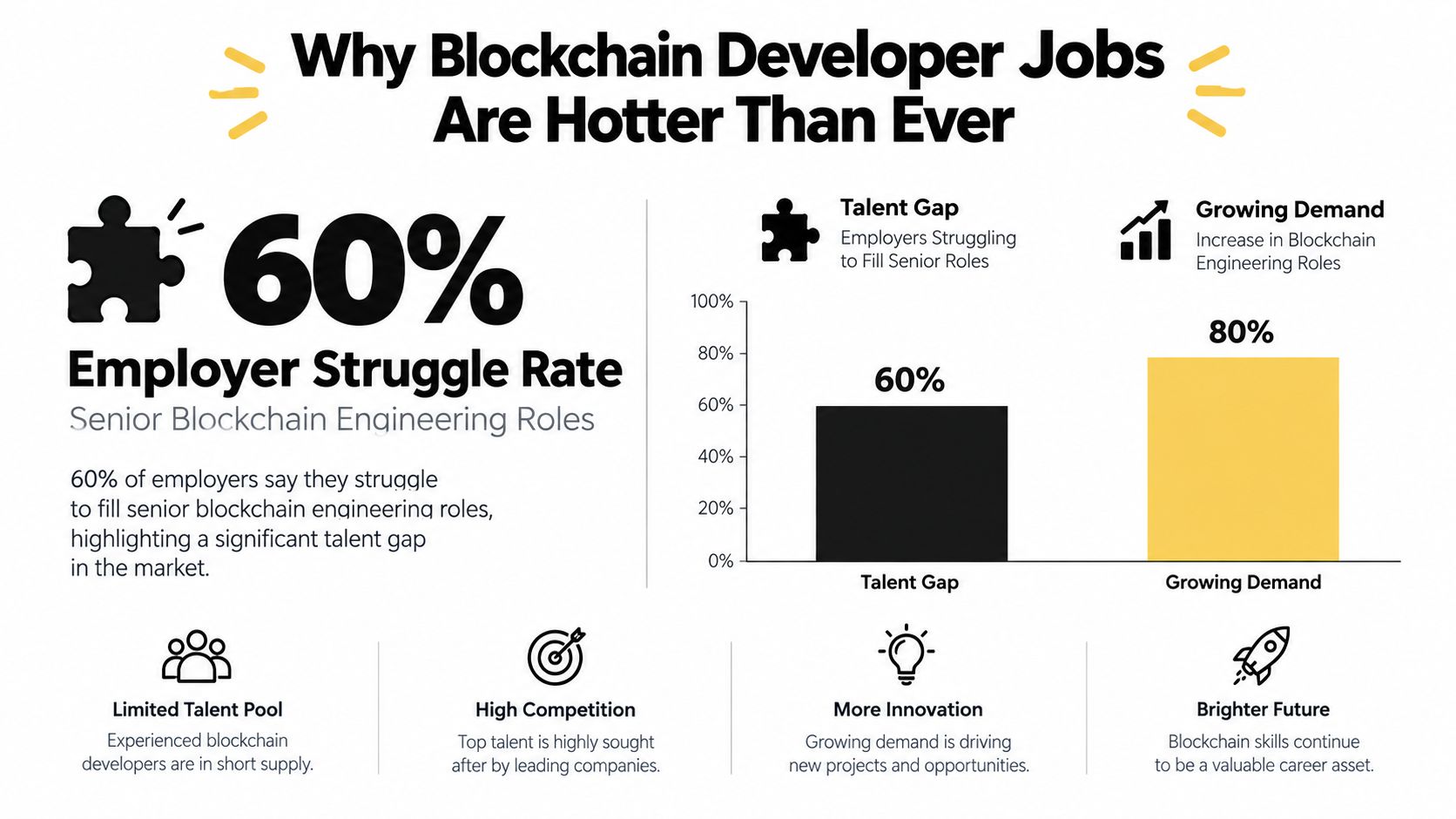
60% of employers struggle to hire senior blockchain engineers, and demand for Solidity, Rust, and Go skills exceeds supply by 2x. If you have the right specialization, blockchain developer jobs are still a strong market. If you only have generic software experience and a surface-level interest in crypto, they're not.
That gap is what most career advice misses. People still talk about “blockchain developer” like it's one role with one salary band and one interview loop. It isn't. Hiring managers are usually trying to fill a much narrower need: a smart contract engineer who can debug Foundry tests, a protocol engineer who understands performance trade-offs, an auditor who can spot exploit patterns, or a full-stack Web3 engineer who can connect wallets, index events, and ship safely.
I've seen both sides of this. Candidates often assume blockchain hiring is wide open because the industry has talent shortages. Employers assume any strong backend or frontend engineer can pick up the stack quickly. Both views are incomplete. Shortage doesn't mean every applicant is competitive. It means teams can't find enough people with the exact depth they need.
Why Blockchain Developer Jobs Are Hotter Than Ever
A lot of hiring markets look crowded from the outside and thin from the inside. Blockchain is one of them.
Employers keep posting roles, but many of those jobs aren't interchangeable. A team building rollup infrastructure doesn't need the same engineer as a DeFi app team. A protocol team hiring for Rust or Go won't get much value from someone whose only experience is writing a couple of Solidity tutorials. That's part of why 60% of employers struggle to hire senior blockchain engineers, while demand for Solidity, Rust, and Go exceeds supply by 2x according to this crypto employment report covered by Fintech.TV.
Why candidates misread the market
The common mistake is assuming shortage equals low bar. It usually means the opposite. Teams lower requirements on pedigree faster than they lower requirements on execution. They'll interview someone without a famous employer on their resume if that person has real repos, testing discipline, and evidence they understand production risk.
That changes how you should think about job search strategy:
- Don't pitch yourself as a generalist first: “I'm a software engineer who can learn blockchain” is weaker than “I build EVM contracts with Foundry and can explain my security decisions.”
- Don't rely on buzzwords: Hiring managers can tell when “Web3 experience” means wallet tutorials and hackathon demos with no depth.
- Don't ignore adjacent systems: The strongest candidates usually understand off-chain services, deployment, indexing, CI, and incident response, not just contract syntax.
Practical rule: In blockchain hiring, the shortage is real. The shortage is also specific.
Why employers misread the market
On the hiring side, weak job posts create their own talent problem. Teams write “senior blockchain developer” when they want one of three very different engineers. Then they wonder why applicant quality is noisy.
The hotter market isn't broad in the way people imagine. It's concentrated around specialized work where mistakes are expensive. That's why the best candidates still get multiple conversations, while broad applicant pools contain many people who aren't close to production-ready. If you're serious about landing blockchain developer jobs, your edge comes from fit, not from using the right title.
Understanding the Main Blockchain Developer Specializations
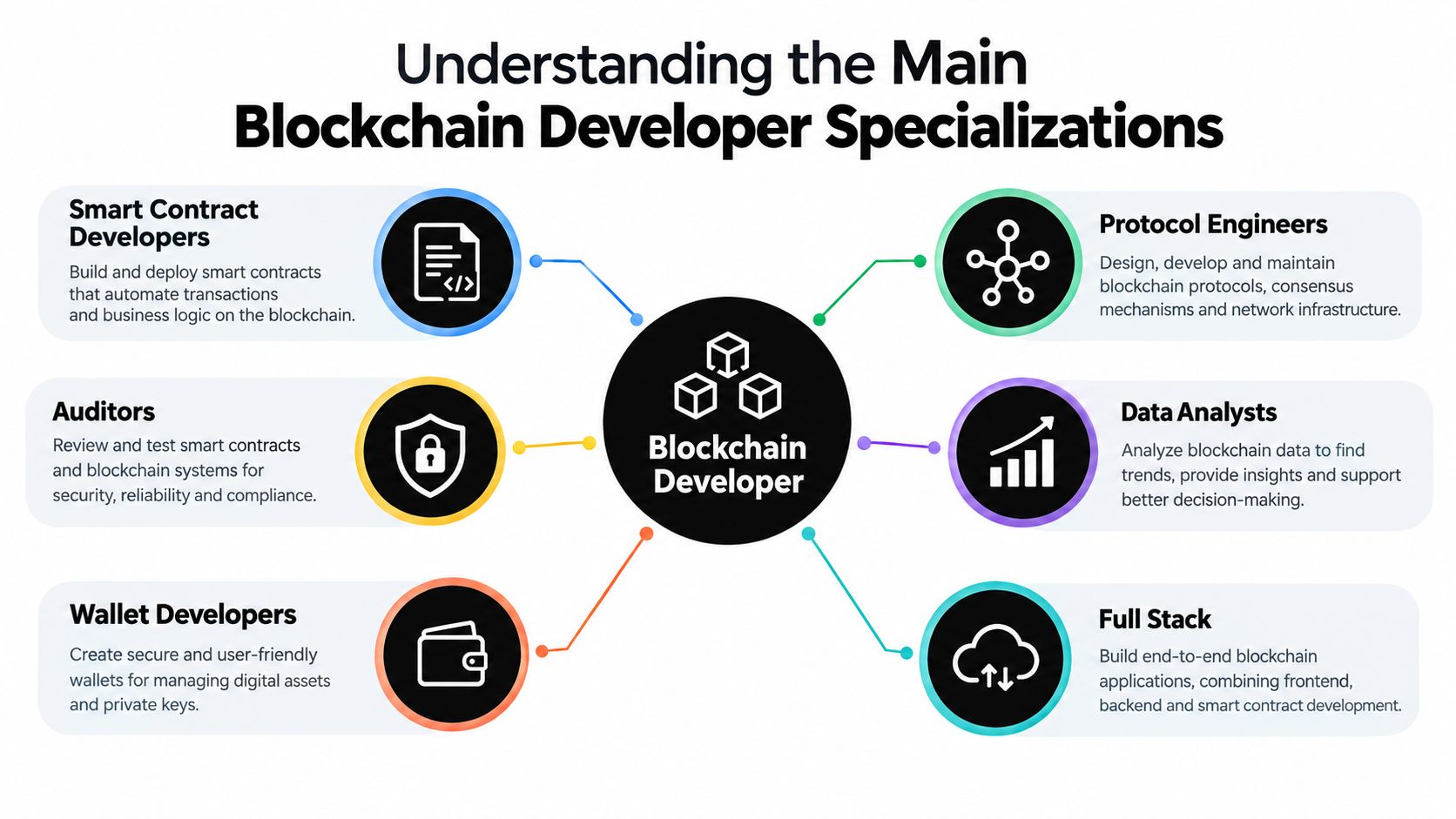
Most hiring friction starts with bad categorization. “Blockchain developer” is a label. Employers hire for narrower operating roles.
The six buckets that matter in practice
For a broad overview of the field, this guide on what a blockchain developer does is useful. In hiring, though, I'd separate the market into these six tracks:
| Specialization | Core work | What interviews usually focus on |
|---|---|---|
| Smart contract developer | Writes, tests, and maintains on-chain logic in Solidity or Rust | Security patterns, testing, gas trade-offs, protocol logic |
| Protocol engineer | Works on consensus, execution, clients, infrastructure, or L1/L2 internals | Distributed systems, performance, language depth, architecture |
| Backend blockchain engineer | Builds APIs, indexers, data pipelines, event processors, and node-facing services | Reliability, data modeling, scaling, blockchain integration |
| Full-stack Web3 developer | Bridges contracts with frontend apps, wallets, and user flows | Wallet integration, contract reads/writes, TypeScript, UX under failure |
| DevOps and infrastructure engineer | Handles CI, deployments, secrets, observability, release processes, and node operations | Automation, reproducibility, incident handling, secure deployment |
| Security specialist or auditor | Reviews contracts, finds vulnerabilities, writes proofs of concept, and hardens systems | Exploit reasoning, code review depth, attack surfaces, communication |
Where each path fits
Smart contract roles are the most visible, but they aren't the whole market. These jobs reward people who can work inside tight constraints: state, gas, reentrancy, privilege design, upgrade patterns, and test quality.
Protocol engineering is a different career entirely. These teams care more about systems thinking, performance, networking, and language-level rigor. The work is less glamorous on social media and often more demanding in interviews.
Backend and full-stack roles attract many candidates from traditional software backgrounds because the jump is more natural. That doesn't mean they're easy. A backend engineer who can index chain data and reason about finality is more useful than someone who only knows generic CRUD work.
The title matters less than the boundary of responsibility. Ask what breaks if you do the job badly.
What specialization means for your career
The hidden segmentation in blockchain developer jobs shows up in three places: compensation, remote access, and interview shape. Security-heavy roles often require deeper review skills. Protocol roles tend to reward low-level engineering depth. Full-stack roles may have more openings, but they also draw a wider candidate pool.
If you're choosing a path, don't pick the title that sounds most prestigious. Pick the operating surface you want to spend years mastering. Hiring gets easier when your public work, language stack, and interview stories all point in the same direction.
Required Skills and Learning Pathways for Each Role
The biggest hiring mistake candidates make is treating languages as the product and tools as a side detail. In production, employers care about both. A contract engineer who can't test well or debug efficiently is hard to trust with meaningful code.
A 2026 job guide says employers repeatedly ask for Solidity, Rust, Layer-2 knowledge, smart-contract development, cryptography, and consensus mechanisms, and for blockchain-specific roles it also lists expectations such as 2+ years of software development experience, Foundry or Hardhat, TypeScript, Ethereum or EVM knowledge, smart-contract testing, DeFi experience, security awareness, GitHub portfolio evidence, and OpenZeppelin familiarity in this blockchain developer jobs guide.
Toolchain fluency is now a hiring signal
This matters more than many applicants realize. The 2025 Solidity Developer Survey found 57% of respondents use Foundry, while Truffle has effectively disappeared. The same survey found stack-too-deep remains the top pain point at 47%, rising to 65% among expert users in SlashData's 2025 blockchain development report.
That tells you something important. Mature teams don't just want Solidity syntax. They want engineers who can ship with current testing, scripting, and debugging workflows.
Blockchain Developer Skills by Specialization
| Specialization | Primary Languages | Key Tools | Experience Level |
|---|---|---|---|
| Smart contract developer | Solidity, Rust | Foundry, Hardhat, OpenZeppelin | Junior to senior |
| Protocol engineer | Rust, Go | Client tooling, profilers, testing frameworks | Mid to senior |
| Backend blockchain engineer | Go, TypeScript, Rust | Indexers, APIs, event processors, GitHub workflows | Junior to senior |
| Full-stack Web3 developer | TypeScript, Solidity | Hardhat or Foundry, wallet libraries, frontend tooling | Junior to mid |
| DevOps and infrastructure engineer | Go, TypeScript | CI pipelines, deployment systems, observability stacks | Mid to senior |
| Security specialist | Solidity, Rust | Foundry, fuzzing workflows, review tooling, OpenZeppelin references | Mid to senior |
If you're early in the process, this primer on learning Solidity programming language helps, but don't stop at syntax.
A learning path that actually maps to hiring
For junior candidates, I'd build in this order:
- EVM and blockchain fundamentals: Learn how transactions, storage, events, and permissions behave.
- One production language: Usually Solidity for EVM roles.
- Testing and debugging: Foundry or Hardhat, with negative tests and edge-case coverage.
- A small end-to-end project: Contract, scripts, frontend or backend integration, and a clean README.
- Security hygiene: Reentrancy, access control, upgrade risk, oracle assumptions, safe library use.
For experienced engineers moving in, the path is different:
- Map your existing advantage first: Backend engineers should lean into infra and indexing. Frontend engineers should lean into wallet flows and contract interaction. Systems engineers should consider protocol or client work.
- Specialize before you broaden: A shallow Solidity repo plus shallow Rust repo usually loses to one focused area done well.
- Show public evidence: GitHub quality still carries more weight than generic credential signaling in this market.
What doesn't work is collecting tools with no coherent body of work. Hiring managers want to see that you can own a slice of the stack safely.
Blockchain Developer Salaries and Remote Work Reality
Compensation in blockchain developer jobs is real, but the market is much more segmented than the clickbait versions suggest.
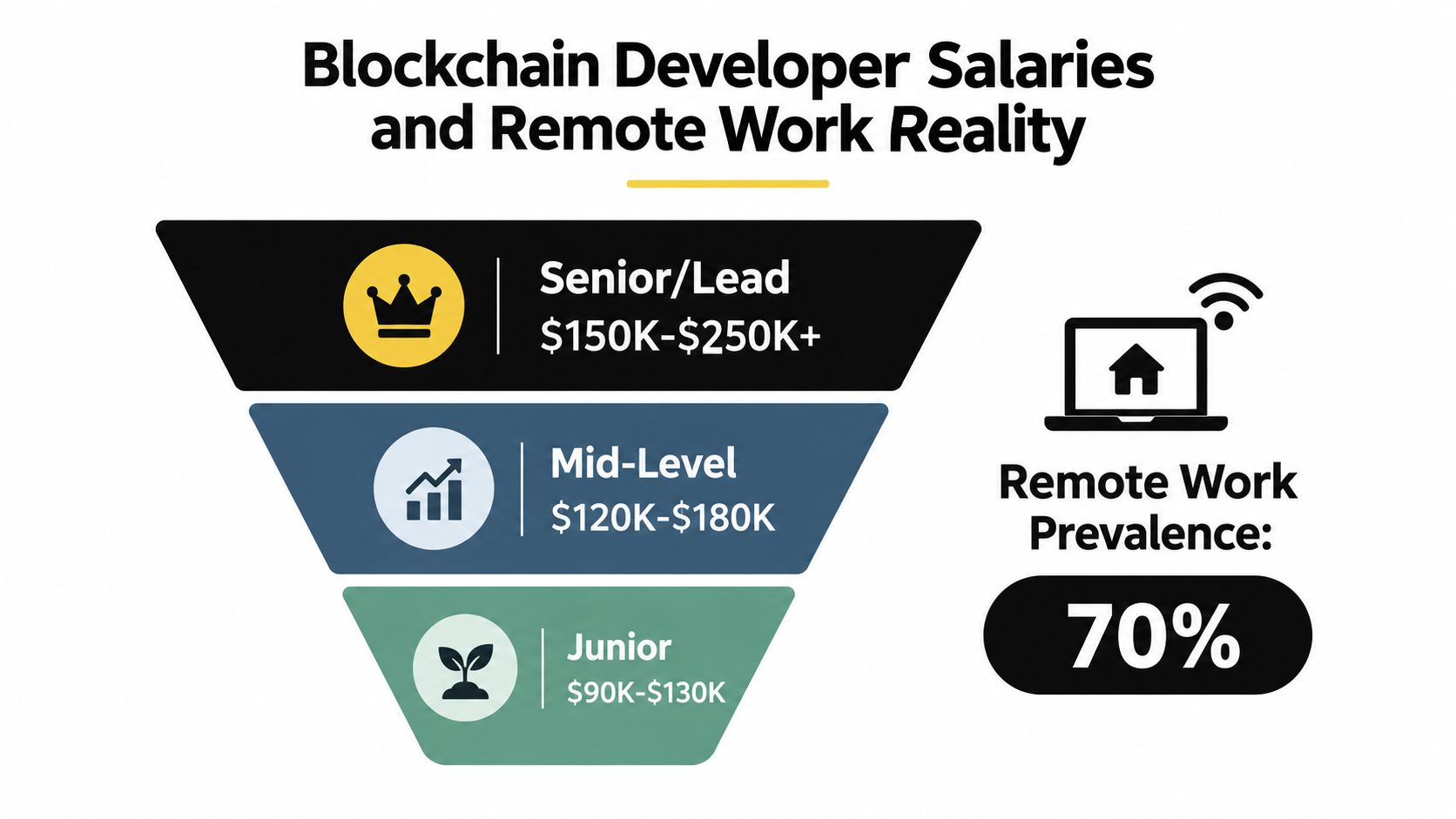
A 2026 roadmap breaks career levels into $90K to $130K for junior, $130K to $180K for mid-level, $180K to $250K+ for senior, and $220K to $300K+ for senior security-focused roles. The same roadmap says protocol engineers at L1/L2 foundations can reach $200K to $350K, while smart-contract auditors can earn $150K to $300K in this blockchain developer jobs roadmap.
Why one salary number is usually useless
Another 2026 salary guide reports a U.S. median base near $140,000, with most offers between $110,000 and $185,000, while senior smart-contract or protocol engineers in DeFi can reach $200,000 to $300,000 when tokens and equity are included in this blockchain developer salary guide.
Then you get wider market data. One 2026 guide reports remote blockchain developer pay around $130k to $250k globally, with top performers reaching $350k+, while other job boards show U.S. averages closer to $105k to $112k. The same source notes a remote-work contradiction: one dataset says about 61% of blockchain developer jobs are remote, while another live hiring report says just 33% of open Web3 roles are remote-friendly in this remote crypto jobs guide.
How to read an offer without fooling yourself
A high salary range doesn't mean your profile fits the top of that band. It usually means the company is pricing for a scarce specialization.
Use three filters:
- Specialization fit: Security, protocol, and infrastructure work usually price differently from general app-layer roles.
- Work model: Remote still matters, but it isn't universal. Some teams pay for global flexibility. Others use location-adjusted bands or cluster around specific markets.
- Comp mix: Base salary, token upside, and equity aren't interchangeable. Treat token-heavy packages as risk-bearing compensation, not guaranteed cash.
A lot of candidates also forget to price the practical side of remote work. If you're comparing offers with different flexibility, benefits, and location constraints, a resource like this work from home job benefits checklist helps you evaluate the non-salary pieces that change day-to-day quality of life.
For a role-by-role breakdown, this page on blockchain developer salary is worth reviewing.
Here's a short market explainer before you negotiate:
What usually gets paid the most
The top end tends to go to people who reduce existential risk for teams. That means auditors, security-focused smart contract engineers, protocol engineers, and infrastructure specialists. General blockchain familiarity can get you interviews. Narrow technical skill is what usually drives stronger offers.
Finding and Evaluating Blockchain Job Listings
Open any large job board and search "blockchain developer" and you get a distorted market view. Employers are not hiring one kind of blockchain engineer. They are hiring Solidity engineers, protocol engineers, auditors, zk specialists, wallet engineers, indexer and data engineers, and full-stack teams that happen to touch contracts. If you read listings as if those roles are interchangeable, you waste time and miss the jobs that fit.
Where serious roles actually show up
Analysts at Pinpoint note in this guide to recruiting blockchain talent that teams often source through technical communities, care about demonstrated smart contract experience, and screen differently from conventional software hiring. That matches what I have seen. Good roles often appear where a team can quickly judge whether you have shipped in the right environment.
A brief mention on a niche board can still be useful, especially if the categories are segmented well. Blockchain Jobs is one example because it separates engineering, security, product, design, legal, and operations instead of flattening everything into "Web3."
The higher-signal channels are usually:
- Specialized job boards: Useful for finding category-specific openings, especially in security, protocol, and smart contract work.
- GitHub and public repos: Maintainers and hiring managers do look at commit history, testing discipline, issue discussions, and release quality.
- Hackathons and ecosystem grants: These surface engineers who can work under time pressure and learn unfamiliar tooling fast.
- Direct applications to protocols and infra companies: This works best when your public work already matches their chain, VM, language, or tooling stack.
If you want a broader view of automated search workflows outside niche boards, this explanation of how DashApply finds jobs is useful for understanding how some tools aggregate and surface openings.
How to evaluate a listing fast
I screen listings by specialization first, not title.
A post that says "blockchain developer" but needs Rust for Solana programs, indexer work for EVM chains, and React wallet integration is describing three different hiring markets with three different salary bands. That mismatch usually creates a bad interview loop and weak offer calibration.
Use a quick filter:
Role definition. Can you tell whether this is app-layer contract work, protocol work, security work, or Web3 product engineering? If the scope is blurred, expect blurred expectations after hiring too.
Toolchain fluency. Good posts name the stack. Solidity with Foundry is different from Solidity with older Hardhat-heavy workflows. Rust on Solana is different from Rust in Cosmos or protocol infrastructure. "Web3 experience" is too vague to help.
Ownership level. Strong listings describe what the engineer owns: writing production contracts, reviewing threat surfaces, building indexing pipelines, maintaining nodes, shipping wallet UX, or contributing to protocol code. Weak ones describe excitement and omit the actual work.
Remote constraints. Remote does not mean globally remote. Check timezone requirements, payroll limitations, and whether compensation is location-adjusted. A listing can look strong until you discover the role is only practical from two or three markets.
Compensation clarity. Mature teams usually explain some mix of salary, token, and equity, even if they do not publish exact ranges. If a post is vague on pay and very specific on hype, I assume the process will be expensive in time.
What convinces hiring managers
Public proof still beats resume padding.
For contract roles, that means repos with tests, deployment scripts, and evidence that you understand failure modes. For protocol or infra roles, it means code that touches performance, data flow, networking, clients, or tooling. For full-stack Web3 roles, it means wallet integration, transaction handling, indexing choices, and sensible frontend state management around chain data.
The strongest signals are usually:
- Finished GitHub repos: Working code, setup instructions, and tests.
- Evidence of iteration: Refactors, bug fixes, review feedback, and improved test coverage.
- Relevant open-source contributions: Even small PRs to the right project can carry more weight than a long course list.
- Stack alignment: A candidate with sharp Foundry tests and Solidity security habits will usually outcompete a generic "blockchain developer" profile for EVM contract roles.
Targeted applications outperform high-volume spraying in this market. Hiring is segmented now. Your search should be segmented the same way.
How Employers Should Write Effective Blockchain Job Posts
Most weak blockchain job posts fail before interviews start. They describe a vague dream candidate instead of a real operating role.
If you're hiring, start by naming the actual work. A smart contract engineer isn't the same as a protocol engineer. A full-stack Web3 role isn't the same as a security review role. Candidates self-select better when the post reflects what the team needs.
What strong posts include
First, specify the technical environment. A 2025 Solidity survey shows Foundry has become the dominant production toolchain for many Solidity developers, while Truffle has effectively faded, which is one reason mentioning current tools matters in the post itself. Saying you use Foundry, Hardhat, OpenZeppelin, TypeScript, Rust, or Go signals that the team understands modern workflows and isn't hiring from outdated assumptions.
Second, separate must-haves from nice-to-haves. If the role really requires contract testing depth, DeFi experience, or protocol-level Rust, say that plainly. Don't bury critical filters in a giant wish list.
Third, be transparent about level. A junior engineer can grow into production work with good review structures. A senior candidate should already know how to debug, reason about failure modes, and make safe trade-offs without heavy hand-holding.
What interview loops should assess
The best interview processes mirror the work:
- Code review exercises: Have candidates review a small contract or service and explain risks.
- Debugging tasks: Give them a failing test, bad assumption, or broken integration.
- Architecture discussions: Ask how they'd structure permissions, upgrades, indexing, or deployment.
- Portfolio walkthroughs: Let them explain real trade-offs they made in public or prior work.
Generic whiteboard questions often miss the skills that matter most. Blockchain hiring gets better when the post and the interview both focus on production judgment, not title inflation.
Building Your Blockchain Development Career Path
Blockchain hiring has grown, but the split is inside the category itself. A smart contract engineer, protocol Rust engineer, data indexing developer, and security reviewer can all be called "blockchain developers" while competing in very different job markets, with different salary bands, interview loops, and remote options.
That split should shape your career strategy early.
There is no single ladder here. There are several tracks, and they branch sooner than many candidates expect. Junior roles usually focus on shipping defined tasks safely. Mid-level roles add system design, code review, and toolchain judgment. Senior roles are about ownership under uncertainty: incident response, architecture trade-offs, security boundaries, and decisions that affect real money.
The strongest career progress usually comes from becoming unusually reliable in one expensive problem area. Teams pay more for engineers who can prevent a bad upgrade, catch a permission bug, tune an indexer under load, or reason through cross-chain failure modes than for candidates with a generic interest in Web3.
Picking the right branch early
Choose a lane based on the kind of work you want to repeat for the next two years, not the broadest title you can claim.
- Early-career developers: Pick one specialization anchor and make it obvious. Solidity with Foundry and OpenZeppelin is a clearer hiring signal than a portfolio split across Solidity, Solana, Cosmos, and AI side projects with no depth.
- Backend engineers entering blockchain: You often have a faster path through data pipelines, indexers, API services, exchange integrations, node operations, or Go and Rust infrastructure work than through pure contract roles.
- Security-minded engineers: Auditing, invariant testing, formal reasoning, and exploit analysis can become a high-trust niche, but the bar is much higher than many bootcamp-style guides suggest.
- Systems-focused engineers: Protocol and client work can have the highest ceiling, but it also asks for stronger distributed systems knowledge, lower-level debugging, and more patience with slower hiring cycles.
Specialization is not permanent. It is a positioning tool. The mistake is trying to look broad before you have become credible.
What progression actually looks like
A practical path is usually less glamorous than people expect. Build public proof of work. Get good at one stack. Join a team that will let you own production problems. Then expand sideways once your judgment is trusted.
A strong portfolio for this field is not just a list of repos. It should show the kind of problems you can handle. For one candidate, that might be a well-tested ERC-4626 vault with clear threat modeling notes. For another, it might be an indexing service that handles reorgs correctly, or a Rust module with benchmarks and failure-case tests. Hiring managers notice this difference quickly.
Keep your portfolio aligned with the jobs you want next. If you want infra roles, a token launchpad clone will not help much. If you want contract roles, five generic CRUD apps will not close the gap. The closer your work matches the target toolchain and failure modes of the role, the easier the interview becomes.
If you're actively exploring blockchain developer jobs, Blockchain Jobs can help you compare current Web3 openings by specialization and stack instead of treating the market as one generic role category.