
Ava Labs Careers: Roles, Hiring Process, and Insider Tips
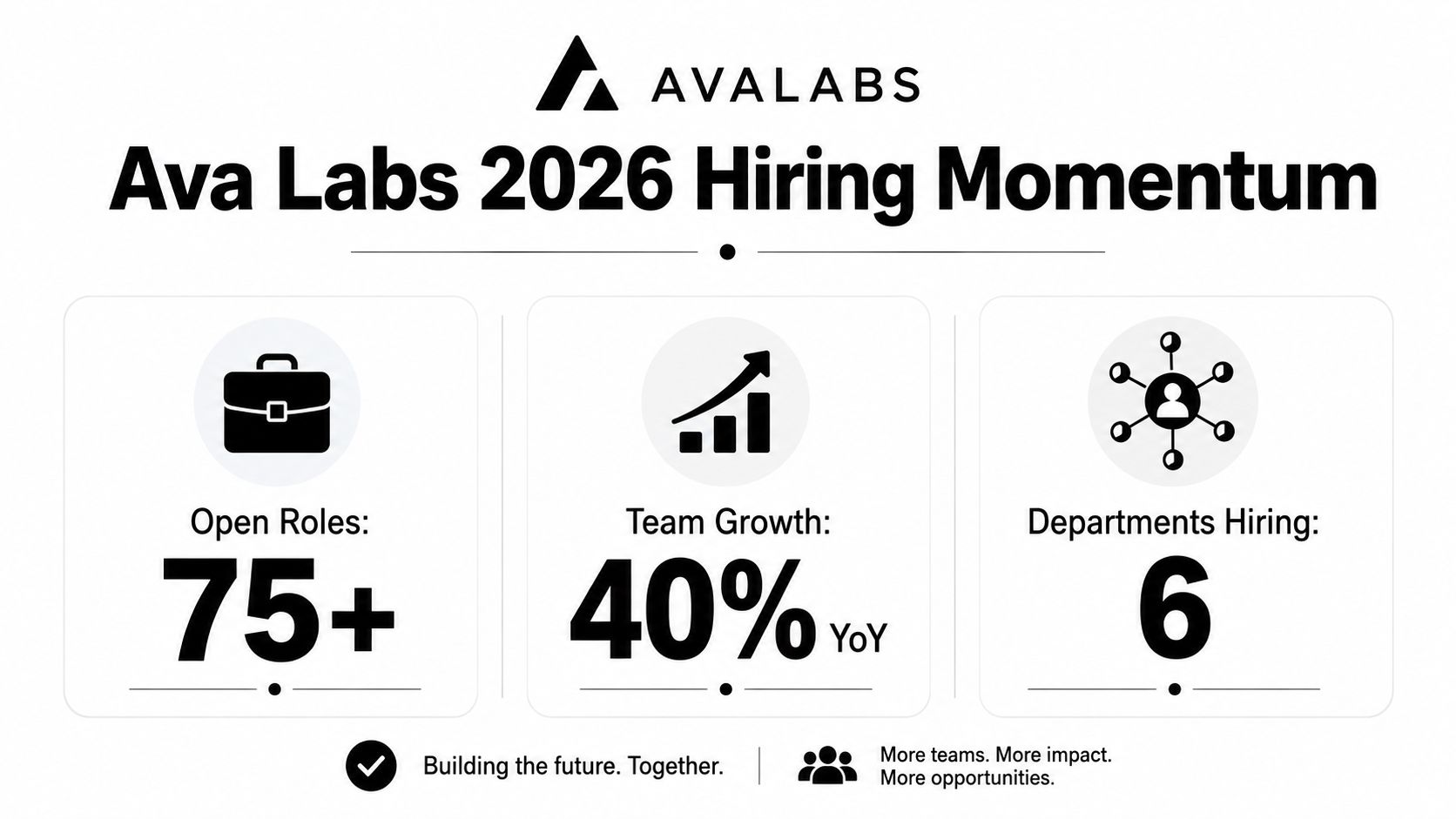
Ava Labs had 23 active job postings in 2026, according to one workforce dataset, representing a 30% increase from 2025. Another dataset counted 31 postings and reported a 58.3% year-over-year rise. That hiring momentum matters because Ava Labs also reduced its workforce by 12% in November 2023, with marketing among the affected teams, according to The Block's coverage of the restructuring.
The right question for candidates isn't whether Ava Labs is hiring. It's which teams management considers strategically important, whether the role has durable ownership, and whether you can meet the technical bar. The current mix points toward protocol, platform, backend, product, and specialized infrastructure work. This guide breaks down the roles, compensation signals, interview process, application strategy, and stability questions you should raise before accepting an offer.
Why Ava Labs Is Hiring Again in 2026
The post-restructuring picture is more constructive than the 2023 headlines suggest. Workforce data indicates that Ava Labs was actively hiring in 2026, with one dataset reporting 23 active postings and a 30% increase from 2025, while another recorded 31 postings and a 58.3% year-over-year increase. Those figures don't prove that every department is expanding equally, but they do show that the company is rebuilding targeted capacity rather than remaining in blanket contraction.
What the hiring pattern signals
Ava Labs' current hiring profile looks selective, not volume-driven. The open roles highlighted in public listings include Staff Protocol Engineer, Staff Engineer for AvalancheGo, Senior Software Engineer, Staff Backend Engineer, Senior Technical Product Manager, and Senior Product Designer, as documented by The Jobs Map's Ava Labs role listings.
That mix tells candidates where the company is placing scarce hiring capital. Protocol reliability, distributed systems, backend services, institutional products, and technical product judgment appear more important than broad-based growth hiring. You should treat this as a signal to apply with a sharply defined capability, not a generic “Web3 enthusiast” profile.
Recruiter's read: Hiring momentum is meaningful only when the role owns a business-critical system. Ask what the team must deliver, what it owns in production, and why the position is open now.
Why timing matters for applicants
Candidates who can demonstrate immediate value are better positioned in a selective hiring market. Ava Labs is more likely to value someone who has operated a distributed system, maintained production infrastructure, designed protocol-adjacent products, or handled complex institutional workflows than someone whose experience consists mainly of broad crypto interest.
The opportunity is strongest for experienced specialists who can work autonomously and explain tradeoffs clearly. Before applying, compare the job description with your evidence. If you can't point to a concrete system, decision, launch, incident, or product outcome that matches the role, revise your positioning first.
Understanding the Ava Labs Talent Strategy
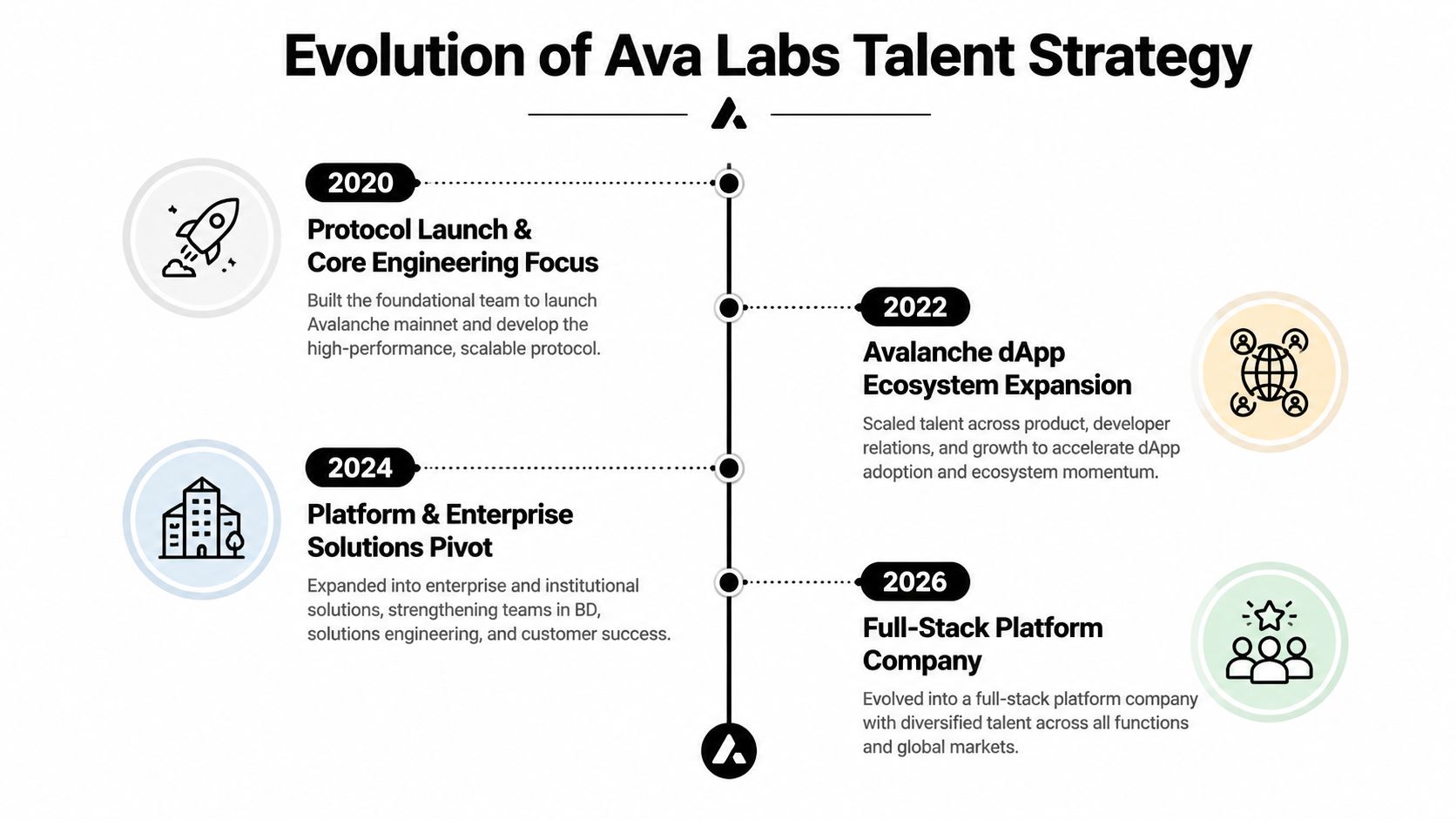
Ava Labs' talent story follows Avalanche's evolution. The company's careers footprint is tied to the 2020 Avalanche mainnet launch, a milestone that moved Ava Labs from protocol development into a broader ecosystem-building phase, according to the Ava Labs careers page. The company also supports recruitment for multiple ecosystem projects within Avalanche, so candidates shouldn't assume every opportunity sits inside the core corporate team.
From protocol startup to platform employer
Independent company directories identify Ava Labs as founded in 2018 and headquartered in Brooklyn, New York. Those directories also place the company at roughly 501 to 1,000 employees and describe remote-friendly benefits. Taken together, the founding date, mainnet launch, and ecosystem recruiting show a clear shift from a focused blockchain infrastructure startup to a platform company with a wider talent surface.
That shift changes how you should search for a role. Core protocol engineering remains central, but adjacent opportunities can involve infrastructure, applications, product, design, ecosystem development, and go-to-market work. The strongest candidates understand how their function supports network adoption, reliability, institutional use cases, or developer growth.
How to position yourself against the platform model
Don't present yourself as someone who only wants to “work in crypto.” Explain which layer of the platform you can improve. An engineer might discuss node performance, compatibility, or operational resilience. A product manager might connect user requirements to protocol constraints and enterprise adoption. A designer might show how they simplify complex custody, compliance, or financial workflows.
For broader guidance on shaping that narrative, review these employer value proposition examples, then adapt the principle to your own candidate value proposition. Your application should make the hiring manager understand both what you can do and why that work matters to Avalanche's ecosystem.
Which Teams and Roles Are Hiring Now
Ava Labs' role mix is heavily weighted toward platform and protocol engineering. The clearest example is the Staff Engineer, AvalancheGo position, which centers on AvalancheGo and the node domain, including consensus, peer-to-peer networking, state sync, the VM plugin interface, and integration with the C-Chain EVM through coreth and libevm. The role is framed as a technical anchor for core network behavior and coordinated upgrades, not as ordinary application development, according to the public AvalancheGo job listing.
Role categories and hiring signals
| Role Category | Example Titles | Seniority Level | Key Skills Required |
|---|---|---|---|
| Protocol and core infrastructure | Staff Protocol Engineer, Staff Engineer, AvalancheGo | Staff and senior | Consensus, distributed systems, peer-to-peer networking, state sync, EVM compatibility |
| Backend and custody | Senior Backend Engineer, senior custody roles | Senior and staff | Backend architecture, secure services, reliability, custody systems |
| Technical product | Senior Technical Product Manager | Senior | Product judgment, technical fluency, roadmap tradeoffs, cross-functional execution |
| Product design | Senior Product Designer | Senior | Complex workflows, systems thinking, institutional user experience |
| Ecosystem and applications | Roles across Avalanche ecosystem projects | Varies | Application delivery, infrastructure integration, ecosystem awareness |
The engineering roles deserve the most attention from technical candidates because they require low-level systems depth. You should be ready to discuss failure modes, state transitions, compatibility constraints, upgrade coordination, and the operational consequences of design decisions. A résumé that lists Solidity without showing protocol ownership or production responsibility will look incomplete.
What non-engineers should infer
The presence of senior product and design roles doesn't mean the company has lowered its technical expectations outside engineering. Product managers need to translate protocol limitations into useful roadmaps. Designers need to make complex institutional workflows understandable without hiding security or compliance requirements.
Use the Ava Labs company role page to monitor the mix, but read each description for ownership language. Roles that mention architecture, platform direction, core systems, institutional products, or network upgrades are likely closer to strategic priorities than roles built around generic execution.
Compensation and What It Signals About Ava Labs
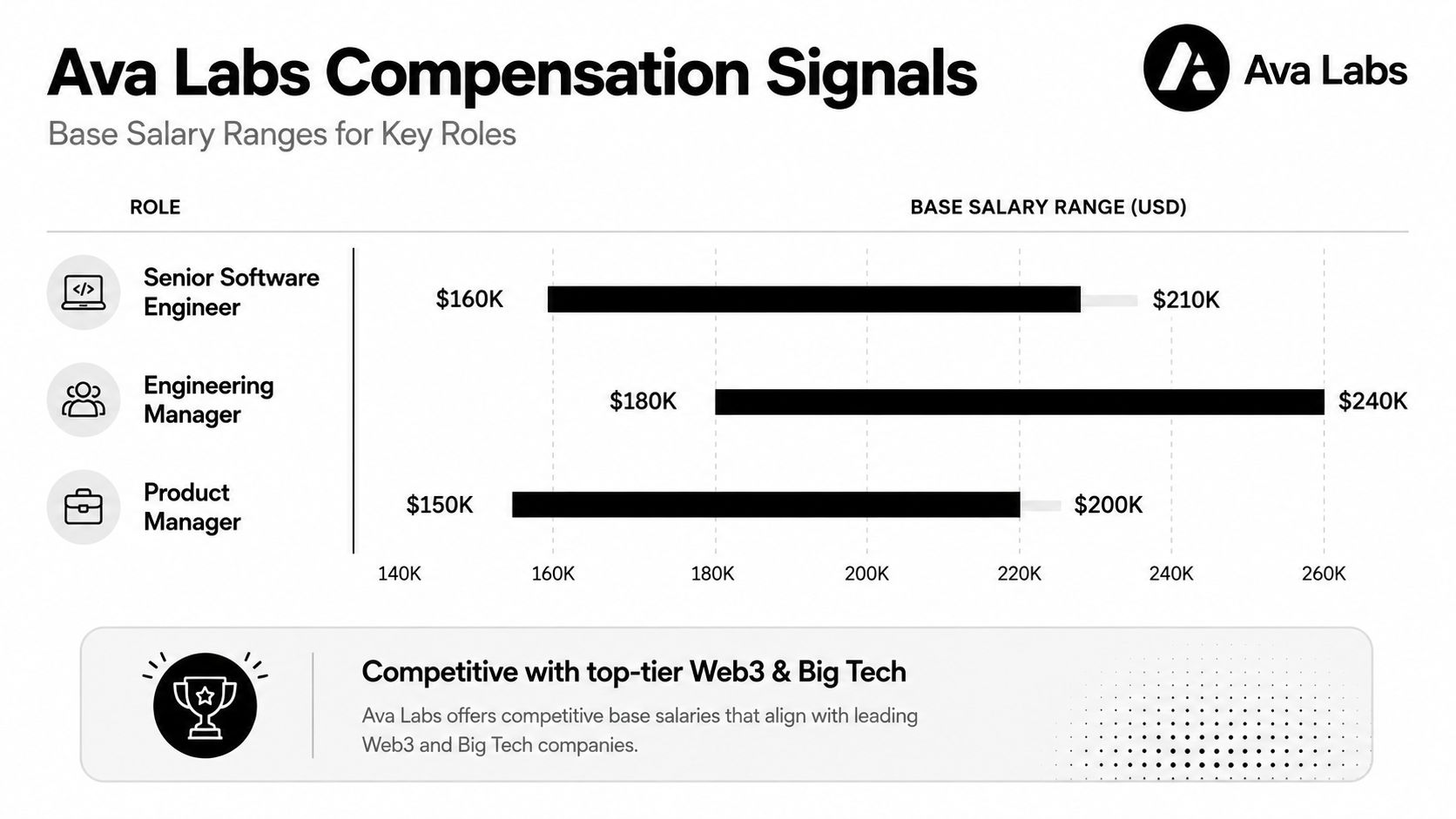
Ava Labs competes for specialized talent with compensation bands that are substantial by startup standards. Public listings show Staff Protocol Engineer compensation around $253,479 to $269,321, Staff Engineer, AvalancheGo compensation between $253,479 and $316,849, Senior Backend Engineer ranges of $159,000 to $199,000, and senior backend or custody ranges commonly reaching about $158,000 to $219,000, according to Web3.Career's Ava Labs compensation listings.
Senior product and design roles also carry meaningful bands. Public data lists a Senior Product Designer range of $153,000 to $191,000, while another listing reports Staff Backend Engineer compensation of $185,000 to $219,000. These ranges aren't interchangeable offers, and candidates should confirm location, employment structure, equity, benefits, and the specific level before treating them as a personal target.
Why protocol expertise commands a premium
The spread is the important signal. Ava Labs appears willing to pay more for expertise that is difficult to replace, particularly in EVM compatibility, protocol maintenance, distributed systems, and custody infrastructure. Defects in those areas can affect security, interoperability, uptime, and coordinated network changes, so hiring managers need people who can reason beyond a narrow feature ticket.
Independent company profiles report total funding of $586 million, including late-stage rounds of $230 million in September 2021 and $350 million in April 2022. Another company profile places total funding at $640 million. These figures differ by source and methodology, so use them as a broad financing context rather than a precise balance-sheet statement, as reflected in Ava Labs' company profile on Welcome to the Jungle.
How to negotiate
Don't negotiate by citing a competing salary without explaining your level. Tie your expectation to scope, scarce expertise, and the risks you can own. If you're targeting a staff protocol role, prepare a concise case showing where you influenced architecture, resolved a distributed-systems problem, improved reliability, or coordinated changes across teams.
Ask whether the published range reflects base salary only, how level is determined, and what the team expects during the first major review cycle. Strong candidates negotiate the complete package, but they also demonstrate why the company should place them near the top of its range.
The Ava Labs Interview Process Explained
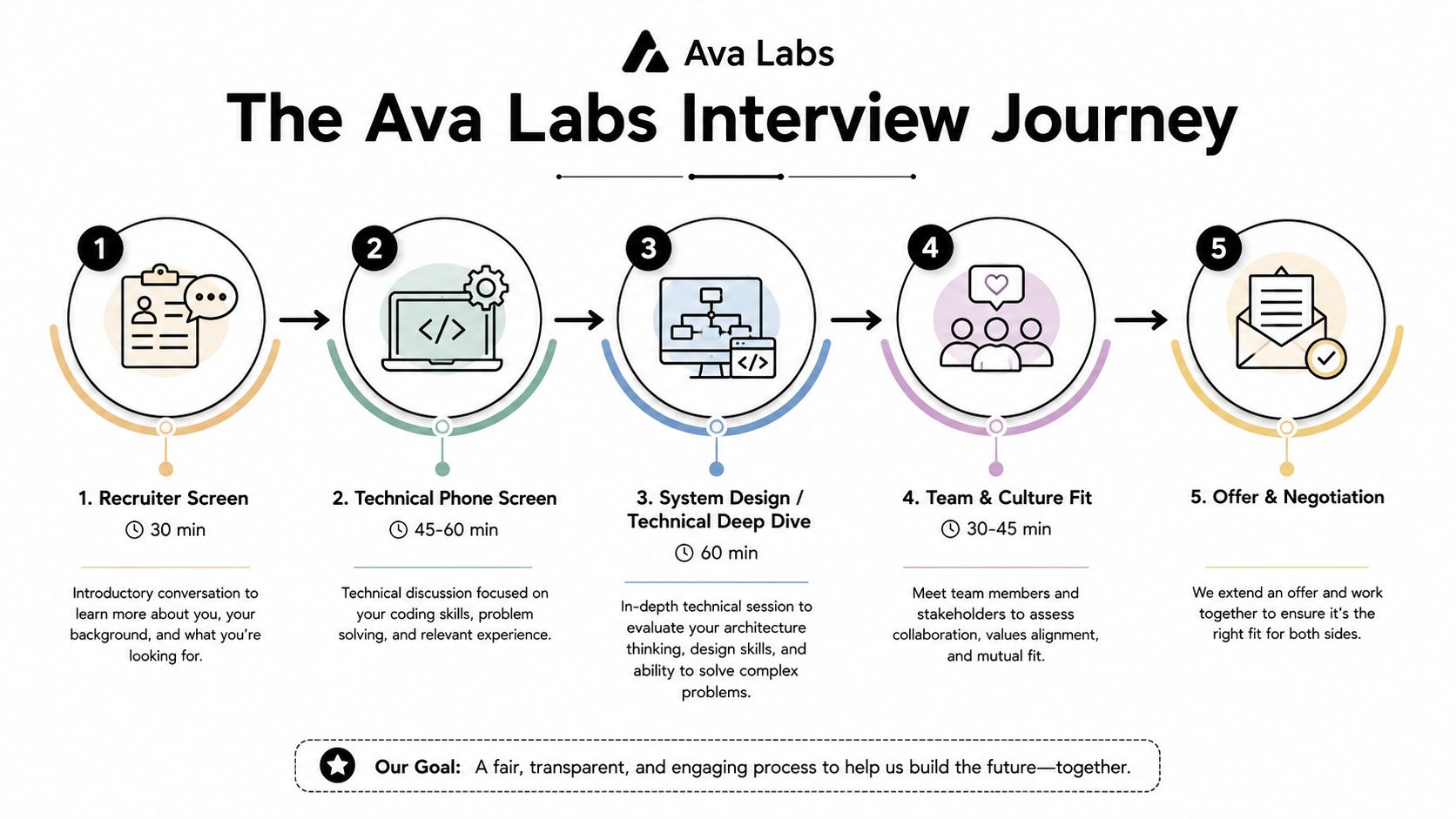
Candidate feedback indicates a process that commonly begins with a recruiter screen, followed by technical interviews lasting about 45 to 60 minutes and behavioral interviews lasting around 45 minutes, according to Ava Labs interview guidance from Scoutify. Treat those timings as a practical guide, not a guarantee. The exact sequence can vary by role, interviewer availability, and whether you're moving between protocol, product, and startup environments.
Prepare for each evaluation stage
Recruiter screen: Explain your career history in terms of scope and outcomes. Be ready to state the role you're targeting, why Ava Labs fits your technical direction, and what kind of work you won't accept.
Technical interview: Practice coding problems, but don't stop there. For engineering roles, expect questions that test debugging, architecture, distributed systems, and the consequences of design decisions.
System design or technical deep dive: Draw a clear system, identify assumptions, discuss bottlenecks, and explain how you'd monitor and upgrade it. Protocol candidates should be comfortable discussing consensus, peer-to-peer behavior, state synchronization, and EVM integration.
Behavioral interview: Use STAR-format stories that show judgment under constraints. Explain the situation, your specific action, the tradeoff you accepted, and the outcome. Avoid stories where “we” did everything and your contribution remains unclear.
Candidate questions and offer discussion: Ask about ownership, process timing, team composition, production responsibilities, and how success is evaluated. Role-specific questions show more maturity than broad questions about culture.
For practice, use resources focused on finding top talent with scenario questions. Scenario preparation helps you rehearse the reasoning process interviewers want to hear, not just memorize polished answers.
Candidates should also clarify the interview sequence early. Ask which stages are technical, whether coding is live or take-home, who owns the final decision, and what the team needs from the person hired. Those questions help you prepare efficiently and expose avoidable ambiguity.
A useful visual overview can reinforce the preparation sequence:
How to Stand Out in Your Application
Ava Labs isn't looking for generic blockchain enthusiasm. Hiring managers want evidence that you can handle specialized systems, ambiguous decisions, and meaningful ownership. Your résumé should make that evidence easy to verify within the first review.
Match your proof to the role
Protocol engineers: Name the distributed systems you worked on, the production constraints you managed, and the failures or upgrades you handled. Explain your role in consensus-adjacent work, networking, state management, or EVM compatibility where relevant.
Backend engineers: Show architecture ownership, reliability decisions, security controls, and service boundaries. “Built APIs” is weak. Describe the system responsibility and the tradeoff you made.
Product managers: Demonstrate product judgment with examples involving technical constraints, customer discovery, prioritization, and cross-functional delivery. Connect the decision to an observable outcome without inventing a metric.
Designers: Present complex workflows, especially products involving custody, institutions, compliance, permissions, or financial operations. Show how your research changed the design and how you worked with engineering.
Remote contributors: Prove that you can create alignment without constant supervision. Include examples of written decision-making, incident communication, documentation, and collaboration across functions.
Don't submit a general résumé and hope the hiring team finds the match. Tailor the top third of the document to the role's central problem, then make every selected project support that positioning. For broader job-search tactics, consult this guide on how to get a job in Web3.
Recruiting teams also benefit from structured evaluation tools, particularly when they need to compare technical and behavioral evidence consistently. A resource on an AI sales agent for recruiters is relevant to the wider recruiting workflow, but candidates should focus on the underlying principle: clear, job-related evidence beats polished but vague self-promotion.
Addressing Career Stability Concerns
The 12% workforce reduction in November 2023, which affected marketing teams among others, is a legitimate part of the Ava Labs career decision. Candidates shouldn't ignore it or accept a careers page as proof of stability. The stronger current signal is that workforce datasets show active hiring in 2026, with reported posting increases ranging from 30% to 58.3% year over year.
The role mix suggests that protocol, platform, backend, and technical product teams currently carry more strategic weight than the growth functions reported as affected during the restructuring. That doesn't make any team risk-free, and public postings can't reveal internal budgets, revenue targets, or future reorganizations.
Ask direct questions before accepting:
- Role durability: Why is this position open, and what business priority funds it?
- Team direction: Which deliverables must the team complete, and what happens if priorities change?
- Performance expectations: How will success be evaluated during the first review cycle?
- Organizational context: Has the team expanded, contracted, or changed ownership recently?
The best candidate decision combines the current hiring signal with specific answers from the hiring manager. Don't join solely because a posting exists. Join when the role has clear ownership, executive sponsorship, and work that remains central to the network or platform.
If you're evaluating Ava Labs or comparing protocol employers, use Blockchain Jobs to find specialized Web3 openings across engineering, product, design, infrastructure, security, and other functions. Search for roles that match your strongest evidence, then apply with a résumé built around ownership and technical impact.