Your Guide to Blockchain Developer Salary: Actionable Insights for Your Career
If you're mapping out a career as a blockchain developer in the U.S., the compensation is a major draw. Entry-level salaries often start around $121,000, with senior experts commanding well over $187,000. This places blockchain development at the top of the tech pay scale, driven by a classic supply and demand imbalance: massive industry need and a limited pool of proven talent. From a career perspective, this is a clear signal of opportunity.
Why Blockchain Salaries Start So High: A Hiring Perspective

Unlike a standard software engineering role, breaking into blockchain requires a very specific and rare combination of skills. You're not just writing application code; you're architecting systems that involve cryptography, distributed networks, and complex economic incentives. For hiring managers, finding candidates who grasp both solid engineering principles and the unique challenges of decentralization is incredibly difficult, which is what inflates salary benchmarks.
For your career progression, understand this: your value is directly tied to your ability to build and secure systems that manage significant financial value. It’s less like building a website and more like designing a digital vault. A single vulnerability in a smart contract can lead to catastrophic losses, so companies are willing to pay a premium for developers who demonstrate the discipline and expertise to prevent such disasters.
A First Look at the Numbers
So, what does the career ladder look like in terms of salary? Let's get specific with some 2025 benchmarks for the U.S. market. Unsurprisingly, compensation scales rapidly with demonstrated experience and impact.
Developers just entering the field can expect offers around $121,000 annually. With a few years of solid experience (typically 3–5), your earning potential moves into the $140,000 to $165,000 range. For senior developers who can lead projects and architect systems, salaries frequently push past $187,000.
Actionable Insight: A high blockchain developer salary isn't just about coding proficiency. It reflects the immense responsibility of securing digital assets. To justify a top-tier salary in interviews, frame your experience in terms of security, reliability, and the value you can protect.
To give you a clearer picture, here’s a quick breakdown of what to expect at different career stages.
US Blockchain Developer Salary at a Glance
This table summarizes the typical base salary ranges in the United States. Use it to benchmark offers and guide your salary negotiations.
| Seniority Level | Typical Annual Salary Range (USD) |
|---|---|
| Entry-Level (0-2 years) | $121,000 - $140,000 |
| Mid-Level (3-5 years) | $140,000 - $165,000 |
| Senior-Level (5+ years) | $165,000 - $187,000+ |
Think of these numbers as your starting point for any salary conversation. Entering an interview armed with these benchmarks is the first step toward securing an offer that reflects your market value. You can see real-world examples, like this opportunity with Zircuit, to see how specific skill sets align with current top-tier compensation.
The Key Factors That Shape Your Salary
Averages are useful, but your actual salary offer will hinge on a specific set of variables. Understanding these factors is crucial for maximizing your earning potential as a developer and for hiring managers looking to attract premier talent.
It’s about much more than years of experience. Two developers with five years on the job can have vastly different compensation packages. The difference lies in specialized skills, the type of company, and the measurable impact you can deliver.
Your Specialized Skill Set
In blockchain, what you can build is what gets you hired. Specializing in an in-demand ecosystem adds a significant premium to your salary because you solve a specific, high-value problem. A developer's tech stack is the first thing any hiring manager examines.
- Platform Expertise: Knowing Solidity for Ethereum and EVM-compatible chains remains a core, high-value skill. However, expertise in languages like Rust for Solana can often command even higher pay due to a smaller talent pool and the demand for high-performance application developers.
- Security and Auditing: This is a critical differentiator. The ability to not just write secure smart contracts but also to audit them for vulnerabilities is one of the most sought-after skills. Frame this as a risk-mitigation skill in interviews—you save companies from potentially catastrophic exploits.
- Full-Stack Web3 Knowledge: It's not enough to just write smart contracts. Companies need developers who can connect a decentralized backend to a seamless user frontend using libraries like Ethers.js or Web3.js. This full-stack capability makes you a more versatile and valuable team member.
Seniority Defined by Impact, Not Years
Web3 moves at a breakneck pace. Consequently, seniority is measured less by time and more by tangible accomplishments. A developer who architected a successful DeFi protocol in two years is often considered more senior than someone who has spent five years maintaining existing dApps.
Hiring Perspective: A strong GitHub portfolio showcasing contributions to open-source protocols or a history of deploying secure, high-value smart contracts is far more compelling than a traditional resume. This proven ability to deliver is what justifies a top-tier salary.
Here’s what hiring managers look for as indicators of seniority:
- Architectural Design: Can you design a secure, scalable, and efficient blockchain system from the ground up? This demonstrates an ability to make critical decisions on protocol choice, tokenomics, and data structures.
- Leadership and Mentorship: Have you led a development team, mentored junior engineers, or driven a complex project from concept to launch? Leadership skills significantly increase your value and open doors to lead developer and architect roles.
- Project Impact: Can you point to projects that handled significant transaction volume or secured a large amount of assets? Highlighting your experience with battle-tested, high-stakes systems is the ultimate mark of a senior developer.
Company and Industry Focus
The type of company you join and its industry focus dramatically influence your compensation. A developer's salary is directly linked to the business model and funding of their employer.
A lean, early-stage DeFi startup might offer a lower base salary but compensate with a generous token package that has enormous upside potential. Conversely, a large enterprise using blockchain for supply chain management will likely offer a higher, more stable base salary with traditional bonuses and benefits.
Similarly, developers working in high-growth sectors like Web3 gaming or FinTech often see better compensation because the competition for specialized talent is fierce. Understanding these nuances is key, and it’s why even companies need roles like a global compensation and benefits specialist to design competitive packages.
How Salaries Compare Across the Globe
The decentralized nature of blockchain has created a truly global talent market. However, a blockchain developer's salary is not uniform worldwide. Your location—or the location of the hiring company—remains one of the most significant factors in your earning potential.
For developers evaluating remote offers or hiring managers assembling distributed teams, understanding these regional compensation differences is non-negotiable.
A developer’s market value can vary dramatically between countries. This reflects a combination of local demand for Web3 skills, the maturity of the regional tech scene, and the cost of living. What is considered a top-tier salary in one location might be an average offer elsewhere.
This infographic highlights how your skills, seniority, and company type are the primary drivers of your salary, regardless of your location.
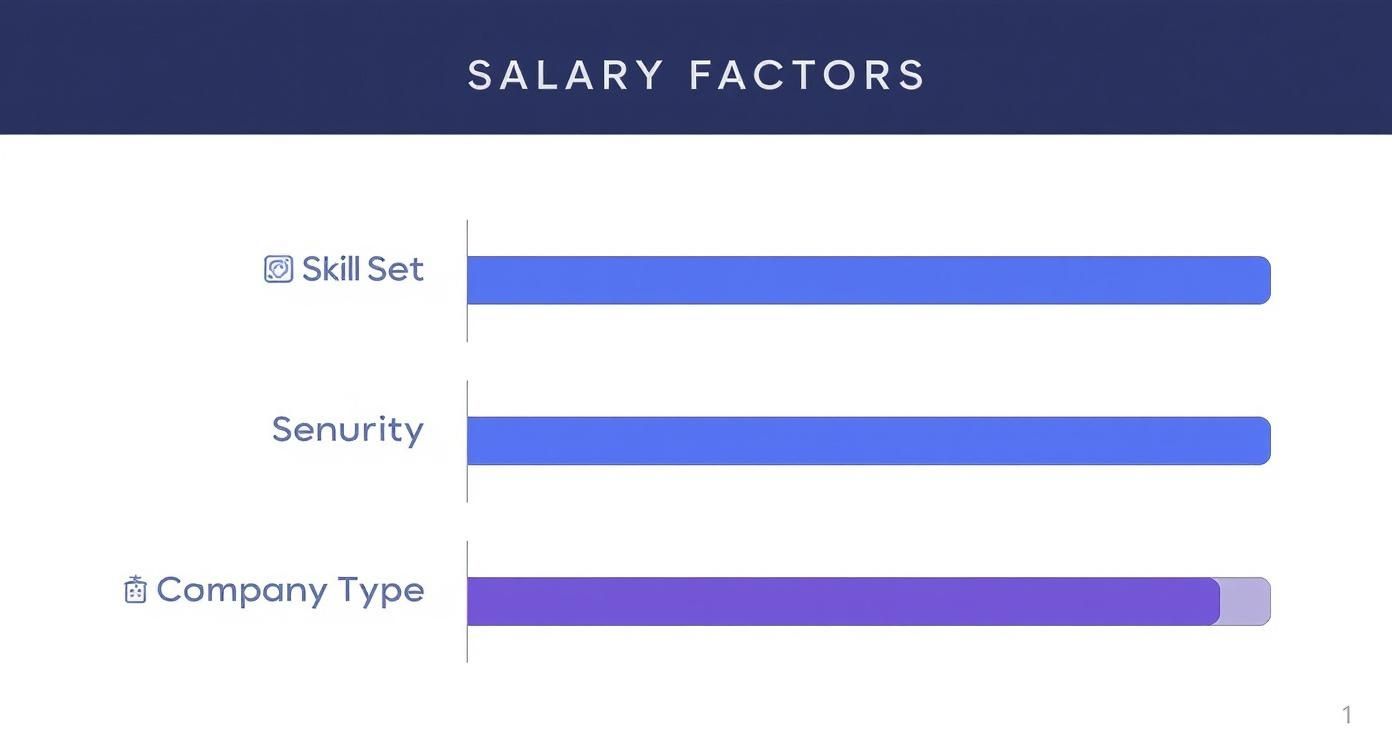
As you can see, these core factors are universal, but their financial weight varies significantly depending on the geographic market.
The High-Paying Hubs
Certain cities and countries have emerged as epicenters of blockchain innovation, creating intense competition for talent that drives salaries to premium levels. These are typically locations with strong financial sectors, favorable regulations, or significant venture capital investment.
For developers, targeting roles in these hubs—even remote ones—can lead to a much larger compensation package.
The highest blockchain developer salaries are often found in these key markets:
- Singapore: As a major fintech and crypto hub in Asia, Singapore often sets the global pace with highly competitive salaries, driven by a government that welcomes digital asset innovation.
- Switzerland: Home to "Crypto Valley" in Zug, Switzerland combines a robust financial industry with crypto-friendly regulations, making it a magnet for top-tier blockchain projects and talent.
- United States: While pay varies by city, major tech hubs like San Francisco and New York continue to offer premium salaries. The high concentration of well-funded startups and large tech companies entering Web3 keeps demand exceptionally high.
These regions establish the global benchmark for what elite developers can earn. If you are interviewing with companies based in these locations, your salary expectations should align with these top-tier markets.
Established and Emerging Markets
Beyond the major hubs, there are established markets with steady demand and emerging talent pools where the Web3 scene is rapidly growing. Across these regions, salaries differ based on industry maturity, local demand, and cost of living.
For example, a C++ blockchain developer earns an average of $220,000 annually in Singapore, placing it at the top globally. Switzerland follows at $160,000, Australia at $150,000, and the U.S. averages around $115,000. At the other end of the spectrum, salaries are lower in developing nations like India, where average pay can be as low as $20,000 annually. You can explore more detailed statistics on global blockchain salaries at JKCP.com.
Actionable Insight: For hiring managers, this global variance is a strategic advantage. Building a distributed team allows you to access a worldwide talent pool, potentially optimizing costs by hiring skilled developers in emerging markets without compromising on quality.
For developers in regions like India or Eastern Europe, the rise of remote-first Web3 companies is a career-defining shift. It provides an opportunity to earn a globally competitive salary that significantly exceeds local market rates, transforming your career trajectory without the need to relocate.
Looking Beyond the Paycheck: How to Decode Your Total Compensation
In Web3, evaluating a job offer based solely on the base salary is a critical mistake. It's like judging a high-performance car by its color alone—you're missing the powerful components under the hood. To accurately assess an offer, you must analyze the entire compensation package.

This is especially true in blockchain, where Web3-native incentives can often have a far greater financial impact than base pay. For developers, understanding how to value these components is key to maximizing your long-term earnings. For hiring managers, crafting a compelling total compensation package is the secret to winning top talent.
First, The Familiar Stuff: Traditional Comp Components
Before diving into the unique aspects of Web3 compensation, let's review the traditional elements you'll encounter.
- Signing Bonus: A one-time cash payment for accepting an offer. In the competitive Web3 space, this is a powerful tool used to attract top developers. It is almost always negotiable, particularly for senior-level candidates.
- Performance Bonus: An annual reward tied to your individual performance and the project's success. During your interview, ask for specific details on how performance is measured. Is it based on code shipped, protocol user growth, or other KPIs? The answer reveals what the company truly values.
- Equity (Stock Options): For centralized companies in the crypto space (e.g., exchanges, infrastructure providers), equity functions similarly to a traditional tech startup. You receive stock options that vest over time, granting you ownership in the company.
While these components are standard, the real game-changer in a blockchain role often lies in incentives unique to the Web3 world.
The Real Kicker: Understanding Web3-Native Incentives
This is where Web3 compensation becomes truly distinct. These incentives are designed to directly align your financial success with the success of the protocol you are building, offering a level of ownership that traditional equity often cannot match.
The most common and potent of these is the token grant. Instead of company shares, you receive a grant of the project's native cryptocurrency tokens.
Key Insight for Developers: A token grant is not just a bonus; it's a direct stake in the network's success. If the protocol gains traction and its token value appreciates, your total compensation can multiply in a way a fixed salary cannot.
However, this high potential comes with high risk due to token price volatility. An offer that appears lucrative one month could be worth significantly less the next. It is absolutely crucial to inquire about the vesting schedule and any lock-up periods. A typical structure includes a one-year "cliff" (no tokens vest if you leave before one year) followed by monthly or quarterly vesting over the next three to four years.
Understanding how these packages are structured is vital, especially for senior roles. For instance, a Lead Developer position with a crypto trading arm will advertise the total compensation, where tokens are a major component.
Don't Overlook the "Hidden" Perks
Beyond direct financial incentives, some Web3 perks offer significant, though less obvious, value. Factor these into your decision-making process.
- Airdrop Eligibility: Working on a major protocol before its token launch can sometimes qualify you for a future airdrop. While never guaranteed, airdrops can be a substantial financial windfall for early contributors.
- Governance Rights: Many token grants include voting power, allowing you to influence the protocol's future direction. This provides a level of direct impact on a project's roadmap rarely seen in traditional tech companies.
- Remote-First Culture: The majority of Web3 companies operate on a fully remote basis. This offers incredible flexibility, enabling you to work from anywhere and potentially lower your cost of living while improving your work-life balance.
Navigating Job Interviews and Salary Negotiations
Passing the technical interview is only half the battle. The final stages—the interviews and salary negotiation—are where you secure a compensation package that reflects your true market value. This process requires a strategic approach to ensure a positive outcome for both you and your potential employer.
For developers, this is your opportunity to connect your technical skills to tangible business value. For hiring managers, it's a chance to demonstrate respect for top talent and establish a strong foundation for a successful working relationship.
Building Your Case Before You Talk Numbers
A successful negotiation begins long before an offer is made. The groundwork you lay throughout the interview process provides the leverage you need to ask for what you're worth. You are essentially building a business case for yourself.
Your project portfolio is your most powerful tool. Don't just list technologies; be prepared to discuss your work in detail. Explain the specific problems you solved, the rationale behind your architectural decisions, and the measurable impact of your contributions.
A hiring manager isn't just looking for a "Solidity developer." They're hiring someone to build a secure, scalable protocol that will manage real financial value. Frame your experience around the value you create and the risk you mitigate, not just the code you write.
This reframing shifts the conversation from a skills checklist to a discussion about how you can directly contribute to the company's success.
How to Handle the "What Are Your Salary Expectations?" Question
This is often a pivotal moment in an interview. Naming a number too early can anchor you too low, while evading the question can seem evasive. The key is to respond with a well-researched, confident answer.
Before your first interview, do your homework. Multiple 2025 salary surveys confirm that blockchain development remains one of the highest-paying fields in tech, with average salaries often exceeding $150,000 annually in major markets.
Data shows that approximately 80% of blockchain developers earn more than $115,000 per year, with fewer than 10% earning under $100,000. For a deeper dive, you can find more detailed insights about blockchain developer salaries on DappUniversity.
With this data, you can approach the conversation strategically:
- Acknowledge the Question: Show that you're prepared to discuss compensation.
- Reference Your Research: Mention that you've researched market rates for comparable roles.
- Provide a Range: Offer a thoughtful range, not a single number. The bottom of your range should be a figure you would be happy to accept, while the top reflects your ideal target.
- Pivot Back to the Role: Conclude by reiterating your enthusiasm for the opportunity.
Here is a sample response: "That's a great question. Based on my research for senior blockchain engineer roles with a focus on DeFi security in this market, positions of this scope typically command a base salary in the $170,000 to $190,000 range. Of course, my main priority is finding the right long-term fit, but that is the ballpark I'm considering."
Strategies for Countering and Closing the Deal
When you receive an offer, your first step is to thank the hiring manager and request a day or two to review it thoroughly. Never accept on the spot. This gives you time to evaluate the entire package, including base salary, bonuses, token grants, and benefits.
If you decide to counter, be specific and provide a clear justification. Frame it around your value, not your desires. For example, if the offer is $165,000, you could respond with: "Thank you so much for the offer! I'm very excited about this opportunity. Considering my experience leading protocol architecture and the market rates we discussed, I was anticipating a base salary closer to $180,000. If you can meet that figure, I am ready to accept today."
For hiring managers, transparency is key. Be upfront about your compensation bands and how salary is determined. A fair and respectful negotiation process builds significant goodwill and can be the deciding factor for a candidate choosing your offer over another. The objective is not to "win" but to begin a strong partnership on a positive note.
Frequently Asked Questions About Blockchain Salaries
Navigating blockchain compensation can be complex. Whether you're a developer assessing your market value or a hiring manager crafting a competitive offer, clarity is essential. Here are answers to some of the most common questions.
What Is a Realistic Entry-Level Blockchain Developer Salary?
While you often hear about massive salaries, a six-figure starting salary is not guaranteed. Your initial compensation depends heavily on your demonstrated ability to build.
A strong GitHub portfolio is more persuasive than any resume. If you can showcase smart contract projects, contributions to open-source protocols, or a well-designed dApp on a testnet, you are in a strong negotiating position. Hiring managers need to see tangible proof of your skills. In major U.S. tech hubs, a compelling entry-level candidate can realistically secure offers in the $90,000 to $121,000 range.
To position yourself at the higher end of this range, specialize in a high-demand area:
- DeFi Protocols: Demonstrate a deep understanding of core DeFi primitives like lending, borrowing, and AMMs. This is the financial foundation of Web3 and makes you immediately valuable.
- Smart Contract Auditing: Even at a junior level, a talent for identifying common security vulnerabilities like reentrancy attacks will make you a highly sought-after candidate.
- Layer 2 Solutions: Familiarity with scaling solutions like Optimism or Arbitrum shows you are thinking about building applications that can handle real-world usage.
Ultimately, a "realistic" salary is one that is supported by a portfolio proving you are ready to contribute from day one.
Which Programming Language Pays the Most?
This is a common question, but it's slightly misleading. It’s less about the language itself and more about what you can build with it. A programming language is a tool; your value is determined by the complexity and importance of the systems you create.
That being said, some languages are associated with ecosystems where capital and demand are higher.
From a hiring manager's perspective, deep expertise in one critical language is far more valuable than superficial knowledge of several. A Rust expert who is deeply embedded in the Solana ecosystem is a more valuable hire than a generalist.
Here is how the major languages generally compare in terms of salary potential:
- Rust: Often commands the highest salaries due to its use in high-performance blockchains like Solana. The talent pool is smaller, and the work frequently involves building foundational, protocol-level technology.
- Solidity: As the language of Ethereum and the broader EVM ecosystem, Solidity skills are the most in-demand. While the talent pool is larger, elite Solidity developers with expertise in security and gas optimization remain at the top of the pay scale.
- Go (Golang): Used for building core infrastructure for projects like Hyperledger Fabric and parts of the Ethereum client ecosystem, Go developers are crucial for maintaining the backbone of Web3.
- Vyper: A Pythonic language for smart contracts, Vyper’s emphasis on security and readability is gaining traction. Proficiency in Vyper can be a strong differentiator.
However, context is everything. A senior developer designing a complex DeFi protocol in Solidity will almost always earn more than a junior developer building simple dApps in Rust.
How Does Remote Work Affect My Salary?
Web3 was built on a remote-first ethos, which has fundamentally altered compensation models. When interviewing for remote roles, you will typically encounter one of two approaches.
The first is location-based pay, where your salary is adjusted based on the cost of living in your city. A developer in San Francisco is paid more than a developer with identical skills in a lower-cost area. Companies use this model to manage payroll budgets and maintain internal pay equity relative to local markets.
The second model, which is increasingly popular in Web3, is location-agnostic pay. In this model, the company establishes a salary band for a role and pays everyone within that band the same, regardless of where they live. These bands are often benchmarked to a high-cost-of-living area.
| Compensation Model | For the Developer (Pros & Cons) | For the Company (Pros & Cons) |
|---|---|---|
| Location-Based Pay | Pro: Aligns with local living costs. Con: You may feel underpaid for doing the same work as a colleague in a more expensive city. | Pro: Manages payroll costs effectively. Con: Narrows the available talent pool to specific regions. |
| Location-Agnostic Pay | Pro: Massive earning potential if you live in a low-cost area. Con: Risk of lifestyle inflation if you relocate. | Pro: Unlocks access to a global talent pool. Con: Results in a significantly higher overall payroll. |
For developers, the trend toward location-agnostic pay is a major career advantage. It means your compensation is tied to your skills and impact, not your zip code. For a skilled developer outside a major tech hub, this represents a life-changing opportunity to earn a globally competitive salary without needing to relocate.
Ready to find a role that pays you for your skills, not your address? Blockchain Jobs is the go-to platform for connecting top Web3 talent with the industry's best companies. You can explore hundreds of remote and on-site roles in engineering, product, marketing, and more. Find your next great opportunity at https://blockchain-jobs.com.