Decentralized Jobs Explained and How to Land One

You've been offered two jobs. One is a familiar remote role with a conventional salary, a manager, and a defined promotion path. The other comes from a DAO, pays part of its compensation in tokens, and promises influence over the product itself. The second role sounds exciting, but you're wondering whether “decentralized” means genuine career ownership or crypto branding around an uncertain job.
That decision deserves more than a scan of job boards. You need to understand how the organization hires, how work gets coordinated, what your interview will test, and whether the role builds durable skills beyond the next market cycle. You'll also need to distinguish a decentralized position from an ordinary remote job with a token attached.
Introduction to Decentralized Jobs and Why They Matter Now
Decentralized jobs have moved into a much larger employment conversation because work itself became geographically distributed. A 2025 academic review estimates that the global share of remote workers rose from about 5–7.9% in 2019 to 72% in September 2020, then eased to 45% by 2022 and 12.7% full-remote in Fall 2023, while 28.2% of workers remained hybrid. The figures show a rapid shift followed by a lasting change in how teams coordinate across locations. (Academic review of remote work trends)
Web3 intensified that shift. Coincub reported 66,494 new Web3 roles in 2025, a 47% rebound from 2024, including 26,925 remote roles, up 40% year over year. Remote U.S. demand led with 21,612 jobs, while Europe and Asia were close to parity in aggregate, evidence that decentralized hiring now operates as a global labor market rather than a small crypto niche. (Coincub's 2025 Web3 jobs report)
Career filter: Don't ask only whether a role is remote. Ask whether it gives you portable skills, visible work, credible references, and a progression path.
That filter matters especially for non-engineers. Protocols need product managers, finance specialists, legal and compliance professionals, community leads, marketers, recruiters, operations managers, writers, and designers. Some roles support permanent protocol operations. Others expand quickly during a speculative cycle and contract just as quickly.
A useful first step is to compare actual openings across Blockchain Jobs and specialist communities, then investigate the people and organizations behind promising roles. If you're assessing a project's broader network, a curated Web3 investor search can help you understand which backers and ecosystems are connected to it. The aim isn't to treat investor backing as a guarantee. It's to gather context before you invest your time or accept token exposure.
How Decentralized Hiring Models Actually Work
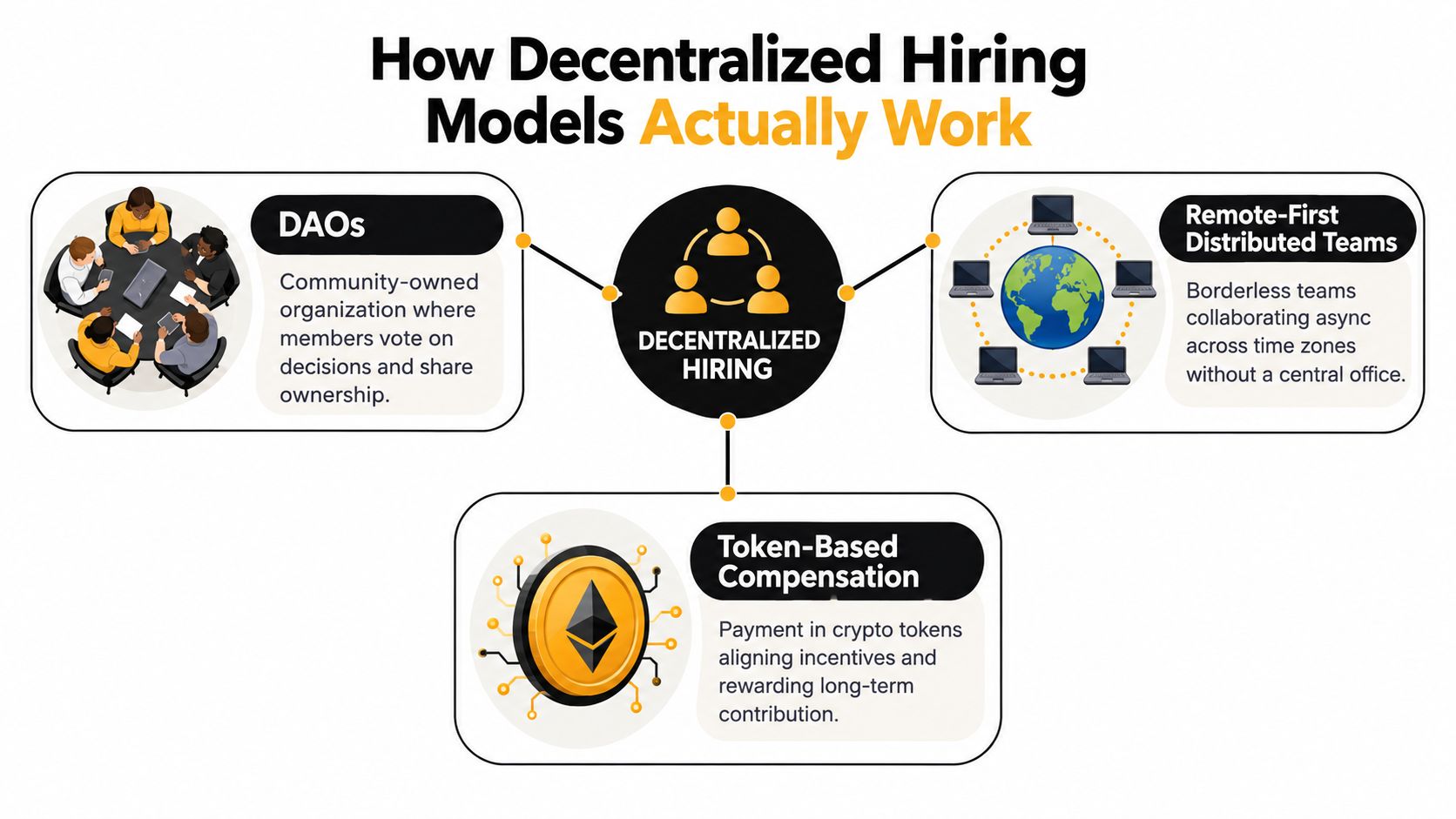
The word “decentralized” describes several hiring models, and confusing them leads to bad career decisions. Start by separating the organization's ownership model from its working model and compensation model.
DAOs work more like co-ops than ordinary companies
A DAO can resemble a digital co-op. Members may help shape proposals, vote on decisions, manage a treasury, or contribute to a product without following a traditional department chart. Employment may involve a core company, a contributor agreement, a grant, or a recurring role funded through governance.
That structure changes the interview. A hiring team may ask how you make decisions with incomplete authority, document a proposal, handle disagreement, or earn trust in a public forum. Your ability to contribute visibly can matter as much as your résumé.
DAO labor economics remains underdeveloped as a research field. Academic work argues that standard industrial and labor economics models don't fully describe digitally coordinated organizations, while research on DAO compensation proposes vesting based on value accrual rather than simple time served. (Research agenda for DAO labor economics and compensation)
Distributed teams resemble an asynchronous production line
A remote-first Web3 company may have conventional executives, employees, and salaries, yet operate without a central office. Think of the team as an asynchronous production line. One person writes a product brief, another reviews it while in a different time zone, and a third turns the approved decision into a launch plan.
The handoff must work without a meeting. Strong teams specify where decisions live, which tool owns the source of truth, how quickly colleagues need to respond, and which hours overlap. A 2026 Web3 hiring report found 33% of open roles were remote-friendly, with demand distributed across the Americas, APAC, EMEA, and LATAM, plus a small number of global-only roles. (Maneki's 2026 Web3 hiring report) This pattern points to teams organized around regional overlap and documented coordination, not unlimited location freedom.
Token compensation adds a second risk layer
Token pay isn't the same as salary. A salary gives you a stated amount in a familiar unit. A token allocation may carry governance rights, upside, liquidity constraints, and price volatility. You need to know whether the token is liquid, when it vests, what happens if you leave, and whether the organization can change the terms through governance.
Ask whether the role has a stable base, a token component, or only a token grant. Then ask how contribution gets measured. If the answer is vague, the role may be selling future alignment instead of offering a workable compensation package.
Mapping Roles and Skills That Decentralized Teams Hire For
Engineering gets the most attention, but decentralized organizations need an operating system around the code. Product teams translate user problems into roadmaps. Operations teams manage vendors, launches, documentation, and contributor workflows. Legal and compliance teams interpret changing rules. Finance teams handle treasury controls, reporting, and payment processes. Community and marketing teams turn technical work into trust, education, and adoption.
Recent hiring data shows why technical candidates should examine the mix rather than assume every applicant competes in one giant pool. One 2026 report found engineering accounted for 46.0% of hiring need but only 27.1% of applications, creating a 0.6x application concentration index, the lowest among major functions. (2026 AI, crypto, and Web3 hiring analysis) That's a specific opportunity signal for blockchain engineers and protocol developers, but it also suggests that candidates should target defined shortages instead of applying broadly.
| Function | Share of Hiring Need | Share of Applications | Opportunity Signal |
|---|---|---|---|
| Engineering and protocol development | 46.0% | 27.1% | Stronger interview leverage in undersupplied technical tracks |
| Product, operations, community, legal, finance, HR, content, and design | Not provided | Not provided | Evaluate role durability, proof of impact, and candidate depth individually |
The non-engineering path becomes durable when it supports recurring protocol operations. Treasury operations, compliance, security governance, product discovery, developer relations, documentation, and contributor programs often remain necessary after a launch campaign ends. A short-lived growth role tied only to social activity or market excitement deserves more scrutiny.
Match your existing experience to the operating problem
- Project or operations background: Show how you run handoffs, maintain decision logs, manage dependencies, and keep contributors accountable without constant meetings.
- Marketing or community experience: Bring examples of education, moderation, campaign measurement, and conflict handling. Community work isn't just posting announcements.
- Legal, finance, or compliance experience: Translate regulated-industry skills into treasury controls, policy design, risk registers, reporting, and governance procedures.
- Product or design experience: Demonstrate research, prioritization, user testing, and decisions made under technical or governance constraints.
- Writing and content experience: Build a portfolio that includes documentation, explainers, release notes, and governance proposals.
Token literacy helps across all of these tracks. You don't need to become a protocol engineer, but you should understand wallets, governance, vesting, liquidity, smart-contract risk, and the difference between a token's utility and its speculative price. For technical candidates, specialized listings can reveal how requirements differ by protocol, infrastructure, and security work. Browse engineering roles in decentralized teams with the interview question in mind: which parts of your experience solve a problem the team has repeatedly failed to solve?
Where to Find Decentralized Jobs Without Wasting Time
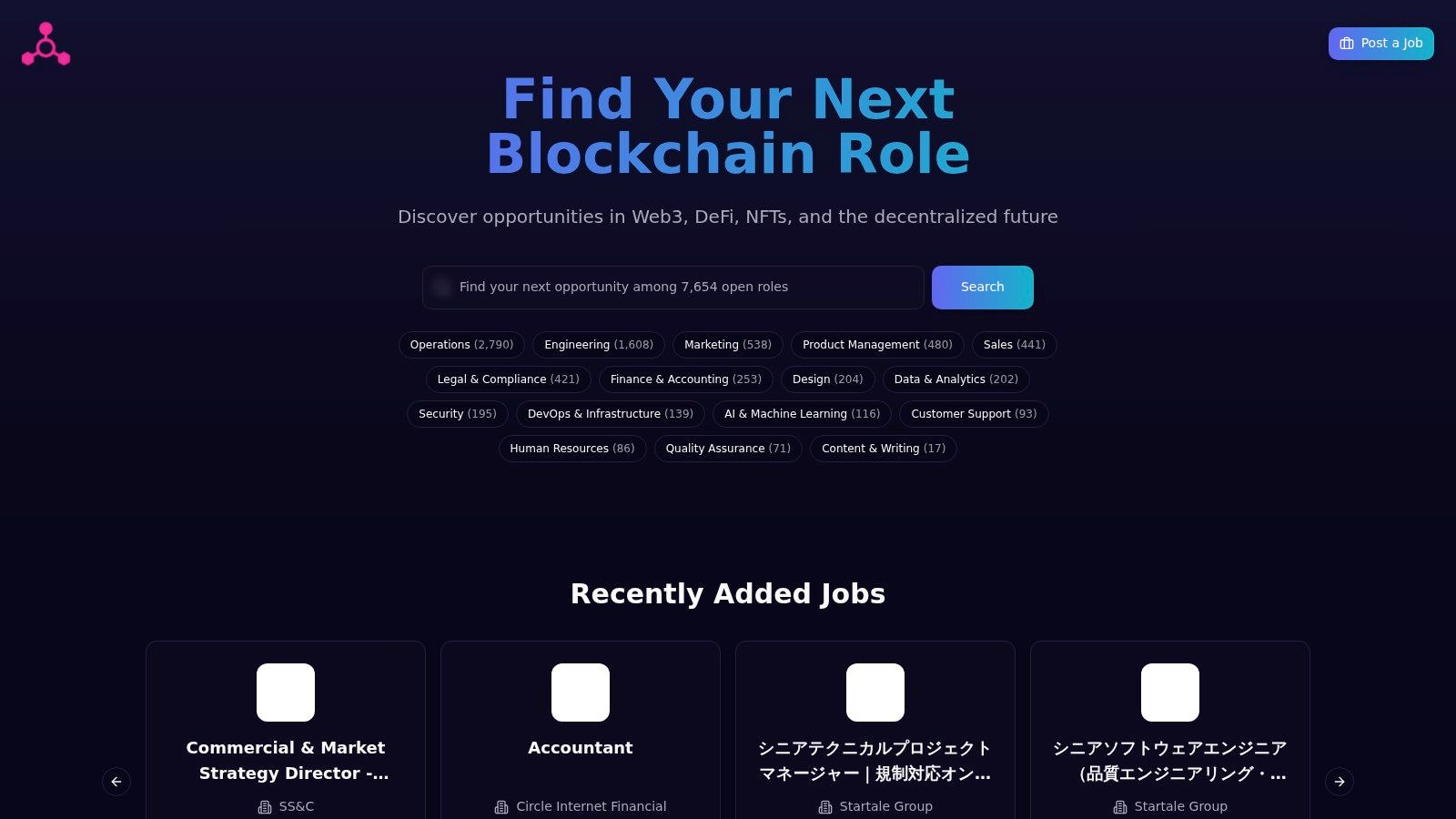
Job discovery works best when each channel has a job. Specialist boards are useful for structured searches by function, seniority, and location. DAO communities can surface contributor work before it becomes a formal opening. Aggregators provide volume, but they also require more filtering. Referrals can offer context about management quality, payment history, and the scope of a role.
Start with the channel that matches your target. An engineer may prioritize protocol-specific listings and technical communities. A community manager may find stronger leads through governance forums, ecosystem Discord servers, and contributor programs. A finance or legal candidate should look for organizations with visible operational needs, not only public announcements.
Use a focused search routine
Set filters before you search. Choose your function, remote status, seniority, and acceptable time-zone overlap. Read the newest relevant listings first, then open the full description and inspect the employer's documentation, leadership, product activity, and compensation language.
A practical routine looks like this:
- Build a narrow list: Save roles where your strongest two or three skills appear in the first part of the description.
- Check the working model: Confirm whether “remote” means worldwide, region-limited, contractor-only, or availability during specific overlapping hours.
- Inspect the evidence: Look for a product, governance history, active documentation, named hiring contacts, and a clear interview process.
- Apply with a custom proof: Connect one past result to the team's stated problem rather than sending a generic Web3 résumé.
- Track the outcome: Record the role, function, source, interview stage, and questions you couldn't answer.
Candidates moving from ordinary remote work may benefit from practical remote work application tips, especially around written communication and location expectations. For a broader location search, use remote decentralized jobs, but don't treat the remote tag as proof that the employer has mature distributed practices.
This video offers another way to review the mechanics of decentralized employment before you commit to a search routine.
How to Evaluate Listings and Spot Strong Opportunities
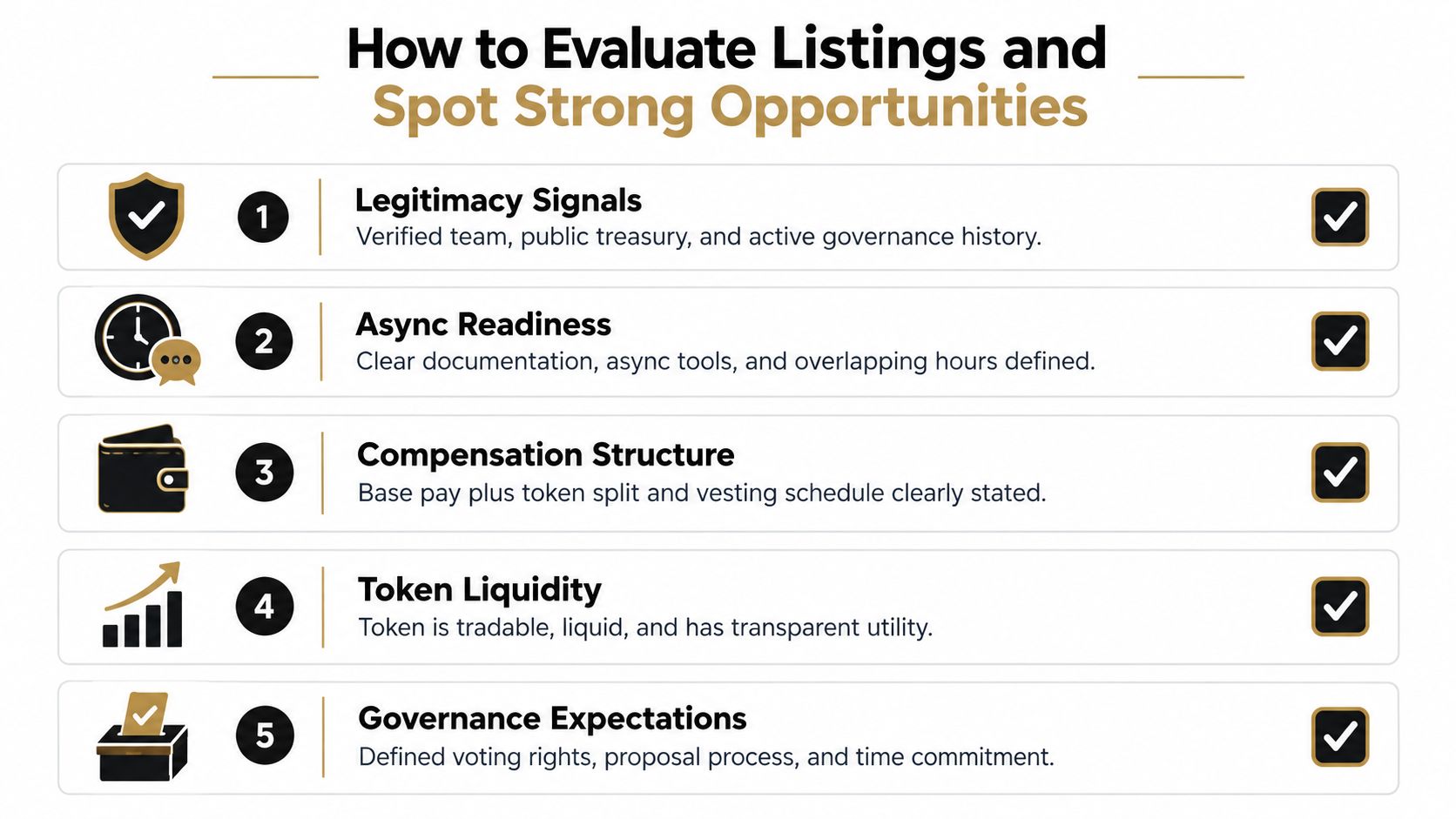
A polished listing can still hide an unclear job. Before applying, score the opportunity against five practical questions. You're testing whether the team can explain its work as clearly as it expects candidates to explain theirs.
Start with legitimacy and operating clarity
Look for a named team, a real product, public documentation, evidence of activity, and a hiring contact who can explain reporting lines. In a DAO, inspect governance history and treasury visibility where those records are public. A project doesn't need to expose every internal detail, but it should be able to show how decisions get made and how contributors get paid.
Remote readiness is equally concrete. The employer should identify collaboration tools, documentation standards, expected overlap, response norms, and the person responsible for your work. “Work from anywhere” without time-zone boundaries may mean the team hasn't designed the role.
Treat compensation as a risk review
Ask for the complete package in writing:
- Base compensation: Is there a stable salary, retainer, or grant, and in which currency?
- Token terms: What asset is included, and is the amount fixed or calculated later?
- Vesting: When does vesting start, what triggers it, and what happens after termination?
- Liquidity: Can you legally and practically access the token, and does it have transparent utility?
- Governance work: Is voting expected, and is that time included in the role?
Token pay creates alignment risk because the asset's value can move independently of your workload. Don't accept a promise that “the token will be worth more later” as a substitute for terms. Ask how the team measures contribution, who can change the arrangement, and whether the offer protects you if governance or market conditions change.
Interview timing can also help you plan. A 2026 AI, crypto, and Web3 market report recorded 15,247 active jobs, 68% remote positions, and an average 23-day time-to-close. The same report put average hiring time at 15 days for DeFi protocols and 38 days for enterprise blockchain roles. (AI, crypto, and Web3 market report for 2026) These are market benchmarks, not promises from an individual employer. If a recruiter can't explain the next stage or decision timing, treat that as a process signal.
Application Interview and Negotiation Playbook for Candidates
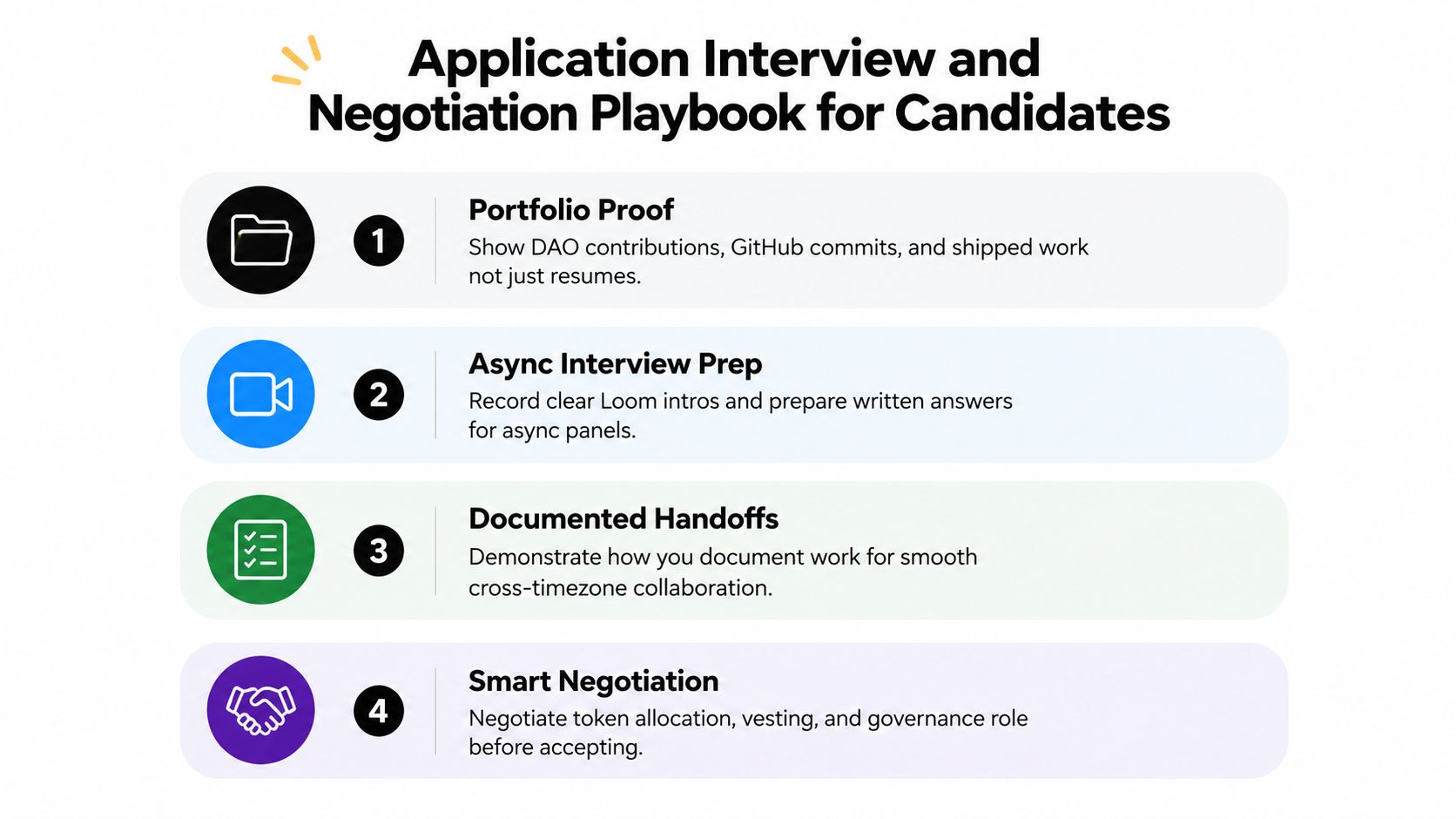
Your application should prove that you can create trust without relying on an office. Replace broad claims with artifacts. A DAO contribution, governance proposal, product teardown, documentation project, GitHub contribution, community process, or public research memo gives the hiring team something concrete to evaluate.
Make your work inspectable
Prepare a short portfolio with three parts:
- The problem: Explain what users, contributors, or the team needed.
- Your decision: Show the trade-offs, constraints, and people involved.
- The result: Include the shipped artifact, operating change, or lesson, without overstating impact.
For a community role, that might be a moderation policy and escalation map. For product, it might be a prioritized roadmap with research notes. For finance, it could be a treasury-control proposal. For content, include documentation that helped a technical audience complete a task.
Async interviews reward clarity rather than theatrical confidence. Record a concise Loom introduction if requested, but also prepare written answers. Use headings, link evidence, state assumptions, and finish with a recommendation. When the interviewer asks how you'd handle a cross-time-zone handoff, describe the document, owner, deadline, decision rule, and escalation path you'd use.
Negotiate the package, not just the headline
Ask for a written breakdown of stable pay, token allocation, vesting, cliffs, exercise or transfer constraints, governance responsibilities, and review dates. If the employer can't give precise terms because governance must approve them, ask what approval process applies and when you'll receive a final agreement.
You can also negotiate structure. A stable base can cover essential expenses while a token component preserves upside. If the employer offers only tokens, request a clear valuation method, vesting schedule, liquidity explanation, and a fallback if the token becomes unusable. Don't frame every request as a demand for certainty. Frame it as a need to understand what work and risk the offer assigns to you.
Negotiation rule: Never trade away clarity about vesting, liquidity, or governance expectations for an exciting title.
Employers can improve hiring by publishing the decision maker, work location rules, compensation range or formula, interview stages, and expected response times. Candidates notice whether a team treats the hiring process with the same care it claims to bring to protocol governance.
Building Your Next Move in Decentralized Work
A strong decentralized career doesn't require you to join a DAO immediately. Choose the operating model that matches your tolerance for ambiguity.
- Choose a DAO path if you want public contribution, governance participation, and influence without a conventional hierarchy.
- Choose a remote-first company if you want distributed work with clearer management, salary structures, and functional accountability.
- Choose a hybrid path if you want to build Web3-specific expertise while keeping compensation and progression closer to conventional employment.
Then select one skill that increases your usefulness across organizations. Engineers might deepen protocol security or infrastructure. Product candidates can learn governance constraints and on-chain user research. Operations candidates can specialize in contributor systems, documentation, or treasury workflows. Legal and finance professionals can build practical token and compliance literacy.
Use the next month as a controlled experiment. Update your profile with shipped work, publish one useful analysis or documentation sample, join a relevant governance or contributor discussion, and apply only to roles where your evidence matches the team's problem. Track interview questions and revise your portfolio after each conversation.
The durable opportunity isn't “working in crypto” as a label. It's becoming the person who can operate clearly when ownership, money, decisions, and teams are distributed. That capability travels across protocols, infrastructure companies, DAOs, and remote-first organizations.
Blockchain Jobs brings together decentralized openings across engineering, product, operations, design, marketing, finance, legal, security, and other Web3 functions, with filters for remote-friendly work and fresh listings. Visit Blockchain Jobs to find roles that match your skills, location needs, and next career move.