Your Guide to Landing Web3 Jobs Remote in 2026

A 2026 market report estimated 66,494 new Web3 roles, including 26,925 remote openings, so remote work represented roughly 40% of the total and rose 40% year over year according to Coincub's Web3 jobs report. That's a substantial market, but the headline hides the question that matters more to candidates: what kind of remote work are you pursuing?
Some teams operate asynchronously across continents. Others call a role remote while requiring regular overlap with a regional hub, occasional travel, or office coordination. Your success depends less on searching for “remote Web3 jobs” broadly and more on matching your role, location, working hours, and employer type to the company's operating model.
Understanding Remote Web3 Careers in 2026
Remote Web3 hiring remains significant, but “remote” describes several operating models. A fully distributed DeFi protocol may assess performance through shipped code, governance participation, and documented decisions. A regulated digital-asset company may permit remote work while requiring dependable overlap with a compliance, engineering, or customer team concentrated in one region.
The 2026 report counted 26,925 remote roles and found especially strong U.S. demand, with 21,612 jobs, while Europe and Asia were close to parity. That distribution points to a practical constraint: Web3 talent markets are global, but companies still organize work around time zones, customers, regulators, and operational risk. The report's regional analysis shows the market's scale without proving that every role allows work from anywhere.

Remote has several operating models
Fully distributed and asynchronous teams rely on written communication, independent execution, and clear handoffs. They may recruit globally, but they expect strong documentation and visible ownership.
Timezone-aligned remote teams hire across a broad region while requiring several hours of daily overlap. This arrangement fits engineering incident response, product and design collaboration, and compliance work involving legal or operations.
Remote-first with office access may offer optional hubs, periodic gatherings, or local preferences. Ask whether office attendance is optional or presented that way during recruitment.
Hybrid-friendly or office-led employers may advertise remote flexibility while limiting it by location or seniority. Phrases such as “preferred,” “case by case,” or “must overlap with” often reveal those conditions.
Practical rule: Treat “remote” as an operating condition to verify, not a benefit to assume.
A separate 2026 Web3 hiring dataset found that 35% of open roles were remote-friendly, with demand across the Americas, EMEA, and APAC. Use that context to make the search specific. Before applying, confirm the required overlap, employment location, travel expectations, and communication rhythm. A role that matches your skills but schedules meetings during your sleeping hours may not be remote in a workable sense.
Decoding Common Remote Web3 Job Titles
Web3 titles often look familiar, but the work changes when the product includes smart contracts, wallets, governance, tokens, or protocol incentives. Hiring managers aren't only looking for someone who can perform a standard function. They want evidence that you understand the consequences of public, composable infrastructure.
Engineering remains the clearest technical path. A Solidity developer writes and tests contracts, works with libraries and deployment tools, and considers security before release. A smart contract engineer may also review integrations, investigate on-chain failures, and coordinate audits. A protocol engineer typically works closer to consensus, execution, networking, cryptography, or core infrastructure. Rust skills are particularly relevant for ecosystems whose core tooling uses Rust.
Product roles require more than feature prioritization. A DeFi product manager needs to understand liquidity, risk, user custody, transaction flow, and how incentives affect behavior. A Web3 product designer must make signing, wallet connection, permissions, and transaction status understandable to people who may not understand blockchain mechanics.
Community and growth roles operate in public. A community moderator handles support, escalation, spam, and governance conversations across Discord or Telegram. A community manager builds durable participation rather than chasing empty engagement. A content strategist must translate technical changes into useful explanations for developers, users, and partners.
Operations, legal, and compliance roles have become more specialized. A crypto compliance analyst may work on KYC, sanctions, transaction monitoring, or policy controls. A token operations manager may coordinate listings, vesting information, treasury processes, or ecosystem partners. A solutions or implementation specialist helps enterprise customers connect digital-asset products to existing workflows.
| Job Title | Core Responsibilities | Essential Skills |
|---|---|---|
| Solidity Developer | Build, test, review, and deploy smart contracts | Solidity, testing, security awareness, Git |
| Protocol Engineer | Develop blockchain or protocol infrastructure | Rust or relevant systems language, distributed systems, cryptography |
| DeFi Product Manager | Define products involving liquidity, risk, wallets, or incentives | Product discovery, DeFi mechanics, analytics, prioritization |
| Community Moderator | Support users, enforce standards, and escalate risks | Discord, Telegram, communication, judgment |
| Web3 Content Strategist | Explain protocols, products, and technical updates | Research, technical writing, editorial judgment |
| Compliance Analyst | Support controls for digital-asset activity | AML, sanctions, regulatory reasoning, documentation |
| Implementation Specialist | Help customers adopt blockchain products | Technical communication, integrations, project coordination |
For technical candidates, browsing a focused engineering jobs category is more useful than treating every blockchain listing as interchangeable. Read the responsibilities for clues about production ownership, customer contact, on-call work, and required overlap. Those details tell you what the hiring manager is buying.
Building a Hireable Web3 Skillset and Portfolio
A conventional resume can summarize your history. It can't prove that you can operate safely in a protocol environment. For remote Web3 roles, a portfolio needs to reduce uncertainty about your judgment, technical depth, and ability to finish work without constant supervision.
The strongest portfolio projects show a complete chain of reasoning. Explain the user problem, architecture, trade-offs, tests, failure modes, deployment process, and what you'd change after review. A polished landing page without a repository, transaction history, documentation, or technical explanation won't carry much weight with an experienced hiring team.
Technical candidates need depth
Market reports show sharp year-over-year demand growth for smart contract engineers at +32%, Rust developers at +40%, and zk engineers at +51%, as reported by Silicon Republic's Web3 careers coverage. The useful takeaway isn't to collect keywords. It's to choose a stack and demonstrate genuine protocol understanding.
A credible technical portfolio might include:
- A deployed contract: Publish the repository, tests, deployment details, and a clear explanation of permissions and upgradeability.
- A security review: Document how you considered reentrancy, access control, oracle assumptions, and signature handling.
- A protocol integration: Show how your application handles failed transactions, confirmations, chain differences, and user mistakes.
- A systems project: For Rust or protocol-focused roles, explain performance decisions, state management, networking, or cryptographic assumptions.
- A readable technical write-up: Hiring managers should be able to understand what you built without reverse-engineering your code.
Use a focused smart contract developer job category to compare recurring requirements across live roles. Then revise your portfolio around repeated requirements rather than adding unrelated projects.
Nontechnical proof still needs evidence
Product, marketing, and operations candidates should also publish work. Create a Dune dashboard and explain the decision it supports. Write a protocol teardown that connects token design to user behavior. Participate thoughtfully in governance forums, publish a community playbook, or document a launch plan with audience, message, channel, and risk assumptions.
Hiring managers value visible judgment. A community candidate who can show how they handled a conflict is more credible than one who only lists “community growth.” A product candidate who can explain why a wallet flow fails is stronger than one who repeats generic Web3 terminology.
Your portfolio should make the interview easier. If the interviewer can see your decisions before the call, you'll spend less time proving that you understand the basics.
Where to Find Legitimate Remote Web3 Jobs
Specialized job boards are a practical starting point because they sort roles by Web3 functions and employer type. Filter by category, region, seniority, and work arrangement. Then verify the company's own site, team presence, product documentation, and hiring contact before sharing personal or financial information.
Remote does not always mean fully distributed. Some protocols hire across regions and organize work asynchronously. Others restrict hiring to specific countries or expect several hours of overlap with a core team. Regional targeting matters because a strong application can still fail if your available hours do not match the team's operating schedule. Choose roles that fit both your skills and the company's remote model.
Use a layered search
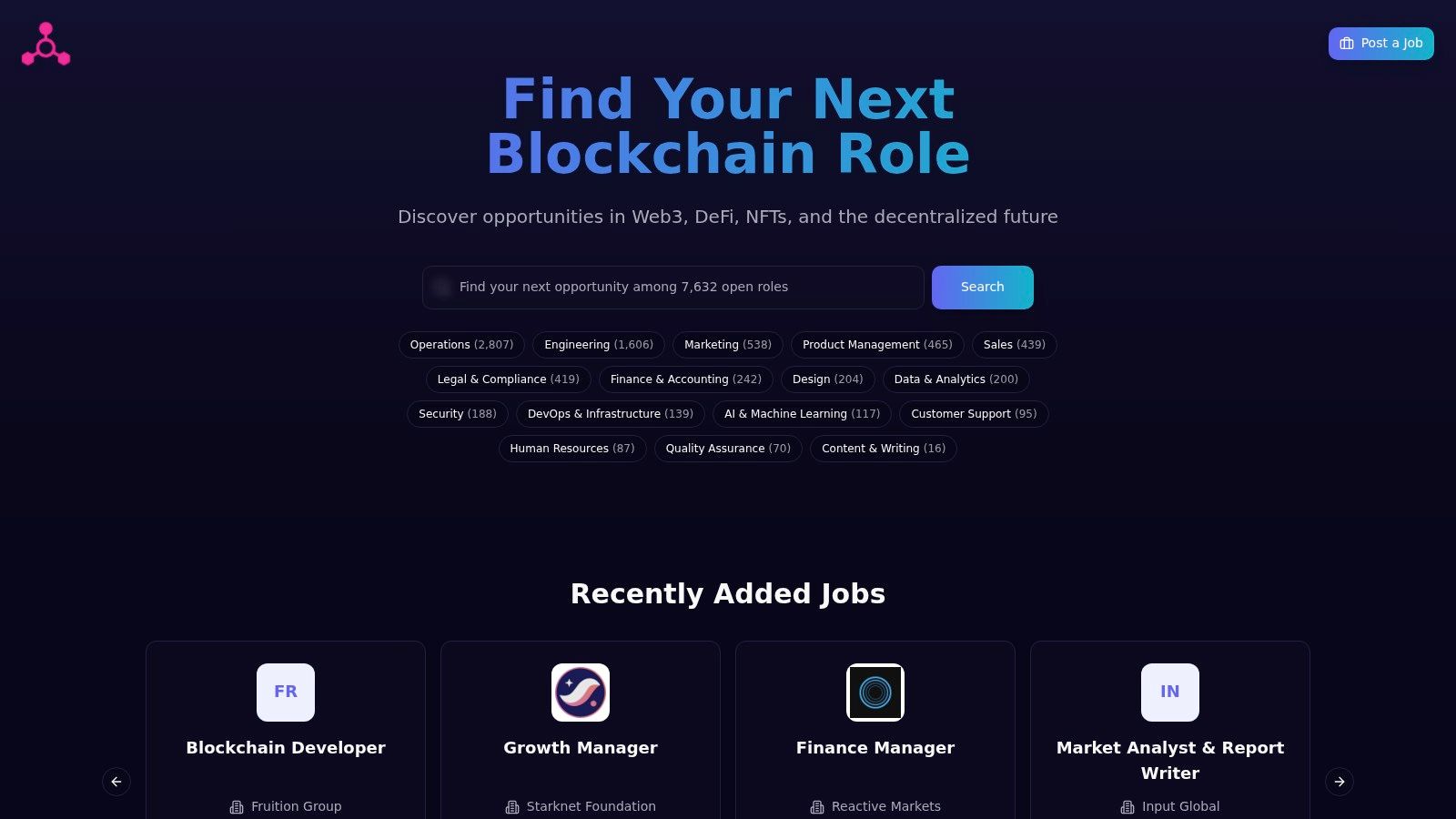
Specialized boards first. Filter for remote openings, then narrow by engineering, product, design, compliance, or operations. The remote blockchain jobs page gives candidates a focused way to review relevant listings without sorting through unrelated technology roles.
Company career pages second. After identifying a protocol, wallet provider, infrastructure company, or regulated employer, review its direct openings. Check whether the position is global, region-limited, contractor-based, or tied to a particular legal entity. The wording often reveals whether the company supports asynchronous work or expects timezone alignment.
Communities third. Discord servers, Telegram groups, governance forums, and X can surface opportunities early. Contribute before applying. Answer technical questions, review proposals, share useful analysis, and build a record that gives your application context.
Recruiters and referrals fourth. Specialist recruiters can clarify compensation structure, location restrictions, and interview expectations before you invest time. A referral carries more weight when the person can describe your work rather than forward your profile.
Contribution pathways last. DAOs and open-source projects may demonstrate execution, but unpaid or token-only work requires careful review. Confirm the scope, decision-maker, expected hours, and payment terms before treating it as a career investment.
Check listings for impersonation, vague token promises, wallet-draining requests, and pressure to move funds. A legitimate employer can explain the role, hiring process, legal entity, and compensation without asking for wallet access or payment for an interview.
Nailing the Web3 Application and Interview Process
Web3 interviews test whether you can work with public infrastructure and ambiguous risk. Your application should therefore lead with evidence, not a long list of tools. Put the strongest project, repository, deployment, dashboard, governance proposal, or launch artifact near the top.
For engineers, prepare to walk through a deployed contract from architecture to mainnet behavior. Web3 hiring guidance recommends asking candidates for deployed contract addresses, verifying them on Etherscan, and discussing mainnet deployments because testnet examples can be fabricated. Technical tests may also include planted vulnerabilities such as reentrancy, access-control flaws, oracle manipulation, or signature replay.

Prepare for production questions
A strong answer names the threat, explains the attack path, identifies the control, and acknowledges residual risk. Don't say only that you “follow best practices.” Show how you reasoned about authorization, upgrade keys, oracle dependencies, emergency pauses, testing coverage, and monitoring.
Remote hiring also tests communication. Interviewers want to know how you document a decision, report a blocked task, handle an incident, and coordinate across time zones. Bring a concise example of a disagreement and explain what changed after the discussion.
For product candidates, discuss user activation, transaction completion, custody, permissions, and failure recovery. For community candidates, show how you separate genuine participation from low-quality activity, how you escalate scams, and how you communicate a protocol incident. For legal and compliance candidates, explain how you balance user access, operational practicality, and regulatory exposure.
A mock interview can help you practice saying technical decisions aloud rather than merely recognizing them on paper. AI mock interview practice is useful for rehearsing concise answers, follow-up questions, and role-specific explanations before a live panel.
Interview standard: If you can't explain what shipped, what failed, and what you learned, the tool list on your resume won't rescue the application.
Use the video below as a prompt for your own preparation. Pause after each major question and answer it using a real project, not a hypothetical response.
Before the final interview, prepare questions about the remote model. Ask for required overlap, incident coverage, meeting load, travel expectations, documentation standards, and how the company handles decisions when teammates aren't online together. These questions signal that you understand remote work as an operating system, not merely a location benefit.
Navigating Salaries and Remote Work Logistics
Compensation data can anchor a conversation, but it shouldn't replace role analysis. A 2026 remote crypto salary dataset based on 264 active listings reported a typical remote compensation range centered between $163,719 and $200,861 annually, with a highest observed salary of $455,000, according to Sail On Chain's remote salary data. Those figures describe a broad market, not an entitlement for every candidate.
Your negotiation position should reflect seniority, specialization, location, employment structure, and the difference between fully remote and timezone-aligned work. A protocol security specialist, Rust engineer, compliance lead, and community manager aren't competing in the same compensation market. Ask how the company defines the band, what portion is cash, whether tokens or equity vest, and what happens if the project changes its token structure.
Read the contract, not just the headline
Web3 employers may use direct employment, an employer-of-record arrangement, or an independent contractor agreement. Each can change taxes, benefits, termination rights, intellectual-property ownership, and payment timing. Request the written agreement before accepting, and obtain qualified legal or tax advice in your jurisdiction when the arrangement involves token compensation or cross-border work.
Payment terms deserve equal attention. Confirm the currency, conversion method, payment date, network fees, custody responsibility, and treatment of delayed transactions. Don't treat an appealing token allocation as equivalent to guaranteed cash compensation.
Time-zone expectations should appear in writing. Ask whether overlap is fixed, whether meetings rotate, who covers incidents, and how urgent decisions are made outside normal hours. A team can be globally distributed and still create an exhausting schedule if it relies on constant live availability.
For practical guidance on documentation, meeting norms, and asynchronous coordination, review these strategies for remote team alignment. Then ask the employer to describe its actual tools and habits. Slack, Discord, Notion, Linear, GitHub, and Telegram can all support remote work, but tools don't compensate for unclear ownership or undocumented decisions.
Evaluate the full offer
Compare the offer across several dimensions:
- Cash compensation: Determine what arrives reliably and when.
- Variable compensation: Understand bonuses, commissions, equity, and token vesting.
- Benefits and protection: Check healthcare, leave, equipment, insurance, and termination terms.
- Workload: Clarify on-call, weekend coverage, travel, and meeting expectations.
- Career progression: Ask how performance is evaluated and how scope expands.
The best offer is the one you can sustain financially and operationally. Remote flexibility loses its value when the contract is vague, the time-zone burden is constant, or the employer expects full-time commitment without clear protections.
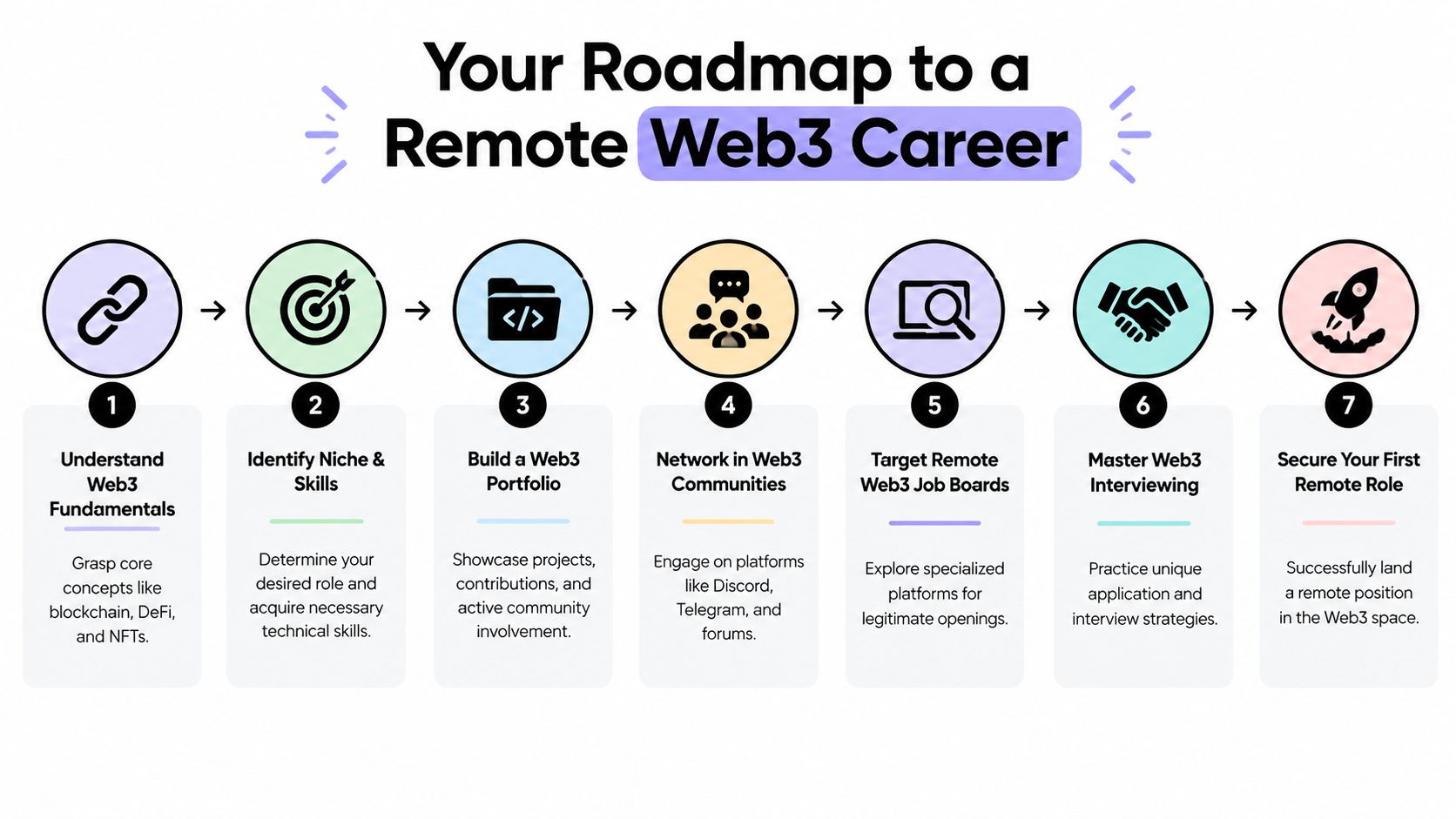
Your Roadmap to a Remote Web3 Career
A workable search starts with focus. Use this checklist to turn broad interest in Web3 into evidence a hiring manager can evaluate.
Identify your niche. Choose engineering, protocol development, product, design, community, marketing, operations, finance, legal, compliance, or another defined path. Match the choice to existing strengths and the type of work you can demonstrate publicly.
Build proof of work. Create a portfolio with repositories, deployed contracts, dashboards, writing, governance contributions, launch plans, or community artifacts. Explain decisions and limitations instead of presenting polished outputs without context.
Engage the community. Participate in Discord, Telegram, forums, GitHub, and other relevant spaces with useful contributions. Build familiarity before asking for a referral.
Target the search. Separate fully distributed roles from timezone-aligned and hybrid-friendly opportunities. Check region, overlap, employment structure, and employer type before applying.
Prepare to prove it. Rehearse project walkthroughs, security reasoning, product trade-offs, communication examples, and questions about remote operations. Your interview should connect your past work to the team's actual risks.
Remote Web3 hiring rewards candidates who understand both the work and the conditions around it. You're not only selling technical ability or professional experience. You're showing that you can deliver independently, communicate across distance, and choose an employer whose operating model supports consistent performance.
Start by selecting one role family, publish one credible proof-of-work project, and apply only to openings whose time-zone and contract expectations you understand. Review current remote listings through Blockchain Jobs, where candidates can search blockchain opportunities across engineering, product, design, marketing, operations, legal, security, and other Web3 functions.