Blockchain DevOps Engineer: 2026 Career & Skills Guide
A lot of people reach this role from one of two directions.
You're either a DevOps engineer who's already good at Kubernetes, Terraform, CI pipelines, and cloud operations, but you've realized that blockchain infrastructure is a different class of problem. Or you're hiring for a protocol, validator business, exchange, or infrastructure team and you've discovered that plenty of applicants can run containers, but far fewer can keep consensus-critical systems healthy during upgrades, incidents, and chain instability.
That gap is exactly why the Blockchain DevOps Engineer role matters. It isn't just DevOps with a wallet address attached. It's the job of making distributed, stateful, consensus-dependent systems stay online, stay consistent, and roll forward safely.
The Rise of the Blockchain DevOps Engineer
The market signals are hard to ignore. A 2026 DevOps statistics roundup from Spacelift reported that 37% of IT leaders identify DevOps and DevSecOps skills as their team's top technical gap, and 29% of IT teams had recently hired a DevOps engineer. The same roundup also cited blockchain hiring data showing vacancies growing by about 300% per year, demand increasing four times since 2017, and 14 vacancies for every blockchain developer.
For candidates, that creates a clear opening. General DevOps is already valuable. Blockchain infrastructure adds another layer of scarcity because companies don't just need someone who can stand up compute. They need someone who can automate validator fleets, manage RPC reliability, handle protocol upgrades, and reduce the operational risk that comes with decentralized systems.
For hiring managers, this explains why the role feels hard to fill. The search often starts with broad infrastructure keywords and ends with a much narrower requirement set. A strong background in automation and cloud is useful, but it doesn't guarantee production readiness in a blockchain environment.
If you're coming from a more traditional ops path, YayRemote's DevOps career guide is a useful baseline because it frames the broader DevOps career progression before you layer on protocol operations, validator management, and chain-specific reliability work.
Why this role became a premium specialization
A Blockchain DevOps Engineer sits between protocol engineering, infrastructure, release management, and incident response. That combination matters because blockchain failures don't behave like ordinary web failures.
A bad release on a standard application might cause degraded service. A bad release on blockchain infrastructure can affect node sync, block production, chain participation, signer safety, and customer-facing uptime at the same time.
Teams don't hire this role to “manage servers.” They hire it to keep decentralized infrastructure predictable under stress.
That's why this job keeps showing up in serious infrastructure teams. The value isn't just in knowing tools. It's in understanding how those tools behave when the thing you're operating is consensus-driven and stateful.
Core Responsibilities and Daily Workflows
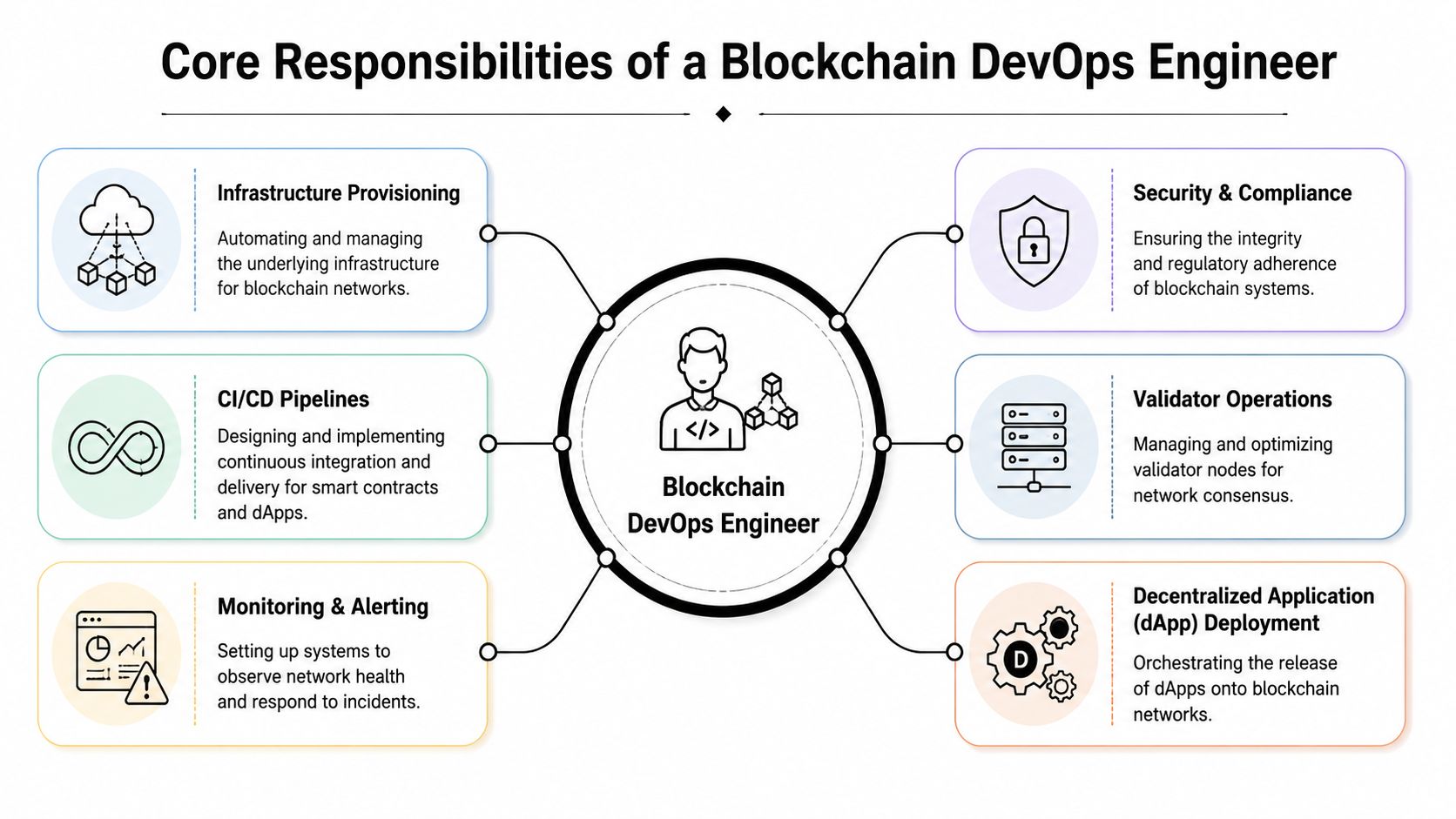
A Blockchain DevOps Engineer usually owns the boring work that becomes very expensive when it's done badly. Provisioning nodes, automating deployments, setting up monitoring, hardening infrastructure, and coordinating upgrades all sound familiar to a traditional DevOps team. The difference is the blast radius.
In blockchain operations, infrastructure drift or a failed rollout can do more than create downtime. As Forte Group's overview of DevOps in blockchain explains, blockchain services are consensus-dependent, so configuration drift, mis-sized infrastructure, or failed upgrades can affect finality, chain participation, and user-facing uptime. That's why continuous monitoring and disciplined release automation aren't optional.
What the work looks like day to day
Some days are pure platform work. You're building reusable Terraform modules, standardizing node bootstrap flows, tightening IAM boundaries, or cleaning up noisy alerts that nobody trusts anymore.
Other days are operationally sharp. You're preparing for a chain upgrade, validating state sync behavior, rotating secrets safely, checking peer health, investigating block lag, or deciding whether a node should be restarted, drained, rebuilt, or left alone.
A strong role description for this kind of work usually looks closer to SRE than generic cloud administration. A good example is this blockchain site reliability engineer opening at INFSTONES, which reflects how tightly reliability engineering and blockchain operations now overlap.
Core ownership areas
- Node lifecycle management. Teams need engineers who can deploy, upgrade, recover, and replace validator, sentry, archive, and RPC nodes without improvising every step.
- Release discipline. Smart contract deployments, node software updates, and infrastructure changes need tested paths, rollback thinking, and clear coordination windows.
- Observability that matters. CPU and memory aren't enough. You need dashboards and alerts tied to sync state, peer count, signer health, block height progression, and protocol-specific error conditions.
- Incident response. The role includes triage during production events, but a key characteristic of a senior operator is reducing repeat incidents through runbooks, automation, and post-incident cleanup.
- Security controls. Key access, secret handling, network segmentation, and change approval all matter more when infrastructure is tied to custody, staking, or validator duties.
Practical rule: if a task can break consensus participation, it deserves a runbook before it deserves a cron job.
The best operators develop strong instincts around safe change. They know when to automate aggressively and when to slow down because state, signing, or upgrade sequencing makes the environment less forgiving than a normal stateless service.
Essential Skills and The Modern BlockOps Toolchain
The fastest way to misunderstand this role is to reduce it to a shopping list of tools. Tools matter, but the key question is whether you can use them to run distributed systems that keep state, depend on protocol rules, and punish sloppy operations.
A useful reference point comes from a blockchain-focused DevOps job description summarized in the Berachain DevOps Engineer document on Scribd. It describes the role around BFT chain infrastructure such as Cosmos SDK plus CometBFT/Tendermint, and it explicitly ties the work to architecting, deploying, and managing node infrastructure, automating CI/CD, and maintaining monitoring with Prometheus, Grafana, and ELK. It also reflects the practical stack commonly expected: Docker, Kubernetes, Terraform, Ansible, cloud platforms, and scripting.
The stack only matters if you use it for repeatability
In standard application infrastructure, you can sometimes get away with “close enough” automation. In BlockOps, that approach creates drift fast.
You want a system where rebuilding a node is routine, not dramatic. Terraform should define the infrastructure shape. Ansible or equivalent config tooling should make software setup repeatable. Container tooling should make runtime behavior more predictable. CI should validate what can be validated before a release reaches production.
Here's the difference in practice:
| DevOps Pillar | Traditional Tool/Use Case | Blockchain DevOps Application |
|---|---|---|
| Infrastructure as Code | Terraform for VPCs, compute, load balancers | Terraform for validator, sentry, RPC, and supporting infrastructure with consistent network and storage patterns |
| Configuration management | Ansible for package install and server setup | Ansible for deterministic node bootstrap, binary rollout, config templating, and upgrade preparation |
| Containers | Docker for app packaging | Docker for node processes, sidecars, exporters, and reproducible environments across chains |
| Orchestration | Kubernetes for stateless services | Kubernetes for selected blockchain workloads, internal tooling, observability, and carefully chosen node patterns where state handling is well understood |
| CI/CD | Build, test, deploy web apps | Build and validate infra changes, node images, deployment artifacts, and contract release workflows |
| Monitoring | Prometheus and Grafana for host and app metrics | Prometheus and Grafana for block height, peer connectivity, signer health, sync lag, and protocol-specific alerts |
| Logging | ELK for centralized app logs | ELK for node logs, consensus events, RPC error patterns, and upgrade troubleshooting |
Skills hiring managers should actually screen for
The strongest candidates can talk through trade-offs, not just name tools.
- IaC fluency. They should explain how they structure Terraform modules for repeatable environments, and where they draw the boundary between infra provisioning and post-provision configuration.
- Stateful operations judgment. Anyone can say they know Kubernetes. Ask when they would not use it for validator workloads, or what storage and restart behavior they worry about.
- Monitoring design. Good candidates know that blockchain observability starts with protocol health, not generic host graphs.
- Upgrade safety. They should have a clear process for binary changes, config migrations, and sequencing on consensus-sensitive systems.
- Scripting discipline. Bash, Python, or Go often shows up here because operators need safe automation, health checks, and glue code.
A lot of teams also underestimate test environments. For candidates trying to build practical familiarity with chain behavior, faucet and testnet workflows can help when you're learning deployment flow, transaction confirmation, and environment differences. A lightweight starting point is this testnet ETH guide for DeFi users, not because it teaches infrastructure directly, but because it helps newer operators understand how non-production blockchain environments are used during testing.
One hiring shortcut that usually fails
Don't assume a résumé full of cloud logos means blockchain readiness.
A candidate may know AWS, Terraform, and Kubernetes well and still struggle badly with peer management, node recovery, chain upgrade procedure, or validator risk. That's why role-specific openings such as this DevOps engineer blockchain role at Binance are useful reference points. They usually reveal the difference between generic infrastructure work and production blockchain operations.
Beyond Cloud Skills The Validator Operations Gap
At this point, the role stops being a variation of standard DevOps and becomes its own specialty.
A lot of hiring teams make the same mistake. They assume a strong cloud engineer can step into validator operations with minimal adaptation. Sometimes that works. Often it doesn't, because validator infrastructure is not just another stateful service. It participates in consensus, and mistakes can become protocol-level penalties rather than ordinary incidents.
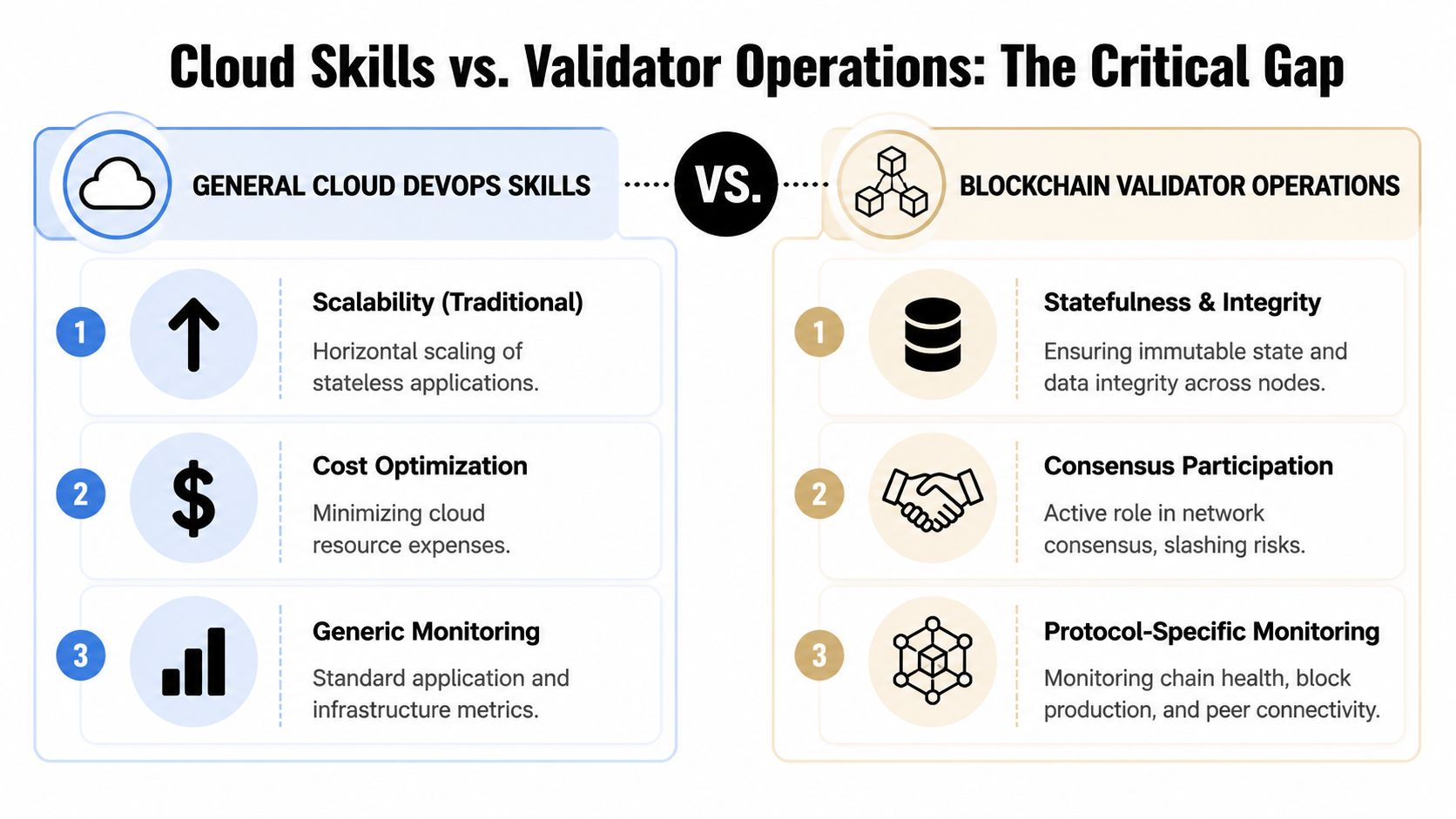
The sharpest articulation of this gap appears in a Nethermind job market analysis hosted by Cryptocurrency Jobs. It describes the steep Validator Operations gap between general cloud DevOps and blockchain-specific BlockOps, notes that blockchain nodes require 24/7 hands-on uptime for consensus participation, warns that a single 5-minute latency spike can trigger slashing, and states there's a 60% failure rate in new node deployments by traditional DevOps engineers.
Why validator work punishes shallow knowledge
A web service can usually fail behind a load balancer and recover. A validator can't rely on that pattern.
State matters. Signing behavior matters. Upgrade timing matters. Peer topology matters. Recovery steps matter. If you restore the wrong way, double-sign, miss blocks, or let latency drift in the wrong window, you can create financial loss and reputation damage.
General cloud skills are the entry ticket. Validator operations is the real job.
That's why “we'll train the blockchain part later” is sometimes realistic for junior support work but risky for production validator ownership.
Later in the learning curve, it helps to watch how operators discuss consensus mechanics and node behavior in practice:
What candidates should learn to close the gap
- Validator architecture. Understand sentries, signer isolation, failover thinking, and what must never be automated blindly.
- Protocol-aware monitoring. Learn which indicators predict validator trouble instead of just showing host stress.
- Safe maintenance habits. Practice restarts, upgrades, and recovery steps in ways that preserve state integrity and signing safety.
- Incident reasoning. Be able to explain whether a problem comes from networking, storage, consensus lag, software version mismatch, or chain conditions.
What hiring managers should test in interviews
Ask candidates to reason through specific failure modes.
Don't ask, “Do you know Kubernetes?” Ask, “A validator starts lagging during a network event. What signals do you check first, and what changes would you avoid making until you understand signer risk?” The second question exposes whether they think like an operator or a generalist admin.
How to Get Hired A Resume and Interview Guide
Most resumes for this role fail for a simple reason. They read like generic infrastructure resumes with a few blockchain nouns added at the end.
Hiring teams want evidence that you can run fragile systems safely. That means your resume needs to show operational ownership, not tool exposure. If you've only written bullets like “used Docker and Kubernetes” or “managed cloud infrastructure,” you're making the reviewer do too much interpretation.

Resume bullets that signal real capability
These examples work because they describe scope, risk, and action clearly without sounding inflated.
- Owned validator and RPC node operations across staging and production environments, including upgrade coordination, incident triage, and recovery runbooks.
- Automated node provisioning with Terraform and Ansible to reduce manual drift and make rebuilds predictable during failures and maintenance windows.
- Built monitoring dashboards in Prometheus and Grafana focused on sync status, peer health, block progression, and service-level alerts for chain infrastructure.
- Hardened deployment workflows for blockchain infrastructure by standardizing release checks, config review, and rollback preparation before production changes.
- Supported protocol upgrades by validating compatibility, sequencing rollout steps, and coordinating engineering and operations during release windows.
- Improved operational readiness by documenting runbooks for node recovery, alert response, and validator maintenance tasks.
If you have direct validator experience, say so plainly. If you don't, don't bluff. Instead, highlight adjacent work that proves you understand stateful systems, automation discipline, and high-availability operations.
What to include if you're transitioning from general DevOps
Use your existing background, but translate it into blockchain-relevant language.
A Kubernetes-heavy platform engineer can emphasize stateful workload operations, observability design, incident response, immutable infrastructure patterns, and secure secret handling. A systems engineer can emphasize Linux operations, automation, release management, and production troubleshooting. A cloud engineer can emphasize reusable infrastructure modules and safe environment promotion.
The strongest transition resume doesn't pretend prior blockchain expertise. It proves you already work in ways that blockchain operations demands.
Interview questions you should prepare for
Expect interviews that test judgment more than memorization.
- How would you automate a hard fork or chain upgrade without creating unnecessary validator risk?
- What would you monitor on a validator besides CPU, memory, and disk? Why?
- A node is falling behind in block height. What's your triage sequence?
- When would you avoid Kubernetes for a blockchain workload?
- How do you prevent configuration drift across validator, sentry, and RPC fleets?
- Describe a production incident where the safest action was not the fastest action.
- How would you separate signer-sensitive components from general infrastructure operations?
- What would make you rebuild a node from scratch instead of repairing it in place?
How hiring managers can separate signal from noise
Good interviews are scenario-based.
Ask candidates to walk through a real maintenance event, a failed upgrade, or a lagging validator. Listen for sequencing, caution around signing and state, and whether they know what not to touch during an incident. If they only answer with tool names, keep digging.
Career Path and Salary Expectations in 2026
This specialization pays more because the failure modes are harsher and the talent pool is narrower.
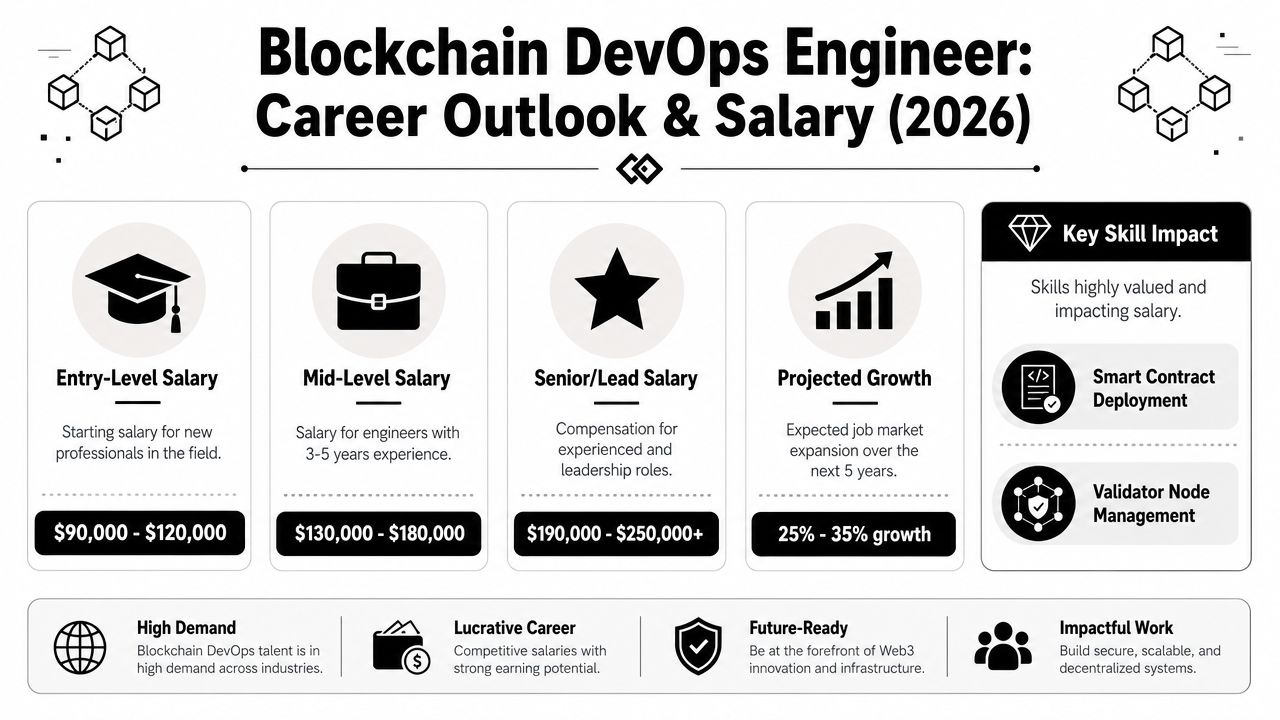
According to StrongDM's DevOps statistics compilation, the average U.S. annual salary for a general DevOps engineer is $103,571, with the top 10% earning $134,000+. The same source cites a 2022 salary analysis reporting an average global salary of $180,000 for a Blockchain DevOps Engineer (BlockOps). It also notes there are over 11,029 DevOps engineers employed in the U.S., that 16.1% are women, and that the average age is 39.
What the compensation premium really means
The salary difference reflects specialization, not branding.
Teams pay more when an engineer can combine infrastructure automation with protocol-aware operations. A candidate who can run CI/CD for web services is useful. A candidate who can protect validator uptime, manage node fleets, and execute safe upgrades is much harder to replace.
That's also why browsing active infrastructure listings in places like DevOps and infrastructure roles on Blockchain Jobs can be helpful. You can see how employers distinguish between platform engineering, SRE, validator operations, and protocol infrastructure ownership.
A realistic career ladder
A common path looks like this:
- Junior or transitioning engineer. Focus on Linux, scripting, observability, IaC, and blockchain test environments.
- Mid-level BlockOps engineer. Take ownership of node deployments, monitoring, runbooks, and on-call readiness.
- Senior Blockchain DevOps Engineer. Lead upgrades, define operational standards, mentor others, and reduce failure-prone manual work.
- Infrastructure lead or Protocol SRE lead. Own reliability strategy, staffing, tooling choices, and incident process.
- Head of Infrastructure or broader engineering leadership. Shape architecture, hiring, and operational risk across the organization.
The role has a strong ceiling because it sits close to uptime, delivery, security, and protocol trust. Few infrastructure jobs touch all four as directly.
Your Next Move in Blockchain DevOps
If you're a candidate, the next step isn't learning one more tool. It's closing the validator operations gap. Study how nodes fail, how upgrades break, how monitoring needs to change when the service participates in consensus, and how safe operators make decisions under pressure. Then rewrite your resume so it shows ownership of stateful systems, automation discipline, and incident judgment.
If you're hiring, stop writing role descriptions that blend cloud administration, smart contract deployment, and validator ownership into one vague checklist. Separate must-have production responsibilities from nice-to-have blockchain familiarity. In interviews, use scenarios that test reasoning around chain health, upgrade safety, and slashing risk.
The distinction in this market isn't “DevOps with blockchain interest.” It's whether someone can operate decentralized infrastructure without treating it like ordinary application hosting.
That's the line between a promising applicant and a dependable Blockchain DevOps Engineer.
If you're ready to act on that, Blockchain Jobs lets candidates search Web3 infrastructure roles and lets employers post openings for DevOps, SRE, and protocol operations teams in one place.