Your Guide to Landing High-Paying Blockchain Engineer Jobs

The role of a Blockchain Engineer has changed dramatically. It's not just about knowing your way around smart contracts anymore. To land one of the top blockchain engineering jobs today, you need a powerful mix of deep technical chops, a solid grasp of economics, and a real strategic mind for decentralized systems. This guide will give you actionable insights to navigate the hiring process, ace the interviews, and accelerate your career progression.
The Modern Blockchain Engineer's Toolkit

The era of being just a Solidity or Rust programmer is over. The most innovative Web3 companies aren't just looking for coders; they're hunting for engineers who can think like system architects and product people. Writing secure, gas-efficient code is now just the price of entry—it's the bare minimum to get an interview.
If you want to get noticed in this market, you have to bring a much broader, more interconnected set of skills to the table. It’s about understanding why you’re building something, not just how to build it. From a hiring perspective, managers are actively looking for candidates who can articulate how their code impacts the health and growth of the entire protocol.
It's More Than Just Smart Contracts
Top-tier companies aren't posting generic jobs for "blockchain developers" anymore. They're hiring for specialized roles that reflect the complexity of today's dApps. To get hired, you need to show expertise in specific domains.
So, where should you focus for career growth?
- Protocol Architecture: Can you design a secure, scalable, and economically sound system from scratch? This is a senior-level skill that hiring managers actively screen for.
- Tokenomics: Do you understand how token incentives drive user behavior and secure the network? In an interview, be prepared to model how an attacker might exploit those incentives.
- System Design: Can you architect the off-chain and on-chain components of a system to work together seamlessly? This is a common topic in late-stage interviews.
This evolution shows what companies really need. The trajectory for blockchain engineer roles into 2026 and beyond is a move from narrow coding skills to broad, multi-disciplinary expertise. Companies will pay a premium for engineers who understand the entire system, from the code to the economics.
A modern blockchain engineer is a hybrid: part software developer, part economist, and part security analyst. The interview process at leading companies is specifically designed to test you in all three areas, not just your coding ability.
How This Changes Your Job Hunt
This shift directly impacts how you approach your job search. Listing programming languages on your resume isn't enough. You must reframe your experience to highlight your system-level contributions and impact.
For example, instead of saying you "wrote smart contracts," rephrase it for your resume and interview talking points: "Designed and implemented a staking mechanism that increased network security by 40% by aligning validator incentives." This demonstrates technical skill and strategic impact—a key differentiator for top-tier roles.
Ultimately, companies are trying to hire engineers who can help them build lasting, valuable decentralized products. Proving you have that big-picture perspective is your ticket to landing the best blockchain engineer jobs and accelerating your career in Web3.
Building a Portfolio That Gets You Hired

Let's be blunt: in Web3, your GitHub is your real resume. It’s the first place a hiring manager looks to validate what you can actually do. A portfolio filled with basic ERC-20 token tutorials won't get you an interview. Employers need to see that you can build solutions to real-world problems.
Your projects must demonstrate that you’ve grappled with core DeFi mechanics, implemented security best practices, and can design sophisticated on-chain logic. Every project is a potential discussion point in an interview, telling a story about your problem-solving process and technical depth.
Go Beyond the Basics with High-Impact Projects
To get a recruiter’s attention, your portfolio needs substance. Ditch the tutorial clones and build projects that address the kinds of challenges active protocols face daily. This is how you prove you’re ready for a serious engineering role.
Think about building something that showcases a higher level of skill and can be a centerpiece of your interview discussions. Here are a few ideas:
- A Functional Mini-DEX: Can you build the core components: liquidity pools, swaps, and a simple front-end? This project demonstrates your understanding of fundamental DeFi money legos.
- DAO Governance dApp: Create a dApp where users can create proposals, vote with tokens, and have decisions executed on-chain. This shows you can handle complex state management and governance mechanics.
- Simple Cross-Chain Messaging: Build a protocol that passes a basic message or value between two different testnets. This signals that you’re thinking about interoperability, a major focus for many top companies.
Your GitHub profile is the stage for this work. A consistently active profile is a positive signal to hiring managers about your passion and dedication.
Documenting Your Work for Maximum Impact
An amazing project with zero documentation is a red flag for hiring managers. Your ability to explain your work is just as critical as your ability to write the code. Every single project in your portfolio needs a clean, well-written README.
Your
READMEisn't just documentation; it's your pre-interview sales pitch. It’s your chance to explain the problem you solved, the tough technical trade-offs you made, and how a hiring manager can run the code. A greatREADMEsignals strong communication skills and respect for the reviewer's time.
Ensure your documentation covers these key points for any potential employer:
- The Problem: What challenge were you trying to solve? Set the context.
- The Solution: Walk through your architectural decisions and the tech stack. Explain why you chose them.
- Setup and Usage: Provide clear, step-by-step instructions so a busy hiring manager can get your project running in minutes.
This level of care transforms your GitHub from a code repository into a powerful portfolio of case studies that directly support your job applications. Whether you're targeting DeFi, DAOs, or infrastructure, building and documenting projects like these is non-negotiable for career progression.
To align your projects with market demand, browse job descriptions for EVM-focused smart contract engineer positions to see the exact skills companies are hiring for right now.
Crafting Your Web3 Resume and LinkedIn Profile
Your resume and LinkedIn profile are your primary tools for getting a foot in the door. For a blockchain engineer role, they must be sharp enough to get past both HR algorithms and skeptical hiring managers. A standard software engineer resume simply won't cut it.
The key difference is the need to showcase tangible, on-chain results. The blockchain is a public ledger; use that transparency to your advantage in your resume. Vague claims fall flat, but hard numbers and demonstrable on-chain impact are what get you interviews.
Translate Your Experience into Web3 Language
The most critical resume skill is framing your accomplishments in a way that resonates with a Web3 hiring manager. Even if you're transitioning from traditional tech, you can translate your experience. Identify overlapping skills like distributed systems, cryptography, or performance optimization.
Then, quantify your impact with metrics that matter in the decentralized world. This is what separates a good resume from a great one.
Here’s a practical example of how to reframe your experience for maximum impact:
Instead of: "Improved API performance."
Try: "Optimized smart contract gas usage, saving users 30% on transaction fees and improving protocol competitiveness."
Instead of: "Developed backend services."
Try: "Engineered and deployed a DeFi protocol that secured $2M+ in total value locked (TVL) within the first quarter."
This approach proves you understand what's truly important in this space: efficiency, security, and real economic value.
Optimizing Your LinkedIn for Inbound Opportunities
Your LinkedIn profile should be a magnet for recruiters. For that to happen, it needs to be optimized with the keywords hiring managers use in their searches every day.
Your headline is the most critical part of your profile. Don't waste it.
Bad Headline: "Software Engineer at Tech Company" Good Headline: "Senior Blockchain Engineer | Solidity, DeFi Protocol Development, Smart Contract Security"
This simple change immediately signals your specialty and makes you discoverable. Next, weave relevant keywords—like Solidity, Rust, EVM, DeFi, Layer 2, and smart contract security—naturally throughout your summary and experience sections.
Don't just set it and forget it. Active engagement signals passion. Follow and interact with major protocols and key figures in the space. Sharing your insights on a new EIP or a technical post demonstrates genuine interest to recruiters, proving you're a committed member of the ecosystem, not just another job seeker.
Navigating the Blockchain Job Market Cycles
The blockchain job market is notoriously volatile, often mirroring the crypto price cycles. One minute, companies are in a hiring frenzy; the next, freezes and layoffs dominate the headlines. Learning to navigate these cycles is a critical career skill.
Unlike the relatively stable hiring in traditional tech, Web3 is driven by market sentiment. In a bull market, VC-backed startups race to scale. In a bear market, the focus shifts. But the core demand for skilled engineers who can build and secure protocols never truly disappears. It just changes.
Reading the Market Signals for Your Career Strategy
The trick is to see past the noise and strategize accordingly. In early 2026, for instance, headlines were bleak. Indeed data showed a 60% month-over-month drop in blockchain developer roles, and LinkedIn reported a 78.9% plunge.
However, a closer look revealed that over 460 full-time Web3 jobs were still posted that same month. You can get more details on these job market trends and their implications. This highlights a crucial career insight: while speculative hiring cools, the need for engineers to build core infrastructure and secure protocols remains strong.
The most successful engineers don't get shaken out by market cycles. They use the quieter "bear markets" to deepen their skills, contribute to open-source projects, and strategically position themselves for the next wave of hiring. This is when you can make the biggest leaps in your career.
Where to Look for Opportunities
Your job search strategy should adapt to the market cycle.
- Bull Markets: Expect a frenzy of hiring from early-stage startups offering high-risk, high-reward equity or token packages. This is the time for aggressive career moves if you have a high-risk tolerance.
- Bear Markets: Established players—major exchanges, infrastructure providers, and well-funded Layer 1 foundations—continue to build. These roles offer more stability and are excellent for strengthening your technical foundation and career resilience.
Regardless of the market, focus your search on specialized job boards and communities where crypto-native companies source talent. By monitoring listings for remote blockchain engineer jobs, you can also access a global pool of opportunities, making your career less dependent on any single region's economic climate.
Mastering the Blockchain Engineering Interview
A blockchain engineering interview is a unique challenge. It combines a classic software engineering interview with a deep dive into the specific constraints and paradigms of Web3. You might whiteboard an algorithm one moment and debate the game theory of a consensus mechanism the next.
The goal of the interview isn't just to assess your coding ability. It's to prove you have a deep, intuitive grasp of the core principles of decentralized systems. Gas efficiency, immutability, and security aren't just topics; they are the fundamental laws, and interviewers must be convinced you can build within them.
The Technical Gauntlet: What to Expect
While you'll face standard algorithm questions, the blockchain-specific challenges are where you'll either shine or fail. The best candidates can always explain the why behind their technical choices, detailing the trade-offs involved.
Hiring managers will focus on topics that directly impact protocol security and efficiency. You must have mastery in these areas:
- EVM Internals: How does the Ethereum Virtual Machine actually work? Be prepared to walk through its memory model (storage, memory, calldata), explain opcodes, and break down gas calculation. A classic interview question is, "Describe the lifecycle of a transaction from submission to block inclusion."
- Smart Contract Security: This is non-negotiable. You must know common vulnerabilities like reentrancy, integer overflow/underflow, and front-running intimately. A common interview format is to be given a vulnerable Solidity snippet and be asked to identify the flaws and rewrite it securely.
- System Design for dApps: How would you architect a decentralized lending protocol? What about a high-traffic NFT marketplace? Be ready to design a full system, justifying decisions about on-chain vs. off-chain logic, data storage (IPFS), and scalability strategies.
The candidates who consistently receive offers are those who think in trade-offs. They don't give a single "right" answer. Instead, they propose several solutions and analyze the pros and cons of each in terms of security, cost, and user experience. This demonstrates senior-level thinking.
To focus your preparation, master the topics that appear most frequently in technical interviews.
Common Blockchain Interview Topics and Focus Areas
| Topic Area | What to Expect | Example Question |
|---|---|---|
| CS Fundamentals | Classic data structures and algorithms, often with a Web3 twist. Expect to implement them live. | "How would you implement a Merkle Tree and explain its importance for on-chain data verification?" |
| Blockchain Core Concepts | Your fundamental understanding of consensus, block structure, cryptography, and the transaction lifecycle. | "Compare and contrast the finality guarantees and security models of Proof of Work and Proof of Stake." |
| EVM & Gas Optimization | Deep knowledge of EVM internals, storage vs. memory, opcodes, and gas-saving techniques. | "Explain the difference between calldata and memory and provide a code example where choosing one over the other significantly saves gas." |
| Solidity & Smart Contracts | Proficiency in Solidity, design patterns (e.g., proxy contracts), and contract interaction. | "What is the Checks-Effects-Interactions pattern, and why is it a critical defense against reentrancy attacks?" |
| Security Vulnerabilities | Identifying and mitigating common attack vectors like reentrancy, oracle manipulation, and access control issues. | "Here is a vulnerable smart contract. Find the security flaw, explain the exploit path, and rewrite it to be secure." |
| dApp Architecture | High-level system design involving on-chain/off-chain components, data indexers, and scalability. | "Design the architecture for a decentralized social media platform. What specific data goes on-chain, and how do you handle the rest?" |
| Testing & Tooling | Deep familiarity with frameworks like Foundry or Hardhat and advanced testing methodologies. | "Describe how you would set up a comprehensive test suite for a complex DeFi protocol using Foundry, including fuzzing and fork tests." |
Mastering these areas will put you in a commanding position for even the most rigorous technical interviews.
Beyond the Code: Nailing the Cultural Fit
In the tight-knit Web3 space, cultural fit is paramount. The behavioral interview for blockchain engineer jobs often carries more weight than in traditional tech. Companies are looking for passionate builders who are committed to the principles of decentralization.
This is your chance to show you're not just a hired gun. Be prepared to discuss:
- The dApps and protocols you use daily and what you admire or would change about their design.
- Your informed opinion on recent EIPs or major developments in ecosystems like Solana or Cosmos.
- Your personal process for keeping up with the rapid pace of innovation.
Hiring managers are looking for genuine curiosity. They are also highly sensitive to security threats, including insider risks. Your authentic passion is not just a bonus; it's a signal of trustworthiness that can make or break a hiring decision.
Negotiating Your Web3 Compensation Package
You've aced the interviews and landed the offer—congratulations. Now, it's time to negotiate a compensation package that reflects your high-value skills.
Negotiating a Web3 offer is more complex than a typical tech role. A standard package includes a base salary, company equity, and project tokens. Understanding each component is critical to negotiating effectively and maximizing your long-term earnings.
Salary benchmarks vary widely based on experience, specialty, and location. Data from January 2026 places the average U.S. blockchain developer salary at $105,000, but senior-focused data suggests a more realistic average closer to $167,893 annually. The most lucrative roles are consistently in security, where smart contract auditors can earn compensation rivaling senior FAANG engineers. You can explore more Web3 hiring trends to benchmark your market value.
Breaking Down the Offer
To negotiate successfully, you must dissect the offer and understand the risk and potential upside of each part.
- Base Salary: Your stable, guaranteed income, typically paid in USD or EUR. This is your foundation.
- Equity: A share of ownership in the company, vesting over several years. Its value depends on the company's future success.
- Token Allocation: A grant of the project's native tokens, also on a vesting schedule. Their value is tied directly to the project's performance and market perception.
The technical skills tested in interviews directly correlate to the seniority—and compensation—of the roles you can secure.
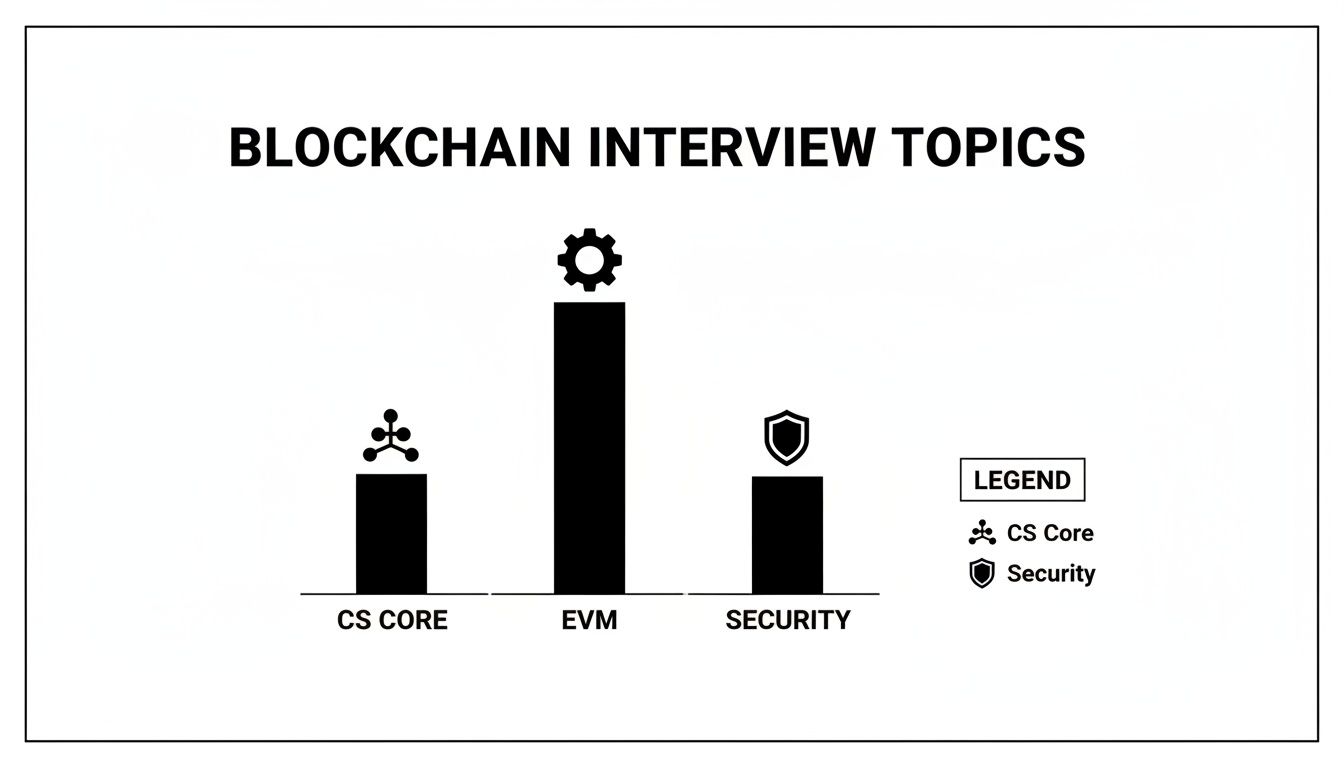
As the chart indicates, security expertise is a highly valued pillar. This specialization commands a significant salary premium because it directly protects the protocol's value.
Location, Location, Negotiation
Your location impacts your earning potential. Major hubs like London, Dubai, and Singapore have intense competition for talent, driving salaries higher.
When negotiating, look beyond the base salary. Ask critical questions: What is the token vesting schedule and cliff? What is the fully diluted token supply and current valuation? For equity, what was the last 409A valuation? A lower base salary might be a strategic trade-off for a larger token or equity package if you have high conviction in the project's long-term success.
A successful negotiation is built on research. Know the market rates for your skills, get clarity on every component of the offer, and be prepared to articulate a clear, data-backed case for your value.
Answering Your Burning Questions About Blockchain Engineering
Pursuing a Web3 career path raises unique questions that traditional tech career guides don't cover. Here are answers to the most common questions from engineers looking to enter or advance in the space.
Do I Really Need to Be a Math Whiz?
For the vast majority of blockchain engineering roles, the answer is a clear no.
If your career goal is to become a core protocol developer inventing novel cryptography, then a deep math background is required. However, for most engineers building dApps and writing smart contracts, it is not a prerequisite.
What's far more important is a strong foundation in computer science, logical reasoning, and a relentless security-first mindset. You need to understand how to apply concepts like hashing and public-key cryptography, not invent them. Hiring managers are evaluating your ability to build secure, efficient systems, not your ability to write mathematical proofs.
Can I Get a Job Without a Computer Science Degree?
Absolutely. Web3 is fundamentally a meritocracy. Your on-chain and open-source contributions are your credentials, and they speak louder than any diploma.
A strong GitHub portfolio showcasing complex projects and contributions to reputable protocols will always outweigh a traditional degree. For hiring managers, the ultimate question is: can you build secure, production-ready systems?
Many of the most respected engineers in the industry are self-taught or transitioned from other fields. Focus your energy on creating irrefutable proof of your skills, and your formal education becomes a secondary concern.
Which Blockchain Specialization Pays the Most?
As of 2026, smart contract security remains the most critical and highest-compensated specialization. For protocols securing billions of dollars in value, the auditors and security engineers who prevent catastrophic exploits provide immense value and are compensated accordingly.
Beyond security, several other specializations are in high demand and offer top-tier compensation for career growth:
- Layer 2 Scaling Solutions: As the industry focuses on scalability, engineers who can build and optimize rollups and other L2 technologies are in extremely high demand.
- Cross-Chain Interoperability: The future is multi-chain. Experts who build the bridges and messaging protocols that enable interoperability are highly valued.
- Zero-Knowledge Proofs: A more niche but rapidly growing field. Engineers with these advanced cryptographic skills are scarce and can command premium salaries.
Ready to find your place in the future of tech? At Blockchain Jobs, we connect top talent with the best opportunities in the Web3 ecosystem. Explore thousands of roles in engineering, security, product, and more. Find your next great role today at https://blockchain-jobs.com.