
Your Guide to High-Paying Careers in Crypto

When people think of crypto jobs, they often picture developers hunched over keyboards, writing complex code. But that's just a small slice of the pie. The industry is booming, and companies need marketers, finance whizzes, and operations experts just as much as they need engineers. To land one of these roles, you need to think like a hiring manager.
As crypto becomes more mainstream, this demand for a wider range of talent is only going to grow. If you're looking for a career change, getting into crypto today is like getting in on the ground floor of a skyscraper with unlimited potential for career progression.
Why a Career in Crypto Is a Smart Move Right Now

The crypto world is growing up. It's moving past its early, speculative days and becoming a core part of how the internet works. From a hiring perspective, this means companies are looking for professionals who can build sustainable, long-term value, not just ride the hype cycles. Building this new world requires more than just coders; it needs the digital equivalents of architects, city planners, storytellers, and community builders to create something truly lasting.
This expansion isn't just theoretical—it's driven by real-world use. Big banks are using blockchain to speed up transactions, game developers are creating player-owned economies with NFTs, and shipping companies are using it for transparent supply chains. Every new application creates a ripple effect, opening up jobs for people who can connect traditional business know-how with the new principles of decentralization—a key combination hiring managers look for.
The Growing Demand for Diverse Talent
A few years ago, the primary job ad you'd see was for a blockchain developer. While that demand is still incredibly strong, the hiring landscape has exploded. Companies are now on the hunt for a much broader set of skills to fuel their growth.
- Strategic and Creative Roles: You'll find tons of openings for product managers, UX/UI designers, and marketing specialists. Their job is to make Web3 apps easy to use and appealing to everyday people, a critical step for adoption.
- Operational and Financial Roles: As projects mature, they need operations managers, financial analysts, and legal experts to build stable foundations, manage treasuries, and navigate complex regulations.
- Community and Growth Roles: Community managers and business development pros are essential for user acquisition and retention. They build engaged user bases and forge the partnerships that help the ecosystem grow.
This shift is great news for your job search. Your current skills are likely more transferable than you think. A project manager from a SaaS company already knows how to bring order to chaos—a priceless skill in a fast-paced crypto startup. A marketer who's great at building online communities has the perfect foundation to become a top-tier Web3 community manager. The key is to frame your experience in a way that resonates with crypto hiring managers.
The big picture for job seekers is this: the industry has moved from just building the pipes to creating products and services that people actually want to use. That transition requires a diverse team that can bridge the gap between complex tech and real human needs.
A Future-Proof Career Path
Jumping into a crypto career isn't just about a potentially high salary; it's an investment in skills that are becoming more and more valuable for long-term career progression. As other industries start adopting this technology, professionals with hands-on crypto experience will be the first ones considered for leadership roles.
Learning how to operate within a Decentralized Autonomous Organization (DAO), understanding tokenomics, and contributing to open-source projects are experiences that make a resume stand out. For anyone willing to dive in and learn, the crypto space offers a clear and exciting path for a career that will stay relevant for years to come.
Exploring Top Crypto Jobs and What They Really Pay
Thinking about a career in crypto? The good news is the field has exploded beyond just hardcore engineering. But to find where you truly fit and succeed in an interview, you need to understand the day-to-day work, the skills hiring managers are looking for, and, of course, what you can expect to earn.
The industry is growing up fast. Jobs that used to be a one-person show are now full-blown specializations. This creates clear career ladders for professionals from all sorts of backgrounds looking to make the jump into Web3.
The Architects: Smart Contract Developers
Picture a Smart Contract Developer as a blend of a high-stakes architect and a transactional lawyer, but for the digital world. They write self-executing code on the blockchain using languages like Solidity or Rust. This code automates everything from DeFi trades to NFT ownership, cutting out the need for a middleman.
When companies hire for this role, they’re looking for more than just a great coder. In an interview, you'll need to demonstrate a deep-seated understanding of security to prevent costly hacks and a mind that can map out every potential outcome of a contract's logic. It’s a job where a tiny mistake can cost millions, so being meticulous is non-negotiable.
The Visionaries: Web3 Product Managers
A Web3 Product Manager is the person who connects the dots between mind-bending blockchain tech and what actual users want and need. A traditional PM might obsess over click-through rates, but a Web3 PM has to think about tokenomics, decentralized governance, and community-led growth. They are the ultimate translators, turning technical jargon into products people genuinely love.
In an interview, you’ll be expected to clearly articulate what makes a decentralized product different from its Web2 cousin. You have to prove you can put the user first while still honoring the core values of decentralization, like transparency and user ownership. Your ability to strategize around community incentives will be a major focus.
A key challenge for a Web3 Product Manager is balancing the ideals of a permissionless, open protocol with the practical need to build a user-friendly and sustainable product. Their success hinges on creating value not just for the company, but for the entire ecosystem of users and token holders.
The Connectors: Crypto Community Managers
In Web3, your community isn't just a group of customers—it is the product. A Crypto Community Manager is the vital bridge between a project and its passionate user base. They’re part diplomat, part event organizer, and part teacher, working to build a thriving culture on platforms like Discord and X (formerly Twitter).
This role is so much more than just posting memes and announcements. The best community managers steer governance proposals, collect crucial user feedback for the dev team, and are the calm voice of reason during a crisis. Hiring managers are searching for people with real empathy, sharp communication skills, and the ability to keep a cool head when things get heated.
In-Demand Crypto Roles and Salary Projections
Let's talk about one of the biggest draws to the crypto space: the pay. With a massive talent shortage and huge demand, salaries in Web3 are some of the most competitive in tech. Below is a snapshot of some popular roles and what you can expect to earn.
| Job Title | Core Responsibilities | Essential Skills for Interviews | Average Salary Range (USD) |
|---|---|---|---|
| Smart Contract Developer | Writing, testing, and deploying secure smart contracts on blockchains like Ethereum. | Solidity/Rust, blockchain security principles, demonstrating a security-first mindset. | $120,000 - $250,000+ |
| Web3 Product Manager | Defining product vision, strategy, and roadmap. Integrating tokenomics and governance. | Product management fundamentals, tokenomics, UX, ability to articulate a GTM strategy. | $100,000 - $200,000 |
| Crypto Community Manager | Fostering community engagement on platforms like Discord/X, managing governance. | Communication, social media management, empathy, crisis management examples. | $70,000 - $150,000 |
| Blockchain Core Engineer | Building and maintaining the foundational layer-1 or layer-2 blockchain protocols. | C++, Go, or Rust; distributed systems, cryptography, consensus algorithms. | $150,000 - $300,000+ |
| DeFi Quant Researcher | Developing and testing profitable trading strategies on decentralized exchanges (DEXs). | Quantitative analysis, Python/C++, smart contract interaction, provable track record. | $150,000 - $500,000+ |
These figures show just how much value specialized skills bring to the table. As you can see, roles that demand deep technical or financial expertise often come with the highest compensation packages, offering significant career progression.
Understanding Crypto Salary Expectations
One of the biggest magnets pulling talent into crypto is the competitive compensation. Because there’s a serious gap between the demand for skilled people and the supply, salaries have shot up, often surpassing those in traditional tech. Roles that require highly specialized knowledge, like blockchain engineering or quantitative trading, are where you’ll see the top-tier pay.
For example, the high-stakes world of decentralized finance has opened up incredibly lucrative career paths. You can check out a specialized opening for a DeFi Quant Researcher/Trader to see just how high the pay can climb for this kind of niche expertise.
The scramble for talent has only gotten more intense as the industry has matured. One recent report found that blockchain core engineers can command salaries from $90,000 to $220,000, while crypto product managers typically earn between $70,000 and $160,000. This competition is pushing companies to offer more than just a big paycheck; they're also providing hefty benefits and clear paths for career progression to attract and keep the best people.
This financial upside is a direct reflection of the immense value that skilled people bring to the table in such a fast-moving industry. Whether you're building the core tech, shaping the product, or growing the user base, your work has a real, measurable impact—and you get rewarded for it. As you map out your career move, keeping these salary benchmarks in mind will help you negotiate with confidence and find roles that match your financial goals.
Building the Skills That Get You Hired in Web3
Forget what you know about traditional career paths. In the crypto space, it's not about the degree you have hanging on your wall—it's about what you can build, manage, and grow. Hiring managers are looking for people with proven, hands-on skills who can solve real problems for Web3 companies.
Whether you're a coder at heart or a strategic thinker, there’s a place for you. The trick is to focus your learning on the skills that companies are actually desperate for, which will accelerate your career progression.
The payoff for developing this expertise is significant. Just look at the typical salary ranges for two of the most common career tracks in the industry.
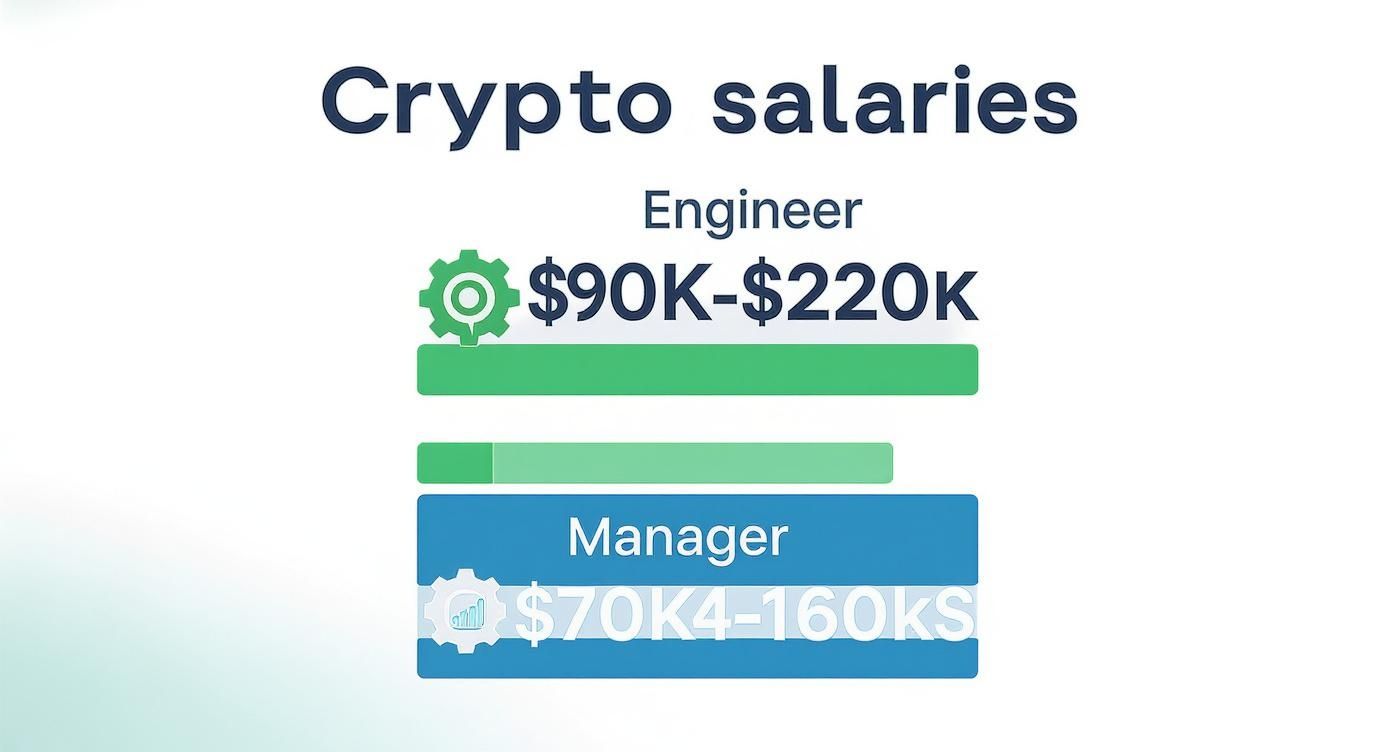
As you can see, both deep technical knowledge and sharp management skills command impressive salaries. This reflects just how much the industry values a wide range of talent.
Core Technical Skills for Aspiring Builders
If you’re drawn to the engineering side of crypto, you'll need to master a few fundamental skills. These are the non-negotiables you’ll see in almost every developer job description.
- Smart Contract Development: Getting good with languages like Solidity (the go-to for Ethereum and similar chains) or Rust (popular for Solana and Polkadot) is a must. The goal isn't just to write code that works, but to write code that’s ironclad—because in crypto, a tiny bug can lead to millions in losses.
- Blockchain Architecture: You need a solid grasp of how these networks actually function. This means understanding core concepts like consensus mechanisms (think Proof-of-Work vs. Proof-of-Stake), Layer 2 scaling solutions, and the trade-offs between different blockchain designs.
- Web3 Libraries and Tools: You'll be expected to hit the ground running with tools like Ethers.js, Web3.js, and development frameworks such as Hardhat or Foundry. This is the toolkit you'll use every single day to build, test, and launch decentralized applications (dApps).
From a hiring manager's perspective, a candidate who has contributed to an open-source protocol or built a simple dApp from scratch is infinitely more valuable than one with only theoretical knowledge. Demonstrable experience is your most powerful asset in an interview.
Essential Non-Technical Skills for Growth and Strategy
You don't have to write a single line of code to have a massive impact in crypto. The industry is starving for sharp minds in strategy, community, and operations. These are the skills that separate the good candidates from the great ones.
- Deep Understanding of Tokenomics: This is the art and science behind a crypto asset's economy. In an interview, you must be able to discuss how token supply, distribution schedules, and utility mechanics drive user behavior and create long-term value.
- Community Building and Engagement: In Web3, your community is your product. Knowing how to cultivate a passionate, engaged following on platforms like Discord and X is a genuine superpower. It's about nurturing a culture and turning users into die-hard fans.
- Decentralized Governance: More and more projects are run by DAOs (Decentralized Autonomous Organizations). Understanding how they work—from proposal systems and voting to treasury management—is becoming a critical skill for almost any non-technical role.
How to Actually Learn These Skills
The Web3 world moves too fast for traditional four-year degrees to keep up. It’s an industry built by self-starters who learn by doing. Here’s how you can build the kind of experience that gets you hired.
- Contribute to Open-Source Projects: Find a project you love on GitHub and dive in. You can start small by fixing typos in documentation, tackling minor bugs, or just participating in development discussions. This is hands-down one of the most respected ways to prove your skills to a hiring manager.
- Participate in a DAO: Don't just watch from the sidelines—join a DAO and get your hands dirty. Vote on proposals, join a working group, or complete a few paid tasks (bounties). It's an incredible real-world lesson in decentralized work that you can speak to in interviews.
- Build a Portfolio of Small Projects: Actions speak louder than resumes. Create your own simple smart contracts, build a basic dApp, or launch your own token on a test network. Document everything you build on GitHub—it becomes your proof-of-work in an interview.
- Enroll in Specialized Online Courses: Targeted courses can give you a huge leg up. For example, if you're excited by the boom in Web3 gaming, a course on adding blockchain to a Unity game could give you a very specific, in-demand skill set.
Your Step-By-Step Plan to Land a Crypto Job

Knowing which roles are out there is just the first step. Actually getting your foot in the door is a whole different ball game. The crypto world plays by its own set of rules, and what works in traditional tech often falls flat here. A polished corporate resume might get you nowhere, while a busy GitHub profile could land you three interviews in a week.
This is your playbook for getting noticed and hired. The secret? Show, don't tell. Hiring managers are looking for people with genuine passion and provable contributions. Think of this as your inside guide to proving you have both the skills and the decentralized mindset to make a real impact.
Craft a Resume That Speaks Web3
Forget everything you know about traditional resume writing. In crypto, your resume needs a total overhaul. While your past experience is still important, it has to be framed through a Web3 lens. The focus isn't on corporate titles; it's on tangible, decentralized contributions.
Here’s how to make your resume pop for a hiring manager:
- Put Your GitHub Front and Center: For any technical role, your GitHub profile is your real resume. Link to it right at the top. Make sure it’s packed with your best work—personal projects, dApp experiments, and especially contributions to open-source protocols.
- Highlight Your DAO Experience: Have you voted on governance proposals? Contributed to a working group? Completed bounties for a DAO? Put it on your resume. This is gold because it proves you know how to work in a collaborative, decentralized environment.
- Translate Your Web2 Wins: Reframe your old achievements. Instead of saying, "Managed a marketing budget of $500k," try something like, "Grew a user base by 30% through community-focused initiatives." That language resonates far more with Web3’s grassroots ethos.
A Web3 hiring manager is looking for proof-of-work. A link to a smart contract you deployed on a testnet or a thoughtful governance proposal you wrote for a DAO is infinitely more powerful than a bullet point listing your old job title.
Network Like a Crypto Native
If you're just spamming your resume on LinkedIn, you're doing it wrong. The real networking—and the best job opportunities—are found on platforms like X (formerly Twitter) and Discord. In this world, genuine connection and contribution are your currency.
The goal is to become a familiar, value-adding voice in the conversation, not just another person looking for a job. Add insightful comments to discussions, share cool projects you’re working on, and offer to help others. Before you know it, people will start to recognize your name and respect your expertise.
This approach pays dividends. In an industry built on trust, a warm intro from a respected community member can be the single most effective way to get your application moved to the top of the pile.
Master the Web3 Interview
A crypto interview isn't just a skills test; it’s a culture fit check. They want to know if you get it—if you genuinely believe in the principles of decentralization, user ownership, and transparency. You’ll need to be ready for questions that go way beyond your technical skills.
Prepare for questions like:
- “Explain a complex crypto concept (like MEV or ZK-proofs) in simple terms.” This tests your depth of understanding and ability to communicate clearly to non-technical stakeholders.
- “What’s your favorite dApp, and what would you do to improve it?” This shows your product sense and how you think about the user experience in a Web3 context.
- “Describe a time you disagreed with a community decision in a DAO or open-source project. How did you handle it?” This probes your ability to navigate decentralized collaboration and conflict professionally.
Your answers need to radiate passion. Show them you’re not just looking for a paycheck—you’re on a mission to help build a more open and fair internet.
The demand for people with this unique blend of skills and mindset is absolutely exploding. One recent report pointed to a massive 118% year-over-year jump in crypto-related job postings, which just goes to show how fast the industry is growing. You can explore more data on crypto hiring trends to get a sense of the scale.
As you get ready to make your move, remember that the best way to find a great role is by staying active and visible. Industry-specific job boards are your best friend. To get started, you can explore hundreds of open positions on Blockchain Jobs and see what leading companies are looking for right now.
How to Grow and Advance Your Crypto Career
https://www.youtube.com/embed/n8aA3DfiVuE
Landing your first crypto job is a huge milestone, but it’s really just the starting line. This industry moves at a blistering pace—what’s cutting-edge today can feel like ancient history six months from now. To ensure long-term career progression, you have to be ready to continuously learn, adapt, and anticipate future trends.
Success isn't just about mastering your current role. It's about future-proofing your skill set by staying curious, looking beyond your day-to-day tasks, and positioning yourself to catch the next wave of innovation just as it starts to build.
Stay Ahead of Industry Trends
In crypto, knowledge isn't just power; it's the engine of your career growth. The people who get promoted fastest are the ones who can spot a new trend and grasp its potential before it hits the mainstream. This means you have to be intentional about your learning.
Staying in the loop doesn't happen by accident. You need to curate your information diet and plant yourself right in the middle of the most important conversations.
- Follow Key Newsletters and Podcasts: Find a few high-signal daily briefings and weekly podcasts from respected analysts and thinkers. This is how you’ll hear about emerging concepts like Decentralized Physical Infrastructure Networks (DePIN) or new Layer-2 scaling solutions before everyone else.
- Be Active in Niche Communities: Don’t just hang out in massive, general crypto groups. Find the Discord servers and Telegram channels for the specific protocols or sectors that fascinate you. That’s where the real-time insights and networking opportunities are.
- Experiment with New Protocols: Reading about a new technology is one thing, but using it is another. Set up a test wallet and get your hands dirty with new dApps, bridges, and protocols. There's no substitute for hands-on experience when discussing trends in an interview.
Staying current is your most important soft skill. In an interview for a senior role, being able to intelligently discuss the potential impact of a recent Ethereum Improvement Proposal (EIP) or a new token standard demonstrates a level of engagement that sets you apart from other candidates.
Mapping Your Career Progression
Your career path in crypto won't be a straight line. Unlike traditional industries with their rigid corporate ladders, Web3 is incredibly fluid. People jump between roles, projects, and even specializations all the time as they find new interests and opportunities.
For instance, a common technical career progression might look like this:
- Junior Smart Contract Developer: You’ll start by writing and testing specific, well-defined smart contracts with oversight from senior team members.
- Senior Blockchain Engineer: Here, you take ownership of bigger pieces of a protocol, start mentoring junior devs, and have a real say in architectural decisions.
- Lead Protocol Architect: At this level, you’re designing entire systems from scratch, making the foundational decisions on consensus, tokenomics, and security that shape the whole project.
And the same kind of growth happens on the non-technical side, too:
- Community Moderator: Your journey might begin on the front lines, engaging with users in Discord, answering questions, and keeping the vibe positive.
- Community Manager: You’ll move into a strategic role, creating and running campaigns to grow and energize the user base.
- Head of Ecosystem Growth: Ultimately, you could be leading the charge on big-picture adoption, forging strategic partnerships, managing grant programs, and driving the protocol's overall success.
Cultivate Leadership Skills for a Decentralized World
As you step into leadership roles, the game changes. Your technical or functional skills become less important than your ability to lead people. And leading in a decentralized, global, and often pseudonymous environment is a unique challenge that requires a specific skill set.
The best leaders in Web3 are masters of influence, not direct authority. They build consensus among a diverse group of stakeholders scattered across different time zones and cultures. This takes incredible communication skills, genuine empathy, and the ability to rally people around a vision without a top-down mandate. To progress, focus on developing these soft skills alongside your technical expertise.
You also have to get comfortable with a high degree of autonomy, trusting your team to execute without constant oversight.
Got Questions About Crypto Careers? We’ve Got Answers.
Jumping into any new field brings up a ton of questions. When that field moves as fast as crypto, those questions can feel even more urgent. Let's tackle some of the most common things people ask when they're thinking about a career in this space.
Think of this as your final briefing before you start hitting "apply." We'll get straight to the point and give you the actionable insights you need to feel confident in your job search.
Do I Actually Need a Degree to Work in Crypto?
This is probably the number one question job seekers have, and the answer is refreshingly simple: no, a formal degree is rarely a deal-breaker. The Web3 world is a true meritocracy. What you can do matters way more than where you went to school.
Hiring managers get far more excited about a solid GitHub profile, a history of smart contributions to a DAO, or a portfolio of well-researched articles than they do about a specific diploma. It's all about your "proof-of-work."
Of course, a degree in computer science, finance, or marketing doesn't hurt. But it’s not the gatekeeper it is in other industries. Your skills and your portfolio are your real credentials here.
How Can I Get Experience if No One Will Hire Me Yet?
This is the classic chicken-and-egg problem, but Web3 solves it beautifully. The open nature of the space means you can start building a resume-worthy track record without ever getting a formal job offer. You just have to roll up your sleeves and jump in.
- Hunt for Bounties: Projects and DAOs are always posting paid tasks—or bounties—for everything from fixing a small bug to designing a graphic. Platforms like Gitcoin are a great place to start building your portfolio.
- Contribute to Open-Source Projects: Find a protocol you genuinely believe in and start helping out. You can start small by improving their documentation, joining discussions on Discord, or tackling issues tagged as "good first issue" on GitHub.
- Join a DAO: Seriously, just get involved. Actively participating in a Decentralized Autonomous Organization is the fastest way to learn about governance, treasury management, and what it’s like to build in public. It's real-world experience you can put straight on your resume.
Is the Crypto Job Market Just a Rollercoaster?
Let's be honest: the crypto market has its cycles. Hiring definitely speeds up during bull runs and can slow down during bear markets. But if you zoom out, the long-term career progression trend is undeniable—this industry is growing, and it's not slowing down.
Even when the market is down, the serious projects keep building and hiring for critical roles. In fact, these downturns can be a fantastic time to find a job because there’s less noise and competition. The companies that are hiring in a bear market are usually the ones with a solid vision and the funding to back it up, offering more stable career paths.
The secret to career stability is to follow the builders. Projects that consistently ship new features and grow their community, no matter the market conditions, are the ones that offer stable, long-term careers in crypto.
What Are the Biggest Red Flags in a Crypto Job Interview?
Remember, an interview is a two-way street. Just as they’re vetting you, you need to be vetting them. The crypto world has its share of sketchy projects, and you need to know how to spot the warning signs.
- Fuzzy on Funding: If a founder gets cagey when you ask about their runway or how they manage their treasury, that's a huge red flag. A solid project will have clear answers.
- Unrealistic Hype: Be wary of teams that talk more about the token price than the product. If they’re promising you the moon without explaining how they'll get there, it’s probably all hype.
- Lack of Technical Depth: The leadership team should be able to answer tough questions about their own technology and business model. If they can't, it suggests there isn't much substance behind the curtain.
You also need to be on guard for security threats. Bad actors have posed as recruiters to try and infiltrate companies. Always verify who you're talking to and trust your gut. If the hiring process feels rushed, unprofessional, or just weird, proceed with caution. Legitimate companies have a structured and professional interview process.
Can I Really Switch from a Non-Tech Role?
Absolutely. In fact, the industry is desperate for you. As crypto projects mature, they need more than just developers. The demand for talented professionals in marketing, operations, finance, and legal is exploding, creating countless opportunities for career progression.
Your current expertise is incredibly valuable. Think about it:
- A traditional financial analyst can easily become a DeFi protocol analyst, applying the same skills to on-chain data.
- An experienced marketer is perfectly positioned to become a Head of Growth for a new Web3 project.
- A corporate lawyer can specialize in crypto compliance, a field with massive demand and a serious shortage of experts.
The trick is to pair your existing skills with a solid understanding of how Web3 works. Dive in, learn the culture, understand the tech, and get a feel for the unique challenges. Combine that crypto-native knowledge with your professional background, and you’ll be a top-tier candidate for all kinds of careers in crypto.
Ready to make your move? At Blockchain Jobs, we connect talented people like you with the most exciting opportunities in the industry. Start exploring open roles today and launch your career in crypto!