
Your Guide to Careers in Cryptography

So, you're thinking about a career in cryptography. Good choice. It's the silent engine humming beneath almost every secure digital interaction we have.
At its core, cryptography is the art and science of secret communication. But instead of invisible ink and wax seals, we use incredibly complex mathematics and algorithms. It’s the reason you can shop online without broadcasting your credit card number to the world or send a private message that stays private. This guide will walk you through what it really takes to build a career in this crucial and fast-moving field, focusing on the skills that get you hired and the strategies that help you advance.
Decoding Your Future in Cryptography
When companies are hiring, they’re looking for people who can do more than just recite textbook definitions. They need experts who can connect the deep, theoretical concepts of cryptography to real-world, practical security problems. Demonstrating your ability to bridge that gap is what will make you stand out in any job interview.
Why Pursue a Career in Cryptography?
Let's talk about hiring and career progression. The demand for professionals who genuinely understand cryptography has exploded. The United States is currently the hotbed for these jobs, largely thanks to its massive tech and finance industries.
A quick search on any major job board tells the story. As of early 2025, there are over 4,000 active job listings for cryptography-related roles in the U.S. alone. The compensation is a major draw. The median annual salary for a cryptographer sits around $103,000, with most professionals earning somewhere between $77,000 and $144,000.
Of course, that’s just the starting point for your career progression. As you move into more senior or specialized roles—think Lead Information Security Engineer with a crypto focus—salaries can easily climb into the $111,100 to $237,100 range. You can dig into these salary benchmarks and career trends to plan your own trajectory.
A career in cryptography is more than just a job. It's a chance to stand on the front lines of digital defense, protecting the data that powers our entire world—from global economies and governments to our own personal conversations.
This guide is built to give you a clear, actionable path forward. We'll cover everything you need to know from a hiring perspective:
- The main career paths you can take, and what the interview process looks like for each.
- The core skills and qualifications hiring managers actually screen for.
- Actionable advice for your resume and interviews to help you land the job offer.
- How the Web3 boom is creating new, high-paying cryptography jobs.
Whether you're a student planning your future or a seasoned pro looking for your next career move, the following sections will provide the insider's view on building a successful career in this fascinating space.
Finding Your Place in the Cryptography Field
When you hear “cryptographer,” what comes to mind? It's often a single, catch-all term. But in the real world, hiring managers aren’t looking for a generic expert—they’re hunting for specialists who solve very different kinds of problems.
Understanding these specializations is your first step toward a successful job hunt. It helps you target the right roles, tailor your resume, and walk into interviews prepared for the specific questions you'll face. Each career path demands a unique mindset and has a distinct progression ladder.
Most careers in cryptography branch into four main domains, each with a different focus and interview style. Think of it as a spectrum of opportunities, from pure theory to hands-on implementation.
This flowchart lays out how these career paths connect, giving you a sense of how skills, responsibilities, and salaries progress.
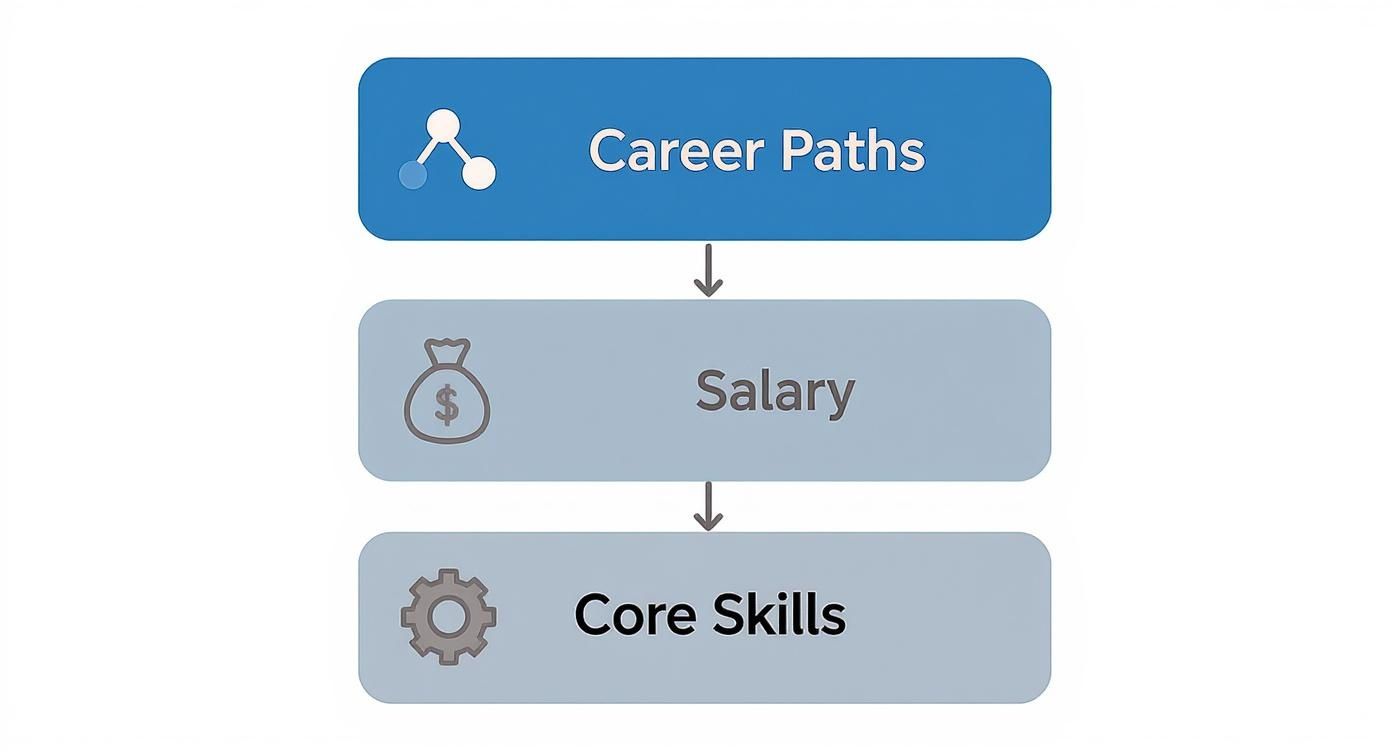
As you can see, while every path shares a common foundation, where you choose to specialize has a massive impact on your daily work, your interview process, and your long-term career progression.
Cryptography Researcher: The Pioneer
At the most abstract end of the spectrum, you’ll find the Cryptography Researcher. These are the mathematicians and theoretical computer scientists pushing the boundaries of what’s possible. Their job isn’t to ship a product; it’s to invent the foundational algorithms that will secure technology a decade from now.
A career here means spending your days deep in academic papers, crafting new mathematical models, and writing proofs. These roles are almost exclusively found in academia, corporate R&D labs, or government agencies. A PhD is a firm prerequisite, and the interview process will feel less like a job interview and more like a thesis defense, focused on your research contributions and ability to innovate.
Applied Cryptographer: The Translator
Next up is the Applied Cryptographer. This professional is the crucial bridge between pure theory and real-world software. They take the complex algorithms from researchers and figure out how to implement them safely and efficiently in actual systems.
Their work involves selecting the right cryptographic tools for a job, analyzing existing protocols for weaknesses, and writing crystal-clear specifications for engineering teams. You’ll find them in finance, cloud computing, and cybersecurity. A hiring manager for this role will grill you on your ability to explain concepts like elliptic curve cryptography and will test your judgment on practical protocol design trade-offs.
The biggest challenge for an Applied Cryptographer isn't just knowing the math; it's understanding the trade-offs. In an interview, you must demonstrate you can balance perfect, theoretical security with the practical constraints of performance, usability, and system complexity.
Cryptographic Engineer: The Builder
This is where theory becomes reality. The Cryptographic Engineer is the hands-on builder who turns specifications into production-ready code. Their entire world revolves around the secure and efficient implementation of cryptographic libraries and systems.
A day in their life involves writing low-level code in C++, Rust, or Go, running extensive test suites, and hunting for subtle implementation bugs that could open up catastrophic vulnerabilities. Tech companies, hardware manufacturers, and especially the blockchain industry are constantly hiring for this role. Expect intense coding challenges and system design questions in an interview—recruiters need to see deep programming expertise and an obsessive attention to detail. A detailed Cryptographic Engineer job description can give you a real-world look at the exact skills employers are screening for right now.
Protocol Developer: The Architect
Finally, we have the Protocol Developer. These are the architects who design the rules of secure communication. They create the end-to-end systems that use cryptography to function, whether it’s for secure messaging, networking, or designing the consensus mechanisms that power a blockchain.
They spend their time mapping out state machines, defining message formats, and ensuring the entire system is secure. An interview for a protocol developer will dive deep into system design, threat modeling, and your grasp of how all the pieces interact. Hiring managers need to know you can secure the whole forest, not just the individual trees.
Building Your Cryptography Skill Stack

Landing a job in cryptography isn't just about what you know—it’s about what you can build, prove, and communicate clearly. Hiring managers are on the hunt for a specific mix of academic rigor, hands-on technical skills, and a sharp analytical mind. Let's break down the skill set that gets your resume to the top of the pile.
Your path into cryptography almost always starts with a solid education. The most direct routes begin with a Bachelor's degree in either Mathematics or Computer Science. These programs provide the non-negotiable theoretical foundation—the discrete math, algebra, and algorithms that everything else is built on.
For most engineering roles, a bachelor's degree paired with a strong portfolio of projects is often enough to secure an interview. But if you’re aiming for a career as a Cryptography Researcher at a major tech lab or in academia, an advanced degree like a Master's or PhD is practically a requirement for getting past the initial screening.
The Technical Toolkit Hiring Managers Expect
Your degree gets you in the conversation, but your practical toolkit is what secures the job offer. When recruiters and hiring managers scan your resume, they’re looking for proficiency in a few key areas. You need to speak their language.
Here are the core competencies you must demonstrate:
- Deep Mathematical Understanding: This is the bedrock. A strong command of number theory, linear algebra, and probability isn't just for show. In an interview, you won't just solve a problem; you'll be expected to explain the mathematical principles behind schemes like RSA or elliptic curve cryptography.
- Algorithm and Data Structure Expertise: Cryptography is all about efficient and secure computation. You need a deep knowledge of how algorithms work, their complexity, and their real-world trade-offs. Be ready for whiteboard sessions that test your ability to design and analyze them from scratch.
- Programming Language Proficiency: Your ability to write clean, secure, and efficient code is paramount. For high-performance libraries and low-level work, C++ and Rust are in high demand. For prototyping, scripting, and security analysis, Python is an industry staple.
The demand for professionals with this skill set is incredibly strong. The Bureau of Labor Statistics projects an 8% growth in cryptography-related roles by 2034, which translates to thousands of new jobs. This demand is particularly hot in tech and finance hubs, with European centers like Zug, Switzerland, and Berlin, Germany, becoming magnets for international talent. You can read more about the global demand for cryptographers to see where the hiring trends are headed.
In a technical interview, your ability to explain the 'why' behind a cryptographic choice is just as important as your ability to implement the 'how.' A strong candidate can articulate the security trade-offs of using AES-GCM versus another mode or explain why a particular curve is chosen for ECC.
Soft Skills That Secure the Job Offer
Technical chops alone won't land you the job. The best cryptographers are also fantastic communicators and problem-solvers. Your soft skills are being evaluated just as carefully as your technical knowledge during every stage of the interview process.
- Analytical and Problem-Solving Mindset: You'll be asked to break down complex security challenges into manageable pieces. Hiring managers love to present open-ended design problems to see how you think, spot potential threats, and architect a sound solution on the fly.
- Communication and Collaboration: This one is crucial for career progression. Can you explain a complex security concept to a non-technical product manager without losing them in jargon? Your ability to clearly articulate risk is a massive differentiator that can make or break your candidacy.
- Attention to Detail: In cryptography, one tiny mistake can bring an entire system crashing down. This quality is tested through code reviews, deep-dive design questions, and challenges requiring absolute precision. Your resume, portfolio, and even your interview answers should reflect an obsessive focus on getting it right.
How Web3 Is Creating New Cryptography Jobs

The rise of blockchain and Web3 has completely transformed the cryptography job market. What was once a niche corner of security has become the foundational layer for a new internet. Core concepts like public-key cryptography and hash functions are now the nuts and bolts holding together cryptocurrencies, NFTs, and decentralized finance (DeFi).
This shift has created a massive demand for entirely new roles that simply didn't exist a decade ago. It’s a gold rush for talent, with companies competing fiercely for people who can marry deep cryptographic theory with a practical understanding of this new decentralized world. This is a prime opportunity to build a career on the cutting edge.
The growth is staggering. With decentralized tech booming, the Web3 industry is projected to pay out $94 billion in wages by 2025—an astonishing annual growth rate of 66.2%. This explosion is fueled by venture capital, corporate investment, and a constant stream of new protocols. You can get a deeper look at the global crypto job market outlook on Pro Global Search.
The New Frontier of Cryptography Roles
Hiring managers in Web3 are searching for a very specific skill set. They don't just need theorists; they need builders who can apply cryptography to create secure, transparent, and economically viable systems. This has carved out several exciting new career paths.
Let's break down three of the most sought-after roles to emerge from the Web3 revolution:
- Cryptoeconomic Designer: This role is one part economist, one part game theorist, and one part cryptographer. These architects design the token models and incentive systems that keep decentralized networks secure. In an interview, expect to whiteboard a system that rewards honest participation without a central authority.
- Smart Contract Auditor: With billions of dollars at stake in DeFi, a tiny bug in a smart contract can spell disaster. Auditors are digital sleuths who hunt for vulnerabilities in code before it goes live. Their job is to think like a hacker, so interviews often involve live coding challenges where you must spot subtle, exploitable flaws.
- Zero-Knowledge Proof Engineer: This is easily one of the most advanced and in-demand roles right now. Zero-knowledge (ZK) proofs are the key to privacy and scalability on the blockchain. Landing this job requires deep mathematical knowledge and strong engineering skills to build systems that allow someone to prove a statement is true without revealing the underlying data.
Landing a job in Web3 cryptography means proving you can think beyond traditional security. You must understand how economic incentives, decentralized governance, and transparent code interact. It's about securing an entire digital economy, not just a single server, and interviews will test this holistic understanding.
What It Takes to Succeed in Web3 Crypto
To catch an employer's eye in the Web3 space, your resume and portfolio must go beyond algorithms. They want to see that you've grappled with blockchain-specific problems. This means having a solid grasp of concepts like consensus mechanisms (Proof-of-Work vs. Proof-of-Stake) and understanding the unique attack vectors in decentralized systems.
If you’re aiming for a role like a ZK engineer, you’ll need to dive deep into the underlying math. To get a real sense of what top companies are looking for, check out this ZK Researcher job posting and notice the specific qualifications they list.
One of the best ways to build a portfolio that gets you hired is to get your hands dirty. Contribute to open-source blockchain projects or participate in Web3-focused Capture the Flag (CTF) security competitions. That’s the kind of practical experience that speaks volumes to hiring managers.
Your Action Plan for Landing a Cryptography Job
Knowing the theory is one thing. Turning that knowledge into a job offer is another. Let's walk through an actionable playbook for getting hired. Your success will boil down to three things: a resume that gets you noticed, a portfolio that proves you can do the work, and an interview performance that shows how you think.
Hiring managers in this space are looking for hard evidence of your skills. Generic resumes listing coursework often end up in the "no" pile. The goal is to build an application that screams practical ability and a genuine passion for the field.
Crafting a Resume That Recruiters Notice
Your resume is your ticket to an interview, and for a technical field like cryptography, it needs to be packed with substance. Recruiters often use automated systems to scan for keywords, so mirroring the language in the job description is a crucial first step.
Frame your resume around specific skills and tangible accomplishments. You want to highlight projects that directly demonstrate your command of core cryptographic principles.
Here’s a structure that gets results:
- Lead with a Skills Summary: At the top, create a tight, scannable section with your core competencies. List programming languages (C++, Python, Rust), specific crypto libraries you’ve used (OpenSSL, libsodium), and concepts you know inside and out (ECC, hash functions, protocol design).
- Detail Your Project Experience: For every project, use the STAR method (Situation, Task, Action, Result). Don't just say "Worked on a secure messaging app." Instead, try: "Designed and implemented an end-to-end encrypted chat protocol based on the Signal Protocol, resulting in a system resilient to man-in-the-middle attacks."
- Quantify Your Achievements: Numbers speak volumes to hiring managers. Did you improve an algorithm's performance? Mention the percentage gain. Did you discover a certain number of critical bugs during an audit? State the exact number.
This approach transforms your resume from a list of duties into a compelling narrative of your capabilities, making it far more effective at grabbing a recruiter's attention.
Building a Portfolio That Proves Your Worth
A solid portfolio is your single best asset, especially if you lack formal work experience. It’s tangible proof that you can apply theory to solve real problems. This is where you bring your resume to life.
Your GitHub profile is your new resume. It's the first place a technical hiring manager will look to see how you think, code, and what you're passionate about. A well-documented, active profile is more persuasive than any bullet point.
To build a portfolio that stands out in the hiring process, focus on these activities:
- Contribute to Open-Source Projects: Pick a well-known cryptography or security library and start small. Fix a bug, improve documentation, or add a test case. These contributions show you can navigate a large codebase and collaborate effectively.
- Participate in Capture The Flag (CTF) Events: CTFs are hands-on security competitions and a fantastic way to sharpen your skills. Excelling in crypto-focused challenges is a clear signal of your problem-solving abilities. Check out sites like CTFtime.org to find events.
- Create Your Own Implementation Projects: Build something from the ground up. Implement a classic cipher or a simplified version of a modern protocol. While not for production, these are incredible learning tools and make for powerful portfolio pieces that you can discuss in an interview.
Nailing the Cryptography Interview
Cryptography interviews are notoriously tough. They are designed to test not just what you know, but how you think under pressure. Expect a mix of deep theoretical questions, live coding challenges, and broad system design problems.
Preparation is everything. Get comfortable whiteboarding complex ideas, writing clean code on the spot, and defending your design choices. Companies like CertiK, which often have openings for a Blockchain Security Expert, put candidates through rigorous technical screenings to validate their skills.
So, what should you really be prepping for? Most interviews break down into a few common question types.
Common Cryptography Interview Question Types
The technical interview is where they separate the contenders from the pretenders. Here’s what you should be ready to tackle.
| Question Type | What It Tests | Example Question |
|---|---|---|
| Conceptual Deep Dive | Your fundamental understanding of core principles. | "Explain the Diffie-Hellman key exchange on this whiteboard. What is it vulnerable to, and how is that vulnerability mitigated in practice?" |
| Live Coding Challenge | Your ability to write clean, correct, and secure code under pressure. | "Implement a function to perform padding for a block cipher. Discuss the security implications of different padding schemes." |
| System Design Problem | Your ability to think about security at a high level and make architectural trade-offs. | "Design a secure system for storing and sharing encrypted user files in the cloud. How would you handle key management and access control?" |
Remember, it's not just about getting the right answer. Interviewers are evaluating your communication skills. Practice explaining complicated topics in simple, clear language. Talking through your thought process as you solve a problem is often just as important as the final solution.
A Few Common Questions About Cryptography Careers
Getting into cryptography can feel like cracking a code in itself. To clear things up, here are answers to common questions that arise when planning a career, preparing for interviews, or figuring out where to start.
Think of this as your cheat sheet for building a solid career strategy.
Do I Really Need a PhD to Work in Crypto?
This is a frequent question, and the answer depends entirely on your desired career path.
If your dream is to work in pure theoretical research—inventing new cryptographic algorithms at a place like Microsoft Research or a university—then yes, a PhD is pretty much your ticket to entry. Those roles are about formal proofs and pushing scientific boundaries. The interview process will feel more like defending a thesis than a typical job interview.
But for the vast majority of jobs? Absolutely not. For roles like Applied Cryptographer, Cryptographic Engineer, or Security Auditor, a Bachelor's or Master's in Computer Science or Math is usually sufficient. In those interviews, hiring managers are far more interested in your practical experience, coding skills, and grasp of existing protocols.
A killer GitHub portfolio showing cryptographic protocols you've implemented or contributions to open-source security projects will often impress a hiring manager for an engineering role far more than an advanced degree. It’s hard evidence that you can build secure systems.
What Programming Languages Should I Focus On?
Your choice of programming languages will directly impact your job prospects, so be strategic. While broad knowledge is good, deep expertise in a few key languages is what gets you hired.
Tailor your toolkit to your chosen career path:
- For Low-Level, High-Performance Work: It's all about C and C++. They are the standard for building fast, secure cryptographic libraries where you need total control over memory. Expect tough coding challenges focused on performance and security in interviews for these roles.
- For Prototyping and Security Analysis: Python is your best friend. It’s perfect for building proofs-of-concept, writing vulnerability testing scripts, and running cryptanalysis. Its simplicity lets you move fast and demonstrate complex ideas.
- For Blockchain and Web3: Rust and Go are seeing a huge surge in demand. Their focus on memory safety and concurrency makes them ideal for building the secure, scalable systems that Web3 companies rely on.
A smart career strategy is to master at least one low-level language (like C++) and one high-level language (like Python). That combination provides a powerful and flexible foundation for almost any job in the field.
How Can I Get Experience if I Don't Have a Job Yet?
This is the classic chicken-and-egg problem, but it's completely solvable. Demonstrating your skills is the single best way to impress a recruiter, especially when you're starting out.
Here are concrete ways to build a portfolio that gets you noticed:
- Contribute to Open-Source Projects: Find a well-known crypto library on GitHub like OpenSSL, BoringSSL, or Libsodium. Start small: fix a bug, improve documentation, or add test cases. This shows initiative and your ability to navigate a complex codebase.
- Jump into Capture The Flag (CTF) Competitions: Look for CTFs with a heavy focus on cryptography challenges. Sites like CTFtime.org are great for finding events. Success in these competitions is a direct signal to employers that you have sharp problem-solving skills.
- Build Your Own Stuff: Just make something. Implement a classic encryption algorithm (for learning, not production!), build a simple secure messaging app, or write a tool that analyzes a protocol's security. Document everything on a personal blog or your GitHub to showcase your work.
When you can discuss these projects in an interview, you're proving you have the passion and practical skills to succeed in the real world.
Are Crypto Jobs Only at Tech Companies?
Not at all. While big tech and cybersecurity firms are major employers, cryptographic skills are in high demand across a surprisingly wide range of industries. Limiting your job search to the obvious places means missing out on incredible career opportunities.
Cryptography experts are essential in sectors like:
- Finance: Banks, trading firms, and fintech startups are built on cryptography. They need experts to secure transactions, protect customer data, and meet stringent regulations.
- Government and Defense: National security agencies have been at the forefront of cryptography for decades. These roles involve protecting state secrets, securing military communications, and developing future encryption standards.
- Healthcare: With the digitization of health records, securing sensitive patient data is non-negotiable. Cryptographers in this field work on ensuring patient privacy and data integrity.
- Consulting: Top-tier consulting firms hire cryptographers to perform security audits, advise clients on compliance, and design secure systems for companies in virtually every industry.
As our world becomes more connected, even fields like the automotive industry and IoT manufacturing need cryptographers to secure everything from smart cars to smart thermostats. This broad demand makes a career in cryptography a stable and future-proof choice.
Ready to find your place in this exciting field? Blockchain Jobs is the premier job board for opportunities in the Web3 and decentralized technology space. Explore roles in security, engineering, research, and more to find the perfect fit for your skills. Start your search for a cryptography job today!