Your Career Guide to Compliance Manager Salaries in 2024
Wondering what a Compliance Manager can expect to earn? It’s a wide range, but you’re typically looking at a base salary between $75,000 and over $150,000 a year. The national average sits comfortably in the six-figure territory.
Of course, that's just a starting point for your next job interview or salary negotiation. Your final number depends heavily on your experience, the industry you’re in, and where you’re located—all factors we’ll break down here. Think of this as your personal guide to figuring out what you’re really worth in today’s market and how to articulate that value to land the best possible offer.
Your Guide to Compliance Manager Salary Benchmarks
Trying to pin down a salary for a compliance role can feel like aiming at a moving target. Regulations are always in flux, and the rise of new sectors like Web3 brings a whole new set of demands. It’s no surprise that salary expectations are more dynamic than ever.
Whether you're prepping for a job interview or you're a hiring manager trying to set a competitive salary, solid benchmarks are non-negotiable. You need them to make smart, data-driven decisions that secure top talent or advance your career.

This section is designed to give you that quick, foundational overview of what to expect. Use this as your at-a-glance dashboard for compensation, setting you up for a deeper dive into what really drives that final number and how you can leverage it in negotiations.
Breaking Down the Numbers
The latest data confirms what many of us in the field already know: demand for skilled compliance pros is strong. In the United States, the average salary for a Compliance Manager in 2026 is right around $95,103 a year, which works out to about $45.72 per hour.
Even for those just breaking into the field, the outlook is promising. Entry-level positions often start near $98,949 annually, which is a fantastic launchpad for a long-term career. Use these figures as a baseline when evaluating your first job offers.
To give you a clearer picture, let's put that into a quick summary table.
Compliance Manager Salary At A Glance
Here’s a snapshot of what you can generally expect at different stages of your career in the US market. Use this table to benchmark offers and map out your earning potential.
| Experience Level | Average Base Salary (US) | Common Salary Range (US) | High-End Potential (Top 10%) |
|---|---|---|---|
| Entry-Level | $75,000 | $65,000 - $85,000 | $95,000+ |
| Mid-Level | $95,000 | $85,000 - $110,000 | $125,000+ |
| Senior-Level | $125,000 | $110,000 - $150,000 | $175,000+ |
These figures show a clear path for growth. As you gain more specialized skills and take on more responsibility, your earning potential increases significantly. This is the career progression you should be aiming for.
So, what does a full compensation package look like? It's almost always more than just the base salary.
- Base Salary: Your guaranteed annual pay and the foundation of your total compensation.
- Annual Bonus: Often tied to individual and company performance. In an interview, ask how the bonus structure works to understand your true upside.
- Equity/Stock Options: Especially common at startups and public companies, this gives you a piece of the pie and aligns your success with the company's long-term growth.
A strong compensation package isn’t just about the money. It’s a reflection of the immense value a sharp compliance manager brings to the table by protecting the company from risk and helping it grow safely. Understanding all these moving parts is crucial when you're analyzing a job offer.
With these initial numbers in hand, you’re in a much better position to benchmark your own salary expectations. When you come across roles like this Compliance Manager opening at Coinbase, you can now see where their offer might land and how it stacks up. In the sections that follow, we'll build on this foundation and explore exactly how your specific skills can command an even higher salary.
How Experience Shapes Your Earning Trajectory
Your salary in compliance isn't just a number. It’s a story about your career path and the value you’ve proven you can bring to a company. As you rack up experience and tackle tougher regulatory puzzles, your compensation should climb right alongside your skills. Getting a handle on this progression is key, whether you're negotiating a new offer or mapping out your career five years down the road.
Think of it as building your professional case. You start with a solid foundation—the basics of compliance—and then you start adding more complex achievements. Your salary potential grows with every project you lead and every risk you mitigate. It's not just about years logged; it's about the impact you've made.
The Foundation Years: Entry-Level Analyst (0-2 Years)
As an Entry-Level Compliance Analyst, your main job is to learn the ropes and support the team. You're the boots on the ground, running through established procedures, doing routine monitoring, and pulling data for audits. Your pay at this stage, usually somewhere between $65,000 and $85,000, matches this focus on learning and executing fundamental tasks.
To accelerate your career progression and pay scale, focus on mastering the basics and demonstrating your potential. Success in your first role isn't just about checking boxes; it’s about showing you're a quick study who can apply what you've learned.
Here are a few career-advancing milestones to aim for that will get you noticed for a promotion:
- Help nail your first big audit. It proves you can perform under pressure and be a reliable part of a critical project—a great talking point in your next performance review.
- Become the go-to expert on a specific rule or process. Even a little specialization makes you stand out and adds to your value when it's time for a promotion.
- Be the one who spots and flags a potential compliance problem. This shows you're thinking proactively, not just waiting for instructions, a key trait of a future manager.
Hitting these goals sends a clear signal to managers that you're ready for more responsibility—and the pay bump that comes with it.
Building Expertise: Compliance Manager (3-7 Years)
When you make the jump to Compliance Manager, your role shifts from doing to owning. You’re not just helping with audits anymore; you’re running them. You're not just following procedures; you're writing them. That extra accountability is why salaries take a significant leap, landing in the $85,000 to $125,000 range.
In interviews for these manager roles, hiring managers will ask behavioral questions about how you manage projects and people. They want to see that you can think strategically and operate with autonomy.
Your value at this stage is measured by your impact. Be prepared to answer, "Can you point to a time you improved a compliance process, saved the company from a potential fine, or successfully trained a team on new regulations?" These are the stories that justify a six-figure salary.
Strategic Leadership: Senior Manager to Director (8+ Years)
At the Senior Manager or Director level, you zoom out from department tasks to company-wide strategy. You're now the architect of the entire compliance framework, advising the C-suite on risk and trying to see around the corner for the next big regulatory shift. Your pay reflects these high stakes, often starting at $125,000 and pushing well past $175,000.
At this point in your career, your influence is your most powerful tool. You’re judged by the strength and foresight of the compliance program you've built. In interviews, be ready to discuss how you've built and scaled compliance functions. Leading the charge on a new company-wide framework or steering the business through a tricky regulatory investigation are the kinds of wins that define this level and command a top-tier salary.
Web3 vs. Traditional Finance Compensation Models
When you're looking at compliance manager salaries, the industry you choose is one of the biggest drivers of your total compensation. The field is essentially split into two worlds with entirely different philosophies on pay: the established, predictable realm of traditional finance (TradFi) and the high-growth, high-risk world of Web3.
Figuring out where you want to build your career is crucial. It’s like choosing between a guaranteed, steady paycheck and a lottery ticket with a potentially life-changing upside. Neither is better than the other, but they serve very different career goals and risk appetites.
This chart lays out the typical career progression for a compliance professional. As you can see, both responsibility and earning potential climb significantly with each step up the ladder.
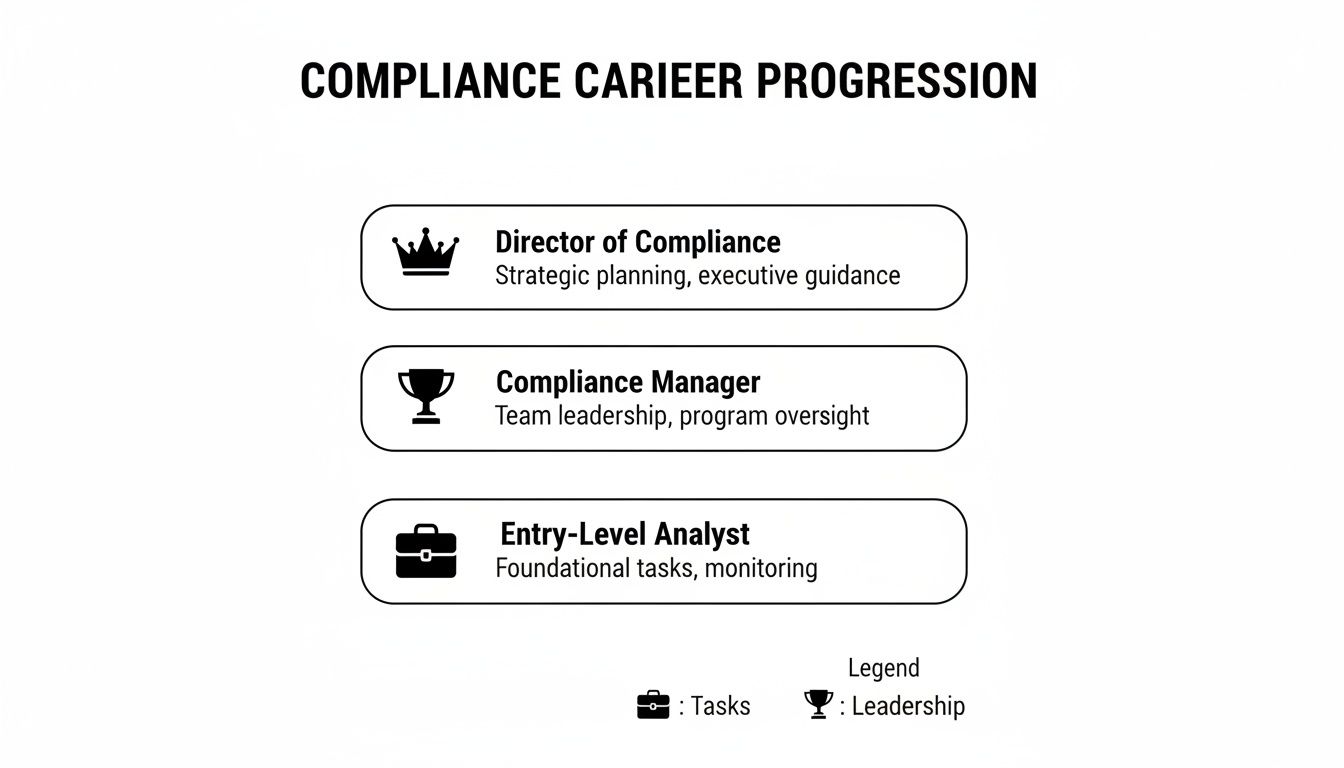
Moving from an analyst to a director role means shifting from tactical execution to strategic oversight, and the compensation reflects that leap.
The Predictability of Traditional Finance
In traditional finance—we're talking big banks, investment firms, and insurance companies—compensation is built on a rock-solid foundation of stability. Your offer will almost always be anchored by a strong base salary, which makes up the bulk of your annual income.
On top of that, you'll get a structured annual bonus. This is usually a percentage of your base pay and is tied to both your performance and the company's overall success. It’s a well-oiled machine, and you know what to expect.
TradFi roles are a magnet for candidates who value security and a clear, well-defined career path. When you interview for these jobs, be ready for questions about your experience with established regulators like the SEC or FINRA and your ability to navigate large, complex organizations.
The High-Stakes Game of Web3 Compensation
Web3, which covers everything from crypto exchanges to DeFi protocols and NFT platforms, plays by a completely different rulebook. The compensation here is designed for explosive growth. While the base salary might be a bit lower than what a major bank would offer, the real prize is the potential for a massive payout through equity or token grants.
This is your "lottery ticket." If the company or protocol takes off, the value of your tokens or equity could easily eclipse your base salary—sometimes by 10x or more. Of course, that potential comes with serious risk. If the project fizzles out, that part of your compensation could end up being worthless.
In a Web3 compliance interview, hiring managers are hunting for adaptability and a forward-thinking mindset.
They need to see that you can apply core compliance principles to brand-new problems that have no regulatory precedent. Your knack for thinking creatively about risk in a decentralized world is far more valuable than decades of experience with old-school banking rules.
Evaluating Your Total Compensation
Because these pay models are so different, just comparing base salaries can be incredibly misleading. You have to look at the whole picture when you receive an offer.
Let's break down how these packages typically differ.
Compensation Breakdown Web3 vs Traditional Finance
| Compensation Component | Traditional Finance (e.g., Bank) | Web3 / Crypto (e.g., DeFi Protocol) | Key Consideration for Candidates |
|---|---|---|---|
| Base Salary | High and stable; the core of the package. | Often competitive but may be lower than TradFi. | Is the base enough to cover your needs without relying on variable pay? |
| Annual Bonus | Cash-based, predictable percentage of salary. | Can be cash, stablecoins, or project tokens; often highly variable. | In the interview, ask: "How is the bonus calculated? Is it tied to milestones I can influence?" |
| Equity/Tokens | Stock options/RSUs in a mature, public company. | Token grants or equity in a private startup; high-risk, high-reward. | Ask about the vesting schedule and the project's long-term potential (tokenomics). |
| Benefits | Robust, comprehensive (e.g., 401k match, premium health insurance). | Can vary widely. Startups may offer more flexible perks like remote work stipends. | Don't overlook the value of a strong benefits package when comparing offers. |
The goal is to understand the potential upside and downside of each component before you sign on the dotted line.
Data from 149 verified profiles shows that the average total compensation for a Compliance Manager in 2026 is a substantial $189,000 annually, with the top 10% pulling in over $282,000. These figures, which roll up base pay, stocks, and bonuses, prove just how valuable this role is in high-growth sectors.
For example, one Security and Compliance Manager in New York reported a $213,000 base salary, a $10,000 stock grant, and a $33,000 bonus. It's a perfect illustration of how different components come together to create a compelling offer.
When you're evaluating a Web3 offer, put on your investigator hat. Here are the critical questions to ask:
- Token Vesting Schedules: "How long until I fully own my tokens or equity?" A four-year schedule with a one-year "cliff" (where you get nothing if you leave before one year) is standard.
- Tokenomics: "What is the total token supply and what is the token's utility in the ecosystem?" A strong, clear use case is a good sign for long-term value.
- Project Roadmap: "What is the company's vision and plan for the next 18-24 months?" The strength of the project is directly linked to your potential payout.
Ultimately, your choice depends on where you are in your career and what you’re trying to achieve. If you're building a stable financial foundation, the predictability of TradFi is tough to beat. But if you have a higher risk tolerance and want to be at the forefront of financial innovation, a Web3 role could be a life-changing opportunity. Ambitious roles like this Head of Compliance opening in Europe often require the best of both worlds—demanding established expertise in a fast-moving, undefined space.
How Location Still Shapes Your Paycheck
Even with remote work becoming the norm, where you live—or where your company is headquartered—still plays a huge role in your salary as a compliance manager. It’s a simple case of supply and demand. Different cities have entirely different competitive landscapes, which directly shapes what you can expect to earn.
Think of it this way: a compliance manager in a major financial hub like New York City is competing in a totally different league than someone in a smaller town with fewer large companies. In the big city, the demand is higher, the cost of living is steeper, and the fight for top talent is fierce. All those factors naturally push salaries skyward.
The Hotspots for High Compliance Salaries
It's no surprise that certain cities have become magnets for compliance professionals, commanding top-tier pay. This isn't random. These locations are typically packed with industries facing heavy regulatory scrutiny, like finance, tech, and biotech.
This creates a powerful cycle for job seekers. More regulated companies mean more high-stakes compliance jobs, which attracts the best talent. To land those experts, companies have to be willing to open up their wallets.
The key takeaway for your job search is simple: your market value is tied to your market. If you’re targeting jobs where the regulatory risks are highest and the money is flowing, your salary potential is going to be significantly greater.
Leading the charge are the usual suspects—traditional financial powerhouses and booming tech hubs where innovation and regulation collide. The demand in these cities is so intense that companies will pay a serious premium to get expert guidance on navigating the tangled web of rules they face.
How Remote Work Is Shaking Things Up
The remote work boom has thrown a fascinating curveball into salary negotiations. Many companies, especially in Web3, are now hiring from a global talent pool. This has led to a couple of different compensation strategies you need to be aware of before you get too far into the interview process.
Some companies have adopted a single, national pay scale, meaning they offer the same salary for a role no matter where the employee is based. For professionals living in lower-cost areas, this can be a massive win. Others, however, stick to location-based pay, adjusting salary offers based on geographic tiers.
As a candidate, you need to figure out a company's philosophy on this early on.
- Just ask. In an early conversation with a recruiter, you can politely inquire, "Does your company have a location-based approach to compensation, or do you use a single national rate?" This helps you set expectations from the start.
- Know your numbers. Research what similar roles pay in your city or state. This gives you a strong, data-backed baseline for your expectations.
- Focus on value. Regardless of their policy, always anchor your negotiation in the value you bring to the table—your specialized skills, certifications, and proven track record.
Getting ahead of this ensures there are no awkward surprises later and lets you negotiate from a position of strength.
While data for Global Compliance Managers shows a U.S. average of $98,949 per year, the real story is in the regional numbers. The majority of professionals fall between $61,500 and $115,000, but top earners can pull in $172,500 or more. Unsurprisingly, hotspots like San Francisco ($116,580) and Silicon Valley cities like Santa Clara ($116,210) lead the pack, driven by that powerful intersection of tech and finance. You can explore more insights on global compliance manager salary data from PayScale.
The High-Value Skills That Boost Your Salary
A high salary isn't just about years on the job. It's a direct reflection of the specific, high-demand skills you bring to the table. In the world of compliance, certain competencies are pure gold. If you want to boost your market value and command a top-tier salary, mastering them is the fastest way to get there.
Think of your compliance career like a skilled trade. General knowledge is your foundation, but specialized tools let you tackle the most complex—and lucrative—projects. For a compliance manager, those tools are niche skills and recognized certifications that instantly signal deep expertise to a hiring manager.

This section is your blueprint for strategic upskilling. By focusing on the exact skills employers are paying a premium for right now, from foundational financial regulations to the new frontier of Web3, you can directly increase your earning potential.
Core Competencies That Command Higher Pay
Before we jump into emerging tech, let's talk about the bedrock of modern compliance. Getting these skills dialed in is non-negotiable for senior roles and a proven way to get a pay bump.
- Anti-Money Laundering (AML): Expertise in AML is always in high demand. In interviews, highlight your experience building robust systems to spot and report suspicious activity, protecting the business from massive fines.
- Data Privacy & Protection: With regulations like GDPR and CCPA, knowing how to handle customer data is a top-tier skill. Frame your experience in terms of helping companies avoid costly data breaches and regulatory heat.
- Cybersecurity Compliance: As everything moves online, understanding and implementing cybersecurity frameworks (like SOC 2 or ISO 27001) is incredibly valuable. This skill bridges the gap between legal and IT, making you a more versatile and attractive candidate.
For any of these areas, a certification is a powerful signal to employers. It’s credible, third-party proof that you have mastered a specific domain.
Certifications are more than just letters after your name. In a competitive job market, they’re a shortcut for hiring managers to spot top talent, often justifying a salary bump of 10-15% or more.
Sought-After Certifications and Their Value
- Certified Anti-Money Laundering Specialist (CAMS): This is the global gold standard for AML professionals. Earning it shows you're serious about fighting financial crime and immediately boosts your credibility and earning potential.
- Certified Information Privacy Professional (CIPP): Offered by the IAPP, this certification has region-specific versions (like CIPP/E for Europe or CIPP/US). It’s the premier credential for data privacy experts.
- Certified in Risk and Information Systems Control (CRISC): This one is perfect for those focused on IT risk and cybersecurity compliance. It proves you can identify and manage risks tied to a company's information systems.
The New Frontier: Web3 and Blockchain Skills
While traditional compliance skills are your foundation, the highest salaries often go to those who can apply these principles to the wild new world of Web3. Right now, the demand for professionals who understand the unique risks of decentralized finance (DeFi) and blockchain technology completely outstrips the supply.
This scarcity creates a huge salary premium. Companies are willing to pay top dollar for someone who can help them innovate safely in a space where the rules are still being written.
Here are the key Web3 skills that are sending compliance salaries soaring:
- Smart Contract Risk Analysis: The ability to look at a smart contract, understand how it works, and spot potential vulnerabilities is a rare and highly prized skill that will set you apart.
- DeFi Regulatory Frameworks: Become the go-to expert on the ever-changing guidance from bodies like the SEC and FATF. This shows you're at the cutting edge of the industry.
- On-Chain Analytics and Forensics: Getting hands-on with tools like Chainalysis or Elliptic to trace transactions and identify illicit activity on the blockchain is a game-changer for AML in the crypto space.
Mastering these Web3 competencies shows you’re not just a compliance manager—you're a strategic partner who can guide a company through the complex and lucrative world of digital assets. To see these skills in action, check out job descriptions for roles like a Technical GRC Expert, which show what leading Web3 firms are truly looking for. Developing these abilities will put you at the absolute top of the market.
How to Confidently Negotiate Your Salary Offer
Getting the job offer feels like crossing the finish line, but it’s not. It's actually the starting gun for negotiation, and it's your single biggest chance to influence your financial trajectory at the company. If you walk into that conversation with a clear strategy, it stops being stressful and becomes your opportunity to get paid what you're truly worth.
Think of it as a collaboration, not a confrontation. You and the hiring manager both want the same thing: for you to bring your compliance expertise to their team. Your job is to simply show them, calmly and professionally, why your skills justify the number you have in mind.
Prepare Your Case with Data
Real negotiation confidence isn’t about being aggressive; it’s about being prepared. Before you talk numbers with a recruiter, you have to do your homework. Use the salary data from this guide and other market research to figure out a realistic range for your specific skills, experience level, and location.
Your entire strategy should be to anchor the conversation in objective market data. That way, it's not about "what I want," but "what the market proves this role is worth."
When you can say, "Based on my research for senior compliance roles in crypto that require CAMS certification, the market rate is between $X and $Y," you’ve completely changed the dynamic. You're not making a personal request; you're presenting a business case.
Master the Key Conversations
A few key moments in the hiring process will shape your final offer. Nailing these sets you up for success when the actual offer comes through.
Answering "What Are Your Salary Expectations?"
Recruiters love asking this early. If you give a single number, you risk leaving money on the table or pricing yourself out. The best move is to offer a well-researched range and then immediately pivot back to the value you bring to the role.
- Try this: "From what I understand about the responsibilities so far, and based on market rates for a compliance manager with my Web3 background, I'm targeting a range around $135,000 to $150,000. Of course, I'm really focused on finding the right fit and I’m open to discussing the full compensation package."
This response proves you’ve done your research but keeps the door open for negotiation.
Making the Counteroffer
Okay, you've got the written offer. Now it’s time to respond. Always start by showing your excitement for the role, then clearly state your counter.
- Start with Gratitude: Kick things off by thanking them for the offer and saying how excited you are about the team and the mission.
- State Your Case: This is where you connect your request back to your research and, more importantly, the value you bring. "My experience with DeFi AML frameworks, for example, is a direct match for the challenges you described in the interview."
- Provide a Specific Number: Don't be vague and ask for "more." Propose a clear, justified number. For example, "After looking over the offer and considering my deep experience in DeFi AML frameworks, I would be thrilled to accept if you can get the base salary to $148,000."
- Consider the Full Package: What if they can't budge on salary? Don't give up. Ask about other levers. Can they increase the signing bonus? Add more equity? Offer a larger home office stipend? Being flexible shows you're serious about joining.
Remember, negotiation is a totally normal and expected part of hiring. When you do your homework and communicate your value clearly, you can confidently land a package that truly reflects what you bring to the table.
A Few Final Questions on Compliance Salaries
As you map out your career path or plan your next hire, you're bound to have some specific questions about compensation. Let's tackle a few of the most common ones we see from professionals in the field.
How Much Do Bonuses Really Add to the Bottom Line?
Bonuses are a huge piece of the puzzle, especially as you climb the ladder. For most compliance manager roles, you can expect an annual bonus anywhere from 10% to 25% of your base salary.
But in high-stakes industries like traditional finance or a Web3 company that's just had a massive token launch, that number can shoot up significantly. If you're a hiring manager, remember that a strong, clearly defined bonus structure is one of your best magnets for attracting top-tier compliance talent. As a candidate, always ask how the bonus is determined.
Are Certifications Worth It for a Bigger Paycheck?
While nothing is a "guarantee," certifications like CAMS or CIPP are about as close as you can get to a salary booster. They're a clear signal to employers that you have specialized, verified knowledge and are serious about your craft.
Think of it this way: a certification is a powerful bargaining chip. When you're negotiating, you can point directly to it as proof of your advanced skills, which often justifies asking for 10-15% more than a candidate without one. For most people, the investment in a certification pays for itself with their next job offer.
For job seekers, a certification is your market validator. It tells a hiring manager you have the proven skills to tackle their specific compliance challenges, making you a less risky and more valuable hire from day one.
How Does Company Size Change the Salary Equation?
Company size plays a massive role in how compliance managers are paid. The compensation philosophy can be worlds apart.
- Large Corporations (1,000+ employees): These organizations generally offer higher base salaries and more comprehensive benefits. Their complex global operations require seasoned compliance leaders, and they have the deep pockets to fund those roles properly.
- Startups and Small Businesses (<100 employees): Here, the base salary might not be as high, but the trade-off is often a hefty equity or token package. You’re also getting a chance to be more hands-on, often building the compliance function from the ground up—an invaluable experience for your resume.
During your job search, you have to decide what matters most to you. Is it the stability and predictability of a corporate giant, or the high-risk, high-reward potential of a startup? Your answer will point you toward the right compensation model for your career goals.
Ready to find your next role in the compliance field? At Blockchain Jobs, we connect skilled professionals with leading companies in the Web3 ecosystem. Explore the latest opportunities at https://blockchain-jobs.com.