Java Programmers Salary in 2026: Your Definitive Guide

Let's get right to it: when we talk about a Java programmer's salary, you'll often hear the US average, which in 2026 hovers around $89,976 per year. But take that number with a huge grain of salt. It’s a useful baseline for market research, but it's not the number that will appear on your offer letter.
Your actual earnings can—and will—vary wildly. It all comes down to a few key things: your years of proven experience, the city on your offer letter, and, frankly, how well you articulate your value during the interview and negotiation process. This guide is designed to give you actionable insights to maximize your career progression and earning potential.
The Java Programmer Salary Landscape in 2026

Think of the Java salary landscape as a topographical map. You've got towering peaks in major tech hubs, rolling hills in secondary markets, and flatter plains elsewhere. For developers looking to level up their careers and for hiring managers trying to build winning teams, understanding this map is the first step toward making smart strategic moves.
Globally, the picture is clear: North America and Western Europe are where the highest salaries are concentrated. Digging into the US data from March 2026, that $89,976 average hides a massive range. A junior developer just starting out might see an offer around $72,282, while a seasoned architect or senior engineer could command $133,291 or more. For a deeper dive into the numbers, you can explore the full data from Indeed.
To give you a clearer picture, here's a quick snapshot of what you can expect in the US based on experience and location. Use these figures as a starting point for your own salary research and negotiation strategy.
Java Programmer Salary Snapshot 2026 (USA)
| Category | Average Annual Salary |
|---|---|
| Entry-Level (0-1 year) | $72,282 |
| Mid-Level (4-6 years) | $89,976 |
| Senior-Level (9+ years) | $133,291+ |
| New York, NY | $131,768 |
| Chicago, IL | $118,398 |
These numbers illustrate just how much experience and geography can impact your bottom line.
Why Location Matters So Much for Your Career Strategy
Location is probably the biggest single factor that can boost your paycheck. It’s simple supply and demand. Major tech hubs are magnets for talent, and companies have to pay a premium to attract and keep the best people. The difference between regions can be staggering.
- New York, USA: In the US, New York City sets the pace with an average salary of $131,768.
- Chicago, USA: Not far behind, Chicago has become a strong secondary hub, offering an average of $118,398.
- Switzerland: Looking globally, Switzerland is in a league of its own. It's the highest-paying country, where mid-level developers can earn an average of $126,000.
- Australia & Canada: Both are top-tier markets, with mid-level roles pulling in around $108,000 in Australia and $100,000 in Canada.
This isn't just about adjusting for the high cost of living. It’s about the concentration of high-growth industries and venture-backed startups that have the capital to compete for top-tier engineers. For developers, this information is gold for career planning—whether that means physically relocating or strategically targeting remote roles with companies based in these high-paying zones.
For hiring managers, this data is just as critical. It tells you what you need to budget to compete for talent in a city like New York and highlights the cost advantages of building a distributed team by hiring in other regions.
Knowing these benchmarks is one thing; landing the job is another. To get a handle on the broader job market, it's worth knowing the best tech job boards where these high-value roles are posted in 2026.
Ultimately, knowing your worth is the key to negotiating effectively and building a rewarding career. For more practical advice, be sure to check out our other articles on the Blockchain Jobs blog.
How Experience Shapes Your Earning Potential
When it comes to a Java programmer's salary, nothing moves the needle more than experience. But it's not just about the number of years on your resume. It's about the evolution of your skills, the scope of your responsibilities, and your ability to solve increasingly complex business problems.
Think of it like this: a junior developer is given a detailed blueprint and told which wall to build. A senior developer is handed a plot of land and asked to design the entire skyscraper. They're both building, but the value they provide—and their compensation—is worlds apart. Hiring managers pay for that accumulated wisdom, the ability to sidestep problems before they happen, and the foresight to build for the future.
The Junior Developer Journey (0-2 Years): Building Your Foundation
As a junior, your main job is to absorb everything you can and execute well-defined tasks. You’ll be tackling bug fixes, writing individual components, and working closely with senior members of your team. Your value is in producing clean, functional code and learning how to fit it into a larger, existing system.
Companies see you as an investment, and they're betting on your potential. This is why interviews for junior roles zero in on your fundamentals:
- Core Java Concepts: Is your understanding of object-oriented programming, data structures, and key APIs solid? Can you explain them clearly?
- Problem-Solving: Can you take a clear, contained problem, talk through your thought process, and write a logical solution from scratch?
- Coachability: Are you eager to learn, responsive to feedback, and a good team player? This is often assessed through your communication style during the technical interview.
Nail these fundamentals and show a genuine passion for growth, and you'll be in a great position to land a strong entry-level offer and begin your career progression.
The Mid-Level Developer Leap (2-5 Years): Taking Ownership
This is where you stop just taking tickets and start owning features. Mid-level developers are expected to work with much more independence. You’ll not only write code but also participate in designing smaller parts of the system and even start guiding the junior developers on your team. The focus shifts from just "does it work?" to "is it efficient, scalable, and easy for others to maintain?"
This leap in autonomy changes the interview game. Expect more system design questions and behavioral scenarios that probe how you handle project ownership and collaboration. The salary bump from junior to mid-level is a direct reflection of this increased responsibility. You're no longer just following the map—you're helping to draw it.
The Senior Developer Apex (5+ Years): Becoming a Force Multiplier
Becoming a senior developer is a profound shift. Your focus expands from a single feature to the health of the entire system. You're a force multiplier, spending your time mentoring other engineers, establishing best practices, and solving the gnarliest architectural problems that can make or break a project.
A senior developer's value isn't just in the code they write, but in the code they prevent others from having to write through smart design and strategic foresight.
This level of expertise is why senior roles command such a significant salary premium. Data consistently shows experience level is the dominant factor in a Java developer's pay. In the US, for example, a junior might average $92,145, while a mid-level developer earns $106,743. Seniors, however, jump to $123,523—a 34% increase from the entry-level role. This pattern is consistent in other major tech hubs like the UK, Canada, and Germany, where senior talent is always in high demand.
At this level, you’re a strategic asset to the company. Interviews will lean heavily on high-level architecture, leadership, and the measurable business impact you've had in past roles. To keep climbing, it’s smart to look into specialized, high-demand engineering roles that can take your career—and your compensation—to the next level.
How Location Dictates Your Java Salary
Ever wonder why a Java programmer in one city can earn double what another does, even with the same skills? While experience is a huge part of the equation, the single biggest factor driving salary differences is geography. Where you live—or, more accurately, where your employer is based—can easily add or subtract tens of thousands of dollars from your paycheck.
We're not just talking about a simple cost-of-living adjustment, either. Think of it as a kind of economic gravity. Tech hotspots like New York, London, and Zurich have a powerful pull, attracting a dense cluster of high-growth companies, venture capital, and established corporations. They're all fishing from the same talent pool, which drives salaries sky-high. This creates a clear career path for ambitious developers: either move to one of these hubs or land a remote job with a company that's headquartered in one.
This chart really drives home how your earnings can climb throughout your career in a market like the US. It's a powerful incentive to keep leveling up your skills and planning your next career move.
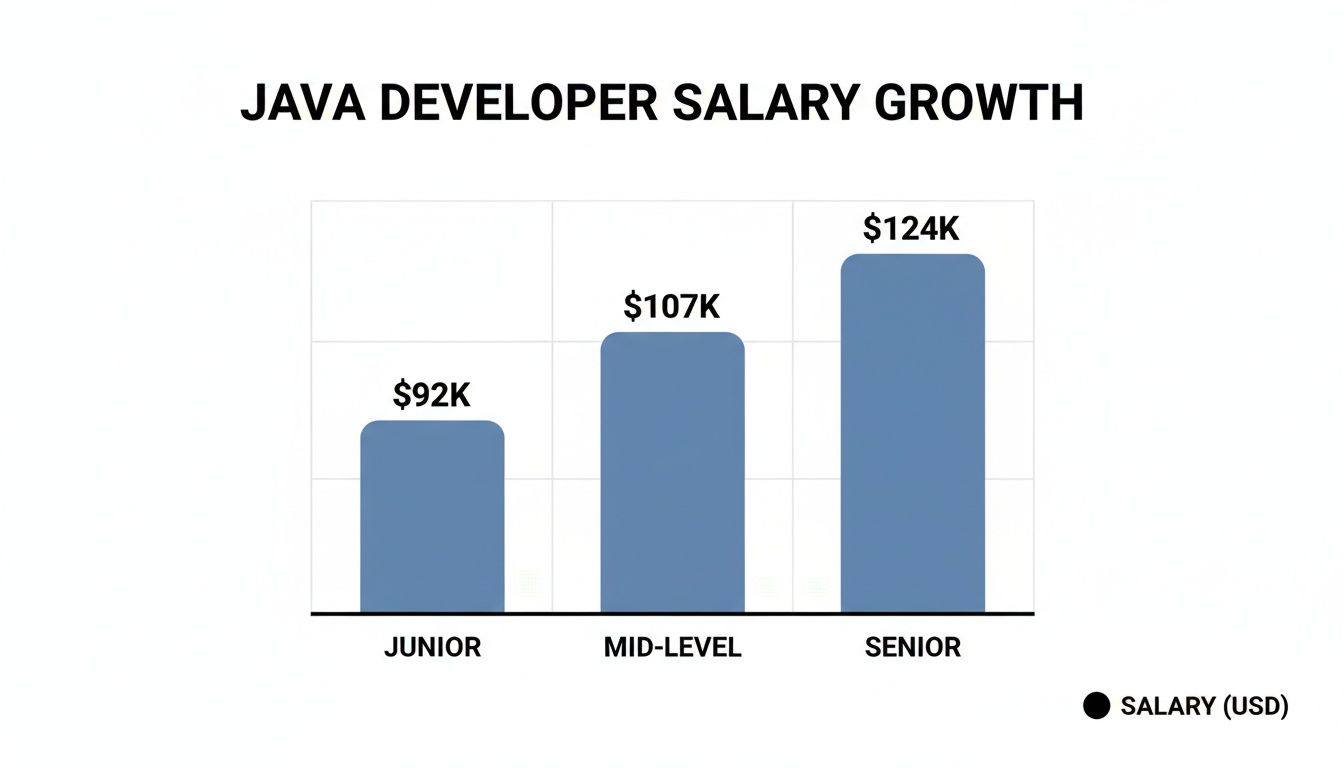
As you can see, the jump from a junior to a senior developer can mean a bump of over $30,000 in your annual base pay. That’s a serious reason to stay focused on your professional growth and strategically plan your job applications.
A Smart Play for Hiring Managers
If you're hiring, this geographic reality isn't a problem; it's a strategic advantage. Sure, you'll pay a premium for an engineer in San Francisco, but you can build an incredibly skilled distributed team by looking at global talent. This isn't about a race to the bottom for the "cheapest" developers. It's about being smart with your budget to hire top-tier talent in markets that operate on a different economic scale.
When you look outside the major Western tech hubs, the savings can be massive—anywhere from 50-97%. Eastern European countries are especially compelling right now. In Poland, for instance, a great mid-level Java developer might have a salary around $48,000, which is 47% less than the US average for the same role. Latin American tech centers offer similar talent with savings in the 55-60% range. By opening up to remote hires, you get access to a worldwide talent pool, keep your burn rate in check, and build a more dynamic engineering team.
Hiring two brilliant developers in a cost-effective region for the price of one in a major tech hub is a game-changer for a growing company. It lets you accelerate your product roadmap without exploding your payroll.
This approach gives you the fuel to scale your team much faster and more sustainably. If you're focusing your search within the US, you can still find pockets of opportunity. Take a look at available Java developer roles across different states to get a feel for the domestic landscape.
To see just how much location matters, here’s a quick comparison of mid-level salaries in some key international markets.
Global Java Developer Salary Comparison (Mid-Level)
| Country/Region | Average Mid-Level Annual Salary (USD) | Cost Savings vs. US Mid-Level |
|---|---|---|
| United States | $90,000 | Baseline |
| Poland | $48,000 | 47% |
| Argentina | $36,000 | 60% |
| United Kingdom | $82,000 | 9% |
This table shows that by hiring outside of the most expensive markets, you can make your budget go significantly further without compromising on the quality of your engineering team.
How Developers Can Use Geography to Their Advantage
As a developer, the old rules no longer apply. You're not stuck with the salaries offered in your hometown. With the explosion of remote work, you can live somewhere with a low cost of living while earning a salary pegged to a high-cost tech hub. This "geographic arbitrage" is one of the quickest ways to increase your real, take-home pay and accelerate your financial goals.
When you're interviewing for a remote position, the key is to be judged on your skills and experience against a global standard, not your local market. Do your homework. Researching the Portugal cost of living and salary data for 2026, for example, gives you a much richer picture of compensation in another part of the world.
Whether you're a developer aiming for a better work-life balance or a manager building a world-class team, understanding how geography shapes a Java programmer's salary is essential for making smarter career and hiring decisions.
Decoding Your Total Compensation Package

It’s a classic mistake. A developer gets an offer, fixates on the base salary, and ignores everything else. A top-tier Java programmer’s salary is never just about that one number. The most competitive offers are a mix of different financial ingredients, and you must understand each piece to evaluate what a job is really worth.
Think of your base salary as the foundation. It’s the predictable, stable income that pays the bills. But the real wealth-building potential? That often comes from the other parts of the package. Smart hiring managers use bonuses and equity to build an offer that’s hard to refuse, and you need to be prepared to evaluate it all.
The Anatomy of a Modern Tech Offer
To truly compare apples to apples—say, an offer from a huge, established company versus a high-growth startup—you need to dissect the package. Each component serves a different purpose and carries a different level of risk. Your ability to negotiate these elements is a key part of career progression.
You'll almost always see these core components:
- Base Salary: Your guaranteed paycheck. This should be high enough to meet your financial needs comfortably, regardless of other components.
- Signing Bonus: One-time cash to get you in the door. It’s a great tool to negotiate for, especially if you’re leaving an unvested bonus at your current job.
- Performance Bonus: Variable pay tied to personal and company performance. Ask the hiring manager how consistently these bonuses pay out and what the typical percentage is.
- Equity: Ownership in the company. This is the component with the highest potential for wealth creation, but also the highest risk.
For any Java developer, but especially those stepping into the Web3 world, getting a handle on equity isn't optional. It’s what can transform a great salary into a life-changing financial outcome.
Weighing Your Options: Equity and Beyond
Equity usually comes in a couple of flavors. In the traditional tech scene, you’re most likely to see Restricted Stock Units (RSUs). These are company shares granted to you that "vest" (meaning, you officially own them) over a set period. In the Web3 space, you might get token grants, which work in a similar way but give you a stake in a decentralized protocol or network.
So, what's the right career move? Is a lower base salary with a mountain of equity at a startup a better deal than a higher base at a public company?
The right answer depends entirely on your personal financial goals and risk tolerance. A higher base provides immediate security, while high-potential equity is a bet on future growth that could pay off spectacularly—or not at all.
To make a smart call, you need to ask the right questions during the negotiation process. This demonstrates your business acumen and is expected of senior candidates.
- What’s the vesting schedule? A four-year schedule with a one-year "cliff" is standard. The cliff means you get nothing if you leave before your first anniversary, so it’s a critical detail to confirm.
- For a startup, what’s the current valuation and the total number of shares outstanding? This is the only way to calculate what your equity grant is actually worth today and to model its future potential.
- For token grants, what are the tokenomics? You need to understand the token's utility, its distribution model, and the lock-up periods to get a real sense of its long-term value.
By looking past the base salary, you start to see the complete picture of what’s on the table. This holistic view gives you the power to negotiate effectively and choose the opportunity that truly aligns with your long-term career goals.
How to Confidently Negotiate Your Salary
That job offer just landed in your inbox. It’s a great feeling, but your work isn’t done yet. This is the final step of the hiring process and your first opportunity to demonstrate your value to your new employer.
Too many Java programmers leave money on the table out of fear or inexperience. Think of negotiation not as a confrontation, but as a professional collaboration to find the compensation that accurately reflects your market value. It’s expected, and doing it well signals that you are a savvy professional.
Successfully negotiating your salary starts long before an offer is even on the table. It begins with solid, data-backed preparation. Armed with the salary benchmarks in this guide—for your specific experience, city, and industry—you have everything you need to make a powerful case for the compensation you deserve.
Do Your Homework Before the Conversation
You should walk into your very first interview with a target salary range already in mind. This isn't just a number you want; it's a number you can confidently defend. Preparation is your single biggest advantage in any salary talk.
Here’s how you build your case:
Know Your Market Value: Use the data in this guide and other sources to determine a realistic salary band for a Java developer with your skills and experience level in the company's location (or the location of its salary bands for remote roles).
Define Your Walk-Away Number: Before any negotiation, you need to figure out the absolute lowest total compensation package you'd be willing to accept. This is your personal baseline. Knowing this gives you the confidence to negotiate for more and the strength to walk away if an offer simply doesn't meet your requirements.
Quantify Your Achievements: Don't just say you're a skilled programmer; prove it with results from your resume. Be ready to talk specifics. Did you lead a project that cut deployment times by 15%? Did you build a new API that drove a measurable lift in user engagement? These data points are your leverage to justify a higher salary.
Having these three things sorted out changes the entire dynamic. You're no longer vaguely asking for "more money." You're presenting a clear, well-reasoned business case that shows you’re a strategic professional who understands your place in the market.
Master the Key Negotiation Moments
Salary negotiation rarely happens in a single conversation. It’s a dance that unfolds over a few key interactions, and knowing the steps can make a huge difference in the final outcome.
The first crucial test often comes on the first recruiter call: "So, what are your salary expectations?" They ask this to screen you and to set a low anchor for future talks. Giving a single number is a rookie mistake.
Instead, use this proven approach to keep your options open.
When asked for your salary expectations, pivot to a well-researched range. For example: "Based on my research for Java roles with my experience level here in the city, the salary bands seem to be in the $115,000 to $130,000 range. Of course, I'm flexible and I’m most interested in learning about the role's responsibilities and the total compensation package to determine a specific number."
This response is perfect. It shows you've done your homework, it anchors the conversation toward the higher end of your range, and it skillfully pivots the discussion back to your value and the complete picture (base, bonus, equity, etc.).
How to Counter a Low Offer
Getting an offer that’s lower than you expected is normal; it’s often just the company's opening move. Don't take it personally or get emotional. Treat it as the start of a professional back-and-forth.
Here’s a simple, effective script you can adapt for an email counteroffer:
"Thank you so much for the offer! I am very excited about the opportunity to join the team and help build out [Project/Company Goal].
Based on my research for similar Java programmer roles in [City] and considering my experience with [mention a key skill like Spring Boot or blockchain], I was expecting a salary closer to $125,000.
I'm confident in the value I can bring to the team, and I'd love to discuss how we might be able to bridge this gap. Is there any flexibility on the base salary, or perhaps on other components like the performance bonus or equity?"
This script works because it’s positive and appreciative. It reinforces your enthusiasm for the job, backs up your counter with market data and your specific skills, and opens the door for a collaborative solution. It shows you're not just a great engineer, but also a skilled communicator focused on finding a win-win outcome—a trait every company wants.
Answers to Your Top Salary Questions
Let's tackle a few of the most common questions that pop up when developers start looking at salary data. Think of this as the practical advice you'd get from a mentor who’s seen it all—from hiring decisions to tough negotiations.
Getting these details right can give you a real advantage in an interview and your overall career strategy.
How Much More Can I Earn With Blockchain Experience?
This is where you can see a significant salary jump. Java developers with legitimate blockchain or Web3 experience often command salaries at the very top of the senior pay scale, frequently pushing past $130,000 in the US.
We're talking about skills in building dApp backends, integrating with smart contracts, or working on enterprise platforms like Corda. From a hiring standpoint, these roles often sweeten the deal with token incentives, which can add a significant—and sometimes massive—upside to your total compensation. It's a lucrative career path, no question.
When you're in an interview for one of these roles, don't just talk about your Java skills. Frame your experience in the context of decentralized architecture. Explain how you apply Java principles to solve blockchain-specific problems. That’s the real differentiator that justifies the salary premium.
Does Knowing Spring Boot Actually Increase My Salary?
Yes, but it's more nuanced than a simple booster. In 2026, knowing a modern framework like Spring Boot is less of a bonus and more of a baseline requirement for most mid-level and senior Java positions.
Think of it this way: knowing Spring Boot doesn't just bump your salary; it unlocks the door to a much larger pool of high-paying, modern jobs. Companies see it as proof that you can build scalable, microservices-based applications efficiently. Without it, you risk being siloed into maintaining older, monolithic legacy systems, which almost always comes with a lower salary and a cap on your career growth. It's a critical skill for staying relevant and marketable.
Should I Choose a Higher Base Salary or More Equity?
This really comes down to your personal finances and your career stage. A higher base salary is guaranteed money in the bank. It offers stability and should always be your first priority.
Equity, whether it's stock options or RSUs, is a bet on the future. It holds the potential for a much bigger payoff down the road, but that potential comes with zero guarantees.
Here’s a practical framework for your decision:
- Early-Stage Startup: The equity here is like a lottery ticket—high-risk, high-reward. A small grant could become life-changing, or it could end up being completely worthless. Prioritize a base salary you can live on and treat the equity as a high-potential bonus.
- Public Company: RSUs are more like a bonus that vests over several years and fluctuates with the stock market. The risk is much lower, but so is the chance of seeing 100x growth. This is a solid way to build wealth more predictably.
For most people, the best strategy is to negotiate a strong base salary that meets your needs comfortably, then treat any equity as the long-term investment that could accelerate your wealth-building goals.
Ready to put this knowledge to the test? Blockchain Jobs is your dedicated platform for finding top-tier roles in the Web3 ecosystem. Explore curated opportunities in engineering, product, and beyond to find your next great career move. Find your next blockchain job today.