
Find & Hire Elite Contract Software Developers for Your Project in 2026

If you’re trying to build a Web3 project, you’ve probably realized that finding the right talent is one of the biggest bottlenecks. But here’s something the top projects know: the answer isn’t always another full-time hire. Smart teams are increasingly leaning on contract software developers to build faster, stay flexible, and gain a serious competitive edge.
Why Top Web3 Projects Rely on Contract Developers

In Web3, speed and specialized expertise are your lifeblood. The gap between a breakthrough launch and a project that fizzles out often comes down to having the right developer, right now. This is where contractors stop being a temporary fix and become a core part of your hiring strategy.
The traditional hiring process can be a black hole for time. It can take months to find, vet, and onboard a full-time employee. In the fast-moving world of DeFi, L2s, and protocol development, that’s an eternity. Your market window could slam shut before your new hire even pushes their first commit.
Bringing in a contractor lets you bypass that drawn-out process. You can onboard elite talent for a specific project, get from concept to mainnet in record time, and maintain flexibility. It's about surgical precision in hiring, not long-term overhead.
Before we dive deeper, it's helpful to see a direct comparison. Here's a quick look at how contract and full-time developers stack up from a hiring perspective.
Contract vs Full-Time Developer At A Glance
| Factor | Contract Software Developer | Full-Time Employee |
|---|---|---|
| Hiring Speed | Fast (days to weeks) | Slow (months) |
| Cost Structure | Higher hourly/project rate, no benefits/equity overhead | Lower base salary, plus benefits, taxes, and equity |
| Commitment | Short-term, project-based (weeks to months) | Long-term, indefinite |
| Specialization | Access to niche, high-demand skills (e.g., ZK proofs) | Generalists or specialists aligned with core business |
| Flexibility | High; easily scale team up or down as needed | Low; scaling is slow and costly |
| Onboarding | Minimal; expected to hit the ground running | Extensive; requires cultural and process integration |
This table makes it clear: contractors offer incredible agility, which is often exactly what a Web3 project needs to survive and thrive. It's a strategic trade-off between short-term cost and long-term flexibility.
The Strategic Value of On-Demand Expertise
Hiring a contractor isn't about filling a seat; it's a calculated move to inject specific, high-impact skills into your project at a critical moment. You're paying a premium for immediate access to an expert who can solve a very particular problem without the long-term baggage of a full-time role.
For hiring managers, consider these strategic scenarios:
- The Pre-Launch Audit: Your token launch is in a month, and you need a rock-solid security audit for your smart contracts. A contract security expert can focus on that one critical task for a few intense weeks.
- A Complex Protocol Upgrade: Your network needs a major upgrade, but your core team is tied up. A contract protocol engineer with deep experience in that specific architecture can lead the charge for a 3-6 month engagement.
- Rolling Out a New dApp Feature: You want to add a novel staking mechanism. A senior Solidity contractor can build, test, and ship it, then hand off the finished code to your in-house team for maintenance.
Career Progression Insight: For developers, these high-impact, focused projects are career gold. They provide opportunities to tackle new, complex problems, build an on-chain portfolio with impressive wins, and sidestep corporate bureaucracy that can stifle growth. Excelling in these roles is the fastest way to become a top-tier, in-demand contractor.
This creates a symbiotic relationship. Your project gets the exact firepower it needs to push through a roadblock, and the developer gets a challenging gig that pays well and makes their resume shine, leading to even better opportunities.
Tapping Into a Global, Specialized Talent Pool
The perfect developer for your project probably doesn't live down the street. A contract-first approach shatters geographical barriers, letting you hire the absolute best person for the job, regardless of their location.
This global access is a massive advantage. The software development outsourcing market is exploding, projected to hit an incredible $752.08 billion by 2031. A key insight is that 42% of companies now prioritize access to specialized talent over simple cost-cutting, as highlighted in market analysis by MyNextDeveloper. This confirms that hiring contractors has become a strategic play for acquiring critical skills.
This shift means you can find a developer with hyper-specific skills in areas like zero-knowledge proofs or advanced cross-chain bridging—talent that’s nearly impossible to source in any single local market. For developers, this opens up a world of opportunity to work on the most exciting projects. To understand this dynamic from a developer's perspective, our guide on how to find freelance source code jobs offers actionable advice.
Finding and Vetting Elite Web3 Talent

If you're hunting for top-tier Web3 talent, your first move is to get away from generic job boards. The best contract software developers are embedded in niche communities. You have to go where they are. This means focusing on curated talent networks, but more importantly, diving into the Discord and Telegram channels for the specific protocols you’re building on.
Crafting a Job Description That Attracts A-Players
Your job post is your first impression. A generic laundry list of responsibilities won’t cut it. The best developers are motivated by meaty technical challenges and the chance to make a real impact.
Here's an actionable checklist for a standout job description:
- Lead with the Mission: What is the grand vision? How does this developer’s role push the entire ecosystem forward?
- Be Specific About the Tech: Don't just say "blockchain experience." Name the exact protocols, languages (Solidity, Rust), and frameworks they'll be working with.
- Frame the Work as a Challenge: Instead of "tasks," talk about the interesting problems they get to solve. Make it sound like a compelling challenge.
- Show Off Your Team: A brief mention of your core team’s background signals a strong engineering culture and that they'll be working with other pros.
Sourcing Where Top Developers Live
Here’s a hard truth: the developer you want probably isn’t actively looking for a job. You have to find them. Your best tool for this is GitHub. It’s more than a code repository; it’s an intelligence-gathering platform for proactive recruiting.
Dig into the contribution history of core infrastructure projects—think Ethereum clients, L2s like Optimism, or major DeFi protocols. Who is consistently getting high-quality pull requests merged? That’s your shortlist. A developer with accepted commits to a project like Geth has already passed a brutal, real-world vetting process by the industry's best.
Career Progression Insight: For a contract software developer, a strong GitHub profile is more than a resume—it's a portfolio of their problem-solving skills, coding style, and collaborative abilities. It’s on-chain evidence of their value that directly leads to inbound job offers.
Another smart move is to tap into regional talent pools. If you're looking for developers in a specific area, services that help you Hire LATAM developers can connect you with skilled professionals you might not find on global platforms.
A Framework for Efficient Vetting
Once you have a list of names, your goal is to qualify them quickly but respectfully. A good process filters out the noise and ensures your team’s valuable time is spent only on the best candidates.
First, do your homework with a portfolio and on-chain review. Scour their GitHub for code quality. Use a block explorer to see what contracts they’ve deployed and how they interact with dApps. This quickly tells you if they’re a tourist or a true native in the space.
Next, schedule a 20-minute initial call. This is purely a vibe check, not a technical quiz. You're gauging their communication skills, their passion for crypto, and whether they genuinely get excited about your project's mission. Ask them what they're building in their spare time.
Only the candidates who impress you in those first two steps should make it to the technical deep dive. This respects everyone's time and focuses your engineering resources where they matter most.
In a market where 74% of employers report trouble finding developers and a massive 85 million talent deficit is projected by 2030, an efficient hiring process isn't a nice-to-have; it's a competitive necessity. This is precisely why 72% of companies now outsource to find specialized skills, making targeted hiring a critical strategy.
If you're looking for curated opportunities, you can browse current Web3 engineering jobs on our platform to see what leading projects are seeking right now.
Conducting Interviews That Reveal True Skill
A great hire almost always boils down to a great interview. When you're bringing on contract software developers, this process has to be ruthlessly efficient and laser-focused on real-world skills, not just textbook knowledge. Your entire goal is to determine if this person can perform on the job from day one.
Forget trivia like, "What are the three types of variable visibility in Solidity?" A top-tier developer has heard that a thousand times. Instead, try something that makes them think: "Walk me through a time you had to slash the gas cost of a critical function. What was your process, and what trade-offs did you have to make?"
The first question tests rote memorization. The second reveals deep, practical expertise and the kind of problem-solving you actually need.
Go Beyond Textbook Questions
To get a real sense of a candidate's abilities, your questions must mirror the actual challenges they'll face. Any senior developer can spot a generic, first-page-of-Google question from a mile away.
Here’s how you can frame questions to probe for genuine, career-proven expertise:
- Architectural Thinking: "Let's say we're designing a new NFT marketplace from scratch. What are the key components you'd map out, and how would you architect the system to handle a flash mint without the whole thing collapsing?"
- Security Mindset: "I'm about to send you a link to a small, intentionally vulnerable smart contract. Talk me through your audit process. What tools are you firing up, and what are the first vulnerabilities you’re hunting for?"
- Gas Optimization: "Give me a scenario where choosing a
mappingover anarrayis an absolute no-brainer for saving gas. Now, when would the opposite be true?"
These questions force candidates to pull from past projects, articulate their thought process, and communicate complex ideas—all mission-critical skills for a remote contractor.
Career Progression Insight: For a developer, being able to articulate these concepts clearly during an interview is just as important as being able to code them. Interviews like this are a two-way street; they show the candidate that your team has a high technical bar, which is a major draw for top talent.
The Power of Practical Technical Assessments
The single best way to know if a developer can deliver is to see them work. A well-designed technical assessment is an incredible predictor of performance, but you must respect the candidate’s time.
A good take-home task should take no more than 2-4 hours to complete. The task itself should be a miniature version of a real project they would actually work on.
Actionable Take-Home Task Ideas
- Mini Smart Contract Audit: Give them a simple contract (100-200 lines) with common vulnerabilities like reentrancy or an integer overflow. Ask for a brief written report on their findings and proposed fixes. This tests security chops and communication.
- dApp Architecture Outline: Provide a one-page brief for a new decentralized app. Their task is to create a high-level technical doc outlining the architecture, their recommended tech stack (and why), and potential scaling issues.
- Code Refactoring Challenge: Hand over a messy, inefficient piece of code. Ask them to refactor it for performance, clarity, and efficiency, explaining their changes in the comments or a pull request.
Structuring the Interview Process
A chaotic interview process is a massive red flag for A-players. An organized framework shows professionalism and respect for their time, giving every candidate a positive experience. To help structure your conversations, a framework like the one below can ensure you cover all your bases.
Sample Interview Question Framework
| Category | Sample Question | What It Assesses |
|---|---|---|
| Deep Technical Knowledge | "Explain the lifecycle of an Ethereum transaction, from creation to finalization, including the role of the mempool." | Fundamental understanding of core blockchain mechanics beyond surface-level concepts. |
| Problem-Solving Ability | "You've deployed a contract, and users report it's reverting unexpectedly. How do you start debugging this on-chain?" | Practical troubleshooting skills and familiarity with tools like Etherscan, Tenderly, or Hardhat. |
| Communication & Collaboration | "Describe a time you had a technical disagreement with a team member. How did you handle it and what was the outcome?" | Soft skills, ability to work in a remote team, and handling of constructive conflict. |
| Project Experience | "Tell me about the most complex technical challenge you've solved in a previous Web3 project. What made it difficult?" | Real-world experience, depth of knowledge, and passion for their work. |
By combining these thoughtful questions with a practical skills assessment, you get a complete picture of the candidate. This approach gives you the confidence to bring on a contractor who can not only write clean code but also think critically, communicate clearly, and start adding real value from day one.
Structuring Contracts and Navigating Crypto Payments
You’ve found a developer who looks perfect on paper and aced the interview. The next step—formalizing the relationship—is where many Web3 projects stumble. A vague contract or a clunky payment process can poison the well, creating friction and distrust before a single line of code is written.
Getting this right is about more than just legal cover. A solid agreement and a clear payment plan build the foundation for a productive partnership. They create alignment and give both you and your developer the peace of mind to focus on shipping great products.
Benchmarking Web3 Developer Rates for 2026
Let’s talk money. Web3 is a seller's market for talent, and contractor rates reflect that. You need to come to the table with a realistic budget grounded in current market rates.
Here’s a snapshot of what senior contract developers are commanding in 2026. These rates can shift based on the project's complexity and a developer’s niche expertise:
- Solidity/EVM Developers: $120 to $250+ per hour. The highest rates are for those with battle-tested experience in DeFi protocols, complex smart contract architecture, or security auditing.
- Rust Developers (Solana, Polkadot): $130 and $275+ per hour. Deep knowledge of specific frameworks, like Solana's Anchor, commands a premium.
- Go Developers (Cosmos SDK, Core Infrastructure): $110 to $220+ per hour, particularly for those working on L1 infrastructure.
Don't fall into the trap of linear thinking. A $200/hour developer isn't just twice as fast as a $100/hour one. The difference is often exponential. They bring better architectural instincts and a deeper understanding of security pitfalls that can save you millions down the road.
Choosing the Right Payment Model
Once you have a handle on the rates, you need to decide how to pay. The right choice depends on the nature of the work.
| Payment Model | Pros | Cons |
|---|---|---|
| Hourly Rate | - Flexible for evolving scopes. - Fair for developers on R&D-heavy tasks. - Easy to track. |
- Can lead to budget uncertainty. - Requires diligent tracking and trust. - No speed incentive. |
| Fixed-Price Milestones | - Predictable budget. - Incentivizes efficiency. - Aligns payment with project progress. |
- Scope must be perfectly defined upfront. - Changes are difficult and costly. - Can lead to disputes over "done." |
A hybrid model often hits the sweet spot. Use fixed-price milestones for clearly defined features but reserve an hourly rate for open-ended tasks like research or bug hunting. This gives you budget predictability where you can get it and flexibility where you need it.
Career Progression Insight: Top contractors master both models. They learn to scope projects precisely for fixed bids and are transparent and meticulous when tracking hourly work. This business acumen is a key differentiator that allows them to command higher rates and build long-term client relationships.
The Essential Contractor Agreement Checklist
Your contract is the single source of truth for the engagement. While you should always have a lawyer review it, make sure your agreement covers these non-negotiable points. You can find helpful guidance in a standard Web Site Development Contract to ensure you cover critical areas.
Here's an actionable checklist of what absolutely must be included:
- Intellectual Property (IP) Ownership: The contract must state, without ambiguity, that your company owns all work product created for the project once payment is made.
- Confidentiality (NDA): A standard non-disclosure agreement protects your trade secrets. A contractor pushing back hard on a reasonable NDA is a major red flag.
- Payment Terms & Schedule: Detail the rate, payment model (hourly/milestone), invoicing cadence, and accepted currencies (e.g., USDC, DAI, ETH).
- Termination Clause: Define how either party can end the relationship, the required notice period, and how payment for work-in-progress will be handled.
- Scope of Work (SOW): The contract should reference a detailed SOW outlining tasks, deliverables, and acceptance criteria.
Onboarding and Managing Contractors for Peak Performance
The contract is signed. This is where many teams drop the ball, but it's where the work of building a successful partnership begins. A thoughtful onboarding process can get a new developer contributing within days, not weeks. Your goal is simple: clear the path for them and build momentum from day one.
Your 30-Day Onboarding Playbook
A top-tier contractor is ready to make an impact. Your job is to make it easy. A structured 30-day plan is the best way to do this, focusing on quick wins.
Week 1: Get Them Productive, Fast
The primary objective for week one is to enable them to successfully merge their first small pull request. This proves the whole system works.
- Day 1: Zero-Friction Setup. Have all credentials and access permissions ready before they log on. Provide a "First-Time Setup" doc that walks them through getting the local environment running smoothly.
- Days 2-3: Context Through Pairing. Schedule short, informal pairing sessions with core engineers. This is about high-bandwidth knowledge transfer—walking through key parts of the codebase and explaining the why behind architectural choices.
- Days 4-5: The First Ticket. Assign a small, well-defined bug fix. This lets them navigate your entire dev lifecycle—branching, coding, testing, and submitting a PR—in a low-stakes environment.
Career Progression Insight: A contractor's first week sets the tone for the entire engagement. Getting a quick win builds their confidence and immediately demonstrates their value to the team. For developers, this is your chance to show you are proactive and a fast learner.
This approach of structuring the engagement for success should start long before their first day.
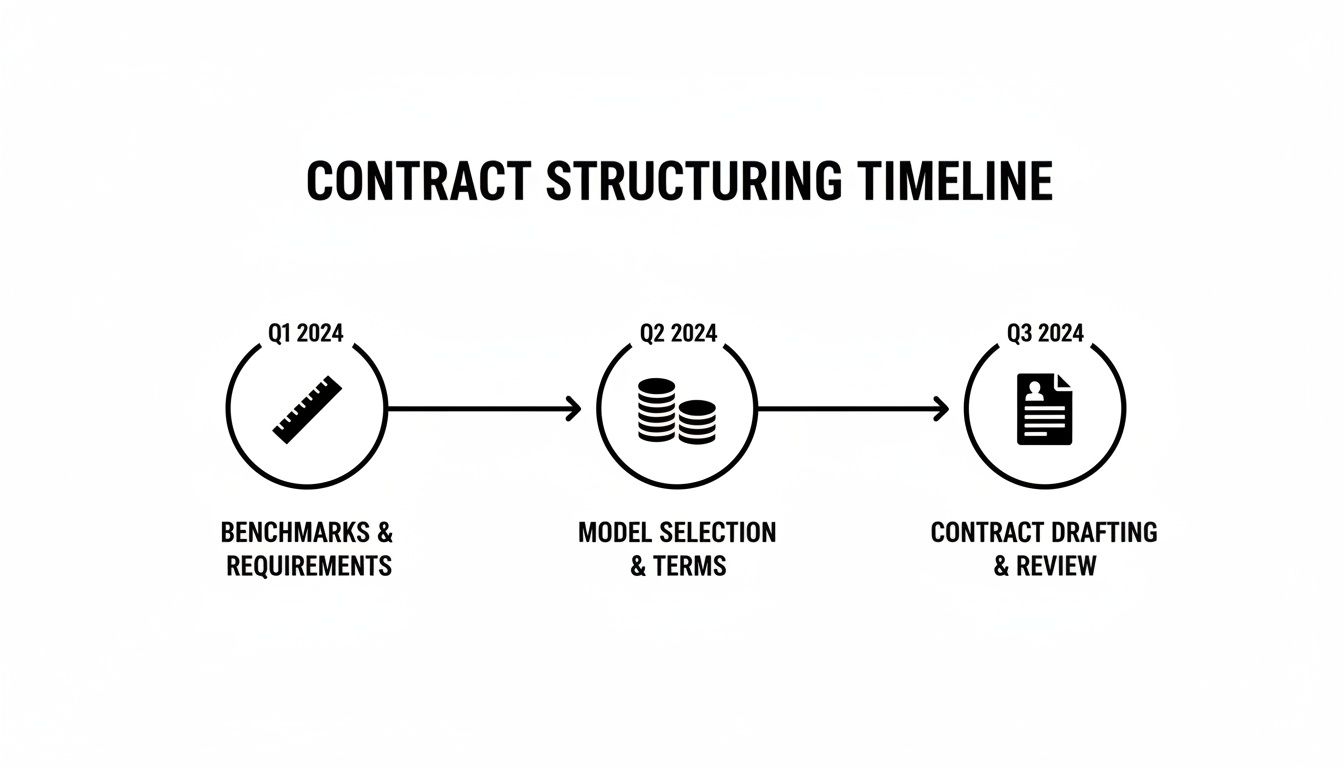
As the timeline shows, a solid contract is built on clear benchmarks and the right payment model, setting the stage for a great working relationship.
Weeks 2-4: From Contributor to Owner
Once they have the lay of the land, it's time to shift focus from basic tasks to real ownership.
- Week 2: Hand them their first meaningful feature or epic. Ensure it's clearly defined with a rock-solid definition of "done."
- Weeks 3-4: Start pulling them into architectural discussions and encouraging them to do code reviews for other team members. This transforms a hired gun into a true teammate who feels empowered to suggest improvements.
Running a Distributed Team That Delivers
Managing remote contractors means you must stop managing activity and start measuring outcomes. Micromanagement is the kryptonite of trust. The secret is disciplined asynchronous communication. Your project management tool must be the single source of truth.
Instead of forcing daily stand-ups, try these async-friendly alternatives:
- Written Check-ins: Use a dedicated Slack or Discord channel for quick daily summaries of progress and blockers.
- Outcome-Based Updates: Frame questions around results, not activity. "What's the latest on Ticket-123?" instead of "What did you do today?"
- Recorded Demos: Have developers record short video demos of finished features. This allows the team to review progress without coordinating schedules.
From Contractor to Partner
Ultimately, your goal is to cultivate a deep sense of ownership. A contractor who feels like a genuine, respected part of the team will always go the extra mile. Give them a voice in decisions, invite them to sprint planning, and listen to their ideas. This level of inclusion is what separates a good contractor from a truly great one. Developers actively seek out these kinds of supportive remote teams, and if you're looking for one, you can check out these remote blockchain jobs.
When you treat your contract software developers like trusted partners, you unlock a level of commitment and quality that no statement of work can ever buy.
Frequently Asked Questions
Hiring contract developers in Web3 can be complex. Here are straight-up answers to the most common questions from both hiring managers and developers.
What Are the Most Common Hiring Mistakes to Avoid?
- Vague Job Descriptions: This attracts a flood of irrelevant applications while experts scroll right past. Be specific about the challenges and technology.
- A Long, Disorganized Interview Process: Top candidates are talking to multiple projects. If you're slow or confusing, they'll drop out, assuming your project is run the same way. Respect their time.
- Failing to Define Scope: This is a recipe for scope creep, blown budgets, and friction. A fuzzy contract, especially around IP and payments, can poison a great working relationship before it even starts.
How Can I Ensure the Security and Quality of Code From a Contractor?
Security isn't an afterthought; it's a culture. It starts with who you hire. Look for contract software developers with an active, public GitHub profile.
Once they're on board, these practices are non-negotiable:
- Mandatory Peer Reviews: Every single pull request needs another engineer's eyes on it. This is your first line of defense against bugs and maintains code quality.
- Automated Testing: Your CI/CD pipeline must run your full test suite on every commit. This provides a constant, unbiased pulse on code quality.
- Third-Party Audits: For anything mission-critical, an independent security audit is a fundamental cost of doing business in Web3. Budget for it from the start.
Career Progression Insight: For developers, embracing and even championing these practices signals a level of professionalism that justifies higher rates and leads to better project offers.
Is Paying Contractors in My Project's Native Token a Good Idea?
It can be a powerful way to align incentives, but it must be handled carefully. A contractor can’t pay their rent with volatile tokens, so a 100% token payment model is a non-starter.
A hybrid model is the best path. Cover the majority of their rate in a stablecoin like USDC for stability. Offer the rest in your project's native token as a performance bonus or milestone reward.
Actionable Tip: Your contract must be crystal clear on how tokens are valued (e.g., using a 30-day time-weighted average price at payout) to avoid disputes. A vesting schedule for the token portion also incentivizes long-term alignment. Always run this by legal counsel.
How Can I Transition From a Full-Time Role to Contracting?
For developers making the jump, preparation is key. Clients are paying a premium for expertise, not to hold your hand. Aim to have at least 3-5 years of solid, professional experience.
You'll also need a financial safety net. A crucial first step is to save 3-6 months of living expenses. This gives you the freedom to turn down bad projects and ride out quiet periods between gigs.
Finally, you must adopt a business mindset. As a contractor, you are a one-person business. This means you're always networking, your portfolio is always up-to-date, and you know what the market is paying. While contractors can often earn 20-40% more than their full-time counterparts, that extra income comes with the responsibility of keeping your own pipeline full.
Ready to find the perfect contract software developer for your Web3 project, or looking to make your next career move? Blockchain Jobs connects top talent with leading companies in the decentralized ecosystem. Post a job or discover your next opportunity today.