Crypto Analyst Jobs: Your 2026 Guide to Landing a Role

Web3 hiring has matured enough that "crypto analyst" now covers several different jobs, not one narrow niche. Browse current crypto data and analytics roles and you will see teams hiring for on-chain investigation, quant research, market intelligence, treasury analysis, risk, and compliance. That variety is the first thing candidates need to understand, because each path screens for different skills and produces different career outcomes.
A trading firm does not hire the same analyst profile as an exchange, a protocol foundation, or a compliance vendor. One team may care about Python, factor models, and execution data. Another may care about wallet attribution, SQL, dashboarding, and smart contract behavior. A third may want someone who can turn protocol metrics into a clear memo for executives or investors.
That is why generic "I love crypto" applications usually go nowhere.
Candidates who get hired tend to do one thing well early. They pick the analyst lane that matches their strengths, then build evidence for that lane instead of trying to look interchangeable across all of them. If your background is statistics and coding, quant or risk may fit. If you are strong at tracing flows, explaining protocol usage, and writing clearly, on-chain or research may be a better bet. Even public market content can show the difference between opinion and method. A good data-driven MATIC forecast is useful because it shows how analysts structure assumptions, compare scenarios, and defend a view with evidence.
The hiring mistake I see most often is simple. Applicants prepare for a price-chart job that often does not exist. Teams are usually trying to solve a specific business problem, and they hire analysts who can show that they understand the problem, the data, and the trade-offs.
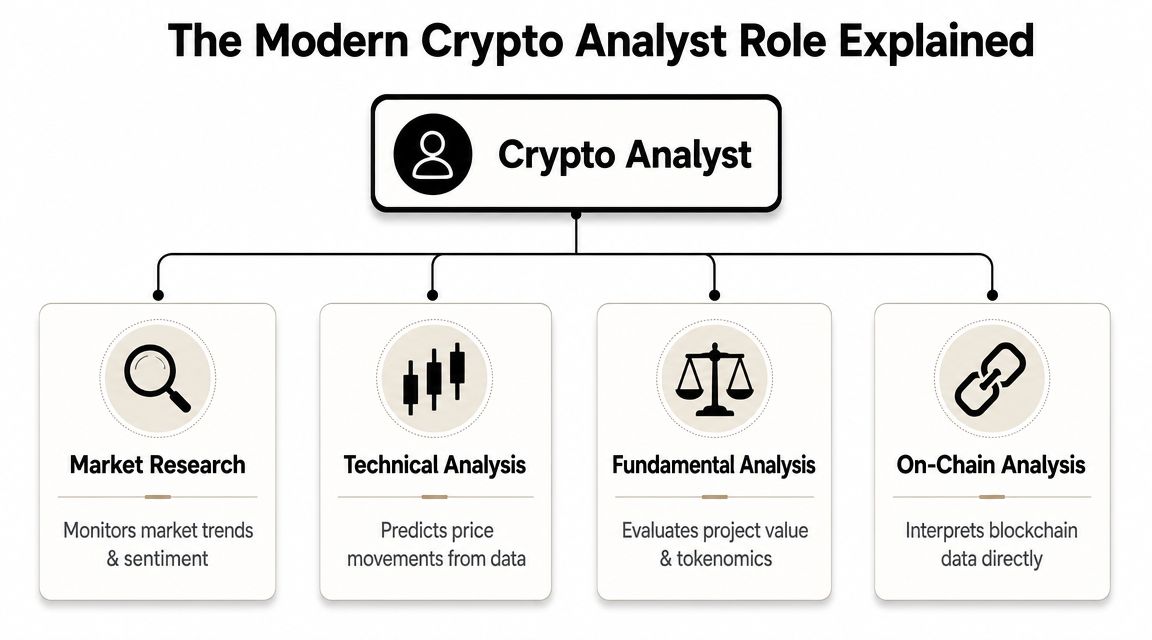
The Modern Crypto Analyst Role Explained
A lot of content still treats crypto analyst jobs as if they all sit inside “research” or “trading.” That's wrong. Live postings show a much wider reality, including SQL-heavy roles, data modeling work, Snowflake pipeline tasks, wallet and contract analysis, and cross-functional analytics work. You can see that breadth in current analyst-crypto listings on Web3.career.
Four common analyst paths
The cleanest way to understand the category is to split it into functions.
| Analyst path | What the team needs from you | What gets misunderstood |
|---|---|---|
| On-chain analyst | Track wallets, flows, protocol usage, smart contract behavior | It isn't just “watch whale wallets” |
| Quant analyst | Build and test models, evaluate signals, monitor risk | It isn't just being good at math |
| Research analyst | Turn messy protocol information into a clear investment or market view | It isn't just writing threads |
| Risk or compliance analyst | Detect exposure, investigate activity, support controls and reporting | It isn't back-office busywork |
That difference matters because each path rewards a different kind of candidate. A strong quant candidate can fail badly in a research interview if they can't tell a coherent story from data. A sharp research writer can struggle in an on-chain role if they can't work with raw datasets or wallet-level evidence.
What employers actually buy
Teams hire analysts to reduce uncertainty. They need someone who can answer questions like:
- What changed on-chain: Is user activity real, incentive-driven, or inorganic?
- What matters commercially: Which metric connects to revenue, retention, liquidity, or risk?
- What deserves escalation: Is this anomaly noise, fraud risk, market structure stress, or a real opportunity?
- What should the team do next: Monitor, hedge, launch, pause, investigate, or communicate?
Practical rule: Don't apply to “crypto analyst” as if it's a single profession. Apply to a business problem.
If you're trying to figure out which path fits you, study public analysis that goes beyond price commentary. A solid example is this data-driven MATIC forecast, which is useful because it shows how analysts can connect market narrative with structured reasoning instead of recycling hype.
You should also review active hiring categories where analyst work overlaps with broader business intelligence and reporting. A good starting point is this set of Web3 data and analytics roles. Even if the title isn't “crypto analyst,” the skill overlap is often substantial.
The real takeaway
The title is a label. The job is a function.
When candidates understand that early, they stop building a vague “crypto analyst” profile and start building a fit for one lane. That's usually the point where applications improve, interviews become more targeted, and hiring managers take them seriously.
Mastering the Essential Crypto Analyst Skills
The strongest crypto analysts don't collect random skills. They build a working stack that supports an end-to-end workflow. Current technical and quantitative postings make that pretty clear: teams want people who can collect market and on-chain data, scrub and normalize it, build features, back-test models, and compare live performance against assumptions while monitoring portfolio and risk exposure. Those requirements show up in crypto technical analyst job listings on Indeed.
Early in your preparation, treat the role like applied analytics, not just market commentary.

Technical skills that actually get used
If you want to be employable, focus on tools that sit inside real workflows.
- SQL for retrieval and slicing: You'll use it to query protocol activity, user cohorts, transaction patterns, and business metrics.
- Python with Pandas and NumPy: This is the default stack for cleaning data, building features, running exploratory analysis, and testing logic.
- Back-testing discipline: Even non-quant teams value candidates who know how to test assumptions before turning them into recommendations.
- Large-dataset handling: Crypto data gets messy fast. Dupes, labeling issues, wallet clustering problems, and inconsistent schemas are normal.
- Dashboarding and reporting: A good analyst doesn't stop at the notebook. They package findings for operators, researchers, and executives.
A lot of candidates learn charting first because it's accessible. That's fine at the beginning, but chart reading alone won't carry you through a technical screen.
Domain knowledge that separates tourists from operators
Crypto rewards context. You need to know what you're looking at before you analyze it.
That means understanding how DeFi protocols generate activity, how tokenomics shape incentives, how Layer 1 and Layer 2 ecosystems differ, and where on-chain data can mislead you. If you can't explain why a metric moved, the metric itself isn't worth much.
Here's a useful mental model for domain depth:
Protocol mechanics
Know how swaps, lending, staking, bridging, and derivatives work.Token design Read emissions, vesting schedules, value accrual paths, and governance rights with a skeptical eye.
Market structure
Understand liquidity fragmentation, exchange behavior, and how narratives pull attention faster than fundamentals.
A practical supplement is studying adjacent hiring expectations outside pure crypto, because the overlap is real. This guide to future data analyst skills is useful for seeing how broader analytics standards are moving toward stronger technical fluency, clearer communication, and more automation-aware workflows.
Before moving on, watch a practitioner explain the analytics mindset in action:
Soft skills that hiring teams remember
Soft skills decide who gets trusted.
The analyst who can explain uncertainty clearly is usually more valuable than the analyst who sounds the smartest in a notebook.
Three matter most:
- Judgment: Knowing when the data is incomplete, noisy, or distorted.
- Communication: Turning a complicated finding into a recommendation someone can act on.
- Prioritization: Focusing on the metric that changes a decision, not the one that looks impressive.
If you're targeting roles that lean more into predictive systems, automation, or modeling infrastructure, it also helps to review adjacent AI and machine learning jobs in Web3. Not because you need to become an ML engineer overnight, but because analyst roles increasingly touch that territory.
Build a Portfolio That Gets You Hired
A resume says you can do the work. A portfolio gives a hiring manager a way to verify it.
That is a fundamental requirement in crypto. The field grew out of a market that still requires specialized knowledge of blockchain, trading, analytics, and investment tools, and that specialization created a labor category centered on market surveillance, token valuation, and on-chain analysis rather than traditional equity research alone. Coursera captures that backdrop in its overview of the crypto analyst career path.
Public proof beats claimed interest
I've reviewed plenty of applications from people who say they're “passionate about crypto.” That line means almost nothing without visible work. A portfolio does the opposite. It shows how you think, what you notice, and whether you can finish an analysis instead of just starting one.
The strongest entry-level candidates usually have some mix of:
- A dashboard portfolio: Dune queries, wallet segmentation work, protocol activity tracking, or market structure views.
- Written research: Short notes, thesis memos, governance analysis, tokenomics breakdowns, or postmortems after major events.
- Open-source analysis: GitHub notebooks, SQL queries, Python scripts, or reproducible research workflows.
- Community contribution: DAO analytics, forum writeups, governance comments, or contributor reports.
What a good portfolio project looks like
Weak portfolio work is vague. Strong portfolio work starts with a concrete question.
Try projects like these:
| Project type | Good question |
|---|---|
| On-chain dashboard | Which addresses are driving real protocol retention versus mercenary usage? |
| Tokenomics memo | Does the token structure reward long-term participation or short-term extraction? |
| Exchange or market analysis | What changed in liquidity quality before and after a major market event? |
| Risk review | Where are the obvious concentration points in holders, governance, or collateral? |
A hiring manager doesn't need polished perfection. They need evidence that you can define a problem, work through noisy inputs, and explain a conclusion.
Hiring signal: A mediocre dashboard with sharp interpretation beats a beautiful dashboard with no point of view.
How to make your work visible
Keep distribution simple. Publish where recruiters and operators already spend time.
- Dune profile first: A clean public profile gives people something concrete to click.
- Short research posts: Write concise pieces on X, Mirror, Substack, or LinkedIn. Don't try to sound institutional.
- GitHub for process: Show notebooks, SQL, README files, and assumptions.
- DAO work when possible: Even unpaid contribution can demonstrate collaboration, ownership, and crypto-native fluency.
If you want a grounded example of how adjacent crypto operations and risk work gets framed in the market, look at a live role like this remote Client Engagement Ops Analyst opening. It's not a pure analyst research role, but it's useful because it shows how crypto employers value process, regulatory awareness, and operational judgment alongside technical fluency.
The standard to aim for
Your portfolio should make a reviewer think, “This person could already contribute here.”
That doesn't require years of formal experience. It requires public work with a clear analytical spine. One thoughtful dashboard, one serious memo, and one well-documented notebook can do more than a stack of generic certificates.
Craft a Standout Analyst Resume and Profile
Most crypto resumes fail because they describe activity, not value. They read like task lists from a general data job with a few token names added in.
Hiring managers scan for fit fast. They want to know which analyst lane you belong to, what evidence supports that claim, and whether your work matches the problems their team needs solved.
Start with positioning, not biography
Your headline should identify your lane. Not “Web3 enthusiast.” Not “Aspiring crypto analyst.” Those labels waste space.
Use something specific instead:
- On-chain analyst focused on wallet behavior, protocol usage, and token flows
- Research analyst covering DeFi, tokenomics, and market structure
- Quant-oriented analyst with Python, SQL, and back-testing experience
- Risk and compliance analyst with transaction monitoring and investigative reporting experience
That framing helps recruiters route your profile correctly. It also stops you from looking unfocused.
Rewrite bullets so they sound like analyst work
Here's the pattern I use when reviewing candidate resumes:
| Weak version | Stronger version |
|---|---|
| Analyzed crypto projects | Evaluated tokenomics, governance structure, and value accrual logic across multiple protocols |
| Built dashboards | Built dashboards tracking wallet activity, protocol usage, and user cohorts for ongoing monitoring |
| Wrote market updates | Produced recurring research notes translating market events into actionable team insights |
| Worked with data | Queried, cleaned, and interpreted on-chain or financial datasets to support decisions |
Notice what's happening. The stronger version shows scope, subject matter, and decision relevance without faking precision.
Feature proof where recruiters can see it
Your top third matters most. Put links to your best work near the top of the resume and in your LinkedIn featured section.
Use a simple checklist:
- Lead with your best artifact: One dashboard, one memo, one GitHub repo.
- Show tool depth: List SQL, Python, Pandas, NumPy, Dune, or other tools only if you've used them in visible work.
- Name the domain: DeFi, stablecoins, Layer 2s, governance, market structure, compliance, or risk.
- Keep the summary short: Two or three lines is enough if the rest of the profile proves it.
“Your profile should answer one question immediately: what kind of analyst should I talk to this person about?”
LinkedIn matters more than many candidates think, especially in Web3 where recruiters often search by keyword and then click into public work. A good profile isn't polished marketing copy. It's a routing mechanism. Make it easy for someone to understand your lane and inspect your output.
Where to Find the Best Crypto Analyst Jobs
The worst job search strategy in this category is volume. Sending the same resume to every exchange, fund, and protocol with an “analyst” opening usually creates silence.
Better results come from matching your lane to the company type. Funds, exchanges, analytics vendors, compliance teams, and protocols all use analysts differently. If you don't adjust for that, your application reads as generic even when your background is solid.
Match the company to the analyst function
Use this filter before you apply:
- Protocols and DAOs: Often want on-chain, growth, or ecosystem analysis tied to product decisions.
- Exchanges: Commonly hire for risk, operations, compliance, market intelligence, and revenue analytics.
- Funds and research shops: Lean harder toward thesis formation, market structure, and deep project evaluation.
- Infrastructure and data companies: Value SQL, modeling, analytics engineering, and cross-functional reporting.
That one step saves time. It also helps you tailor your portfolio link and cover note around a real business need.
Use niche boards, then go direct
Generic job boards are fine for market awareness, but many crypto teams hire through specialized channels, direct outreach, and network-driven referrals.
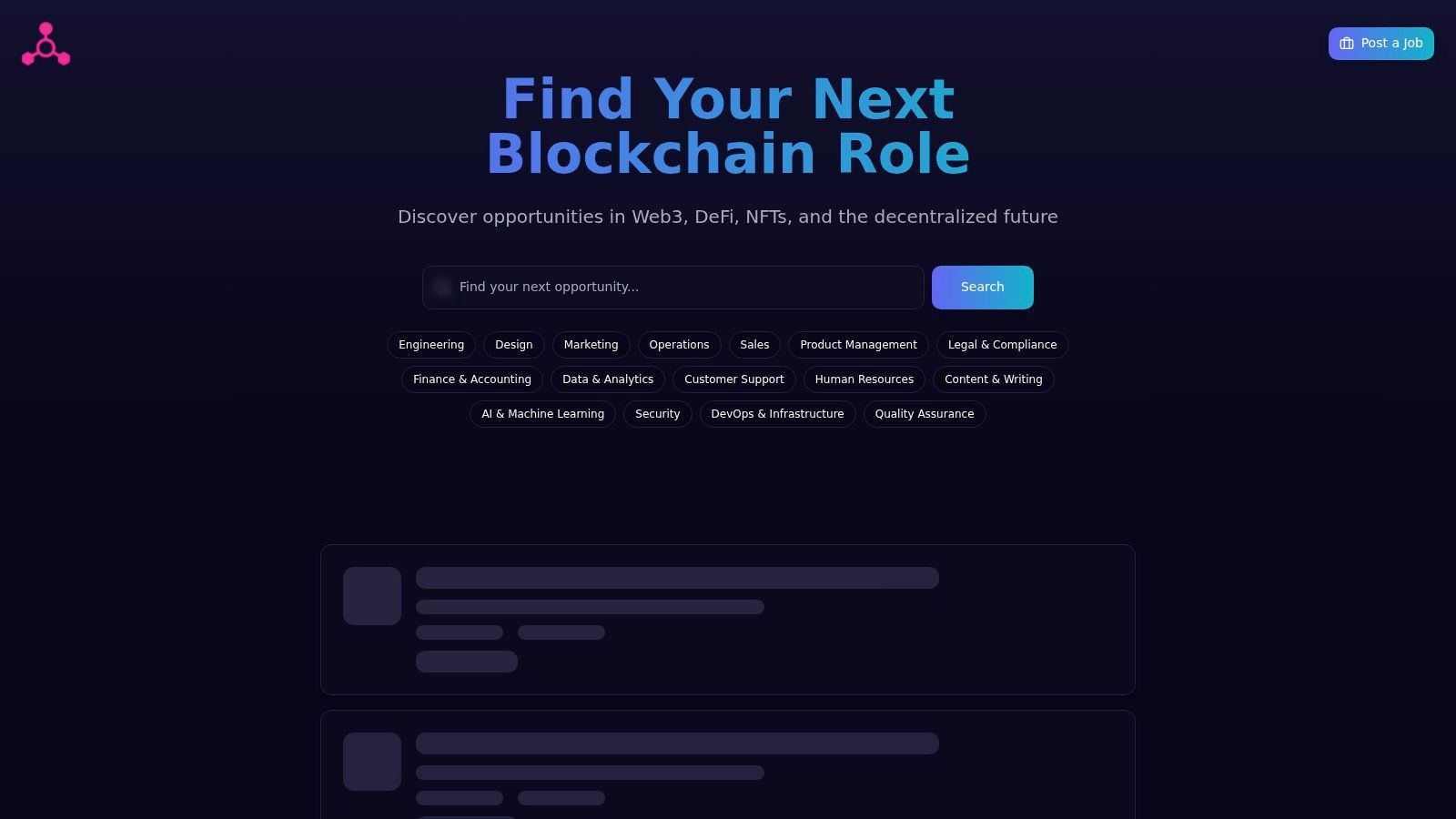
A practical place to search is Blockchain Jobs, which organizes Web3 roles by function so you can separate data, analytics, compliance, operations, and adjacent categories instead of searching one overloaded keyword.
Then go one level deeper:
Build a target list
Pick companies whose products you understand.Read their public footprint
Look at dashboards, governance posts, docs, or research they publish.Send contextual applications
Mention one issue, metric, or product behavior you noticed.Use your portfolio as the opener
A sharp dashboard or memo creates a better conversation than a generic intro message.
Field note: The candidates who get responses fastest usually make the recruiter's job easy. Their application already explains why they fit that exact opening.
Nailing Your Crypto Analyst Interview
Crypto analyst interviews usually reveal the same thing from three angles: how you think, how you work with evidence, and how you communicate under ambiguity.
A candidate can sound excellent in a casual conversation and still fail the process if they can't structure an analysis. That's why prep should focus less on memorizing questions and more on building a repeatable method.
What the interview process often tests
Most interview loops include a mix of these components:
| Interview type | What they're really testing |
|---|---|
| Behavioral screen | Ownership, judgment, communication, and culture fit |
| Technical assessment | SQL, Python, data logic, or analytical reasoning |
| Case study or take-home | How you structure a messy problem and defend a conclusion |
| Market discussion | Whether your crypto knowledge is current, nuanced, and evidence-based |
Behavioral rounds matter more than many technical candidates expect. Teams need analysts who can explain uncertainty without sounding evasive, challenge assumptions without becoming combative, and adjust recommendations when new facts show up.
How to handle the take-home or live case
Here, many applicants drift into rambling. Use a framework.
If you're asked to evaluate a DeFi protocol, structure it like this:
What the protocol does
Explain the product, users, and basic mechanism in plain English.Where value might accrue
Separate protocol usage from token value capture. Those are not the same thing.What the on-chain evidence says
Look for wallet concentration, user quality, transaction patterns, and dependency on incentives.What can break
Cover security assumptions, governance risk, liquidity dependence, and obvious failure modes.Your recommendation
End with a decision. Monitor, avoid, investigate further, or engage.
That final step matters. Many smart candidates stop at “it's complicated.” Hiring managers want to know whether you can still make a call when the picture isn't perfect.
Don't aim to sound omniscient. Aim to sound rigorous.
Common mistakes that sink otherwise good candidates
I see the same errors repeatedly:
- Talking only about price: Price is one output. Good analysts trace the drivers.
- Using buzzwords instead of evidence: “Strong community” and “good fundamentals” don't mean much without specifics.
- Ignoring trade-offs: Every protocol has them. Pretending otherwise makes you look naive.
- Overloading the answer: If you mention every metric, you probably missed the one that matters.
- Failing to state assumptions: A recommendation without assumptions is hard to trust.
What impresses hiring managers
Strong interview answers usually have three traits.
First, they separate signal from noise. Second, they admit uncertainty without collapsing into vagueness. Third, they connect analysis to action.
If you're asked a market opinion question, don't perform expertise. Pick one angle, support it, explain what would change your mind, and stop. Analysts get hired for disciplined thinking, not for sounding like a live news feed.
Negotiating Salary and Advancing Your Career
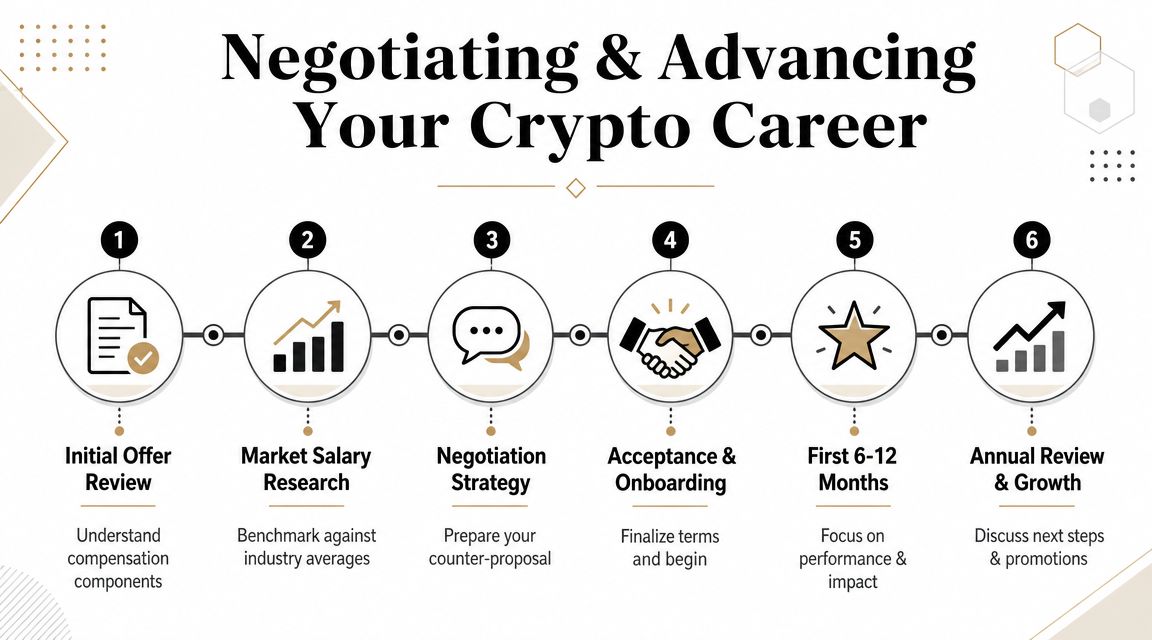
Compensation in crypto analyst jobs swings widely because "crypto analyst" covers several different jobs. A DeFi risk analyst, an on-chain researcher, a quant, and a compliance-focused analyst can all carry the same title while doing very different work. If you negotiate from a generic title, you will usually price yourself poorly. Negotiate from the lane you are entering and the problems you can solve.
How to negotiate without guessing
Good candidates do not ask for more money because crypto is "hot." They make a case based on scope, scarcity, and evidence.
A clean negotiation approach looks like this:
- Tie your ask to the role you are filling: Token risk, on-chain research, treasury analysis, market structure work, and compliance support produce different business value.
- Use your portfolio as proof: A sharp teardown, dashboard, model, or incident review often carries more weight than another line on a resume.
- Clarify the full package: Base salary matters, but so do bonus terms, token grants, vesting, clawback terms, and what performance is expected in the first 90 days.
- Price the messiness of the work: Roles tied to volatile markets, odd hours, or high-stakes decision support should be paid differently from reporting-heavy analyst jobs.
- Negotiate from ownership: Hiring managers pay more for someone who can take over a recurring problem with limited supervision.
One practical note. Token compensation can be meaningful, or it can be a distraction. Ask how it vests, whether there is a liquidation window, and what percentage of total compensation depends on token price holding up. I have seen candidates overvalue upside and ignore basic cash-flow risk.
What Promotion Depends On
The first promotion usually goes to the analyst who becomes dependable in one lane and increasingly useful outside it. That means good judgment, clear writing, and the ability to help a team make decisions under time pressure.
Promotion comes faster when you can do these things consistently:
| Career move | What it takes |
|---|---|
| Analyst to senior analyst | Better judgment, clearer communication, stronger ownership |
| Senior analyst to lead or head of research | Team influence, process building, sharper prioritization |
| Analyst to strategy, investing, or product | Ability to connect analysis to business decisions |
Specialization gets you hired. Range gets you promoted.
An on-chain analyst who learns risk framing becomes more valuable. A quant who can explain model limits to non-technical stakeholders becomes more valuable. A research analyst who can turn findings into product, treasury, or governance recommendations becomes much harder to replace.
Career reality: Your first role does not lock you in. It gives you a platform. Analysts often move into research leadership, risk, product strategy, investing, or founding roles after they build trust and domain depth.
The people who move up fastest do more than produce analysis. They become the person others rely on when the data is incomplete, the market is stressed, and a decision still has to be made.
If you're actively searching, Blockchain Jobs is a practical place to find Web3 openings across analytics, compliance, operations, engineering, and adjacent functions. Use it to narrow the lane that fits your background, then apply with a portfolio that shows exactly how you think.