Crypto Jobs Los Angeles 2026: Your Guide to Web3 Careers

Los Angeles crypto hiring is often perceived as being exclusively for Solidity engineers. This overlooks a broader reality. Depending on the platform, LA shows anywhere from 9 specialized openings concentrated in engineering, legal, and finance on niche listings, to 349 Web3 roles on broader aggregators, to 63 cryptocurrency jobs on LinkedIn and 80 on Indeed in late June 2026, with salary bands stretching from entry-level marketing pay to executive growth leadership and senior counsel compensation (Los Angeles crypto job listings on specialized platforms, broader LA Web3 job listings).
That range matters because it tells you two things at once. First, crypto jobs in Los Angeles are real and varied. Second, your search strategy has to match the kind of role you want. If you're a developer, you're competing in a skills-first market. If you're in legal, compliance, finance, marketing, ops, customer support, or community, you're not an afterthought anymore. You're part of the hiring core.
I've seen candidates waste months by aiming too broadly, sending generic resumes, and applying like this is still conventional tech. LA crypto hiring rewards specificity. The people who get interviews know which slice of the market they're entering, how to prove crypto fluency, and how to talk about risk, regulation, product, and users in the same conversation.
Understanding the LA Crypto Job Market
Hundreds of Web3 roles are tied to Los Angeles on major job datasets, and that number only matters if you read past the headline. LA is a real hiring market for crypto, but it does not hire like San Francisco, New York, or Miami. Teams here skew toward product, consumer, fintech, and regulated business models, which creates more room for operators, marketers, legal talent, finance professionals, and customer-facing hires than many candidates expect.
According to Crypto jobs data for Los Angeles on Cryptocurrency Jobs, LA regularly shows a meaningful volume of active Web3 openings across functions. The engineering demand is real, but the stronger signal is breadth. You will see protocols and infrastructure companies, but you will also see exchanges, consumer apps, payments businesses, analytics firms, and startup teams building around compliance, partnerships, and growth.

What hiring looks like on the ground
From a recruiting standpoint, LA tends to reward candidates who can connect crypto knowledge to business outcomes. A protocol may still need a smart contract engineer. A payments company may be hiring compliance counsel, partnerships leads, rev ops, lifecycle marketing, or customer success. A consumer Web3 brand may need community managers and content leads who understand wallets, token incentives, and onchain user behavior well enough to avoid sounding like they learned it last week.
This is the part many articles miss. Non-technical hiring in LA crypto is not filler around an engineering core. It is often tied directly to revenue, regulation, retention, and market trust.
That matters because hiring managers in these roles screen differently. They are not only asking whether you have crypto interest. They are asking whether you can handle ambiguity, explain risk clearly, and work inside a market that changes fast without losing judgment.
Practical rule: Pick the lane before you apply. In LA, crypto hiring usually clusters around product and engineering, regulated operations, business growth, and support functions that keep those teams effective.
Salary expectations by function
Salary ranges vary widely by company stage, token exposure, remote policy, and whether the role sits close to revenue or regulation. A seed-stage startup may offer lower base pay with upside. A later-stage company usually pays more cash and expects cleaner specialization. For non-technical candidates, the biggest jumps usually come when you can show crypto-specific experience, not just transferable experience from SaaS or traditional finance.
| Job Title | Annual Salary Range | Primary Skills |
|---|---|---|
| Blockchain Data Engineer | $114,000 to $218,000 | Data pipelines, blockchain analytics, protocol data modeling |
| Smart Contract Developer | $114,000 to $218,000 | Solidity, testing, security mindset, protocol architecture |
| Senior Protocol Engineer | Toward or above $150,000, with some senior remote-equivalent roles reaching $250,000 | Smart contracts, systems design, audits, shipping history |
| Senior Counsel | $147,000 to $232,000 | Securities awareness, compliance, contracts, regulatory judgment |
| Head of Growth | $200,000 to $225,000 | Growth strategy, product marketing, partnerships, analytics |
| Social Media or Marketing roles | $58,000 to $115,000 | Community, content, campaigns, platform fluency |
Candidates often make the wrong comparison and measure LA against SF compensation alone. A better comparison is role quality versus competition. LA can be an excellent market for professionals who bring one strong functional skill and one crypto-relevant layer on top of it. For example, an operations candidate who understands KYC flows, a marketer who can read wallet behavior, or a legal hire who can speak to token risk and product constraints will usually stand out faster than a generalist with a polished resume and no real market fluency.
For a clearer picture of how different employers structure teams, review Web3 companies hiring across categories. If your background is closer to accounting or finance than protocol work, it also helps to compare adjacent hiring markets such as contract accounting roles 2026. That gives you a better benchmark for how crypto finance and ops roles stack up against broader remote opportunities.
Where to Find Your Next Crypto Role in LA
The fastest way to waste time is to search one board, type "crypto jobs Los Angeles," and hope the market sorts itself for you. It won't. Good candidates search in layers.
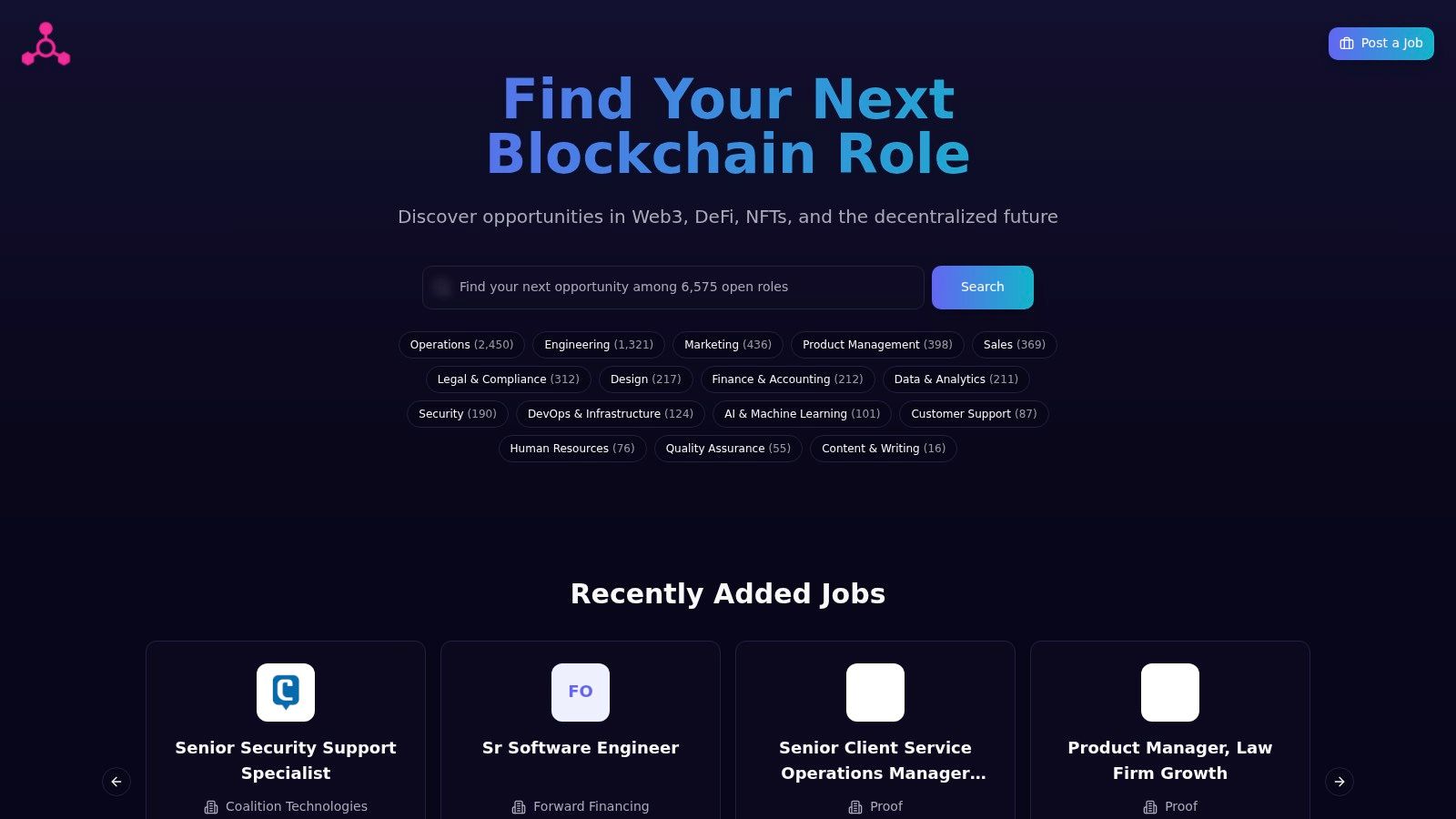
Start with listings that are crypto-native. Then move outward to broader aggregators, then to communities where jobs appear before they hit boards.
Search in three lanes
The cleanest approach is to split your search into three buckets.
- Crypto-native boards first. These usually surface roles with clearer Web3 expectations, better category filtering, and more realistic job descriptions than generic boards.
- Mainstream platforms second. LinkedIn and Indeed help you catch employers that don't market themselves as crypto-first, especially in legal, finance, operations, and partnerships.
- Community channels third. Discords, Telegram groups, founder feeds, and project communities often expose contract work, trial projects, and early-stage roles before formal hiring opens.
If you're looking broadly across the country while staying open to LA companies, filtering USA blockchain jobs by location helps widen the net without losing relevance.
Non-technical roles are easier to find if you search differently
Most guides fall short in their advice. They treat crypto hiring like a coding-only market, so non-technical applicants assume they don't belong. That's wrong.
ZipRecruiter data on no-experience cryptocurrency jobs in Los Angeles lists 102 "no experience" cryptocurrency jobs in LA, which is a useful reminder that career changers and non-coders do have entry points. Some of these roles won't be entirely crypto-native, but they still matter. They let you build industry context, work with crypto-adjacent users, and develop a portfolio you can later turn into stronger Web3 applications.
That matters for people targeting:
- Marketing and community roles
- Operations and customer support
- Finance and accounting support
- Legal intake, contracts, and compliance coordination
- Partnerships and business development
If you're coming from accounting or finance and want contract work while moving toward Web3, resources like contract accounting roles 2026 can be a practical bridge. That path makes sense for candidates who already know reconciliations, reporting, and vendor workflows but need time to build crypto-specific fluency.
Here's a simple way to search more effectively:
- Search for company problems, not just titles. "Compliance analyst stablecoin" often works better than "crypto compliance."
- Search adjacent terms. Try blockchain, digital assets, on-chain, wallet, exchange, payments, DeFi, or protocol operations.
- Look for hybrid language. Some strong roles live under fintech, gaming, creator economy, or payments instead of "crypto."
A lot of openings are also found by tracking people, not boards. Follow founders, general counsels, growth leads, and talent partners at LA firms. Hiring teams often post role context on social before the listing is polished.
A good reality check sits below. It helps candidates understand how crypto employers frame opportunities and skills, even when the title isn't obvious.
Roles in crypto don't always announce themselves clearly. A "partnerships manager" at a payments startup and a "community lead" at a protocol may both require stronger on-chain literacy than a traditional tech job with a more technical title.
Crafting a Crypto-Native Application
Recruiters in LA sort crypto applications fast. In practice, that means your resume has a few seconds to show whether you understand how this industry works.

A generic tech resume gets ignored because it hides the one thing crypto employers care about. Evidence. Hiring teams want proof that you can operate in an environment shaped by token incentives, public communities, regulatory uncertainty, wallet friction, and fast product changes.
That applies well beyond engineering. LA has real demand for marketers, community operators, legal specialists, compliance hires, finance managers, customer support leads, and partnerships people who can work inside crypto products without needing basic terms explained to them.
For engineers, evidence usually means shipped code, GitHub history, audit awareness, test coverage, protocol contributions, or clear ownership of a feature.
For non-technical candidates, evidence looks different and is often easier to present than people think. Strong proof can include governance participation you can explain in plain English, lifecycle email or growth campaigns tied to wallet activation, policy or disclosure work around digital assets, fraud or payment ops experience, customer support systems for high-risk users, or public writing that shows you understand custody, bridges, L2s, staking, or token design.
A hiring manager should be able to answer one question quickly after reading your application: can this person do the job in a crypto company, not just talk about crypto on social media?
Build your materials around that standard:
- Lead with job fit. State the business problem you solve, such as partner growth, incident communications, user onboarding, sanctions review, treasury reporting, or protocol content.
- Show proof early. Link to shipped work, dashboards, campaign results, deal sheets, writing samples, governance posts, compliance memos, portfolio projects, or code repositories.
- Translate adjacent experience. Candidates from fintech, gaming, creator platforms, marketplaces, payments, or legal ops often have relevant experience. Spell out the overlap instead of expecting the reader to connect it.
- Use crypto language carefully. Name the chains, wallets, tools, and risks you already know. Do not stuff in terms you cannot discuss in an interview.
If you're applying to technical roles, reviewing current blockchain engineering openings helps you match the language hiring teams use without turning your resume into a buzzword list.
I see the same pattern across good hires in this market. Teams increasingly screen for demonstrated ability over pedigree, which is part of the future of talent acquisition. Crypto makes that easier because much of the work is public and easy to verify.
Send evidence before adjectives. "I led governance communications during a token migration and handled user confusion across Discord and email" is stronger than "passionate Web3 community leader."
A short outreach note usually beats a long cover letter because it respects the recruiter's time and gives them something they can forward internally. Use this format:
Hi [Name], I'm applying for the [Role]. My background is in [core function], and I'm a fit for this role because I've already handled [specific problem]. Relevant examples include [verifiable project or result]. I can also speak directly to [crypto-specific topic such as wallets, compliance, governance, liquidity, partnerships, or user onboarding]. I'm interested in your team's work on [product or business line] because [specific reason]. Happy to share samples or walk through how I'd approach the role.
That note works because it shows judgment. It tells the recruiter you understand the company, the function, and the operating environment.
Nailing the Los Angeles Crypto Interview
A crypto interview in LA often feels normal in round one, then suddenly becomes much more specific. That's where people get exposed. They can talk about enthusiasm, but they can't discuss mechanisms, trade-offs, or risk.
The strongest hiring teams use a structured process. According to crypto.jobs hiring methodology for LA-based roles, expert hiring for LA crypto jobs often includes a 3-step technical validation: OnChain portfolio audit, a real-time Solidity coding challenge, and a protocol-specific scenario simulation. That process has 94% predictive accuracy for long-term retention.
What that means for engineers
A typical engineer interview might unfold like this.
You start with portfolio review. The interviewer asks which repositories matter, what you personally shipped, what broke, and how you tested it. If you can't separate your contribution from the team's, that creates doubt immediately.
Then comes live coding. It isn't just about syntax. They want to see whether you write defensively, think about edge cases, and communicate under pressure.
The final round is usually the primary differentiator. You may get a scenario involving bridge risk, exploit response, protocol incentives, upgrade decisions, or governance conflict. Good candidates explain both the technical path and the operational consequences.
What non-technical candidates get asked instead
Non-technical interviews aren't easier. They're different.
A legal, operations, growth, or support candidate may get questions like:
- How would you explain self-custody risk to a mainstream user?
- What changes when a product moves from closed beta to tokenized community governance?
- How would you handle a user support spike tied to a wallet issue or failed transaction?
- What do SEC or FINCEN concerns change in the way a company launches or communicates?
- How would you prioritize trust, speed, and growth if the product team wants faster onboarding?
These interviews test whether you can connect business judgment to crypto realities. The best answers are simple, structured, and grounded in consequences.
Try this answer framework:
- Define the user or business problem.
- Name the crypto-specific risk.
- Explain the trade-off.
- Give the action you'd take first.
- Say how you'd measure whether it worked.
For hiring managers, the quality of your questions matters too. If you need inspiration, MyCulture.ai hiring questions offers useful prompts you can adapt when you're interviewing the interviewer about team norms, decision-making, and expectations.
Ask one question that proves you understand the company's risk surface. For example: "How do product, legal, and support coordinate when users encounter issues tied to transaction finality or wallet behavior?"
What usually goes wrong
Candidates fail LA crypto interviews for predictable reasons.
- They stay generic. They say they're excited about Web3 but can't discuss one protocol in depth.
- They over-index on buzzwords. Throwing around DeFi, DAO, and tokenomics without specifics backfires.
- They don't simplify well. Good teams value people who can explain complex on-chain concepts to users, executives, or regulators.
- They ignore compliance. Even product and marketing hires should show some awareness of regulated risk.
If you want to stand out, prepare one deep case study from your own work and one deep case study from the employer's world. That's usually enough to separate you from candidates who only memorized terms.
Building Your Career Beyond the Offer Letter
Getting hired into crypto jobs in Los Angeles is an entry point, not the finish line. Career momentum comes from choosing the right problems after you join.
The biggest mistake I see is chasing title upgrades too early. In crypto, reputation compounds faster through visible work than through title inflation. If you become the person who can ship during ambiguity, coordinate across legal and product, or calm users during operational stress, you become hard to replace.
Pick a lane that gains value
The market is rewarding more than engineering. CryptoJobsList hiring trends show 62% growth in business development roles over the last 3 months in 2026, with top hiring categories including Trading, Finance, Security, and Compliance. That tells you where long-term advantage is accumulating.
If you're already inside a company, look for projects that increase your credibility in one of these areas:
- Security-adjacent work. Incident communications, user protection flows, or coordination with engineering during high-risk moments.
- Compliance-heavy execution. Policy rollouts, vendor reviews, product launches that need tighter controls, or documentation that stands up to scrutiny.
- Revenue-facing work. Partnerships, growth systems, market expansion, or institutional relationships.
- Infrastructure thinking. Even non-engineers benefit when they understand how the product moves value.
Remote versus on-site in Los Angeles
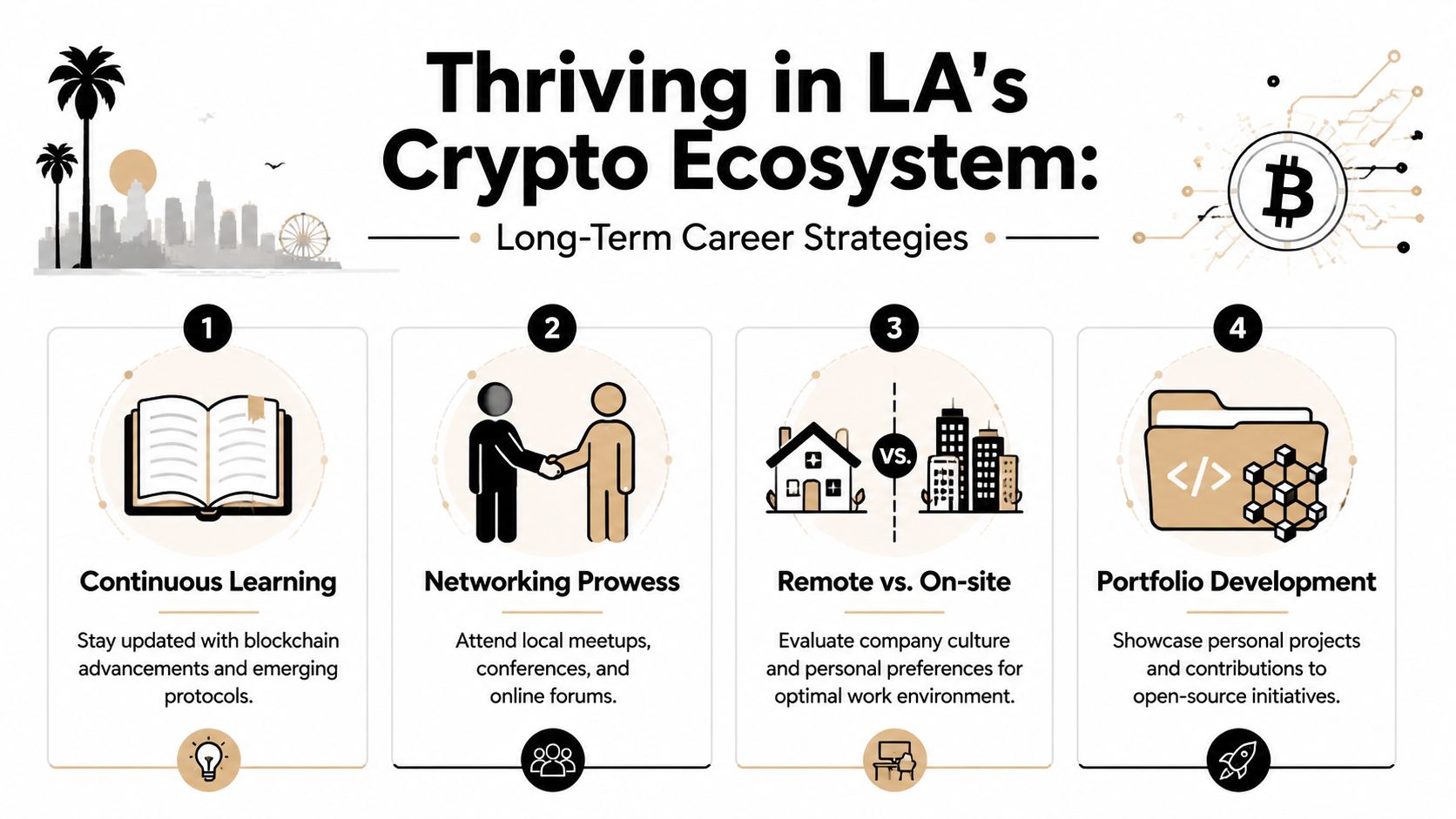
LA gives you a useful middle ground. You can build a national or global crypto career while still benefiting from local relationships. Many companies operate remote-first, but in-person access still helps when you're trying to move from contributor to trusted operator.
A simple way to decide:
- Choose remote if your strength is specialized execution and the company already documents decisions well.
- Choose hybrid if you need faster access to product leaders, founders, or cross-functional context.
- Choose on-site or frequent in-person time if your role depends on partnerships, recruiting, legal coordination, or relationship-heavy internal influence.
The best early-career move isn't always the highest salary. It's often the role that puts you closest to real decisions, sharp teammates, and visible problem-solving.
Build your name in the ecosystem
LA rewards people who show up consistently. Attend meetups, join project communities, comment thoughtfully on launches, and contribute small pieces of useful work. That can mean governance participation, research threads, moderation help, writing, partnerships support, or volunteer coordination at events.
Your next promotion or job often comes from someone seeing how you operate in public and semi-public environments. That's especially true in crypto, where trust is built through visible judgment.
Frequently Asked Questions About LA Crypto Jobs
Can you get a crypto job in Los Angeles without coding skills
Yes. Legal, compliance, operations, finance, business development, customer support, marketing, and community roles are all part of the market. The strongest non-technical candidates don't pretend to be engineers. They prove they understand how crypto products work, where users struggle, and what risks matter.
A good first move is to pick one area of crypto fluency and build evidence around it. If you're in marketing, that might be community education for wallets or DeFi products. If you're in legal, it might be digital asset policy tracking or contract work tied to crypto companies. If you're in ops, it might be payments, fraud, or onboarding workflows.
Do you need a formal degree
Not always. In crypto hiring, employers often care more about proof than pedigree. Public work, shipped projects, writing, community contributions, and clear thinking usually carry more weight than a generic credential list.
For technical candidates, that means code and shipped systems. For non-technical candidates, it means visible, relevant work samples and smart explanations of what you did.
How do you get experience if you have none
Start smaller than you think you should.
Try this:
- Join a DAO or protocol community and contribute in a way that's visible and useful.
- Create a small portfolio. Write protocol explainers, build a research thread, document support pain points, or map a user onboarding flow.
- Take adjacent work seriously. Fintech, payments, compliance, marketplaces, gaming, and security can all translate into crypto with the right framing.
- Offer focused help. A founder may ignore a vague "I'd love to help" message but respond to a short note offering to improve a FAQ, audit community onboarding, or clean up support documentation.
What should you put on a resume if you're changing careers
Lead with overlap, not aspiration. Show which parts of your prior work map directly to crypto needs.
Examples:
- Customer support becomes wallet troubleshooting, transaction education, or risk-sensitive user communication.
- B2B sales becomes partnerships for infrastructure, exchanges, or crypto-enabled products.
- Compliance or legal work becomes policy, controls, contracts, disclosure, and launch review.
- Content marketing becomes protocol education, community growth, and user trust-building.
What's the fastest way to get noticed by hiring teams
Be specific and easy to verify. Tailor your application, keep your outreach short, and include proof. Hiring teams move faster when they can quickly see what you've done and how it maps to their current needs.
Also, target roles that are slightly below your ceiling if you're entering the industry for the first time. Crypto companies often promote quickly when someone proves they can learn fast, communicate clearly, and operate with good judgment.
If you're ready to move from browsing to applying, Blockchain Jobs is a strong place to search focused Web3 roles across engineering, legal, compliance, marketing, operations, finance, product, and more. Use it to spot active teams, compare role categories, and find openings that match the kind of crypto career you want to build.