
crypto jobs remote: Your Guide to Landing Remote Roles

Finding remote crypto jobs isn't some niche hunt anymore—it's become the default way the industry operates. The whole Web3 world is built on decentralization and borderless access, so it makes perfect sense that remote work isn't just a perk, but a core part of its DNA. This guide provides actionable steps to navigate the hiring process, ace your interviews, and build a career in this space, no matter where you live.
The Unstoppable Rise of Remote Work in Web3
 The crypto industry wasn't just forced to adapt to remote work; it was practically born from it. With a philosophy centered on decentralization, teams were often spread across the globe from the very beginning. Hiring managers in this space care more about your skills and genuine passion for Web3 than your proximity to an office.
This culture has created a hiring environment where what you can prove you can do matters far more than a traditional resume. For a hiring manager, a developer's active GitHub history or a community manager’s respected presence on Discord is a much stronger indicator of ability than a polished cover letter.
Built Remote-First from the Ground Up
The numbers back this up. For job seekers, this isn't just a passing trend; it's the established model for how Web3 companies build and staff their teams.
The table below paints a clear picture of how this remote-first mindset directly impacts your career opportunities.
Snapshot of the Remote Crypto Job Market
| Metric | Statistic | What This Means for Your Job Search |
|---|---|---|
| Fully Remote Companies | 54% | Over half the companies you apply to won't have location constraints, widening your options significantly. |
| Hybrid Companies | 30% | Many offer flexibility, which is a key point to clarify during your interview process. |
| Total Remote/Hybrid | 98% | Your chances of finding a role that fits your lifestyle are incredibly high, a major career advantage. |
| In-Office Only | 2% | Traditional office roles are the exception; focusing on remote skills is the most direct path to a job. |
Source: Data compiled from BeInCrypto's analysis on the latest crypto job trends.
As you can see, a staggering 98% of crypto organizations have remote work built into their structure. This completely flips the script for job seekers and career progression.
This isn't about old-school companies trying to figure out remote work. It's about a new generation of companies building on a global talent pool from day one. Your next big career move could be with a team scattered across a dozen different time zones.
This reality smashes geographical barriers and truly levels the playing field for talent. If you're looking to break in or move up, proving your ability to deliver in a decentralized setting is your most valuable career asset.
For more career tips and industry deep dives, checking out the Blockchain Jobs blog for valuable resources is a great way to stay ahead of the curve.
Finding High-Quality Remote Crypto Jobs

The secret to landing a great remote crypto job isn't just about what you know—it's about where you look. Sending your resume into the black hole of massive, generic job boards is an inefficient strategy.
To get noticed by hiring managers, you need to go where Web3 founders and recruiters are already active. Think of it less like a job hunt and more like a targeted career campaign. It's about putting your energy into specialized platforms where you can build a reputation before you even submit an application.
Go Straight to the Source with Specialized Job Boards
Forget about Indeed or Monster for these kinds of roles. They're too noisy, and the best crypto jobs rarely show up there. To maximize your interview chances, focus on job boards built for the Web3 world.
- Crypto-Native Platforms: Sites like Blockchain Jobs, CryptoJobsList, and Web3 Career are goldmines. They are curated, meaning you're applying for legitimate roles from serious companies who often pay a listing fee—a built-in filter for quality.
- AngelList (now Wellfound): This is a powerhouse for finding jobs at early-stage startups building the next big thing in crypto. It’s an excellent place for candidates looking for high-impact roles.
- Direct Company Career Pages: Have a dream company in mind, like Uniswap or Tether? Go straight to their website. Their careers page is often the first place new openings are posted, giving you a head start. You might find a perfect fit, like this software engineer position for crypto wallets, before it gets wider distribution.
By focusing on these niche boards, you are positioning yourself in the right pool of candidates from the start. Recruiters on these platforms understand the industry and can better match your skills to their needs.
Here's an actionable career tip: spend 80% of your application time on crypto-specific job boards and direct company sites. Use the other 20% for networking. This focus prevents burnout from generic platforms and delivers a higher interview rate.
Become a Magnet for Recruiters on LinkedIn
Your LinkedIn profile is more than just a digital CV; it's a homing beacon for Web3 recruiters. Headhunters search daily for keywords tied to specific protocols, skills, and blockchain technologies.
To get on their radar, optimize your profile with terms like “DeFi,” “NFTs,” “Solidity,” “Community Management,” or “Tokenomics” throughout your headline, summary, and work experience. This simple tweak makes your profile discoverable.
But don't just set it and forget it. Engage with posts from crypto founders and companies you admire. A genuinely insightful comment can do more for your visibility than a dozen cold applications, often leading to inbound interview requests.
Tap Into the Power of Community Hubs
The real alpha for job hunting is found within the communities themselves. Web3 was built on Discord and Telegram. It’s where teams collaborate, share ideas, and post jobs—often before they hit a formal job board.
Here is a practical strategy to get hired through communities:
- Join Project Discords: Select a few projects you genuinely find interesting and become an active member of their Discord server.
- Participate Authentically: Don't just show up and announce you're looking for a job. Add real value by answering questions, sharing insights, and being a helpful presence. This builds your reputation.
- Look for "Jobs" or "Bounties" Channels: Most servers have dedicated channels for job openings or small, paid tasks (bounties). Completing bounties is a fantastic way to prove your skills, get your foot in the door, and often leads directly to a full-time offer.
This approach transforms you from just another applicant into a known, valued community member. When a position opens up, you'll be one of the first people the team thinks of.
Building a Standout Web3 Resume and Profile

When you're chasing crypto jobs remote, a generic resume won't cut it. Web3 hiring managers aren't just scanning for job titles; they're looking for proof that you understand the culture and can contribute to a decentralized world. It's time to translate your experience into the language of Web3.
A Web2 resume shows you can follow a playbook. A Web3 resume shows you can help write it. Your goal is to position yourself as an active participant in the ecosystem, making you a more compelling hire.
Translate Your Skills for Web3
First, you need to reframe your past accomplishments. It's all about connecting what you've already done to the outcomes that matter in crypto. Don't just list responsibilities—show your impact using Web3-native terms and metrics to catch a recruiter's eye.
Let's take a typical marketing role and give it a Web3 makeover for a resume:
- Before: "Managed social media channels and grew online following."
- After: "Grew a DeFi protocol’s Twitter and Discord community to 50k engaged members, driving a 20% increase in dApp user sign-ups through targeted content and community campaigns."
The "after" version is powerful because it uses industry lingo ("DeFi protocol," "dApp") and showcases results that Web3 projects value: community growth and user acquisition.
A great Web3 resume answers the hiring manager's unasked question: "Does this person actually get it?" It demonstrates fluency in the culture and an understanding of what drives value in a decentralized project, making you a much more compelling candidate than someone with a generic corporate background.
To prepare for an interview, review your experience and find the Web3 parallels. Project management experience? That's coordinating DAO proposals. Financial analysis skills? Think on-chain data analysis or tokenomics modeling. Even a role like the one in this Senior Technical Recruiter job posting demands deep industry knowledge to be successful in hiring the right talent.
Showcase Provable Contributions
In Web3, your actions speak louder than words on a PDF. The single best way to impress a hiring manager is to show tangible proof of your skills and passion. This is your "proof-of-work," and it’s often more valuable than any resume bullet point.
- For Developers: Your GitHub is your resume. Contribute to open-source Web3 projects, build a small dApp, or participate in a hackathon. An active commit history is undeniable proof of your capabilities.
- For Non-Technical Roles: Your public contributions are just as crucial. Write a deep-dive analysis of a protocol on Medium, create a viral Twitter thread breaking down a complex DeFi concept, or become a key contributor in a project's Discord.
These activities create a digital footprint that recruiters will search for. It shows you’re not just looking for a job—you’re genuinely invested in the space. Building in public this way demonstrates initiative and expertise that you can't fake in an interview.
Navigating the Web3 Interview Process
So you’ve landed the interview—congratulations! The interview process for a remote Web3 role is often different from a traditional corporate one. Hiring managers and founders aren't just ticking boxes on a skills checklist; they are assessing your genuine passion and critical thinking about the space.
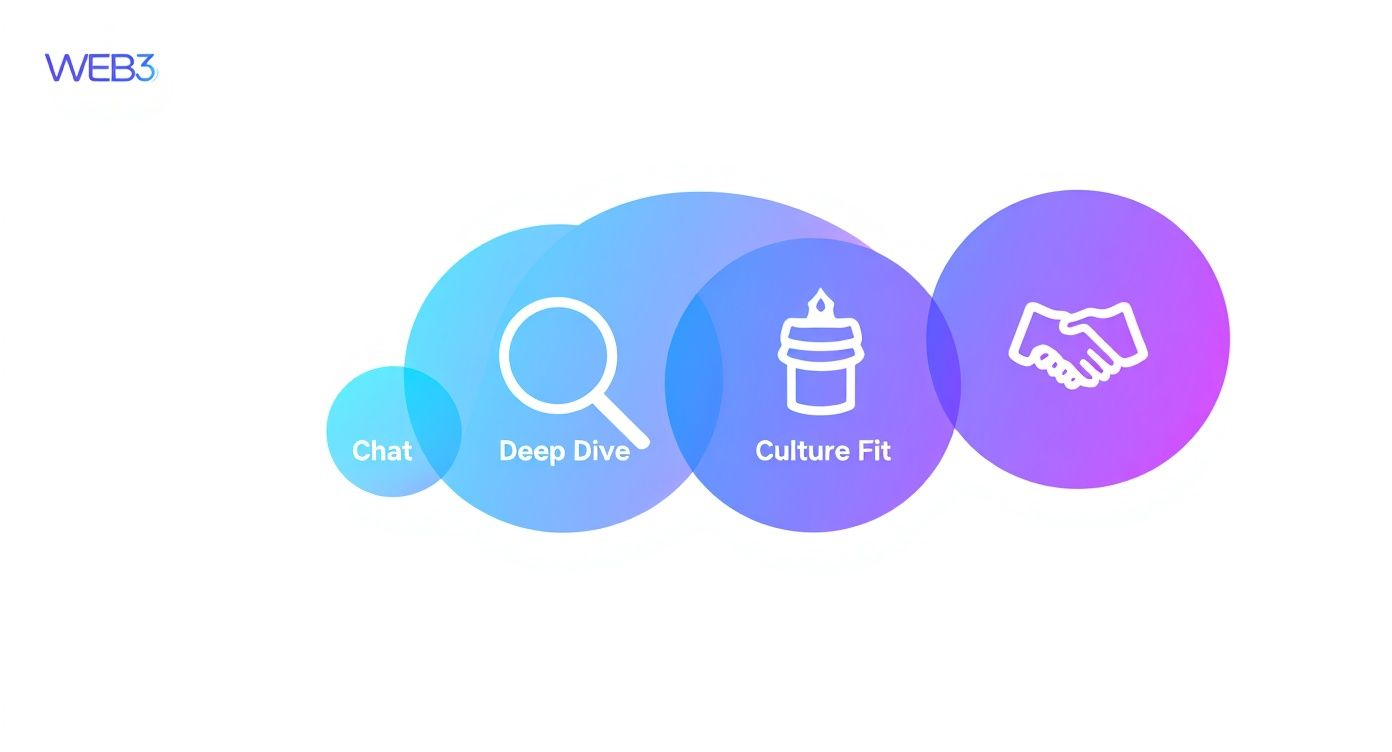
The process typically has a few stages: an initial chat with a recruiter, deeper technical or functional dives with team members, and often a final conversation with a founder. The key to progressing is to show up for each stage having done deep research on their specific project, its competitors, and its place in the market.
Answering Core Web3 Questions
Generic, canned answers will get you rejected. Interviewers want to see that you’ve not only read their whitepaper but can also think critically about their strategy and challenges.
Be prepared for questions that test both your communication skills and your crypto knowledge:
- "Explain our protocol to me like I know nothing about crypto." This tests your ability to distill complex ideas. The best answer uses a simple, relatable analogy that clearly communicates the project's value proposition to a non-expert user.
- "What’s a dApp you love, and what’s one thing you’d change about it?" This shows you're an active user, not just an observer. Pick a dApp you actually use and offer a thoughtful, specific critique. It demonstrates that you think like an owner and a problem-solver.
- "Where do you see our project in two years?" A strong answer builds on their public roadmap but adds your unique strategic perspective. Suggest a new market trend they could leverage or a potential partnership that aligns with their goals.
Ultimately, this part of the interview is less about finding a single "correct" answer and more about demonstrating how you think and solve problems.
The candidates who really stand out are the ones who come with their own insightful questions—about our tokenomics, governance structure, or how we plan to tackle user acquisition. It shows me they’re not just looking for a paycheck; they’re looking to build something meaningful.
Spotting Red Flags During the Interview
Remember, an interview is a two-way street. You are interviewing them just as much as they are interviewing you. The demand for talent is high—the U.S. Bureau of Labor Statistics expects a 22% jump in demand for blockchain developers by 2025, and in 2025 alone, the industry created over 66,000 new jobs. You can dive deeper into these figures by checking out the full report on crypto hiring trends in 2025.
With that kind of demand, you can afford to be selective. Watch for warning signs that a project might be unstable or a potential scam.
Here are a few red flags to look for during the hiring process:
- Vague or Evasive Answers: If they can't clearly explain their business model, roadmap, or mission, consider it a major red flag.
- Unrealistic Promises: Be skeptical of anyone promising that their token price is "guaranteed to go up" or making wild claims they can't back up with a solid plan.
- Requests for Sensitive Information: This is a critical one. No legitimate employer will ever ask for your private keys or seed phrase. If they ask you to download strange "proprietary testing software," end the process immediately.
- A Disorganized Process: A consistently chaotic interview experience—missed appointments, unprepared interviewers—often reflects a disorganized and potentially unstable company culture.
Always trust your gut. If something feels off, it probably is. The right crypto job should feel like a true partnership, and that starts with feeling confident in the team's vision and integrity from day one.
Negotiating Your Remote Crypto Job Offer
Receiving a job offer is a major milestone, but don't rush to accept. This is where you transition from a candidate to a potential partner, and it's critical to understand the nuances of a Web3 compensation package. It's far more complex than a traditional tech offer, requiring a long-term perspective on equity and risk.
Deconstructing the Crypto Compensation Package
Most crypto offers blend stability (fiat salary) with high-growth potential (tokens). Your first task is to break down each component to understand its true value and risk.
- Base Salary (Fiat): This is your reliable income paid in USD, EUR, or another government-issued currency. It’s what covers your living expenses, regardless of market volatility.
- Token Allocation (Equity): This is your ownership stake in the project's success. It can come as grants (you own them after vesting) or options (you get the right to buy them at a set price).
- Performance Bonuses: These are often tied to specific project milestones or individual KPIs. They can be paid in fiat, stablecoins, or the project’s native token.
The multi-stage interview process you just completed was designed to find someone aligned with the project's long-term vision. Keep that context in mind as you evaluate an offer heavily tied to that future success.
Asking the Right Questions About Tokens
The token portion of your offer holds the most potential but also the most risk. Don't be shy during negotiations; your goal is to get absolute clarity on the terms to accurately assess its future value.
The most important part of a crypto job negotiation isn't just asking for more; it's asking for clarity. Understanding your token vesting schedule, the total supply, and the project’s tokenomics is non-negotiable for making an informed career decision.
Walk into the negotiation armed with specific, critical questions:
- What is the vesting schedule? A typical structure is a four-year vesting period with a one-year cliff. This means you receive no tokens for the first year. After the cliff, you usually get 25% of your allocation, with the rest distributed monthly or quarterly over the remaining three years.
- Are these grants or options? Grants are generally preferable as you own the tokens outright after they vest. Options require you to pay a "strike price" to purchase the tokens, adding financial risk and complexity.
- What percentage of the total token supply does this represent? This is crucial for valuation. A grant of 100,000 tokens means very different things if the total supply is 10 million versus 10 billion.
Decoding Your Crypto Job Offer
To help you navigate the negotiation, use this table to break down the key components of a Web3 offer and the critical questions to ask for each one.
| Component | What It Is | Key Questions to Ask During Negotiation |
|---|---|---|
| Base Salary (Fiat) | Your guaranteed, stable income paid in a traditional currency (e.g., USD, EUR). | Is there flexibility on the base? What is the cadence for salary reviews? Is it paid bi-weekly or monthly? |
| Token Allocation | Your equity stake in the project, offered as tokens that vest over time. This is your high-upside component. | What is the vesting schedule and cliff? Are these grants or options? What percentage of the total supply does this grant represent? |
| Sign-On Bonus | A one-time payment to incentivize you to accept the offer. | Is this paid in fiat, stablecoins, or native tokens? Are there any clawback provisions if I leave before a certain date? |
| Performance Bonus | Additional compensation tied to achieving specific individual or company goals. | How are performance targets set and measured? Is the bonus discretionary? In what currency is it paid? What has the payout historically been? |
| Benefits | Standard employment benefits like health insurance, paid time off, and remote work stipends. | What does the health plan cover? How much is the remote work/wellness stipend? Is there a 401(k) or equivalent retirement plan? |
Use this framework to ensure you cover all your bases and evaluate the offer holistically, rather than fixating on a single number.
Benchmarking and Finalizing Your Offer
Determining a "fair" salary in this volatile market can be challenging, but benchmarking is essential. As of July 2025, the average annual salary for remote crypto professionals in the US hovers around $97,445.
However, the real story is in the range—the top 90th percentile of earners pull in $171,500 or more per year. This wide gap indicates significant room for negotiation based on experience and role. You can find more detailed figures using resources like the salary data for remote crypto roles from ZipRecruiter.
When you enter the final negotiation, anchor your request in solid research and focus on the total package value. Sometimes, a slightly lower base salary is a smart trade-off for a generous token allocation in a project you believe has massive long-term potential. Your goal is to secure a balanced offer that provides financial stability today with a meaningful stake in tomorrow's success.
Answering Your Top Questions About Remote Crypto Careers
Jumping into the world of remote crypto jobs can feel like learning a new language. You’re bound to have questions about the skills you need, how to get your foot in the door, and how to stay safe.
Let's address some of the most common hurdles for aspiring Web3 professionals.
Do I Really Need to Be a Developer?
Not at all. This is the biggest misconception preventing talented people from entering the space. While developers are crucial, the ecosystem is rapidly maturing and requires professionals across all functions.
We're seeing huge demand for non-technical roles, especially in marketing, operations, community management, product design, and compliance.
From a hiring perspective, the most important quality isn't a computer science degree—it's genuine passion and a deep understanding of the space. You can demonstrate this by:
- Getting involved in a DAO: Even small contributions to governance discussions or community projects are valuable experiences to put on a resume.
- Being active in online communities: Become a helpful, recognized member of a project's Discord or Telegram.
- Creating your own content: Write a blog post, start a Twitter thread, or make a short video explaining a Web3 concept. This is your public portfolio.
Focus on translating your existing skills into the Web3 context. A great marketer is still a great marketer; they just need to master the new channels and audience behaviors of a decentralized world.
How Can I Get Experience When I'm Just Starting Out?
You can start building your Web3 resume right now, without a formal job title. The key is to build in public. In this industry, "proof-of-work" is often more compelling to a hiring manager than a traditional CV because it shows initiative.
A great first step is to join the Discord or Telegram for a project you admire. Don't just lurk—become an active, value-adding member. Look for channels dedicated to "bounties." These are small, paid tasks that projects post for things like writing articles, moderating chats, designing graphics, or testing new features.
Completing bounties is one of the single best ways to break into this industry. You get hands-on experience, build a portfolio you can actually show people, and connect directly with team members who are often the ones making hiring decisions.
These small projects serve as a trial run, proving your skills and reliability. It's a well-established path that frequently leads directly to a full-time remote crypto job offer.
How Do I Spot and Avoid Job Scams?
Vigilance is non-negotiable. The open nature of crypto attracts scammers, but their methods often follow predictable patterns.
Here are the biggest red flags to watch for in your job search to protect your career and assets:
- Vague Job Descriptions: Legitimate jobs have clear responsibilities. Be wary of posts that are overly generic or filled with buzzwords but lack substance.
- Unprofessional Communication: Watch out for emails riddled with typos, recruiters with blank LinkedIn profiles, or anyone pressuring you into an immediate decision.
- Requests for Money or Private Keys: A real company will never ask you to pay for equipment, training, or an "application fee." They will absolutely never ask for your wallet's private keys or seed phrase.
- Suspicious "Technical Tests": Be extremely cautious if an interview requires you to download and run a random file or custom software. This is a common tactic to install malware.
Always perform your own due diligence. Verify the recruiter's identity on LinkedIn and confirm that the job is posted on the company's official website. If an offer seems too good to be true, it is. Trust your gut and prioritize your security.
Ready to find a legitimate, high-quality remote crypto job? On Blockchain Jobs, all listings are carefully vetted to connect you with real opportunities in the Web3 space. Start your search and find your next role today!