
Crypto Tax Compliance for Professionals: A Career Guide
Only about 14% of at least $457 billion in potentially taxable on-chain cryptocurrency activity was captured by international reporting rules in 2025, according to an OECD-linked analysis of crypto tax reporting coverage. That gap is more than a policy problem. It's a hiring signal.
Exchanges need people who can reconcile wallet activity with tax forms. Accounting firms need professionals who understand both traditional reporting and blockchain data. Legal and compliance teams need reviewers who can translate CARF, DAC8, and Form 1099-DA requirements into controls that engineering teams can implement.
If you're a tax, audit, accounting, data, or legal professional, crypto tax compliance is no longer a niche specialty to study later. It's becoming a career lane with direct exposure to regulatory strategy, product operations, audit defense, and executive risk.
Why Crypto Tax Compliance Is a Defining Career Moment
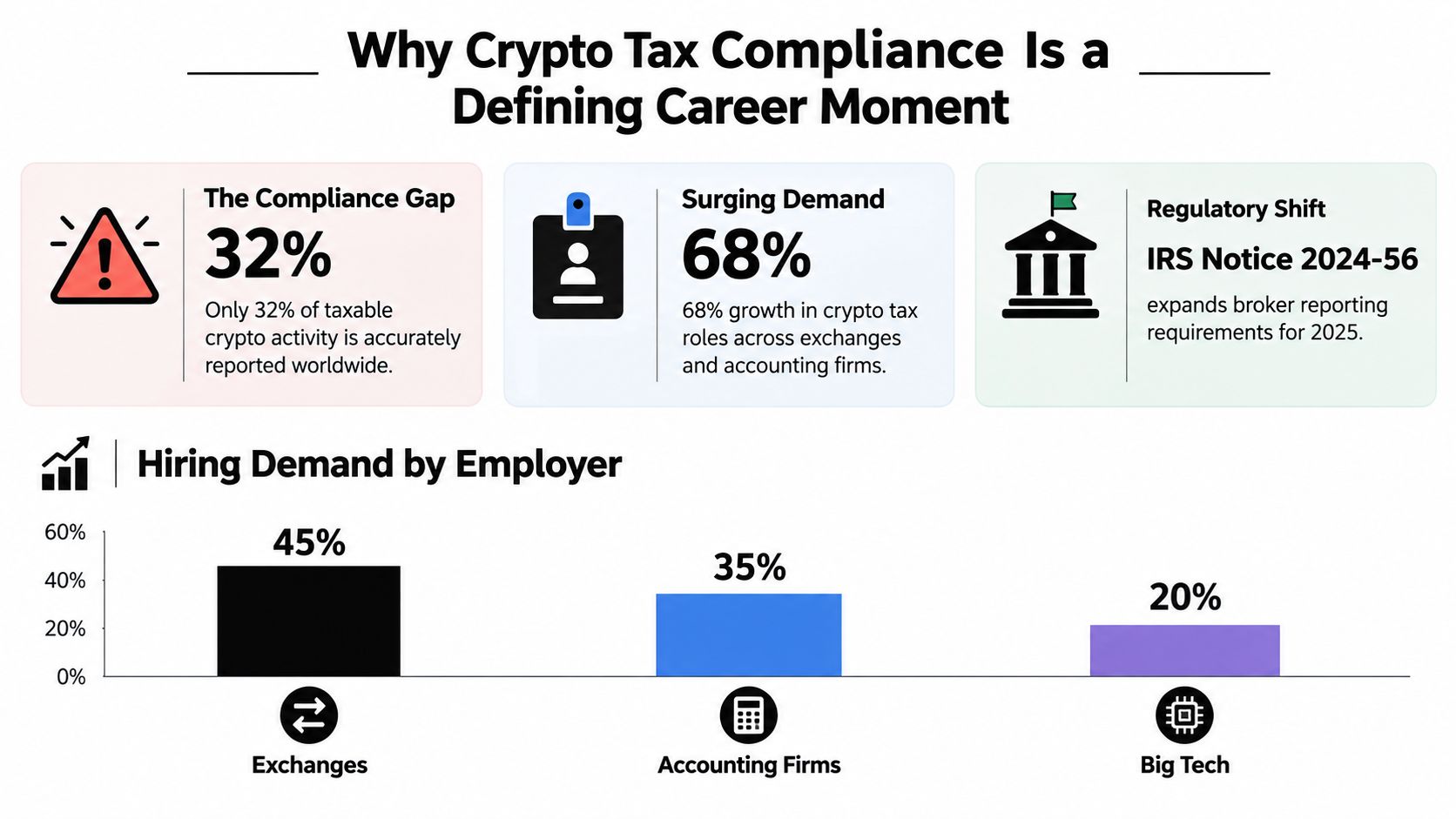
Tax authorities captured only part of potentially taxable crypto activity, leaving a clear operational gap between blockchain records and reportable information. The United States accounted for $112.6 billion of potentially taxable activity in 2025, including $64.6 billion in payments, $30.1 billion in gains, and $17.9 billion in income. Those figures are reported in the analysis of global taxable on-chain activity and reporting coverage. For candidates, the hiring signal is direct: employers need people who can turn incomplete, inconsistent blockchain data into defensible reporting processes.
That work spans the entire compliance chain. Exchanges must identify customers, capture tax residency, classify transactions, issue information returns, and investigate mismatches between reported proceeds and customer records. Accounting firms need reviewers who can reconstruct basis across multiple custodians and distinguish a wallet transfer from a taxable disposal. Legal teams need professionals who can preserve evidence, define disclosure obligations, and coordinate responses to tax authority inquiries.
Regulation has moved into operating rooms
The OECD's Crypto-Asset Reporting Framework, or CARF, was completed in 2022 and provides the global standard for automatically exchanging crypto-asset tax information. CARF extends the transparency model used for traditional financial accounts to crypto transactions. Participating jurisdictions must collect information from crypto-asset service providers and exchange it with the taxpayer's country of residence. The OECD's 2024 update on bringing tax transparency to crypto assets describes the move from policy design to implementation.
For hiring managers, this creates specific interview tests. Can a candidate map a regulatory requirement to customer data, ownership, controls, and exception handling? Can they explain how a reporting field moves from a wallet or platform record into a tax form? Candidates who answer those questions clearly will outperform applicants who can only recite framework names.
The EU's DAC8 regime puts those skills into production for providers serving EU-resident users. Firms must begin collecting reportable transaction data from 1 January 2026, with the first reporting deadline scheduled between 1 January and 30 September 2027, according to the European Commission's DAC8 overview. That timeline points to roles in regulatory implementation, tax operations, data quality, and reporting controls.
In the United States, brokers must report gross proceeds for transactions on or after 1 January 2025, and cost basis for certain transactions beginning 1 January 2026, according to IRS guidance on digital asset broker reporting. The staggered rollout makes reconciliation a multi-year responsibility, not a one-time project.
Recruiter's view: Hiring managers want candidates who can explain what data enters the system, who owns it, how exceptions are documented, and what happens when the numbers disagree.
The strongest career moves follow that intersection. Tax professionals who learn on-chain data can move into product compliance. Auditors who understand reporting schemas can join transformation teams. Legal professionals who can classify transactions can progress into regulatory operations leadership. Start building that experience before the rules mature fully.
The Core Frameworks Every Compliance Professional Must Know
A strong crypto tax candidate can explain how each framework changes data ownership, controls, and reporting work. CARF is the global data model, setting shared fields and processes for exchanging crypto tax information. DAC8 is the European operating requirement, creating collection and reporting duties for relevant crypto-asset service providers. Form 1099-DA is the U.S. information-return requirement, requiring brokers to report specified digital asset sale information to the IRS and taxpayers.
CARF sets the international data model
CARF requires participating jurisdictions to establish common due-diligence and reporting processes for crypto-asset service providers. Providers must identify customers, determine tax residency, collect transaction information, and support standardized exchanges between tax authorities. The OECD released CARF data exchange formats and technical guidance, including XML schemas and user guides.
That technical scope defines the hiring profile. Compliance teams need data analysts, reporting engineers, tax operations managers, regulatory implementation specialists, and quality assurance reviewers. Candidates should be ready to map a legal requirement to a structured field, identify the system owner, and explain how an exception reaches resolution. Policy knowledge alone will not separate them from applicants who can connect rules to production controls.
DAC8 turns EU obligations into a recurring workflow
DAC8 requires reporting crypto-asset service providers to collect reportable transaction data on EU-resident users from 1 January 2026. The first reporting cycle is scheduled to require preparation for a deadline between 1 January and 30 September 2027, based on the European requirements described earlier.
Teams must set up entity registration, tax-residency capture, transaction classification, validation checks, and recurring report generation before that filing window. Interviewers should ask candidates how they would assign data ownership, handle missing tax-residency information, manage remediation queues, and evidence controls over report submissions. Those questions test operating judgment, not memorization.
Form 1099-DA creates the U.S. reconciliation challenge
The IRS says brokers must provide taxpayers with the same Form 1099-DA information reported to the agency by 17 February 2026. Taxpayers must still report relevant income, gains, or losses if they do not receive the form, as explained in the IRS reminder for digital asset taxpayers.
| Framework | Jurisdiction | Effective Date | Reporting Scope | Primary Hiring Impact |
|---|---|---|---|---|
| CARF | Participating jurisdictions | Completed in 2022, implementation moved forward in 2024 and 2025 | Customer identity, tax residency, and reportable crypto transactions | Data governance, XML reporting, regulatory implementation, controls |
| DAC8 | European Union | Collection from 1 January 2026 | Reportable transactions involving EU-resident users | EU tax operations, registration, classification, reporting calendars |
| Form 1099-DA | United States | Gross proceeds for transactions on or after 1 January 2025, certain basis reporting from 1 January 2026 | Broker-reported digital asset sales and exchanges | Information returns, basis reconciliation, customer support, audit response |
Professionals moving between tax systems should study adjacent reporting workflows, including this complete MTD guide for self assessment. The transferable skill is process design: turning rules into ownership, evidence, validation, and repeatable reporting.
Individual Versus Business Reporting Obligations
Individuals usually experience crypto tax compliance as a recordkeeping problem. Businesses handle it as a controlled reporting operation involving deadlines, approvals, exception queues, customer communications, and audit exposure. That difference defines the skills hiring managers test.
A taxpayer may need to reconstruct cost basis from exchange exports, self-custody wallets, staking activity, decentralized applications, and transfers between platforms. Form 8949 may appear in the individual filing workflow, but the harder work happens before preparation. The taxpayer must determine whether each transaction was a transfer, sale, exchange, income event, or matter requiring further analysis.
The IRS's staggered broker rules make that work more demanding. Brokers must report gross proceeds for transactions on or after 1 January 2025, while cost basis reporting for certain transactions begins on 1 January 2026. As described in the IRS broker reporting guidance cited earlier, many 2025 statements will not provide the basis taxpayers need. Individuals may still have to reconstruct it themselves.
Candidates should expect interview questions such as: Which wallet records would you request first? How would you distinguish a transfer from a disposal? What evidence supports your classification? Strong answers show a repeatable investigation method, not just familiarity with tax forms.
The business side requires control ownership
A crypto-active business must manage information returns, customer data, classification logic, review evidence, and audit defense. An exchange may assign a retail reporting team to 1099-DA issuance while a corporate tax group handles internal controls, tax provision questions, and reporting positions. A DAO treasury or DeFi business may face fragmented wallet ownership and unclear responsibility for transaction records.
Staking rewards, DeFi interactions, and NFT royalties explain why job descriptions separate customer reporting from technical tax analysis. The same on-chain event can create different operational questions for an individual, custodian, protocol, or treasury team. Hiring managers want candidates who can state the assumption, identify the missing fact, and escalate the issue before it contaminates a reporting file.
| Obligation | Individual Taxpayer | Crypto-Active Business |
|---|---|---|
| Cost basis | Reconstruct basis across exchanges, wallets, and transfers | Maintain data lineage, allocation logic, and review controls |
| Information returns | Review broker statements and reconcile them to personal records | Prepare, validate, issue, and correct required forms |
| Staking and protocol activity | Classify receipts and disposals based on the facts | Build product and ledger classifications that support consistent treatment |
| Audit defense | Preserve transaction records and explanations | Maintain policies, approvals, evidence, and response ownership |
| Customer or investor reporting | Usually self-report to the tax authority | Coordinate tax, finance, legal, support, and engineering teams |
Candidates should study operational roles such as the Accounting and Regulatory Reporting Manager position at Coinbase. The valuable resume signal is evidence of reconciliations, reporting controls, stakeholder escalations, and documentation completed under review.
Career Paths and Where the Hiring Is Happening
The best employer depends on what you want to become. Exchanges offer the closest view of live customer and transaction operations. Big Four practices offer structured training and broad client exposure. Crypto-native accounting firms provide faster specialization. Web3 startups offer the widest ambiguity and the greatest need for people who can create a process from scratch.
Do not choose based on brand alone. Choose based on the type of evidence you'll be able to put on your resume after the role.
Compare the operating environments
| Employer Type | Senior Comp Range | Ramp to Independent Work | Exit Options |
|---|---|---|---|
| In-house exchange compliance | Varies by employer and level | Fast exposure to real reporting operations, with substantial product complexity | Tax operations leadership, product compliance, regulatory reporting |
| Big Four tax practice | Varies by practice, market, and level | Structured ramp, strong review discipline, broad client work | CFO advisory, partner track, industry tax leadership, regulator roles |
| Crypto-native accounting firm | Varies by firm and seniority | Direct specialization in digital asset records and client remediation | Boutique practice, advisory leadership, exchange or software roles |
| Web3 startup or DAO tooling company | Varies widely and depends on funding and scope | High ambiguity, rapid ownership, uneven process maturity | Head of finance, protocol operations, founding a specialist practice |
Senior candidates should be able to connect GAAP reporting, tax reporting, and machine-readable CARF exports rather than treating them as separate disciplines. The work often crosses finance, data engineering, legal, customer operations, and information security. That cross-functional fluency is more valuable than another generic software badge.
Candidates considering corporate compliance leadership should also understand the broader expectations covered in guidance on recruiting for corporate legal departments. Legal and tax hiring managers increasingly look for professionals who can manage regulatory interpretation, policy implementation, investigations, and executive communication in one operating model.
What interviewers actually test
At an exchange, expect questions about missing basis, duplicate transactions, wallet transfers, customer identity, and escalation thresholds. At a professional services firm, expect a case requiring you to explain your assumptions and defend a workpaper. At a startup, expect to design a reporting process when the data model and ownership structure are incomplete.
A role such as Tax Director at a digital asset company points toward the senior profile employers want: someone who can set policy, guide implementation, review complex transactions, and communicate clearly with executives. Your resume should show those outcomes, not just list “crypto tax” among your interests.
A Day in the Life of a Crypto Tax Analyst
Maya's day begins at 9 a.m. with a standup about a 2025 IRS broker-reporting inquiry. She's a senior analyst at a mid-sized exchange, and her first responsibility isn't calculating a gain. It's triaging a queue of Form 1099-DA discrepancies, separating data defects from customer-reported history gaps and genuine classification questions.
Her team uses TaxBit for entity-level reporting, a custom SQL pipeline to pull CSV exports from custodians, and Chainalysis for transaction clustering. Maya starts with the exception dashboard, identifies repeated mismatches tied to transferred assets, and assigns each issue an owner. She records the source file, reporting period, affected account, logic applied, and next action. That audit trail matters as much as the correction.
The difficult work happens between systems
At 11 a.m., Maya investigates a customer's claimed wash-sale adjustment across Coinbase and Kraken wallets. She doesn't accept the label at face value. She checks acquisition and disposal timestamps, wallet ownership, transfer paths, asset identifiers, and the basis supplied by each platform. The key judgment is deciding which records describe the same economic position and which merely share a ticker or token name.
At 1 p.m., engineering joins a call about a new staking-reward data feed. The feed is breaking cost-basis reconciliation because rewards arrive with incomplete timestamps and inconsistent event labels. Maya translates the tax impact into system requirements: required fields, validation rules, fallback treatment, exception ownership, and the evidence a reviewer needs before approving the output.
Senior-level behavior: Don't hide uncertainty inside a spreadsheet. Name the missing fact, document the provisional treatment, and give the next team a precise request.
By 4 p.m., she's drafting memo lines for outside counsel reviewing a pending IRS John Doe summons. Her work doesn't decide the legal response, but it gives counsel a reliable map of the data: what exists, where it came from, how it was transformed, and which records require preservation. She distinguishes confirmed facts from analysis and avoids unsupported conclusions.
The difference between a mid-level analyst and a senior reviewer appears in those decisions. Mid-level staff can run imports and identify mismatches. Senior staff define the issue, assess materiality, challenge the source data, explain the risk, and leave a record another professional can defend.
Skills and Certifications That Move You Up the Ladder
A CPA remains the strongest foundation for tax and accounting roles, but it isn't enough by itself. Hiring managers want proof that you can operate in a digital asset environment, where transaction data may arrive from exchanges, custodians, blockchains, internal ledgers, and third-party analytics platforms.
Start with the skills that change your output
SQL has the highest immediate impact for many reporting roles. You should be able to pull custodian data, join wallet and account tables, identify duplicates, and create an exception report. A strong resume bullet says what you reconciled and what control you improved, without exposing confidential data.
Python becomes valuable when you can automate repetitive work, such as preparing Form 8949 inputs, normalizing CSV exports, or testing classification logic. Don't list Python as a skill without an artifact. Bring a redacted script or explain the inputs, transformations, error handling, and review process.
On-chain analytics platforms such as Chainalysis, TRM Labs, and Nansen help you investigate transaction flows and wallet relationships. TaxBit and comparable reporting platforms matter for entity-level reporting, workflow management, and form production. The strongest candidates understand where software ends and professional judgment begins.
Add credentials with a clear hiring signal
A CAMS certification can support anti-money laundering and financial crime roles. A CFE can strengthen an audit, investigations, or fraud-focused profile. The IRS Annual Federal Tax Refresher can show continued tax learning, while an Enrolled Agent credential can help professionals demonstrate federal tax competence.
Your portfolio should answer a hiring manager's next question, “Can this person do the work?”
- CARF memo: Prepare a redacted sample response to a CARF data request, showing the requested fields, data owner, validation steps, and unresolved gaps.
- Reconciliation repository: Build a GitHub project that normalizes custodian CSV files and flags transfer, duplicate, and missing-basis exceptions.
- Technical writing: Publish a clear teardown of a DAC8 implementation issue, focusing on residency capture, reportable transaction classification, and reporting governance.
- Transaction case study: Explain a complex staking-reward allocation, including assumptions, source records, treatment alternatives, and review controls.
- Interview narrative: Be ready to walk through one defect you found, how you proved its cause, and how you prevented recurrence.
For a role such as SME Tax Manager at TaxBit, expect the bar to include technical accuracy, client communication, process ownership, and the ability to review work produced by others. Credentials open the conversation. Demonstrable judgment gets you promoted.
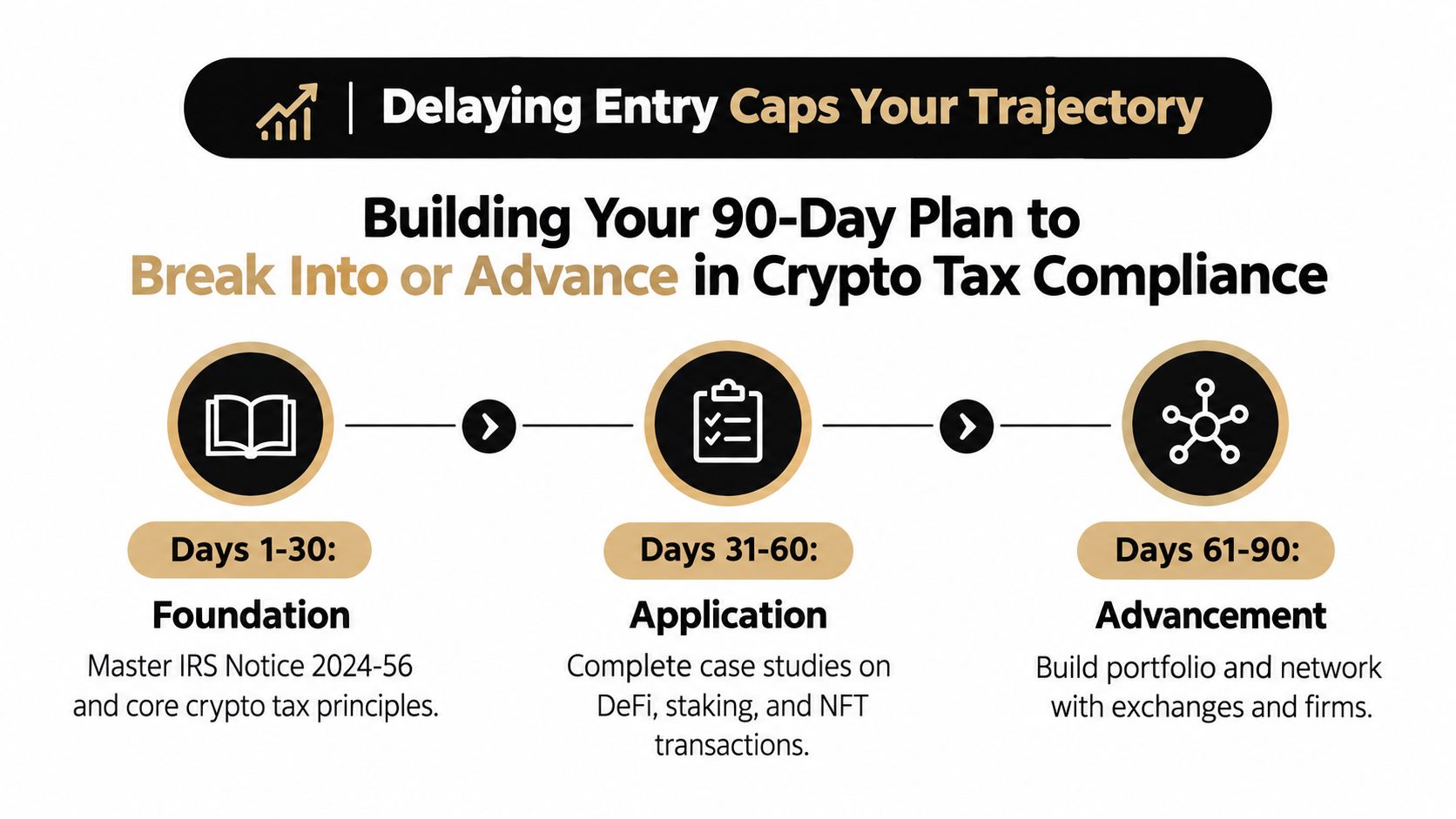
Building Your 90-Day Plan to Break Into or Advance in Crypto Tax Compliance
Professionals who postpone crypto tax compliance work are limiting their future options. The field now rewards people who can connect rules to systems, systems to records, and records to defensible reporting. You don't need to become an expert in every token or protocol. You need a focused plan that produces visible evidence of competence.
Days 1 to 30 build the foundation
Audit your resume for transferable language. Replace “prepared tax returns” with the specific risk, reporting, reconciliation, control, or audit work you performed. Subscribe to IRS digital asset guidance and read the primary materials closely. Then use a crypto tax software trial to follow one transaction from source data through cost-basis logic and final reporting output.
Study the core vocabulary: CARF, DAC8, Form 1099-DA, tax residency, covered and noncovered assets, wallet transfers, staking rewards, and exception handling. Write a one-page explanation in your own words. If you can't explain the workflow without reading from notes, you're not ready for a technical interview.
Days 31 to 60 create proof
Choose one credential that matches your target role. An Enrolled Agent may fit a tax advisory path. A Chainalysis certificate may support an investigative or compliance operations path. Don't collect credentials randomly. Select one and connect it to a portfolio project.
Publish a LinkedIn analysis of a recent digital asset reporting development. Request three informational interviews, one with an exchange compliance lead, one with a Big Four tax professional, and one with a crypto-native startup operator. Ask what data problems their team faces, what junior hires misunderstand, and which resume evidence gets attention.
Days 61 to 90 execute the search
Target ten roles and tailor each CV to the job description. Use the employer's vocabulary when it accurately describes your experience: information returns, tax operations, data lineage, reconciliation, regulatory reporting, audit response, controls, or customer reporting.
Prepare direct answers to questions such as:
- How would you reconcile a Form 1099-DA with incomplete basis records?
- What data must a provider capture for DAC8?
- How does CARF affect identity and residency workflows?
- How would you investigate a wallet transfer that appears to be a disposal?
- How would you document an exception for internal and external review?
Before discussing compensation, research the role's scope, reporting line, location expectations, and level. Seniority should reflect independent judgment, review responsibility, stakeholder management, and implementation ownership, not just years in accounting.
Watch the video for another practical perspective on building a focused career plan:
My recruiter's verdict is simple. Candidates who land offers show a work sample, explain their reasoning, and connect regulatory language to operational decisions. Candidates who keep applying usually submit generic resumes that say “crypto enthusiast” but don't demonstrate reconciliation, reporting, controls, or judgment.
Blockchain Jobs connects professionals with roles across Web3, including finance and accounting, legal and compliance, data, operations, and security. Visit Blockchain Jobs to find crypto tax compliance opportunities where your reporting, audit, and regulatory skills can translate into your next career move.