Land High-Paying Crypto AML Jobs: The 2026 Career Guide

You're probably in one of two spots right now.
You've spent years in bank AML, payments compliance, correspondent banking reviews, or fraud ops, and you can feel the ceiling. The work is familiar. The rules are stable. The promotion path is slow. Then you look at crypto and see a market that still feels messy, overhyped, and oddly full of compliance openings.
Or you already applied to a few crypto AML jobs and got silence back. Not because you're unqualified, but because hiring managers in this sector don't reward generic AML experience on its own. They want people who can translate that foundation into blockchain-specific judgment.
That gap is where most TradFi candidates get stuck.
Crypto AML is no longer a side niche for a handful of exchanges. It's a regulated operating function with real hiring demand, real specialization, and real salary upside. But the entry point isn't “learn some blockchain terms and spray applications.” It's understanding what teams need, what they pay for, where remote work is genuine and where it isn't, and how to present yourself as someone who can investigate crypto risk instead of just reciting policy.
Why Crypto AML Is Your Next Big Career Move
If you're coming from TradFi AML, your first instinct is usually caution. That's reasonable. Crypto has a reputation problem, and some firms still run immature controls. But the serious employers aren't hiring compliance staff as window dressing anymore. They're building regulated businesses that need people who can stand up monitoring, EDD, sanctions controls, Travel Rule workflows, and escalation processes that survive scrutiny.
That shift is visible in hiring demand. The global Web3 job market rebounded by 47% in 2025, with 66,494 new roles added, and compliance hiring was pushed by regulation including MiCA in the EU and stablecoin progress in the US, with AML/KYC specialists, MLROs, and surveillance analysts now dominating hiring despite a general oversupply of developers, according to Coincub's 2025 Web3 jobs report.
Regulation created the opportunity
The usual outsider view is that crypto hiring follows token prices. That's incomplete. In compliance, regulation is the stronger driver.
When licensing regimes tighten, firms need transaction monitoring, onboarding controls, sanctions screening, policy writing, alert governance, and exam-ready documentation. That work doesn't disappear because the market gets noisy. In many firms, it expands.
For TradFi professionals, that matters because your background is more transferable than you think. Case narratives, adverse media review, source-of-funds reasoning, beneficial ownership skepticism, escalation discipline, and audit defensibility all carry over. The gap isn't whether you understand AML. The gap is whether you understand how crypto changes the evidence set.
A practical way to close that gap is to understand how on-chain activity and DeFi mechanics work in plain business terms. Legitt AI's guide to smart contracts is useful for that because it explains the underlying contracts and decentralized finance flows that compliance teams keep seeing in investigations.
Stability in Web3 doesn't always look like engineering
A lot of career advice in crypto still points people toward development roles. That misses where many of the durable openings are.
Compliance is one of the few functions that tends to become more valuable as the sector matures. Firms can delay product features. They can't delay core AML obligations for long if they want banking access, licensing credibility, or institutional clients. That's why professionals scanning legal and compliance roles in blockchain often find a cleaner path into Web3 than people chasing crowded narrative-driven positions.
Practical rule: If you already know how to investigate risk, document judgment, and defend an escalation, you're not starting over in crypto. You're adapting your operating context.
The right question isn't whether crypto AML is risky as a career move. The better question is whether you're willing to learn a new transaction environment fast enough to capitalize on a market that now treats compliance as core infrastructure.
Decoding Crypto AML Roles and Responsibilities
Crypto AML titles can look familiar and still mean very different things in practice. One company's AML Analyst is another company's sanctions investigator, onboarding specialist, and case writer rolled into one. You need to read past the title and map the role to the actual workflow.
What the ladder usually looks like
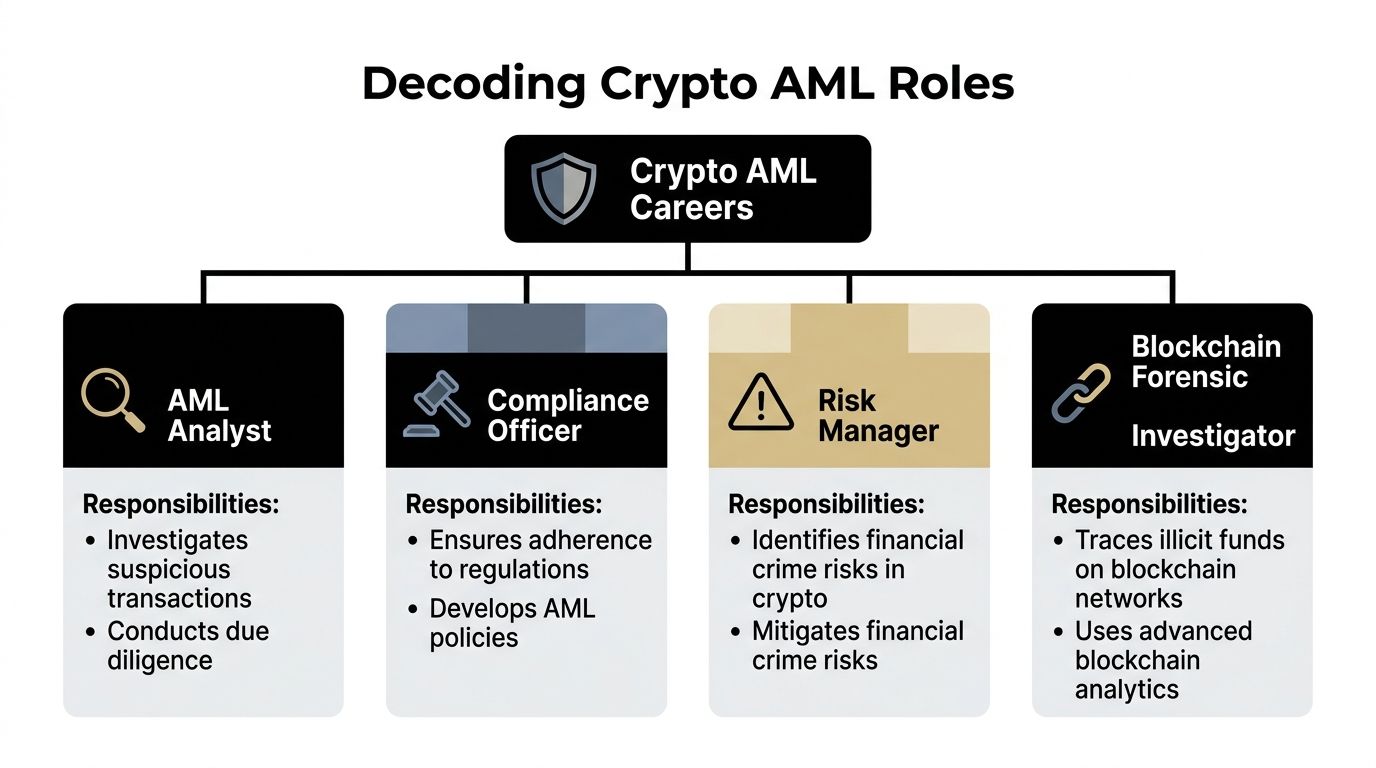
At the operating level, most crypto AML teams cluster into four broad role types.
| Role | What they own | What hiring managers look for |
|---|---|---|
| AML Analyst | Alert review, KYC refreshes, EDD support, negative news checks, basic wallet review | Clear writing, escalation judgment, consistency |
| Compliance Officer | Policy application, QA, complex investigations, regulator-facing support | Strong crypto typology knowledge, tool fluency, decision quality |
| Risk Manager | Control design, risk taxonomy, thresholds, governance | Program thinking, cross-functional influence |
| Blockchain Forensic Investigator | On-chain tracing, entity clustering, exposure analysis, evidentiary case builds | Deep chain analysis, narrative construction, pattern recognition |
The biggest mistake TradFi candidates make is assuming they should target only analyst roles to “break in.” Sometimes that's right. Often it isn't. If you've already handled complex EDD, correspondent banking risk, sanctions investigations, or quality control, you may be better suited to a senior analyst or officer role, provided you can explain crypto-native risk clearly.
What senior teams actually do all day
A senior AML Compliance Officer role at a Tier 1 crypto exchange typically requires 3+ years of hands-on experience specifically within a crypto exchange environment, with preference for candidates from Binance, OKX, or Bybit, plus proficiency in Chainalysis or Elliptic and CAMS or ICA certification. In that hiring context, those specifications correlate with an 85% success rate in detecting complex laundering patterns involving DeFi bridges compared with analysts without that tool proficiency, based on a live role profile published via Recruiterflow.
That same role profile describes the work in a way that's much more useful than the usual job-board fluff. The daily flow is practical:
- Monitor transactions and identify activity that deserves review.
- Investigate fraud and suspicious behavior by collecting facts and analyzing chain data.
- Apply regulatory compliance tools and policies instead of relying on intuition alone.
- Execute KYC and EDD procedures with documentation that holds up internally.
Analysts following that stricter framework achieve a 92% accuracy rate in identifying suspicious activity, versus 60% for heuristic-only approaches in the same source. That gap tells you what high performance looks like in interviews. Teams don't want vibes. They want repeatable investigative process.
The crypto-specific difficulty TradFi people underestimate
In banking, identity is usually the starting point. In crypto, wallet activity is often the starting point, and identity may be partial, delayed, or absent.
That's why DeFi investigations trip up otherwise strong AML professionals. The same role profile notes a 40% failure rate in DeFi-related compliance due to the lack of standardized identity protocols, and points to mitigation through cross-referencing wallet addresses with centralized exchange onboarding records and heuristic clustering.
That's the job. Not just “spot suspicious activity,” but build an evidence chain when direct identity data is incomplete.
Good crypto investigators don't panic when identity is missing. They widen the lens. They look at wallet behavior, counterparties, service exposure, bridge usage, timing, and how the customer story does or doesn't fit the chain.
If you want a concrete example of how new crypto products can create AML blind spots outside the obvious exchange setting, Visbanking on no-KYC crypto cards is worth reading. It's a useful reminder that vendor chains, embedded finance, and crypto-adjacent card programs can create exposure well beyond a simple exchange account review.
Reporting lines matter more than title prestige
Before you accept any role, ask who reviews your work and where escalations go.
A solid crypto AML job usually has a clear line from analyst to officer or manager, then into MLRO, Head of Compliance, or a similar governance owner. A weak setup often buries compliance inside operations with vague ownership for sanctions, transaction monitoring tuning, and SAR-equivalent decisioning.
If the company can't explain that structure cleanly, expect chaos later.
Building Your Crypto AML Skill Stack and Toolbox
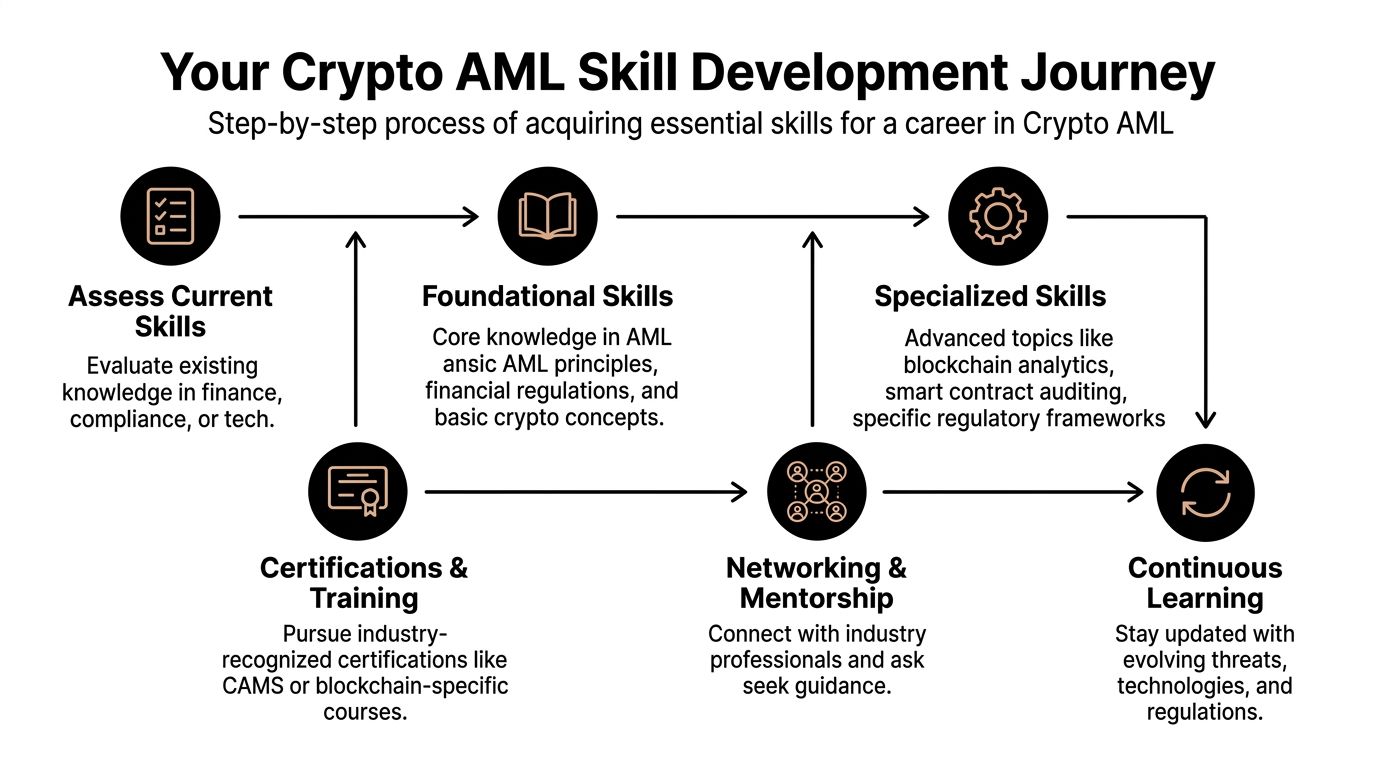
TradFi professionals usually don't need to relearn AML from zero. They need to sort their skills into two piles. The first pile already transfers. The second pile is what crypto hiring managers use to separate serious candidates from tourists.
Start with that distinction and your learning path gets much cleaner.
Foundation skills you already have
The strongest candidates from banking and fintech already understand the parts that most junior crypto-native applicants don't.
These usually transfer well:
- Risk-based thinking. You know not every alert deserves the same treatment.
- EDD discipline. You can assess whether the documents and narrative match the risk.
- Adverse media judgment. You know when negative news is material and when it's noise.
- Escalation writing. You can explain why a case matters.
- Policy adherence. You understand that consistency matters as much as being individually clever.
What doesn't transfer automatically is the evidence source. In crypto, you're often reviewing wallet interactions, token flows, bridge hops, service exposures, and smart contract touchpoints rather than traditional account movement alone.
That's why the first shift is conceptual. You must get comfortable treating the blockchain itself as part of the case file.
The crypto-native skills that get you hired
Here's the practical order I'd use for a TradFi transition.
Learn blockchain mechanics before analytics tooling
Don't start by memorizing every product demo. First learn what you're looking at.
You should be able to explain, in plain language:
- How wallets send and receive assets
- What a bridge does
- Why mixers and peel chains matter
- How centralized exchanges differ from self-custody flows
- Why stablecoins show up constantly in AML cases
- How DeFi protocols complicate attribution
Once that clicks, analytics tools become much easier to use well.
A current role that combines AML work with data-heavy investigation can help you reverse-engineer what employers want in practice. Reviewing an AML and financial crime analyst role focused on data is useful because it shows how crypto employers increasingly expect analysts to think beyond checklist compliance.
Then get tool-fluent
You don't need to be a blockchain forensic expert on day one. You do need to speak the language of the core platforms.
Chainalysis, Elliptic, and TRM Labs all help teams trace funds, identify exposure to risky services, cluster related activity, and build transaction narratives. Hiring managers don't just want to hear that you've “used blockchain tools.” They want to know what you did with them.
Better interview language sounds like this:
- You traced inbound and outbound wallet activity across multiple counterparties.
- You identified interaction with high-risk services and explained why that exposure mattered.
- You reconciled customer explanations against actual on-chain behavior.
- You used wallet screening output as a lead, not as the final decision.
Certifications matter, but not in the way people think
For most TradFi candidates, CAMS still has value because it signals baseline AML credibility. In many hiring contexts, ICA also carries weight. But certification won't rescue a weak crypto understanding.
If a role asks for Chainalysis, Elliptic, or similar tool proficiency, take that seriously. Employers often use those requirements as shorthand for whether you can become useful quickly. Tool training plus a few self-directed case writeups usually beats collecting generic certificates with no application.
This is also where targeted education helps. A concise explainer can sharpen your mental model before you touch a platform.
What works: Learn one chain well, understand one bridge flow well, and write up a few clean investigations.
What doesn't: Listing ten buzzwords and hoping the interviewer fills in the gaps for you.
Build a toolbox, not a trivia list
A hiring manager is trying to answer one question. Can this person review crypto risk with enough structure to trust them on real cases?
That's why your toolbox should include more than vendor names. It should include habits:
- A case note template for wallet review, customer narrative, red flags, and recommendation
- A typology library you maintain for your own reference
- A shortlist of protocols and services you understand well
- A repeatable review sequence so you don't miss obvious facts
People who move from TradFi into crypto successfully don't win by sounding futuristic. They win by proving they can apply old discipline to a new rail.
How to Get Noticed and Hired in Crypto AML
Most TradFi resumes fail in crypto for a simple reason. They describe responsibilities, not investigative value.
Hiring managers in this space don't care that you “performed AML reviews” or “supported KYC processes.” Everyone says that. They want evidence that you can make decisions under ambiguity, write clearly, and adapt to a risk environment where the transaction trail is public but identity can be fragmented.
Rewrite your experience in crypto language
Don't fake crypto exposure you don't have. Translate your work truthfully.
Here's the difference.
Before
- Responsible for KYC and due diligence reviews
- Investigated suspicious transactions
- Worked with compliance team on escalations
After
- Conducted customer due diligence and enhanced due diligence reviews for higher-risk accounts, documenting source-of-funds reasoning and escalation recommendations in a format usable by compliance decision-makers
- Investigated transactional anomalies by reconciling customer activity against known risk indicators and preparing written case narratives for disposition
- Partnered with compliance stakeholders to escalate complex cases involving sanctions, adverse media, and onboarding inconsistencies
That second version works better because it shows judgment, outputs, and who used your work.
Show that you can think in scenarios
Crypto interviewers often test whether you can reason through unfamiliar fact patterns. They don't need perfect technical language from a TradFi candidate. They need to see how you approach the problem.
If you get a question like “Walk me through how you'd investigate potential sanctions evasion through a DeFi bridge,” use a structure like this:
Define the trigger
Explain what caused concern in the first place.Secure the facts
What wallet addresses, timestamps, counterparties, customer data, and onboarding records are available?Trace the flow
Describe how you'd follow the movement across wallets, services, and bridges.Test the customer narrative
Does the stated purpose of activity fit the observed behavior?Document and escalate
State what you'd write, what you'd recommend, and what extra evidence you'd request.
That answer format does two things. It demonstrates control, and it shows you won't freeze when the case leaves the comfort of bank rails.
Your interview edge is disciplined skepticism
Crypto firms see a lot of applicants who learned jargon fast but can't investigate. They also see TradFi candidates who know AML thoroughly but speak about crypto as if it's a strange exception. Neither profile is ideal.
The best middle ground is disciplined skepticism. You're not starry-eyed about the sector, and you're not dismissive either. You understand that the controls need to be stronger precisely because the transaction environment is different.
A few things hiring managers usually like to hear:
- You know wallet screening is a starting point, not a conclusion.
- You understand that false positives can waste team capacity if thresholds are poor.
- You care about evidentiary clarity, not just catching “bad actors.”
- You know policy has to be executable by operations, not just technically correct.
If you can explain your reasoning under uncertainty, you'll often beat the candidate who memorized more crypto vocabulary than you did.
Small proof beats big claims
You don't need a famous exchange on your resume to get interviews. But you do need signals.
A useful prep exercise is to take one recent enforcement story, exploit, or sanctions-related case and write a one-page internal-style memo. Keep it plain. What happened, what wallets or services mattered, what red flags stand out, what questions remain unanswered, and what action you'd recommend if this were your customer.
That single habit can change how you interview. You stop speaking in generic compliance terms and start talking like someone who already works the cases.
Navigating Crypto AML Salaries and Career Paths
Most articles often fall short here. They either throw out giant salary ranges with no context, or they pretend “remote” means anyone anywhere can get the same package. Neither is true.
Crypto AML compensation can be strong. It can also be confusing. Jurisdiction, licensing, language requirements, prior regulator experience, and whether the employer is a US platform or an offshore exchange all affect what you can realistically earn.
What the market pays
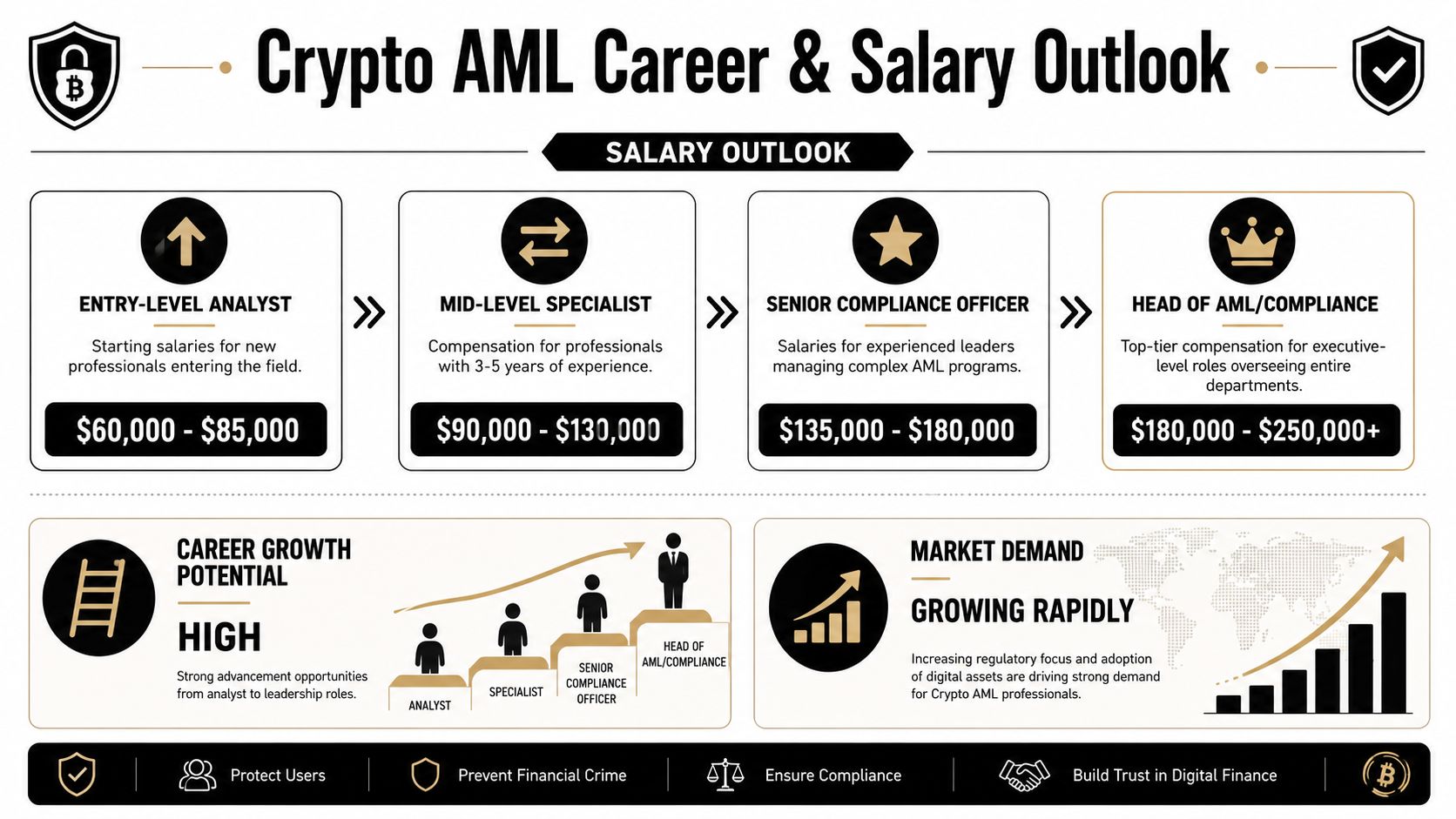
As of July 7, 2026, the average hourly pay for AML Crypto roles in the United States is $31.53, and senior AML Compliance Officer roles at remote crypto exchanges show full-time annual compensation around $136,000 to $152,000, according to ZipRecruiter's AML Crypto listings.
A separate benchmark for AML crypto roles in North America places successful candidates at $145,000 to $180,000 base salary with discretionary bonuses, while remote global roles in Asian exchanges offer about $136,000 to $152,000 annually in USDT, with a 15% market premium for candidates with Mandarin proficiency and prior regulatory agency experience at FINRA or SEC, according to ZipRecruiter's cryptocurrency AML market benchmark in Texas.
That tells you two important things.
First, serious crypto compliance jobs can pay at or above what many TradFi professionals expect for comparable seniority. Second, niche attributes can move compensation materially. Language capability and regulator-side experience aren't “nice to have” in the right roles. They change your pricing power.
The remote work paradox is real
A lot of crypto AML jobs are marketed as remote. Many are not location-agnostic.
One recurring pattern in hiring is that companies label a role remote but still require residency in a particular country or region, often because of licensing exposure, legal entity setup, internal approval permissions, or language coverage. The result is that a role can be fully home-based and still closed to most of the world.
This matters especially for professionals in LATAM, Africa, and parts of Asia who read “remote” and assume open access. In practice, many employers still want someone in the US, EU, or Singapore, or someone who can support local regulator interactions and language demands. That's not always obvious on the first read of a job description.
Hiring reality: In crypto compliance, “remote” often means “not office-based,” not “work from anywhere.”
If you're evaluating an opportunity, ask these questions early:
- Entity question. Which employing entity hires this role?
- Residency question. Is in-country residency mandatory?
- Time zone question. Is there genuine flexibility or just a hidden local-hours expectation?
- Language question. Is the stated language requirement operational or merely preferred?
- Regulatory exposure question. Will this role interact with a specific regulator or licensed vehicle?
Those answers often matter as much as the headline salary.
Career progression is narrower and faster
Crypto AML career ladders are usually less bureaucratic than banks. That's good and bad.
The good part is speed. Analysts can move into senior investigations, policy-heavy officer roles, sanctions specialization, quality assurance, or program management faster than they might in a large bank. The bad part is that weak firms may offer title inflation without proper mentoring or governance.
A practical progression often looks like this:
| Stage | What proves you're ready for the next move |
|---|---|
| Analyst | You can clear alerts and write defensible cases |
| Senior Analyst or Investigator | You can handle ambiguity and train others |
| Compliance Officer | You can make policy-operational decisions and own escalations |
| MLRO or Head of Compliance | You can run the program, face regulators, and manage risk trade-offs |
The best long-term accelerators tend to be specialization rather than title chasing. If you become the person who can handle DeFi exposure, sanctions edge cases, Travel Rule execution, or complex exchange-to-wallet investigations, your market value rises faster than if you stay a generalist forever.
Finding and Landing Your First Crypto AML Role
Once you've got the basics in place, the job search itself needs to be targeted. Generalist boards can be useful for volume, but they also create noise. You end up competing in a pile of low-context applications, many for roles that aren't truly crypto-native or that describe the job poorly.

Use job boards as signal, not as strategy
In July 2026, Glassdoor listed 49 open remote AML Crypto jobs, with salaries of $124K to $146K annually for general roles and $65K to $110K for Senior AML Analysts, while hourly rates ran from $50.00 to $60.00. Indeed reported 769 total AML Crypto jobs available, with annual salaries spanning $116,200 to $229,100 for full-time roles and up to $278,300 for specialized positions, according to Glassdoor's remote AML crypto jobs market view.
That confirms demand. It doesn't tell you where your effort is best spent.
Use broad boards to understand title patterns, compensation signals, and which employers are repeatedly hiring. Then focus your applications on roles where the remit is clear, the company is regulated or regulation-facing, and the reporting line makes sense.
A focused listing like this AML Compliance Officer opening at Polymarket is the kind of role worth studying closely because strong job descriptions reveal how a company thinks about compliance.
Build proof of work that hiring managers can inspect
Applications alone are rarely enough for a lateral move into crypto AML. You need a small body of visible work.
Good examples include:
- A short case memo on a public exploit, bridge abuse event, or sanctions-related enforcement action
- A wallet review walkthrough using public blockchain data and a clear narrative format
- A post on operational AML trade-offs in exchanges, payment apps, or DeFi-adjacent products
- A concise policy critique of weak KYC or alert escalation design in crypto contexts
Keep these practical. No grandstanding. No pretending you solved the whole industry. Show how you think.
Network like an operator
Crypto hiring still has an unusually high referral component, especially in compliance. But “networking” here works best when it looks like contribution, not cold self-promotion.
Try this approach:
- Follow compliance leads, investigators, and policy people rather than only recruiters.
- Comment on actual issues such as sanctions controls, Travel Rule operations, or typology changes.
- Ask informed questions that show you've done the work first.
- Share short observations from your own AML background that translate well into crypto.
This works because compliance teams want people who raise the quality of discussion. They don't need more applicants saying they're “passionate about Web3.”
A good reputation in this market usually starts with one sensible comment, one useful memo, or one sharp conversation. Not with a personal brand campaign.
A practical first-role checklist
Before you hit apply, run through this list:
- Match the title to your real level. Don't undersell yourself into an entry role if your investigations background is already strong.
- Read for hidden constraints. Residency, time zone, and language issues can kill a process late.
- Tailor the resume. Translate banking language into investigation and risk language.
- Prepare two case stories. One should show good escalation judgment. One should show restraint.
- Bring a writing sample if appropriate. Clear case writing is a differentiator.
- Study the company's product flows. Exchange, wallet, payment app, DeFi interface, or card program each creates different AML exposure.
The people who land crypto AML jobs fastest aren't always the most technical. Usually, they're the most legible. Hiring managers can see how they'd perform in the seat.
If you're serious about breaking into crypto compliance or moving up to a better role, start where the signal is strongest. Blockchain Jobs is a focused place to find Web3 compliance openings without wading through the usual noise, and it's a practical way to track the companies actively building serious AML teams.