Cryptocurrency Investigator Jobs: Career Path & Hiring Guide
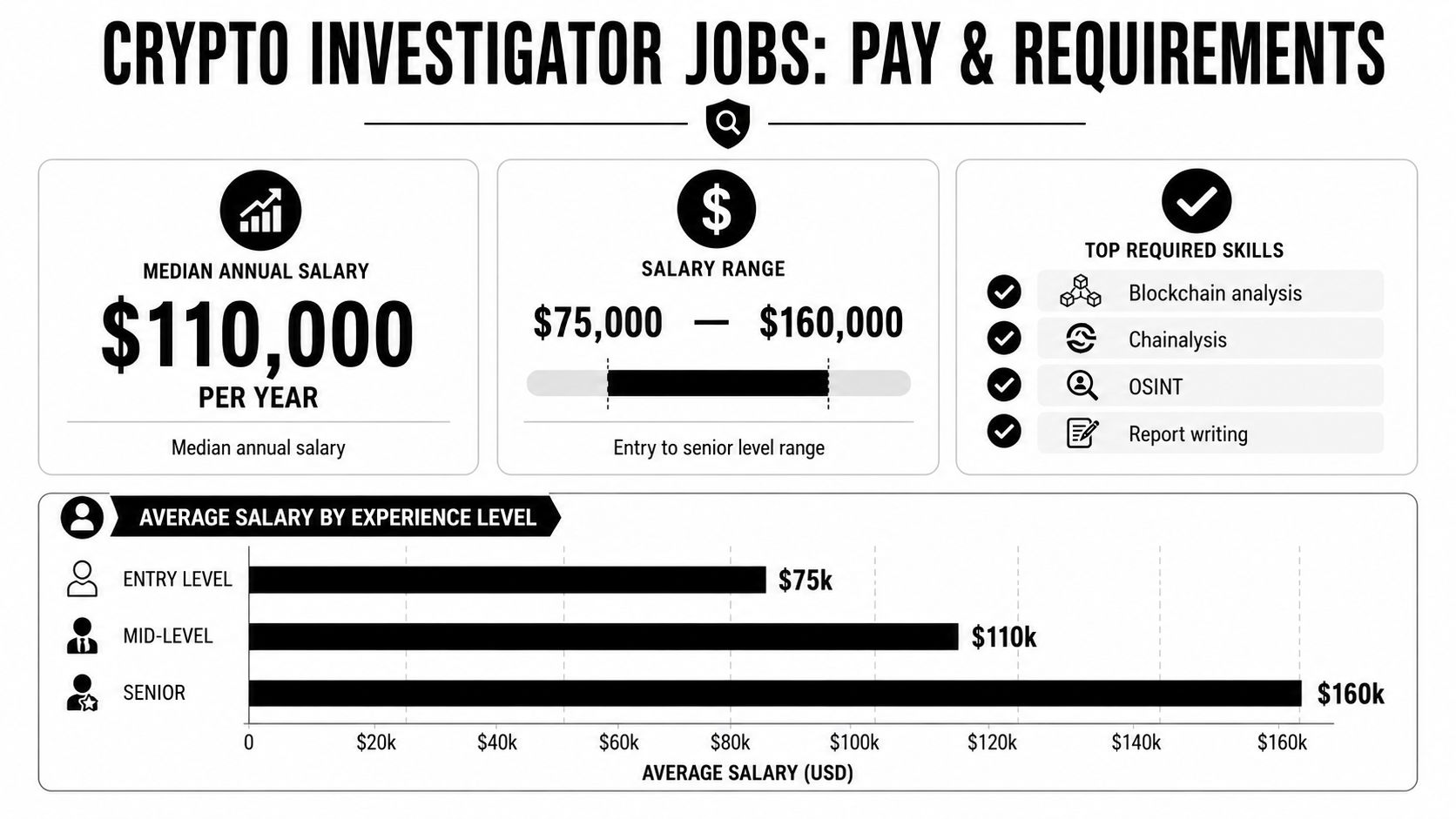
As of May 23, 2026, a Cryptocurrency Investigator in the United States earns an average annual salary of $75,325, with most roles between $52,500 and $98,500, top earners at $116,500, and some listings reaching $131,000, according to ZipRecruiter's Cryptocurrency Investigator salary data. That range changes the career conversation. Cryptocurrency investigator jobs are no longer improvised tracing assignments for technically curious analysts. They're becoming a professional track combining blockchain forensics, anti-money laundering, sanctions, fraud, litigation support, and regulatory reporting.
The strongest candidates understand both sides of the work. They can follow funds across chains, but they can also explain why a case matters, document evidence defensibly, communicate with legal and compliance teams, and make a recommendation that a regulated institution can act on.
What Cryptocurrency Investigator Jobs Actually Pay and Require
Salary bands show how quickly cryptocurrency investigator jobs are separating into career levels. A 2026 Web3 job-market snapshot places entry-level roles around $51,000 to $91,000, mid-level roles around $90,000 to $140,000, and senior roles around $130,000 to $180,000 or more. Specialized lead positions can reach $180,000 to $260,000 plus equity, while expert-witness assignments may pay $300 to $700 per hour, according to Web3.career's crypto investigator job guide.
The bands reflect different hiring standards. Entry-level employers look for investigation fundamentals, alert handling, and reliable work within defined procedures. Mid-level candidates need independent case ownership. Senior hires must show sound judgment, escalation management, quality control, sanctions knowledge, and conclusions that withstand legal or regulatory scrutiny.
The role has expanded
The strongest career path now runs from crypto-native forensics into hybrid investigations and compliance. An investigator may start with a wallet address, then connect on-chain activity to fraud typologies, sanctions exposure, suspicious activity reporting, customer risk, law-enforcement requests, and internal controls.
That expansion creates the pay gap. Specialist firms hire for complex tracing and expert testimony. Regulated exchanges and fintechs also need investigators who understand virtual currency within established financial-crime programs. Some specialist-firm senior roles now sit in the $180,000-plus range, as reflected in the ZipRecruiter market overview.
Recruiter's rule: Don't market yourself as someone who “likes crypto.” Market yourself as an investigator who can use blockchain evidence to solve financial-crime problems.
Certifications matter when they support that broader remit. AML, sanctions, fraud, or financial-crime credentials can strengthen a candidate's move into regulated institutions, while documented chain-tracing work proves technical ability. Hiring managers also want cross-functional judgment. A strong investigator knows when an on-chain clue requires customer due diligence, an exchange request, an FIU filing, a sanctions review, or a litigation hold.
Review a live global investigator opening at TRM Labs and compare its requirements with your tools, evidence handling, certifications, and casework. That comparison reveals whether you are prepared for a specialist investigation role or the wider compliance track.
Day-to-Day Responsibilities of a Crypto Investigator
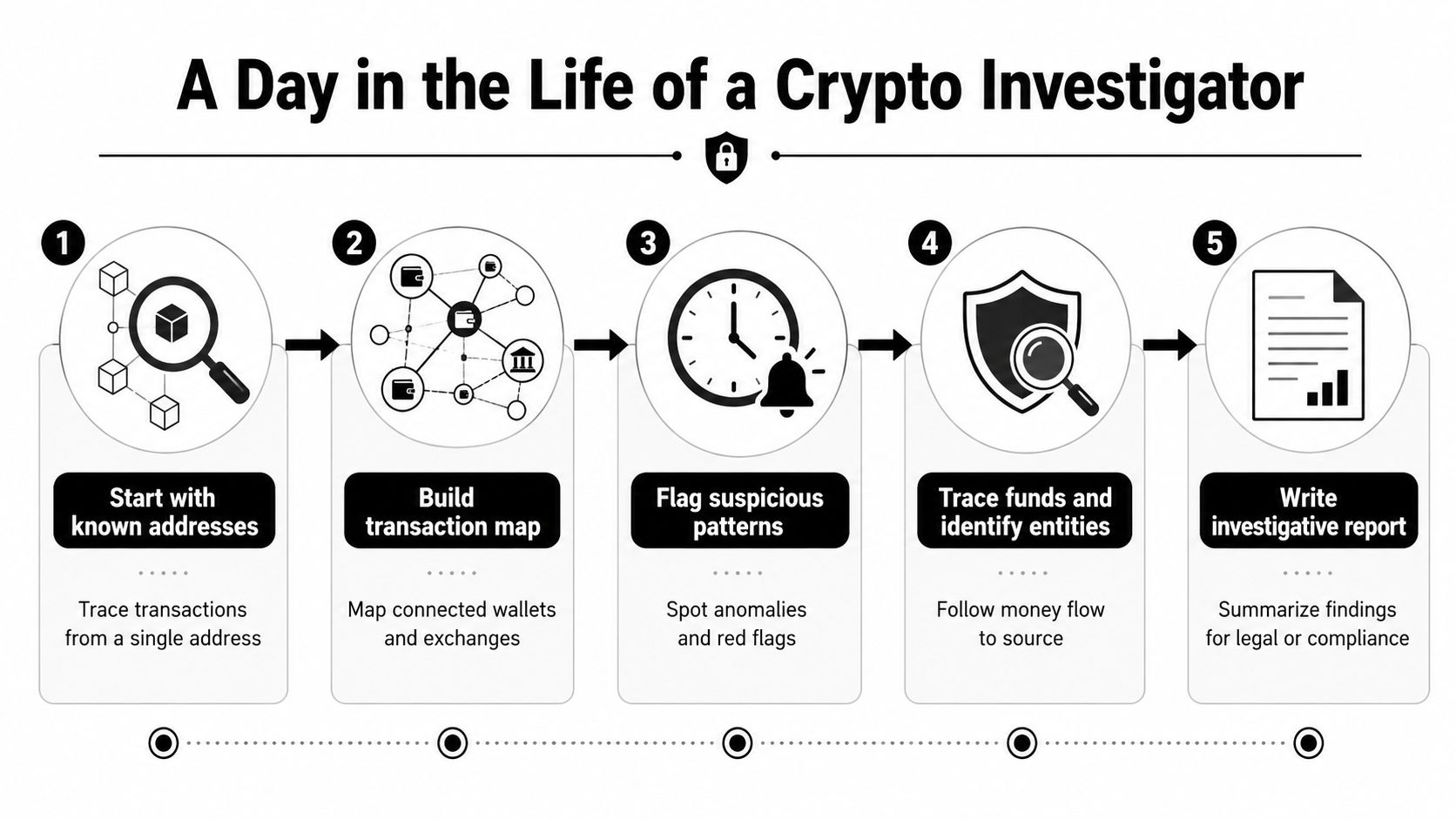
The work starts with an imperfect lead. It might be a victim's report, a known scammer address, an address associated with a service, or an alert generated by a compliance system. Your first task is to preserve the starting point and establish what you know, what you suspect, and what still needs verification.
The investigation workflow
Build the transaction graph. Trace movements hop by hop rather than treating each transfer as an isolated event. Record timestamps, assets, counterparties, services, and relevant transaction identifiers.
Cluster linked wallets. Look for behavioral and transactional relationships that may indicate common control. Clustering is an analytical judgment, not proof of identity, so every inference needs a confidence assessment and supporting evidence.
Follow the money to usable points. Investigators examine exchange deposits, bridges, mixers, hosted wallets, payment services, and other off-ramps. The objective is often to identify where legal process, account records, or a freeze request could produce actionable results.
Connect on-chain and off-chain evidence. Customer information, communications, domain records, social profiles, device evidence, business registrations, and victim statements can strengthen or contradict blockchain signals. A wallet label alone isn't a complete finding.
Write for someone who wasn't in the room. Reports must explain methodology, assumptions, evidence, limitations, and recommended next actions. A senior investigator may brief counsel, law enforcement, executives, or a financial-intelligence unit, so clarity matters as much as technical fluency.
Privacy coins, Layer-2 networks, mixers, and self-custody wallets create practical barriers. Funds can move beyond an exchange-assisted recovery path, and cross-chain activity can make an apparently simple case much harder to resolve. A survey of law-enforcement respondents found that over 60% of crypto investigations led to a positive outcome such as conviction or asset seizure, while the same field continues to face cases that stall because obfuscation and self-custody limit recovery options, as documented in TRM Labs' law-enforcement crypto-crime survey.
The technical workflow is only half the job. Employers want disciplined evidence handling, careful escalation, and reports that distinguish facts from hypotheses. Explore how those expectations appear in a cryptocurrency intelligence analyst role at Elliptic.
A practical demonstration of investigative thinking can help during interviews, especially when you explain why each hop matters and where your confidence drops.
Building Your Qualifications and Certification Stack
Hiring managers don't select candidates because they collected credentials. They select candidates who can prove that the credential supports sound investigative work. Build your qualifications in layers, starting with investigation fundamentals and adding blockchain specialization where it strengthens your target role.
Start with transferable investigations experience
Employers commonly look for three to five years of investigations experience, including suspicious activity report filing, strong written and verbal communication, time management, analytical judgment, and investigative discipline. Some roles also value bilingual ability because cross-border investigations require coordination across jurisdictions and teams, as shown in the AML Investigator role at Robinhood.
If you're earlier in your career, build evidence through financial-crime operations, fraud analysis, compliance investigations, law-enforcement work, intelligence analysis, or a closely related function. A bachelor's degree can help, especially in finance, criminal justice, or computer science, but it won't compensate for weak case documentation or an inability to explain your reasoning.
Choose certifications for the employer you want
The certifications that repeatedly appear in hiring requirements or preferred qualifications include:
- ACAMS: The Certified Anti-Money Laundering Specialist credential helps demonstrate conventional AML knowledge, particularly for exchanges, banks, and fintechs.
- Certified Fraud Examiner: The CFE is useful when your target work involves fraud typologies, interviews, loss analysis, and broader financial investigations.
- Chainalysis KYT and Reactor: Tool-specific knowledge matters because employers need analysts who can operate investigation platforms, not just discuss blockchain theory.
- TRM Labs and Elliptic equivalents: Familiarity with competing analytics environments signals adaptability across vendors.
- Certified Cryptocurrency Investigator: The CCI credential can reinforce a focused blockchain-investigations profile.
Major employers list these certifications alongside blockchain analytics and suspicious-activity workflows. One Binance investigations role specifically names a bachelor's degree, analytics-tool experience, and SAR-related investigation workflows as preferred qualifications.
Demonstrate tools and communication
Some blockchain-forensics roles ask for two to four or more years of hands-on work in blockchain investigations, financial-crime analysis, or crypto compliance. They may expect experience with TRM Labs, Chainalysis, Elliptic, and Arkham, plus OSINT methods and the ability to explain complex blockchain concepts to technical and non-technical audiences, according to this 1inch blockchain-forensics role.
OSINT should include more than browsing social media. Learn how to preserve sources, compare identities, validate online claims, and use techniques such as reverse image search OSINT when investigating aliases, copied profiles, or suspicious business identities. Create a sanitized portfolio with sample transaction maps, investigative notes, typology analysis, and a legal-ready report structure.
For a senior target, study the expectations in this senior forensic-accounting cryptocurrency investigations role. It's the combination of credentials, hands-on analysis, and defensible communication that moves an application forward.
Resume and Interview Strategies That Get You Hired
A resume for cryptocurrency investigator jobs should read like an evidence log, not a technology wishlist. “Familiar with blockchain” tells a recruiter almost nothing. “Reviewed wallet activity, documented transaction paths, prepared escalation memos, and supported SAR decisions” shows how you work.
Write about casework without breaking confidentiality
Replace confidential names and exact identifiers with controlled descriptions. State the case type, your role, the investigative method, the stakeholders involved, and the decision produced.
Useful resume language includes:
- Case ownership: “Led investigations involving suspected fraud, sanctions exposure, or account takeover activity.”
- Blockchain analysis: “Mapped linked wallets and traced funds across multiple networks using commercial analytics platforms.”
- Regulatory workflow: “Prepared investigative narratives and supported suspicious activity reporting decisions.”
- Evidence quality: “Maintained clear documentation of sources, assumptions, escalations, and unresolved limitations.”
- Stakeholder management: “Presented findings to compliance, legal, operations, and external investigative partners.”
Don't inflate outcomes. If you contributed to a seizure, prosecution, account restriction, or customer remediation decision, describe your contribution precisely. Hiring managers can spot vague impact language, and investigation work rewards credibility over theatrics.
Expect scenario-based interviews
Interviewers often test judgment rather than memorization. Prepare to explain what you'd do if funds move through a mixer, cross-chain bridge, privacy-focused asset, or self-custody wallet. Walk through preservation, attribution, escalation, evidence gaps, and the next lawful source of information.
You may also be asked to explain a complex blockchain concept to a non-technical executive. Use a plain-language structure: what happened, why it matters, what supports the conclusion, what remains uncertain, and what action you recommend.
One technical issue deserves special preparation. Blockchain analytics can produce extremely low false-positive rates, yet still miss known criminal addresses. A Thomson Reuters analysis cites false-positive rates of 0.01%, 0.15%, and 0.11% across three tested datasets for a leading tool, while warning that false negatives reached up to 75% of known criminal addresses in tested datasets, as explained in Thomson Reuters' analysis of evolving crypto-crime forensics.
Interview standard: Say what the tool indicates, what it cannot establish, and which off-chain evidence you'd seek next.
Bring a short case exercise to your preparation. Create a timeline, label assumptions, show alternative hypotheses, and write a concise executive summary. That packet will sharpen your answers far more than rehearsing generic strengths and weaknesses.
Where to Find Openings and How to Network Effectively
The best search strategy combines specialist job boards, direct employer research, and targeted conversations with people who manage investigations teams. General searches can surface openings, but they often miss the language regulated institutions use for the same work, including AML, sanctions, fraud, financial intelligence, transaction monitoring, and virtual-asset compliance.
Search by function, not just title
Use several versions of the role:
- Crypto investigator
- Blockchain intelligence analyst
- AML investigator, crypto
- Financial-crime investigator
- Sanctions investigator
- Blockchain-forensics analyst
- Fraud investigations associate
- Digital-asset compliance investigator
Check specialist platforms such as Web3.career and focused blockchain employment boards. Search exchanges, fintechs, analytics vendors, forensic-accounting firms, and consulting practices separately because each employer type describes the work differently.
A regulated institution may emphasize SARs, quality assurance, sanctions, and regulatory obligations. A specialist intelligence firm may emphasize tracing, OSINT, expert reports, and law-enforcement support. A crypto-native company may prioritize speed, cross-chain fluency, stablecoins, DeFi, and the ability to operate without a large existing process library.
Make outreach useful
Don't send a message that asks whether someone is hiring. Show that you understand their work and ask a narrow question about the skills they screen for.
A strong message might look like this:
I'm building toward crypto financial-crime investigations after working in fraud and transaction monitoring. Your team's focus on cross-chain tracing and legal-ready reporting matches the direction I'm targeting. Which capability separates successful applicants from technically curious candidates?
Send that to investigations managers, AML leads, compliance recruiters, and analysts whose work resembles your target role. Personalize the message around a product, investigation specialty, or job requirement. Keep the request small, and don't attach a long autobiography.
Informational conversations should produce learning, not an immediate referral request. Ask which case types occupy the team, what tools analysts use, how reports move through review, and which certification would matter for that employer. Then act on the advice and follow up with a concise update.
The market is also moving toward roles requiring multi-chain transaction tracing, stablecoin and DeFi familiarity, legal-ready reporting, and cross-functional stakeholder management. Tailor every application to those requirements instead of presenting yourself as a general Web3 candidate. That positioning will carry better across exchanges, fintechs, investigative firms, and public-sector contractors.
Planning Your Career Progression and Long-Term Growth
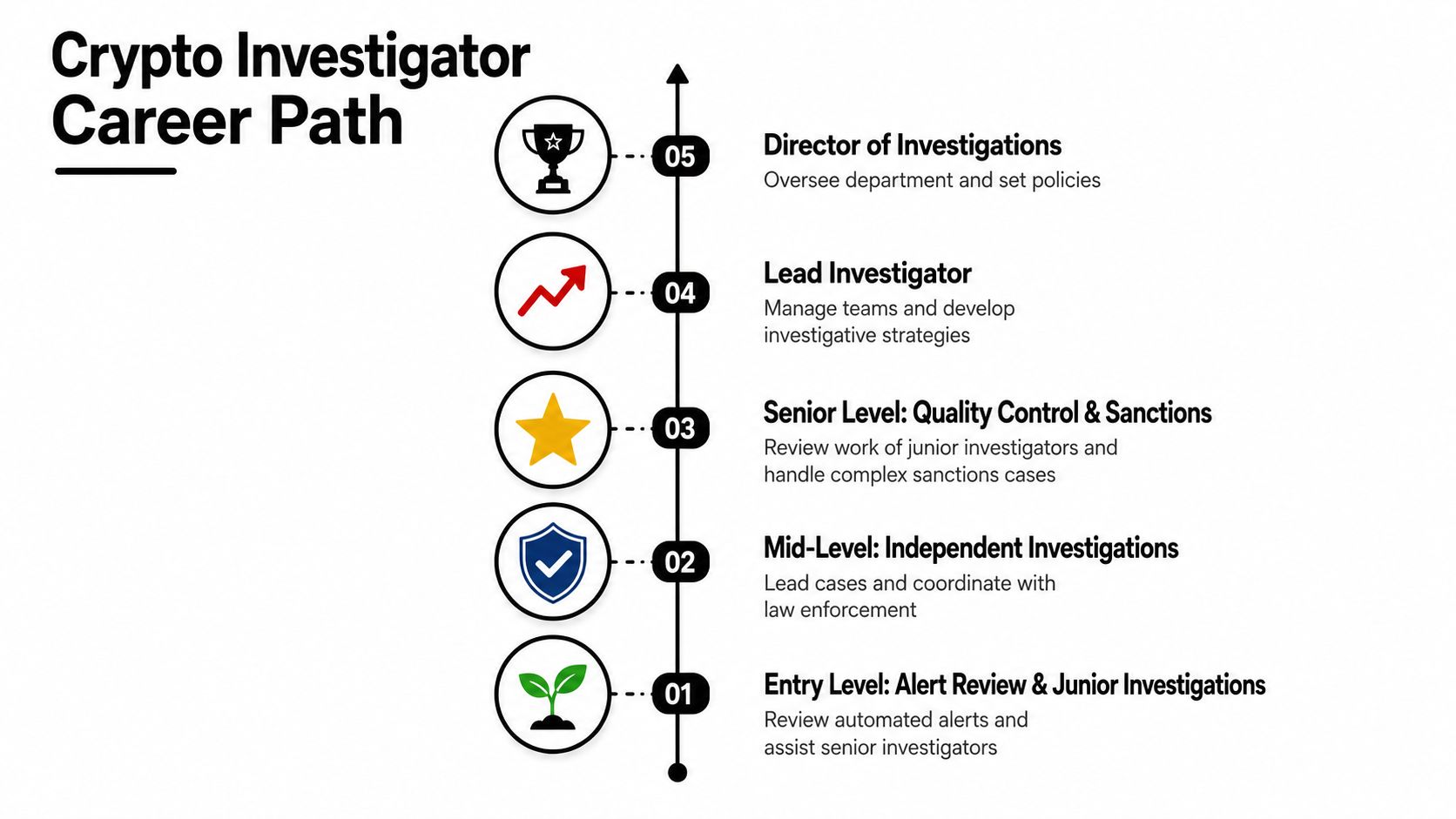
Plan this career as a progression from evidence production to investigative judgment, then to control ownership. Entry roles focus on alert review and junior casework. Later positions demand independent investigations, quality control, sanctions knowledge, team leadership, and broader compliance responsibility. Regulated institutions increasingly want investigators who can connect blockchain evidence to formal financial-crime controls.
A practical three-to-five-year roadmap
Early stage: Build fluency in transaction monitoring, SAR workflows, wallet analysis, evidence preservation, and report writing. Consistency is the target. Senior reviewers must trust your timelines, source notes, escalation decisions, and explanations.
Middle stage: Own cases from intake through disposition. Add cross-chain tracing, OSINT, stablecoin and DeFi knowledge, and direct coordination with legal, law-enforcement, and compliance stakeholders. A large exchange role shows the next threshold, requiring at least four years of AML, counter-terrorist financing, and sanctions investigations experience, along with virtual-currency knowledge, analytics tools, quality-control experience, and recognized credentials such as LCOI, ICA, or ACAMS, as described in Coinbase's international investigations role.
Advanced stage: Choose a specialty, including sanctions, quality assurance, fraud intelligence, expert testimony, or investigations management. Senior roles can reach $130,000 to $180,000 or more, while specialized lead roles may reach $180,000 to $260,000 plus equity. Treat these figures as market ranges, not guaranteed offers. Compensation depends on regulated-sector experience, technical depth, location, and leadership scope.
Expert-witness work can become a separate premium channel, with rates of $300 to $700 per hour reported in the market guide cited earlier. Prepare for it through transparent methodology, precise exhibits, clear limitations, and calm explanations under challenge.
For documentation-heavy work, HyperWhisper's secure dictation can help capture structured notes efficiently, if employer security and confidentiality policies permit it. Long-term mobility belongs to investigators who combine technical tracing with regulated-financial-crime judgment. That hybrid profile travels well across exchanges, fintechs, consulting firms, analytics providers, and government-facing investigative teams.