Unlock Your Career in Crypto Compliance: An Expert Guide
If you're looking for a career with serious upward momentum, crypto compliance is where the action is. This isn't just a niche; it's a field experiencing a full-blown talent crunch, creating incredible opportunities for job seekers with the right skills. To land one of these crypto compliance jobs, you need to think like a hiring manager.
The demand is white-hot. Billions in institutional capital are flooding into digital assets, but there's a critical shortage of people who can navigate the complex regulatory landscape. This puts you, the candidate, in a powerful position during job interviews and salary negotiations.
Why Crypto Compliance Is a Booming Career Path
So, what's fueling this hiring frenzy? Simply put, the industry is maturing. Big money requires big trust, and that trust is built on solid regulatory frameworks. Companies are desperate to hire professionals who can bridge the gap between traditional financial regulations and the unique challenges of blockchain technology.
This desperation has created a "talent chasm," and it puts you, the candidate, in a powerful position. We're seeing salary premiums of 16-20% for crypto compliance roles compared to similar jobs in traditional finance. With an estimated 84% of fintech firms struggling to fill these positions, it's clear who has the leverage. You can get a deeper look at these salary trends and hiring data over at Briefglance.com.
This table breaks down the core factors creating this high-stakes hiring environment, helping you position your skills for what employers need most.
Key Drivers of Demand for Crypto Compliance Roles in 2026
| Market Driver | Impact on Hiring & Interviews | What to Emphasize in Your Career |
|---|---|---|
| Institutional Adoption | Massive demand for professionals who can build enterprise-grade compliance programs. Interview questions will focus on your experience with institutional-level risk. | Highlight your experience with AML/KYC frameworks, risk assessment, institutional onboarding, and Travel Rule solutions. Frame it as enabling business growth. |
| Evolving Regulations | Constant need for experts who can interpret and implement new rules (e.g., MiCA, FATF). Hiring managers look for adaptability and forward-thinking analysis. | Showcase your ability in regulatory analysis, policy writing, and cross-jurisdictional compliance. Mention specific regulations you've worked with. |
| DeFi & Web3 Growth | Need to apply compliance principles to decentralized protocols and new technologies. This is a key area to differentiate yourself from traditional compliance professionals. | Stress your knowledge of on-chain analytics, smart contract risk, sanctions screening for DeFi, and NFT compliance. Be prepared for scenario-based questions. |
| Building Public Trust | Companies use strong compliance as a marketing tool to attract users and partners. Your role is not just risk mitigation but also reputation management. | Frame your skills in terms of communications, crisis management, and building transparent compliance reporting systems. Show you understand the commercial impact. |
As you can see, career progression in this field requires a broad skillset that helps legitimize and grow the entire digital asset space.
From Gatekeeper to Growth Enabler: Your Career Narrative
Here’s the real shift in mindset you need for a successful career in crypto compliance. In a traditional bank, the compliance department is often seen as the "business prevention unit." Their job is to say "no."
In crypto, that dynamic is completely flipped.
A savvy compliance team is a direct engine for growth. A strong compliance framework is what allows a crypto exchange to:
- Land partnerships with major financial institutions.
- Secure the necessary licenses to operate in lucrative markets.
- Build the user trust needed to attract and retain customers.
This changes everything for your career progression. Your work isn't just about ticking boxes; it's about unlocking revenue. When you interview, don't just talk about "preventing fines." Frame your accomplishments around enabling growth. For example: "My implementation of the Travel Rule framework allowed us to expand into three new jurisdictions," or "I designed the enhanced due diligence process that secured our first institutional client."
My Take: The demand for crypto compliance professionals isn't a bubble. It's a foundational career path. The entire digital asset ecosystem needs people who can build bridges between regulators and innovators. If you can be that bridge, you're not just getting a job—you're building a future-proof career.
Building the Right Skillset to Land Crypto Compliance Jobs
Landing a top-tier crypto compliance job isn't about just knowing regulations or just understanding blockchain. It's about being the person who can bridge those two worlds. Hiring managers are desperate for professionals who can fluently discuss the Bank Secrecy Act with a regulator in the morning, and then discuss on-chain transaction monitoring with a blockchain developer in the afternoon. That's the person who gets hired and promoted.
The demand for this unique blend of skills isn't slowing down. As massive amounts of capital have poured into crypto, a huge talent gap has emerged. Companies have the money, but they can't find the right people fast enough.
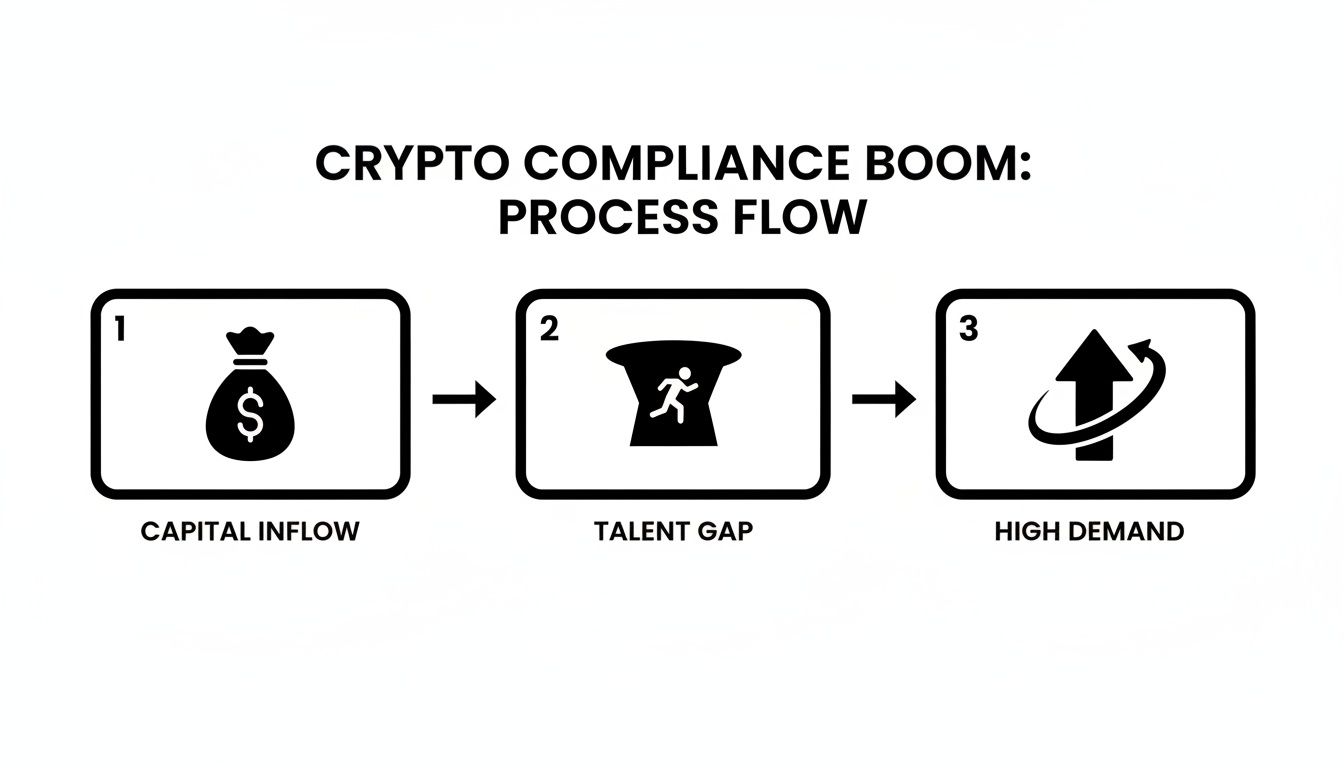
This gap is your career opportunity. The market is practically screaming for people with the right combination of traditional compliance know-how and modern tech skills.
Mastering the Hard Skills That Get You Hired
Let's start with the non-negotiables. These are the skills that get your resume past the screening software and prove you can do the job from day one.
AML/KYC Frameworks: You need a rock-solid grasp of Anti-Money Laundering (AML) and Know Your Customer (KYC) rules. In an interview, be ready to explain how concepts like the FATF Travel Rule apply to pseudonymous, on-chain transactions.
Sanctions Screening: Knowing your way around OFAC lists and other global sanctions is absolutely critical. Be prepared for an interviewer to ask, "Walk me through how you would screen a wallet that just interacted with a sanctioned mixer." Your answer needs to be specific, actionable, and demonstrate a clear methodology.
Blockchain Analytics Tools: This is where you really differentiate yourself. It’s one thing to list Chainalysis, Elliptic, or TRM Labs on your resume. It's another to demonstrate hands-on experience in an interview.
Anyone can say they "know" a tool. The candidates who get hired are the ones who can say, "I used Chainalysis Reactor to trace stolen funds from the latest DeFi hack through three different wallets and a mixing service. Here's what I found and how I reported it." That’s a game-changer in an interview.
Cultivating Essential Soft Skills for Career Advancement
While hard skills get you in the door, it’s the soft skills that land you the offer and accelerate your career progression. In a field as new and fast-moving as crypto, knowing what are transferable skills is your secret weapon for translating past experience into future success.
Your ability to communicate is everything. A hiring manager needs to see that you can explain the complex money laundering risks of a new NFT project to the C-suite in plain English. Just as important is your ability to adapt and learn. The rules and the tech are constantly changing, and you must demonstrate a genuine desire to stay on the cutting edge. This is a key trait hiring managers look for.
Take a look at job descriptions like this Lead Compliance Analyst position. You'll see that top companies aren't just listing technical requirements; they're explicitly seeking people who can think critically, communicate clearly, and thrive in a dynamic environment.
Crafting a Resume That Gets You the Interview
Think of your resume as your first interview for crypto compliance jobs. It's not just a list of past roles. It’s your proof that you understand the unique risks and speak the language of Web3. Both hiring managers and the Applicant Tracking Systems (ATS) they use are scanning for signals that you can connect traditional finance rules with the realities of on-chain activity.
Sending out a generic resume is a surefire way to get ignored. You must mirror the language in the job post, which is why it's so important to learn how to tailor your resume to the job description. This shows the hiring manager you're the right fit before you even have a conversation.

Translate Your Experience for Web3 Hiring Managers
The single biggest mistake candidates make is a simple copy-and-paste of their TradFi experience. You need to reframe your accomplishments through a crypto lens, demonstrating how your skills apply to a decentralized and often pseudonymous world.
For instance, don’t just say you "conducted KYC." That's table stakes. Instead, show you grasp the elevated risks in crypto.
- Before: "Performed KYC checks on new customers."
- After: "Executed enhanced due diligence (EDD) on high-risk customers, including on-chain wallet screening and source-of-funds analysis for large crypto deposits."
The "After" version tells a hiring manager that you're ready to tackle the specific challenges of digital assets from day one. You're not just a form-filler; you're a risk investigator.
Weave in Critical ATS Keywords to Get Seen
Your resume absolutely must get past the bots. To do that, you need to pepper it with the specific terms that crypto compliance recruiters are searching for. This dramatically improves your odds of your resume landing in front of a human.
Key Takeaway: Recruiters aren't just looking for "AML." They're searching for proof you can apply it in a crypto context. Your resume must include terms like on-chain forensics, Travel Rule, sanctions screening, risk assessment, and the names of blockchain analytics tools like Chainalysis or TRM Labs.
Showcase Impact with Metrics to Impress
Numbers talk. Quantifying your achievements turns your resume from a list of duties into a compelling story of your impact. Don't just describe what you did—show the result. This is crucial for demonstrating your value.
- Weak: "Monitored transactions for suspicious activity."
- Strong: "Monitored $50M+ in daily transaction volume, identifying and escalating 15 high-risk cases per week, which reduced the firm's potential exposure to illicit funds by 25%."
This approach proves your direct value, which is everything in a fast-moving crypto firm. Demonstrating that you can protect the business while enabling growth makes you a top-tier candidate. If you want to see how leading companies describe these roles, check out specialized listings like this AML Compliance Officer position.
Where to Find the Best Crypto Compliance Jobs
Finding a top-tier crypto compliance job isn't about scrolling through endless pages on Indeed or Monster. The best opportunities are on niche platforms and within closed professional circles. To land a great role, you need a strategic job search plan that targets where insiders are hiring.
The demand for your skills is exploding. The Web3 job market is on fire, with over 460 full-time positions posted in January 2026 alone. This isn't a fluke; it's a direct result of institutional money flowing in and regulators getting serious. As a result, hiring is heating up in global hubs like London, Dubai, Singapore, and Berlin, as highlighted in recent Web3 hiring trends analysis.
Ditch Generalist Job Boards for Targeted Searches
Forget the big, generic job sites. They cast too wide a net, and you’ll waste hours sifting through irrelevant listings. Your time is better spent on platforms built specifically for the blockchain world.
Niche Job Boards: Sites like Blockchain Jobs are your best friend. They're curated for the industry, so you're not competing with noise from other sectors. You can jump straight to a list of legal and compliance positions and know every single one is relevant.
Direct to Company Career Pages: This is a seriously underrated job search tactic. Pinpoint 10-15 crypto companies you admire—exchanges, DeFi protocols, RegTech firms—and bookmark their career pages. Check them weekly. Companies often post there first to fill a role before paying for a public listing.
Get Active Where Hiring Managers Are Looking
In Web3, who you know is just as important as what you know. Many of the most interesting compliance jobs are never publicly advertised. They're filled through referrals and direct outreach. You need to be visible where the industry lives.
A strong professional presence on X (formerly Twitter) and active participation in relevant Discord or Telegram channels are no longer optional—they are essential job-seeking tools. Follow compliance leaders, engage with their content, and join discussions to get on their radar before you even apply.
This isn’t about blindly sending your resume to everyone. It's about building a reputation. Share your take on a new regulatory framework or ask a thoughtful question in a community forum. Show you're genuinely engaged, and you'll catch the attention of hiring managers and recruiters.
Partner with a Specialist Web3 Recruiter
A new breed of recruiter has emerged, focusing solely on the crypto and Web3 space. These specialists have deep connections and are the gatekeepers for confidential, high-stakes roles that you'll never see on a job board.
Getting on their good side can completely change your job search. Look for them on LinkedIn using keywords like "Web3 recruiter" or "crypto talent." When you reach out, send a personalized message explaining your focus on crypto compliance and your key skills. They are always building a pipeline of qualified candidates for their clients.
Mastering the Interview and Negotiating Your Offer
Alright, you've landed the interview. This is your chance to prove you're more than just a resume. Forget reciting regulations; hiring managers in crypto want to see how you think on your feet when faced with complex, on-chain problems. This is where your practical knowledge truly shines.

Expect to be thrown into the deep end with scenario-based questions. The goal is to see how you apply compliance principles to the often messy reality of DeFi, NFTs, and cross-chain transactions.
Answering Common and Advanced Interview Questions
Your interviewers are trying to bridge the gap between traditional compliance theory and the fast-paced world of blockchain. The questions will reflect this, blending old-school concepts with new-school tech.
For instance, they might ask: "Walk me through how you would assess the risk of a new DeFi lending protocol for our platform."
A strong answer requires a clear, step-by-step methodology:
- Protocol Analysis: "First, I'd analyze the protocol's fundamentals. Have the smart contracts been audited by a reputable firm like Trail of Bits or OpenZeppelin? Who is the team—are they anonymous or doxxed? What does the governance structure look like, and how decentralized is it?"
- Risk Identification: "Next, I’d pinpoint specific compliance risks. This includes potential sanctions evasion through unregulated liquidity pools, exposure to illicit funds from Tornado Cash, or vulnerabilities to smart contract exploits that could create regulatory and reputational risk for us."
- Control Implementation: "Finally, I'd propose concrete controls. This means using specific blockchain analytics tools for wallet screening, setting transaction volume limits to flag suspicious activity, and creating a monitoring plan for the protocol’s treasury and key addresses."
This approach proves you’re not just spotting problems—you’re a problem-solver who can build practical solutions.
Pro Tip: Use the "STAR" method (Situation, Task, Action, Result) but give it a crypto spin. Instead of a generic example, talk about a time you investigated an on-chain event or assessed a new digital asset risk. This makes your traditional finance experience immediately relevant and highly valuable.
Negotiating Your Crypto Compensation Package
Once you've aced the interview, the ball is in your court. It's time to negotiate an offer that reflects your specialized, high-demand skills. You have significant leverage, so don't be timid.
The industry has changed dramatically, and by 2026, the talent landscape is all about specific, high-demand skills like Travel Rule implementation, on-chain sanctions screening, and transaction monitoring. This is especially true for exchanges in tightly regulated jurisdictions. You can discover more about these industry shifts on Solidus Labs to benchmark your market value.
Let's talk money. Research the going rates for similar roles and be ready to justify why your background commands a premium.
Your compensation will likely be a mix of:
- Base Salary: This is your foundation. Given the demand, it should align with the 16-20% premium that top crypto compliance roles often carry over their TradFi counterparts.
- Performance Bonus: Usually a percentage of your base, tied to your personal achievements (e.g., securing a license) and the company's success.
- Equity or Token Allocations: This is where you can find serious upside potential. Always ask about vesting schedules, strike price for options, and the total diluted supply to understand your real stake.
When you negotiate, frame your worth in terms of value. Explain how your expertise will help the company secure new licenses, attract institutional clients, and protect the business from millions in potential regulatory fines. You’re not an expense; you’re a strategic investment in the company's growth and stability.
Common Questions About Crypto Compliance Careers
If you’re planning your career in crypto compliance, you probably have a lot of questions. It's a field packed with opportunity, but it moves at a different speed than traditional finance. Here are actionable answers to common questions from job seekers.
Do I Need a Coding Background for a Crypto Compliance Job?
Let’s get this one out of the way: no, you don't need to be a developer. But—and this is a big but—you absolutely must be technically literate.
You won't be writing smart contracts, but you have to understand what they are, how they function, and where the compliance risks lie. You need to be comfortable navigating a blockchain explorer and explaining the mechanics of on-chain transactions. Many of the best people in this space came from traditional banking or legal backgrounds. Their career progression was fueled by their commitment to learning the technology that underpins the risk.
The real test is whether you can translate technical concepts for a non-technical audience. In an interview, can you explain the risks of a new DeFi protocol to developers, executives, and regulators? That's the skill that gets you hired and promoted.
You don't need to be a developer, but you need to be the person who can explain the risks of a protocol to developers and regulators alike. This is the skill that ensures your career growth.
What Is a Realistic Salary for a Crypto Compliance Role?
Compensation in crypto compliance is highly competitive. While it varies based on your experience, location, and the company, you can use these ranges as a guide when negotiating an offer.
- Analyst (2-4 years experience): A base salary in the $90,000 to $150,000 range is typical.
- Senior Analyst/Manager: This is where you can start seeing $150,000 to $220,000+ in base pay.
- Director/CCO: For leadership roles at major firms, total compensation can easily clear $300,000, especially when you factor in equity or token packages.
Companies are often willing to pay a 16-20% premium over equivalent banking roles to get the right talent. Remember to factor in the total compensation package, including potential token allocations, which can significantly increase your earning potential.
What Does the Career Path for a Crypto Compliance Officer Look Like?
The career ladder in crypto compliance is not just promising; it’s incredibly diverse. The classic path starts at the Analyst level, moves up to Senior Analyst or Manager, and can lead to becoming the Chief Compliance Officer (CCO) of a major exchange or crypto firm.
But your career options don't stop there. Your unique blend of regulatory knowledge and on-chain expertise opens doors across the entire industry. I’ve seen seasoned professionals make successful career moves into:
- Consulting: Joining top-tier firms building out their digital asset practices.
- Government & Regulation: Working for regulatory agencies that need people who understand the industry from the inside.
- RegTech: Joining the companies that are building the next generation of compliance tools.
- Venture Capital: Advising VCs on the regulatory risks of their portfolio companies.
Your skills are transferable across the whole ecosystem, offering long-term career security and variety.
How Important Are Certifications Like CAMS for My Career?
Certifications like the Certified Anti-Money Laundering Specialist (CAMS) are still valuable. They show you have a solid grasp of fundamental AML principles and often act as a screening tool for recruiters. Think of it as a prerequisite that gets your resume looked at.
However, a CAMS certification alone is no longer enough to be a top candidate. Hiring managers now expect you to have crypto-specific credentials to go along with it. To advance your career, you should pursue certifications from blockchain analytics providers like Chainalysis (the CRC is highly regarded) or TRM Labs.
The ideal candidate today is someone who can pair that traditional certification with real, hands-on crypto knowledge. This combination proves you can apply timeless AML principles to the new, on-chain world, making you a highly sought-after professional.
Ready to find your place in the fast-growing world of Web3? Blockchain Jobs is the premier destination for connecting top talent with leading companies in the decentralized space. Explore curated listings in legal, compliance, and more to find your next great role.