
Liquidity Management Jobs: A Practical Career Guide
You've found a role titled Liquidity Manager, but the job description mentions Basel rules, SQL, cash forecasting, and balance-sheet reporting in the same breath. Or you're coming from treasury and wondering whether a DeFi protocol will value your experience. Maybe you're an analyst who can build a dashboard but can't explain why a bank holds a particular liquidity buffer. These are common problems because liquidity management jobs aren't one career track. They're a three-lane market, and hiring teams use very different filters in each lane.
The best candidates identify their lane first, then build evidence around the decisions that lane requires. Traditional bank treasury rewards regulatory judgment, corporate treasury rewards forecasting and control, and DeFi rewards fast risk decisions across transparent but volatile markets. Your resume, interview preparation, and technical development should reflect that distinction.
What Liquidity Management Jobs Actually Are in 2026
Liquidity management jobs sit between finance, risk, operations, and data. The underlying question is always similar: which assets need to be available, where should they sit, and how much uncertainty can the organization absorb? The language changes by employer, however, and that language determines who gets screened in.
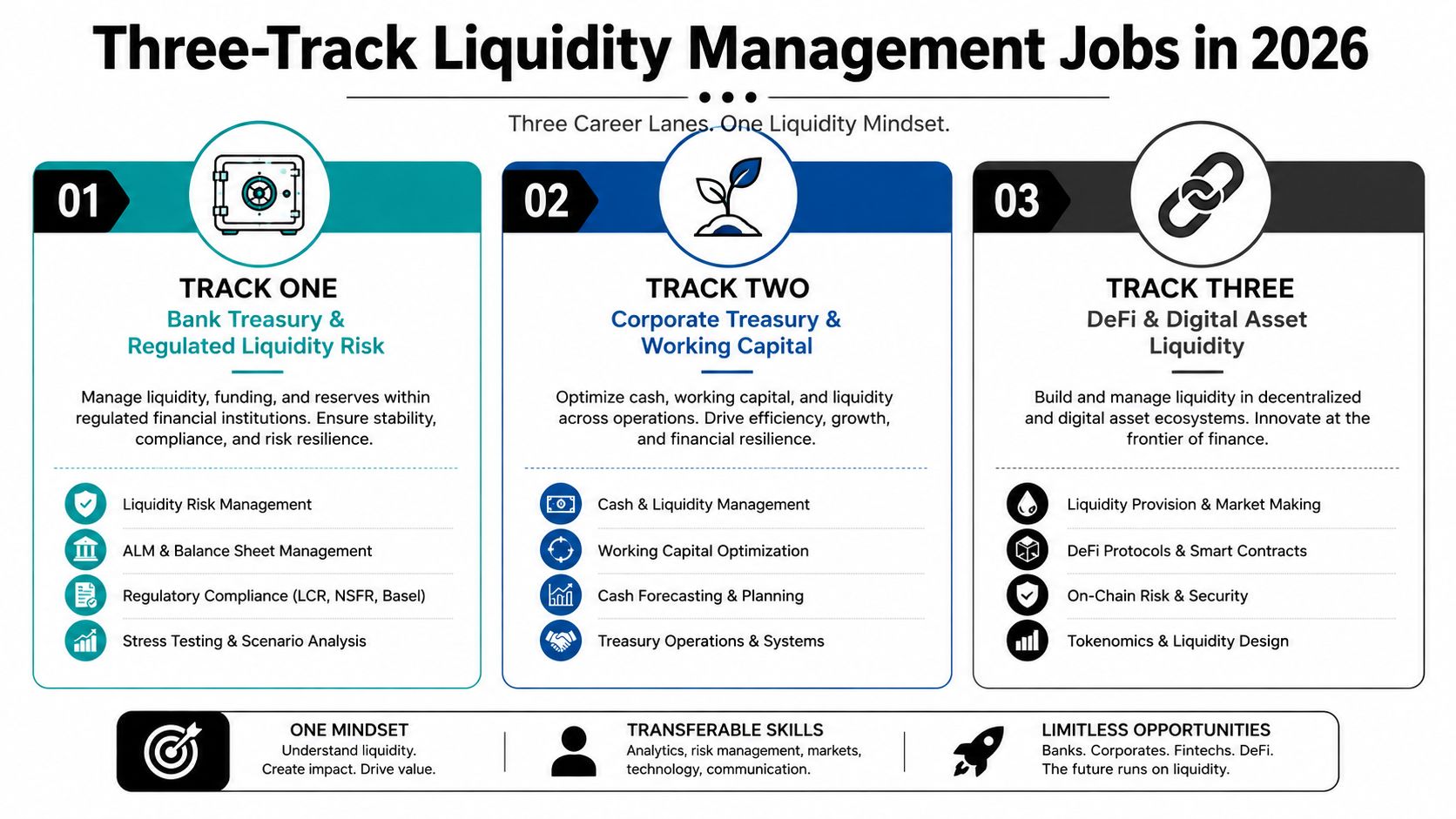
Three career tracks
Bank treasury is the most regulated lane. Roles cover liquidity risk, asset and liability management, funding, intraday liquidity, and regulatory reporting. The Liquidity Coverage Ratio requires unencumbered high-quality liquid assets to cover total net cash outflows over a 30-calendar-day stress scenario, with a minimum ratio of 100%, according to the Basel Committee's LCR standard. Candidates need to understand bank balance sheets, HQLA composition, stress assumptions, and the relationship between liquidity, funding, and capital.
Corporate treasury focuses on operating cash rather than bank-wide prudential ratios. Analysts and managers consolidate balances across subsidiaries, forecast inflows and outflows, manage FX exposure, invest surplus cash, and maintain operating buffers. Enterprise liquidity platforms commonly consolidate global balances, support cash-flow forecasting, and automate surplus-cash investment, as described in J.P. Morgan's treasury liquidity management overview.
DeFi liquidity provisioning is a different operating environment. Teams manage pool depth, lending utilization, inventory, and pricing risk across decentralized exchanges and lending venues. A liquidity specialist may rebalance concentrated positions on Uniswap v3, monitor Curve pools, or move stablecoin inventory across bridges and centralized exchanges. Smart-contract behavior, oracle design, governance decisions, and market-maker incentives matter as much as conventional cash controls.
Hiring rule: Don't send a corporate cash-management resume to a DeFi protocol and expect the recruiter to translate it for you.
Select your lane before editing your resume. If you want regulated balance-sheet work, lead with LCR, NSFR, stress testing, and reporting. If you want corporate treasury, lead with forecasting, bank connectivity, ERP or TMS experience, and controls. If you want DeFi, show protocol-specific analysis, wallet operations, pool mechanics, and incident judgment.
Core Responsibilities Across Treasury and DeFi
The job becomes clearer when you follow the daily workflow. A liquidity manager receives position data, compares it with expected flows, checks risk thresholds, decides whether to raise, deploy, or move liquidity, and communicates the decision to stakeholders. The tools differ, but the operating loop remains remarkably consistent.
In bank treasury, that loop can include calibrating HQLA buffers, monitoring intraday positions, stress-testing deposit outflows, and maintaining funds-transfer-pricing assumptions. In corporate treasury, the work shifts toward subsidiary cash forecasts, short-term investments, FX hedging, debt schedules, and bank-account rationalization. A corporate liquidity analyst posting from Goldman Sachs illustrates the wider entry-level expectation, combining a bachelor's degree, analytical ability, Excel, PowerPoint, Tableau, and programming familiarity.
DeFi teams replace bank accounts and legal entities with wallets, pools, venues, and smart-contract parameters. A liquidity lead may monitor Aave, Compound, Morpho, and Uniswap v3, rebalance concentrated liquidity, track stablecoin exposure, and maintain runbooks for oracle divergence or a peg-loss event. The strongest operators don't wait for a dashboard alert. They define what action follows each threshold and who can approve it.
| Daily Responsibilities by Track | Bank Treasury | Corporate Treasury | DeFi Liquidity |
|---|---|---|---|
| Position monitoring | HQLA, funding, intraday balances | Bank accounts, subsidiaries, investments | Pool depth, utilization, wallet inventory |
| Forecasting | Stress outflows and liquidity ratios | Operating cash, FX, debt and investments | Borrowing demand, emissions, volatility and flows |
| Execution | Funding trades, collateral and buffer changes | Cash sweeps, investments and hedges | Pool rebalances, bridge transfers and venue allocation |
| Controls | Basel reporting, governance and model controls | ERP, TMS, SOX and approval controls | Smart-contract, oracle, wallet and governance controls |
| Communication | Treasury and risk committees | CFO, finance and operating teams | Governance, risk, trading and engineering |
Data quality determines whether any of this works. People exploring how automation changes financial operations may find useful context in Faberwork's guide to industries benefiting from Agentic AI, but candidates should remember that automation can't repair incomplete position data or undefined decision rights.
For a practical view of the DeFi lane, compare your experience with a DeFi liquidity lead opportunity at Polymarket. Read the responsibilities closely. The question isn't whether you've used crypto products. It's whether you can own liquidity decisions under changing market conditions.
Skills Hiring Managers Screen For
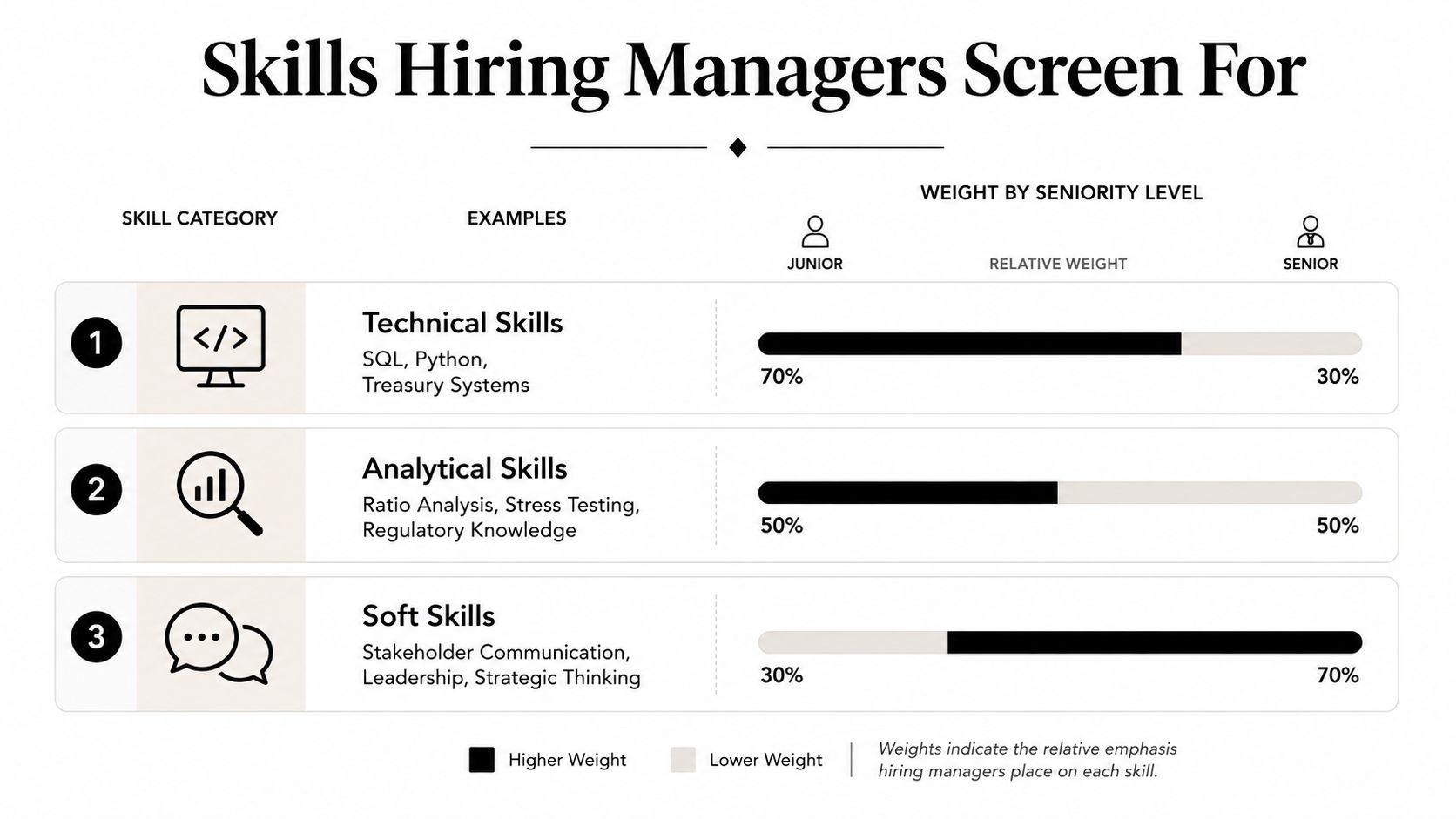
Hiring managers don't evaluate every skill equally. At entry level, they want evidence that you can manipulate data accurately, explain a model, and learn the organization's systems. At mid-level, they want ownership. At senior level, they want someone who can make a defensible decision, align risk and business stakeholders, and explain the trade-off to a committee.
The technical layer
Excel remains a gateway skill, especially for analyst roles. Advanced formulas, scenario models, pivot tables, VBA, and clean presentation still matter because many liquidity processes begin in spreadsheets before they become automated. A liquidity and funding analyst posting from Lam Research also identifies advanced Excel, large data sets, treasury management systems, SAP, Kyriba, SOX controls, and corporate governance as relevant experience, as shown in the role description.
SQL and Python separate candidates who can inspect data from candidates who only consume reports. Bank roles may add platforms such as Bloomberg, Calypso, or QRM. DeFi roles may expect Solidity familiarity, The Graph, Dune, Nansen, and a working understanding of on-chain data structures.
The analytical layer
The core analytical test is whether you can connect a number to a decision. That means cash-flow modeling, scenario analysis, duration, basis, curve mechanics where relevant, liquidity ratios, collateral, and concentration risk. RBC's liquidity analyst requirements show how reporting, balance-sheet knowledge, VBA Excel, SQL, regulation, and strategic thinking can sit in one profile, according to the RBC role listing.
The human layer
Communication becomes more important as scope expands. A senior hire must coordinate with trading, risk, finance, engineering, and executives while documenting assumptions clearly enough for review. Candidates who can't explain why they changed a forecast or moved liquidity will struggle, even if their model is technically correct.
Use this self-audit:
- Entry: Can you build a clean cash model, query a dataset, and explain your assumptions?
- Mid-level: Have you owned a recurring forecast, reporting process, control, or rebalance?
- Senior: Can you defend capital allocation, manage stakeholders, and present risk decisions to leadership?
Salary Bands and Compensation Reality
Compensation comparisons fail when candidates treat bank treasury, corporate cash management, and DeFi liquidity as interchangeable. They're not. The employer's regulatory burden, balance-sheet scale, technical expectations, location, and bonus structure all affect the offer.
The most defensible public baseline is U.S. data for liquidity manager roles. ZipRecruiter's liquidity manager salary data, reported as of June 3, 2025, listed average annual pay of $59,525, with the 25th percentile at $42,000, the 75th percentile at $68,500, and top earners at $100,000. The same dataset listed an hourly equivalent of $28.62, roughly $1,144 per week or $4,960 per month, while listed salaries ranged from $24,500 to $116,000 across the United States.
Large financial institutions price specialized responsibility much higher. Indeed listings cited in the verified data placed some U.S. liquidity management treasury associate roles at about $95,000 to $115,000, while other treasury liquidity roles reached $205,000 per year. Nomura's New York liquidity management and reporting specialist associate role advertised $115,000 to $125,000 at commencement of employment, according to the Nomura-related salary listing. These figures show why title alone is a poor benchmark.
| Liquidity Management Compensation by Track 2026 | Analyst | Manager | Senior or VP | Head of Function |
|---|---|---|---|---|
| Bank treasury | Public ranges vary by market and institution | Compensation rises with ownership of funding and reporting | Senior roles can reach the higher institutional ranges cited above | Usually negotiated around scope, risk ownership, and total package |
| Corporate treasury | Often anchored to forecasting, systems, and controls | Greater responsibility for entities, funding, and hedging | Pay reflects balance-sheet and stakeholder scope | Driven by cash, funding, banking, and executive responsibility |
| DeFi liquidity | May combine cash compensation with token exposure | Scope depends on protocol, venues, and risk mandate | Total compensation can include incentives or PnL participation | Governance influence, treasury authority, and token economics matter |
Don't value token compensation at its headline price. Liquidity roles in Web3 can include grants, vesting restrictions, market volatility, and governance conditions that make paper value different from realized compensation. Benchmark the cash portion first, then assess liquidity, vesting, downside, and decision rights.
For interviews, ask how the employer defines total compensation, which portion is guaranteed, what controls token exposure, and whether the role owns treasury decisions or only reports them. That diligence is more useful than copying an informal salary number from a forum.
The Treasury and Data Engineering Hybrid Edge
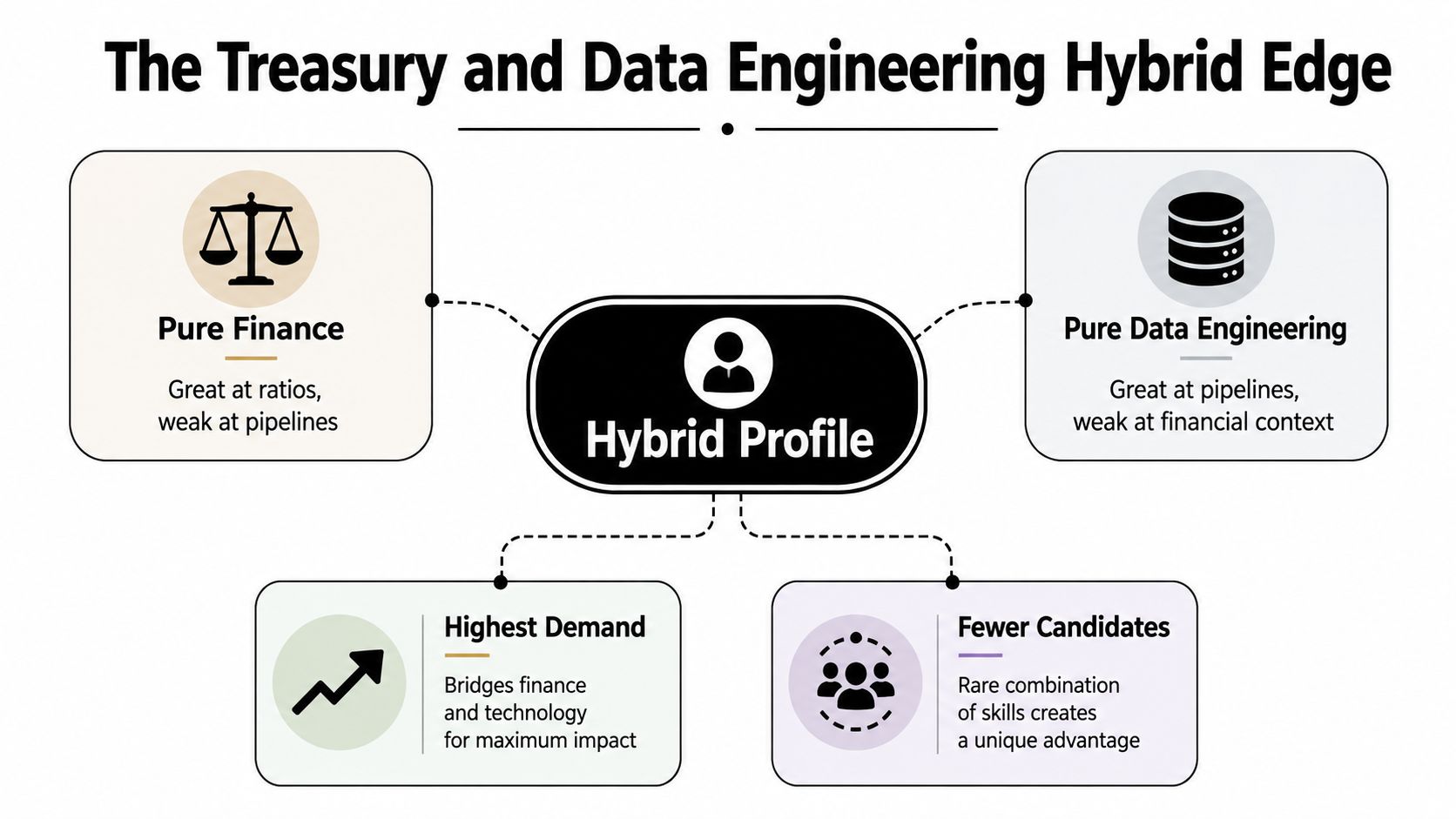
The strongest profile in liquidity hiring combines financial judgment with production-grade data fluency. Pure finance candidates often understand ratios, funding, and controls but struggle to trace a broken pipeline. Pure engineers can build reliable systems but may not understand why a balance-sheet assumption, collateral haircut, or stablecoin concentration changes the risk decision.
That gap creates a practical advantage for candidates who can work across both domains. A hybrid operator might write Python to automate cash sweeps, build an on-chain dashboard with Dune or The Graph, reconcile bank data with protocol wallets, or create scenario tooling for liquidity stress. The value isn't the tool itself. It's the ability to turn messy position data into an action that treasury, risk, and engineering can trust.
What to put on your profile
Avoid vague phrases such as “DeFi native,” “data-driven treasury professional,” or “experienced in liquidity optimization.” Replace them with evidence:
- Data pipeline: “Built a reconciliation workflow connecting bank balances, ERP records, and wallet positions.”
- Forecasting: “Created a Python cash-flow model with documented assumptions, exception handling, and review controls.”
- On-chain analytics: “Developed a Dune dashboard tracking pool utilization, stablecoin concentration, and wallet movements.”
- Risk translation: “Converted protocol liquidity metrics into an escalation framework for treasury and governance stakeholders.”
The public job market already signals this hybrid requirement. A JPMorgan Chase corporate treasury liquidity management vice president posting references tools including Excel, PowerPoint, SQL, Python, Tableau, Snowflake, dashboarding, and technology implementation alongside liquidity and balance-sheet knowledge, as shown in the JPMorgan Chase role.
Don't claim a premium you can't substantiate. The verified hiring data supports the direction of travel, not a precise uplift. Show the artifact, explain the decision it improved, and make the reviewer's job easy.
Candidates targeting Web3 treasury operations should also study the expectations in this treasury operations analyst role at Blockchain Works. The right question is whether your technical work changes liquidity control, not whether it merely produces another dashboard.
Career Paths From Analyst to Head of Liquidity
A liquidity career compounds through scope, not title. Your first role should give you access to positions, forecasts, controls, or reporting. Your next role should give you ownership of decisions. The move after that should give you people, capital, and executive exposure.
A practical progression ladder
Graduate analyst: Start in bank treasury rotations, FP&A, corporate cash operations, or protocol operations. Build competence in Excel, accounting, cash-flow mechanics, and data quality. Analyst-level liquidity roles commonly ask for a bachelor's degree and 0 to 3 years of experience, alongside quantitative and problem-solving skills, according to the Goldman Sachs liquidity management analyst posting.
Senior analyst: Own a forecast, reporting pack, dashboard, or control process. A Standard Chartered associate liquidity management role specified 3+ years of experience in money markets or a related field, reinforcing that employers often prefer prior market exposure rather than purely academic preparation, as shown in the Standard Chartered listing.
Manager or specialist: Choose your market. Traditional candidates can pursue CFA or FRM depending on whether investment and balance-sheet work or risk specialization fits better. Web3 candidates need a visible record of protocol contributions, Dune dashboards, audit findings, treasury proposals, or documented incident analysis.
Head of treasury or DeFi liquidity lead: Senior hiring is about capital allocation, governance, and communication. You should be able to defend liquidity decisions, manage a team, set escalation rules, and communicate with boards, committees, token holders, or executive leadership.
Titles compress in DeFi, so a person called “manager” may own more practical scope than a bank manager with a narrower remit. A bank path can take 7 to 10 years from analyst to VP, while a DeFi path can take 4 to 6 years, according to the career progression data provided. Treat those as market-oriented guideposts, not guarantees.
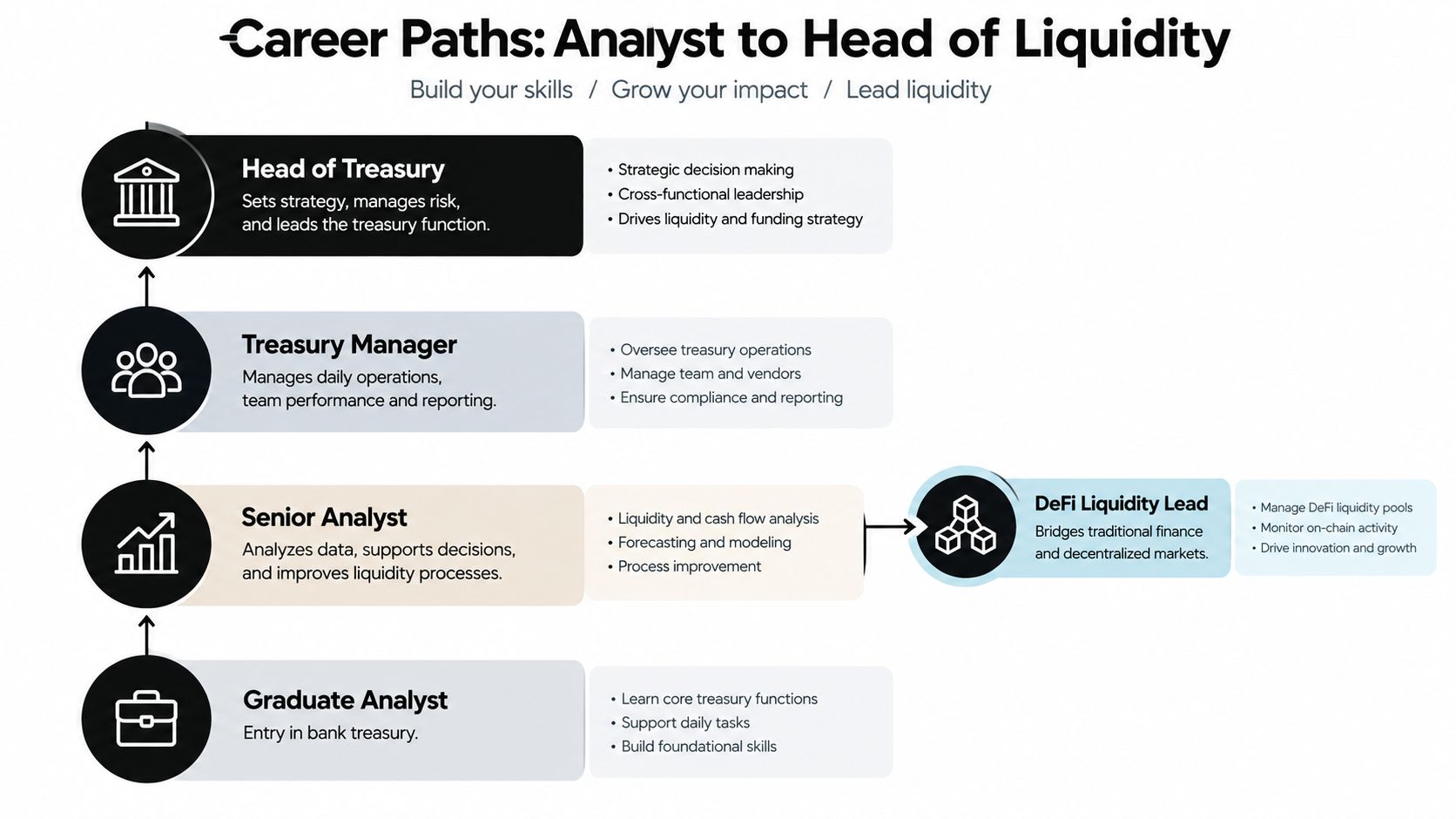
Credentials help, but ownership wins. If you can show that you made a forecast, changed a control, improved a reporting process, or protected liquidity during a difficult market event, you'll have stronger evidence than a certificate alone.
Resume and Interview Tactics That Land Offers
“Managed liquidity risk” gets skipped because it says nothing about your judgment. Every serious treasury resume contains a version of it. Hiring managers want to know what you managed, which instrument or system you used, and what decision you owned.
Use this rewrite pattern:
Practical rule: Name the exposure, the action, and the consequence. If you can't disclose a result, describe the decision and control clearly instead of inventing a metric.
For bank roles, discuss HQLA, funding, collateral, LCR, NSFR, reporting, and stress testing. For corporate roles, discuss cash forecasting, bank accounts, FX, investments, ERP, TMS, Kyriba, SAP, and controls. For DeFi roles, name the protocol, pool, chain, wallet process, parameter, and risk event.
| Resume Bullets That Get Interviews vs. Get Skipped | Weak Bullets | Strong Bullets |
|---|---|---|
| Forecasting | Managed cash forecasts | Owned a documented forecast process, reconciled actuals, and escalated variance drivers |
| Reporting | Prepared liquidity reports | Produced regulatory or management reporting with defined controls and review ownership |
| DeFi operations | Worked with DeFi liquidity | Monitored named pools and venues, documented rebalance triggers, and coordinated execution |
| Systems | Used treasury systems | Used a TMS or ERP workflow to reconcile balances, investigate exceptions, and support approvals |
| Risk | Managed liquidity risk | Modeled a specified stress scenario and presented the resulting action to stakeholders |
Expect questions on stressed cash forecasting, LCR and NSFR mechanics, drawdown bridging, stablecoin depeg scenarios, oracle manipulation, and data breaks. Answer with situation, action, and result, but don't manufacture a result you can't verify. Explain the assumptions, the trade-off, and the control that prevented a repeat.
Bring a one-page memo on a recent liquidity event. Show the position, the risk, the options considered, your recommendation, and the escalation path. Candidates preparing for promotion-style conversations may also benefit from Intonetic promotion interview preparation, especially when they need to frame expanded scope rather than list tasks.
Technical fluency can open the door outside conventional treasury titles. Study the requirements in this senior software engineer liquidity management role at Ripple if you're trying to move toward the infrastructure side. The strongest applicants know whether they're applying as an operator, analyst, risk specialist, or builder.
Finding Liquidity Management Jobs and Next Steps
Treat your search like a liquidity process. Define the target universe, set monitoring rules, review signals, and improve the conversion rate at each stage. Browsing every finance or Web3 listing creates noise. A narrow search creates evidence.
Start with three filters on specialist job boards: the keyword liquidity, a lane tag such as treasury, DeFi, or market making, and remote eligibility where relevant. Add a recent-posting filter so you're not spending time on stale roles. Save alerts, then cross-check serious openings on LinkedIn and the employer's own careers page.
Use crypto-native boards such as CryptoJobsList and Remote3 for protocol roles, but verify the employer, reporting line, compensation structure, and technical expectations. To reduce wasted applications, resources such as skip ghost jobs with Remote First Jobs can help you think more critically about listing quality and employer signals.
Your 30-day operating cadence
Week one: Audit your resume against the lane you want. Rewrite three bullets to show the exposure, action, system, and decision. Remove unrelated achievements that force the recruiter to infer your fit.
Week two: Apply to targeted roles rather than spraying applications. Contact hiring managers with a specific observation about the organization's balance sheet, protocol, treasury design, or liquidity risk. A thoughtful thesis beats a generic “I'd love to connect.”
Week three: Prepare two case studies. Build one treasury stress test and one DeFi pool-rebalance analysis. Include assumptions, constraints, escalation points, and what data you'd request before acting.
Week four: Run mock interviews and track movement from recruiter screen to technical round. If applications produce screens but no technical interviews, your resume may be unclear. If technical rounds fail, your modeling or domain knowledge needs work. If final rounds fail, practice stakeholder communication and decision ownership.
The hiring market favors candidates who make their fit obvious. Pick one lane, build two credible work samples, and apply with a resume that mirrors the employer's vocabulary. That approach will outperform a broad profile that claims equal expertise in banking, corporate treasury, and DeFi without proving any of them.
Blockchain Jobs connects candidates with opportunities across Web3, including finance, treasury, DeFi, data, engineering, and operations roles. Visit Blockchain Jobs to search current liquidity management jobs, filter for the track that fits your background, and find a role where your financial and technical skills can compound.