Blockchain Finance Jobs: Roles, Salaries, and Hiring Paths
You've spent years building forecasts, testing controls, or reviewing financial statements. Then, late at night, you open a crypto treasury posting and wonder whether the opportunity is serious finance or just exit liquidity with better branding. That doubt is reasonable. The strongest blockchain finance jobs aren't asking candidates to cheer for tokens. They're asking whether you can protect liquidity, document decisions, reconcile on-chain activity, and satisfy regulators when the operating model is unfamiliar.
Maria, a Big Four senior auditor with seven years of SOX experience, is a useful example. She's not starting from zero. Her challenge is translating audit evidence, control testing, and reporting discipline into wallets, multisig approvals, stablecoin reserves, and protocol governance. That translation is where the hiring market is becoming more selective.
Why Blockchain Finance Is a Real Career Path in 2026
Blockchain finance has moved beyond speculative trading desks and informal token operations. The durable career path sits inside regulated controls, treasury governance, financial reporting, compliance, and risk. European regulatory work around MiCA, accounting flows connected to US spot exchange-traded funds, and stablecoin reserve audits have all pushed digital-asset businesses toward more formal finance functions. These developments don't eliminate risk, but they make finance expertise more valuable.
Institutional activity is also changing the employer terrain. Banks are exploring tokenized deposit pilots, payment companies are building settlement rails that use blockchain infrastructure, and protocols increasingly recruit people with Big Four, banking, audit, and compliance backgrounds. The question for candidates is no longer whether a company uses crypto terminology. It's whether the business has enough treasury complexity and regulatory exposure to need professional controls.
Where the hiring is strongest
The most credible opportunities for finance professionals are concentrated in:
- DeFi treasury operations, including liquidity planning, wallet controls, protocol revenue reconciliation, and incentive budgeting.
- Stablecoin issuers, where reserve management, safeguarding, reporting, and transaction monitoring matter every day.
- Real-world asset tokenization teams, which need people who understand fund structures, valuation, reporting, and investor controls.
- DAO finance committees, where FP&A, budgeting, grant oversight, and governance documentation must work across pseudonymous contributors.
- On-chain payments operations, especially at fintech businesses connecting blockchain settlement with conventional payment processes.
Pure trading roles and NFT-community finance seats are less dependable targets for a traditional finance candidate. They may still exist, but they're narrower, more cycle-sensitive, and often reward market-making or community-specific experience over control design.
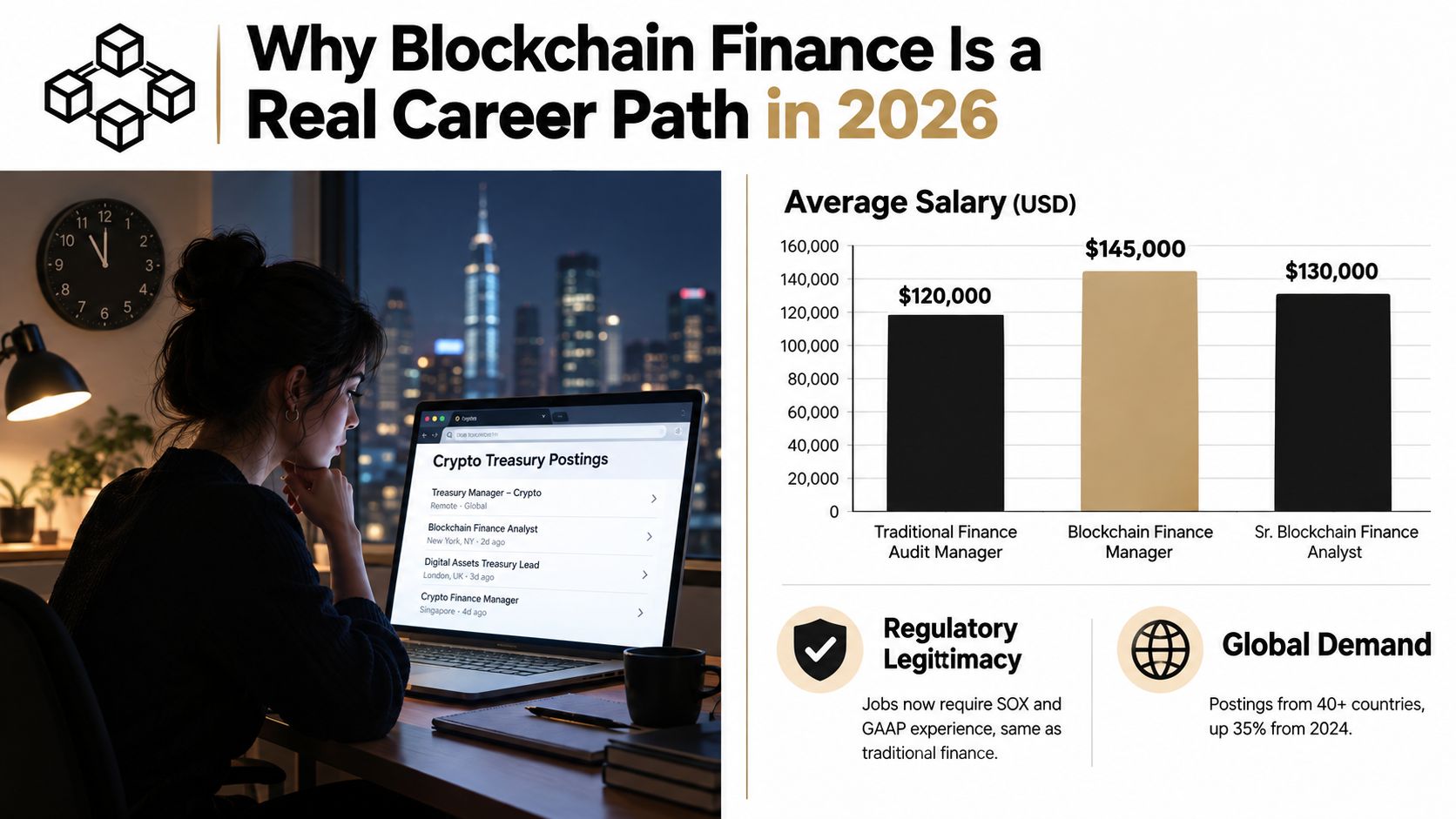
The labor market has already shown both scale and volatility. A 2022 CFTE blockchain finance employment report estimated that the largest 54 blockchain unicorns employed 32,500 people worldwide, with the largest company employing 7,400 people and advertising about 6,500 new openings in April 2022. The report also said sector headcount had doubled from 2021 to 2022. Coincub later reported that Europe held 67.8% of blockchain jobs in 2023, about 60,000 roles, while North America and Asia each held around 14%, or roughly 13,000 jobs apiece. Most regions lost about 40% of jobs between 2022 and 2023, while Asia fell by 20% and Australia recorded a slight increase, according to its 2023 blockchain jobs report.
Maria's practical next step isn't learning every protocol. It's identifying the controls she already understands, then proving she can apply them to digital-asset workflows. A posting such as Head of Internal Audit at BitGo makes the point: the market needs professionals who can make blockchain businesses auditable, not merely professionals who can discuss crypto.
The Main Roles Inside Blockchain Finance Teams
Blockchain finance hiring starts with controls, then rewards crypto-native fluency. Recruiters assess who can protect assets, reconcile activity, document decisions, and explain risk under pressure. Titles differ by company, so evaluate each role by its deliverables, reporting line, approval authority, and operating tools.
DeFi operations
A DeFi operations analyst tracks protocol revenue, liquidity, runway, incentive emissions, and wallet activity. Weekly work can include reconciling on-chain income with off-chain expenses, reviewing liquidity movements, maintaining a treasury dashboard, and preparing a memo for a finance lead or DAO committee. Common tools include Dune Analytics, block explorers, spreadsheets, accounting software, and governance forums.
Your resume should show the control behind the analysis. State how you reconciled transactions, investigated an unexplained balance change, confirmed authorization, and assessed the effect on runway or counterparty exposure. “Monitored treasury activity” is weak. “Reconciled wallet transactions to operating expenses and escalated unauthorized movements” communicates ownership.
Tokenomics and protocol finance
Tokenomics specialists model supply schedules, vesting and release schedules, liquidity-mining budgets, and dilution scenarios. They usually work with finance, strategy, or protocol leadership and coordinate with growth, product, engineering, and market-making partners.
The assignment is to test whether incentives support sustainable economics. A strong candidate can compare emissions proposals, stress-test a token release, document assumptions, and prepare governance material that non-finance voters can evaluate. Recruiters look for models that expose downside, not token narratives built only to attract attention.
Treasury and corporate finance
Treasury leads manage stablecoin reserves, DEX liquidity, custody relationships, bridges, market makers, and counterparty limits. Depending on the organization, they report to a CFO, COO, or finance committee. Their operating stack may include custody platforms, multisig systems, ERP software, bank portals, spreadsheets, dashboards, and transaction-monitoring systems.
The job is control under speed. Treasury candidates must be able to set approval thresholds, maintain wallet inventories, separate duties, forecast liquidity, and define escalation procedures for continuously moving assets. Audit, controllership, or banking experience gives you a credible entry point. Add evidence that you can apply those controls to wallets, multisigs, stablecoins, and protocol exposures.
Compliance and controls
Compliance and controls staff own AML processes, sanctions screening, regulatory reporting, SOC 2 evidence, audit requests, and documentation for banks or regulators. Reporting lines may lead to a chief compliance officer, general counsel, CFO, or risk leader.
Current listings cluster around DeFi, compliance, trading, SQL, Python, tokenomics, auditing, and NetSuite. The finance role market sample at Sail Onchain reflects the market's expectation that finance hires work close to data and operations, not only the general ledger.
| Role Family | Core Deliverables | Typical Partners |
|---|---|---|
| DeFi operations | Treasury memos, revenue reconciliation, runway tracking, incentive monitoring | Protocol, data, growth, DAO governance |
| Tokenomics | Supply models, vesting schedules, emissions analysis, dilution scenarios | Product, engineering, growth, market makers |
| Treasury and corporate finance | Reserve policy, liquidity planning, counterparty controls, cash forecasting | CFO, custodians, banks, exchanges |
| Compliance and controls | AML workflows, sanctions reviews, audit evidence, regulatory reporting | Legal, risk, auditors, banking partners |
Trading-adjacent candidates should separate finance operations from performance-only roles. Review postings such as find proprietary trading jobs to identify whether the work centers on risk, execution, capital allocation, or control ownership. Position yourself for treasury only when the posting and your evidence match.
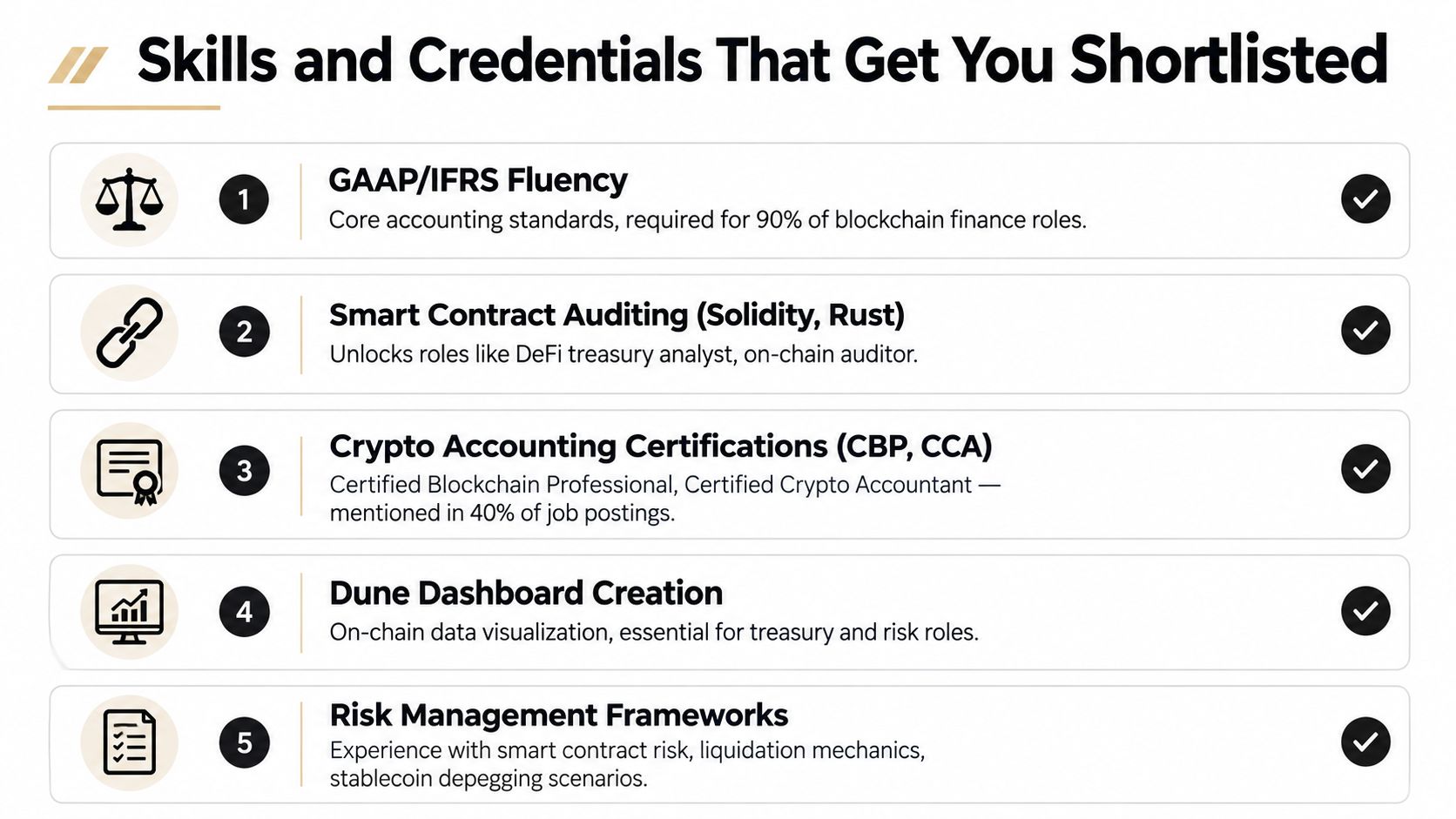
Skills and Credentials That Get You Shortlisted
Hiring managers screen for a stack, not a single blockchain certificate. The foundation remains GAAP or IFRS fluency, three-statement modeling in Excel or Google Sheets, and the ability to inspect a smart-contract address on Etherscan without treating the transaction history as unreadable noise.
From there, add skills based on the role you want:
- Treasury and DeFi operations: Learn wallets, multisigs, bridging risks, stablecoin mechanics, Dune SQL, and basic protocol liquidity analysis.
- Tokenomics: Build supply, vesting, emissions, and dilution models. Solidity literacy helps you read token contracts, while Foundry or Hardhat can help you run simple test scripts.
- Compliance and risk: Connect AML, sanctions, transaction monitoring, travel-rule processes, custody controls, and market-conduct concepts to digital-asset workflows.
- Reporting and controllership: Practice reconciling wallet activity to accounting records, classifying token transactions, documenting valuation assumptions, and explaining exceptions.
- Data-heavy finance: Develop SQL and Python skills. Some employers also value Java, REST microservices, Kafka, and Snowflake experience, particularly where finance teams work alongside platform and data engineering.
Credentials can strengthen a résumé, but they don't replace evidence. A CPA supports audit-heavy protocols and financial reporting. The CFA is useful for treasury, valuation, and tokenomics. CAMS or CAFP can support compliance and sanctions paths, while FRM helps candidates targeting market, liquidity, or protocol risk. Hiring managers also value credentials such as AWS Certified DevOps Engineer or CISSP when finance work touches infrastructure, security, and operational resilience, as reflected in current finance-blockchain job listings.
Translate old skills into new evidence
SOX control testing maps directly to wallet approval matrices, multisig signer reviews, access recertification, and treasury change controls. Payments operations maps to reserve reconciliation, safeguarding, settlement exceptions, and transaction monitoring. Audit maps to evidence retention, control design, and management assertions around digital-asset reporting.
Your soft signals matter too. Write concise finance memos, participate constructively in public DAO forums, document assumptions, and show that you can record decisions on-chain without confusing transparency with control. For résumé structure and role-language examples, compare your bullets with finance descriptions for STAR candidates.
What Blockchain Finance Jobs Actually Pay
A treasury candidate can earn more by proving control ownership than by adding another crypto keyword. Function, regulatory exposure, entity structure, seniority, and token terms set compensation. Treasury, payments, accounting, and compliance roles increasingly follow traditional finance pay logic because employers need people who can protect funds, document decisions, and withstand review. DeFi operations may include token upside, but that upside can weaken retention and total compensation when liquidity or valuation changes.
A 2024 Web3 finance compensation report placed average CFO pay at $181,000 annually, compared with an overall Web3 finance average of $145,000. The same Web3 Finance Compensation Report reported that nearly half of respondents received some or all compensation in crypto. Candidates must therefore evaluate payroll, withholding, valuation, vesting, and personal liquidity, not just the headline number.
A live sample from Sail Onchain included 105 postings with salary data. Pay ranged from $12,000 to $600,000 per year, with a median of $174,500 and a typical range of $152,509 to $195,002, according to its blockchain finance jobs page. Read those figures as market dispersion, not a guaranteed rate for a title. Treasury authority, control design, financial modeling, and jurisdictional expertise can change an offer sharply.
| Function | Analyst / Associate | Manager / Senior | Director / Lead |
|---|---|---|---|
| DeFi operations | Cash plus possible token participation, usually tied to protocol scope | Higher cash for runway, liquidity, and governance ownership | Premium for treasury authority and cross-protocol risk |
| Treasury and accounting | Traditional finance-style base with digital-asset responsibility | Stronger offers for reserves, reporting, controls, and multi-entity work | Executive-level compensation tied to scale, auditability, and capital protection |
| FP&A and tokenomics | Modeling and reporting scope, sometimes token-heavy | Premium for emissions, dilution, and scenario ownership | Strategic compensation for protocol economics and governance influence |
| Payments and stablecoin finance | Operations and reconciliation focus | Higher value for reserve, settlement, and safeguarding controls | Leadership premium where regulatory accountability sits with the role |
| Compliance and risk | Structured entry path through KYC, AML, and investigations | Stronger pay for advisory, sanctions, travel rule, and market-risk expertise | Highest premiums for CCO, Head of Compliance, and jurisdictional ownership |
Ask for the full-year base, not an advertised ceiling. Separate base salary, bonus, equity, and tokens. Model token compensation conservatively, inspect vesting and cliff schedules, confirm eligibility after probation, and test whether the offer remains acceptable after a 50% token drawdown. Check location adjustments, benefits, payroll entity, tax treatment, and whether the employer can legally pay you where you live.
Negotiation rule: Secure the cash floor first. Treat tokens as uncertain upside until vesting, liquidity, tax, and governance terms are documented.
Where to Find Listings and How to Apply Well
A serious search uses several channels at once. Start with specialist blockchain boards, then monitor protocol career pages, fintech employers, custodians, accounting firms, stablecoin issuers, and company LinkedIn accounts. Well-moderated Discord and Telegram communities can surface roles early, but verify every employer before sharing sensitive documents or accepting an interview.
Use search terms that match operating work:
- Treasury analyst: Search for wallet management, cash forecasting, reserve reporting, and custody operations.
- DeFi operations: Add protocol finance, liquidity operations, incentive analysis, and DAO finance.
- Stablecoin finance: Look for reserve analyst, payments controller, safeguarding, and settlement operations.
- Tokenomics research: Search supply modeling, emissions, vesting, valuation, and governance analytics.
- Crypto compliance: Include AML, sanctions, transaction monitoring, travel rule, investigations, and regulatory reporting.
Remote labels require investigation. Confirm hiring countries, payroll entity, time-zone expectations, visa support, travel requirements, and whether the company expects you to work near a regulated entity. “Work from anywhere” can mean very different things depending on the employer's legal and operational setup.
Build a disciplined pipeline
Create a target list of roughly 30 organizations across protocols, exchanges, payment companies, custodians, stablecoin issuers, accounting firms, and infrastructure providers. Track compensation, visa support, token terms, interview stage, contact, follow-up date, and rejection reason in a spreadsheet.
Tailor each application around a finance problem. Replace “passionate about Web3” with evidence such as reconciling wallet activity, improving cash forecasting, designing a treasury policy, documenting token reporting, or testing an approval workflow. Apply within 48 hours when you're qualified, then contact the hiring lead with useful context rather than sending a bare application link.
For a broader remote-oriented search, review Blockchain jobs from We Are Distributed alongside specialist sources. You can also inspect current finance and accounting openings to compare titles, requirements, and employer language. Use referrals carefully. Ask an operator for perspective or a warm introduction, but don't pressure people who haven't offered one.
Pivoting From Traditional Finance Into Web3 Finance
Traditional finance isn't a fallback. For many blockchain finance jobs, it's the strongest entry ticket because digital-asset employers need people who can apply regulated-controls discipline to systems that settle on-chain.
Map your background to a specific seat:
- Accountants and auditors: Target crypto accounting, controllership, revenue assurance, financial reporting, and internal audit.
- Treasury and FP&A professionals: Position yourself for wallet management, stablecoin operations, cash forecasting, and DeFi strategy.
- Banking, payments, and risk candidates: Target operations, transaction monitoring, compliance, settlement, and stablecoin finance.
- Compliance professionals: Connect AML, sanctions, travel-rule, safeguarding, and market-conduct controls to the company's products and jurisdictions.
A treasury candidate shouldn't lead with a claim that they're learning Solidity. Lead with policy design, counterparty limits, liquidity planning, multi-entity cash visibility, and escalation procedures. Then show that you can work with wallets, block explorers, multisigs, accounting platforms, spreadsheets, and SQL.
Build proof before collecting credentials
Create a compact portfolio that demonstrates applied ability:
- Reconcile a set of sample on-chain transactions to an accounting schedule.
- Document a treasury control framework for wallet approvals and signer changes.
- Build a token-supply model covering vesting, emissions, and release schedules.
- Write a DeFi protocol risk assessment covering liquidity, oracle, bridge, and liquidation exposure.
CPA, ACCA, CAMS, and other relevant finance credentials can strengthen regulated applications, but employers usually learn more from a clear artifact than from a logo on a résumé. Translate your previous experience into risk management, reporting integrity, liquidity discipline, and stakeholder control.
A traditional candidate can also use an early-career route to test the market. The digital assets strategy internship program at T. Rowe Price illustrates how institutional pathways can connect conventional finance with digital-asset strategy.
Interview Prep for Blockchain Finance Roles
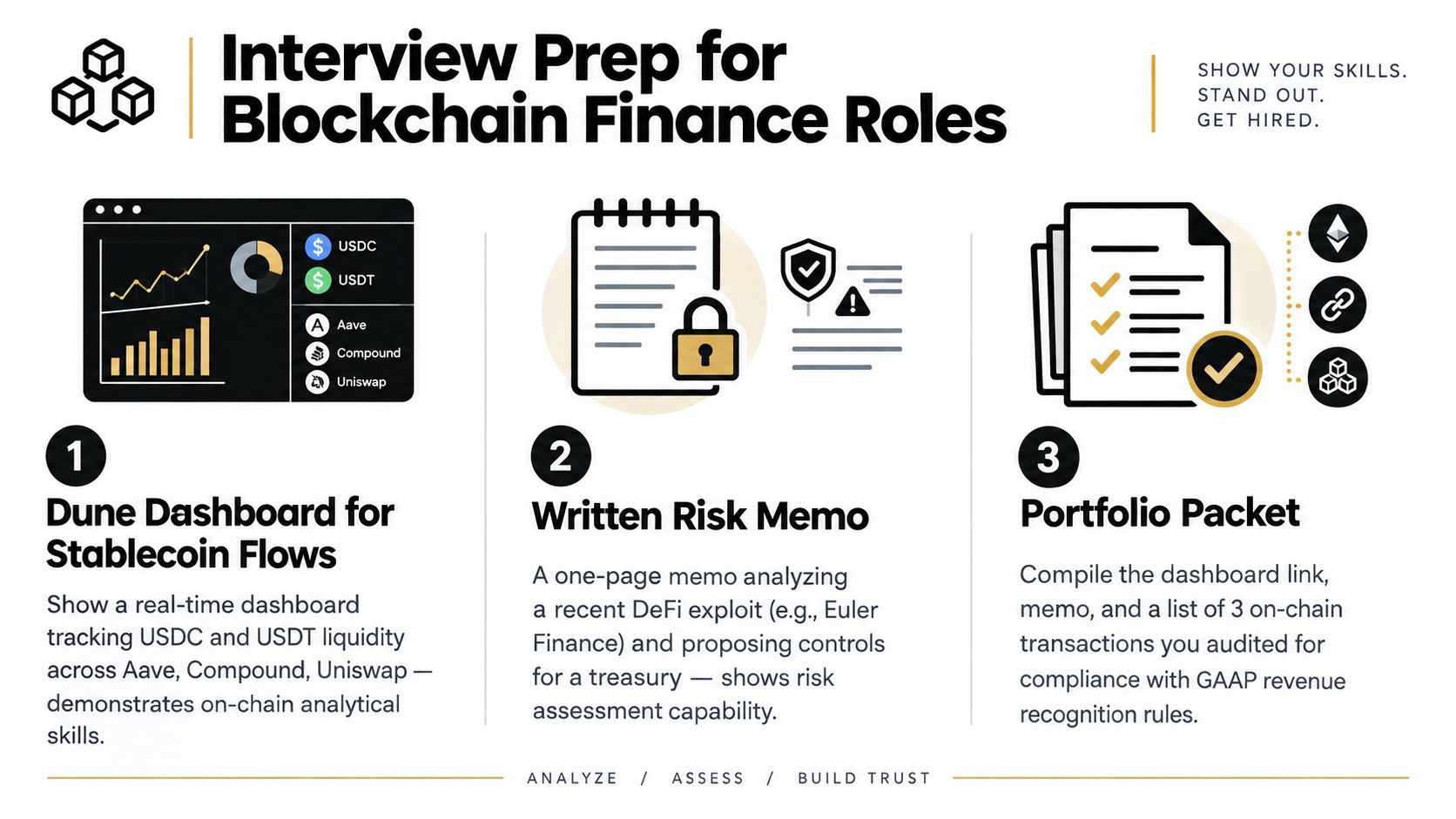
Blockchain finance interviews test whether you can preserve financial discipline when the infrastructure is unfamiliar. Prepare a portfolio packet before you apply, not after the first recruiter call.
Include three artifacts:
- A Dune dashboard: Track stablecoin flows, wallet balances, liquidity movements, and protocol activity. Explain the query logic and the decisions the dashboard supports.
- A written risk memo: Evaluate a protocol's liquidation engine, oracle dependencies, bridge exposure, or reserve risks. State assumptions, controls, escalation triggers, and unresolved questions.
- A treasury policy: Write one page covering wallet ownership, approval thresholds, signer changes, emergency actions, reconciliation, and reporting cadence for a DAO or protocol.
Expect three interview tracks
The technical round may test token mechanics, liquidity, stablecoin peg design, settlement risk, and the difference between a balance-sheet asset and a protocol-controlled position. You should be able to explain a transaction clearly from wallet initiation through confirmation, reconciliation, reporting, and exception handling.
The controls round may cover SOC 2, MiCA, OFAC screening, audit trails, custody, segregation of duties, and evidence retention. Don't answer with slogans. Describe who approves the transaction, what system records it, how exceptions escalate, and how an auditor verifies the control operated.
The culture round often exposes candidates who only understand centralized finance. Be ready to discuss pseudonymous counterparties, multisig signers, DAO governance votes, emergency pauses, and situations where transparent code still leaves unclear accountability.
Interview standard: Explain the control, the owner, the evidence, the failure mode, and the escalation path. That answer is stronger than a long explanation of why blockchain matters.
Rehearse practical scenarios. Calculate runway across USDC, ETH, and stETH holdings. Explain why a bridge was halted. Walk a founder through a token vesting cliff. Describe how you'd investigate an unexplained wallet movement and what you'd report to the audit committee. References from Big Four, treasury, banking, or compliance leaders can reinforce your credibility because they validate the discipline behind your transition.
Your 90-Day Plan to Land a Blockchain Finance Role
Use three focused sprints. Don't spend the entire period consuming crypto commentary. Produce evidence, create a targeted pipeline, and practice the interviews that expose weak spots.
Days 1 to 30 for the baseline
Rewrite your résumé in a Web3 format. Put controls, liquidity, reporting, risk, and regulatory experience near the top, then add the blockchain tools you can use. Complete Chainalysis Reactor or an ICA blockchain certificate if it supports your target role, and publish one artifact such as a Dune query, treasury policy, or written risk memo.
Days 31 to 60 for the pipeline
Subscribe to eight niche boards, follow 30 protocol treasury leads on LinkedIn and X, and set alerts for treasury, tokenomics, and DeFi operations titles. Apply to 20 targeted roles, while requesting three warm introductions per week through relevant Discord and Telegram communities. Track responses by channel so you know whether your résumé, targeting, or interview performance is the constraint.
Days 61 to 90 for the close
Run 10 mock interviews covering token mechanics and controls scenarios. Convert two referrals into active conversations, then negotiate with the compensation benchmarks already discussed. Keep a decision log that records every application, interview question, compensation term, and rejection reason.
| Sprint | Focus | Key Deliverables | Success Metric |
|---|---|---|---|
| Days 1 to 30 | Baseline | Web3 résumé, credential progress, one portfolio artifact | A credible profile for a defined role family |
| Days 31 to 60 | Pipeline | Board subscriptions, target-company research, tailored applications, warm introductions | A measurable flow of qualified conversations |
| Days 61 to 90 | Close | Mock interviews, referral conversion, offer analysis, negotiation | An offer or a sharper re-plan based on recorded evidence |
The ladder is straightforward. Start with transferable controls or finance experience, add practical blockchain tooling, prove your work with a portfolio, target a function rather than a fashionable title, and negotiate the cash and token terms separately. Candidates who follow that sequence will outperform applicants who list every crypto keyword but can't explain how a treasury transaction gets approved, recorded, reconciled, and reported.
Blockchain Jobs gives candidates a focused way to search opportunities across Web3 finance, accounting, operations, compliance, and related functions without relying on generic job-board noise. Visit Blockchain Jobs to find current openings, compare role requirements, and start building a targeted blockchain finance pipeline today.