
Cryptocurrency Jobs Remote: Your 2026 How-To Guide

Remote crypto hiring is big enough now that treating it like a side market is a mistake. A quick scan of remote cryptocurrency roles on Blockchain Jobs shows the range immediately: engineering, security, product, operations, research, finance, and growth. The opportunity is real, but so is the filter.
From a hiring manager's seat, remote crypto candidates usually fail for predictable reasons. They submit the same resume they send to SaaS companies. They describe responsibilities instead of shipped work. They say they are “passionate about blockchain” but show no on-chain curiosity, no public writing, no governance participation, no useful side project, and no proof they can operate without constant oversight.
That is why strong candidates get interviews faster. They reduce risk fast.
Your job is not to sound excited about Web3. Your job is to make a remote team believe you can contribute in a low-context, high-volatility environment without creating drag. That means a resume with sharp evidence, a portfolio with relevant work, and interview answers that show judgment under uncertainty.
The same logic applies across role types. An engineer needs proof of code quality and security awareness. A product hire needs evidence they understand incentives, users, and protocol constraints. A trader or analyst exploring paths like crypto prop trading still gets judged on edge, discipline, and whether their track record is credible.
Approach this market the way hiring managers do. Ask what would make you easy to trust, easy to onboard, and worth the salary from day one. That is the standard that gets remote crypto offers.
The New Reality of Remote Crypto Work
Remote crypto hiring now spans enough companies, functions, and salary bands that you should treat it like a real labor market, not a niche side path. Compensation is also strong at the top end. For example, a Senior Infrastructure Engineer role on CryptoJobsList shows how serious remote crypto teams pay for scarce technical talent.
Here is the part candidates miss. Hiring managers are not impressed by your interest in Web3. They care whether you will be easy to trust in a remote, fast-changing environment where context is thin and mistakes are expensive.
That shifts the standard.
A remote crypto candidate gets screened on judgment, communication, and evidence of relevant work before pedigree matters much. If your background makes sense on paper but your application reads like generic tech, you look expensive to onboard.
What hiring managers actually screen for
From the hiring side, the first question is simple. Will this person create momentum or create drag?
That usually breaks into three checks:
- Async competence: Can you write updates clearly, make progress without constant calls, and leave a clean decision trail?
- Judgment under ambiguity: Can you work through shifting priorities, incomplete specs, and public feedback loops without stalling?
- Web3 context: Do you understand incentives, token mechanics, governance, security tradeoffs, and the difference between users, speculators, validators, and core contributors?
Candidates who pass these checks get moved forward faster. Candidates who do not usually get filtered out before a serious interview.
If you are targeting engineering roles, spend time reviewing active remote crypto engineering openings and read them like a hiring manager. The pattern will be obvious. Teams want people who can ship in public, document decisions, and handle ownership without hand-holding.
Practical rule: Your application should reduce uncertainty within 30 seconds.
Why the old job search playbook breaks here
Traditional tech habits often produce weak crypto applications. A polished resume, a tidy LinkedIn, and broad claims about “innovation” do not answer the questions a remote crypto team has.
They want proof tied to the role. For engineers, that can be shipped code, audits, performance work, or security-minded architecture choices. For product and ops hires, it can be governance posts, ecosystem analysis, user research, token design critique, or process docs that show you can operate with little supervision. For commercial and growth roles, it can be partnership work, community programs, analytics, or market expansion work with clear outcomes.
The hiring manager is asking one thing throughout. Can this person contribute with low oversight in a market that changes weekly?
If your materials answer that clearly, you look hireable. If they do not, you look generic.
Sourcing High-Signal Remote Crypto Roles
If you're applying through giant generic job boards, you're wasting time. The remote crypto market behaves differently from general software hiring. In June 2021, 44% of crypto software development jobs on Indeed were remote versus 31% of all other software development postings, according to Indeed Hiring Lab's crypto hiring analysis. Remote-first is not a perk here. It's the baseline.
That means you need a better search process, not more applications.
Start with boards that already filter for the niche
Your first pass should focus on specialist boards where the employer already expects crypto-aware applicants. That cuts down on noise and raises the odds that your application lands with someone who knows what they're hiring for.
A practical place to start is the remote roles feed on Blockchain Jobs. Use it as a filter, not a crutch. Scan titles, note recurring skill asks, and track which companies keep appearing.
Then branch out to project career pages, ecosystem foundation sites, and investor portfolio pages. Good crypto roles often appear there before they spread wider.
Judge role quality before you apply
Not every posting deserves your time. Some are real openings. Some are resume collection. Some are chaos in text form.
Use this quick screen:
| Signal | What to look for | What it usually means |
|---|---|---|
| Scope clarity | Deliverables, team context, reporting line | The manager has defined the need |
| Technical specificity | Named stack, protocol type, user segment | The team knows what success looks like |
| Compensation transparency | Salary, token component, or clear band logic | Less wasted time later |
| Operational detail | Time zone, async expectations, overlap hours | They've actually run distributed teams |
| Public footprint | Team members, product docs, GitHub, community | Easier diligence for you |
If a posting is all slogans and no operating detail, skip it.
Use social channels for jobs before they become “jobs”
A lot of strong remote crypto roles start as conversations, not listings. Founders post on X. Contributors mention hiring in Discord. Operators ask their network before a formal requisition ever goes live.
That's where candidate edge shows up. You don't need to camp in every server. You need a short list of projects you respect and a habit of checking where those teams communicate.
A smart move is to track adjacent paths too. If you're exploring trading-adjacent roles, market structure, or execution-heavy crypto work, resources on crypto prop trading can help you understand how some firms think about performance, risk, and candidate fit. That context can sharpen how you read job descriptions, especially for analyst and trading-side roles.
Most candidates search for openings. Better candidates track companies, contributors, and product momentum, then apply before the crowd notices.
Build a weekly sourcing rhythm
Don't “job hunt” in random bursts. Run a simple operating system.
- Monday: Review specialist job boards and save only roles that match your actual skill set.
- Midweek: Check founder posts, ecosystem channels, and community announcements for unlisted hiring signals.
- Friday: Send a small number of customized applications and follow up on warm paths.
This beats sending twenty weak applications in one afternoon. Hiring managers can smell mass apply behavior almost instantly.
Tailoring Your Resume and Portfolio for Web3
Your old resume is probably underselling you. In crypto hiring, the issue usually isn't lack of experience. It's lack of translation.
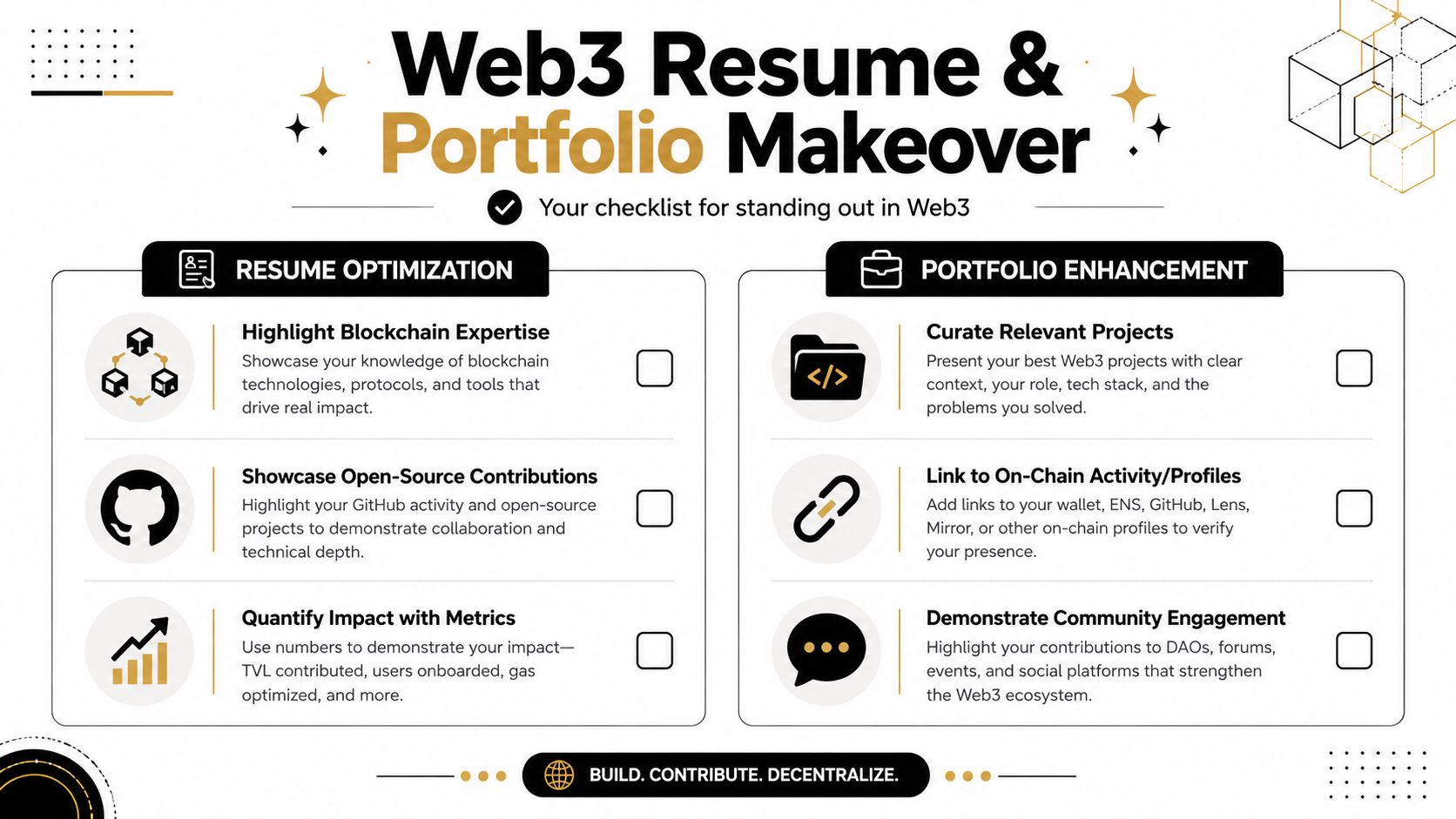
Hiring managers don't want a laundry list. They want evidence that you understand Web3 work as it's done. That means your resume needs to show ownership, speed, judgment, and domain familiarity.
Rewrite bullets to sound like a person who's done the work
Most resumes fail because they read like HR summaries. Crypto teams want operator language.
Here's the difference:
| Weak bullet | Better Web3 version |
|---|---|
| Managed product roadmap for fintech app | Owned roadmap for wallet and transaction flows, prioritized release tradeoffs across compliance, UX, and engineering |
| Led community growth efforts | Built and moderated community programs across Discord and social channels, turned user feedback into product and content priorities |
| Wrote content for blockchain brand | Produced protocol explainers, launch content, and ecosystem education tailored to users, partners, and token holders |
| Improved security processes | Coordinated incident response workflows with engineering and security stakeholders, documented operational controls for distributed teams |
The stronger version sounds closer to how crypto teams talk about work. It's specific without pretending.
Show proof of work, not just employment
A lot of promising candidates have relevant skills but no obvious crypto signal. That's fixable. Build a lightweight portfolio around evidence.
For engineers, this can include GitHub repos, protocol contributions, audits, testnet builds, hackathon work, or technical writing. For product managers, designers, marketers, and community people, the proof looks different but it still counts.
Use a simple portfolio stack:
- Public writing: Post protocol teardowns, governance summaries, or user journey critiques.
- On-chain familiarity: Link wallets, governance participation, or ecosystem profiles when appropriate.
- Project artifacts: Include Figma files, strategy docs, launch plans, dashboards, or research memos.
- Open collaboration: Show how you worked in public, not just what you shipped in private.
If you're targeting engineering roles, reviewing live blockchain engineering openings helps you mirror the language hiring teams use around infrastructure, protocol development, and security.
Hiring signal: A portfolio doesn't need to be huge. It needs to remove doubt.
What non-developers get wrong
Non-technical candidates often assume they need to fake technical depth. Bad move. Hiring managers can tell.
What you should do instead is demonstrate market literacy. Explain a protocol clearly. Compare community incentive models. Break down a launch. Show that you understand users, distribution, governance, and risk. That's far more valuable than sprinkling in buzzwords.
A strong Web3 portfolio says, “I can think inside this market.” That's what gets interviews.
Networking in Web3 Communities to Get Hired
Networking in Web3 doesn't work like traditional corporate networking. Nobody cares that you sent a polished cold message saying you'd “love to connect.” They care whether your name has shown up attached to useful work.
That's why reputation often beats pedigree in remote crypto hiring. Teams trust people they've seen contribute, explain, fix, moderate, review, or ship.

Contribution creates familiarity
If I'm hiring for a remote role, I'd rather talk to the candidate who's been making useful comments in governance discussions than the candidate who sends a perfect resume with no visible footprint.
Why? Because community behavior tells me how you think in the wild. I can see whether you ask sharp questions, whether you understand incentives, and whether you know how to disagree without becoming a problem.
Useful contribution can look like:
- GitHub input: Filing issues, improving docs, testing features, or reviewing implementation details.
- Community stewardship: Helping users in Discord, clarifying confusing product updates, or surfacing repeat pain points.
- Research and commentary: Posting thoughtful protocol analysis on X, Mirror, or personal blogs.
- Governance participation: Reading proposals, asking grounded questions, and commenting with actual substance.
None of this requires you to become a full-time content machine.
Don't chase visibility. Build trust.
A lot of candidates over-index on “personal brand” and under-invest in signal. They post hot takes, repost headlines, and try to sound plugged in. Hiring managers usually ignore that.
What gets remembered is consistency. If you write online, write usefully. If you use LinkedIn as one part of your professional surface area, sharpen your distribution with an effective LinkedIn growth guide so your posts don't die unseen. But keep the standard high. Empty posting hurts more than silence.
The fastest way to become hireable in Web3 is to become recognizable for something useful.
A practical reputation ladder
You don't need insider access. You need repetitions.
Pick a lane
Stay focused for a while. Security, infra, product, data, compliance, community, growth. General curiosity is fine. General positioning is weak.Choose a few ecosystems
Follow a small number of teams closely enough that your comments have context.Make visible contributions
Publish notes, answer questions, test products, suggest fixes, summarize governance decisions.Turn warm familiarity into conversations
Once people have seen your work, outreach gets easier and less awkward.
This is one of the rare hiring markets where a pseudonymous contributor with a real track record can outcompete a polished but invisible applicant.
Nailing the Web3 Interview and Technical Assessment
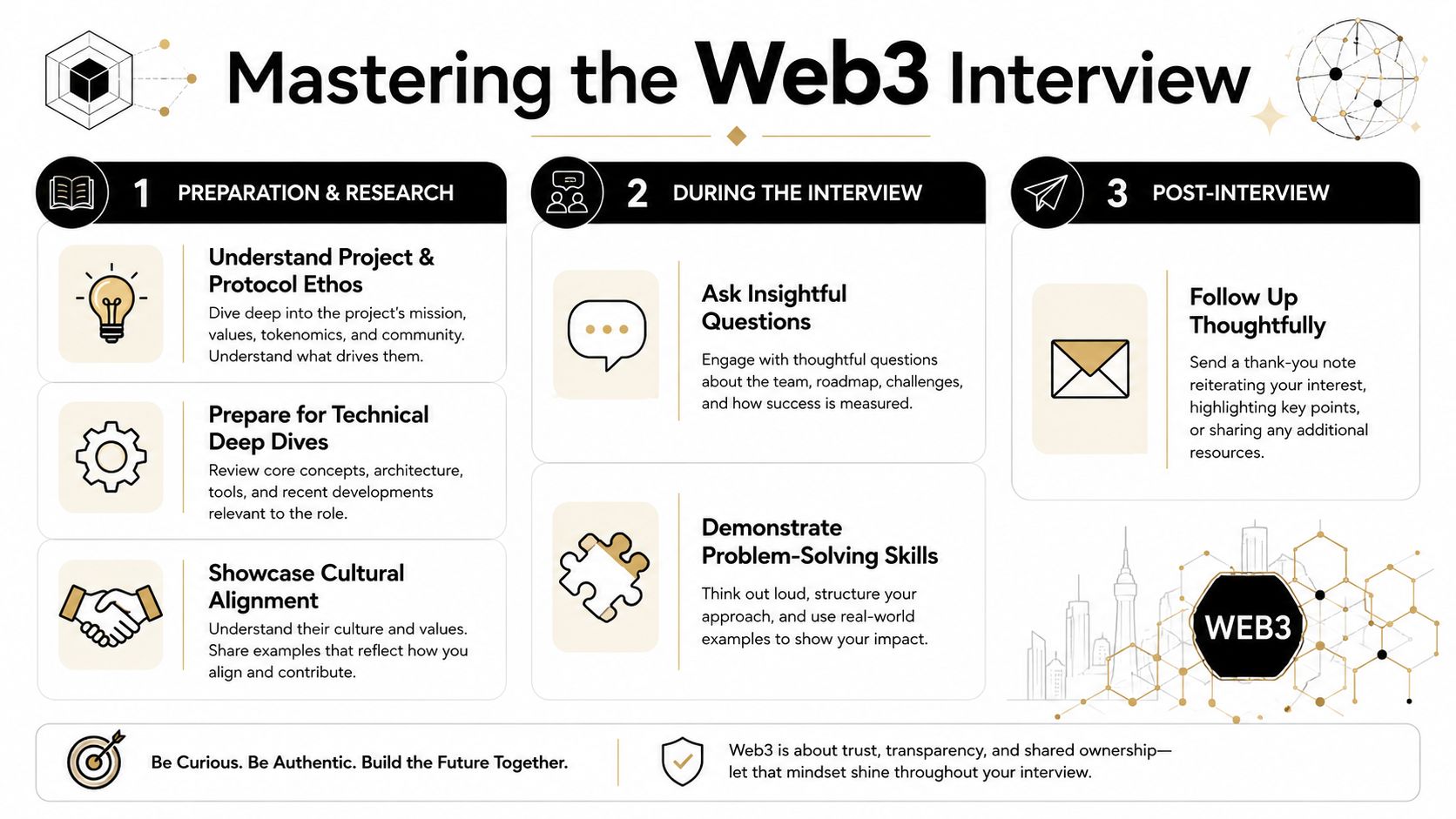
By the time you're interviewing, the team already thinks you might be able to do the job. The interview is about risk, judgment, and fit under pressure.
For remote cryptocurrency jobs, that matters even more because teams are often small, distributed, and moving fast. They don't have much tolerance for passengers.
The money is real, too. ZipRecruiter reported that the average yearly pay for remote cryptocurrency jobs in the United States was $97,445 as of June 15, 2026, with most workers earning between $52,000 and $138,000, and a separate market snapshot put the average remote salary at $85,266, as shown in ZipRecruiter's remote cryptocurrency pay data. Teams paying at that level don't just want enthusiasm. They want conviction that you can operate.
What culture fit really means in crypto
Culture fit is a loaded term. In practice, most hiring managers are testing whether you can function in a decentralized, low-structure environment.
Expect questions that reveal:
- How you make decisions with incomplete information
- How you handle async communication
- How you prioritize when multiple stakeholders pull in different directions
- How you react when markets or community sentiment shift fast
A weak answer sounds polished but generic. A strong answer is grounded in a real example, shows your tradeoffs, and makes it clear you don't need excessive supervision.
Here's a useful prep asset before you interview:
How to handle technical and practical assessments
Crypto assessments can feel compressed. Some are highly technical. Some are business-heavy. Almost all of them are trying to simulate actual work.
For developers, the test may involve smart contract review, protocol design thinking, infrastructure judgment, or debugging under constraints. For non-developers, expect assignments like a launch plan, ecosystem growth memo, product critique, or market analysis.
Use this approach:
- Clarify assumptions early: If the brief is vague, ask smart scoping questions.
- Show your reasoning: Don't just hand over the answer. Explain tradeoffs and priorities.
- Keep it practical: Hiring managers want execution logic, not performative depth.
- Tie back to users and risk: In Web3, product choices often have financial and security consequences.
A good interview answer doesn't prove you know everything. It proves you know how to think.
Ask questions that adults ask
Most candidates waste the final interview segment on safe questions they copied from the internet. Don't do that.
Ask about operating realities:
| Better question | Why it matters |
|---|---|
| What does success look like in the first stretch of this role? | Reveals whether the team has real expectations |
| Where does the team currently lose time or clarity? | Surfaces operational pain |
| How are product, engineering, and community decisions made? | Shows whether the org is coherent |
| What risks do you think the team is underestimating? | Signals judgment |
| How does remote collaboration actually work day to day? | Exposes whether “remote” is mature or messy |
Smart questions make you sound like a future teammate, not a hopeful applicant.
Negotiating Your Offer and Thriving Remotely
A crypto offer is rarely just a salary. It's a package with moving parts, and candidates mess this up all the time by focusing only on the cash number.
For senior remote crypto roles, the spread can be huge. One market guide reports senior blockchain developer remote pay at about $180,000 to $250,000 globally, with top performers reaching higher, while smart contract auditors can earn $150,000 to $300,000+ with bug bounty upside, according to Crypto Recruit's remote crypto compensation guide. That kind of range tells you something important. Scarcity drives pricing more than tidy title ladders do.
Evaluate the full package
When you get an offer, break it into parts.
| Offer component | What to check |
|---|---|
| Base pay | Fiat or stablecoin, payment schedule, currency risk |
| Equity or tokens | Vesting terms, lockups, liquidity reality, dilution risk |
| Bonus upside | Performance structure, bug bounties, milestone logic |
| Working model | Time zone overlap, meeting load, async expectations |
| Legal structure | Employment, contractor status, local compliance implications |
If the company can't explain how compensation works in plain English, treat that as a warning.
Negotiate with a scarcity argument, not vibes
The best negotiations in crypto are evidence-based. Tie your ask to hard-to-replace skills, relevant execution history, and role risk.
Good framing sounds like this:
- I've done closely related work in a comparable environment.
- I can shorten your onboarding risk because I already understand the tools, users, or protocol category.
- The role combines responsibilities that usually sit across multiple hires.
Bad framing sounds like, “I'm very excited and believe I'd add a lot of value.”
Excitement is not an advantage.
If you want a concrete example of how some teams define remote conditions, overlap expectations, and distributed role setup, review a live posting like this remote-first role with PST overlap. You're not copying the job. You're training your eye to spot how serious teams structure the work.
Negotiate for clarity first. Compensation gets messy when role scope stays fuzzy.
Remote success starts after the signature
A lot of hires win the offer and then stumble in the first month because they treat remote like freedom instead of a performance system.
The people who last in crypto remote roles usually do a few things well:
- They over-communicate progress without spamming
- They write decisions down
- They raise risks early
- They build relationships before urgent work forces it
- They learn the team's actual rhythm instead of imposing their own
Remote crypto teams reward people who create momentum without drama. If you become the person who makes unclear work clearer, your career compounds fast.
Common Questions About Remote Cryptocurrency Jobs
Are remote crypto jobs really location-independent
Often, no. Many “remote” crypto jobs still restrict applicants by jurisdiction or time zone. Some listings explicitly require overlap with European or American time zones, and some employers adjust compensation by location, as noted on Crypto Jobs List remote job coverage. So when you see cryptocurrency jobs remote, read the fine print before you get attached.
The practical distinction matters:
- Remote can mean you work from home in an approved country.
- Distributed usually means the team is spread out, but not necessarily globally open.
- Globally remote is the rare version where geography is broad.
Ask this early in the process. Don't wait until the final round to discover they can't hire in your region.
How should I think about taxes and crypto-denominated pay
Treat this like a professional issue, not a Reddit thread. If part of your compensation is paid in crypto or stablecoins, keep clean records from day one and get qualified tax advice when the setup is unclear.
The biggest mistake candidates make is assuming payment format changes nothing. It can affect reporting, timing, local compliance, and how you evaluate volatility risk.
What red flags should make me walk away
Three come up often.
- Pressure and vagueness: If the team pushes urgency but avoids clear scope, pause.
- Compensation fog: If nobody can explain salary, token terms, or vesting cleanly, that's a bad sign.
- Operational immaturity: If the team can't describe decision-making, reporting lines, or basic communication habits, remote work there will be painful.
One more thing. If a role asks you to move funds through your personal wallet, “process payments,” or act as a pass-through for someone else's crypto activity, walk away immediately. Legitimate employers don't hire that way.
If you're serious about landing a role in Web3, keep your search focused and your proof of work visible. Blockchain Jobs is one place to track current openings across functions like engineering, product, marketing, operations, compliance, and more, especially if you want a dedicated board built around blockchain and crypto roles rather than a generic job aggregator.