
Cryptocurrency Sales Jobs: Land Your Web3 Career Now

A crypto sales job is all about bringing capital and users into the Web3 ecosystem. You're on the front lines, pitching the products and services of innovative protocols, exchanges, and platforms to the institutions and individuals with the capital to drive real impact. It’s a fast-paced career path that offers accelerated growth for sales professionals who want to be at the center of financial innovation.
Understanding The Crypto Sales Landscape

While traders often dominate the crypto narrative, the industry's sustainable growth is built by sales professionals who forge key relationships and bring in institutional capital. A career in crypto sales places you directly at the intersection of high finance and transformative technology, making you a critical engine for the entire ecosystem's expansion.
Your ability to connect with clients and close deals directly fuels the adoption of new protocols and platforms. You're not just selling a product; you're evangelizing a new financial paradigm. The career progression opportunities here are immense, as the global crypto industry already employs around 1.6 million people, with the workforce growing by over 50% since 2020. With remote roles making up about 40% of all new Web3 listings, it's also a highly flexible and global field.
What Does a Crypto Sales Job Actually Entail?
Selling in crypto is a far cry from a standard SaaS role. To succeed, you must possess a strong command of complex financial instruments, tokenomics, and the inherent volatility of the market. Your day-to-day responsibilities will vary, but the ultimate goal is always the same: drive measurable growth for the network.
To help you identify the right fit for your career goals, here are some of the most common sales roles in the crypto space and their typical client focus.
Key Cryptocurrency Sales Roles and Targets
| Role Title | Primary Focus | Target Client |
|---|---|---|
| Institutional Sales Rep | Selling investment products, trading tools, or custody solutions. | Hedge funds, family offices, asset managers, VCs. |
| Business Development Manager | Building strategic partnerships to expand user bases and network effects. | Other protocols, dApps, ecosystems, Web2 companies. |
| Protocol Sales Specialist | Educating and onboarding enterprises onto a specific blockchain or L2. | Large corporations, tech companies, financial institutions. |
| Partnerships Manager | Sourcing and managing integrations with other projects. | DeFi protocols, wallets, exchanges, data providers. |
| Account Executive | Closing deals for specific products like data APIs or infrastructure services. | Developers, startups, small to mid-sized businesses. |
Each of these roles requires a distinct approach, but all demand a powerful combination of sales expertise and deep crypto fluency.
The career trajectory in this space is accelerated. A successful Business Development Representative (BDR) can move into a senior account executive role within 18 months, and from there, into a Head of Partnerships position in just a few years—a pace rarely seen in traditional finance or tech.
If you're transitioning from another industry, your core sales skills—pipeline management, relationship building, closing—are highly transferable. The key to getting hired is to layer a genuine, demonstrable passion for the decentralized world on top of that foundation. To gain further career insights, check out our blog on blockchain industry trends.
What It Really Takes to Land a Top Web3 Sales Job

Consistently hitting quota is essential, but excelling in cryptocurrency sales jobs requires more. It’s about building trust in an ecosystem built on verifiable truth, not just handshakes. To secure an interview, you need a specific blend of deep technical knowledge and sharp soft skills that traditional sales playbooks don't cover.
Hiring managers are looking for authenticity. They need team members who are true believers in the technology and can articulate its value proposition with conviction, not just recite a script. This means getting comfortable with the core concepts that power Web3. You don't need to be a developer, but you must be able to speak the language of the engineers and investors you'll be selling to. This isn't optional—it's the price of admission, and you will be tested on it during the interview process.
Getting the Technical Side Down Cold
To stand out in a competitive hiring pool, you must demonstrate a functional grasp of the technology you're selling. Recruiters and hiring managers can easily spot a candidate who is faking their way through technical concepts. Your first objective is to establish credibility the moment the interview begins.
Focus your learning on these key areas to prepare for interviews:
- Blockchain Mechanics: Understand the difference between Layer 1 and Layer 2 solutions. Be prepared to explain various consensus mechanisms (e.g., Proof-of-Work vs. Proof-of-Stake) and articulate how a transaction is validated and secured on-chain.
- DeFi Primitives: Know the foundational building blocks of decentralized finance. Be ready to discuss automated market makers (AMMs), lending protocols, yield farming, and liquidity pools with confidence.
- Tokenomics: This is critical. You must be able to analyze a project's token distribution, utility, and incentive models. A hiring manager may ask, "How does this token model incentivize network adoption and long-term value accrual?"
In an interview, nobody's going to ask you to write a line of code. But they might ask you to explain a tricky concept like "impermanent loss" to a portfolio manager or break down the value of a specific ZK-rollup. Your real power lies in making complex ideas simple.
Mastering the Human Element of Web3 Sales
Technical fluency gets you the interview, but soft skills get you the job offer. The most successful sales professionals in crypto are masters at building genuine connections and navigating the industry's unique, community-driven culture. These are the skills that separate a good salesperson from a great one—the kind who can close the high-stakes deals required in senior positions, like a Sales Director role at Fireblocks.
Here’s where to focus your professional development:
- Consultative Selling: Your job is to act as a trusted advisor. This means asking insightful questions to uncover a client's core pain points—be it security, scalability, or market access—and positioning a decentralized solution that directly addresses them.
- Building Genuine Rapport: Crypto is driven by community. If you're pitching a partnership to a DAO, join their Discord or Telegram first. Participate in the conversation, understand their governance model, and demonstrate that you're invested in their project’s success, not just your commission.
- Adaptability and Resilience: The crypto market is notoriously volatile. A strong pipeline can evaporate in a market downturn. Hiring managers need to see that you possess the grit to handle this pressure, pivot your strategy, and maintain focus on long-term goals.
How to Frame Your Experience for Crypto Roles

While your traditional sales experience is your greatest asset, breaking into top cryptocurrency sales jobs requires you to speak the language of Web3. Hiring managers aren't looking for another quota-crusher; they need someone who understands the unique metrics and growth drivers of a decentralized network. The key is to translate your proven track record into terms that resonate with a crypto-native team.
Simply listing past achievements won't be enough. You must reframe them. Instead of focusing solely on Annual Recurring Revenue (ARR) or deal count, quantify the impact of those deals in a Web3 context. Did your work increase active users, deepen liquidity pools, or drive broader protocol adoption? These are the outcomes that truly matter.
Translating Your Resume for Web3 Impact
A recruiter typically spends only about six seconds reviewing a resume. Your bullet points must immediately demonstrate your understanding of the crypto space and prove that your skills are directly transferable.
Let's make this actionable. A standard bullet point from a SaaS sales role might read:
Before:
- "Exceeded annual sales quota by 140%, generating $2.5M in new ARR by selling enterprise software solutions."
While impressive, it doesn't connect with a Web3 hiring manager. Now, let’s reframe that same accomplishment using crypto-specific metrics to show you understand what drives success in this industry.
After:
- "Drove a 35% increase in protocol user acquisition over two quarters, directly contributing to a $15M growth in Total Value Locked (TVL)."
This revised version proves you understand key performance indicators like user acquisition and TVL—the core metrics that define success for a DeFi protocol or blockchain project.
Optimizing Your LinkedIn for Crypto Recruiters
Your LinkedIn profile is often the first touchpoint for a recruiter. It must be optimized with relevant keywords and demonstrate genuine engagement with the industry. Hiring managers want to see passion, not just a job seeker chasing a paycheck.
- Keyword Optimization: Integrate terms like "DeFi," "tokenization," "institutional adoption," "Layer 2," and "protocol growth" into your headline, summary, and experience sections. This is how you appear in recruiter searches.
- Demonstrate Passion: Your activity on the platform serves as public proof of your commitment. Share insightful articles about market trends, post thoughtful comments on content from industry leaders, and engage in relevant groups.
A well-optimized LinkedIn profile does more than just attract recruiters; it’s your digital resume and portfolio rolled into one. Think of it as pre-selling your expertise. If a hiring manager sees you intelligently discussing the implications of a new EIP or a cross-chain bridge, you’ve already proven your interest before you even hop on a call.
By strategically reframing your accomplishments and actively participating in the ecosystem, you position yourself not just as a traditional salesperson, but as the Web3 growth leader that companies are eager to hire.
Navigating the Web3 Sales Interview Process
Preparing for a cryptocurrency sales job interview is a unique challenge. The process is a multi-stage gauntlet designed to rigorously test not only your sales acumen but also your technical depth, market instincts, and resilience in a volatile environment.
You might go from a high-level chat with a recruiter to a deeply technical discussion with a founder or head of engineering. This rigorous process exists for a reason: companies need to be certain you can do more than close a deal. They need to see that you can think strategically, grasp complex technology, and earn the trust of highly intelligent and skeptical buyers.
From Recruiter Screens to Founder Deep Dives
The journey to a Web3 sales offer typically unfolds over several distinct stages. Each stage is designed to assess different attributes, from your cultural fit and passion to your ability to strategize and execute.
- Recruiter & Hiring Manager Calls: These initial calls focus on your background, your motivation for moving into crypto, and your understanding of the company's mission. Be prepared with a compelling and genuine answer for "Why Web3?" and "Why this specific project?"
- Technical Deep Dive: This is where your knowledge is put to the test. Expect to meet with a product manager or engineer who will assess your understanding of their protocol, the competitive landscape, and the broader ecosystem.
- The Practical Assessment: Many companies use a take-home assignment to evaluate your practical skills. You might be asked to create a mock go-to-market plan, build a sales deck for a specific client profile, or outline your 30-60-90 day strategy. Treat this as your opportunity to showcase your strategic thinking.
- Final Round with Leadership: The last stage is often a conversation with a founder or C-level executive. This discussion typically focuses on your strategic mindset, long-term vision, and cultural alignment. They are assessing your potential as a future leader within the organization.
Remember that every interview stage is a two-way street. This is your chance to ask sharp questions about their tokenomics, financial runway, and community governance. This not only demonstrates your expertise but also helps you vet whether the company is a good long-term fit for your career.
Answering Tough, Crypto-Specific Questions
Standard sales interview questions get a Web3 makeover. You won't just be asked about your sales process; you'll be asked how that process holds up during a brutal bear market. You must be ready with specific, real-world examples that demonstrate your resilience and strategic thinking.
Use the STAR method (Situation, Task, Action, Result) to structure your answers, providing compelling narratives backed by data.
Prepare for questions like these:
- "How would you pitch our Layer-2 solution to a skeptical enterprise client worried about security?" A strong answer will demonstrate that you understand their specific concerns (e.g., smart contract risk, regulatory uncertainty) and can translate complex technical features into tangible business benefits like cost savings and operational efficiency.
- "Walk me through a time when market volatility completely wrecked your pipeline. How did you recover?" This is a direct test of your resilience. Don’t just say you worked harder. Detail how you re-prioritized leads, shifted focus to more stable market segments, and nurtured long-term relationships with prospects who were temporarily on pause.
The Current Hiring Environment
To navigate the interview process successfully, you need a realistic view of the market. The crypto job market is cyclical, but the demand for high-caliber sales talent remains constant.
While technical roles comprise about 60% of job openings, the remaining 40% are focused on market expansion—including sales and business development. Notably, around 65% of current openings are for mid- to senior-level specialists and department heads, indicating that companies are prioritizing experienced professionals to drive sustainable growth. For a deeper analysis, explore crypto hiring trends to stay informed.
By thoroughly preparing for each unique stage and mastering your professional narrative, you can enter every interview with the confidence needed to land an exceptional role.
Decoding Your Crypto Sales Compensation Package
Understanding a compensation offer for a crypto sales job requires a different mindset than evaluating a traditional tech package. Web3 offers often include powerful wealth-building components tied directly to network growth. Successfully negotiating these elements is critical for maximizing your long-term career and financial success.
The components may seem familiar—base salary, performance incentives, equity—but the structure is unique. Your base salary provides stability, while the performance incentives offer significant upside directly linked to the project's success.
Beyond Standard Commission Structures
In crypto sales, your variable compensation is rarely a simple percentage of a contract value. More often, it's tied to on-chain metrics that you directly influence. This model creates a powerful alignment between your personal success and the overall health of the protocol.
Your performance incentives are often linked to key metrics such as:
- Total Value Locked (TVL): For DeFi roles, your bonus might be calculated based on the new TVL generated through your partnerships.
- Trading Volume: If you work for an exchange, your compensation could be tied to the trading volume from the institutional accounts you manage.
- Active Wallets or Users: For roles focused on adoption, you could be rewarded based on the growth of new, active wallets interacting with the protocol.
During salary negotiations, it is crucial to ask, "How are these performance metrics tracked and attributed to my efforts?" Insist on a transparent system to ensure your contributions are accurately measured and rewarded.
The Power of Token Incentives
This is where a crypto sales offer can significantly outperform a traditional tech package. Token incentives grant you direct ownership in the network you are helping to build. While a tech offer may include stock options, tokens can provide faster liquidity and potentially life-changing upside if the project succeeds.
However, token grants come with their own set of rules. As you progress through interviews and negotiate an offer, you must get clear answers on these key points:
- Vesting Schedule: How long until the tokens are fully yours? A standard schedule is a one-year "cliff" (you receive no tokens if you leave before one year), followed by monthly or quarterly vesting over the next three to four years.
- Lock-up Periods: Once your tokens vest, are there any restrictions on selling them? It is common for early team members to have lock-up periods to promote market stability.
- Liquidity: Is the token already trading on major exchanges like Coinbase or Binance? Or will liquidity be established at a future Token Generation Event (TGE)? The answer dramatically impacts their immediate value.
Here's a comparison to clarify the differences in compensation models:
Traditional Tech Sales vs Crypto Sales Compensation
| Component | Traditional Tech Sales (Example) | Cryptocurrency Sales (Example) |
|---|---|---|
| Base Salary | Competitive fixed salary providing income stability. E.g., $120,000/year. | Solid base salary, often competitive with tech. E.g., $110,000/year. |
| Commission | Percentage of Annual Contract Value (ACV). E.g., 10% on a $500k deal = $50k. | Bonus tied to on-chain metrics. E.g., % of new TVL or trading volume generated. |
| Equity | Stock options (ISOs/NSOs) with a 4-year vest and 1-year cliff. | Token grant with a similar vesting schedule. E.g., $100,000 in tokens vesting over 4 years. |
| Liquidity | Equity is illiquid until an IPO or acquisition, which can take years. | Tokens can become liquid after vesting and lock-up periods, often much sooner than stock. |
| Upside Potential | Capped by company valuation and market performance. | Potentially uncapped, directly tied to network growth and token price appreciation. |
A well-structured crypto compensation package provides a stable foundation through base salary while offering significant upside via performance bonuses and token ownership. By asking the right questions and understanding these unique components, you can ensure your offer truly reflects the value you bring and maximizes your stake in the decentralized future.
Where to Find the Best Cryptocurrency Sales Jobs
To find the most promising cryptocurrency sales jobs, you need to look beyond generic job boards like Indeed or LinkedIn. The best opportunities are found within the crypto ecosystem itself, on specialized platforms and communities where founders, builders, and hiring managers are actively seeking talent.
Focusing your job search on these niche channels is the most effective way to connect with serious companies that value candidates who genuinely understand the space. This targeted approach cuts through the noise and positions you directly in front of the right decision-makers.
Target Niche Crypto Job Boards
Concentrate your job search on platforms that are dedicated to the Web3 industry. These sites have become the primary hiring hubs for everyone from early-stage startups to established protocols.
Here are the key platforms to monitor daily:
- CryptoJobsList: As one of the oldest and most respected job boards in the space, it features a wide range of sales and business development roles.
- Web3.career: Known for its user-friendly interface and high-quality listings, often from top venture-backed companies.
- Bankless Jobs: An excellent resource for those interested in DeFi, this board is connected to the popular Bankless media brand and features roles with a strong DeFi focus.
Using these specialized sites signals to recruiters that you are already an industry insider, giving your application an immediate advantage.
Network in the Right Digital Channels
In Web3, your network is one of your most valuable career assets. The most critical conversations, partnerships, and hiring decisions often originate on platforms like X (formerly Twitter) and Telegram. Following key founders, VCs, and project leads provides a real-time view of which companies are growing and what talent they need.
Be an active participant, not a passive observer. Engage in relevant discussions, share your perspective on market trends, and build authentic connections. A single, insightful reply to a founder’s post can open more doors than a hundred cold applications.
As you begin to land interviews, your negotiation will focus on several key compensation components.
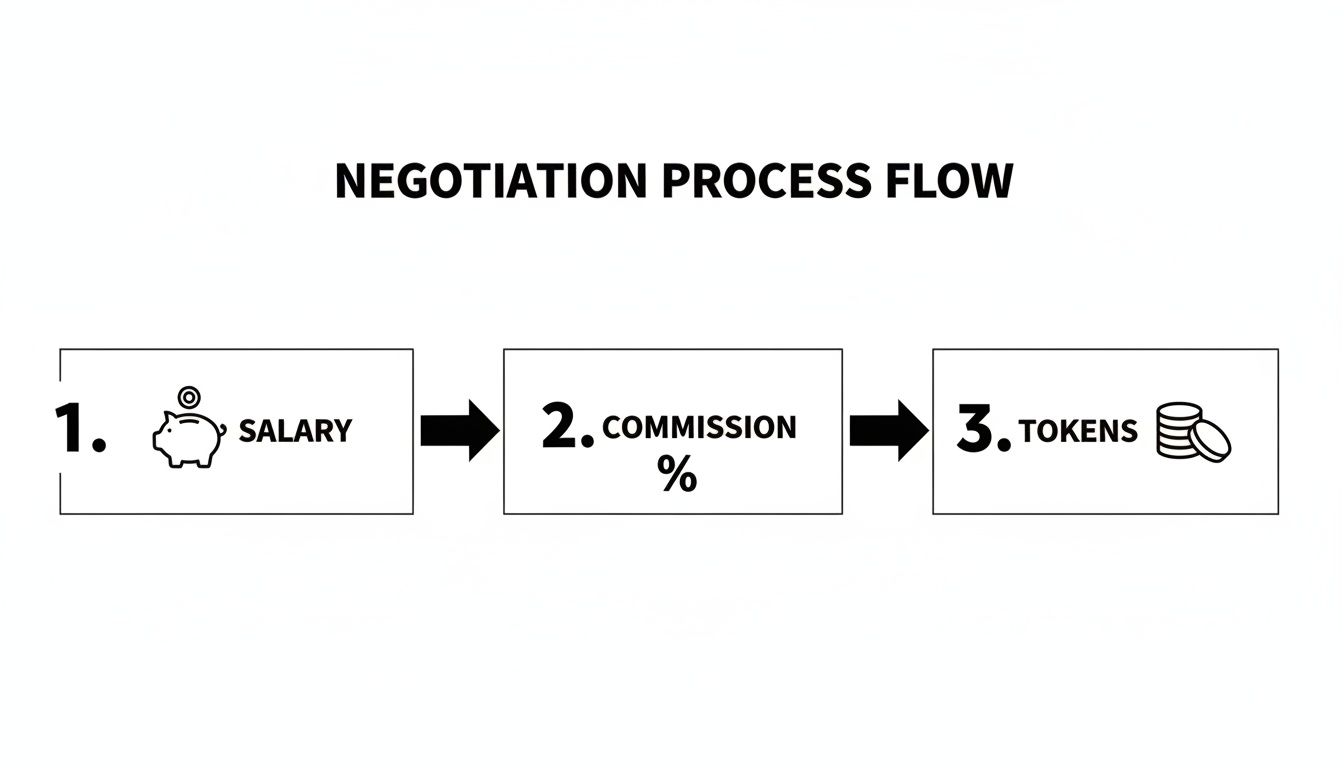
Understanding how salary, commission, and tokens interact is essential to securing the best possible package and aligning your incentives with the company's long-term success.
Leverage Direct Outreach and Events
Don't hesitate to go directly to the source. Identify five to ten projects that genuinely excite you and reach out to their head of sales or a founder on LinkedIn. A concise, personalized message explaining the specific value you could bring is far more effective than a generic application. Mentioning a recent product launch or partnership demonstrates that you’ve done your research.
Crypto conferences are also prime networking opportunities. The most valuable interactions often happen in the "hallway track"—the informal conversations between sessions. Arrive with a clear elevator pitch and a list of target companies. To get a head start on who's hiring, explore this curated list of top blockchain companies and startups.
Ready to find your next role in the decentralized world? Blockchain Jobs is the premier job board connecting top talent with leading Web3 companies. Start your search today.