
Your Guide to Cryptography Job opportunities: From Interview to Career Progression

The demand for professionals who truly understand cryptography is exploding, creating some seriously high-stakes, high-reward career opportunities. Think of a cryptographer as the master locksmith of our digital world. They're the ones designing and protecting the very systems that secure everything from our financial data to the entire Web3 ecosystem.
This guide isn't about abstract theory. It's a practical, actionable roadmap to landing a cryptography job, acing the interview, and building a long-term career in this dynamic field.
The Expanding World of Cryptography Careers

Cryptography careers are no longer confined to academic or government circles. Today, cryptography is a crucial pillar of the entire global economy. This shift is driven by the non-stop growth of digital services and the constant threat of cyberattacks.
Every time you buy something online, send a private message, or check your bank balance, you're relying on cryptographic principles. From a hiring perspective, this reliance translates directly into job demand. Companies in finance, healthcare, and big tech are all scrambling to find experts who can build, implement, and stress-test secure systems. A professional with a deep grasp of cryptographic protocols is one of the most valuable assets in the entire tech industry.
Why Demand Is Soaring
A few key trends are pouring fuel on this fire. The explosion of cloud computing and the Internet of Things (IoT) has dramatically increased the amount of data in transit and at rest, creating a massive playground for bad actors. Because of this, the need for rock-solid encryption has never been more urgent for hiring managers.
On top of that, new technologies are creating both new problems and new career opportunities:
- Blockchain and Web3: The entire decentralized world is built on a cryptographic foundation. This creates an urgent need for professionals who can secure smart contracts, design privacy-preserving protocols, and ensure the integrity of distributed ledgers.
- Quantum Computing: The looming threat of quantum computers breaking our current encryption standards has ignited a race to develop "post-quantum cryptography" (PQC). This has opened up a whole new frontier for researchers and engineers, creating highly specialized and lucrative career paths.
We’re seeing the demand for these specialized roles skyrocket, especially in the cybersecurity and blockchain sectors. Job titles like Cybersecurity Cryptanalyst—experts who analyze and try to break cryptographic systems to find weaknesses—are now highly sought after by governments, security firms, and major corporations. To understand how to position yourself for these roles, it's helpful to monitor crypto hiring market trends.
To give you a lay of the land, here’s a look at the major career tracks hiring managers are looking to fill.
Snapshot of Key Cryptography Career Paths
This table provides a high-level overview of the primary career tracks in cryptography, highlighting the industries they serve and the core focus of each role. Use this as a quick reference to map your skills to the right opportunities.
| Career Path | Primary Industry | Core Focus |
|---|---|---|
| Cryptographer/Researcher | Academia, Government, R&D | Designing new cryptographic algorithms and protocols |
| Cryptography Engineer | Tech, Finance, Web3 | Implementing and deploying cryptographic systems |
| Cryptanalyst | Cybersecurity, Intelligence | Analyzing and breaking codes to find vulnerabilities |
| Security Architect | All Industries | Designing secure systems using cryptographic principles |
| Blockchain Developer | Web3, FinTech | Building decentralized applications with crypto |
This table is just the starting point. Each of these paths has its own unique career ladder and skill requirements.
Your Roadmap to a Career in Cryptography
Navigating the different cryptography job opportunities means understanding the landscape from an employer's point of view. It’s not just about memorizing algorithms; it’s about knowing how to apply them to solve real-world security puzzles that businesses face.
Whether you aim to be an engineer building a secure messaging app, an analyst hunting for flaws in a system, or a researcher designing next-generation cryptographic standards, your work will be at the very heart of digital trust.
This guide is designed to be your career roadmap. We will provide actionable insights into the most promising roles, the skills that get you noticed in interviews, and the career progression you can expect in this exciting field.
If you’re especially drawn to the decentralized space, browsing a specialized job board like Blockchain Jobs can give you a focused look at what hiring managers are seeking. My goal is to equip you with the knowledge to pursue those kinds of roles with confidence.
The Most In-Demand Cryptography Roles You'll See Today

If you're targeting a cryptography career, the best place to start is with the actual jobs companies are hiring for. The field is huge, but a few key roles appear consistently. These aren't just titles; they're distinct career paths, each with its own set of skills to master and interview hurdles to clear.
Think of it like building a fortress. You need an architect to design the walls, engineers to lay the stone, and a specialized team whose only job is to try and break in to find the weak spots. In the world of digital security, these cryptography roles are just as specialized and absolutely essential.
Cryptographic Engineer: The Digital Builder
At its core, the Cryptographic Engineer is the builder. They're the ones who take complex cryptographic theory and turn it into real-world, functional code that keeps data safe. Their mission is to weave encryption and key management directly into the fabric of software, making security a fundamental feature, not an afterthought.
Hiring managers are looking for candidates with serious programming chops—usually in languages like C++, Rust, or Python—and a solid grasp of cryptographic libraries. Expect a technical interview to include coding challenges where you might have to implement a cryptographic primitive or secure an API endpoint from scratch. Success in these interviews demonstrates you can be trusted with production code.
A typical day involves anything from writing new encryption features to code-reviewing a colleague's work for security holes or debugging a performance bottleneck. To see what this looks like in the Web3 world, check out job descriptions like this Cryptographic Engineer position for Bitcoin and DeFi, which clearly outlines the practical skills they need.
Cryptanalyst: The Ethical Codebreaker
While the engineer builds, the Cryptanalyst tries to break. Think of this role as a highly focused ethical hacker who lives and breathes cryptographic systems. A cryptanalyst’s entire job is to poke, prod, and analyze encryption algorithms, hunting for vulnerabilities. They have to think like an attacker to find the flaws before the bad guys do.
This path requires a highly creative and analytical mind. You’re not just following a playbook; you’re looking for the gaps that everyone else missed. In an interview, you'll be tested on your ability to spot non-obvious flaws. Career-wise, successful cryptanalysts often advance into senior security research or leadership roles in penetration testing.
The real value of a Cryptanalyst is their ability to find that one critical vulnerability that could have led to a catastrophic breach. It’s a high-stakes hunt for the needle in the haystack that protects millions of users and entire companies.
Blockchain Security Architect: The Decentralized Designer
With the explosion of Web3, the Blockchain Security Architect has quickly become one of the most critical roles. These are the experts who design the security frameworks for everything from decentralized apps (dApps) to entire blockchain networks. They're the ones standing between a protocol and the next billion-dollar headline-making exploit.
To land this job, you need a unique blend of several deep skill sets:
- Cryptography Expertise: A rock-solid understanding of the primitives that secure transactions, wallets, and consensus.
- Smart Contract Knowledge: Knowing where the skeletons are buried in smart contract code and how to avoid common attack vectors.
- Systems Thinking: The ability to see the big picture and design an entire decentralized system to be resilient against everything from 51% attacks to oracle manipulation.
Post-Quantum Cryptography Researcher: The Future-Proofer
Way out on the cutting edge, you’ll find the Post-Quantum Cryptography (PQC) Researcher. Their job is to develop entirely new encryption methods that can stand up to the immense power of future quantum computers. While this work often happens in academic settings or corporate R&D labs, it’s becoming more mainstream every day.
These are the people preparing us for a complete paradigm shift in digital security. Major players like AWS and Google are already hiring PQC researchers to start migrating their massive infrastructures to quantum-resistant standards. A career here means you’re not just solving today’s problems—you’re building the security foundation for the next 50 years.
Building the Skills That Get You Hired
So, you're aiming for a career in cryptography? It's a fantastic goal, but breaking in requires a specific, powerful skillset that shows hiring managers you can deliver value from day one.
Hiring managers in this field are looking for a unique blend: someone who understands the deep mathematical theories but can also apply them in the real world to build secure, practical systems. Your resume, portfolio, and interview performance all need to tell this story clearly.
Think of it this way—you're building a bridge between abstract math and tangible security. To do that, you need a solid foundation, the right tools, and proof you can actually build something that stands up to pressure.
Start with the "Why": The Theoretical Foundation
Before you even write a line of code, you must grasp the principles that make cryptography work. This isn't just about passing an exam; it's about understanding why a particular algorithm is secure and, just as importantly, how it can be broken. Recruiters for serious crypto roles will absolutely test you on this during the interview.
This foundational knowledge is your bedrock:
- Number Theory and Abstract Algebra: This is the language of modern public-key cryptography. Concepts like prime factorization and discrete logarithms are the mechanics behind algorithms like RSA and Diffie-Hellman. You need to know them cold to pass a technical screen.
- Probability and Statistics: How do you measure the strength of a protocol? By analyzing the statistical likelihood of an attack succeeding. This is where probability comes in, and it's essential for security analysis.
- Discrete Mathematics: This is the logical scaffolding for both computer science and cryptography. It gives you the tools to analyze protocols and reason about security in a formal way.
Without this theoretical base, a developer is just plugging in a library without truly understanding the risks. That's a massive liability, and it's something every good hiring manager knows how to spot.
Build with the "How": Mastering the Technical Tools
Theory is critical, but it won't land you the job on its own. You have to prove you can translate those concepts into clean, efficient, and secure code. In cryptography, one tiny implementation mistake can bring an entire system crashing down. Technical excellence isn't just a "nice to have"; it's a non-negotiable requirement.
Your technical toolkit needs to be sharp and ready:
- Programming Languages: For high-performance crypto, you'll often see requirements for low-level languages like C++ or the increasingly popular Rust. A strong command of Python is also a huge asset for rapid prototyping, scripting, and security analysis.
- Cryptographic Libraries: You need real, hands-on experience with battle-tested libraries like OpenSSL, Bouncy Castle, or libsodium. Be prepared to discuss not just how to use them, but the trade-offs and common pitfalls of each.
- Blockchain-Specific Skills: If you're targeting Web3, understanding advanced concepts like zero-knowledge proofs is what will set you apart. Take a look at this Core ZK Engineer position to see just how central that expertise can be for top-tier roles.
Show, Don't Tell: Gaining Practical Security Experience
This is the final, crucial piece to getting hired. You need to prove you can apply all this knowledge to solve real-world security problems. This is what separates a theorist from a practitioner—and employers are hiring practitioners.
Your best friend in the job hunt is a strong portfolio. It's one thing to say you understand secure coding; it's another to show off contributions to an open-source security project or share detailed write-ups of your solutions to Capture The Flag (CTF) challenges. That kind of evidence is golden for a hiring manager.
This practical experience is built on skills in secure development practices, protocol analysis, and vulnerability hunting.
To give you a clearer picture, here’s a breakdown of the skills and certifications that consistently pop up in job descriptions.
Top Skills and Certifications for Cryptography Professionals
| Skill Category | Essential Skills and Knowledge | Top Certifications |
|---|---|---|
| Hard Skills | C++, Rust, Python, Go Applied mathematics (number theory, algebra) Knowledge of standard crypto libraries (OpenSSL) Protocol analysis and design Zero-Knowledge Proofs (for Web3 roles) Secure coding practices |
Offensive Security Certified Professional (OSCP) GIAC Defensible Security Architecture (GDSA) |
| Soft Skills | Problem-solving and analytical thinking Attention to detail (critical for implementation) Clear communication (explaining complex topics) Collaboration and teamwork |
Varies by role, but demonstrated through project work and interview performance. |
| Knowledge Base | Symmetric vs. Asymmetric Cryptography Hash functions, MACs, digital signatures Public Key Infrastructure (PKI) Common vulnerabilities (e.g., side-channel attacks) |
Certified Information Systems Security Professional (CISSP) EC-Council Certified Encryption Specialist (ECES) |
While a certification like the CISSP won't replace hands-on experience, it does signal a broad and serious commitment to the security field that employers definitely notice. In the end, it's the powerful combination of deep theory, sharp technical skill, and proven practical application that will open the door to the best cryptography jobs out there.
Cracking the Code of the Web3 and Blockchain Job Market
While traditional tech offers solid cryptography jobs, the Web3 and blockchain world is a different beast entirely. It's a rapidly expanding frontier where cryptography isn't just a security feature—it's the bedrock of entire digital economies. This has created a unique and incredibly lucrative market for security professionals.
Picture a popular DeFi protocol or a smart contract securing millions of dollars in assets. That’s not just software; it's a digital Fort Knox. Cryptographers and security specialists are the ones designing the vaults and forging the locks. The stakes couldn't be higher—one tiny vulnerability can lead to a financial catastrophe.
This high-stakes reality is exactly why Web3 companies are willing to pay top dollar for elite talent. They’re not just hiring coders; they're recruiting guardians to protect their entire ecosystem.
What Web3 Hiring Managers Actually Care About
To land a job in Web3, you need to bring more to the table than just textbook knowledge of cryptographic algorithms. Hiring managers in this space are on the hunt for people who get the unique challenges of decentralized systems. They want to see that you can think like an adversary.
In an interview, you'll get questions designed to see if you can spot the subtle logic flaws in a smart contract that an attacker would exploit. They’ll want to know how you’d build a system to withstand not just technical hacks, but also clever economic attacks like flash loan manipulation.
Your real value in the Web3 job market comes down to this: can you anticipate and shut down new threats in a world that changes by the day? It’s about proving you can protect a protocol from dangers that might not even be public knowledge yet. This is what you must demonstrate in your interviews.
This forward-thinking, almost paranoid, mindset is what sets a great candidate apart. Companies need people who are obsessive learners, active in the community, and always one step ahead of the latest attack vectors.
The Most In-Demand Security Roles
The Web3 ecosystem is huge, but a few security roles have become absolutely essential. These are often the best-paid and most sought-after jobs because they’re on the front lines, defending user funds and keeping protocols from collapsing.
If you’re looking to get into the space, focusing on these roles can put your career on the fast track:
- Smart Contract Auditor: This is one of the most critical jobs out there. Auditors do a deep, line-by-line dive into smart contract code to find holes before it goes live. A clean audit report is like a stamp of approval for any new project, making skilled auditors indispensable.
- DeFi Security Engineer: This job is about more than just auditing. A DeFi Security Engineer is embedded within a project, building secure systems from scratch, setting up monitoring tools, and jumping on incidents the moment they happen. They're the in-house expert keeping the protocol safe 24/7.
- Zero-Knowledge Proof (ZKP) Engineer: With privacy and scalability becoming huge priorities, ZKP specialists are gold. These engineers build incredibly complex cryptographic systems that enable private transactions and verifiable computations—a foundational technology for the next wave of blockchains.
The Money Behind the Movement
The buzz around this sector isn't just hype; the hiring and salary numbers back it up. We're seeing explosive growth in crypto-related jobs, fueled by wider blockchain adoption. According to the 2025 crypto employment market report, the Web3 industry alone is projected to pay out $94 billion in annual wages by 2025, which is a staggering compound annual growth rate of 66.2%.
This boom is pulling professionals from traditional finance into roles like DeFi Risk Analyst, while the demand for blockchain developers is expected to jump by 22% by 2025. You can dig deeper into these crypto hiring market trends to see what it all means for job seekers.
All this financial momentum translates directly into big paychecks and massive opportunities for anyone with the right crypto skills. The message is loud and clear: Web3 isn't just a niche anymore. It's a booming industry actively looking for its next generation of security leaders.
Mapping Your Salary and Career Progression
Let's talk about what a career in cryptography actually looks like on the ground, especially when it comes to your paycheck and your path forward. This field pays well and has a surprisingly clear ladder for ambitious professionals. Your career progression will take you from mastering fundamentals to eventually steering the entire security strategy of a major company.
Think of it as a journey. You begin as a junior engineer, learning the ropes on real-world problems. From there, you move up to a mid-level role where you're trusted with bigger challenges. Ultimately, you can become a senior architect or researcher—the person who designs the security systems everyone else builds on. Each step brings more responsibility and better compensation.
Entry-Level and Mid-Level Earning Potential
Right out of the gate, junior cryptographic engineers or security analysts can expect to earn in the $90,000 to $125,000 range, depending on location and company type. At this stage, your job is about implementation, fixing bugs, and learning from senior team members. The quickest way to advance is to prove you can write clean, secure, and efficient code.
After a few years of solid experience, you’ll be ready for a mid-level position, where salaries often jump into the $130,000 to $170,000 range. Now, you’re not just executing—you’re taking ownership of projects, helping design new systems, and mentoring juniors. Hiring managers for these roles want to see a portfolio of work and evidence that you understand protocol design and threat modeling.
Reaching the Senior and Principal Tiers
This is where your expertise truly pays off. Senior and Principal Cryptographers, Security Architects, and Researchers regularly command salaries well over $200,000, with top specialists breaking $250,000. These are the leaders of massive projects, setting the technical vision for the team and tackling tough problems like the shift to post-quantum cryptography.
The demand for this talent is exploding. The 2025 crypto employment market report shows job openings shot up by a staggering 47% between 2024 and 2025 alone. It's a seller's market, with top-tier blockchain developers and security experts pulling in salaries north of $200,000. The big players—cryptocurrency exchanges, blockchain infrastructure firms, and DeFi protocols—are where 70% of these jobs are concentrated.
The diagram below gives you a feel for just how specialized and critical these roles have become, especially in the booming Web3 ecosystem.
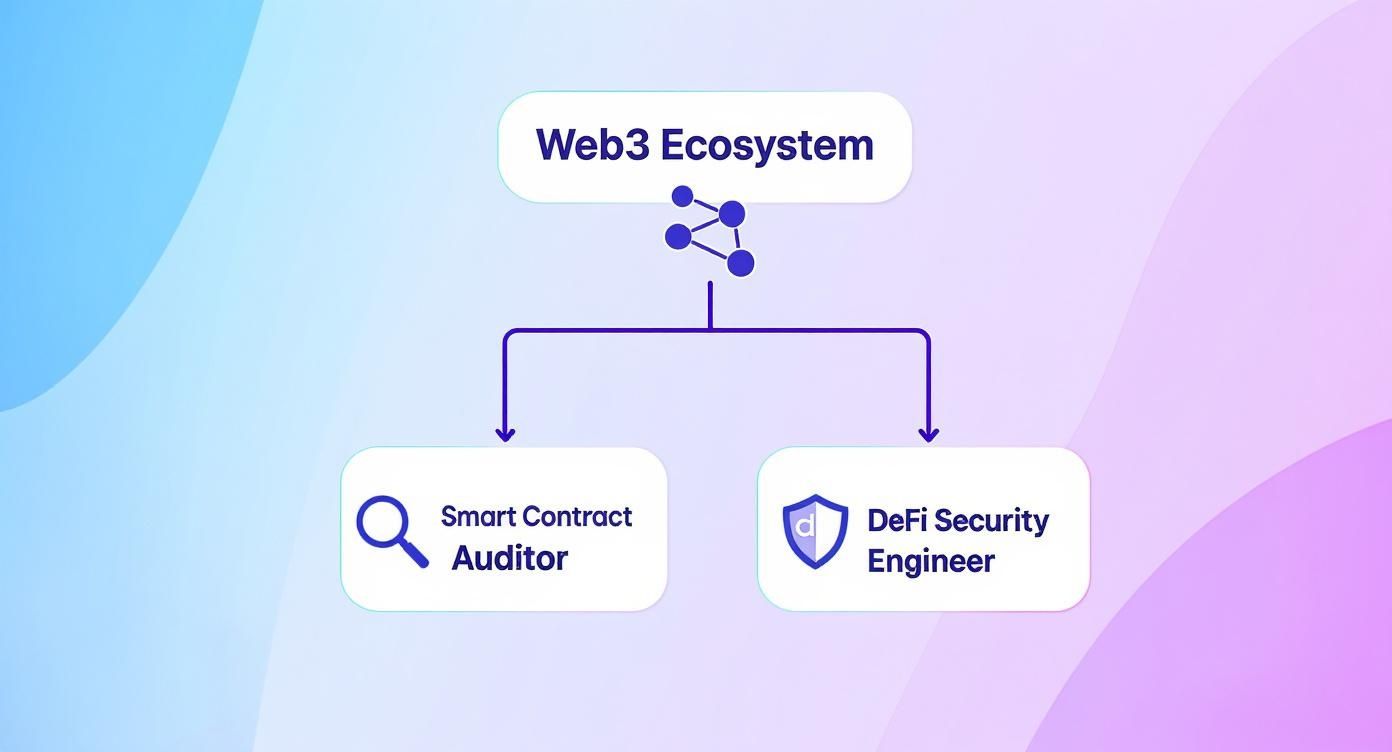
As you can see, roles like a Smart Contract Auditor or a DeFi Security Engineer are the bedrock of the Web3 world. They're the ones directly responsible for keeping billions of dollars in digital assets safe.
Key Factors Influencing Your Salary
So, what determines your earning potential and career velocity? A few key things can really move the needle. If you understand them, you can be much more strategic about the opportunities you pursue.
The single biggest lever on your compensation is specialization. Becoming a recognized expert in a niche but critical area—like zero-knowledge proofs or formal verification—makes you an indispensable asset that companies will compete for.
Here are the main things that will shape your paycheck and career progression:
- Specialization: Deep expertise in a hot field like Post-Quantum Cryptography (PQC), Zero-Knowledge Proofs (ZKPs), or Multi-Party Computation (MPC) commands a significant salary premium.
- Industry: Web3 and FinTech companies often pay more than traditional tech or government roles due to the high stakes involved.
- Location vs. Remote: While classic tech hubs still pay top dollar, remote work has changed the game. Top talent can now command premium pay regardless of location.
- Demonstrated Impact: Nothing speaks louder than a solid portfolio. Contributions to open-source security projects on GitHub, published research, or successful bug bounty finds are concrete proof of your skills. This is your best leverage during salary negotiations and performance reviews.
How to Ace Your Cryptography Job Interview

Getting past the resume screen is just the first step. The cryptography interview is where you truly prove your mettle. Hiring managers aren't just looking for someone who can recite definitions; they want to see how you think on your feet and tackle real-world security puzzles when the pressure is on.
Forget generic interview tips. You need to prepare for a serious technical grilling. This isn't about "gotcha" questions. It's about confirming you have the methodical, security-first mindset that's absolutely essential for any role in this field.
Preparing for the Technical Deep Dive
Let's be clear: cryptography interviews are intense. You’ll need to demonstrate a rock-solid grasp of the fundamental concepts. Simply knowing algorithm names like AES or RSA won't be nearly enough. You have to understand how they work, their strengths, and, more importantly, their weaknesses and common implementation pitfalls.
You can bet on questions that dig deep into your core knowledge. An interviewer might ask you to describe a Diffie-Hellman key exchange from scratch or explain the practical differences between a stream cipher and a block cipher. Be ready to talk about the trade-offs between symmetric and asymmetric encryption for a specific application.
Expect to face a few different kinds of technical challenges:
- Whiteboard Sessions: You might be asked to design a secure protocol on the fly. This tests your ability to think through threat models, spot potential weak points, and justify your design choices.
- Coding Challenges: These tests gauge your implementation skills. You could be asked to write code for a cryptographic primitive or, more likely, find and fix a vulnerability in a block of existing code.
- Theoretical Probing: Expect sharp, direct questions designed to make sure you truly understand the security guarantees of the cryptographic tools you claim to know.
A classic interview question is, "What are the security assumptions behind RSA?" A great answer goes beyond just mentioning the difficulty of integer factorization. It shows you understand why the algorithm is secure and the real-world conditions under which it can fail. That’s what interviewers are looking for.
Showcasing Your Practical Skills with a Portfolio
While the technical Q&A tests what you know, your portfolio proves what you can actually do. For many hiring managers, a strong portfolio is the single most compelling piece of evidence of your skills and passion. It's your opportunity to demonstrate your capabilities before you even walk in the door.
A well-crafted portfolio isn't just a nice-to-have; it's a powerful tool that demonstrates initiative and real-world command of your knowledge.
What to Include in Your Portfolio to Impress Hiring Managers:
- GitHub Projects: This is an absolute must. Your GitHub profile should showcase personal projects where you've implemented cryptographic protocols, built a secure app, or contributed to a security library. Clean, well-documented code is critical.
- Open-Source Contributions: Contributing to established open-source security projects like OpenSSL or a major blockchain protocol is a huge plus. It shows employers you can collaborate effectively and write code that meets high standards.
- Capture The Flag (CTF) Write-ups: CTF competitions are a fantastic way to sharpen your problem-solving abilities. Publishing detailed write-ups that explain how you cracked tough crypto challenges is a powerful way to demonstrate your thought process.
Ultimately, crushing your interview comes down to solid preparation and tangible proof of your skills. If you master the fundamentals and build a portfolio that showcases your practical abilities, you'll be able to confidently navigate the interview process and land one of the many exciting cryptography job opportunities out there.
Your Questions Answered: Breaking into a Cryptography Career
Thinking about a career in cryptography? You probably have a lot of questions. Let's tackle some of the most common ones from people trying to break into the field and get hired.
Do I Really Need a PhD to Be a Cryptographer?
This is a huge misconception. While a PhD is the standard path for deep research roles—like inventing new algorithms at a university or a corporate R&D lab—it's not required for the vast majority of cryptography jobs.
For roles like Cryptographic Engineer, Security Analyst, or Smart Contract Auditor, hiring managers are far more interested in what you can do. They want to see practical, hands-on skills.
What really gets you noticed is:
- Solid programming chops in languages like Rust, C++, or Python.
- Real-world experience implementing cryptographic protocols correctly.
- A strong GitHub portfolio showcasing your projects or contributions to open-source security tools.
A bachelor's or master's in computer science or math gives you a great starting point, but your demonstrated ability to build secure systems is what will ultimately get you hired.
In fast-moving industries like Web3, a strong portfolio of practical work will almost always beat a purely academic resume for most engineering roles.
Where Are The Best Cryptography Job Opportunities?
Cryptography is no longer a niche pursuit. It's the backbone of security in several massive industries, each with unique hiring needs.
The biggest demand is concentrated in a few key areas:
- Web3 and Blockchain: This is the red-hot center of the market. Companies are scrambling for experts who can secure protocols, audit smart contracts, and build next-gen privacy tech like zero-knowledge proofs.
- Cybersecurity Firms: These are the classic employers. They hire cryptanalysts and security engineers for penetration testing, vulnerability research, and building security products.
- Big Tech and Finance: Giants in tech and banking need cryptographers to protect user data, secure financial transactions, and engineer trusted computing environments.
Can I Find a Remote Job in Cryptography?
Yes, absolutely. The demand for skilled cryptography professionals far outstrips the talent pool in any single city. Because of this, a huge number of cryptography job opportunities are fully remote.
This is especially true in the Web3 and cybersecurity spaces, which were built on the idea of globally distributed teams from the start. This allows companies to hire the best person for the job, regardless of their location. To thrive in that environment, you need to be a self-motivated professional with strong communication skills who can work effectively in a distributed team.
Ready to jump in? Blockchain Jobs is the top spot for finding your next role in Web3, DeFi, and the decentralized world. Start exploring curated cryptography jobs and get in front of leading companies today at https://blockchain-jobs.com.